

The DOI matches its Crossref record; 82 of the 82 references it cites were found in a registry or an index; 16 of the 32 sources its claims cite were checked for support.
Examining the effectiveness and acceptability of a group-based ACT intervention delivered by videoconference to international university students during the COVID-19 pandemic.
Open accessAbstract
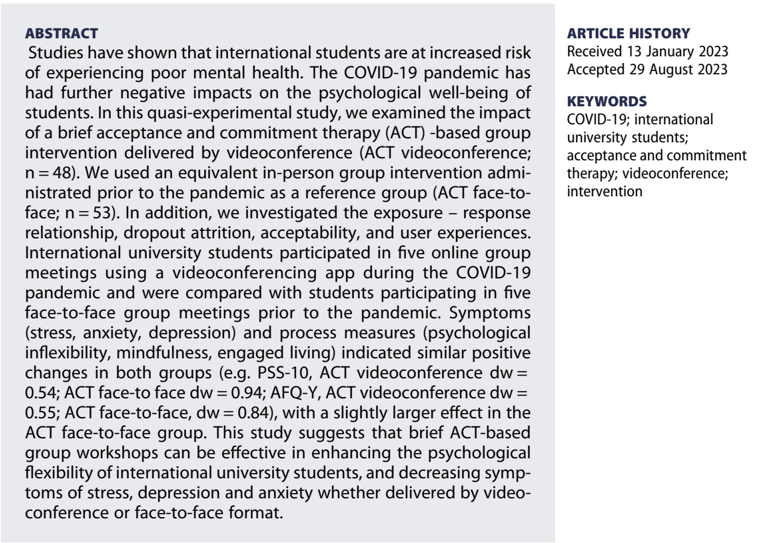
Studies have shown that international students are at increased risk of experiencing poor mental health. The COVID-19 pandemic has had further negative impacts on the psychological well-being of students. In this quasi-experimental study, we examined the impact of a brief acceptance and commitment therapy (ACT) -based group intervention delivered by videoconference (ACT videoconference; n = 48). We used an equivalent in-person group intervention administrated prior to the pandemic as a reference group (ACT face-to-face; n = 53). In addition, we investigated the exposure – response relationship, dropout attrition, acceptability, and user experiences. International university students participated in five online group meetings using a videoconferencing app during the COVID-19 pandemic and were compared with students participating in five face-to-face group meetings prior to the pandemic. Symptoms (stress, anxiety, depression) and process measures (psychological inflexibility, mindfulness, engaged living) indicated similar positive changes in both groups (e.g. PSS-10, ACT videoconference dw = 0.54; ACT face-to face dw = 0.94; AFQ-Y, ACT videoconference dw = 0.55; ACT face-to-face, dw = 0.84), with a slightly larger effect in the ACT face-to-face group. This study suggests that brief ACT-based group workshops can be effective in enhancing the psychological flexibility of international university students, and decreasing symptoms of stress, depression and anxiety whether delivered by videoconference or face-to-face format.
Overview
CoChat Summary
TL;DR
This study examined a 5-week ACT group workshop delivered by Zoom to international university students during COVID-19, using a pre-post comparison with a prior face-to-face ACT workshop as the reference group. The videoconference format produced beneficial changes in stress and psychological flexibility, with outcomes broadly comparable to the face-to-face format, though face-to-face participants reported slightly higher satisfaction.
Key findings
- In the videoconference group, stress decreased and psychological flexibility improved from pre- to post-intervention; the paper reports within-group effect sizes of d = 0.54 for stress, 0.55 for psychological inflexibility, 0.45 for total mindfulness, 0.51 for nonjudging, and 0.52 for life fulfillment.
- In the face-to-face reference group, the corresponding within-group effects were also beneficial and generally larger: d = 0.94 for stress, 0.84 for psychological inflexibility, 0.57 for total mindfulness, 0.63 for nonjudging, and 0.64 for life fulfillment.
- The study reports no significant interaction effects between delivery format and change over time; between-group effect sizes were described as very small to small (d = 0.05 to 0.36) in favor of face-to-face delivery.
- Overall satisfaction was higher for face-to-face delivery (M = 8.57, SD = 1.30, n = 47) than videoconference (M = 7.88, SD = 1.76, n = 43; t(88) = 2.130, p = 0.039), but recommendation rates were similar (86% videoconference vs 83% face-to-face).
Methods
- Design: non-randomized comparison of two ACT group interventions, one delivered by Zoom during the COVID-19 pandemic and one face-to-face delivered before the pandemic; the paper explicitly states participants were not randomly divided into conditions.
- Sample/data: 101 international university students completed pre-measurement and were analyzed (48 videoconference, 53 face-to-face); the sample was 79% female, mean age 25.95 years, and represented 40 nationalities.
- Analysis: baseline group differences were tested with t-tests and chi-square tests; change from pre to post was analyzed with latent change score models and Wald tests, with effect sizes reported as Cohen’s d and missing data handled under a missing-at-random assumption.
Limitations
- The paper states there was no randomized control group and the sample size was small, limiting generalizability and preventing firm causal conclusions.
- The sample was mostly female (around 80%), which the paper says limits generalizability.
- The paper states that the lack of a control group means threats to internal validity such as history, maturation, and regression to the mean cannot be ruled out; it also could not separate the effect of the intervention from the effect of group involvement.
- Evident from the text: the videoconference and face-to-face conditions differed not only by delivery mode but also by pandemic context and related protocol adjustments, so the comparison is confounded by time/context as well as format.
Model-written summary. Check it against the paper before relying on it.
Integrity signals
Registry
Cites
Statistics
Figures




Verification
Claims the paper makes
13 Valid · 1 Not valid · 10 Not checked · 63 Own results and interpretations
The cited sources support only part of this claim — read each source’s verdict below.
In the paper
“Preventive measures, such as closing campuses and transi tions to online teaching, have adversely affected students' mental health, particularly that of international students (Lai et al., 2020).”
What the sources say
- Partly supportedcites Lai et al., 2020 sourceExperimental — accuracy not yet measured
The Introduction (page not provided) identifies campus closures and online teaching as disruptions that can adversely affect students’ mental health, but says their effects were unclear. The Discussion (page not provided) links changes in teaching format with higher stress and anxiety or depression symptoms among the international students studied. These passages support the concern, but not the claim that the preventive measures have definitively caused those effects. (LLM, conf=0.86)
plainstates a cause- Asserted: passes — The authors put it forward as true.
- Checkable: passes — It can be checked against evidence.
- Load-bearing: passes — The paper’s conclusions depend on it.
- Based: passes — The paper gives a reason why it holds.
- Partly supported
Every source the paper cites for this claim was checked and supports it.
In the paper
“and international students even more so due to their temporary status in their host countries and disruptions to their daily life”
What the sources say
- Supportedcites Gomes & Forbes-Mewett, 2021 source
The paper’s Abstract says international students struggled to cope during the pandemic primarily because of their temporary status in host countries, and describes job loss and difficulty paying rent or buying food. It also describes pandemic disruptions to everyday life. (LLM, conf=0.91)
plainstates a cause- Asserted: passes — The authors put it forward as true.
- Checkable: passes — It can be checked against evidence.
- Load-bearing: passes — The paper’s conclusions depend on it.
- Based: passes — The paper gives a reason why it holds.
- Supported
A result the paper reports from its own data — it cites no other source for it, so there is none to check. The quote shows it is in the paper.
In the paper
“The pre-post change in psychological inflexibility (AFQ-Y) when completing 3 to 4 sessions ( M = 6.74, SD = 9.82) was significantly smaller ( t = -2.083, df = 45, p = 0.043) compared to when completing 5 sessions ( M = 11.92, SD = 7.06).”
plainstates an associationn = 23 ·- Asserted: passes — The authors put it forward as true.
- Checkable: passes — It can be checked against evidence.
- Load-bearing: unclear — It is unclear whether the paper’s conclusions depend on it.
- Based: passes — The paper gives a reason why it holds.
A result the paper reports from its own data — it cites no other source for it, so there is none to check. The quote shows it is in the paper.
In the paper
“Thus, there were no statistical differences between the groups in the number of sessions attended (video conference, M = 4.28, SD = 0.67; face-to-face, M = 4.34, SD = 0.76).”
plain- Asserted: passes — The authors put it forward as true.
- Checkable: passes — It can be checked against evidence.
- Load-bearing: unclear — It is unclear whether the paper’s conclusions depend on it.
- Based: passes — The paper gives a reason why it holds.
A result the paper reports from its own data — it cites no other source for it, so there is none to check. The quote shows it is in the paper.
In the paper
“The betweengroup ESs were either very small ( d = 0.05 to 0.19) or small ( d = 0.20 to 0.36) in favor for the face-to-face intervention.”
plain- Asserted: passes — The authors put it forward as true.
- Checkable: passes — It can be checked against evidence.
- Load-bearing: passes — The paper’s conclusions depend on it.
- Based: passes — The paper gives a reason why it holds.
33 more claims
Create a free account to see all 87 claims and every source verdict.
- Probably not a substantial claim. 29
- It may state two separate claims as one. 28
Statistics that don’t add up
Each reported p-value recomputed from its test statistic and degrees of freedom.
Rated minor: it would not touch a result — a value no result rests on, a p-value that stays on the same side of the significance level, or a conflict that is clerical, resolved elsewhere in the paper, or outside its own findings.
In the paper
“t (88) = 2.130, p = 0.039”
Reported p = .039 · recomputed p = .036
Statistics recomputed
Every reported test result, recomputed from its test statistic and degrees of freedom. A result shows as not adding up only once an independent check has confirmed it.
- Doesn’t add upt(88) = 2.13reported p = .039 · recomputed p = .036
“t (88) = 2.130, p = .039”
- ConsistentF(5, 84) = 0.98reported p = .435 · recomputed p = .435
“F(5,84) = 0.980, p = .435”
- ConsistentF(5, 84) = 1.448reported p = .216 · recomputed p = .216
“F(5,84) = 1.448, p = .216”
- ConsistentF(5, 84) = 0.334reported p = .891 · recomputed p = .891
“F(5,84) = 0.334, p = .891”
Self-check
Percentages, sums and reported differences re-computed from the paper’s own numbers.
Rated major: it would touch a result — a value a result rests on, reported and recomputed p-values on opposite sides of the significance level, two passages that conflict with no sign which is right, or a cited work retracted before this paper was published.
In the paper
“| ACT face-to-face | 37.87 (8.72) | 4.97 (6.92) | 0.153 | 0.22 | 0.39 | 0.01; 0.78* |”
Reported 0.153 · recomputed 32.9
Citations
Cites
The PHQ-9: Validity of a brief depression severity measure
Kroenke, K., Spitzer, R. L., & Williams, J. B. W. (2001) · Journal of General Internal Medicine · doi:10.1046/j.1525-1497.2001.016009606.x · Cited by 44,910 · cited 2×
“The validity and reliability of the PHQ-9 have been found to be good in previous studies, including student samples (Kroenke, Spitzer, & Williams, 2001; Tavakoli, Broyles, Reid, Sandoval, & Correa-Fernández, 2019).”
A Global Measure of Perceived Stress
Cohen, S., Kamarck, T., & Mermelstein, R. (1983) · Journal of Health and Social Behavior · doi:10.2307/2136404 · Cited by 32,807 · cited 1×
“The Perceived Stress Scale (PSS-10) was used to measure symptoms of stress (Cohen & Williamson, 1988; Cohen, Kamarck, & Mermelstein, 1983).”
A Brief Measure for Assessing Generalized Anxiety Disorder: The GAD-7
Spitzer, R. L., Kroenke, K., Williams, J. B. W., & Löwe, B. (2006) · Archives of Internal Medicine · doi:10.1001/archinte.166.10.1092 · Cited by 31,765 · cited 2×
“The Generalized Anxiety Disorder Assessment (GAD-7) is a self-administered questionnaire that evaluates the level of generalized anxiety (Spitzer, Kroenke, Williams, & Löwe, 2006).”
Lakens, D. (2013) · Frontiers in Psychology · doi:10.3389/fpsyg.2013.00863 · Cited by 10,303 · cited 1×
“When calculating Cohen’s d for the within-subjects ESs , we used the average standard deviation of both repeated measures as a standardizer, as recommended by Lakens (2013).”
Using Self-Report Assessment Methods to Explore Facets of Mindfulness
Baer, R. A., Smith, G. T., Hopkins, J., Krietemeyer, J., & Toney, L. (2006) · Assessment · doi:10.1177/1073191105283504 · Cited by 7,511 · cited 2×
“The FFMQ has an adequate internal consistency (Baer et al., 2008) and is a valid measure of mindfulness among university students (Baer, Smith, Hopkins, Krietemeyer, & Toney, 2006; Carmody, Baer, Lykins, & Olendzki, 2009).”
Online Learning: A Panacea in the Time of COVID-19 Crisis
Dhawan, S. (2020) · Journal of Educational Technology Systems · doi:10.1177/0047239520934018 · Cited by 5,083 · cited 1×
“The COVID-19 pandemic challenged the education system across the world and forced schools, colleges, and universities to discontinue in-person teaching and shift to online teaching (Dhawan, 2020).”
Baer, R. A., Smith, G. T., Lykins, E., Button, D., Krietemeyer, J., Sauer, S., Walsh, E., Duggan, D., & Williams, J. M. G. (2008) · Assessment · doi:10.1177/1073191107313003 · Cited by 2,930 · cited 1×
“The FFMQ has an adequate internal consistency (Baer et al., 2008) and is a valid measure of mindfulness among university students (Baer, Smith, Hopkins, Krietemeyer, & Toney, 2006; Carmody, Baer, Lykins, & Olendzki, 2009).”
Pierce, M., Hope, H., Ford, T., Hatch, S., Hotopf, M., John, A., Kontopantelis, E., Webb, R., Wessely, S., McManus, S., et al. (2020) · The Lancet Psychiatry · doi:10.1016/s2215-0366(20)30308-4 · Cited by 2,621 · cited 1×
“Indeed, research has demonstrated a strong positive association between COVID-19-related hardship and distress (Pierce et al., 2020).”
Review of the Psychometric Evidence of the Perceived Stress Scale
Lee, E.-H. (2012) · Asian Nursing Research · doi:10.1016/j.anr.2012.08.004 · Cited by 2,305 · cited 1×
“The PSS has been used in student populations (Tavakoli, Broyles, Reid, Sandoval, & Correa-Fernández, 2019), with an internal consistency ranging from .74 to .91 (Lee, 2012).”
Psychological interventions for people affected by the COVID-19 epidemic
Duan, L., & Zhu, G. (2020) · The Lancet Psychiatry · doi:10.1016/s2215-0366(20)30073-0 · Cited by 1,885 · cited 1×
“In addition, the use of technology became the only way to offer psychological services (Duan & Zhu, 2020; Jiang et al., 2020; Li et al., 2020; McGuire, 2020; Zhou et al., 2020).”
Research works printed but not linked: 5
- Cohen, S., & Williamson, G. (1988). Perceived stress in a probability sample of the US. In S. Spacapam & S. Oskamp (Eds.), The social psychology of health: The claremont symposium on applied social psychology. Newbury Park, California: Sage Publications.
- 10.3390/ijerph18189897/s1 · doi:10.3390/ijerph18189897/s1
- Muthén, L. K. (1998). Mplus user’s guide. Los Angeles, CA: Muthén & Muthén.
- Pistorello, J. (Ed.). (2013). Mindfulness and acceptance for counseling college students: Theory and practical applications for intervention, prevention, and outreach. Oakland, CA: New Harbinger Publications.
- Strosahl, K. D., Robinson, P. J., & Gustavsson, T. (2012). Brief interventions for radical change: Principles and practice of focused acceptance and commitment therapy. Oakland, CA: New Harbinger Publications.
Cited by
Assessment of stress and health conditions among students in the context of the war in Ukraine
Potop, V., Vypasniak, I., Ivanyshyn, I., Lutskyi, V., Kryventsova, I., Shesterova, L., & Prusik, K. (2024) · Physical Culture Recreation and Rehabilitation · doi:10.15561/physcult.2024.0203 · Cited by 14
“Short-term group workshops based on Acceptance and Commitment Therapy (ACT) have proven effective in reducing symptoms of stress, depression, and anxiety among students [19, 20].”
Pranata, G. K. A. W., Koa, A. J. A. F., & Chang, Y. (2024) · Nursing and Health Sciences · doi:10.1111/nhs.70003 · Cited by 4
Cheng, S., & Xiong, Y. (2026) · International Journal of Intercultural Relations · doi:10.1016/j.ijintrel.2026.102377 · Cited by 1
Dat, N. B., Minh, N. T. H., Thuong, N. X., & Hoang, N. K. (2026) · Counselling Psychology Quarterly · doi:10.1080/09515070.2026.2666075 · Cited by 1
Mental health and well-being in higher education: A review of international students living abroad
Aziz, A. L., Talib, C. A., Hakim, A. R., & Rimadani, R. (2026) · Social Sciences & Humanities Open · doi:10.1016/j.ssaho.2026.103120
Metadata
- Authors
- Brandolin, F., Lappalainen, P., Gorinelli, S., Muotka, J., & Lappalainen, R.
- Affiliations
- University of Jyväskylä (FI)
- Corresponding author
- Brandolin, Francesca
- Venue
- Counselling Psychology Quarterly
- Publisher
- Informa UK Limited
- Published
- 2023-09-10
- Volume
- 37
- Issue
- 4
- Pages
- 517-541
- ISSN
- 0951-5070 (ISSN-L)
- 1469-3674
- OpenAlex
- W4386587623
- Cited by
- 5
- References
- 81
- Citations by year
- 2026: 3 · 2024: 2
- FWCI
- 1.46
- Type
- journal article
- Language
- en
- Open access
- hybrid
- doi.org
- Licence
- Locations
- Counselling Psychology Quarterly (publishedVersion, cc-by)
- Jyväskylä University Digital Archive (University of Jyväskylä) (submittedVersion, cc-by)
- Topics
- Social Sciences › Psychology › Clinical Psychology › Mindfulness and Compassion Interventions
- Social Sciences › Psychology › Clinical Psychology › COVID-19 and Mental Health
- Social Sciences › Psychology › Applied Psychology › Digital Mental Health Interventions
- Keywords
- ACT intervention, group intervention, videoconferencing, international university students, COVID-19 pandemic, intervention effectiveness, acceptability, student mental health
About these checks
Registry, retraction, Cites and statistics results are computed, not judged, with one exception: a printed reference that no index lists is read once by a model before it counts as a citation error. Claims are extracted by a model and kept only when their quote appears verbatim in the text; each cited source is then checked, with a model’s help, for whether it says what the claim relies on. Those verdicts can be wrong — read the claim’s quote and the cited source before relying on one.
The claim verdicts this report counts are experimental: their accuracy is not yet measured.
A language model drew the claims from the paper on 2026-10-11, under version 3 of the claim definition (model deepseek-v4.1-flash, prompt extract-v3).
A second model labelled each claim on 2026-10-11 (model jev-1.13-20260917, definition revision gold-guideline-v0.2).
Cited sources are checked with a language model’s help (gpt-6-sol).
Statistics and arithmetic are recomputed, not judged.
Confidence bands are shown only for fields calibrated on our annotated test set. None is calibrated yet, so no band is shown.
What counts as a claim ›How we measure confidence ›How we check this ›
Are you an author, or do you see a problem with this page? Request a review
How to cite
Cite CoChat for the checks on this page, and the paper for its own findings.
- This page
- CoChat. (2026). Citation check: Examining the effectiveness and acceptability of a group-based ACT intervention delivered by videoconference to international university students during the COVID-19 pandemic. https://app.cochat.ai/papers/10.1080/09515070.2023.2254726
- The paper
- Brandolin, F., Lappalainen, P., Gorinelli, S., Muotka, J., & Lappalainen, R. (2024). Examining the effectiveness and acceptability of a group-based ACT intervention delivered by videoconference to international university students during the COVID-19 pandemic. Counselling Psychology Quarterly. https://doi.org/10.1080/09515070.2023.2254726
Data sources
Bibliographic data: Semantic Scholar, OpenAlex, Crossref.
Contains information from the Semantic Scholar Academic Graph Datasets, made available under the ODC Attribution License (ODC-BY 1.0).
Semantic Scholar’s data is described in: Kinney, R., et al. (2023). The Semantic Scholar Open Data Platform. arXiv:2301.10140.
