

Examining the effectiveness and acceptability of a group-based ACT intervention delivered by videoconference to international university students during the COVID-19 pandemic.
Open accessThe DOI matches its Crossref record; 82 of the 83 references it cites were found in a registry or an index; 16 of the 32 sources its claims cite were checked for support.
Abstract
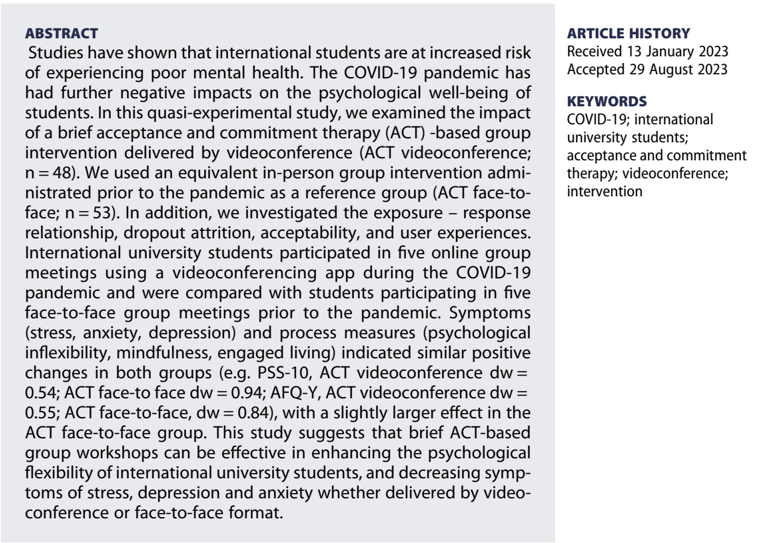
Studies have shown that international students are at increased risk of experiencing poor mental health. The COVID-19 pandemic has had further negative impacts on the psychological well-being of students. In this quasi-experimental study, we examined the impact of a brief acceptance and commitment therapy (ACT) -based group intervention delivered by videoconference (ACT videoconference; n = 48). We used an equivalent in-person group intervention administrated prior to the pandemic as a reference group (ACT face-to-face; n = 53). In addition, we investigated the exposure – response relationship, dropout attrition, acceptability, and user experiences. International university students participated in five online group meetings using a videoconferencing app during the COVID-19 pandemic and were compared with students participating in five face-to-face group meetings prior to the pandemic. Symptoms (stress, anxiety, depression) and process measures (psychological inflexibility, mindfulness, engaged living) indicated similar positive changes in both groups (e.g. PSS-10, ACT videoconference dw = 0.54; ACT face-to face dw = 0.94; AFQ-Y, ACT videoconference dw = 0.55; ACT face-to-face, dw = 0.84), with a slightly larger effect in the ACT face-to-face group. This study suggests that brief ACT-based group workshops can be effective in enhancing the psychological flexibility of international university students, and decreasing symptoms of stress, depression and anxiety whether delivered by videoconference or face-to-face format.
Overview
CoChat Summary
TL;DR
This study examined a 5-week ACT group workshop delivered by Zoom to international university students during COVID-19, using a pre-post comparison with a prior face-to-face ACT workshop as the reference group. The videoconference format produced beneficial changes in stress and psychological flexibility, with outcomes broadly comparable to the face-to-face format, though face-to-face participants reported slightly higher satisfaction.
Key findings
- In the videoconference group, stress decreased and psychological flexibility improved from pre- to post-intervention; the paper reports within-group effect sizes of d = 0.54 for stress, 0.55 for psychological inflexibility, 0.45 for total mindfulness, 0.51 for nonjudging, and 0.52 for life fulfillment.
- In the face-to-face reference group, the corresponding within-group effects were also beneficial and generally larger: d = 0.94 for stress, 0.84 for psychological inflexibility, 0.57 for total mindfulness, 0.63 for nonjudging, and 0.64 for life fulfillment.
- The study reports no significant interaction effects between delivery format and change over time; between-group effect sizes were described as very small to small (d = 0.05 to 0.36) in favor of face-to-face delivery.
- Overall satisfaction was higher for face-to-face delivery (M = 8.57, SD = 1.30, n = 47) than videoconference (M = 7.88, SD = 1.76, n = 43; t(88) = 2.130, p = 0.039), but recommendation rates were similar (86% videoconference vs 83% face-to-face).
Methods
- Design: non-randomized comparison of two ACT group interventions, one delivered by Zoom during the COVID-19 pandemic and one face-to-face delivered before the pandemic; the paper explicitly states participants were not randomly divided into conditions.
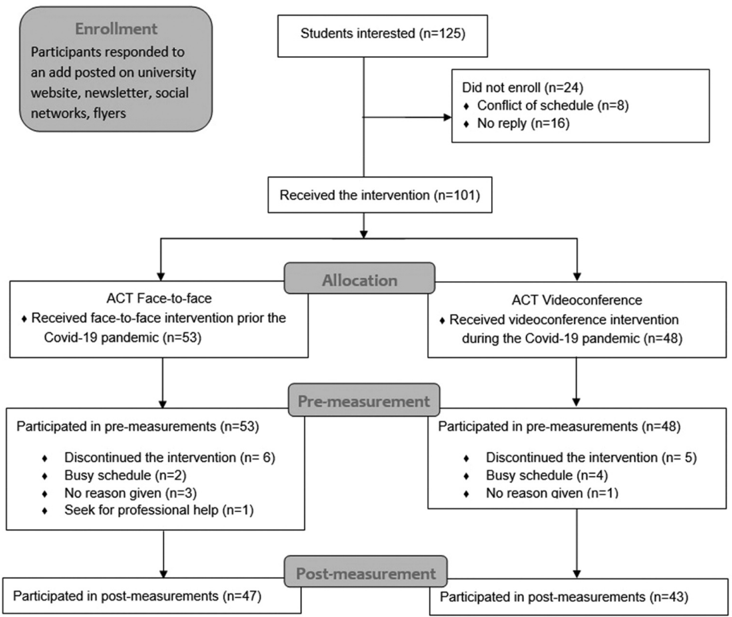
- Sample/data: 101 international university students completed pre-measurement and were analyzed (48 videoconference, 53 face-to-face); the sample was 79% female, mean age 25.95 years, and represented 40 nationalities.
- Analysis: baseline group differences were tested with t-tests and chi-square tests; change from pre to post was analyzed with latent change score models and Wald tests, with effect sizes reported as Cohen’s d and missing data handled under a missing-at-random assumption.
Limitations
- The paper states there was no randomized control group and the sample size was small, limiting generalizability and preventing firm causal conclusions.
- The sample was mostly female (around 80%), which the paper says limits generalizability.
- The paper states that the lack of a control group means threats to internal validity such as history, maturation, and regression to the mean cannot be ruled out; it also could not separate the effect of the intervention from the effect of group involvement.
- Evident from the text: the videoconference and face-to-face conditions differed not only by delivery mode but also by pandemic context and related protocol adjustments, so the comparison is confounded by time/context as well as format.
Model-written summary. Check it against the paper before relying on it.
Integrity signals
Registry
Cites
Statistics
Figures

Verification
Claims the paper makes
13 Valid · 1 Not valid · 10 Not checked · 63 Own results and interpretations
The cited sources support only part of this claim — read each source’s verdict below.
In the paper
“Preventive measures, such as closing campuses and transi tions to online teaching, have adversely affected students' mental health, particularly that of international students (Lai et al., 2020).”
What the sources say
- Partly supportedcites Lai et al., 2020 matched to “Mental Health Impacts of the COVID-19 Pandemic on International University Students, Related Stressors, and Coping Strategies” (2020) sourceExperimental — accuracy not yet measured
The Introduction (page not provided) identifies campus closures and online teaching as disruptions that can adversely affect students’ mental health, but says their effects were unclear. The Discussion (page not provided) links changes in teaching format with higher stress and anxiety or depression symptoms among the international students studied. These passages support the concern, but not the claim that the preventive measures have definitively caused those effects. (LLM, conf=0.86)
plainstates a cause- Asserted: passes — The authors put it forward as true.
- Checkable: passes — It can be checked against evidence.
- Load-bearing: passes — The paper’s conclusions depend on it.
- Based: passes — The paper gives a reason why it holds.
- Partly supported
Every source the paper cites for this claim was checked and supports it.
In the paper
“and international students even more so due to their temporary status in their host countries and disruptions to their daily life”
What the sources say
- Supportedcites Gomes & Forbes-Mewett, 2021 matched to “International Students in the Time of COVID-19: International Education at the Crossroads” (2021) source
The paper’s Abstract says international students struggled to cope during the pandemic primarily because of their temporary status in host countries, and describes job loss and difficulty paying rent or buying food. It also describes pandemic disruptions to everyday life. (LLM, conf=0.91)
plainstates a cause- Asserted: passes — The authors put it forward as true.
- Checkable: passes — It can be checked against evidence.
- Load-bearing: passes — The paper’s conclusions depend on it.
- Based: passes — The paper gives a reason why it holds.
- Supported
A result the paper reports from its own data — it cites no other source for it, so there is none to check. The quote shows it is in the paper.
In the paper
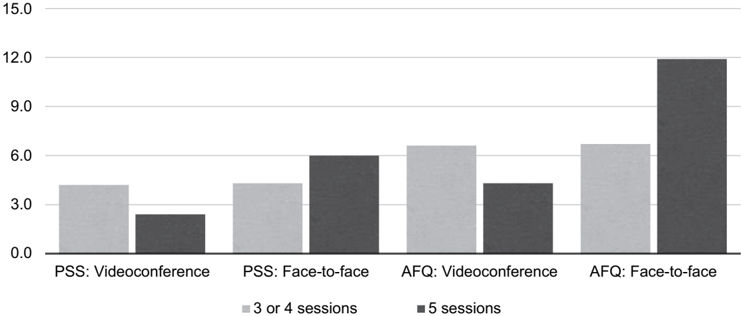
“The pre-post change in psychological inflexibility (AFQ-Y) when completing 3 to 4 sessions ( M = 6.74, SD = 9.82) was significantly smaller ( t = -2.083, df = 45, p = 0.043) compared to when completing 5 sessions ( M = 11.92, SD = 7.06).”
plainstates an associationn = 23 ·- Asserted: passes — The authors put it forward as true.
- Checkable: passes — It can be checked against evidence.
- Load-bearing: unclear — It is unclear whether the paper’s conclusions depend on it.
- Based: passes — The paper gives a reason why it holds.
A result the paper reports from its own data — it cites no other source for it, so there is none to check. The quote shows it is in the paper.
In the paper
“Thus, there were no statistical differences between the groups in the number of sessions attended (video conference, M = 4.28, SD = 0.67; face-to-face, M = 4.34, SD = 0.76).”
plain- Asserted: passes — The authors put it forward as true.
- Checkable: passes — It can be checked against evidence.
- Load-bearing: unclear — It is unclear whether the paper’s conclusions depend on it.
- Based: passes — The paper gives a reason why it holds.
A result the paper reports from its own data — it cites no other source for it, so there is none to check. The quote shows it is in the paper.
In the paper
“The betweengroup ESs were either very small ( d = 0.05 to 0.19) or small ( d = 0.20 to 0.36) in favor for the face-to-face intervention.”
plain- Asserted: passes — The authors put it forward as true.
- Checkable: passes — It can be checked against evidence.
- Load-bearing: passes — The paper’s conclusions depend on it.
- Based: passes — The paper gives a reason why it holds.
33 more claims
Create a free account to see all 87 claims and every source verdict.
- Probably not a substantial claim. 29
- It may state two separate claims as one. 28
Statistics that don’t add up
Each reported p-value recomputed from its test statistic and degrees of freedom, each partial η² from its F, and each ratio, mean difference or B printed with a p checked against its own confidence interval.
Rated minor: it would not touch a result — a value no result rests on, a p-value that stays on the same side of the significance level, or a conflict that is clerical, resolved elsewhere in the paper, or outside its own findings.
In the paper
“t (88) = 2.130, p = 0.039”
Reported p = .039 · recomputed p = .036
Statistics recomputed
Every reported test result, recomputed from its test statistic and degrees of freedom. A result shows as not adding up only once an independent check has confirmed it.
- Doesn’t add upt(88) = 2.13reported p = .039 · recomputed p = .036
“t (88) = 2.130, p = .039”
- ConsistentF(5, 84) = 0.98reported p = .435 · recomputed p = .435
“F(5,84) = 0.980, p = .435”
- ConsistentF(5, 84) = 1.448reported p = .216 · recomputed p = .216
“F(5,84) = 1.448, p = .216”
- ConsistentF(5, 84) = 0.334reported p = .891 · recomputed p = .891
“F(5,84) = 0.334, p = .891”
Self-check
Percentages, sums and reported differences re-computed from the paper’s own numbers.
Rated major: it would touch a result — a value a result rests on, reported and recomputed p-values on opposite sides of the significance level, two passages that conflict with no sign which is right, or a cited work retracted before this paper was published.
In the paper
“| ACT face-to-face | 37.87 (8.72) | 4.97 (6.92) | 0.153 | 0.22 | 0.39 | 0.01; 0.78* |”
Reported 0.153 · recomputed 32.9
Citations
Cites
The PHQ-9: Validity of a brief depression severity measure
Kroenke, K., Spitzer, R. L., & Williams, J. B. W. (2001) · Journal of General Internal Medicine · doi:10.1046/j.1525-1497.2001.016009606.x · Cited by 44,910 · cited 2×
“The validity and reliability of the PHQ-9 have been found to be good in previous studies, including student samples (Kroenke, Spitzer, & Williams, 2001; Tavakoli, Broyles, Reid, Sandoval, & Correa-Fernández, 2019).”
A Global Measure of Perceived Stress
Cohen, S., Kamarck, T., & Mermelstein, R. (1983) · Journal of Health and Social Behavior · doi:10.2307/2136404 · Cited by 32,807 · cited 1×
“The Perceived Stress Scale (PSS-10) was used to measure symptoms of stress (Cohen & Williamson, 1988; Cohen, Kamarck, & Mermelstein, 1983).”
A Brief Measure for Assessing Generalized Anxiety Disorder: The GAD-7
Spitzer, R. L., Kroenke, K., Williams, J. B. W., & Löwe, B. (2006) · Archives of Internal Medicine · doi:10.1001/archinte.166.10.1092 · Cited by 31,765 · cited 2×
“The Generalized Anxiety Disorder Assessment (GAD-7) is a self-administered questionnaire that evaluates the level of generalized anxiety (Spitzer, Kroenke, Williams, & Löwe, 2006).”
Lakens, D. (2013) · Frontiers in Psychology · doi:10.3389/fpsyg.2013.00863 · Cited by 10,303 · cited 1×
“When calculating Cohen’s d for the within-subjects ESs , we used the average standard deviation of both repeated measures as a standardizer, as recommended by Lakens (2013).”
Using Self-Report Assessment Methods to Explore Facets of Mindfulness
Baer, R. A., Smith, G. T., Hopkins, J., Krietemeyer, J., & Toney, L. (2006) · Assessment · doi:10.1177/1073191105283504 · Cited by 7,511 · cited 2×
“The FFMQ has an adequate internal consistency (Baer et al., 2008) and is a valid measure of mindfulness among university students (Baer, Smith, Hopkins, Krietemeyer, & Toney, 2006; Carmody, Baer, Lykins, & Olendzki, 2009).”
Online Learning: A Panacea in the Time of COVID-19 Crisis
Dhawan, S. (2020) · Journal of Educational Technology Systems · doi:10.1177/0047239520934018 · Cited by 5,083 · cited 1×
“The COVID-19 pandemic challenged the education system across the world and forced schools, colleges, and universities to discontinue in-person teaching and shift to online teaching (Dhawan, 2020).”
Baer, R. A., Smith, G. T., Lykins, E., Button, D., Krietemeyer, J., Sauer, S., Walsh, E., Duggan, D., & Williams, J. M. G. (2008) · Assessment · doi:10.1177/1073191107313003 · Cited by 2,930 · cited 1×
“The FFMQ has an adequate internal consistency (Baer et al., 2008) and is a valid measure of mindfulness among university students (Baer, Smith, Hopkins, Krietemeyer, & Toney, 2006; Carmody, Baer, Lykins, & Olendzki, 2009).”
Pierce, M., Hope, H., Ford, T., Hatch, S., Hotopf, M., John, A., Kontopantelis, E., Webb, R., Wessely, S., McManus, S., et al. (2020) · The Lancet Psychiatry · doi:10.1016/s2215-0366(20)30308-4 · Cited by 2,621 · cited 1×
“Indeed, research has demonstrated a strong positive association between COVID-19-related hardship and distress (Pierce et al., 2020).”
Review of the Psychometric Evidence of the Perceived Stress Scale
Lee, E.-H. (2012) · Asian Nursing Research · doi:10.1016/j.anr.2012.08.004 · Cited by 2,305 · cited 1×
“The PSS has been used in student populations (Tavakoli, Broyles, Reid, Sandoval, & Correa-Fernández, 2019), with an internal consistency ranging from .74 to .91 (Lee, 2012).”
Psychological interventions for people affected by the COVID-19 epidemic
Duan, L., & Zhu, G. (2020) · The Lancet Psychiatry · doi:10.1016/s2215-0366(20)30073-0 · Cited by 1,885 · cited 1×
“In addition, the use of technology became the only way to offer psychological services (Duan & Zhu, 2020; Jiang et al., 2020; Li et al., 2020; McGuire, 2020; Zhou et al., 2020).”
THE THEORY AND PRACTICE OF GROUP PSYCHOTHERAPY
DURKIN, H. E. (1948) · Annals of the New York Academy of Sciences · doi:10.1111/j.1749-6632.1948.tb30971.x · Cited by 1,506
Progression of Mental Health Services during the COVID-19 Outbreak in China
Li, W., Yang, Y., Liu, Z.-H., Zhao, Y.-J., Zhang, Q., Zhang, L., Cheung, T., & Xiang, Y.-T. (2020) · International Journal of Biological Sciences · doi:10.7150/ijbs.45120 · Cited by 1,213 · cited 1×
“In addition, the use of technology became the only way to offer psychological services (Duan & Zhu, 2020; Jiang et al., 2020; Li et al., 2020; McGuire, 2020; Zhou et al., 2020).”
The Role of Telehealth in Reducing the Mental Health Burden from COVID-19
Zhou, X., Snoswell, C. L., Harding, L. E., Bambling, M., Edirippulige, S., Bai, X., & Smith, A. C. (2020) · Telemedicine and e-Health · doi:10.1089/tmj.2020.0068 · Cited by 1,159 · cited 1×
“In addition, the use of technology became the only way to offer psychological services (Duan & Zhu, 2020; Jiang et al., 2020; Li et al., 2020; McGuire, 2020; Zhou et al., 2020).”
Addressing the Mental Health Concerns of International Students
Mori, S. C. (2000) · Journal of Counseling & Development · doi:10.1002/j.1556-6676.2000.tb02571.x · Cited by 1,111 · cited 1×
“International students are considered at an elevated risk for psychological problems (Brown & Brown, 2013; Jung, Hecht, & Wadsworth, 2007; Mori, 2000), including stress, loneliness (e.g. Rosenthal, Russell, & Thomson, 2006; Russell, Rosenthal, & Thomson, 2010; Sawir, Marginson, Deumert, Nyland, &…”
Loneliness and international students: an Australian study
Sawir, E., Marginson, S., Deumert, A., Nyland, C., & Ramia, G. (2008) · Journal of Studies in International Education · doi:10.1177/1028315307299699 · Cited by 829 · cited 1×
“…Hecht, & Wadsworth, 2007; Mori, 2000), including stress, loneliness (e.g. Rosenthal, Russell, & Thomson, 2006; Russell, Rosenthal, & Thomson, 2010; Sawir, Marginson, Deumert, Nyland, & Ramia, 2008), depressive symptoms (e.g. Rice, Choi, Zhang, Morero, & Anderson, 2012), and anxiety (Shadowen,…”
Hayes, S. C. (2016) · Behavior Therapy · doi:10.1016/j.beth.2016.11.006 · Cited by 785 · cited 1×
“Empirical evidence supports psychological flexibility as the mechanism of action in acceptance and commitment therapy (ACT; Doorley, Goodman, Kelso, & Kashdan, 2020; Hayes, 2016; Mallett, Coyle, Kuang, & Gillanders, 2021; Stockton et al., 2019; Trompetter, Bohlmeijer, Veehof, & Schreurs, 2015).”
The empirical status of acceptance and commitment therapy: A review of meta-analyses
Gloster, A. T., Walder, N., Levin, M. E., Twohig, M. P., & Karekla, M. (2020) · Journal of Contextual Behavioral Science · doi:10.1016/j.jcbs.2020.09.009 · Cited by 622 · cited 2×
“ACT has been found to be effective in a variety of conditions (Gloster, Walder, Levin, Twohig, & Karekla, 2020), this review on the empirical status of ACT showed that it is efficacious for all conditions examined, including anxiety (small to medium, Effect Size, ES, g = 0.18–0.57), depression…”
InfluentialEarly withdrawal from mental health treatment: Implications for psychotherapy practice.
Barrett, M. S., Chua, W.-J., Crits-Christoph, P., Gibbons, M. B., & Thompson, D. (2008) · Psychotherapy: Theory, Research, Practice, Training · doi:10.1037/0033-3204.45.2.247 · Cited by 564
An empirical study of the mechanisms of mindfulness in a mindfulness-based stress reduction program.
Carmody, J., Baer, R. A., L. B. Lykins, E., & Olendzki, N. (2009) · Journal of Clinical Psychology · doi:10.1002/jclp.20579 · Cited by 526
Greco, L. A., Lambert, W., & Baer, R. A. (2008) · Psychological Assessment · doi:10.1037/1040-3590.20.2.93 · Cited by 514 · cited 2×
“The AFQ-Y has shown adequate reliability and validity in child and adolescent (Greco, Lambert, & Baer, 2008) and university student samples (Schmalz & Murrell, 2010) and in predicting psychological symptoms (Fergus et al., 2012).”
Dawson, D. L., & Golijani-Moghaddam, N. (2020) · Journal of Contextual Behavioral Science · doi:10.1016/j.jcbs.2020.07.010 · Cited by 445 · cited 1×
“In contrast, lower levels of psychological flexibility have been found to be associated with higher levels of depression, anxiety, and COVID-19-related distress (Dawson & Golijani-Moghaddam, 2020; Gloster, Walder, Levin, Twohig, & Karekla, 2020; Mallett, Coyle, Kuang, & Gillanders, 2021).”
Adlaf, E. M., Gliksman, L., Demers, A., & Newton-Taylor, B. (2001) · Journal of American College Health · doi:10.1080/07448480109596009 · Cited by 406
Examining psychological inflexibility as a transdiagnostic process across psychological disorders
Levin, M. E., MacLane, C., Daflos, S., Seeley, J. R., Hayes, S. C., Biglan, A., & Pistorello, J. (2014) · Journal of Contextual Behavioral Science · doi:10.1016/j.jcbs.2014.06.003 · Cited by 400 · cited 5×
“…findings were consistent with earlier ACT-based studies reporting positive outcomes in general (e.g. Grégoire, Lachance, Bouffard, & Dionne, 2018; Levin et al., 2014; Levin, Hayes, Pistorello, & Seeley, 2016; Levin, Krafft, Pistorello, & Seeley, 2019; Räsänen, Lappalainen, Muotka, Tolvanen, &…”
InfluentialStudents’ mental health problems before, during, and after COVID-19 lockdown in Italy
Meda, N., Pardini, S., Slongo, I., Bodini, L., Zordan, M. A., Rigobello, P., Visioli, F., & Novara, C. (2021) · Journal of Psychiatric Research · doi:10.1016/j.jpsychires.2020.12.045 · Cited by 398 · cited 2×
“Furthermore, university students have been deeply affected by the pandemic, reporting moderate to severe levels of depression and anxiety (e.g. Di Consiglio, Merola, Pascucci, Violani, & Couyoumdjian, 2021; Meda et al., 2021).”
Psychological flexibility: What we know, what we do not know, and what we think we know
Doorley, J. D., Goodman, F. R., Kelso, K. C., & Kashdan, T. B. (2020) · Social and Personality Psychology Compass · doi:10.1111/spc3.12566 · Cited by 264 · cited 1×
“Empirical evidence supports psychological flexibility as the mechanism of action in acceptance and commitment therapy (ACT; Doorley, Goodman, Kelso, & Kashdan, 2020; Hayes, 2016; Mallett, Coyle, Kuang, & Gillanders, 2021; Stockton et al., 2019; Trompetter, Bohlmeijer, Veehof, & Schreurs, 2015).”
Gallagher, M. W., Zvolensky, M. J., Long, L. J., Rogers, A. H., & Garey, L. (2020) · Cognitive Therapy and Research · doi:10.1007/s10608-020-10143-y · Cited by 262 · cited 1×
“…prompting numerous disruptions to daily life, unique stressors, increased mental health concerns, and CONTACT Francesca Brandolin francesca.f.brandolin@jyu.com; francesca.brandolin@gmail.com decreased quality of life (Gallagher, Zvolensky, Long, Rogers, & Garey, 2020; White & Van Der Boor, 2020).”
Varker, T., Brand, R. M., Ward, J., Terhaag, S., & Phelps, A. (2019) · Psychological Services · doi:10.1037/ser0000239 · Cited by 261
Trompetter, H. R., Bohlmeijer, E. T., Veehof, M. M., & Schreurs, K. M. G. (2015) · Journal of Behavioral Medicine · doi:10.1007/s10865-014-9579-0 · Cited by 255 · cited 1×
“Empirical evidence supports psychological flexibility as the mechanism of action in acceptance and commitment therapy (ACT; Doorley, Goodman, Kelso, & Kashdan, 2020; Hayes, 2016; Mallett, Coyle, Kuang, & Gillanders, 2021; Stockton et al., 2019; Trompetter, Bohlmeijer, Veehof, & Schreurs, 2015).”
The international student experience: three styles of adaptation
Russell, J., Rosenthal, D., & Thomson, G. (2010) · Higher Education · doi:10.1007/s10734-009-9297-7 · Cited by 253
International Students and Mental Health
Forbes-Mewett, H., & Sawyer, A.-M. (2016) · Journal of International Students · doi:10.32674/jis.v6i3.348 · Cited by 244
López, J., Perez-Rojo, G., Noriega, C., Carretero, I., Velasco, C., Martinez-Huertas, J. A., López-Frutos, P., & Galarraga, L. (2020) · International Psychogeriatrics · doi:10.1017/s1041610220000964 · Cited by 241 · cited 2×
“Burlingame, 2020), suggesting that they are effective at reducing depression, anxiety, and stress and that they allow group cohesion similar to that in in-person group therapy (Gentry, Lapid, Clark, & Rummans, 2019; López et al., 2020).”
Acceptance and commitment: Implications for prevention science
Biglan, A., Hayes, S. C., & Pistorello, J. (2008) · Prevention Science · doi:10.1007/s11121-008-0099-4 · Cited by 240 · cited 1×
“Skills related to health, adaptation, resilience, and flexibility are considered protective factors in mental health (Biglan, Hayes, & Pistorello, 2008).”
Lai, A. Y.-K., Lee, L., Wang, M.-P., Feng, Y., Lai, T. T.-K., Ho, L.-M., Lam, V. S.-F., Ip, M. S.-M., & Lam, T.-H. (2020) · Frontiers in Psychiatry · doi:10.3389/fpsyt.2020.584240 · Cited by 237 · cited 5×
“Their survey indicated that more than 80% of the students perceived moderate-to-high stress, with females showing higher stress and lower resilience than males (Lai et al., 2020).”
InfluentialJung, E., Hecht, M. L., & Wadsworth, B. C. (2007) · International Journal of Intercultural Relations · doi:10.1016/j.ijintrel.2007.04.001 · Cited by 223 · cited 1×
“International students are considered at an elevated risk for psychological problems (Brown & Brown, 2013; Jung, Hecht, & Wadsworth, 2007; Mori, 2000), including stress, loneliness (e.g. Rosenthal, Russell, & Thomson, 2006; Russell, Rosenthal, & Thomson, 2010; Sawir, Marginson, Deumert, Nyland, &…”
Räsänen, P., Lappalainen, P., Muotka, J., Tolvanen, A., & Lappalainen, R. (2016) · Behaviour Research and Therapy · doi:10.1016/j.brat.2016.01.001 · Cited by 221 · cited 7×
“However, our studies suggest among students the changes in stress (PSS) were comparable whether the interventions were delivered individually (within group d = 0.76, Räsänen, Lappalainen, Muotka, Tolvanen, & Lappalainen, 2016) or in group ( d = 0.54–0.94, the current study).”
InfluentialSelf-citationWhite, R. G., & Van Der Boor, C. (2020) · BJPsych Open · doi:10.1192/bjo.2020.79 · Cited by 217 · cited 1×
“…prompting numerous disruptions to daily life, unique stressors, increased mental health concerns, and CONTACT Francesca Brandolin francesca.f.brandolin@jyu.com; francesca.brandolin@gmail.com decreased quality of life (Gallagher, Zvolensky, Long, Rogers, & Garey, 2020; White & Van Der Boor, 2020).”
Pakenham, K. I., Landi, G., Boccolini, G., Furlani, A., Grandi, S., & Tossani, E. (2020) · Journal of Contextual Behavioral Science · doi:10.1016/j.jcbs.2020.07.003 · Cited by 210 · cited 3×
“…has been proven to be a moderating factor in the relationships between social isolation and depression and anxiety (Smith, Twohy, & Smith, 2020), COVID-19 risk factors and mental health difficulties (Pakenham et al., 2020), and COVID-19 stressors and suicide risk (Crasta, Daks, & Rogge, 2020).”
Jiang, X., Deng, L., Zhu, Y., Ji, H., Tao, L., Liu, L., Yang, D., & Ji, W. (2020) · Psychiatry Research · doi:10.1016/j.psychres.2020.112903 · Cited by 209 · cited 1×
“In addition, the use of technology became the only way to offer psychological services (Duan & Zhu, 2020; Jiang et al., 2020; Li et al., 2020; McGuire, 2020; Zhou et al., 2020).”
Netz, N., Mishra, S., Gwosc, C., & Hauschildt, K. (2015) · doi:10.3278/6001920bw · Cited by 207
Evidence for telehealth group-based treatment: a systematic review
Gentry, M. T., Lapid, M. I., Clark, M. M., & Rummans, T. A. (2019) · Journal of Telemedicine and Telecare · doi:10.1177/1357633x18775855 · Cited by 200 · cited 1×
“…exponentially with COVID-19 (Marmarosh, Forsyth, Strauss, & Burlingame, 2020), suggesting that they are effective at reducing depression, anxiety, and stress and that they allow group cohesion similar to that in in-person group therapy (Gentry, Lapid, Clark, & Rummans, 2019; López et al., 2020).”
Smith, B. M., Twohy, A. J., & Smith, G. S. (2020) · Journal of Contextual Behavioral Science · doi:10.1016/j.jcbs.2020.09.005 · Cited by 194 · cited 1×
“…psychological flexibility has been proven to be a moderating factor in the relationships between social isolation and depression and anxiety (Smith, Twohy, & Smith, 2020), COVID-19 risk factors and mental health difficulties (Pakenham et al., 2020), and COVID-19 stressors and suicide risk…”
Stockton, D., Kellett, S., Berrios, R., Sirois, F., Wilkinson, N., & Miles, G. (2019) · Behavioural and Cognitive Psychotherapy · doi:10.1017/s1352465818000553 · Cited by 193 · cited 1×
“Empirical evidence supports psychological flexibility as the mechanism of action in acceptance and commitment therapy (ACT; Doorley, Goodman, Kelso, & Kashdan, 2020; Hayes, 2016; Mallett, Coyle, Kuang, & Gillanders, 2021; Stockton et al., 2019; Trompetter, Bohlmeijer, Veehof, & Schreurs, 2015).”
Batastini, A. B., Paprzycki, P., Jones, A. C. T., & MacLean, N. (2021) · Clinical Psychology Review · doi:10.1016/j.cpr.2020.101944 · Cited by 181 · cited 1×
“Meta-analyses suggest that videoconferencing interventions consistently produce treatment effects largely equivalent to those of in-person interventions (Batastini, Paprzycki, Jones, & MacLean, 2021; Varker, Brand, Ward, Terhaag, & Phelps, 2019).”
Acceptance and commitment therapy: towards a unified model of behavior change
Hayes, S. C. (2019) · World Psychiatry · doi:10.1002/wps.20626 · Cited by 154 · cited 1×
“The aim of ACT is to foster psychological flexibility through six related skills: (1) acceptance, (2) defusion, (3) being present, (4) self as context, (5) values, and (6) committed action (Hayes, 2019).”
McCracken, L. M., Badinlou, F., Buhrman, M., & Brocki, K. C. (2021) · Journal of Contextual Behavioral Science · doi:10.1016/j.jcbs.2020.11.003 · Cited by 146 · cited 1×
“Individuals high in psychological flexibility may be less affected by the adverse consequences of the COVID-19 pandemic (e.g. McCracken, Badinlou, Buhrman, & Brocki, 2021).”
Muto, T., Hayes, S. C., & Jeffcoat, T. (2011) · Behavior Therapy · doi:10.1016/j.beth.2010.08.009 · Cited by 144 · cited 5×
“…Lachance, Bouffard, & Dionne, 2018; Levin et al., 2014; Levin, Hayes, Pistorello, & Seeley, 2016; Levin, Krafft, Pistorello, & Seeley, 2019; Räsänen, Lappalainen, Muotka, Tolvanen, & Lappalainen, 2016) and international (Muto, Hayes, & Jeffcoat, 2011; Xu, O’Brien, & Chen, 2020) student populations.”
InfluentialLappalainen, P., Granlund, A., Siltanen, S., Ahonen, S., Vitikainen, M., Tolvanen, A., & Lappalainen, R. (2014) · Behaviour Research and Therapy · doi:10.1016/j.brat.2014.07.006 · Cited by 138 · cited 1×
“The structure and content of the intervention were constructed by the University of Jyväskylä research group specialized in brief ACT interventions (see, e.g. Lappalainen et al., 2014, 2021; Räsänen, Lappalainen, Muotka, Tolvanen, & Lappalainen, 2016).”
Self-citationGrégoire, S., Lachance, L., Bouffard, T., & Dionne, F. (2018) · Behavior Therapy · doi:10.1016/j.beth.2017.10.003 · Cited by 129 · cited 1×
“These findings were consistent with earlier ACT-based studies reporting positive outcomes in general (e.g. Grégoire, Lachance, Bouffard, & Dionne, 2018; Levin et al., 2014; Levin, Hayes, Pistorello, & Seeley, 2016; Levin, Krafft, Pistorello, & Seeley, 2019; Räsänen, Lappalainen, Muotka, Tolvanen, &…”
Self-Critical Perfectionism, Acculturative Stress, and Depression Among International Students
Rice, K. G., Choi, C.-C., Zhang, Y., Morero, Y. I., & Anderson, D. (2012) · The Counseling Psychologist · doi:10.1177/0011000011427061 · Cited by 110 · cited 1×
“…Russell, & Thomson, 2006; Russell, Rosenthal, & Thomson, 2010; Sawir, Marginson, Deumert, Nyland, & Ramia, 2008), depressive symptoms (e.g. Rice, Choi, Zhang, Morero, & Anderson, 2012), and anxiety (Shadowen, Williamson, Guerra, Ammigan, & Drexler, 2019) and their distress has been found…”
The psychology of the COVID-19 pandemic: A group-level perspective.
Marmarosh, C. L., Forsyth, D. R., Strauss, B., & Burlingame, G. M. (2020) · Group Dynamics: Theory, Research, and Practice · doi:10.1037/gdn0000142 · Cited by 106 · cited 4×
“Furthermore, online group interventions have grown exponentially with COVID-19 (Marmarosh, Forsyth, Strauss, & Burlingame, 2020), suggesting that they are effective at reducing depression, anxiety, and stress and that they allow group cohesion similar to that in in-person group therapy (Gentry,…”
InfluentialStafford‐Brown, J., & Pakenham, K. I. (2012) · Journal of Clinical Psychology · doi:10.1002/jclp.21844 · Cited by 103 · cited 2×
“…small effect (d = .29) on student well-being (Howell & Passmore, 2019), improving the psychological health and well-being of college students (see also Levin et al., 2014; Muto, Hayes, & Jeffcoat, 2011; Räsänen, Lappalainen, Muotka, Tolvanen, & Lappalainen, 2016; Stafford-Brown & Pakenham, 2012).”
Levin, M. E., Hayes, S. C., Pistorello, J., & Seeley, J. R. (2016) · Journal of Clinical Psychology · doi:10.1002/jclp.22254 · Cited by 103 · cited 1×
“…with earlier ACT-based studies reporting positive outcomes in general (e.g. Grégoire, Lachance, Bouffard, & Dionne, 2018; Levin et al., 2014; Levin, Hayes, Pistorello, & Seeley, 2016; Levin, Krafft, Pistorello, & Seeley, 2019; Räsänen, Lappalainen, Muotka, Tolvanen, & Lappalainen, 2016) and…”
Wang, S., Zhou, Y., Yu, S., Ran, L.-W., Liu, X.-P., & Chen, Y.-F. (2017) · Research on Social Work Practice · doi:10.1177/1049731515577890 · Cited by 84
Howell, A. J., & Passmore, H.-A. (2019) · Journal of Happiness Studies · doi:10.1007/s10902-018-0027-7 · Cited by 83 · cited 3×
“Multiple studies have shown that ACT training has a positive effect on student well-being (Howell & Passmore, 2019).”
InfluentialShadowen, N. L., Williamson, A. A., Guerra, N. G., Ammigan, R., & Drexler, M. L. (2019) · Journal of International Students · doi:10.32674/jis.v9i1.277 · Cited by 79 · cited 1×
“…2010; Sawir, Marginson, Deumert, Nyland, & Ramia, 2008), depressive symptoms (e.g. Rice, Choi, Zhang, Morero, & Anderson, 2012), and anxiety (Shadowen, Williamson, Guerra, Ammigan, & Drexler, 2019) and their distress has been found to be even higher than that of domestic students…”
International students and mental health
Forbes-Mewett, H. (2020) · Monash University · doi:10.26180/5ee8016ab569a · Cited by 76
Tavakoli, N., Broyles, A., Reid, E. K., Sandoval, J. R., & Correa-Fernández, V. (2019) · Journal of Contextual Behavioral Science · doi:10.1016/j.jcbs.2018.11.001 · Cited by 72
Crasta, D., Daks, J. S., & Rogge, R. D. (2020) · Journal of Contextual Behavioral Science · doi:10.1016/j.jcbs.2020.09.003 · Cited by 72 · cited 1×
“…has been proven to be a moderating factor in the relationships between social isolation and depression and anxiety (Smith, Twohy, & Smith, 2020), COVID-19 risk factors and mental health difficulties (Pakenham et al., 2020), and COVID-19 stressors and suicide risk (Crasta, Daks, & Rogge, 2020).”
Lappalainen, R., Lappalainen, P., Puolakanaho, A., Hirvonen, R., Eklund, K., Ahonen, T., Muotka, J., & Kiuru, N. (2021) · Journal of Contextual Behavioral Science · doi:10.1016/j.jcbs.2021.01.007 · Cited by 69 · cited 1×
“The structure and content of the intervention were constructed by the University of Jyväskylä research group specialized in brief ACT interventions (see, e.g. Lappalainen et al., 2014, 2021; Räsänen, Lappalainen, Muotka, Tolvanen, & Lappalainen, 2016).”
Self-citationFergus, T. A., Valentiner, D. P., Gillen, M. J., Hiraoka, R., Twohig, M. P., Abramowitz, J. S., & McGrath, P. B. (2012) · Psychological Assessment · doi:10.1037/a0025776 · Cited by 68
Measuring experiential avoidance in adults: the Avoidance and Fusion Questionnaire
Schmalz, J. E., & Murrell, A. R. (2010) · International Journal of Behavioral Consultation and Therapy · doi:10.1037/h0100908 · Cited by 65 · cited 1×
“The AFQ-Y has shown adequate reliability and validity in child and adolescent (Greco, Lambert, & Baer, 2008) and university student samples (Schmalz & Murrell, 2010) and in predicting psychological symptoms (Fergus et al., 2012).”
Katajavuori, N., Vehkalahti, K., & Asikainen, H. (2023) · Current Psychology · doi:10.1007/s12144-021-01837-x · Cited by 50 · cited 2×
“…in the USA (Levin et al., 2014; Muto, Hayes, & Jeffcoat, 2011), but there are many studies also in Europe (Christodoulou, Flaxman, & Lloyd, 2021; Katajavuori, Vehkalahti, & Asikainen, 2021; Räsänen, Lappalainen, Muotka, Tolvanen, & Lappalainen, 2016; Shepherd, Golijani-Moghaddam, & Dawson,…”
Mallett, R., Coyle, C., Kuang, Y., & Gillanders, D. T. (2021) · Journal of Contextual Behavioral Science · doi:10.1016/j.jcbs.2021.09.003 · Cited by 46 · cited 3×
“Empirical evidence supports psychological flexibility as the mechanism of action in acceptance and commitment therapy (ACT; Doorley, Goodman, Kelso, & Kashdan, 2020; Hayes, 2016; Mallett, Coyle, Kuang, & Gillanders, 2021; Stockton et al., 2019; Trompetter, Bohlmeijer, Veehof, & Schreurs, 2015).”
Hernández-López, M., Cepeda-Benito, A., Díaz-Pavón, P., & Rodríguez-Valverde, M. (2021) · Journal of Contextual Behavioral Science · doi:10.1016/j.jcbs.2020.12.002 · Cited by 45
Yuen, E. K., Goetter, E. M., Stasio, M. J., Ash, P., Mansour, B., McNally, E., Sanchez, M., Hobar, E., Forte, S., Zulaica, K., et al. (2019) · Journal of Contextual Behavioral Science · doi:10.1016/j.jcbs.2019.01.006 · Cited by 43 · cited 3×
“In other videoconference studies with students, Yuen and colleagues (Yuen et al., 2019) found that a 12-session ACT group videoconferencing intervention decreased social anxiety symptoms.”
Influential(2006) · Cited by 43
Di Consiglio, M., Merola, S., Pascucci, T., Violani, C., & Couyoumdjian, A. (2021) · International Journal of Environmental Research and Public Health · doi:10.3390/ijerph18189897 · Cited by 42
The international student sojourn, identity conflict and threats to well-being
Brown, J., & Brown, L. (2013) · British Journal of Guidance & Counselling · doi:10.1080/03069885.2012.729026 · Cited by 41 · cited 1×
“International students are considered at an elevated risk for psychological problems (Brown & Brown, 2013; Jung, Hecht, & Wadsworth, 2007; Mori, 2000), including stress, loneliness (e.g. Rosenthal, Russell, & Thomson, 2006; Russell, Rosenthal, & Thomson, 2010; Sawir, Marginson, Deumert, Nyland, &…”
Grégoire, S., Doucerain, M., Morin, L., & Finkelstein-Fox, L. (2021) · Journal of Contextual Behavioral Science · doi:10.1016/j.jcbs.2021.03.006 · Cited by 38
Kim, Y. K., Maleku, A., Lemieux, C. M., Du, X., & Chen, Z. (2019) · Journal of International Students · doi:10.32674/jis.v9i1.264 · Cited by 35 · cited 1×
“The internal consistency of the GAD-7 has been found to be excellent (α = .92; Spitzer, Kroenke, Williams, & Löwe, 2006), including in studies of university students (Kim, Maleku, Lemieu, Du, & Chen, 2019).”
(2019) · Cited by 32
Chinese international student stress and coping: A pilot study of acceptance and commitment therapy
Xu, H., O'Brien, W. H., & Chen, Y. (2020) · Journal of Contextual Behavioral Science · doi:10.1016/j.jcbs.2019.12.010 · Cited by 32 · cited 4×
“For example, ACT has been explored among Japanese international students attending college in the United States, with favourable results (Muto, Hayes, & Jeffcoat, 2011), and Chinese students studying abroad in the USA (Xu, O’Brien, & Chen, 2020).”
InfluentialShepherd, K., Golijani-Moghaddam, N., & Dawson, D. L. (2022) · Journal of Contextual Behavioral Science · doi:10.1016/j.jcbs.2021.12.003 · Cited by 31
Levin, M. E., Krafft, J., Pistorello, J., & Seeley, J. R. (2019) · Journal of Contextual Behavioral Science · doi:10.1016/j.jcbs.2018.03.004 · Cited by 30 · cited 1×
“…positive outcomes in general (e.g. Grégoire, Lachance, Bouffard, & Dionne, 2018; Levin et al., 2014; Levin, Hayes, Pistorello, & Seeley, 2016; Levin, Krafft, Pistorello, & Seeley, 2019; Räsänen, Lappalainen, Muotka, Tolvanen, & Lappalainen, 2016) and international (Muto, Hayes, & Jeffcoat,…”
Using Video Conferencing Applications to Share the Death Experience During the COVID-19 Pandemic
Billingsley, L. (2020) · Journal of Radiology Nursing · doi:10.1016/j.jradnu.2020.08.001 · Cited by 27 · cited 1×
“Indeed, the use of videoconferencing applications was noticeably accelerated during the COVID-19 pandemic (Billingsley, 2020).”
Viskovich, S., Pakenham, K. I., & Fowler, J. A. (2021) · Journal of Contextual Behavioral Science · doi:10.1016/j.jcbs.2021.10.001 · Cited by 22 · cited 1×
“ACT can provide valuable tools to enhance psychological flexibility and well-being, including college settings (Pistorello, 2013; Viskovich, Pakenham, & Fowler, 2021).”
Zemestani, M., Hosseini, M., Petersen, J. M., & Twohig, M. P. (2022) · Journal of Contextual Behavioral Science · doi:10.1016/j.jcbs.2022.08.001 · Cited by 17 · cited 1×
“…and negative emotional symptoms and decreasing procrastination (Christodoulou, Flaxman, & Lloyd, 2021; Wang et al., 2017) as well reducing anxiety and depression symptoms as shown in Iranian adolescents in a videoconference group intervention (Zemestani, Hosseini, Petersen, & Twohig, 2022).”
Browning, M. E., Morena, A., Gould, E. R., & Lloyd-Richardson, E. E. (2023) · Journal of College Student Psychotherapy · doi:10.1080/87568225.2022.2029659 · Cited by 13
Acceptance and Commitment Therapy in Group Format for College Students
Christodoulou, V., Flaxman, P. E., & Lloyd, J. (2021) · Journal of College Counseling · doi:10.1002/jocc.12192 · Cited by 12 · cited 7×
“Moreover, we found that there were no differences in the impact of the intervention on symptoms between the different cultural groups, for example, between the subgroups of student from Asia and students from Central Europe, UK and Baltics.”
InfluentialInternational Students in the Time of COVID-19: International Education at the Crossroads
Gomes, C., & Forbes-Mewett, H. (2021) · Journal of International Students · doi:10.32674/jis.v11is2.4292 · Cited by 12 · cited 1×
“…students have been deeply affected by the pandemic (e.g. Di Consiglio, Merola, Pascucci, Violani, & Couyoumdjian, 2021; Meda et al., 2021) and international students even more so due to their temporary status in their host countries and disruptions to their daily life (Gomes & Forbes-Mewett, 2021).”
ACT with Pain : measurement, efficacy and mechanisms of Acceptance & Commitment Therapy
Trompetter, H. (2014) · doi:10.3990/1.9789036537087 · Cited by 4 · cited 1×
“The Engaged Living Scale (ELS) measures the ability to engage in actions in accordance with their values (Trompetter, 2014).”
Brandolin, F., Lappalainen, P., Gorinelli, S., Muotka, J., Räsänen, P., & Lappalainen, R. (2023) · British Journal of Guidance & Counselling · doi:10.1080/03069885.2023.2165636 · Cited by 3 · cited 1×
“We observed earlier that a five-week in-person ACT group workshop was effective at reducing psychological symptoms of stress, depression, and anxiety (Brandolin et al., 2023).”
Self-citationBarbero (2014) · doi:10.1016/j · Cited by 1
Research works printed but not linked: 4
- Cohen, S., & Williamson, G. (1988). Perceived stress in a probability sample of the US. In S. Spacapam & S. Oskamp (Eds.), The social psychology of health: The claremont symposium on applied social psychology . Newbury Park, California: Sage Publications.
- Muthén, L. K. (1998). Mplus user's guide . Los Angeles, CA: Muthén & Muthén.
- Pistorello, J. (Ed.). (2013). Mindfulness and acceptance for counseling college students: Theory and practical applications for intervention, prevention, and outreach . Oakland, CA: New Harbinger Publications.
- Strosahl, K. D., Robinson, P. J., & Gustavsson, T. (2012). Brief interventions for radical change: Principles and practice of focused acceptance and commitment therapy . Oakland, CA: New Harbinger Publications.
Cited by
Assessment of stress and health conditions among students in the context of the war in Ukraine
Potop, V., Vypasniak, I., Ivanyshyn, I., Lutskyi, V., Kryventsova, I., Shesterova, L., & Prusik, K. (2024) · Physical Culture Recreation and Rehabilitation · doi:10.15561/physcult.2024.0203 · Cited by 14
“Short-term group workshops based on Acceptance and Commitment Therapy (ACT) have proven effective in reducing symptoms of stress, depression, and anxiety among students [19, 20].”
Pranata, G. K. A. W., Koa, A. J. A. F., & Chang, Y. (2024) · Nursing and Health Sciences · doi:10.1111/nhs.70003 · Cited by 5
Cheng, S., & Xiong, Y. (2026) · International Journal of Intercultural Relations · doi:10.1016/j.ijintrel.2026.102377 · Cited by 1
Dat, N. B., Minh, N. T. H., Thuong, N. X., & Hoang, N. K. (2026) · Counselling Psychology Quarterly · doi:10.1080/09515070.2026.2666075 · Cited by 1
Mental health and well-being in higher education: A review of international students living abroad
Aziz, A. L., Talib, C. A., Hakim, A. R., & Rimadani, R. (2026) · Social Sciences & Humanities Open · doi:10.1016/j.ssaho.2026.103120 · Cited by 2
Metadata
- Authors
- Brandolin, F., Lappalainen, P., Gorinelli, S., Muotka, J., & Lappalainen, R.
- Affiliations
- University of Jyväskylä (FI)
- Corresponding author
- Brandolin, Francesca
- Venue
- Counselling Psychology Quarterly
- Publisher
- Informa UK Limited
- Published
- 2023-09-10
- Volume
- 37
- Issue
- 4
- Pages
- 517-541
- ISSN
- 0951-5070 (ISSN-L)
- 1469-3674
- OpenAlex
- W4386587623
- Semantic Scholar
- ca308656909afdeadb61bf4173578324abfefca3
- Cited by
- 5
- References
- 81
- Citations by year
- 2026: 3 · 2024: 2
- FWCI
- 1.46
- Type
- journal article
- Language
- en
- Open access
- hybrid
- doi.org
- Licence
- Locations
- Counselling Psychology Quarterly (publishedVersion, cc-by)
- Jyväskylä University Digital Archive (University of Jyväskylä) (submittedVersion, cc-by)
- Topics
- Social Sciences › Psychology › Clinical Psychology › Mindfulness and Compassion Interventions
- Social Sciences › Psychology › Clinical Psychology › COVID-19 and Mental Health
- Social Sciences › Psychology › Applied Psychology › Digital Mental Health Interventions
- Keywords
- ACT intervention, group intervention, videoconferencing, international university students, COVID-19 pandemic, intervention effectiveness, acceptability, student mental health
About these checks
Registry, retraction, Cites and statistics results are computed, not judged, with one exception: a printed reference that no index lists is read once by a model before it counts as a citation error. Claims are extracted by a model and kept only when their quote appears verbatim in the text; each cited source is then checked, with a model’s help, for whether it says what the claim relies on. Those verdicts can be wrong — read the claim’s quote and the cited source before relying on one.
The claim verdicts this report counts are experimental: their accuracy is not yet measured.
A language model drew the claims from the paper on 2026-10-11, under version 3 of the claim definition (model deepseek-v4.1-flash, prompt extract-v3).
A second model labelled each claim on 2026-10-11 (model jev-1.13-20260917, definition revision gold-guideline-v0.2).
Cited sources are checked with a language model’s help (gpt-6-sol).
Statistics and arithmetic are recomputed, not judged.
Confidence bands are shown only for fields calibrated on our annotated test set. None is calibrated yet, so no band is shown.
What counts as a claim ›How we measure confidence ›How we check this ›
Are you an author, or do you see a problem with this page? Request a review
Data sources
Bibliographic data: Semantic Scholar, OpenAlex, Crossref.
Contains information from the Semantic Scholar Academic Graph Datasets, made available under the ODC Attribution License (ODC-BY 1.0).
Semantic Scholar’s data is described in: Kinney, R., et al. (2023). The Semantic Scholar Open Data Platform. arXiv:2301.10140.
