

Third wave cognitive behavioural therapies for people with multiple sclerosis: a scoping review
Open accessThe DOI matches its Crossref record; 124 of the 124 references it cites were found in a registry or an index.
Abstract
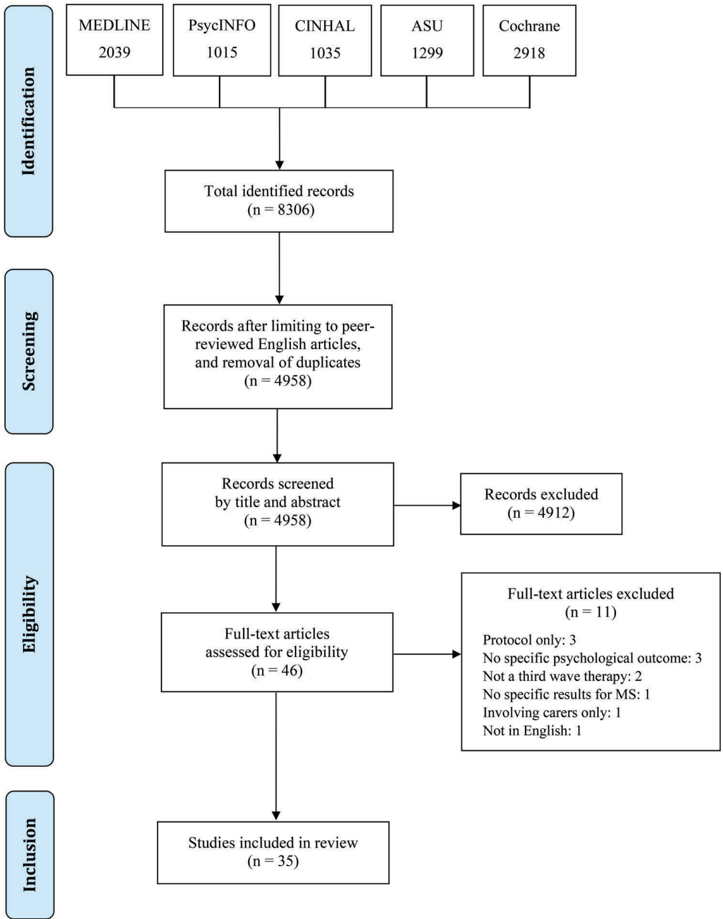
PURPOSE: Multiple sclerosis (MS) is a chronic condition linked to a wide range of psychological difficulties. While traditional cognitive behavioural therapy has been studied extensively with people with MS, much less is known about more recent "third wave" approaches. METHODS: A scoping review was carried out by performing a systematic search across MEDLINE Complete, PsycINFO, CINAHL, Academic Search Ultimate, and Cochrane Library up to January 2022. RESULTS: From an initial return of 8306 citations, 35 studies were included, 20 of which were randomised controlled trials (RCTs). These showed that four third wave approaches have been investigated with people with MS to date: acceptance and commitment therapy (ACT), dialectical behaviour therapy (DBT), mindfulness-based stress reduction (MBSR), and mindfulness-based cognitive therapy (MBCT). MBSR and MBCT may be helpful to address a range of psychological difficulties up to three months post-intervention. However, MS-specific adaptations may be required, and more evidence is needed on longer-term effectiveness. Limited evidence is also available for DBT and ACT, but additional research is warranted before any recommendation can be made. CONCLUSIONS: As third wave approaches keep being refined, further more rigorous investigations are needed to implement them to the benefit of people with MS. Implications for RehabilitationMultiple sclerosis is linked to a wide range of psychological difficulties in adults.Little is currently known on third wave psychotherapies for people with MS.Mindfulness-based stress reduction and mindfulness-based cognitive therapy may be helpful to address a wide range of difficulties in MS.Specific adaptations may be needed to deliver suitable therapies to people with MS.Additional research is warranted to build on preliminary findings for DBT and ACT.
Overview
The claims and statistics of this paper haven’t been checked yet.
Free: it reads the open-access text and checks the first 5 claims that cite a source we can check. Create a free account to check every claim.
Integrity signals
Registry
Cites
Statistics
Figures


Verification
Claims the paper makes
The claims and statistics of this paper haven’t been checked yet.
Free: it reads the open-access text and checks the first 5 claims that cite a source we can check. Create a free account to check every claim.
Claims other papers make about this one
Each is checked against this paper’s own text: does it say what the citing paper says it does?
The cited source says what the claim attributes to it.
In the citing paper
“evidence-based psychological interventions which have shown promising results in other similar conditions such as multiple sclerosis and Parkinson’s disease [21–23].”
Self-check
Percentages, sums and reported differences re-computed from the paper’s own numbers.
The self-check needs the paper’s full text.
Citations
Cites
Scoping studies: towards a methodological framework
Arksey, H., & O'Malley, L. (2005) · International Journal of Social Research Methodology · doi:10.1080/1364557032000119616 · Cited by 36,742
Diagnostic criteria for multiple sclerosis: 2010 revisions to the McDonald criteria
Polman, C. H., Reingold, S. C., Banwell, B., Clanet, M., Cohen, J. A., Filippi, M., Fujihara, K., Havrdova, E., Hutchinson, M., Kappos, L., et al. (2011) · Annals of Neurology · doi:10.1002/ana.22366 · Cited by 9,802
Mindfulness-based interventions in context: Past, present, and future
Kabat-Zinn, J. (2003) · Clinical Psychology: Science and Practice · doi:10.1093/clipsy.bpg016 · Cited by 8,615
(2008) · Medical Entomology and Zoology · Cited by 7,477
Guidance for conducting systematic scoping reviews
Peters, M. D. J., Godfrey, C. M., Khalil, H., McInerney, P., Parker, D., & Soares, C. B. (2015) · International Journal of Evidence-Based Healthcare · doi:10.1097/xeb.0000000000000050 · Cited by 7,472
Prevention of relapse/recurrence in major depression by mindfulness-based cognitive therapy.
Teasdale, J. D., Segal, Z. V., Williams, J. M. G., Ridgeway, V. A., Soulsby, J. M., & Lau, M. A. (2000) · Journal of Consulting and Clinical Psychology · doi:10.1037/0022-006x.68.4.615 · Cited by 3,236
Defining the clinical course of multiple sclerosis: The 2013 revisions
Lublin, F. D., Reingold, S. C., Cohen, J. A., Cutter, G. R., Sørensen, P. S., Thompson, A. J., Wolinsky, J. S., Balcer, L. J., Banwell, B., Barkhof, F., et al. (2014) · Neurology · doi:10.1212/wnl.0000000000000560 · Cited by 3,177
A scoping review of scoping reviews: advancing the approach and enhancing the consistency
Pham, M. T., Rajić, A., Greig, J. D., Sargeant, J. M., Papadopoulos, A., & McEwen, S. A. (2014) · Research Synthesis Methods · doi:10.1002/jrsm.1123 · Cited by 3,078
Hayes, S. C. (2004) · Behavior Therapy · doi:10.1016/s0005-7894(04)80013-3 · Cited by 2,493
Cognitive-behavioral treatment of chronically parasuicidal borderline patients
Linehan, M. M. (1991) · Archives of General Psychiatry · doi:10.1001/archpsyc.1991.01810360024003 · Cited by 2,203
Research works printed but not linked: 10
- Goldenberg MM. Multiple sclerosis review. P T. 2012;37(3): 175-184.
- Hamel DL, Deloire M, Ruet A, et al. Deciphering depres- sive mood in relapsing-remitting and progressive multiple sclerosis and its consequence on quality of life. PLoS One. 2015;10:1-12.
- Abbasi SM, Alimohammadi NP, Pahlavanzadeh SM. Effectiveness of cognitive behavioral therapy on the qual- ity of sleep in women with multiple sclerosis: a random- ized controlled trial study. Int J Commun Based Nurs Midwifery. 2016;4:320-328. 0
- Hunot V, Moore THM, Caldwell DM, et al. "Third wave" cognitive and behavioural therapies versus other psychological therapies for depression. Cochrane Database Syst Rev. 2013;(10):CD008704. 0
- Sepehri S, Zandnia F, Rad M, et al. Effectiveness of group dialectical behavior therapy (DBT) in reducing depressive symptoms in women with multiple sclerosis in Iran. JEBP. 2017;2:120-125.
- Alisaleh E, Shahrbanoo G. Effectiveness of mindfulness- based stress reduction (MBSR) in stress and fatigue in patients with multiple sclerosis (MS). Int J Med Res Heal Sci. 2016;5:486-491.
- Karimi M, Bagajan KQ, Naghsh Z, et al. Comparison of the effectiveness of acceptance and commitment therapy and cognitive behavior therapy on fatigue in multiple sclerosis (Ms) patients. Sci J Kurdistan Univ Med Sci. 2021;26: 117-131.
- Potter KJ, Golijana-Moghaddam N, Evangelou N, et al. Self-help acceptance and commitment therapy for carers of people with multiple sclerosis: a feasibility randomised controlled trial. J Clin Psychol Med Settings. 2021;28: 279-294. Available from: 10.1002/central/CN-02100632/full · doi:10.1002/central/cn-02100632/full
- Hayes SC. Get out of your mind and into your life: the new acceptance and commitment therapy. California: New Harbinger Publications; 2005.
- Linehan MM. Dialectical behavior Therapy Skills Training Manual. Guilford Press; 2015. Available from: https://www. guilford.com/books/DBT-Skills-Training-Manual/Marsha- Linehan/9781462516995
Cited by
Cognitive Impairment in Multiple Sclerosis: An Update on Assessment and Management
Portaccio, E., & Amato, M. P. (2022) · NeuroSci · doi:10.3390/neurosci3040048 · Cited by 96
“Among non-pharmacological strategies, psychological interventions such as mindfulness-based approaches, have shown to be effective in improving cognitive functioning in MS [73,74].”
BackgroundAn Overview of Research on Acceptance and Commitment Therapy
Levin, M. E., Krafft, J., & Twohig, M. P. (2024) · Psychiatric Clinics of North America · doi:10.1016/j.psc.2024.02.007 · Cited by 49
Tworek, G., Thompson, N. R., Kane, A., & Sullivan, A. B. (2023) · Multiple Sclerosis and Related Disorders · doi:10.1016/j.msard.2023.104591 · Cited by 26
Dale, M., Wood, A., Zarotti, N., Eccles, F. J. R., Gunn, S., Kiani, R., Mobley, A., Robertson, N., & Simpson, J. (2022) · Journal of Personalized Medicine · doi:10.3390/jpm12081222 · Cited by 29
Self-citationStigma and health outcomes in multiple sclerosis: a systematic review
Powell, B., Mills, R. J., Tennant, A., Young, C. A., & Langdon, D. W. (2024) · BMC Neurology · doi:10.1186/s12883-024-03853-3 · Cited by 24
“There is also a growing evidence base for third-wave cognitive-behavioural approaches for MS such as mindfulness-based interventions [42, 43].”
Background
Metadata
- Authors
- Zarotti, N., Eccles, F., Broyd, A., Longinotti, C., Mobley, A., & Simpson, J.
- Affiliations
- Lancaster University (GB)
- University College London Hospitals NHS Foundation Trust (GB)
- Worcestershire Health and Care NHS Trust (GB)
- Corresponding author
- Simpson, Jane
- Venue
- Disability and Rehabilitation
- Publisher
- Informa UK Limited
- Published
- 2022-05-06
- Volume
- 45
- Issue
- 10
- Pages
- 1720-1735
- ISSN
- 0963-8288 (ISSN-L)
- 1464-5165
- OpenAlex
- W4229003899
- Cited by
- 40
- References
- 124
- Citations by year
- 2026: 5 · 2025: 6 · 2024: 10 · 2023: 13 · 2022: 6
- FWCI
- 1.46
- Type
- journal article
- Language
- en
- Open access
- hybrid
- doi.org
- Licence
- Locations
- Disability and Rehabilitation (publishedVersion, cc-by-nc-nd)
- PubMed (publishedVersion)
- UEA Digital Repository (University of East Anglia) (acceptedVersion)
- Lancaster EPrints (Lancaster University) (submittedVersion)
- Funders
- British Psychological Society
- Topics
- Social Sciences › Psychology › Clinical Psychology › Mindfulness and Compassion Interventions
- Health Sciences › Medicine › Clinical Neurology › Multiple Sclerosis Research Studies
- Health Sciences › Medicine › Oncology › Cancer survivorship and care
- Keywords
- multiple sclerosis, third-wave psychotherapy, acceptance and commitment therapy, dialectical behavior therapy, mindfulness-based stress reduction, mindfulness-based cognitive therapy, psychological difficulties, psychological intervention, treatment effectiveness
- MeSH terms
- Adult, Humans, Cognitive Behavioral Therapy, Mindfulness
About these checks
Registry, retraction, Cites and statistics results are computed, not judged, with one exception: a printed reference that no index lists is read once by a model before it counts as a citation error. Claims are extracted by a model and kept only when their quote appears verbatim in the text; each cited source is then checked, with a model’s help, for whether it says what the claim relies on. Those verdicts can be wrong — read the claim’s quote and the cited source before relying on one.
Statistics and arithmetic are recomputed, not judged.
Confidence bands are shown only for fields calibrated on our annotated test set. None is calibrated yet, so no band is shown.
What counts as a claim ›How we measure confidence ›How we check this ›
Are you an author, or do you see a problem with this page? Request a review
How to cite
Cite CoChat for the checks on this page, and the paper for its own findings.
- This page
- CoChat. (2026). Citation check: Third wave cognitive behavioural therapies for people with multiple sclerosis: a scoping review. https://app.cochat.ai/papers/10.1080/09638288.2022.2069292
- The paper
- Zarotti, N., Eccles, F., Broyd, A., Longinotti, C., Mobley, A., & Simpson, J. (2023). Third wave cognitive behavioural therapies for people with multiple sclerosis: a scoping review. Disability and Rehabilitation. https://doi.org/10.1080/09638288.2022.2069292
Data sources
Bibliographic data: Semantic Scholar, OpenAlex, Crossref.
Contains information from the Semantic Scholar Academic Graph Datasets, made available under the ODC Attribution License (ODC-BY 1.0).
Semantic Scholar’s data is described in: Kinney, R., et al. (2023). The Semantic Scholar Open Data Platform. arXiv:2301.10140.
