

The DOI matches its Crossref record; 157 of the 163 references it cites were found in a registry or an index.
Changing the medical model of disability to the normalization model of disability: clarifying the past to create a new future direction
Open accessAbstract
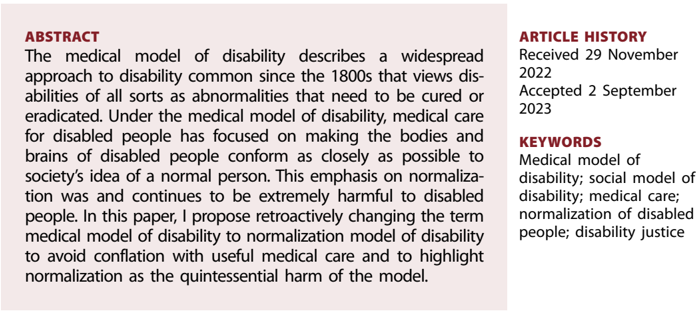
The medical model of disability describes a widespread approach to disability common since the 1800s that views disabilities of all sorts as abnormalities that need to be cured or eradicated.Under the medical model of disability, medical care for disabled people has focused on making the bodies and brains of disabled people conform as closely as possible to society's idea of a normal person.This emphasis on normalization was and continues to be extremely harmful to disabled people.In this paper, I propose retroactively changing the term medical model of disability to normalization model of disability to avoid conflation with useful medical care and to highlight normalization as the quintessential harm of the model. Points of interest• Disability models are mental maps that shape all aspects of life for disabled people.• The medical model of disability has dominated societies for a long time.• The medical model sees disabilities as abnormal and tries to make disabled people conform to our idea of a normal body or brain.• Trying to make disabled people just like so-called normal people is very harmful and hurts disabled people.• In this article, the author suggests we change the name of the medical model of disability to the normalization model of disability so that everyone understands clearly just how harmful normalization is.• The author also suggests we change the name because disabled people might want medical care in some circumstances.Using the term 'medical model' can cause confusion because the medical model was and continues to be very bad, but not all medical care is bad.
Overview
The claims and statistics of this paper haven’t been checked yet.
Run the check — free, no account needed. It reads the open-access text and checks the sources it cites.
Integrity signals
Registry
Cites
Statistics
Figures


Verification
Claims the paper makes
The claims and statistics of this paper haven’t been checked yet.
Run the check — free, no account needed. It reads the open-access text and checks the sources it cites.
Claims other papers make about this one
Each is checked against this paper’s own text: does it say what the citing paper says it does?
The source backs part of the claim, not all of it — or backs it for a different population, condition or comparison.
In the citing paper
“organisational responses to disability often focus on identifying and accommodating individual differences in relation to perceived workplace norms, rather than examining how workplace systems themselves are structured”
From The system-level organisational design framework: a neuro-cognitive trait interaction approach to workplace inclusion for autistic people (2026) · cites this paper as Zaks, 2024
Experimental — accuracy not yet measured
Self-check
Percentages, sums and reported differences re-computed from the paper’s own numbers.
The self-check needs the paper’s full text.
Citations
Cites
The Need for a New Medical Model: A Challenge for Biomedicine
Engel, G. L. (1977) · Science · doi:10.1126/science.847460 · Cited by 12,887
Asylums: Essays on the Social Situation of Mental Patients and Other Inmates.
Pfautz, H. W., & Goffman, E. (1962) · American Sociological Review · doi:10.2307/2090043 · Cited by 8,308
Lukes, S. (1974) · Power · doi:10.1007/978-0-230-80257-5_2 · Cited by 6,654
Selections from the Prison Notebooks
Gramsci, A. (2007) · Duke University Press eBooks · doi:10.2307/j.ctv120qr2d.14 · Cited by 6,401
Classificação Internacional de Funcionalidade (CIF)
Battistella, L. R., & de Brito, C. M. M. (2002) · Acta Fisiátrica · doi:10.5935/0104-7795.20020003 · Cited by 4,470
Oliver, M. (1990) · doi:10.1007/978-1-349-20895-1 · Cited by 4,227
SZASZ, T. S. (1960) · Springer eBooks · doi:10.1007/978-1-4615-6561-1_9 · Cited by 2,648
The disability paradox: high quality of life against all odds
Albrecht, G. L., & DEVLIEGER, P. J. (1999) · Social Science & Medicine · doi:10.1016/s0277-9536(98)00411-0 · Cited by 2,146
The social model of disability: thirty years on
Oliver, M. (2013) · Disability & Society · doi:10.1080/09687599.2013.818773 · Cited by 1,648
Davis, L. J. (2013) · Routledge eBooks · doi:10.4324/9780203077887 · Cited by 1,486
Research works printed but not linked: 24
- Andrews, E. E. 2020. Disability as Diversity: Developing Cultural Competence. Oxford: Oxford University Press.
- Asch, A. 1994. “The Human Genome Project and Disability Rights.” Disability Rag 15 (1): 12–15.
- Blatt, B., and F. Kaplan. 1966. Christmas in Purgatory. Boston: Allyn & Bacon.
- Brown, S. E. 2003. “Movie Stars and Sensuous Scars: Essays on the Journey from Disability Shame to Disability Pride.” Bloomington, IN: IUniverse.
- Conyers, L. M. 2003. “Disability Culture: A Cultural Model of Disability.” Rehabilitation Education 17 (3): 139–154.
- Dahrendorf, R. 1969. “On the Origin of Social Inequality.” In W. T. Blackstone (ed.), The Concept of Equality, 96–114. Minneapolis, MN: Burgess.
- Durkheim, E. 1969. “Individualism and the Intellectuals (S. Lukes, Trans.).” Political Studies 17 (1): 14–30 (Original work published 1898).
- Gabbard C. 2010. November 7. A life beyond reason. The Chronicle of Higher Education: The Chronicle Review. http://www.chronicle.com/article/a-life-beyond-reason/.
- Goble, C. 2014. “Dependence, Independence and Normality.” In Disabling Barriers – Enabling Environments, edited by J. Swain, S. French, C. Barnes, and C. Thomas, 31–36. Thousand Oaks, CA: Sage.
- Klein, J. M. 2012. “Compensating Victims of Forced Sterilization: Lessons from North Carolina. Journal of Law.” Medicine & Ethics 40 (2): 422–427.
- Linton, S., and C. von Tippelskirch, (Producers & Directors). 2014. Invitation to Dance [Motion Picture]. United States: Metuffer Films.
- 10.1007/978-1-349-02248-9 · DOI
- McBryde, J. H. 2005. Too Late to Die Young. New York: Henry Holt & Co.
- McDonald, G., and M. Oxford. 1995. “History of Independent Living.” Dayton, OH: Access Center for Independent Living.
- Oliver, M. 2004. “The Social Model in Action: If I Had a Hammer.” In C. Barnes and G. Mercer, Implementing the Social Model of Disability: Theory and Research, 18–31. Leeds, United Kingdom: The Disability Press.
- Parsons, T. 1951. The Social System. Glencoe, IL: Free Press.
- Rivera, G. 1972. Willowbrook: A Report on How It is and Why It Doesn’t Have to Be That Way. New York: Vintage Books.
- Saxton, M. 2013. “Disability Rights and Selective Abortion.” In The Disability Studies Reader, edited by L. J. Davis, 87–99. London: Routledge.
- Shakespeare, T. 2006. “The Social Model of Disability.” In The Disability Studies Reader, edited by L. J. Davis, 214–221. London: Routledge.
- 10.1037/h0046535 · DOI
- Thomas, C. 2014. “Disability and Impairment.” In Disabling Barriers – Enabling Environments, edited by J. Swain, S. French, C. Barnes, and C. Thomas, 9–16. Thousand Oaks, CA: Sage.
- Walker, N. 2012. “Throw Away the Master’s Tools: Liberating Ourselves from the Pathology Paradigm.” In Loud Hands: Autistic People, Speaking, edited by J. Bascom, 225–237. Washington, D.C.: The Autistic Press.
- Wendell, S. 1996. The Rejected Body. London: Routledge.
- World Health Organization. 2001. The International Classification of Functioning, Disability and Health (ICF). Geneva: World Health Organization.
Cited by
Sorted by citations
Woolfson, L. M. (2024) · British Journal of Educational Psychology · doi:10.1111/bjep.12701 · Cited by 88
Ailey, S. H., Bathje, M., Tichá, R., Abery, B. H., Khuu, B. P., & Angel, L. (2024) · Journal of Applied Research in Intellectual Disabilities · doi:10.1111/jar.13208 · Cited by 16
Förster, A., & Schnell, N. (2024) · International Journal of Child-Computer Interaction · doi:10.1016/j.ijcci.2024.100666 · Cited by 18
Defining hearing culture in context of Deaf culture: A grounded theory examination
Cue, K. R. (2024) · Disability & Society · doi:10.1080/09687599.2024.2369649 · Cited by 12
Rahajeng, U. W., Hendriani, W., & Paramita, P. P. (2024) · Disabilities · doi:10.3390/disabilities4030042 · Cited by 33
Disability Models: Societal Impacts and Policy Implications
Shamsabadipour, A. (2025) · Springer eBooks · doi:10.1007/978-3-031-40858-8_409-1 · Cited by 13
Richard, C., Corbière, M., Fiset-Renaud, H., Caiada, M., Lamontagne, J., Diotte, F., Kik, A.-M., Merlo, R., & Lecomte, T. (2025) · Journal of Occupational Rehabilitation · doi:10.1007/s10926-025-10288-1 · Cited by 8
Esparza, W. D., Lorenzo-Hidalgo, A., Camaño-Carballo, L., Vinueza-Fernandez, I., García-Pérez, D., Romero-Riaño, P., & Esparza-Agudelo, A. (2026) · Frontiers in Education · doi:10.3389/feduc.2026.1628793 · Cited by 8
Torres, M., Rocca, A., Mollo, A., Dorado, R. G., Ortega, M., Núñez, I., & González, G. (2025) · Education for Chemical Engineers · doi:10.1016/j.ece.2025.10.003 · Cited by 7
What Does Neurodiversity Mean to You? Shared Meanings from University Students, Faculty and Staff
Accardo, A. L., & Cormier, K. K. (2025) · Neurodiversity · doi:10.1177/27546330251331876 · Cited by 8
The Burn Survivor’s Perspective on Disability: A Survey-Based Analysis
Stanton, E. W., Celie, K., Chacon, D. W., Rutter, C., & Yenikomshian, H. A. (2025) · Journal of Burn Care & Research · doi:10.1093/jbcr/iraf045 · Cited by 5
Adjustment to the learning environment among university students who are deaf or hard of hearing
Percival, K., Ahmed, M., & Khan, N. B. (2025) · South African Journal of Communication Disorders · doi:10.4102/sajcd.v72i1.1114 · Cited by 14
Sudhakaran, G. M., Booth, C. A., Prabhakaran, A., He, P., Renukappa, S., & Abbey, S. J. (2025) · Smart and Sustainable Built Environment · doi:10.1108/sasbe-07-2025-0364 · Cited by 5
Ghosh, P., Liedo, B., & Riek, L. D. (2026) · ACM/IEEE International Conference on Human-Robot Interaction (HRI) · doi:10.1145/3757279.3785636 · Cited by 4
Sathananthan, N., Morris, E. M. J., das Nair, R., Gillanders, D. T., Wright, B. J., & Wong, D. K. (2025) · Neuropsychological Rehabilitation · doi:10.1080/09602011.2025.2476074 · Cited by 4
Social workers’ experience with the concept of empowerment: voices from the disability field
Tören, Z., & Açan, B. A. (2024) · Journal of Social Work Practice · doi:10.1080/02650533.2024.2379449 · Cited by 4
Nthibeli, M., Griffiths, D., & Bekker, T. L.-A. (2025) · Journal of Social Issues · doi:10.1111/josi.70031 · Cited by 8
Cultivating Inclusive Classroom Practices in Special Education
Nel, M., & Bornman, J. (2025) · Education Sciences · doi:10.3390/educsci15080970 · Cited by 3
Nutter, S., Waugh, R., McEachran, E., Toor, A., Shelley, J., Alberga, A. S., Forhan, M. A., Kirk, S., Nagpal, T. S., Patton, I. T., et al. (2025) · International Journal for Equity in Health · doi:10.1186/s12939-025-02606-z · Cited by 4
Phonetic cues to depression: A sociolinguistic perspective
Hall‐Lew, L. (2024) · Language and Linguistics Compass · doi:10.1111/lnc3.12529 · Cited by 3
AlMeraj, Z., Husain, F., & Arriaga, R. I. (2025) · IEEE Access · doi:10.1109/access.2025.3580608 · Cited by 6
Being heard and being seen: building connection in the Deafblind community
Hallinan, S., Bevis, M., Tseris, E. J., Lorenz, J., Cooper, A., Vodic, A., Belcher, D., Summers, K., & Howard, A. R. H. (2025) · Disability & Society · doi:10.1080/09687599.2025.2509551 · Cited by 2
Wu, F. Y., Udomsirirat, V. T., Dwertmann, D. J. G., & Oswald, F. L. (2025) · Journal of Vocational Behavior · doi:10.1016/j.jvb.2025.104192 · Cited by 2
Orozco, I., & López‐Gavira, R. (2026) · Higher Education Research & Development · doi:10.1080/07294360.2026.2627875 · Cited by 2
Inclusive education policies in Portugal: implications for the practice of occupational therapists
Silveira-Maia, M. (2024) · Cadernos Brasileiros de Terapia Ocupacional · doi:10.1590/2526-8910.ctoen392337962 · Cited by 2
The Role of Assistive Technology in Education
Chakabwata, W. (2024) · Advances in educational technologies and instructional design book series · doi:10.4018/979-8-3693-8227-1.ch007 · Cited by 2
Models of Disability and Sexuality
McCoy, R. T., Marynowski, K. D., McDonough, A. J., Joseph, K. M., & Bongar, B. M. (2024) · Springer eBooks · doi:10.1007/978-3-031-08956-5_2494-1 · Cited by 2
Boisgontier, M. P. (2025) · medRxiv · doi:10.1101/2025.02.22.25322346 · Cited by 2
Boisgontier, M. P. (2025) · medRxiv · doi:10.1101/2025.03.11.25323797 · Cited by 2
Política de educação inclusiva em Portugal: implicações para a prática dos terapeutas ocupacionais
Silveira-Maia, M. (2024) · Cadernos Brasileiros de Terapia Ocupacional · doi:10.1590/2526-8910.ctoen392337961 · Cited by 1
Disability Awareness and Inclusion
Gonzalez, C. C., Vasquez, R. C., & Reed, B. J. (2024) · Advances in educational marketing, administration, and leadership book series · doi:10.4018/979-8-3693-3342-6.ch001 · Cited by 1
Selisko, T. J., & Dilling, M. (2025) · International Journal of Changes in Education · doi:10.47852/bonviewijce52024575 · Cited by 1
Unmasking transition inequalities: why belonging is key to transitioning well in autism
Dallman, A., & Wright, M. (2025) · Journal of Occupational Therapy Schools & Early Intervention · doi:10.1080/19411243.2025.2516420 · Cited by 1
Hanssen, N. B., Valle, A. M., Lagestad, P., Tverbakk, M. L. R., & Marôco, J. P. (2025) · International Journal of Inclusive Education · doi:10.1080/13603116.2025.2514139 · Cited by 1
Lessons from the Pacific: a scoping review of Vanuatu disabilities in education practices
Vira, A. E., Page, A., & Ledger, S. (2025) · International Journal of Inclusive Education · doi:10.1080/13603116.2025.2530633 · Cited by 1
Undercover Oddball: An Autoethnographic Account of Neurodivergence in the Workplace
Taylor, A. (2025) · New Horizons in Adult Education and Human Resource Development · doi:10.1177/19394225251372291 · Cited by 1
Tal-Alon, N. (2025) · International Journal of Inclusive Education · doi:10.1080/13603116.2025.2560003 · Cited by 1
Biagiotti, G., Bellacicco, R., Moriña, A., & Tontini, L. (2025) · Studies in Higher Education · doi:10.1080/03075079.2025.2573214 · Cited by 3
Design, Disability, and Critical Pedagogy in STS
Whitney, K. S., Whitney, K., Healey, K., Hardin, J. A., Carter, A., Hamele, A., & Smith, L. (2025) · Science Technology & Human Values · doi:10.1177/01622439251386940 · Cited by 1
Más allá y más acá de la educación inclusiva. Crítica y expansión de su concepto
Herrero, P. R., & Gascón, A. D. L. H. (2025) · Estudios sobre Educación · doi:10.15581/004.51.001 · Cited by 1
Toward an Emergent Paradigm for Neurodiversity and Health
Hogenkamp, L., Sanghavi, D., & Natri, H. M. (2026) · Autism in Adulthood · doi:10.1177/25739581261433443 · Cited by 3
The source code of social theorising: engaging with binary distinctions, concepts and typologies
Mladenov, T. (2026) · Information Technology and People · doi:10.1108/itp-12-2025-1932 · Cited by 1
The Ethical Concerns of Human–Computer Interface in Assistive Systems: A Systematic Survey
Ejaz, S., Ahmad, J., Shafi, I., Rehman, H. M. R. U., & Ashraf, I. (2026) · International Journal of Human-Computer Interaction · doi:10.1080/10447318.2026.2659302 · Cited by 1
Kúld, P. B., Frielink, N., Schuengel, C., & Embregts, P. J. C. M. (2026) · PLoS ONE · doi:10.1371/journal.pone.0349403 · Cited by 1
AllPlay Dance: Enabling Access and Inclusion through Professional Development for Dance Teachers
Millard, O., Benham-Bannon, A., Surry, N., Lewis, S., Smith, M., & Rinehart, N. (2026) · Journal of Dance Education · doi:10.1080/15290824.2025.2522096 · Cited by 1
Murphy, A. (2026) · Disability & Society · doi:10.1080/09687599.2026.2709522 · Cited by 2
Lo, C. O., Tan, Y. S. M., Chang, C.-J., Lin, C.-H., Lau, M., Ng, N. K., Tsao, Y.-T., Huang, A., Chan, D., Guryil, G., et al. (2026) · International Journal of Qualitative Methods · doi:10.1177/16094069261476902 · Cited by 2
Designing with Impaired Technologies: A Game Jam of Constraints and Affordance Shrinkage
Lo, P., Stangroome, G. J., Joshi, V., Burnett, J., Thue, D., Bennett, D., & Metatla, O. (2026) · Annual Symposium on Computer-Human Interaction in Play · doi:10.1145/3800965.3834287 · Cited by 1
López‐Gavira, R., Orozco, I., & Angerhausen, P. (2024) · Zeitschrift für Bildungsforschung · doi:10.1007/s35834-024-00462-5 · Cited by 1
A Register-Based Study of Early-Life Disabilities and Income Attainment in Adulthood
Gugushvili, A., Finnvold, J. E., Dokken, T., & Grue, J. (2025) · Socius Sociological Research for a Dynamic World · doi:10.1177/23780231251335191 · Cited by 2
Budworth, P., & Larrington‐Spencer, H. (2025) · Springer eBooks · doi:10.1007/978-3-031-40858-8_232-1 · Cited by 2
Dark, J. (2026) · Frontiers in Psychology · doi:10.3389/fpsyg.2026.1826284
Meanings of independence and assistance: textual analysis of personal assistance in South Korea
Oh, J. (2024) · Disability & Society · doi:10.1080/09687599.2024.2360431
Nothing for Us, Without Us! Workplace Allyship and Employees with Disabilities
Stephenson, J. H. (2024) · Palgrave studies in equity, diversity, inclusion, and indigenization in business · doi:10.1007/978-3-031-64961-5_7 · Cited by 2
‘It Never Ends’: Disability Advocacy and the Practice of Resilient Hope
Gould, J. B. (2024) · Religions · doi:10.3390/rel15101166
Promoting Social Inclusion and Support of People With Intellectual and Developmental Disabilities
Sadiki, M. C. (2024) · Advances in psychology, mental health, and behavioral studies (APMHBS) book series · doi:10.4018/979-8-3693-3176-7.ch017
Adaptive Diving in South Africa: A Perspective of Disabled People and Their Support Structure
Makuyana, T., & Lucrezi, S. (2025) · Tourism in Marine Environments · doi:10.3727/216901925x17361523459298
Counselors-in-Training and Counselor Educators with Disabilities
Whittaker, T. T., Staten, B. H., & Pierce, K. L. (2024) · Springer texts in education · doi:10.1007/978-3-031-68358-9_13
Rahayu, A. M., Cahyono, D., & Palarani, Y. (2025) · Poverty & Public Policy · doi:10.1002/pop4.70013
Benoit, S. M. (2025) · IGI Global eBooks · doi:10.4018/979-8-3373-1000-8.ch009
Weber, R. R., & Caleb, A. M. (2025) · Teaching and Learning in Medicine · doi:10.1080/10401334.2025.2521002
Artaria, M. D., Suen, M., & Alaydrus, S. M. (2025) · Record and Library Journal · doi:10.20473/rlj.v11-i1.2025.127-144
Bodoraya, S. A. G. (2025) · Philippine Association for the Sociology of Religion Journal · doi:10.63931/4yvwtv38
Disability Identity as a Source for Innovative Learning
Skelton, S. M. (2025) · Springer international handbooks of education · doi:10.1007/978-3-031-57286-9_34-1
Blessy, R., & Shirly, S. (2025) · International Journal of Research in English · doi:10.33545/26648717.2025.v7.i2b.436
Boisgontier, M. P. (2025) · Physiotherapy Canada · doi:10.3138/ptc-2025-0026
Building a Bridge to Postsecondary Success From a Neurodiverse Perspective
Tapia, M. (2025) · IGI Global eBooks · doi:10.4018/979-8-3373-6350-9.ch003
Mulibana, P. K., Meregi, A. D., & Sikhwari, M. G. (2025) · E-Journal of Humanities Arts and Social Sciences · doi:10.38159/ehass.202561013
Toman, M., Atanasio, M., & Teaster, P. B. (2025) · Healthcare · doi:10.3390/healthcare13222925
Bamu, B. N. (2025) · Journal of Disability & Religion · doi:10.1080/23312521.2025.2594221
Hanlon, N. (2025) · International Journal of Social Pedagogy · doi:10.14324/111.444.ijsp.2025.v14.x.015
Accessibility Codes and Standards
Christoffersen, P., & Singer, P. M. (2025) · Springer eBooks · doi:10.1007/978-3-031-40858-8_601-1
A Scoping Review of Resettlement and Integration of Refugees with Disabilities
Badu, E., McMahon, T., & Goggin, G. M. (2025) · Journal of International Migration and Integration / Revue de l integration et de la migration internationale · doi:10.1007/s12134-025-01334-1
Gallardo-López, J. A., & Fernández, A. C. (2025) · VISUAL REVIEW International Visual Culture Review / Revista Internacional de Cultura Visual · doi:10.62161/revvisual.v17.5919
Honoring Alice Wong’s Legacy by Advocating for Disability Justice
Houtrow, A. J. (2026) · Archives of Physical Medicine and Rehabilitation · doi:10.1016/j.apmr.2025.12.026
Mohamed, A. H. H., Opoku, M. P., Almarzooqi, S. A., Alhmoudi, L., & Algburi, A. (2026) · The Family Journal · doi:10.1177/10664807251411485
Leech, C. C., & Solís, J. (2026) · Bilingual Research Journal · doi:10.1080/15235882.2026.2618718
Heerden, R. V., & Naicker, V. (2026) · EUREKA Social and Humanities · doi:10.21303/2504-5571.2026.004141
Neurodivergent Patients in Forensic Mental Health Wards: Practice Pointers From a Scoping Study
Foster, B., & Gibbs, A. (2026) · Kōtuitui New Zealand Journal of Social Sciences Online · doi:10.1002/kot2.70006
Ralić, A. Ž., Pavon, M. V., & Alimović, S. (2026) · Research in Developmental Disabilities · doi:10.1016/j.ridd.2026.105252
Moes, K. (2026) · Frontiers in Psychiatry · doi:10.3389/fpsyt.2026.1785195
Brushett, A., Séguin, K., Wong, L., McCarry-Taillefer, C., Rosenbaum, P., Packham, T., & Campbell, W. N. (2026) · Frontiers in Public Health · doi:10.3389/fpubh.2026.1745224 · Cited by 1
Lavreniuk, S., & Mazhak, I. (2026) · Springer eBooks · doi:10.1007/978-3-030-68127-2_841-1
Hughes, A. (2026) · Springer eBooks · doi:10.1007/978-3-032-15942-7_4
Disabled Nurses in an Ableist Profession: Lessons From the Past and Directions for the Future
Valdez, A. M. (2026) · Journal of Advanced Nursing · doi:10.1111/jan.70581
Derbyshire, J., Burns, N., & Azzarelli, S. (2026) · Neurodiversity · doi:10.1177/27546330261430014
Pan, L., & Dizon, T. C. T. (2026) · ETDC Indonesian Journal of Research and Educational Review · doi:10.51574/ijrer.v5i3.4542
Emotions and Philosophy of Disability
Eickers, G. (2026) · Oxford University Press eBooks · doi:10.1093/9780197852668.003.0034
Titchkosky, T., & Cagulada, E. (2026) · doi:10.1093/9780197852668.003.0025
Design for Dis/Ability: A Crip Inquiry into Personal Energy Tracking
Kaklopoulou, I., Homewood, S., & Sanches, P. (2026) · CHI Conference on Human Factors in Computing Systems · doi:10.1145/3772318.3790404
Aljaser, K. M. (2026) · Frontiers in Psychology · doi:10.3389/fpsyg.2026.1626005
Placing disability front and centre in political geography
Alexander, D. A. (2026) · Political Geography · doi:10.1016/j.polgeo.2026.103561
Emara, I. H. (2026) · Media Practice and Education · doi:10.1080/25741136.2026.2666915
Foundations: Bioethics, Disability, and Historical Injustices
Anilkumar, A. S., & Veerabathiran, R. (2026) · SpringerBriefs in modern perspectives on disability research. · doi:10.1007/978-981-95-8197-9_1
Understanding support needs: Finnish neurodivergent young adults’ perspectives
Heinijoki, H., Karhula, M., Vuoskoski, P., Munukka, M., Nikander, R., & Seppänen‐Järvelä, R. (2026) · Disability & Society · doi:10.1080/09687599.2026.2667531
Important Theories and Frameworks in Disability Education
Kumar, A., & Neha (2026) · SpringerBriefs in modern perspectives on disability research. · doi:10.1007/978-981-95-7823-8_2
Dayan, H., Khoury‐Kassabri, M., Krivine, E., & Bloch, Y. (2026) · European Child & Adolescent Psychiatry · doi:10.1007/s00787-026-03063-x
Colonial Medicine and the Making of the Disabled Body
Thomas, S. M., & Veerabathiran, R. (2026) · SpringerBriefs in modern perspectives on disability research. · doi:10.1007/978-981-95-8950-0_1
Metadata
- Authors
- Zaks, Z.
- Affiliations
- Fielding Graduate University (US)
- Corresponding author
- Zaks, Zosia
- ORCID
- Zaks, Zosia
- Venue
- Disability & Society
- Publisher
- Informa UK Limited
- Published
- 2023-09-15
- Volume
- 39
- Issue
- 12
- Pages
- 3233-3260
- ISSN
- 0267-4645 (ISSN-L)
- 0968-7599
- 1360-0508
- OpenAlex
- W4386775381
- Cited by
- 147
- References
- 163
- Citations by year
- 2026: 84 · 2025: 44 · 2024: 19
- FWCI
- 36.78
- Type
- journal article
- Language
- en
- Open access
- hybrid
- doi.org
- Licence
- Locations
- Disability & Society (publishedVersion, cc-by-nc-nd)
- Topics
- Social Sciences › Sociology and Political Science › Disability Rights and Representation
- Social Sciences › Arts and Humanities › History and Philosophy of Science › Medicine, History, and Philosophy
- Social Sciences › Education › Inclusion and Disability in Education and Sport
- Keywords
- medical model of disability, normalization, disability terminology, models of disability, disability rights, disability history
About these checks
Registry, retraction, Cites and statistics results are computed, not judged, with one exception: a printed reference that no index lists is read once by a model before it counts as a citation error. Claims are extracted by a model and kept only when their quote appears verbatim in the text; each cited source is then checked, with a model’s help, for whether it says what the claim relies on. Those verdicts can be wrong — read the claim’s quote and the cited source before relying on one.
Statistics and arithmetic are recomputed, not judged.
Confidence bands are shown only for fields calibrated on our annotated test set. None is calibrated yet, so no band is shown.
What counts as a claim ›How we measure confidence ›How we check this ›
Are you an author, or do you see a problem with this page? Request a review
