

The DOI matches its Crossref record; 157 of the 163 references it cites were found in a registry or an index.
Changing the medical model of disability to the normalization model of disability: clarifying the past to create a new future direction
Open accessAbstract
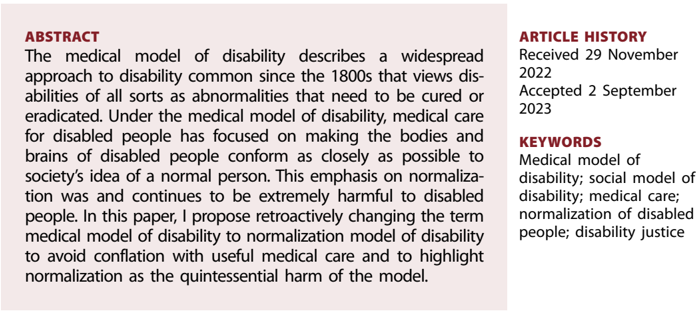
The medical model of disability describes a widespread approach to disability common since the 1800s that views disabilities of all sorts as abnormalities that need to be cured or eradicated.Under the medical model of disability, medical care for disabled people has focused on making the bodies and brains of disabled people conform as closely as possible to society's idea of a normal person.This emphasis on normalization was and continues to be extremely harmful to disabled people.In this paper, I propose retroactively changing the term medical model of disability to normalization model of disability to avoid conflation with useful medical care and to highlight normalization as the quintessential harm of the model. Points of interest• Disability models are mental maps that shape all aspects of life for disabled people.• The medical model of disability has dominated societies for a long time.• The medical model sees disabilities as abnormal and tries to make disabled people conform to our idea of a normal body or brain.• Trying to make disabled people just like so-called normal people is very harmful and hurts disabled people.• In this article, the author suggests we change the name of the medical model of disability to the normalization model of disability so that everyone understands clearly just how harmful normalization is.• The author also suggests we change the name because disabled people might want medical care in some circumstances.Using the term 'medical model' can cause confusion because the medical model was and continues to be very bad, but not all medical care is bad.
Overview
The claims and statistics of this paper haven’t been checked yet.
Run the check — free, no account needed. It reads the open-access text and checks the sources it cites.
Integrity signals
Registry
Cites
Statistics
Figures


Verification
Claims the paper makes
The claims and statistics of this paper haven’t been checked yet.
Run the check — free, no account needed. It reads the open-access text and checks the sources it cites.
Claims other papers make about this one
Each is checked against this paper’s own text: does it say what the citing paper says it does?
The source backs part of the claim, not all of it — or backs it for a different population, condition or comparison.
In the citing paper
“organisational responses to disability often focus on identifying and accommodating individual differences in relation to perceived workplace norms, rather than examining how workplace systems themselves are structured”
From The system-level organisational design framework: a neuro-cognitive trait interaction approach to workplace inclusion for autistic people (2026) · cites this paper as Zaks, 2024
Experimental — accuracy not yet measured
Self-check
Percentages, sums and reported differences re-computed from the paper’s own numbers.
The self-check needs the paper’s full text.
Citations
Cites
The Need for a New Medical Model: A Challenge for Biomedicine
Engel, G. L. (1977) · Science · doi:10.1126/science.847460 · Cited by 12,887
Asylums: Essays on the Social Situation of Mental Patients and Other Inmates.
Pfautz, H. W., & Goffman, E. (1962) · American Sociological Review · doi:10.2307/2090043 · Cited by 8,308
Lukes, S. (1974) · Power · doi:10.1007/978-0-230-80257-5_2 · Cited by 6,654
Selections from the Prison Notebooks
Gramsci, A. (2007) · Duke University Press eBooks · doi:10.2307/j.ctv120qr2d.14 · Cited by 6,401
Classificação Internacional de Funcionalidade (CIF)
Battistella, L. R., & de Brito, C. M. M. (2002) · Acta Fisiátrica · doi:10.5935/0104-7795.20020003 · Cited by 4,470
Oliver, M. (1990) · doi:10.1007/978-1-349-20895-1 · Cited by 4,227
SZASZ, T. S. (1960) · Springer eBooks · doi:10.1007/978-1-4615-6561-1_9 · Cited by 2,648
The disability paradox: high quality of life against all odds
Albrecht, G. L., & DEVLIEGER, P. J. (1999) · Social Science & Medicine · doi:10.1016/s0277-9536(98)00411-0 · Cited by 2,146
The social model of disability: thirty years on
Oliver, M. (2013) · Disability & Society · doi:10.1080/09687599.2013.818773 · Cited by 1,648
Davis, L. J. (2013) · Routledge eBooks · doi:10.4324/9780203077887 · Cited by 1,486
Research works printed but not linked: 24
- Andrews, E. E. 2020. Disability as Diversity: Developing Cultural Competence. Oxford: Oxford University Press.
- Asch, A. 1994. “The Human Genome Project and Disability Rights.” Disability Rag 15 (1): 12–15.
- Blatt, B., and F. Kaplan. 1966. Christmas in Purgatory. Boston: Allyn & Bacon.
- Brown, S. E. 2003. “Movie Stars and Sensuous Scars: Essays on the Journey from Disability Shame to Disability Pride.” Bloomington, IN: IUniverse.
- Conyers, L. M. 2003. “Disability Culture: A Cultural Model of Disability.” Rehabilitation Education 17 (3): 139–154.
- Dahrendorf, R. 1969. “On the Origin of Social Inequality.” In W. T. Blackstone (ed.), The Concept of Equality, 96–114. Minneapolis, MN: Burgess.
- Durkheim, E. 1969. “Individualism and the Intellectuals (S. Lukes, Trans.).” Political Studies 17 (1): 14–30 (Original work published 1898).
- Gabbard C. 2010. November 7. A life beyond reason. The Chronicle of Higher Education: The Chronicle Review. http://www.chronicle.com/article/a-life-beyond-reason/.
- Goble, C. 2014. “Dependence, Independence and Normality.” In Disabling Barriers – Enabling Environments, edited by J. Swain, S. French, C. Barnes, and C. Thomas, 31–36. Thousand Oaks, CA: Sage.
- Klein, J. M. 2012. “Compensating Victims of Forced Sterilization: Lessons from North Carolina. Journal of Law.” Medicine & Ethics 40 (2): 422–427.
- Linton, S., and C. von Tippelskirch, (Producers & Directors). 2014. Invitation to Dance [Motion Picture]. United States: Metuffer Films.
- 10.1007/978-1-349-02248-9 · DOI
- McBryde, J. H. 2005. Too Late to Die Young. New York: Henry Holt & Co.
- McDonald, G., and M. Oxford. 1995. “History of Independent Living.” Dayton, OH: Access Center for Independent Living.
- Oliver, M. 2004. “The Social Model in Action: If I Had a Hammer.” In C. Barnes and G. Mercer, Implementing the Social Model of Disability: Theory and Research, 18–31. Leeds, United Kingdom: The Disability Press.
- Parsons, T. 1951. The Social System. Glencoe, IL: Free Press.
- Rivera, G. 1972. Willowbrook: A Report on How It is and Why It Doesn’t Have to Be That Way. New York: Vintage Books.
- Saxton, M. 2013. “Disability Rights and Selective Abortion.” In The Disability Studies Reader, edited by L. J. Davis, 87–99. London: Routledge.
- Shakespeare, T. 2006. “The Social Model of Disability.” In The Disability Studies Reader, edited by L. J. Davis, 214–221. London: Routledge.
- 10.1037/h0046535 · DOI
- Thomas, C. 2014. “Disability and Impairment.” In Disabling Barriers – Enabling Environments, edited by J. Swain, S. French, C. Barnes, and C. Thomas, 9–16. Thousand Oaks, CA: Sage.
- Walker, N. 2012. “Throw Away the Master’s Tools: Liberating Ourselves from the Pathology Paradigm.” In Loud Hands: Autistic People, Speaking, edited by J. Bascom, 225–237. Washington, D.C.: The Autistic Press.
- Wendell, S. 1996. The Rejected Body. London: Routledge.
- World Health Organization. 2001. The International Classification of Functioning, Disability and Health (ICF). Geneva: World Health Organization.
Cited by
Sorted by citations
Woolfson, L. M. (2024) · British Journal of Educational Psychology · doi:10.1111/bjep.12701 · Cited by 88
Ailey, S. H., Bathje, M., Tichá, R., Abery, B. H., Khuu, B. P., & Angel, L. (2024) · Journal of Applied Research in Intellectual Disabilities · doi:10.1111/jar.13208 · Cited by 16
Förster, A., & Schnell, N. (2024) · International Journal of Child-Computer Interaction · doi:10.1016/j.ijcci.2024.100666 · Cited by 18
Defining hearing culture in context of Deaf culture: A grounded theory examination
Cue, K. R. (2024) · Disability & Society · doi:10.1080/09687599.2024.2369649 · Cited by 12
Rahajeng, U. W., Hendriani, W., & Paramita, P. P. (2024) · Disabilities · doi:10.3390/disabilities4030042 · Cited by 33
Metadata
- Authors
- Zaks, Z.
- Affiliations
- Fielding Graduate University (US)
- Corresponding author
- Zaks, Zosia
- ORCID
- Zaks, Zosia
- Venue
- Disability & Society
- Publisher
- Informa UK Limited
- Published
- 2023-09-15
- Volume
- 39
- Issue
- 12
- Pages
- 3233-3260
- ISSN
- 0267-4645 (ISSN-L)
- 0968-7599
- 1360-0508
- OpenAlex
- W4386775381
- Cited by
- 147
- References
- 163
- Citations by year
- 2026: 84 · 2025: 44 · 2024: 19
- FWCI
- 36.78
- Type
- journal article
- Language
- en
- Open access
- hybrid
- doi.org
- Licence
- Locations
- Disability & Society (publishedVersion, cc-by-nc-nd)
- Topics
- Social Sciences › Sociology and Political Science › Disability Rights and Representation
- Social Sciences › Arts and Humanities › History and Philosophy of Science › Medicine, History, and Philosophy
- Social Sciences › Education › Inclusion and Disability in Education and Sport
- Keywords
- medical model of disability, normalization, disability terminology, models of disability, disability rights, disability history
About these checks
Registry, retraction, Cites and statistics results are computed, not judged, with one exception: a printed reference that no index lists is read once by a model before it counts as a citation error. Claims are extracted by a model and kept only when their quote appears verbatim in the text; each cited source is then checked, with a model’s help, for whether it says what the claim relies on. Those verdicts can be wrong — read the claim’s quote and the cited source before relying on one.
Statistics and arithmetic are recomputed, not judged.
Confidence bands are shown only for fields calibrated on our annotated test set. None is calibrated yet, so no band is shown.
What counts as a claim ›How we measure confidence ›How we check this ›
Are you an author, or do you see a problem with this page? Request a review
