

The DOI matches its Crossref record; 157 of the 163 references it cites were found in a registry or an index.
Changing the medical model of disability to the normalization model of disability: clarifying the past to create a new future direction
Open accessAbstract
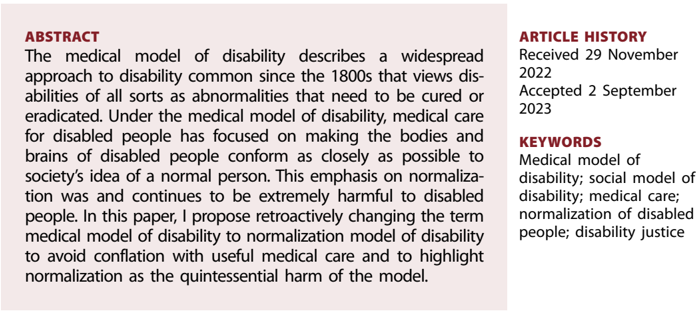
The medical model of disability describes a widespread approach to disability common since the 1800s that views disabilities of all sorts as abnormalities that need to be cured or eradicated.Under the medical model of disability, medical care for disabled people has focused on making the bodies and brains of disabled people conform as closely as possible to society's idea of a normal person.This emphasis on normalization was and continues to be extremely harmful to disabled people.In this paper, I propose retroactively changing the term medical model of disability to normalization model of disability to avoid conflation with useful medical care and to highlight normalization as the quintessential harm of the model. Points of interest• Disability models are mental maps that shape all aspects of life for disabled people.• The medical model of disability has dominated societies for a long time.• The medical model sees disabilities as abnormal and tries to make disabled people conform to our idea of a normal body or brain.• Trying to make disabled people just like so-called normal people is very harmful and hurts disabled people.• In this article, the author suggests we change the name of the medical model of disability to the normalization model of disability so that everyone understands clearly just how harmful normalization is.• The author also suggests we change the name because disabled people might want medical care in some circumstances.Using the term 'medical model' can cause confusion because the medical model was and continues to be very bad, but not all medical care is bad.
Overview
The claims and statistics of this paper haven’t been checked yet.
Run the check — free, no account needed. It reads the open-access text and checks the sources it cites.
Integrity signals
Registry
Cites
Statistics
Figures


Verification
Claims the paper makes
The claims and statistics of this paper haven’t been checked yet.
Run the check — free, no account needed. It reads the open-access text and checks the sources it cites.
Claims other papers make about this one
Each is checked against this paper’s own text: does it say what the citing paper says it does?
The source backs part of the claim, not all of it — or backs it for a different population, condition or comparison.
In the citing paper
“organisational responses to disability often focus on identifying and accommodating individual differences in relation to perceived workplace norms, rather than examining how workplace systems themselves are structured”
From The system-level organisational design framework: a neuro-cognitive trait interaction approach to workplace inclusion for autistic people (2026) · cites this paper as Zaks, 2024
Experimental — accuracy not yet measured
Self-check
Percentages, sums and reported differences re-computed from the paper’s own numbers.
The self-check needs the paper’s full text.
Citations
Cites
The Need for a New Medical Model: A Challenge for Biomedicine
Engel, G. L. (1977) · Science · doi:10.1126/science.847460 · Cited by 12,887
Asylums: Essays on the Social Situation of Mental Patients and Other Inmates.
Pfautz, H. W., & Goffman, E. (1962) · American Sociological Review · doi:10.2307/2090043 · Cited by 8,308
Lukes, S. (1974) · Power · doi:10.1007/978-0-230-80257-5_2 · Cited by 6,654
Selections from the Prison Notebooks
Gramsci, A. (2007) · Duke University Press eBooks · doi:10.2307/j.ctv120qr2d.14 · Cited by 6,401
Classificação Internacional de Funcionalidade (CIF)
Battistella, L. R., & de Brito, C. M. M. (2002) · Acta Fisiátrica · doi:10.5935/0104-7795.20020003 · Cited by 4,470
Oliver, M. (1990) · doi:10.1007/978-1-349-20895-1 · Cited by 4,227
SZASZ, T. S. (1960) · Springer eBooks · doi:10.1007/978-1-4615-6561-1_9 · Cited by 2,648
The disability paradox: high quality of life against all odds
Albrecht, G. L., & DEVLIEGER, P. J. (1999) · Social Science & Medicine · doi:10.1016/s0277-9536(98)00411-0 · Cited by 2,146
The social model of disability: thirty years on
Oliver, M. (2013) · Disability & Society · doi:10.1080/09687599.2013.818773 · Cited by 1,648
Davis, L. J. (2013) · Routledge eBooks · doi:10.4324/9780203077887 · Cited by 1,486
The Social Construction of Reality
Berger, P. L., & Luckmann, T. (2023) · Routledge eBooks · doi:10.4324/9781003320609-11 · Cited by 1,455
(2018) · فصلنامه علمی پژوهشی توانبخشی · doi:10.32598/rj · Cited by 1,454
Asylums :essays on the social situation of mental patients andother inmates
Goffman, E. (1991) · Andalas University Repository (Andalas University) · Cited by 1,330
Disability Rights and Wrongs Revisited
Shakespeare, T. (2013) · Routledge eBooks · doi:10.4324/9781315887456 · Cited by 1,222
International classification of impairments, disabilities, and handicaps
&NA; (1980) · International Journal of Rehabilitation Research · doi:10.1097/00004356-198012000-00032 · Cited by 1,195
The social model of disability: An outdated ideology?
Shakespeare, T., & Watson, N. (2004) · Research in social science and disability · doi:10.1016/s1479-3547(01)80018-x · Cited by 1,166
Good days, bad days: the self in chronic illness and time
(1992) · Choice Reviews Online · doi:10.5860/choice.29-5985 · Cited by 1,136
Nothing about us without us: disability oppression and empowerment
Charlton, J. I. (1998) · Choice Reviews Online · doi:10.5860/choice.36-0640 · Cited by 1,124
Disabling Barriers-Enabling Environments
Shakespeare, T. (1994) · Disability & Society · doi:10.1080/09687599466780121 · Cited by 976
The Concept of Oppression and the Development of a Social Theory of Disability
Abberley, P. (1987) · Disability & Society · doi:10.1080/02674648766780021 · Cited by 844
Social Work with Disabled People
Oliver, M. (1983) · doi:10.1007/978-1-349-86058-6 · Cited by 813
No Pity: People with Disabilities Forging a New Civil Rights Movement
Leighty, C. A., & Shapiro, J. P. (1994) · Michigan Law Review · doi:10.2307/1289622 · Cited by 771
Towards an Affirmation Model of Disability
Swain, J., & French, S. (2000) · Disability & Society · doi:10.1080/09687590050058189 · Cited by 719
Garland‐Thomson, R. (2005) · Signs · doi:10.1086/423352 · Cited by 704
The Capability Approach and Disability
Mitra, S. (2006) · Journal of Disability Policy Studies · doi:10.1177/10442073060160040501 · Cited by 666
Decolonising disability: Thinking and acting globally
Meekosha, H. (2011) · Disability & Society · doi:10.1080/09687599.2011.602860 · Cited by 653
Flint, Environmental Racism, and Racial Capitalism
Pulido, L. (2016) · Capitalism Nature Socialism · doi:10.1080/10455752.2016.1213013 · Cited by 639
No Pity: People with Disabilities Forging a New Civil Rights Movement
Shapiro, J. P. (1993) · Cited by 610
Barton, L., Barnes, C., & Oliver, M. (2002) · Polity Press eBooks · Cited by 590
Cultural Representation of Disabled People: Dustbins for Disavowal?
Shakespeare, T. (1994) · Disability & Society · doi:10.1080/09687599466780341 · Cited by 588
The Clinical Application of the Biopsychosocial Model
Engel, G. L. (1981) · Journal of Medicine and Philosophy · doi:10.1093/jmp/6.2.101 · Cited by 531
The Universal Design File: Designing for People of All Ages and Abilities
Story, M. F., Mueller, J., & Mace, R. L. (1998) · Cited by 493
McDermott, R., & Varenne, H. (1995) · Anthropology & Education Quarterly · doi:10.1525/aeq.1995.26.3.05x0936z · Cited by 482
Rethinking disability: the social model of disability and chronic disease
Goering, S. (2015) · Current Reviews in Musculoskeletal Medicine · doi:10.1007/s12178-015-9273-z · Cited by 477
Toward a Feminist Theory of Disability
Wendell, S. (1989) · Hypatia · doi:10.1111/j.1527-2001.1989.tb00576.x · Cited by 469
The Social Model of Disability: Dichotomy between Impairment and Disability
Anastasiou, D., & Kauffman, J. M. (2013) · The Journal of Medicine and Philosophy A Forum for Bioethics and Philosophy of Medicine · doi:10.1093/jmp/jht026 · Cited by 448
Routledge Handbook of Disability Studies
Watson, N., Roulstone, A., & Thomas, C. (2013) · Routledge eBooks · doi:10.4324/9780203144114 · Cited by 446
The Case for Conserving Disability
Garland‐Thomson, R. (2012) · Journal of Bioethical Inquiry · doi:10.1007/s11673-012-9380-0 · Cited by 446
Disability and the Justification of Inequality in American History
Davis, L. J. (2013) · Routledge eBooks · doi:10.4324/9780203077887-8 · Cited by 440
Including all of our lives: Renewing the social model of disability
Crow, L. (2010) · doi:10.4324/9780203839782-15 · Cited by 421
Pellow, D. N. (2016) · Du Bois Review: Social Science Research on Race · doi:10.1017/s1742058x1600014x · Cited by 343
Kirmayer, L. J. (2006) · Transcultural Psychiatry · doi:10.1177/1363461506061761 · Cited by 326
Social Pathology: A Systematic Approach to the Theory of Sociopathic Behavior
Lemert, E. M. (1951) · JAMA · doi:10.1001/jama.1951.03670190103037 · Cited by 322
An Institutional History of Disability
Braddock, D. L., & Parish, S. L. (2001) · Sage eBooks · doi:10.4135/9781412976251.n2 · Cited by 314
Definitions, Models, Classifications, Schemes, and Applications
Altman, B. M. (2001) · Sage eBooks · doi:10.4135/9781412976251.n4 · Cited by 313
Marks, D. (1997) · Disability and Rehabilitation · doi:10.3109/09638289709166831 · Cited by 308
The Politics of Physical Differences: Disability and Discrimination
Hahn, H. (1988) · Journal of Social Issues · doi:10.1111/j.1540-4560.1988.tb02047.x · Cited by 298
Universalism, universal design and equitable access to the built environment
Imrie, R. (2012) · Disability and Rehabilitation · doi:10.3109/09638288.2011.624250 · Cited by 284
Johnson, M. L., & McRuer, R. (2014) · Journal of Literary & Cultural Disability Studies · doi:10.3828/jlcds.2014.12 · Cited by 281
Human Rights and the Global South: the case of disability
Meekosha, H., & Soldatić, K. (2011) · Third World Quarterly · doi:10.1080/01436597.2011.614800 · Cited by 280
The origin and nature of our institutional models
Wolfensberger, W. P. (1975) · Medical Entomology and Zoology · Cited by 259
Disability: Identity and Difference
(2000) · Bloomsbury Academic eBooks · doi:10.5040/9781350393189.ch-007 · Cited by 258
Ginsburg, F., & Rapp, R. (2013) · Annual Review of Anthropology · doi:10.1146/annurev-anthro-092412-155502 · Cited by 257
Social and medical models of disability and mental health: evolution and renewal
Hogan, A. J. (2019) · Canadian Medical Association Journal · doi:10.1503/cmaj.181008 · Cited by 240
Toward the Necessary Universalizing of a Disability Policy
Zola, I. K. (1989) · Milbank Quarterly · doi:10.2307/3350151 · Cited by 234
Grech, S. (2015) · Social Identities · doi:10.1080/13504630.2014.995347 · Cited by 228
Hans Asperger, National Socialism, and “race hygiene” in Nazi-era Vienna
Czech, H. (2018) · Molecular Autism · doi:10.1186/s13229-018-0208-6 · Cited by 226
Gabel, S. L., & Peters, S. (2004) · Disability & Society · doi:10.1080/0968759042000252515 · Cited by 225
Disability, poverty and development: critical reflections on the majority world debate
Grech, S. (2009) · Disability & Society · doi:10.1080/09687590903160266 · Cited by 214
Health and Illness in a Changing Society
Conrad, P., & Bury, M. R. (1998) · Contemporary Sociology A Journal of Reviews · doi:10.2307/2654542 · Cited by 210
Disability: A Diversity Model Approach in Human Service Practice
Mackelprang, R. W., & Salsgiver, R. O. (1998) · Medical Entomology and Zoology · Cited by 209
Southern Bodies and Disability: re-thinking concepts
Connell, R. W. (2011) · Third World Quarterly · doi:10.1080/01436597.2011.614799 · Cited by 200
A New Human Rights Model of Disability
Degener, T. (2017) · Springer eBooks · doi:10.1007/978-3-319-43790-3_2 · Cited by 193
The Sociology and Social Psychology of Disability and Rehabilitation.
Scott, F. G., & Safilios‐Rothschild, C. (1972) · Contemporary Sociology A Journal of Reviews · doi:10.2307/2063500 · Cited by 192
Hostile, benevolent and ambivalent ableism: contemporary manifestations
Nario‐Redmond, M. R., Kemerling, A. A., & Silverman, A. (2019) · Journal of Social Issues · doi:10.1111/josi.12337 · Cited by 187
Universal Design and the Problem of “Post-Disability” Ideology
Hamraie, A. (2016) · Design and Culture · doi:10.1080/17547075.2016.1218714 · Cited by 163
Mitchell, D., & Snyder, S. L. (2003) · Disability & Society · doi:10.1080/0968759032000127281 · Cited by 160
The Road to Empowerment: A Historical Perspective on the Medicalization of Disability
Hayes, J., & Hannold, E. M. (2007) · Journal of Health and Human Services Administration · doi:10.1177/107937390703000303 · Cited by 145
The rise and fall of the biopsychosocial model: reconciling art and science in psychiatry
(2010) · Choice Reviews Online · doi:10.5860/choice.47-6284 · Cited by 136
In the name of health and illness: On some socio-political consequences of medical influence
Zola, I. K. (1975) · Social Science & Medicine (1967) · doi:10.1016/0037-7856(75)90098-0 · Cited by 135
Limitations of the biopsychosocial model in psychiatry
Benning, T. B. (2015) · Advances in Medical Education and Practice · doi:10.2147/amep.s82937 · Cited by 132
Bunbury, S. (2019) · International Journal of Discrimination and the Law · doi:10.1177/1358229118820742 · Cited by 130
What we have done: an oral history of the disability rights movement
(2012) · Choice Reviews Online · doi:10.5860/choice.50-0560 · Cited by 125
Recovering a Cripistemology of Pain
Patsavas, A. (2014) · Journal of Literary & Cultural Disability Studies · doi:10.3828/jlcds.2014.16 · Cited by 123
The sociology and social psychology of disability and rehabilitation
Bolton, B. (1971) · Social Science & Medicine (1967) · doi:10.1016/0037-7856(71)90022-9 · Cited by 123
Williams, G. (2001) · Sage eBooks · doi:10.4135/9781412976251.n5 · Cited by 119
Self‐Determination and Empowerment: A Feminist Standpoint Analysis of Talk about Disability
Sprague, J., & Hayes, J. (2000) · American Journal of Community Psychology · doi:10.1023/a:1005197704441 · Cited by 106
Anthropological Theories of Disability
Reid-Cunningham, A. R. (2009) · Journal of Human Behavior in the Social Environment · doi:10.1080/10911350802631644 · Cited by 104
Good Days, Bad Days: The Self in Chronic Illness and Time
Charmaz, K. C. (1991) · DigitalGeorgetown (Georgetown University Library) · Cited by 104
The Power of Models of Disability
Smart, J. F. (2009) · Digital Commons - USU (Utah State University) · Cited by 103
Disability: a welfarist approach
Savulescu, J., & Kahane, G. (2011) · Clinical Ethics · doi:10.1258/ce.2011.011010 · Cited by 102
Qureshi, H., & Walker, A. (1989) · doi:10.1007/978-1-349-20264-5_7 · Cited by 102
Do disabled people need a stronger social model: a social model of human rights?
Berghs, M. J., Atkin, K. M., Hatton, C., & Thomas, C. (2019) · Disability & Society · doi:10.1080/09687599.2019.1619239 · Cited by 102
What we have done: an oral history of the disability rights movement
Markie-Frost, K. (2013) · International Journal of Disability Development and Education · doi:10.1080/1034912x.2013.854955 · Cited by 97
Exploring how the social model of disability can be re-invigorated: in response to Mike Oliver
Levitt, J. M. (2017) · Disability & Society · doi:10.1080/09687599.2017.1300390 · Cited by 97
The Rise and Fall of the Biopsychosocial Model
Ghaemi, S. N. (2012) · Johns Hopkins University Press eBooks · doi:10.1353/book.3501 · Cited by 94
Transnationalising Disability Studies: Rights, Justice and Impairment
Soldatić, K., & Grech, S. (2014) · Disability Studies Quarterly · doi:10.18061/dsq.v34i2.4249 · Cited by 91
Socio-Medical Inquiries: Recollections, Reflections, and Reconsiderations.
Verbrugge, L. M., & Zola, I. K. (1984) · Contemporary Sociology A Journal of Reviews · doi:10.2307/2069099 · Cited by 90
Hahn, H. (1985) · American Behavioral Scientist · doi:10.1177/000276485028003002 · Cited by 87
Blaming the victim, all over again: Waddell and Aylward’s biopsychosocial (BPS) model of disability
Shakespeare, T., Watson, N., & Alghaib, O. A. (2016) · Critical Social Policy · doi:10.1177/0261018316649120 · Cited by 87
‘The line between intervention and abuse’ – autism and applied behaviour analysis
Kirkham, P. (2017) · History of the Human Sciences · doi:10.1177/0952695117702571 · Cited by 85
Hunt, W. A. (1956) · Charles C Thomas Publisher eBooks · doi:10.1037/11153-000 · Cited by 83
On embodiment: A case study of congenital limb deficiency in American culture
Frank, G. (1986) · Culture Medicine and Psychiatry · doi:10.1007/bf00114696 · Cited by 81
Pauli, B. J. (2020) · Wiley Interdisciplinary Reviews Water · doi:10.1002/wat2.1420 · Cited by 79
“Beyond the Pale”: Tainted Whiteness, Cognitive Disability, and Eugenic Sterilization
Stubblefield, A. (2007) · Hypatia · doi:10.1111/j.1527-2001.2007.tb00987.x · Cited by 75
Barnes, C. (1992) · Personnel Review · doi:10.1108/00483489210021080 · Cited by 65
Citizenship: reflections on a relevant but ambivalent concept for persons with disabilities
Waldschmidt, A., & Sépulchre, M. (2019) · Disability & Society · doi:10.1080/09687599.2018.1543580 · Cited by 64
Theories of disability and the origins of the oppression of disabled people in western society
Barnes, C. (2018) · Routledge eBooks · doi:10.4324/9781315841984-4 · Cited by 64
Turning experience into theory: The affirmation model as a tool for critical Praxis
Cameron, C. (2015) · Social Work and Social Sciences Review · doi:10.1921/swssr.v17i3.802 · Cited by 62
Medical Sociology and Disability Theory
Thomas, C. (2010) · Palgrave Macmillan UK eBooks · doi:10.1057/9780230297432_3 · Cited by 60
The Physically Handicapped in Certain Non‐Occidental Societies
Hanks, J. R., & Hanks, L. M. (1948) · Journal of Social Issues · doi:10.1111/j.1540-4560.1948.tb01514.x · Cited by 60
A sociology of disability or a disablist sociology?
Oliver, M. (2018) · Routledge eBooks · doi:10.4324/9781315841984-3 · Cited by 60
Living with a chronic deteriorating disease: the trajectory with muscular dystrophy over ten years
Boström, K., & Ahlström, G. (2004) · Disability and Rehabilitation · doi:10.1080/0963-8280400000898 · Cited by 58
Handbook of rehabilitation counseling
Riggar, T. F., & Maki, D. R. (2004) · Springer eBooks · Cited by 56
Gibson, B. E. (2014) · Disability and Rehabilitation · doi:10.3109/09638288.2014.891661 · Cited by 54
Hogan, A. J. (2019) · Bulletin of the history of medicine · doi:10.1353/bhm.2019.0028 · Cited by 54
The Concept of Harm and the Significance of Normality
Kahane, G., & Savulescu, J. (2012) · Journal of Applied Philosophy · doi:10.1111/j.1468-5930.2012.00574.x · Cited by 52
McGill, P., Bradshaw, J., Smyth, G., Hurman, M., & Roy, A. (2020) · Tizard Learning Disability Review · doi:10.1108/tldr-05-2020-0007 · Cited by 47
Areheart, B. A. (2008) · Indiana Magazine of History (Indiana University) · Cited by 43
'Us' and 'them'? Feminist research, community care and disability*
Morris, J. (1991) · Critical Social Policy · doi:10.1177/026101839101103302 · Cited by 43
Situating universal design architecture: designing with whom?
Jones, P. (2014) · Disability and Rehabilitation · doi:10.3109/09638288.2014.944274 · Cited by 42
SOME OBSERVATIONS ON THE RELATIONSHIP BETWEEN PSYCHIATRY AND THE LAW
SZASZ, T. S. (1956) · Archives of Neurology And Psychiatry · doi:10.1001/archneurpsyc.1956.02330210077008 · Cited by 40
Disability : the social, political, and ethical debate
Baird, R., Rosenbaum, S. E., & Toombs, S. K. (2009) · DigitalGeorgetown (Georgetown University Library) · Cited by 38
Disability as a dialectical concept: building on Vygotsky’s defectology
Bøttcher, L., & Dammeyer, J. (2012) · European Journal of Special Needs Education · doi:10.1080/08856257.2012.711958 · Cited by 38
‘Cabbage Syndrome’: The Social Construction of Dependence
Stevens, A. R. A. (1991) · Disability & Society · doi:10.1080/02674649166780181 · Cited by 36
Reconciling the capability approach and the ICF
Bickenbach, J. E. (2014) · Alter · doi:10.1016/j.alter.2013.08.003 · Cited by 36
Notes on Natural Worlds, Disabled Bodies, and a Politics of Cure
Clare, E. (2017) · UNP - Nebraska eBooks · doi:10.2307/j.ctt1p6jht5.11 · Cited by 33
Postmodern synergistic knowledge creation: extending the boundaries of disability studies
Simmons, B., Blackmore, T., & Bayliss, P. (2008) · Disability & Society · doi:10.1080/09687590802469222 · Cited by 32
Pediatric lead exposure and the water crisis in Flint, Michigan
DeWitt, R. D. (2017) · JAAPA · doi:10.1097/01.jaa.0000511794.60054.eb · Cited by 32
Psychological Disadvantage and a Welfarist Approach to Psychiatry
Roache, R., & Savulescu, J. (2018) · Philosophy, psychiatry & psychology · doi:10.1353/ppp.2018.0035 · Cited by 31
Reinders, J. S., Stainton, T., & Parmenter, T. R. (2019) · Journal of Policy and Practice in Intellectual Disabilities · doi:10.1111/jppi.12298 · Cited by 28
Sociology and disability: some emerging issues
Barton, L. (2018) · Routledge eBooks · doi:10.4324/9781315841984-2 · Cited by 27
Models of Disability: The Juxtaposition of Biology and Social Construction
Smart, J. F. (2003) · Digital Commons - USU (Utah State University) · Cited by 24
Salmon, A. (2007) · The Journal for Critical Education Policy Studies · Cited by 23
Koch, T. (2005) · Journal of Disability Policy Studies · doi:10.1177/10442073050160020301 · Cited by 23
Goffman’sAsylumsand the Total Institution Model of Mental Hospitals
Weinstein, R. M. (1994) · Psychiatry · doi:10.1080/00332747.1994.11024699 · Cited by 22
Quality of Health Care for People With Developmental Disabilities: The Challenge of Managed Care
Walsh, K. K., Kastner, T. A., & Taylor, S. J. (1999) · Mental Retardation · doi:10.1352/0047-6765(1999)037 · Cited by 21
Foucault and ‘the Right to Life’: from Technologies of Normalization to Societies of Control”
Anders, A. D. (2013) · Disability Studies Quarterly · doi:10.18061/dsq.v33i3.3340 · Cited by 19
Times Change, but Things Remain the Same
Thomas, C. (2019) · Disability & Society · doi:10.1080/09687599.2019.1664074 · Cited by 19
Intervening on disability attitudes through disability models and contact in psychology education.
Bogart, K. R., Bonnett, A. K., Logan, S. W., & Kallem, C. J. (2020) · Scholarship of Teaching and Learning in Psychology · doi:10.1037/stl0000194 · Cited by 19
Misnaming, Metaphors, the Medical Model, and Some Muddles
Begelman, D. A. (1971) · Psychiatry · doi:10.1080/00332747.1971.11023655 · Cited by 18
Pulled towards the Border: Creating a Disability Identity at the Interstices of Society
Coster, J. D. (2012) · Disability Studies Quarterly · doi:10.18061/dsq.v32i2.3196 · Cited by 17
Redefining Disability: Maleficent, Unjust and Inconsistent
Cox-White, B., & Boxall, S. F. (2008) · The Journal of Medicine and Philosophy A Forum for Bioethics and Philosophy of Medicine · doi:10.1093/jmp/jhn030 · Cited by 17
Fuentes, A., Marks, J., Ingold, T., Sussman, R. W., Kirch, P. V., Brumfiel, E. M., Rapp, R., Ginsburg, F., Nader, L., & Kottak, C. P. (2010) · American Anthropologist · doi:10.1111/j.1548-1433.2010.01271.x · Cited by 17
Elizabeth Bouvia, Assisted Suicide and Social Prejudice
Longmore, P. K. (2020) · Routledge eBooks · doi:10.4324/9781315050492-16 · Cited by 17
Abortion and Disability: Who Should and Should Not Inhabit the World?
Davis, L. J. (2013) · Routledge eBooks · doi:10.4324/9780203077887-13 · Cited by 15
Stirring up the sediment: the corporeal pedagogies of disabilities
Cadwallader, J. R. (2010) · Discourse Studies in the Cultural Politics of Education · doi:10.1080/01596306.2010.504366 · Cited by 14
The Slow Poisoning of Black Bodies: A Lesson in Environmental Racism and Hidden Violence
Turner, R. (2016) · Meridians · doi:10.2979/meridians.15.1.10 · Cited by 14
Socio-Medical Inquiries: Recollections, Reflections, and Reconsiderations
Zola, I. K. (1983) · DigitalGeorgetown (Georgetown University Library) · Cited by 12
The politics of disability identity
Peters, S. (2018) · Routledge eBooks · doi:10.4324/9781315841984-14 · Cited by 11
Training of a Psychiatrist-Psychoanalyst
GRINKER, R. R. (1994) · Journal of the American Academy of Psychoanalysis · doi:10.1521/jaap.1.1994.22.2.343 · Cited by 10
Clauses of conditionality: the ‘reasonable’ accommodation of language
Slee, R. (2018) · Routledge eBooks · doi:10.4324/9781315841984-8 · Cited by 9
A critique of the role of the traditional charities
Drake, R. F. (2018) · Routledge eBooks · doi:10.4324/9781315841984-11 · Cited by 8
"Cabbage Syndrome" the social construction of dependence
Barnes, C. (1990) · Cited by 8
Misinterpreting criticisms of the medical model.
Roos, P. D. (1971) · PubMed · Cited by 7
Understanding the Assumptions of Major Models of Disability Theory
Durham, C., & Ramcharan, P. (2017) · Springer eBooks · doi:10.1007/978-981-10-5666-6_2 · Cited by 6
Eugenics, Disability, and Bioethics
Wilson, R. A. (2022) · Routledge eBooks · doi:10.4324/9781003289487-4 · Cited by 6
Eccentricity: the case for undermining legal categories of disability and normalcy
O’Connell, K. (2017) · Continuum · doi:10.1080/10304312.2017.1275080 · Cited by 5
The medical model in special education
Reger, R. (1972) · Psychology in the Schools · doi:10.1002/1520-6807(197201)9:1 · Cited by 4
Theorising special educational needs in a changing political climate
Riddell, S. I. (2018) · Routledge eBooks · doi:10.4324/9781315841984-7 · Cited by 4
New Directions in Special Education
Holzberg, R. (1975) · Kappa Delta Pi Record · doi:10.1080/00228958.1975.10516899 · Cited by 2
Connections to, Implications of, and Directions for a Cybernetic Theory of Psychopathology
Hopwood, C. J., & Schwaba, T. (2018) · Psychological Inquiry · doi:10.1080/1047840x.2018.1513683 · Cited by 2
The Impact of Prenatal Screening on Disability Communities and the Meaning of Disability
Bryant, L. D., & Shakespeare, T. (2021) · The International Library of Bioethics · doi:10.1007/978-3-030-82536-2_4 · Cited by 2
Neurological Diversity and Environmental (In)Justice:
Gibbons, S. (2017) · UNP - Nebraska eBooks · doi:10.2307/j.ctt1p6jht5.23 · Cited by 2
The Sacrament of Anointing and the Disabled
Kennedy, D. (1982) · Liturgy · doi:10.1080/04580638209408600 · Cited by 1
Teacher education and the behaviorally disordered child
Kavale, K. A., & Hirshoren, A. (1977) · The Exceptional Child · doi:10.1080/0156655770240302 · Cited by 1
Rothman, D. J., & Rothman, S. M. (2017) · Routledge eBooks · doi:10.4324/9781315135441-3 · Cited by 1
Research works printed but not linked: 24
- Andrews, E. E. 2020. Disability as Diversity: Developing Cultural Competence. Oxford: Oxford University Press.
- Asch, A. 1994. “The Human Genome Project and Disability Rights.” Disability Rag 15 (1): 12–15.
- Blatt, B., and F. Kaplan. 1966. Christmas in Purgatory. Boston: Allyn & Bacon.
- Brown, S. E. 2003. “Movie Stars and Sensuous Scars: Essays on the Journey from Disability Shame to Disability Pride.” Bloomington, IN: IUniverse.
- Conyers, L. M. 2003. “Disability Culture: A Cultural Model of Disability.” Rehabilitation Education 17 (3): 139–154.
- Dahrendorf, R. 1969. “On the Origin of Social Inequality.” In W. T. Blackstone (ed.), The Concept of Equality, 96–114. Minneapolis, MN: Burgess.
- Durkheim, E. 1969. “Individualism and the Intellectuals (S. Lukes, Trans.).” Political Studies 17 (1): 14–30 (Original work published 1898).
- Gabbard C. 2010. November 7. A life beyond reason. The Chronicle of Higher Education: The Chronicle Review. http://www.chronicle.com/article/a-life-beyond-reason/.
- Goble, C. 2014. “Dependence, Independence and Normality.” In Disabling Barriers – Enabling Environments, edited by J. Swain, S. French, C. Barnes, and C. Thomas, 31–36. Thousand Oaks, CA: Sage.
- Klein, J. M. 2012. “Compensating Victims of Forced Sterilization: Lessons from North Carolina. Journal of Law.” Medicine & Ethics 40 (2): 422–427.
- Linton, S., and C. von Tippelskirch, (Producers & Directors). 2014. Invitation to Dance [Motion Picture]. United States: Metuffer Films.
- 10.1007/978-1-349-02248-9 · DOI
- McBryde, J. H. 2005. Too Late to Die Young. New York: Henry Holt & Co.
- McDonald, G., and M. Oxford. 1995. “History of Independent Living.” Dayton, OH: Access Center for Independent Living.
- Oliver, M. 2004. “The Social Model in Action: If I Had a Hammer.” In C. Barnes and G. Mercer, Implementing the Social Model of Disability: Theory and Research, 18–31. Leeds, United Kingdom: The Disability Press.
- Parsons, T. 1951. The Social System. Glencoe, IL: Free Press.
- Rivera, G. 1972. Willowbrook: A Report on How It is and Why It Doesn’t Have to Be That Way. New York: Vintage Books.
- Saxton, M. 2013. “Disability Rights and Selective Abortion.” In The Disability Studies Reader, edited by L. J. Davis, 87–99. London: Routledge.
- Shakespeare, T. 2006. “The Social Model of Disability.” In The Disability Studies Reader, edited by L. J. Davis, 214–221. London: Routledge.
- 10.1037/h0046535 · DOI
- Thomas, C. 2014. “Disability and Impairment.” In Disabling Barriers – Enabling Environments, edited by J. Swain, S. French, C. Barnes, and C. Thomas, 9–16. Thousand Oaks, CA: Sage.
- Walker, N. 2012. “Throw Away the Master’s Tools: Liberating Ourselves from the Pathology Paradigm.” In Loud Hands: Autistic People, Speaking, edited by J. Bascom, 225–237. Washington, D.C.: The Autistic Press.
- Wendell, S. 1996. The Rejected Body. London: Routledge.
- World Health Organization. 2001. The International Classification of Functioning, Disability and Health (ICF). Geneva: World Health Organization.
Cited by
Sorted by citations
Woolfson, L. M. (2024) · British Journal of Educational Psychology · doi:10.1111/bjep.12701 · Cited by 88
Ailey, S. H., Bathje, M., Tichá, R., Abery, B. H., Khuu, B. P., & Angel, L. (2024) · Journal of Applied Research in Intellectual Disabilities · doi:10.1111/jar.13208 · Cited by 16
Förster, A., & Schnell, N. (2024) · International Journal of Child-Computer Interaction · doi:10.1016/j.ijcci.2024.100666 · Cited by 18
Defining hearing culture in context of Deaf culture: A grounded theory examination
Cue, K. R. (2024) · Disability & Society · doi:10.1080/09687599.2024.2369649 · Cited by 12
Rahajeng, U. W., Hendriani, W., & Paramita, P. P. (2024) · Disabilities · doi:10.3390/disabilities4030042 · Cited by 33
Metadata
- Authors
- Zaks, Z.
- Affiliations
- Fielding Graduate University (US)
- Corresponding author
- Zaks, Zosia
- ORCID
- Zaks, Zosia
- Venue
- Disability & Society
- Publisher
- Informa UK Limited
- Published
- 2023-09-15
- Volume
- 39
- Issue
- 12
- Pages
- 3233-3260
- ISSN
- 0267-4645 (ISSN-L)
- 0968-7599
- 1360-0508
- OpenAlex
- W4386775381
- Cited by
- 147
- References
- 163
- Citations by year
- 2026: 84 · 2025: 44 · 2024: 19
- FWCI
- 36.78
- Type
- journal article
- Language
- en
- Open access
- hybrid
- doi.org
- Licence
- Locations
- Disability & Society (publishedVersion, cc-by-nc-nd)
- Topics
- Social Sciences › Sociology and Political Science › Disability Rights and Representation
- Social Sciences › Arts and Humanities › History and Philosophy of Science › Medicine, History, and Philosophy
- Social Sciences › Education › Inclusion and Disability in Education and Sport
- Keywords
- medical model of disability, normalization, disability terminology, models of disability, disability rights, disability history
About these checks
Registry, retraction, Cites and statistics results are computed, not judged, with one exception: a printed reference that no index lists is read once by a model before it counts as a citation error. Claims are extracted by a model and kept only when their quote appears verbatim in the text; each cited source is then checked, with a model’s help, for whether it says what the claim relies on. Those verdicts can be wrong — read the claim’s quote and the cited source before relying on one.
Statistics and arithmetic are recomputed, not judged.
Confidence bands are shown only for fields calibrated on our annotated test set. None is calibrated yet, so no band is shown.
What counts as a claim ›How we measure confidence ›How we check this ›
Are you an author, or do you see a problem with this page? Request a review
