

The DOI matches its Crossref record; 77 of the 84 references it cites were found in a registry or an index.
Values and Creativity
Open accessAbstract
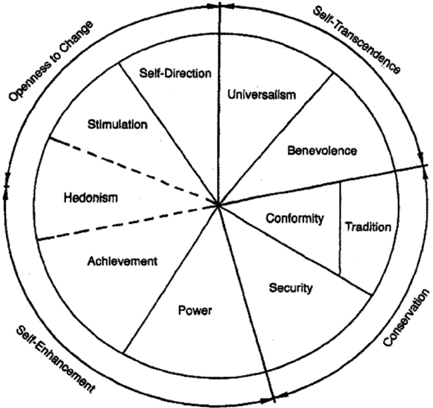
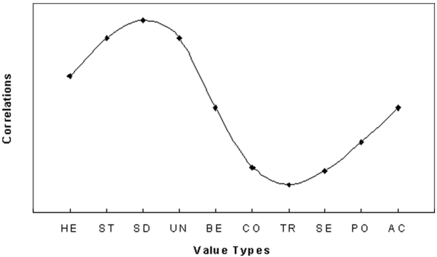
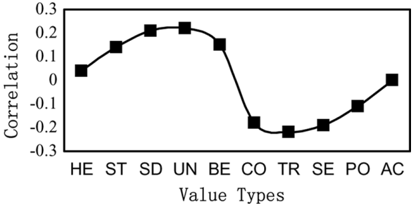
Does extrinsic motivation inhibit or foster creativity? Whereas previous researchers examined the effects of externally controlled extrinsic motivation on creativity, we focus on the effects of self-determined extrinsic motivation arising from one's personally held core values. In this study, we present a theoretical argument which predicts that (a) creative behavior is fostered by certain value types, inhibited by other value types, and holistically related to the total integrative-dynamic pattern of value types identified by Schwartz (1994 Schwartz , S. ( 1994 ). Are there universal aspects in the structure and contents of human values? Journal of Social Issues , 50 , 19 – 45 .[Crossref], [Web of Science ®] , [Google Scholar]), and (b) creative performance is synergistically promoted by the interaction between the Self-Direction value type and intrinsic motivational orientation. These hypotheses were tested in a study of 248 undergraduates whose value priorities and intrinsic motivational orientation were measured by self-report and whose creative performance was assessed across multiple tasks in the verbal, artistic, and mathematical domains. All predictions were supported.
Overview
The claims and statistics of this paper haven’t been checked yet.
Run the check — free, no account needed. It reads the open-access text and checks the sources it cites.
Integrity signals
Registry
Cites
Statistics
Figures
Verification
Claims the paper makes
The claims and statistics of this paper haven’t been checked yet.
Run the check — free, no account needed. It reads the open-access text and checks the sources it cites.
Claims other papers make about this one
Each is checked against this paper’s own text: does it say what the citing paper says it does?
The cited source says what the claim attributes to it.
In the citing paper
“Schwartz's (1992) self-direction value was positively related to creativity (Dollinger, Burke, & Gump, 2007; Kasof, Chen, Himsel, & Greenberger, 2007).”
From Creativity: The Influence of Cultural, Social, and Work Contexts (2010) · cites this paper as Kasof, Chen, Himsel, & Greenberger, 2007
The cited source says what the claim attributes to it.
In the citing paper
“In contrast, the values of tradition, security, and conformity were negatively related to creativity (Dollinger et al., 2007; Kasof et al., 2007).”
From Creativity: The Influence of Cultural, Social, and Work Contexts (2010) · cites this paper as Kasof et al., 2007
Self-check
Percentages, sums and reported differences re-computed from the paper’s own numbers.
The self-check needs the paper’s full text.
Citations
Cites
(1973) · DigitalGeorgetown (Georgetown University Library) · Cited by 10,144
Are There Universal Aspects in the Structure and Contents of Human Values?
Schwartz, S. H. (1994) · Journal of Social Issues · doi:10.1111/j.1540-4560.1994.tb01196.x · Cited by 6,122 · cited 6×
“Schwartz (1994) further argued that value types differ in their degree of compatibility with other value types.”
BackgroundMethodInfluentialMeasurement and Control of Response Bias
Paulhus, D. L. (1991) · Elsevier eBooks · doi:10.1016/b978-0-12-590241-0.50006-x · Cited by 3,867 · cited 1×
“We used the 20-item Impression Management Scale (Paulhus, 1991) rather than the Crowne-Marlowe Scale because the latter actually measures approval motivation rather than response bias (Paulhus).”
MethodThe Social Psychology of Creativity
Amabile, T. M. (1983) · Springer eBooks · doi:10.1007/978-1-4612-5533-8 · Cited by 3,183
The pervasive effects of family on entrepreneurship: toward a family embeddedness perspective
Aldrich, H. E., & Cliff, J. E. (2003) · Journal of Business Venturing · doi:10.1016/s0883-9026(03)00011-9 · Cited by 2,802
Further Examining the American Dream: Differential Correlates of Intrinsic and Extrinsic Goals
Kasser, T., & Ryan, R. M. (1996) · Personality and Social Psychology Bulletin · doi:10.1177/0146167296223006 · Cited by 2,745 · cited 2×
“(This may explain why narcissistic individuals, who highly value public recognition of competitive success, Kasser & Ryan, 1996, behave more creatively when anticipating public social comparison but not when anticipating private social comparison, Wallace & Baumeister, 2002.)”
BackgroundA motivational approach to self: integration in personality.
Deci, E. L., & Ryan, R. M. (1990) · PubMed · Cited by 2,718
Goal striving, need satisfaction, and longitudinal well-being: The self-concordance model
Sheldon, K. M., & Elliot, A. J. (1999) · Journal of Personality and Social Psychology · doi:10.1037/0022-3514.76.3.482 · Cited by 2,541 · cited 2×
“…with personal values (Sansone & Smith, 2000) and operationalized with participants’ assessments of the importance, value, or degree of fit with one’s values of various goals, strivings, or other endeavors (e.g., Koestner et al., 2002; Sheldon & Elliot, 1998, 1999; Sheldon & Houser-Marko, 2001).”
BackgroundA Meta-Analysis of Personality in Scientific and Artistic Creativity
Feist, G. J. (1998) · Personality and Social Psychology Review · doi:10.1207/s15327957pspr0204_5 · Cited by 2,180 · cited 1×
“Additionally, creative behavior is encouraged by attributes that are expressed in the values of independence, autonomy, and curiosity (Feist, 1998; Ochse, 1990).”
BackgroundA structural equation test of the value-attitude-behavior hierarchy.
Homer, P., & Kahle, L. (1988) · Journal of Personality and Social Psychology · doi:10.1037/0022-3514.54.4.638 · Cited by 2,041 · cited 1×
“106 Creativity Research Journal Second, by influencing one’s evaluations of activities and their expected consequences, one’s value priorities help determine, respectively, one’s level of intrinsic motivation and external motivation for doing activities (Feather, 1995; Homer & Kahle, 1988).”
Background
Research works printed but not linked: 17
- Amabile , T. ( 1996 ). Creativity in context . Boulder , CO : Westview Press .
- Crutchfield , R. ( 1961 ). The creative process . In Proceedings of the Conference on “The Creative Person” (pp. VI-1 – VI-16 ). Lake Tahoe , CA : University of California Alumni Center .
- Csikszentmihalyi , M. ( 1996 ). Creativity . New York : Harper Perennial .
- De Cook , L. ( 1972 ). Ansel Adams . Boston , MA : Little, Brown .
- Getzels , J. , & Csikszentmihalyi , M. ( 1976 ). The creative vision . New York : John Wiley .
- Koestner , R. , & Losier , G. ( 2002 ). Distinguishing three ways of being internally motivated: A closer look at introjection, identification, and intrinsic motivation . In E. Deci & R. Ryan (Eds.), Handbook of self-determination (pp. XX – XX ). Rochester , NY : University of Rochester Press .
- 10.1037/0022-3514.70.5.1025 · DOI
- MacKinnon , D. ( 1962 ). The personality correlates of creativity: A study of American architects . In G. Nielsen (Ed.), Proceedings of the 14th International Congress of Applied Psychology ( Vol. 2 , pp. 11 – 39 ). Copenhagen : Munksgaard .
- Ochse , R. ( 1990 ). Before the gates of excellence . New York : Cambridge University Press .
- Plimpton , G. (Ed). (1999). The writer's chapbook . New York : Modern Library.
- Pryor , J. , Hurtado , S. , Saenz , V. , Londholm , J. , Korn , W. , & Mahoney , K. ( 2006 ). The American freshman . Los Angeles : UCLA Higher Education Research Institute .
- Schwartz , S. ( 1996 ). Value priorities and behavior: Applying a theory of integrated value systems . In C. Seligman , J. Olson , & M. Zanna (Eds.), The psychology of values: The Ontario symposium ( Vol. 8 , pp. 1 – 24 ). Mahwah , NJ : Lawrence Erlbaum Associates, Inc.
- Scott , W. ( 1965 ). Values and organizations . Chicago : Rand McNally .
- 10.1037/0022-3514.39.5.953 · DOI
- Uelsmann , J. ( 1992 ). Photo synthesis . Gainesville , FL : University Press of Florida .
- Webb , J. ( 1998 ). Tunesmith . New York : Hyperion .
- Zollo , P. ( 2003 ). Songwriters on songwriting . Cambridge , MA : Da Capo.
Cited by
Sorted by citations
Beyond the Glass Ceiling: Does Gender Matter?
Adams, R. B., & Funk, P. (2011) · Management Science · doi:10.1287/mnsc.1110.1452 · Cited by 1,552
Personal Values Across Cultures
Sagiv, L., & Schwartz, S. H. (2021) · Annual Review of Psychology · doi:10.1146/annurev-psych-020821-125100 · Cited by 449
Shareholders and stakeholders: How do directors decide?
Adams, R. B., Licht, A. N., & Sagiv, L. (2011) · Strategic Management Journal · doi:10.1002/smj.940 · Cited by 412
“For example, evidence suggests that values are related to creativity (Dollinger, Burke, and Gump, 2007; Kasof et al., 2007), reactions to organizational change (Sverdlik and Oreg, 2009), cooperation versus competition in social dilemmas (Sagiv, Sverdlik, and Schwarz, 2011) and conflict resolution style (Morris et al.”
Beyond New and Appropriate: Who Decides What Is Creative?
Kaufman, J. C., & Baer, J. (2012) · Creativity Research Journal · doi:10.1080/10400419.2012.649237 · Cited by 337
“As a result, some researchers have been tempted to use nonexperts as judges of creativity—novices, such as college students with no other qualifications than a desire to earn research participation credit in Introductory Psychology (eg, Baer, 1996 ; Chen, Himsel, Kasof, Greenberger, & Dmitreiva, 2006; Joussemet & Koes…”
BackgroundSmall Business Owners' Success Criteria, a Values Approach to Personal Differences
Gorgievski, M. J., Ascalon, M. E., & Stephan, U. (2011) · Journal of Small Business Management · doi:10.1111/j.1540-627x.2011.00322.x · Cited by 329
Metadata
- Authors
- Kasof, J., Chen, C., Himsel, A., & Greenberger, E.
- Affiliations
- University of California, Irvine (US)
- Corresponding author
- Kasof, Joseph
- ORCID
- Chen, Chuansheng
- Venue
- Creativity Research Journal
- Publisher
- Informa UK Limited
- Published
- 2007-07-20
- Volume
- 19
- Issue
- 2-3
- Pages
- 105-122
- ISSN
- 1040-0419 (ISSN-L)
- 1532-6934
- OpenAlex
- W2069449766
- Cited by
- 151
- References
- 84
- Citations by year
- 2026: 4 · 2025: 8 · 2024: 8 · 2023: 10 · 2022: 6 · 2021: 11 · 2020: 8 · 2019: 8 · 2018: 20 · 2017: 9 · 2016: 7 · 2015: 4 · 2014: 5 · 2013: 8 · 2012: 8
- FWCI
- 7.71
- Type
- journal article
- Language
- en
- Open access
- green
- escholarship.org
- Licence
- cc-by
- Locations
- Creativity Research Journal (publishedVersion)
- eScholarship (California Digital Library) (submittedVersion, cc-by)
- Topics
- Social Sciences › Psychology › Experimental and Cognitive Psychology › Creativity in Education and Neuroscience
- Social Sciences › Psychology › Social Psychology › Cultural Differences and Values
- Social Sciences › Psychology › Experimental and Cognitive Psychology › Psychological and Educational Research Studies
- Keywords
- creativity, extrinsic motivation, self-determination theory, core values, value types, self-direction, intrinsic motivation, creative performance
About these checks
Registry, retraction, Cites and statistics results are computed, not judged, with one exception: a printed reference that no index lists is read once by a model before it counts as a citation error. Claims are extracted by a model and kept only when their quote appears verbatim in the text; each cited source is then checked, with a model’s help, for whether it says what the claim relies on. Those verdicts can be wrong — read the claim’s quote and the cited source before relying on one.
Statistics and arithmetic are recomputed, not judged.
Confidence bands are shown only for fields calibrated on our annotated test set. None is calibrated yet, so no band is shown.
What counts as a claim ›How we measure confidence ›How we check this ›
Are you an author, or do you see a problem with this page? Request a review
