

"I Despise Myself for Thinking about Them." A Thematic Analysis of the Mental Health Implications and Employed Coping Mechanisms of Self-Reported Non-Offending Minor Attracted Persons.
The DOI matches its Crossref record; 78 of the 78 references it cites were found in a registry or an index; 2 of the 42 sources its claims cite were checked for support.
Abstract
'Non-offending pedophiles' or 'minor attracted persons' are individuals who suppress an attraction to children. Previous analyses of this population's mental illness employed overt self-report methods, limited by social desirability. Additionally, studies assessing the coping mechanisms employed to remain offense-free are underpowered; understanding of these would facilitate the rehabilitation of prior offenders. A thematic analysis of coping mechanisms and mental illness was conducted on 5,210 posts on the 'Virtuous Pedophiles' forum. Four themes emerged for coping mechanisms: Managing risk and attraction to children, Managing mood, Managing preferences prosocially and Friends, family and relationships, with 13 subthemes. Five themes emerged for mental ill-health, including: Addiction, Anxiety, Depression, Self-hatred/Self-harm/Suicide and Other. Self-hatred/Self-harm/Suicide accounted for almost a third of discussed mental ill-health. These results highlight the severity of mental ill-health amongst this population and the coping mechanisms employed to remain offense-free.
Overview
CoChat Summary
## TL;DR
This paper uses a thematic analysis of 5,210 posts from the “Virtuous Pedophiles” forum to describe coping mechanisms and self-reported mental ill-health among self-identified non-offending minor attracted persons (MAPs). It finds high levels of distress—especially self-hatred/self-harm/suicide—and identifies four coping-mechanism themes, but it does not establish whether those coping strategies are effective.
## Key findings
- The analysis of 5,210 posts produced 4 coping-mechanism themes with 13 subthemes: managing risk and attraction to children, managing mood, managing preferences prosocially, and friends/family/relationships.
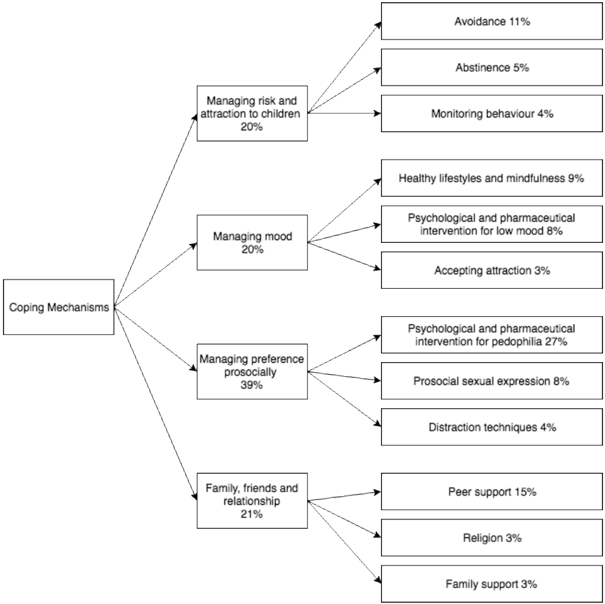
- For coping mechanisms, the paper reports theme shares of 20% (managing risk and attraction to children), 20% (managing mood), 39% (managing preferences prosocially), and 21% (friends, family and relationships).
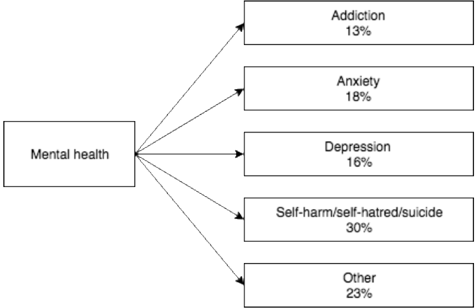
- Mental ill-health was organized into 5 themes: addiction, anxiety, depression, self-hatred/self-harm/suicide, and other; self-hatred/self-harm/suicide accounted for 30% of all references to mental ill-health, the largest mental-health theme.
- Other reported mental-ill-health theme shares were 13% addiction, 18% anxiety, 16% depression, and 23% other; the authors also note that self-hatred/self-harm/suicide accounted for “almost a third” of discussed mental ill-health.
- The paper states that 95% percentage agreement (κ = .92) was obtained in interrater reliability on a random 10% of the data.
## Methods
- Design: Qualitative thematic analysis using an inductive approach and a critical realist perspective.
- Sample/data: All posts in the forum topics “Life Experiences” (246 threads) and “Requests for Support” (275 threads) from 1 Feb 2017 to 1 Feb 2018 were reviewed, yielding 5,210 posts; the forum community is described as over 3,000 MAPs.
- Analysis: The first researcher manually coded posts in NVivo; 10% of the data were randomly selected for a second researcher to check theme interpretation, yielding 95% agreement (κ = .92).
## Limitations
- The paper states that, because of the forum’s anonymous nature, the researchers could not link themes to individuals or collect demographics such as gender, age, sexual-preference details, or prior offending history.
- The paper states that the study relied on self-reported experiences of mental illness, which cannot be considered equivalent to clinical diagnoses or confirmed by other methods; it also notes that the sample may include members with a history of offending because the forum permits them if they are currently non-offending.
- The paper states that only 2 of 22 discussion topics were reviewed because it was impractical to examine all topics, so relevant themes in the other topics may have been missed; this is a stated limitation.
- Evident from the text: the analysis is based on forum posts rather than direct interviews, so findings reflect written self-presentation in an online community and not independently verified individual-level outcomes.
Model-written summary. Check it against the paper before relying on it.
Integrity signals
Registry
Cites
Statistics
Figures
Verification
Claims the paper makes
2 Valid · 2 Not valid · 32 Not checked · 54 Own results and interpretations
A result the paper reports from its own data — it cites no other source for it, so there is none to check. The quote shows it is in the paper.
In the paper
“Approximately 5% of coping mechanisms related to abstinence”
plainstates an association- Asserted: passes — The authors put it forward as true.
- Checkable: passes — It can be checked against evidence.
- Load-bearing: unclear — It is unclear whether the paper’s conclusions depend on it.
- Based: passes — The paper gives a reason why it holds.
A result the paper reports from its own data — it cites no other source for it, so there is none to check. The quote shows it is in the paper.
In the paper
“familial support accounted for 3% of coping strategies discussed”
plain- Asserted: passes — The authors put it forward as true.
- Checkable: passes — It can be checked against evidence.
- Load-bearing: unclear — It is unclear whether the paper’s conclusions depend on it.
- Based: passes — The paper gives a reason why it holds.
A result the paper reports from its own data — it cites no other source for it, so there is none to check. The quote shows it is in the paper.
In the paper
“Self-hatred/Selfharm/Suicide accounted for almost a third of discussed mental ill-health.”
- Also stated in: § Self-Hatred/Self-Harm/Suicide · plain
“Comprising 30% of all references, 'Self-hatred/Self-harm/Suicide' is the largest theme relating to mental health.”
plain- Asserted: passes — The authors put it forward as true.
- Checkable: passes — It can be checked against evidence.
- Load-bearing: passes — The paper’s conclusions depend on it.
- Based: passes — The paper gives a reason why it holds.
- Also stated in: § Self-Hatred/Self-Harm/Suicide · plain
A result the paper reports from its own data — it cites no other source for it, so there is none to check. The quote shows it is in the paper.
In the paper
“Disclosing attractions to peers comprised 15% of discussed coping mechanisms”
plain- Asserted: passes — The authors put it forward as true.
- Checkable: passes — It can be checked against evidence.
- Load-bearing: unclear — It is unclear whether the paper’s conclusions depend on it.
- Based: passes — The paper gives a reason why it holds.
A result the paper reports from its own data — it cites no other source for it, so there is none to check. The quote shows it is in the paper.
In the paper
“This theme relates to the support received from others and accounts for 21% of coping mechanisms.”
plain- Asserted: passes — The authors put it forward as true.
- Checkable: passes — It can be checked against evidence.
- Load-bearing: unclear — It is unclear whether the paper’s conclusions depend on it.
- Based: passes — The paper gives a reason why it holds.
53 more claims
Create a free account to see all 90 claims and to verify the 4 references still open.
- It may state two separate claims as one. 18
- Probably not a substantial claim. 17
Citations
Cites
Using thematic analysis in psychology
Braun, V., & Clarke, V. (2006) · Qualitative Research in Psychology · doi:10.1191/1478088706qp063oa · Cited by 194,414
Diagnostic and Statistical Manual of Mental Disorders
American Psychiatric Association (2013) · doi:10.1176/appi.books.9780890425596 · Cited by 116,369
Meyer, I. H. (2003) · Psychological Bulletin · doi:10.1037/0033-2909.129.5.674 · Cited by 14,736
Diagnostic and Statistical Manual of Mental Disorders(DSM)
(2008) · Encyclopedia of Counseling · doi:10.4135/9781412963978.n182 · Cited by 10,830
The emerging field of emotion regulation: an integrative review
Gross, J. J. (1998) · Review of General Psychology · doi:10.1037/1089-2680.2.3.271 · Cited by 9,916 · cited 1×
“Suppression is considered maladaptive, as it appears to reduce emotion-related behavior but not experience of the emotion (Gross, 1998), designated the ‘Rebound Effect’ (Wegner, 1994).”
BackgroundEmotion-regulation strategies across psychopathology: A meta-analytic review
Aldao, A., Nolen-Hoeksema, S., & Schweizer, S. (2010) · Clinical Psychology Review · doi:10.1016/j.cpr.2009.11.004 · Cited by 6,686
Successful Qualitative Research: A practical guide for beginners
(2014) · QMiP Bulletin · doi:10.53841/bpsqmip.2014.1.18.39 · Cited by 6,661
(1999) · Cited by 5,934
Emotion regulation: affective, cognitive, and social consequences.
Gross, J. J. (2002) · Psychophysiology · doi:10.1017/s0048577201393198 · Cited by 4,890 · cited 2×
“…Received 5 May 2019 Revised 2 August 2019 Accepted 5 August 2019 KEYWORDS Suppression; pedophilia; minor attracted person; mental ill-health; coping mechanisms ‘Suppression’ is an emotion regulation strategy, which inhibits inappropriate or unwanted emotional responses to stimuli (Gross, 2002).”
BackgroundSuccessful qualitative research: A practical guide for beginners
(2016) · QMiP Bulletin · doi:10.53841/bpsqmip.2016.1.21.48 · Cited by 4,019
Research works printed but not linked: 5
- Abel G. G., 2001, The stop child molestation book: What ordinary people can do in their everyday lives to save three million children
- Blagden N. J., 2017, Sexual Abuse, 49, 330
- 10.1016/S0005-7967(02)00020-7\ · doi:10.1016/s0005-7967(02)00020-7\
- O’Donnell G., 2015, The Bulletin of the Australian Psychological Society Ltd, 37, 14
- Pyhälä R., 2017, Pediatrics, 32, 43
Cited by
Lawrence, A. L., & Willis, G. M. (2021) · International Journal of Sexual Health · doi:10.1080/19317611.2020.1865498 · Cited by 57
“We Do Exist”: The Experiences of Women Living with a Sexual Interest in Minors
Lievesley, R., & Lapworth, R. (2021) · Archives of Sexual Behavior · doi:10.1007/s10508-021-02160-z · Cited by 43
“…misuse conditions (e.g., Cohen et al., 2018; Elchuk et al., 2021; Raymond et al., 1999; Schaefer et al., 2010), social isolation (Elchuk et al., 2021; Jahnke et al., 2015b), and the internalization of stigma and self-loathing (Lievesley et al., 2020; McPhail & Stephens, 2020; Stevens & Wood, 2019).”
BackgroundLievesley, R., & Harper, C. A. (2021) · Journal of Sexual Aggression · doi:10.1080/13552600.2021.1883754 · Cited by 35
“…is not only observed within general public samples, but also among the media (Harper & Hogue, 2017), researchers who study paedophilia using samples consisting only of individuals with sexual convictions (Feelgood & Hoyer, 2008), and health professionals (Jahnke et al., 2015c; Stiels-Glenn, 2010).”
BackgroundPrevalence and correlates of individuals with sexual interest in children: A systematic review
Savoie, V., Quayle, E., & Flynn, E. (2021) · Child Abuse & Neglect · doi:10.1016/j.chiabu.2021.105005 · Cited by 53
Lievesley, R., Harper, C. A., Elliott, H., & Woodward, E. (2022) · Journal of Sex & Marital Therapy · doi:10.1080/0092623x.2022.2149437 · Cited by 28
“Some MAPs also appear to recognize a need to control their levels of sexual arousal and may do this by abstaining from masturbation (Stevens & Wood, 2019), actively avoiding children (Lievesley et al., 2020), or stopping themselves being online where child sexual exploitation material can be…”
BackgroundInfluentialPrimary Health Professionals’ Beliefs, Experiences, and Willingness to Treat Minor-Attracted Persons
Lievesley, R., Elliott, H., Harper, C. A., & Woodward, E. (2022) · Archives of Sexual Behavior · doi:10.1007/s10508-021-02271-7 · Cited by 29
“MAPs negative treatment encounters lead many to seek support in informal networks, such as via trusted friends and family, or online communities (Jones et al., 2021; Stevens & Wood, 2019).”
BackgroundMinor-attracted persons: A neglected population
Sorrentino, R. M. (2021) · Current Psychiatry · doi:10.12788/cp.0149 · Cited by 27
When virtuous paedophiles meet online: A sociological study of a paedophile community
Nielsen, M., Aaskov, L., & Larsen, J. E. (2020) · Sexualities · doi:10.1177/1363460720979306 · Cited by 28
“Additionally, the VP-forum can help paedophiles manage their sexual arousal in everyday life by providing coping strategies (Cranney, 2017; Stevens and Wood, 2019), challenging distorted thinking and providing feedback on their behaviour.”
BackgroundInfluentialThe Treatment Needs and Experiences of Pedohebephiles: A Systematic Review
Chronos, A., Jahnke, S., & Blagden, N. (2024) · Archives of Sexual Behavior · doi:10.1007/s10508-024-02943-0 · Cited by 28
“…attraction Schaefer et al., 2023 Mental health, more information on attraction Stephens & McPhail, 2019 Problems related to sexual interests Stevens & Wood, 2019 Managing mood, addiction, anxiety, depression, self-hatred, self-harm, suicidality Tozdan et al., 2022 Changing attraction…”
BackgroundOnline forum use in child attracted persons
Roche, K. M., Stephens, S., Moss, S., & Seto, M. C. (2022) · The Canadian Journal of Human Sexuality · doi:10.3138/cjhs.2022-0007 · Cited by 19
Qualitative Analysis of Minor Attracted Persons’ Subjective Experience: Implications for Treatment
Schaefer, A., Wittenberg, A., GALYNKER, I. I., & Cohen, L. J. (2022) · Journal of Sex & Marital Therapy · doi:10.1080/0092623x.2022.2126808 · Cited by 25
“…about seeking help (Levenson & Grady, 2018), attitudes toward adult-child sex (Jahnke et al., 2018; Spriggs et al., 2018), physical and psychological features of children that MAPs find attractive (Martijn et al., 2022), and coping mechanisms employed to remain offense-free (Stevens & Wood, 2019).”
BackgroundMcPhail, I. V., & Stephens, S. (2024) · Archives of Sexual Behavior · doi:10.1007/s10508-024-02842-4 · Cited by 18
“For instance, MAPs report self-hatred and seeing themselves as monsters on account of their attractions (Blagden et al., 2018; Cash, 2016; Stevens & Wood, 2019).”
Fantasy Sexual Material Use by People with Attractions to Children
Lievesley, R., Harper, C. A., Woodward, E., & Tenbergen, G. (2023) · Current Psychiatry Reports · doi:10.1007/s11920-023-01435-7 · Cited by 14
A Review of Academic Use of the Term “Minor Attracted Persons”
Farmer, C., Salter, M., & Woodlock, D. (2024) · Trauma Violence & Abuse · doi:10.1177/15248380241270028 · Cited by 13
“…to recruit “non-offending” pedophiles for research purposes are confounded by the fact that it is not possible to ascertain whether an individual has, or has not, offended against a child (Stevens & Wood, 2019, p. 970), a matter about which child sex offenders routinely lie (Bourke et al., 2015).”
BackgroundRealization, Self-View, and Disclosure of Pedophilia: A Content Analysis of Online Posts
Jiménez-Arista, L. E., & Reid, D. B. (2022) · Sexual Abuse · doi:10.1177/10790632221099256 · Cited by 20
“For example, one study found that Self-hatred/Self-harm/ Suicide was the largest mental health theme (about 30% of all references) in an examination of coping mechanisms in non-offending individuals with pedophilia (Stevens & Wood, 2019).”
Online sexual deviance, pornography and child sexual exploitation material
Quayle, E. (2020) · Forensische Psychiatrie Psychologie Kriminologie · doi:10.1007/s11757-020-00607-y · Cited by 22
“More recently there has been a call to move away from the narrow definition provided by categorical models such as DSM to terminology such as paedo-hebephilia (Bailey et al. 2016) or minor-attracted persons (Stevens and Wood 2019).”
Background“We do exist”: The Experiences of Women Living with a Sexual Interest in MinorsPreprint
Lievesley, R., & Lapworth, R. (2021) · doi:10.31234/osf.io/2xjsv · Cited by 11
Bekkers, L. M. J., Leukfeldt, R., & Holt, T. J. (2023) · Sexual Abuse · doi:10.1177/10790632231154882 · Cited by 13
“The variety of strategies users disclose includes the avoidance of contact with children and seeking peer support (Stevens & Wood, 2019).”
BackgroundLievesley, R., Swaby, H., Stevenson, J. H., & Harper, C. A. (2024) · Journal of Sex & Marital Therapy · doi:10.1080/0092623x.2024.2402320 · Cited by 11
“…how members of various online communities “cope” with their attractions to children (Grady et al., 2019; Jones et al., 2021; Lievesley et al., 2020; Stevens & Wood, 2019), and thus still frame these as a problem to be fixed rather than as a sexuality pattern to be lived with by those who…”
Ingram, M., Thorne, E., Letourneau, E. J., & Nestadt, P. S. (2023) · OMEGA - Journal of Death and Dying · doi:10.1177/00302228221150304 · Cited by 12
The Subjective Experience of Individuals with Pedohebephilic Interest
McPhail, I. V. (2024) · Current Sexual Health Reports · doi:10.1007/s11930-023-00381-y · Cited by 11
“10 Qualitative research tends to support the experiences of elevated distress, suicidality, and mental health symptoms [87, 88].”
Christophersen, L., & Brotto, G. (2024) · Trauma Violence & Abuse · doi:10.1177/15248380241262286 · Cited by 10
“…of stigmati-zation experienced by people with pedophilia contributes to exacerbated mental health issues (Blagden et al., 2018; Elchuk et al., 2022; Houtepen et al., 2016; Jahnke et al., 2015c; Lawrence & Willis, 2021; Stevens & Wood, 2019), further emphasizing the critical need for treatment.”
BackgroundInfluentialRecruitment Issues in Research with People Who are Attracted to Children: A Systematic Review
Roche, K. M., Pagacz, J., Lalumière, M. L., & Seto, M. C. (2025) · The Journal of Sex Research · doi:10.1080/00224499.2025.2484197 · Cited by 9
Who is worthy of help? Constructing the stereotype of the “ideal victim” of child sexual abuse
Eelmaa, S., & Murumaa-Mengel, M. (2022) · Nomos Verlagsgesellschaft mbH & Co. KG eBooks · doi:10.5771/9783748904403-261 · Cited by 9
Themes Associated with Suicidal Ideation and Behavior Among People Attracted to Children
Ingram, M., Letourneau, E. J., & Nestadt, P. S. (2024) · Archives of Sexual Behavior · doi:10.1007/s10508-023-02770-9 · Cited by 8
“Stevens and Wood (2019) found that references to self-hatred, self-harm, and suicide were the largest theme related to mental health, representing 30% of responses.”
Shafiq, S. (2023) · GLOBAL PSYCHIATRY ARCHIVES · doi:10.52095/gpa.2023.4702.1046 · Cited by 6
Murphy, R. (2024) · Journal of Social Work · doi:10.1177/14680173241240973 · Cited by 7
Nováková, L. M., Krejčová, L., Potyszová, K., & Klapilová, K. (2023) · Sexual & Relationship Therapy · doi:10.1080/14681994.2023.2232318 · Cited by 6
“Such skills constitute protective factors and powerful coping strategies identified and endorsed by the help-seeking individuals themselves (Stevens & Wood, 2019).”
They Need Somebody, and Not Just Anybody: Help-Seeking Behaviour in Minor-Attracted Persons
Uzieblo, K., & Boeck, M. D. (2022) · Springer eBooks · doi:10.1007/978-3-030-80212-7_12 · Cited by 3
Pedersen, M. R. (2022) · Nomos Verlagsgesellschaft mbH & Co. KG eBooks · doi:10.5771/9783748904403-279 · Cited by 2
‘I have no desire to hurt a child’: prosocial navigation of sexual attraction to children
Phillipps, M. E. R., & Willis, G. M. (2025) · Psychiatry Psychology and Law · doi:10.1080/13218719.2025.2546305 · Cited by 1
“Across findings from Jones et al. (2021) and Stevens and Wood (2019), strategies included acceptance of one’s sexual attractions, contact rules around minors, avoidance (including avoiding contact with children and installing software to prevent CSEM access) and use of legal outlets for sexual…”
Lievesley, R., & Harper, C. A. (2026) · Psychology & Sexuality · doi:10.1080/19419899.2026.2619511 · Cited by 1
Salter, M., Whitten, T., Woodlock, D., Lu, M., Lamond, M., Naldrett, G., & Tyler, M. (2026) · Journal of Interpersonal Violence · doi:10.1177/08862605251403618 · Cited by 1
“In the absence of mental health support, men with a sexual interest in children evince a range of harmful coping strategies and mental health outcomes such as anxiety, depression, addiction, self-hatred, and suicide ideation (Stevens & Wood, 2019).”
Pedersen, M. R. (2021) · STS Encounters · doi:10.7146/stse.v12i1.135405 · Cited by 2
Paraphilia, Gender Dysphoria, and Hypersexuality
Cantor, J. M. (2023) · Oxford University Press eBooks · doi:10.1093/med-psych/9780197542521.003.0024 · Cited by 1
Konrad, A., Heid, L. M., Scheuermann, H., Beier, K. M., & Amelung, T. R. (2025) · Frontiers in Psychology · doi:10.3389/fpsyg.2024.1463191 · Cited by 2
“…interests viewed acceptance of their inclinations not only as crucial for their mental health but also for their motivation to control their sexual urges towards minors in the form of achieving pride concerning their management (Jones et al., 2021; Levenson and Grady, 2019; Stevens and Wood, 2019).”
InfluentialToward a Holistic Approach to Treatment and Support for People with Attractions to Children
Lievesley, R., Harper, C. A., & Woodward, E. (2025) · Current Sexual Health Reports · doi:10.1007/s11930-025-00403-x · Cited by 3
“Research has shown that many people in this population experience significant emotional distress related to their attractions, prompting them to seek mental health support [3, 16, 21], and lone-liness and low self-esteem are known risk factors toward offending behavior [20, 22–24].”
InfluentialLievesley, R., & Harper, C. A. (2020) · doi:10.31234/osf.io/b36a8 · Cited by 1
Primary health professionals’ beliefs, experiences, and willingness to treat minor attracted personsPreprint
Lievesley, R., Swaby, H., Harper, C. A., et al. (2021) · doi:10.31234/osf.io/ks9cx
Exploring the Link Between Sexual Thoughts of Children and Sexual Offending Against Children
Thorne, J. R. (2020) · Cited by 1
Davis, M. R., & Darjee, R. (2025) · Dangerous behavior in clinical and forensic psychology · doi:10.1007/978-3-031-83135-5_13 · Cited by 1
Arenzon, V., Curtis, A., de Almeida, H., & Evanoff, C. (2025) · Sexual Offending Theory Research and Prevention · doi:10.5964/sotrap.13135 · Cited by 3
“A growing body of literature on paraphil ias (i.e., atypical sexual interests) find a minority of people with pedophilic (i.e., sexual interest for pre-pubescent children) and hebephilic (i.e., sexual interest for pubescent children) interests (Gerwinn et al., 2018; Stevens & Wood, 2019).”
Cheetham, W., & Bartels, R. M. (2025) · Journal of Sex & Marital Therapy · doi:10.1080/0092623x.2025.2595165
“…greater loneliness, a lack of hope for the future, higher levels of guilt and shame, symptoms of depression and anxiety, substance misuse, and increased suicidality (Elchuk et al., 2022; Jahnke, Schmidt, et al., 2015; Lievesley et al., 2020; McPhail & Stephens, 2024; Stevens & Wood, 2019).”
InfluentialGarant, E., & Proulx, J. (2026) · Sexual Abuse · doi:10.1177/10790632261415814
“…sexual offenses against minors (Grady et al., 2019; Houtepen et al., 2016; Jones et al., 2020; Levenson & Grady, 2019; Lievesley et al., 2020; Stevens & Wood, 2019), their generally low incidence of self-reported sexual contacts with minors contrasts with their high level of concern about…”
Fernandes, M., & Farrants, J. R. (2026) · Archives of Sexual Behavior · doi:10.1007/s10508-025-03376-z
Marsh-Rossney, R., Insoll, T., Ovaska, A. K., Vaaranen-Valkonen, N., & Lorenzo-Dus, N. (2026) · Journal of Child Sexual Abuse · doi:10.1080/10538712.2026.2681216 · Cited by 1
“Furthermore, research has examined the negative self-perceptions of pedophiles in online forums/message boards (see Jenkins, 2001; Stevens & Wood, 2019), revealing mixed attitudes: some criticized themselves and their actions, while others rushed to justify and defend.”
Operationalizing chronophilia: A framework for age-based sexual preference classification
Sohrabi, S. (2026) · Acta Psychologica · doi:10.1016/j.actpsy.2026.107897
Metadata
- Authors
- Stevens, E., & Wood, J.
- Affiliations
- University of Kent (GB)
- Corresponding author
- Stevens, Eleanor
- Venue
- Journal of Child Sexual Abuse
- Publisher
- Informa UK Limited
- Published
- 2019-09-11
- Volume
- 28
- Issue
- 8
- Pages
- 968-989
- ISSN
- 1053-8712 (ISSN-L)
- 1547-0679
- OpenAlex
- W2973089129
- Semantic Scholar
- 24b59753805a9c4f13e647b0b964b84d611687ee
- Cited by
- 44
- References
- 75
- Citations by year
- 2026: 6 · 2025: 7 · 2024: 8 · 2023: 6 · 2022: 8 · 2021: 6 · 2020: 3
- FWCI
- 4.96
- Type
- journal article
- Language
- en
- Open access
- closed
- Locations
- Journal of Child Sexual Abuse (publishedVersion)
- PubMed (publishedVersion)
- Kent Academic Repository (University of Kent) (acceptedVersion)
- Topics
- Social Sciences › Psychology › Clinical Psychology › Psychopathy, Forensic Psychiatry, Sexual Offending
- Social Sciences › Psychology › Clinical Psychology › Psychology and Mental Health
- Social Sciences › Psychology › Clinical Psychology › Sexuality, Behavior, and Technology
- Keywords
- coping strategies, mental health, self-hatred, self-harm, suicide, addiction, anxiety, depression, online forums, social desirability bias, risk management, prosocial behavior, offender rehabilitation
- MeSH terms
- Adult, Child, Child Abuse, Sexual, Female, Humans, Male, Mental Health, Pedophilia, Self Concept, Criminals, Self Report
About these checks
Registry, retraction, Cites and statistics results are computed, not judged, with one exception: a printed reference that no index lists is read once by a model before it counts as a citation error. Claims are extracted by a model and kept only when their quote appears verbatim in the text; each cited source is then checked, with a model’s help, for whether it says what the claim relies on. Those verdicts can be wrong — read the claim’s quote and the cited source before relying on one.
The claim verdicts this report counts are experimental: their accuracy is not yet measured.
A language model drew the claims from the paper on 2026-10-11, under version 3 of the claim definition (model deepseek-v4.1-flash, prompt extract-v3).
A second model labelled each claim on 2026-10-11 (model jev-1.13-20260917, definition revision gold-guideline-v0.2).
Statistics and arithmetic are recomputed, not judged.
Confidence bands are shown only for fields calibrated on our annotated test set. None is calibrated yet, so no band is shown.
What counts as a claim ›How we measure confidence ›How we check this ›
Are you an author, or do you see a problem with this page? Request a review
Data sources
Bibliographic data: Semantic Scholar, OpenAlex, Crossref.
Contains information from the Semantic Scholar Academic Graph Datasets, made available under the ODC Attribution License (ODC-BY 1.0).
Semantic Scholar’s data is described in: Kinney, R., et al. (2023). The Semantic Scholar Open Data Platform. arXiv:2301.10140.
