

Varieties of Illiberal Backlash in Central Europe
Open accessThe DOI matches its Crossref record; 52 of the 54 references it cites were found in a registry or an index; 4 of the 26 sources its claims cite were checked for support.
Abstract
The article studies why abortion rights and LGBTQ rights are rolled back differently across Central Europe.
Overview
CoChat Summary
TL;DR
The paper argues that illiberal backlash in Central Europe varies with the strength of alliances between socially conservative advocacy groups and political parties, but is constrained by public opinion and the presence of a pluralistic moderate confessional party. Across Czechia, Hungary, Poland, and Slovakia, backlash is most intense in Poland and Hungary, medium in Slovakia, and low in Czechia.
Key findings
- Illiberal backlash is driven by a new alliance of confessional political parties and socially conservative groups, but two factors curb it: public opinion and competition from a pluralistic, moderate confessional party.
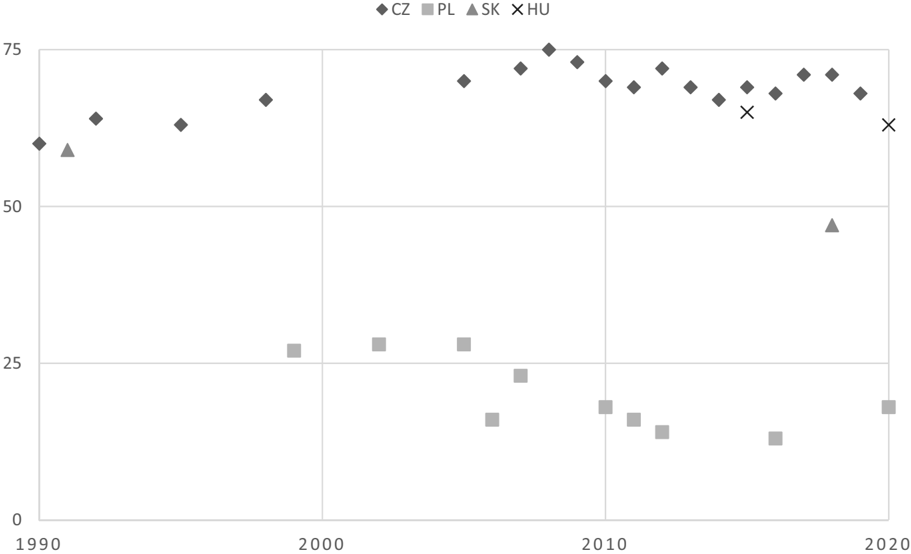
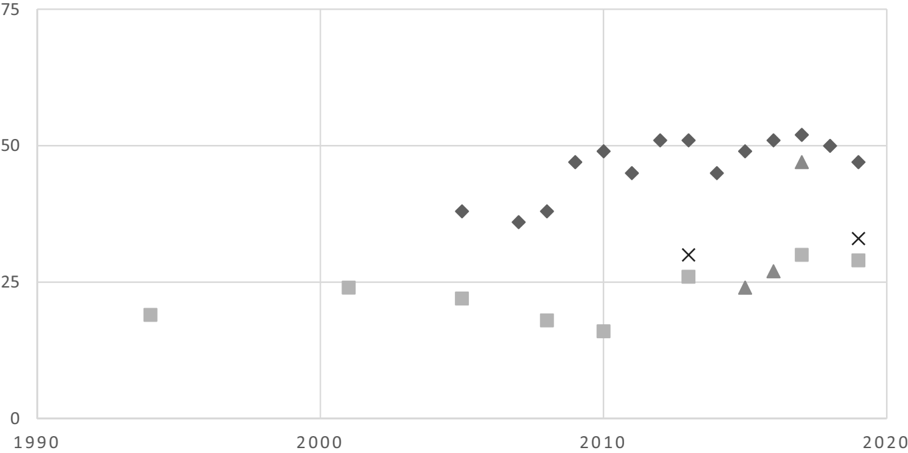
- Public opinion varies: support for abortion on request was most favorable in Czechia and Hungary (68% and 63%, respectively, in 2019) and limited in Slovakia and Poland (18% in 2020); same-sex marriage support was highest in Czechia but declined from 51% in 2013 to 47% in 2019; registered-partnership support was around 75% in Czechia, about 50% in Slovakia (2015), and 36% in Poland (2017).
- Hungary kept abortion on request legal—78% supported the current legal framework in 2020—while Fidesz used waiting periods, counseling, and conscientious objection to restrict access; it also restricted LGBTQ rights via the 2012 constitution, 2016 “sex at birth” law, 2020 adoption ban, and 2021 sex-education law, though the 2009 registered partnership remained.
- Poland’s 2020 Constitutional Tribunal near-total abortion ban was rejected by 84% of Poles and sparked protests; Poland ranks last in the EU on LGBTQ equality, repeatedly rejected registered partnerships in 2013, 2014, and 2018, and proposed an adoption ban for same-sex couples in 2020. Slovakia’s 2020 abortion restriction failed by one vote, with only 56.6% of government MPs supporting it, 23% against, and 20.48% abstaining or absent; Czechia had low contestation, adopted registered partnerships in 2006, made no efforts to restrict abortion, and allowed Polish women access to abortion.
Methods
- Comparative case study of the Visegrad Four—Czechia, Hungary, Poland, and Slovakia—examining reproductive and LGBTQ rights regulation from 2010 to 2021 and public attitudes from 1990/1994 to 2020.
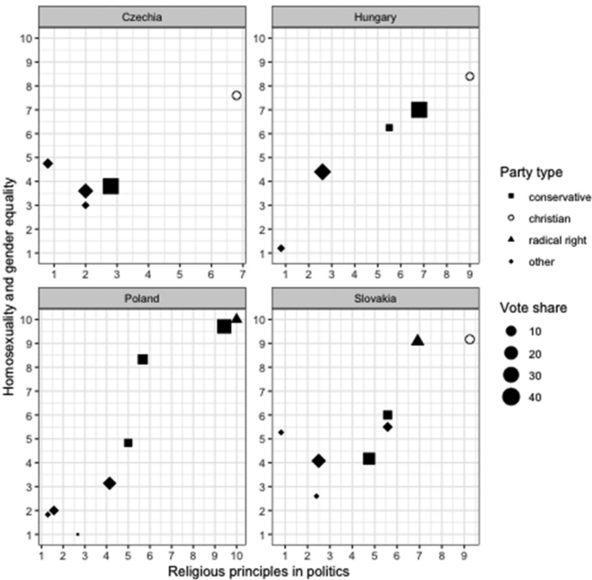
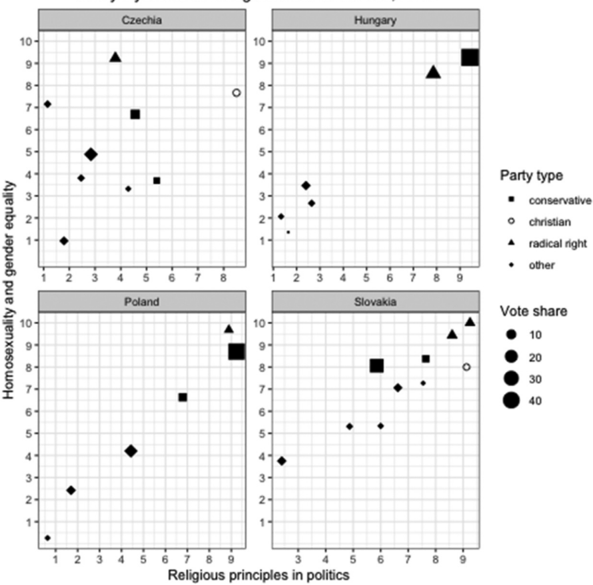
- Combines domestic and international public opinion surveys, legal and regulatory review, and Chapel Hill Expert Survey (CHES) party positions on social lifestyle and religious principles for 2006 and 2019.
- Qualitative assessment of illiberal alliances between parties and conservative advocates and their ability to change the legal and regulatory environment.
Limitations
- Stated in the paper: data availability varies significantly; polling on same-sex marriage in Slovakia is less common; there is no Hungarian data on registered partnerships; the temporal dimension of illiberalism is unpredictable; and some issues remain unresolved, including possible illiberal queuing effects on public opinion.
- Evident from the text: the analysis is descriptive and comparative without formal causal identification; CHES party-position data are used only for 2006 and 2019; and public opinion series are uneven across countries and time.
Model-written summary. Check it against the paper before relying on it.
Integrity signals
Registry
Cites
Statistics
Figures


Verification
Claims the paper makes
4 Valid · 27 Not valid · 16 Not checked · 92 Own results and interpretations
The cited sources support only part of this claim — read each source’s verdict below.
In the paper
“illiberal politicians prioritize immediate voter needs over governance (Buštíková and Baboš 2020;Grzymala-Busse and Nalepa 2019).”
§ Varieties of Illiberal Backlash in Central Europe > Abstract
What the sources say
- Partly supportedcites Buštíková and Baboš 2020 matched to “Best in Covid: Populists in the Time of Pandemic” (2020) sourceExperimental — accuracy not yet measured
Section 2, “Technocratic Populism,” contrasts populists’ short-term responses to voter demands with responsible governments’ provision of long-term public goods. Section 5 says Matovič catered to immediate voter needs even when doing so undermined his governance. The paper makes this point about populists, particularly the leaders it studies, rather than illiberal politicians generally. (LLM, conf=0.82)
- Not matchedcites Grzymala-Busse and Nalepa 2019
An author–year citation the paper’s reference list doesn’t settle. We don’t search these by name.
plainstates a cause- Asserted: passes — The authors put it forward as true.
- Checkable: passes — It can be checked against evidence.
- Load-bearing: passes — The paper’s conclusions depend on it.
- Based: passes — The paper gives a reason why it holds.
- Partly supported
The cited sources support only part of this claim — read each source’s verdict below.
In the paper
“Socially conservative groups provide illiberal politicians with votes, resources, legitimacy, and mobilization power (cf.Greskovits 2020; Guasti and Bustikova 2020).”
§ Varieties of Illiberal Backlash in Central Europe > Conclusion
What the sources say
- Partly supportedcites Greskovits 2020 matched to “Rebuilding the Hungarian right through conquering civil society: the Civic Circles Movement” (2020) sourceExperimental — accuracy not yet measured
The Introduction and Conclusion (page unavailable) say that conservative civic activism helped Fidesz’s rise and resilience, and the section on party–movement cooperation describes activists canvassing, strengthening its electorate, and expanding its grassroots networks. These passages support votes and mobilization power, as well as organizational resources. They do not establish that the groups conferred legitimacy, and the evidence is primarily about the Hungarian case rather than socially conservative groups generally. (LLM, conf=0.84)
- Not checked — no full text of the sourcecites Guasti and Bustikova 2020 matched to “In Europe’s Closet: the rights of sexual minorities in the Czech Republic and Slovakia” (2020) source
plainstates a cause- Asserted: passes — The authors put it forward as true.
- Checkable: passes — It can be checked against evidence.
- Load-bearing: passes — The paper’s conclusions depend on it.
- Based: passes — The paper gives a reason why it holds.
- Partly supported
The cited sources support only part of this claim — read each source’s verdict below.
In the paper
“For them-unlike liberal progressive groups that inherited from the communist experience a legacy of antipartisanship-such partnerships do not diminish their credibility (cf.Bernhard 2020; Greskovits 2020).”
§ Varieties of Illiberal Backlash in Central Europe > Conclusion
What the sources say
- Not checked — no full text of the sourcecites Bernhard 2020 matched to “What do we know about civil society and regime change thirty years after 1989?” (2020) source
- Partly supportedcites Greskovits 2020 matched to “Rebuilding the Hungarian right through conquering civil society: the Civic Circles Movement” (2020) sourceExperimental — accuracy not yet measured
In “Party and movement: gains from cooperation and modes of coordination” (page unavailable), Greskovits describes cooperation among conservative civic circles, Churches, Christian Democratic parties, and Fidesz. The paper does not establish that these partnerships left the groups’ credibility intact or contrast their credibility with that of liberal progressive groups. (LLM, conf=0.78)
plain- Asserted: passes — The authors put it forward as true.
- Checkable: passes — It can be checked against evidence.
- Load-bearing: passes — The paper’s conclusions depend on it.
- Based: passes — The paper gives a reason why it holds.
A result the paper states — it cites no source for it, so there is none to check. The quote shows it is in the paper.
In the paper
“Since Viktor Orban's return to power in 2010, Hungary has adopted a restrictive approach to LGBTQ rights.”
§ Varieties of Illiberal Backlash in Central Europe > Abortion and Same-Sex Rights in Central Europe
plainstates a cause- Asserted: passes — The authors put it forward as true.
- Checkable: passes — It can be checked against evidence.
- Load-bearing: passes — The paper’s conclusions depend on it.
- Based: passes — The paper gives a reason why it holds.
A result the paper states — it cites no source for it, so there is none to check. The quote shows it is in the paper.
In the paper
“Notwithstanding these changes, registered partnerships for same-sex couples have remained legal in Hungary since 2009.”
§ Varieties of Illiberal Backlash in Central Europe > Legal Changes to LGBTQ Rights
plain- Asserted: passes — The authors put it forward as true.
- Checkable: passes — It can be checked against evidence.
- Load-bearing: unclear — It is unclear whether the paper’s conclusions depend on it.
- Based: passes — The paper gives a reason why it holds.
59 more claims
Create a free account to see all 139 claims and to verify the 3 references still open.
- It may state two separate claims as one. 51
- Probably not a substantial claim. 40
- The quote only partly states this claim. 2
Self-check
Percentages, sums and reported differences re-computed from the paper’s own numbers.
Each contradiction between two passages listed here was confirmed by an independent check.
Rated major: it would touch a result — a value a result rests on, reported and recomputed p-values on opposite sides of the significance level, two passages that conflict with no sign which is right, or a cited work retracted before this paper was published.
In the paper
§ Varieties of Illiberal Backlash in Central Europe > Abortion and Same-Sex Rights in Central Europe
“In 2016, a new law was adopted.It introduced a "sex at birth" category, which bans legal gender change.”
§ Varieties of Illiberal Backlash in Central Europe > Conclusion
“| | 2021 22/27 registered | 2020 transgender people | no registered partnership/ | no registered partnership/ | 2016 CC allows registered | |”
Rated minor: it would not touch a result — a value no result rests on, a p-value that stays on the same side of the significance level, or a conflict that is clerical, resolved elsewhere in the paper, or outside its own findings.
In the paper
§ Varieties of Illiberal Backlash in Central Europe > Legal Changes in Reproductive Rights
“Reproductive rights polarize Poland and Slovakia, but only about 20 percent of the population supports a full abortion ban.”
§ Varieties of Illiberal Backlash in Central Europe > Abortion and Same-Sex Rights in Central Europe
“On-request 22 percent; only in certain circumstances 62 percent; completely illegal 11 percent; do not know 5 percent.”
Rated minor: it would not touch a result — a value no result rests on, a p-value that stays on the same side of the significance level, or a conflict that is clerical, resolved elsewhere in the paper, or outside its own findings.
In the paper
§ Varieties of Illiberal Backlash in Central Europe > Abortion and Same-Sex Rights in Central Europe
“In 2015, the referendum failed due to a low turnout.”
§ Varieties of Illiberal Backlash in Central Europe > Policy Changes to Reproductive and LGBTQ Rights
“In 2014, a referendum to preemptively ban registered partnerships, same-sex marriage, and adoption by same-sex couples failed in Slovakia.”
Citations
Cites
Exclusionary vs. Inclusionary Populism: Comparing Contemporary Europe and Latin America
Mudde, C., & Rovira Kaltwasser, C. (2013) · Government and Opposition · doi:10.1017/gov.2012.11 · Cited by 1,345 · cited 1×
“Alongside opposition to particularistic ethnicities, the old and the new forms of identity politics formed an amalgam of exclusionary populism (Mudde and Kaltwasser 2013), ethnopopulism (Vachudova 2021; Jenne 2018), ethnonationalist populism (Bonikowski 2017), and paternalist populism (Enyedi 2020).”
BackgroundPost-Communist Party Systems: Competition, Representation, and Inter-Party Cooperation
Kitschelt, H., Mansfeldova, Z., Markowski, R., & Toka, G. (1999) · doi:10.1017/cbo9781139175173 · Cited by 1,084
The Rise of Christian Democracy in Europe
Kalyvas, S. N. (1996) · Cornell University Press eBooks · doi:10.7591/9781501731419 · Cited by 822
Chapel Hill Expert Survey trend file, 1999–2019
Jolly, S., Bakker, R., Hooghe, L., Marks, G., Polk, J., Rovny, J., Steenbergen, M., & Vachudova, M. A. (2022) · Electoral Studies · doi:10.1016/j.electstud.2021.102420 · Cited by 741
Ethno‐nationalist populism and the mobilization of collective resentment
Bonikowski, B. (2017) · The British Journal of Sociology · doi:10.1111/1468-4446.12325 · Cited by 644 · cited 1×
“Alongside opposition to particularistic ethnicities, the old and the new forms of identity politics formed an amalgam of exclusionary populism (Mudde and Kaltwasser 2013), ethnopopulism (Vachudova 2021; Jenne 2018), ethnonationalist populism (Bonikowski 2017), and paternalist populism (Enyedi 2020).”
BackgroundPoland's Constitutional Breakdown
Sadurski, W. (2019) · doi:10.1093/oso/9780198840503.001.0001 · Cited by 588 · cited 1×
“The pushback against minority rights, traditionally associated with ethnicity, is a warning sign of nascent illiberalism (Anders and Lorenz 2021; Sadurski 2019).”
BackgroundAnti-gender campaigns in Europe: Mobilizing against equality
Perger, N. (2018) · Andragoška spoznanja · doi:10.4312/as.24.3.95-96 · Cited by 434
The Hollowing and Backsliding of Democracy in East Central Europe
Greskovits, B. (2015) · Global Policy · doi:10.1111/1758-5899.12225 · Cited by 310 · cited 3×
“…registered partnerships also increased over time but has only reached about 50 percent in Slovakia (2015) and 36 percent in Poland (2017).6 Alliances between political parties and conservative groups, including church organizations, think tanks, and NGOs (Greskovits 2015, 2020), fuel illiberalism.”
BackgroundThe Illiberal Turn or Swerve in Central Europe?
Bustikova, L., & Guasti, P. (2017) · Politics and Governance · doi:10.17645/pag.v5i4.1156 · Cited by 304 · cited 1×
“Yet, once in government, Orban’s political party, Fidesz, started to target the parts of civil society that promote human rights, civil liberties, and corruption oversight (Bill 2020; Greskovits 2015, 2020; Bustikova and Guasti 2017).”
BackgroundSelf-citationThe State as a Firm: Understanding the Autocratic Roots of Technocratic Populism
Buštíková, L., & Guasti, P. (2019) · East European Politics and Societies: and Cultures · doi:10.1177/0888325418791723 · Cited by 284 · cited 1×
“When in power, illiberal parties exploit reproductive and sexual rights differently (Buštíková and Guasti 2019; Grzebalska and Pető 2018; Lorenz and Anders 2020).3 What explains variation in legislative and policy outcomes in the Visegrad four countries?”
BackgroundSelf-citation
Research works printed but not linked: 9
- 7. Some communist-era policies remain on the books (e.g., manda- tory sterilization during sex-reassignment surgery in the Czech Republic and Slovakia and mandatory hormone replacement ther- apy in Poland). https://tgeu.org/wp-content/uploads/2018/05/ MapB_TGEU2018_Online.pdf; cf. ILGA Annual Review of the human rights situation of the LGBTI people in Europe and Central Asia, available online https://ilga-europe.org/annualre view/2021 p. 102 (last visited June 30, 2021).
- 8. ILGA Annual Review of the human rights situation of LGBTI people in Europe and Central Asia, available online https://ilga- europe.org/annualreview/2021 (last visited June 30, 2021).
- 11. Anders, L. H., and A. Lorenz. 2021. Illiberal Trends and Anti-EU Politics in East Central Europe. Cham: Palgrave Macmillan.
- 27. CBOS. 2020. O dopuszczalności przerywania ciąży i protestach po wyroku Trybunału Konstytucyjnego. Komunikat z Badan 153/2020. Warszawa: CBOS. https://www.cbos.pl/SPISKOM.POL/2020/K_153_20.PDF
- ILGA, 2010, 2010 Annual Report
- 9. ILGA Annual Review 2021, available online at https://ilga-europe. org/annualreview/2021 (last visited June 30, 2021), p. 90; but in 2020 a couple was sentenced to one year in prison for carrying explosives at 2019 Lublin Pride.
- 47. Korolczuk, E. 2016. "Explaining Mass Protests against Abortion Ban in Poland: The Power of Connective Action." Zoon politikon 7: 91-113.
- 53. Lorenz, A., and L. H. Anders. 2020. Illiberal Trends and Anti-EU Politics in East Central Europe. Cham: Palgrave Macmillan.
- 68. Taggart, P. 2000. Populism. Buckingham, UK: Open University Press.
Cited by
Concept and Varieties of Illiberalism
Enyedi, Z. (2024) · Politics and Governance · doi:10.17645/pag.8521 · Cited by 71
“…as a set of principles opposed to pluralism, minority accommodation, and ideological heterogeneity, emphasizing that illiberalism “calls for hetero‐normative sexuality and ties of solidarity formed around a communitarian view of nationhood and sovereignty” (Guasti & Bustikova, 2023, p. 131).”
BackgroundGoverning the Economy Under Populist Rule: The Cases of Hungary and Poland
Benczés, I., & Orzechowska‐Wacławska, J. (2024) · Problems of Post-Communism · doi:10.1080/10758216.2023.2301085 · Cited by 49
“…as a democratic backsliding (Dawson and Hanley 2019; Holesch and Kyriazi 2022; Vachudova 2020), an illiberal turn (Buzogány and Varga 2023; Guasti and Bustikova 2023; Pirro and Stanley 2022), an autocratic challenge (K. Kovács and Lane Scheppele 2018; Győrffy and Martin 2022;…”
The Dis/Articulation of Anti-Gender Politics in Eastern Europe: Introduction
Norocel, O. C., & Paternotte, D. (2023) · Problems of Post-Communism · doi:10.1080/10758216.2023.2176075 · Cited by 53
“…collaboration between politicians with illiberal tendencies, and civil society groups with a socially conservative agenda (in this issue, Guasti and Bustikova 2023; Mos 2022; Norocel and Băluță 2021); the role of national Christian Orthodox churches —sometimes aligned with other religious…”
BackgroundInfluentialRe-evaluating the East-West divide in the European Union
Volintiru, C., Surubaru, N., Epstein, R. A., & Fagan, A. (2024) · Journal of European Public Policy · doi:10.1080/13501763.2024.2313694 · Cited by 26
“Regional investment aid is used aptly by some countries in ECE to attract more foreign capital despite the nationalist rhetoric of ruling elites.”
BackgroundInfluentialO’Sullivan, M., & Krulišová, K. (2023) · Journal of International Relations and Development · doi:10.1057/s41268-023-00302-5 · Cited by 17
“Studies highlighting issues of illiberalism, democratic backsliding, and racism indeed dominate the academic debates on the region (Guasti and Bustikova 2023).”
BackgroundIn defence of democracy: parliamentary opposition and democratic resilience in Poland
Muliavka, V., Kwiatkowska, A., & Plisiecki, H. (2024) · East European Politics · doi:10.1080/21599165.2024.2415633 · Cited by 17
“As a result, skilful populists capi-talised on this discrepancy, initiating a counter-reaction in the form of illiberal backlash (Guasti and Bustikova 2023), seizing the window of opportunity for autocratisation (Welzel 2021; Lührmann 2021).”
The Relationship Between Topics, Negativity, and User Engagement in Election Campaigns on Facebook
Balaban, D. C., Macková, A., Burai, K., Grechanaya, T., & Gërguri, D. (2024) · Politics and Governance · doi:10.17645/pag.8098 · Cited by 18
Morbid symptoms: a feminist dialectics of global patriarchy in crisis
Johnston, M. F., & Meger, S. (2024) · European Journal of International Relations · doi:10.1177/13540661241295658 · Cited by 45
“…the state, be it in the form of male guardianship laws (Akbari and True, 2022; Qodir et al., 2022); attempts to enact anti-abortion legislation (Guasti and Bustikova, 2023; Morgan, 2023; Tamés and Casas, 2022); the defunding of women’s shelters and rape-crisis centres (Dragiewicz, 2011;…”
Prearo, M., & Scopelliti, A. (2025) · South European Society & Politics · doi:10.1080/13608746.2025.2463915 · Cited by 9
“Accordingly, in their perspective, the progressive cultural shift demanded by current societies is a vital danger for the traditional values of the ‘common people’ (patriarchy and heterosexuality) that will lead to societal instability (Norris & Inglehart 2019; Guasti & Bustikova 2023).”
Polarization and Democracy in Central Europe
Guasti, P., & Michal, A. (2025) · Politics and Governance · doi:10.17645/pag.9560 · Cited by 11
Self-citationGoing in Different Directions? The 2023 Elections in Poland and Slovakia and Their Aftermath
Haughton, T., Pomorska, K., Malová, D., et al. (2024) · JCMS Journal of Common Market Studies · doi:10.1111/jcms.13656 · Cited by 8
Global Hate Politics Against LGBTQ+ People: Introduction to Special Collection
Kline, N., Bidell, M. P., & Rhodes, S. D. (2024) · Sexuality Research and Social Policy · doi:10.1007/s13178-024-00999-0 · Cited by 7
“Outside the US, anti-LGBTQ+ legislation has gained traction in European Union countries, while in parts of Latin America, anti-LGBTQ+ violence persists and has even seen a surge (Gera, 2023; Guasti & Bustikova, 2023; Malta et al., 2023).”
Far‐Right Illiberalism in the European Parliament
Böckmann, L., de Lange, S. L., Brack, N., & Rooduijn, M. (2025) · Politics and Governance · doi:10.17645/pag.9466 · Cited by 10
“…with collectively defined and legalized values that substitute the diversity of individual preferences and conceptions of a good life, advocating “hetero‐normative sexuality and ties of solidarity formed around a communitarian view of nationhood and sovereignty” (Guasti & Bustikova, 2023, p. 131).”
InfluentialLeft authoritarianism and positional shifts of populist parties in Central and Eastern Europe
Ivanov, D. (2024) · East European Politics · doi:10.1080/21599165.2024.2303712 · Cited by 8
“However, what remains puzzling is the varying success of popu-list parties in Central and Eastern Europe in adapting to deepening cultural and socio-economic divisions (Guasti and Bu š tíková 2023).”
Herke, B. L. (2024) · International Journal of Social Welfare · doi:10.1111/ijsw.12691 · Cited by 10
Maderová, B., Stašek, A., Návratová, L., Doležalová, T. F., & Scott, Z. (2025) · Psychology and Sexuality · doi:10.1080/19419899.2025.2580978 · Cited by 5
“As a predominantly Catholic country, Slovakia’s religious heritage plays a pivotal role in shaping public opinion and policy, frequently creating tension with progressive movements that advocate for LGBTQIA+ rights (Grančayová et al., 2024; Guasti & Bustikova, 2023; Sekerák, 2022).”
When Illiberals Govern: Educational and Cultural Policies in Hungary and Poland
Radó, P., & Mikola, B. (2025) · Politics and Governance · doi:10.17645/pag.9535 · Cited by 8
“…few years (Enyedi, 2024; Laruelle, 2022; Sajó et al., 2021), research on the policy outputs of illiberal governments remains limited, with most studies focusing on immigration (Bocskor, 2018; Okólski & Wach, 2020) and gender policies (Fodor, 2022; Graff & Korolczuk, 2022; Guasti & Buštíková, 2023).”
Conceptual Space for Illiberal Democracy
Smilova, R. (2025) · Politics and Governance · doi:10.17645/pag.9734 · Cited by 8
Dobbins, M., & Labanino, R. (2024) · Regulation & Governance · doi:10.1111/rego.12631 · Cited by 11
Michal, A. (2024) · Parliamentary Affairs · doi:10.1093/pa/gsae036 · Cited by 4
Confessional Illiberalism in Europe
Halevy, L., & Buštíková, L. (2025) · Politics and Governance · doi:10.17645/pag.9675 · Cited by 4
Self-citationAlternatives to Liberal Democracies and Their Consolidation in Central and Eastern Europe
Markowski, R., & Kotnarowski, M. (2025) · Politics and Governance · doi:10.17645/pag.9545 · Cited by 5
Linking European Integration with Illiberalism: ‘Laboratory’ of Central-Eastern Europe
Hloušek, V. (2023) · Politics in Central Europe · doi:10.2478/pce-2023-0010 · Cited by 10
Right Move? Populist Radical Right Parties and Europe
Rosina, M., Griffini, M., & Talani, L. S. (2025) · The International Spectator · doi:10.1080/03932729.2025.2468921 · Cited by 3
“PiS is no stranger to authoritarianism either, as evidenced by the total ban on abortion introduced in 2020 through the Constitutional Tribunal (Guasti and Buštíková 2023).”
Cultural policies of populist governments in central and Eastern Europe: a comparative review
Mikola, B., Zagórski, P., Schafer, D., Cirhan, T., Suchánek, J., & Kevický, D. (2025) · International Journal of Cultural Policy · doi:10.1080/10286632.2025.2477478 · Cited by 6
When the Local is Illiberal: Local Welfare Chauvinism and the Populist Radical Right
Bellè, E. (2025) · Government and Opposition · doi:10.1017/gov.2025.14 · Cited by 4
“These boundaries refer to a core ideological element of this political family, the Gemeinschaft–Gesellschaft contraposition (Guasti and Bustikova 2023).”
Pavlović, D. (2023) · Politics in Central Europe · doi:10.2478/pce-2023-0029 · Cited by 3
Fighting against COVID-19: With or without politics?
Kovanič, M., & Steuer, M. D. (2023) · Social Science & Medicine · doi:10.1016/j.socscimed.2023.116297 · Cited by 6
State expenditures and varieties of capitalism in East Central Europe
Csontos, T. T. (2025) · Journal of Contemporary Central and Eastern Europe · doi:10.1080/25739638.2025.2509243 · Cited by 3
“Illiberalism also appears in the Czech Republic and Slovakia, albeit less dominantly (Guasti and Bustikova 2023; Scott 2022), and influences the political discourse in Romania and Bulgaria (Ban 2019; Rone 2023).”
Naxera, V. (2025) · Innovation The European Journal of Social Science Research · doi:10.1080/13511610.2025.2538661 · Cited by 3
“Although both competing and mutually excluding proposals were debated and successfully passed their first reading in the House of Commons in 2021, the whole process was again halted due to the end of the House’s term (Guasti and Bustikova 2023).”
InfluentialDimitrova, A. L., & Wunsch, N. (2026) · European Politics and Society · doi:10.1080/23745118.2026.2661023 · Cited by 4
Carl Schmitt and Democratic Backsliding
Karolewski, I. P., Libin, X., Patapan, H., Halmai, G., Kutay, A., Guasti, P., & Scheuerman, W. E. (2023) · Contemporary Political Theory · doi:10.1057/s41296-023-00625-5 · Cited by 6
Self-citationJung, D.-J., & O’Dwyer, C. (2024) · East European Politics · doi:10.1080/21599165.2024.2331504 · Cited by 2
“…onto a broader ethno-nationalist frame about homosexuality as threatening the fi xity of national identity, especially when that national identity has a basis in religion – such as Catholicism in Poland (see also Ayoub and Chetaille 2020; Gould and Moe 2015, 273; Guasti and Bustikova 2023, 131).”
InfluentialFighting for Space Within the Cis‐ and Heteronormative Public Sphere: An Analysis of Budapest Pride
Sipos, A., & Bagyura, M. (2024) · Social Inclusion · doi:10.17645/si.7808 · Cited by 2
“However, it is crucial to acknowledge that the transnationalization and globalization of LGBTQI+ norms and rights can also lead to contestation (Ayoub, 2015, 2016; Guasti & Bustikova, 2023).”
BackgroundBožič, I. R., & Krotký, J. K. (2024) · Journal of Adolescent Research · doi:10.1177/07435584241280270 · Cited by 2
“With notable exceptions of forming alliances between conservative advocacy groups and political parties (Guasti & Bustikova, 2023) and regular anti-government protest movements, excluding civil society from policymaking prevents its recognition as a legitimate advocate for knowledge.”
Community forestry in the Czech Republic – A historical throwback or a step forward?
Machoň, M. (2024) · Urban forestry & urban greening · doi:10.1016/j.ufug.2024.128227 · Cited by 1
Rivalries and realignments: the rise (and fall) of competing alliances in Central Europe
Poznar, A., & Havlík, V. (2025) · Journal of European Integration · doi:10.1080/07036337.2025.2586584 · Cited by 3
Explaining degrees of far-right illiberalism in the European parliament
Böckmann, L. (2026) · Comparative European Politics · doi:10.1057/s41295-026-00462-x · Cited by 2
Rethinking Conceptualizations of Civil Societies in and beyond Post-Socialist Contexts
Polanska, D. V., Pixová, M., & Bródy, L. S. (2026) · VOLUNTAS International Journal of Voluntary and Nonprofit Organizations · doi:10.1017/s0957876526000070 · Cited by 1
Bellè, E., & Burchietti, O. (2026) · Environment and Planning C Politics and Space · doi:10.1177/23996544261440687 · Cited by 1
The 2025 Czech parliamentary election
Buben, R., & Kouba, K. (2026) · West European Politics · doi:10.1080/01402382.2026.2667788 · Cited by 1
“Illiberal backlash dynamics across Central Europe suggest Czechia might not be immune to these trends (Guasti and Bustikova 2023, Hanley and Cianetti 2024).”
Hrbková, L., Cely, T., & Jungwirth, M. (2026) · Public Opinion Quarterly · doi:10.1093/poq/nfag041 · Cited by 1
“In Hungary, links between gender, Russia, and EU issues reflect long-term politicized conflict (Guasti and Bustikova 2023).”
Michal, A., Malý, M., & Hrebenár, P. (2023) · ACTA POLITOLOGICA · doi:10.14712/1803-8220/15_2023 · Cited by 2
“…law – not only due to the persistent debates about aspects of the ‘third wave’ of democratization (Huntington 1991) but, above all, due to the increasingly autocratic tendencies observed in several Central Eastern European (CEE) countries (Guasti & Buštíková 2023; Rossi 2020; Szente 2021).”
Show me how to live: transactional advocacy organizations, managerial populism, and the EU
Navrátil, J., & Císař, O. (2023) · Journal of Contemporary European Studies · doi:10.1080/14782804.2023.2271852 · Cited by 1
“…of authoritarian-conservative populism in Central-and Eastern-European countries (democratic backsliding/illiberal backlash) for civil society organizations (shrinking civic space; Gerö et al. 2023; Guasti and Bustikova 2023; Kamiński and Riedel 2021; Pospieszna and Vetulani-Cęgiel 2021).”
Bognár, B., & Kmetty, Z. (2025) · Religions · doi:10.3390/rel16020168 · Cited by 1
Unintended Consequences? Russian Disinformation and Public OpinionPreprint
Hlatky, R. (2024) · OSF Preprints (OSF Preprints) · doi:10.31219/osf.io/85vmt · Cited by 3
Between stability and crisis: everyday uncertainty in the European Union
Goodman, S. W. (2023) · Journal of European Public Policy · doi:10.1080/13501763.2023.2247430
“But from studying the e ff ects of the accession process (Spendzharova & Vachudova, 2012), identity (Schilde, 2014), or illiberal back-lash (Guasti & Bustikova, 2023), the members states of Central and Eastern Europe remain critical to understanding the expanse and scope of EU auth-ority.”
Marušiak, J. (2023) · Springer eBooks · doi:10.1007/978-3-658-42633-0_3
Biesemans, R. (2023) · Cevipol Working Papers. · doi:10.3917/lcdc1.232.0002
Exploring the catalysts of lobbying coalitions in Central and Eastern Europe
Dobbins, M., & Labanino, R. (2024) · East European Politics · doi:10.1080/21599165.2024.2402238 · Cited by 1
“The Czech Republic and Slovenia are rated as consolidated democracies, but the quality of Czech democratic regressed under the Babiš government from December 2017 to December 2021 (Guasti and Buštíková 2023).”
The use of historical ponds in political campaigns in the Czech Republic
Vokurka, M. (2025) · Cultural Studies · doi:10.1080/09502386.2025.2467717
Stancea, A., & Boţan, M. (2025) · Communications · doi:10.1515/commun-2024-0038 · Cited by 2
Toxifying Gender: A Bulgarian Dictionary Joins the Anti-Genderism Register
Slavova, E. (2025) · Palgrave studies in language, gender and sexuality · doi:10.1007/978-3-031-84528-4_9
The Nonlinear Complexity of Gender in Post-Socialist Economies
Skoglund, E. (2025) · Oxford University Press eBooks · doi:10.1093/oxfordhb/9780197621509.013.15
Populist Radical Right in the Visegrád Four: Diverging Strategies, Converging Agendas
Dayıoğlu, A. G. (2025) · Marmara Üniversitesi Siyasal Bilimler Dergisi · doi:10.14782/marmarasbd.1670409 · Cited by 1
Representation and resentment: Explaining radical-right electoral success
Hlatky, R., Liu, A. H., Li, Y., & Young, A. P. (2025) · European Journal of Political Research · doi:10.1017/s1475676525100169 · Cited by 1
Markowski, R. (2026) · Journal of Asian and African Studies · doi:10.1177/00219096251380749 · Cited by 1
“( Guasti and Bustikova, 2023) Actors promoting these non-liberal alternatives often defy neat categorization.”
167Chapter 11 Taking Stock of LGBTQ+ Politics After Communism
O’Dwyer, C. (2025) · De Gruyter eBooks · doi:10.1515/9783111320021-016
Marriage of Love? Cross‐Fertilisation Between Illiberalism and Euroscepticism
Hloušek, V., & Havlík, V. (2026) · JCMS Journal of Common Market Studies · doi:10.1111/jcms.70105
Turková, K., Tejkalová, A. N., Hrbáčková, A., & Macková, V. (2026) · Celebrity Studies · doi:10.1080/19392397.2026.2660971 · Cited by 2
“However, metaphorically, there are still many obstacles to overcome and a long way to go, especially in Central Europe where illiberal backlash towards minorities has strongly polarised the situation (Guasti and Bustikova 2023).”
InfluentialChimiak, G. (2026) · Interest Groups & Advocacy · doi:10.1057/s41309-026-00266-0
Michal, A. (2026) · Czech Sociological Review · doi:10.13060/csr.2026.015
Hrbková, L., Spáč, P., & Havlík, V. (2026) · Problems of Post-Communism · doi:10.1080/10758216.2026.2665694
“…state-mandated gender equality, and now exhibit complex mixtures of traditional and modern gender attitudes shaped by both communist legacies and contemporary conservative movements (Guasti and Bustikova 2023; Einhorn 1993; Gal and Kligman 2000; LaFont 2001; Penn and Massino 2009; Rashkova 2017).”
Strategic Ambivalence as Antiqueer Governance
Shtorn, E. (2026) · GLQ A Journal of Lesbian and Gay Studies · doi:10.1215/10642684-12425489
The AfD and its Electoral Persistence in Eastern Germany. Causes, Issues, and Implications
Heinze, A.-S., Kailitz, S., Pickel, G., & Weisskircher, M. (2026) · German Politics · doi:10.1080/09644008.2026.2689631 · Cited by 9
“These regional dynamics resonate with broader findings from research on party system transformation and populist mobilisation in structurally disadvantaged regions, including developments in Central and Eastern Europe (Guasti and Bustikova 2023; Minkenberg 2015; Minkenberg and Végh 2024).”
Attitudinal impacts of polarized protests: experimental evidence from abortion protests in Poland
Nilsen, A. (2026) · Journal of Peace Research · doi:10.1093/jopres/xjag066
Protest Convergences. Sources of an Emerging Illiberal Discourse in the Czech Republic
Hesová, Z. (2026) · Revue d’études comparatives Est-Ouest · doi:10.3917/receo1.562.0117
Civil Society and Dissensus over Liberal Democracy
Buštíková, L., & Walecka, K. (2026) · Springer eBooks · doi:10.1007/978-3-032-22481-1_21
Self-citationDisinformation, Ideology, and Public Opinion in Central Europe
Hlatky, R. (2026) · Cambridge University Press eBooks · doi:10.1017/9781009616935
The EU’s democratic backsliding and its external costs: fuelling illiberalism in the neighbourhood
Makaradze, S., & Andguladze, A. (2026) · East European Politics · doi:10.1080/21599165.2026.2719598
Dobbins, M., & Labanino, R. (2026) · Democratization · doi:10.1080/13510347.2026.2739387
Metadata
- Authors
- Guasti, P., & Bustikova, L.
- Affiliations
- Charles University (CZ)
- St Antony’s College, University of Oxford, Oxford, UK
- Corresponding author
- Guasti, Petra
- ORCID
- Guasti, Petra
- Venue
- Problems of Post-Communism
- Publisher
- Informa UK Limited
- Published
- 2023-01-05
- Volume
- 70
- Issue
- 2
- Pages
- 130-142
- ISSN
- 1075-8216 (ISSN-L)
- 1557-783X
- OpenAlex
- W4313557510
- Semantic Scholar
- 1aff55248387ceb6a8f9d58e653e04b101a1160f
- Cited by
- 73
- References
- 47
- Citations by year
- 2026: 21 · 2025: 23 · 2024: 18 · 2023: 11
- FWCI
- 71.77
- Type
- journal article
- Language
- en
- Open access
- hybrid
- doi.org
- Locations
- Problems of Post-Communism (publishedVersion, cc-by)
- Funders
- European Commission (LX22NPO5101)
- Topics
- Social Sciences › Political Science and International Relations › Populism, Right-Wing Movements
- Social Sciences › Political Science and International Relations › Electoral Systems and Political Participation
- Social Sciences › Sociology and Political Science › Political Conflict and Governance
- Keywords
- abortion rights, same-sex marriage, LGBT rights, gender equality, social conservatism, political parties, public opinion, confessional parties, Central Europe
About these checks
Registry, retraction, Cites and statistics results are computed, not judged, with one exception: a printed reference that no index lists is read once by a model before it counts as a citation error. Claims are extracted by a model and kept only when their quote appears verbatim in the text; each cited source is then checked, with a model’s help, for whether it says what the claim relies on. Those verdicts can be wrong — read the claim’s quote and the cited source before relying on one.
The claim verdicts this report counts are experimental: their accuracy is not yet measured.
A language model drew the claims from the paper on 2026-10-10, under version 3 of the claim definition (model deepseek-v4.1-flash, prompt extract-v3).
A second model labelled each claim on 2026-10-10 (model jev-1.13-20260917, definition revision gold-guideline-v0.2).
Cited sources are checked with a language model’s help (gpt-6-sol).
Statistics and arithmetic are recomputed, not judged.
Confidence bands are shown only for fields calibrated on our annotated test set. None is calibrated yet, so no band is shown.
What counts as a claim ›How we measure confidence ›How we check this ›
Are you an author, or do you see a problem with this page? Request a review
Data sources
Bibliographic data: Semantic Scholar, OpenAlex, Crossref.
Contains information from the Semantic Scholar Academic Graph Datasets, made available under the ODC Attribution License (ODC-BY 1.0).
Semantic Scholar’s data is described in: Kinney, R., et al. (2023). The Semantic Scholar Open Data Platform. arXiv:2301.10140.
