

Associations between unmet needs for daytime activities and company and scores on the Neuropsychiatric Inventory-Questionnaire in people with dementia: a longitudinal study
Open accessThe DOI matches its Crossref record; 42 of the 42 references it cites were found in a registry or an index.
Abstract
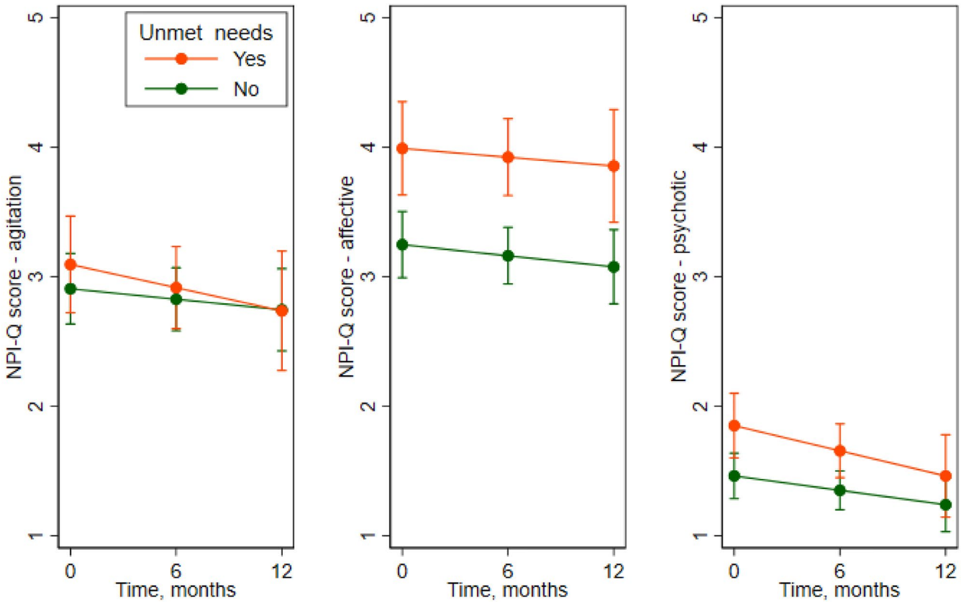
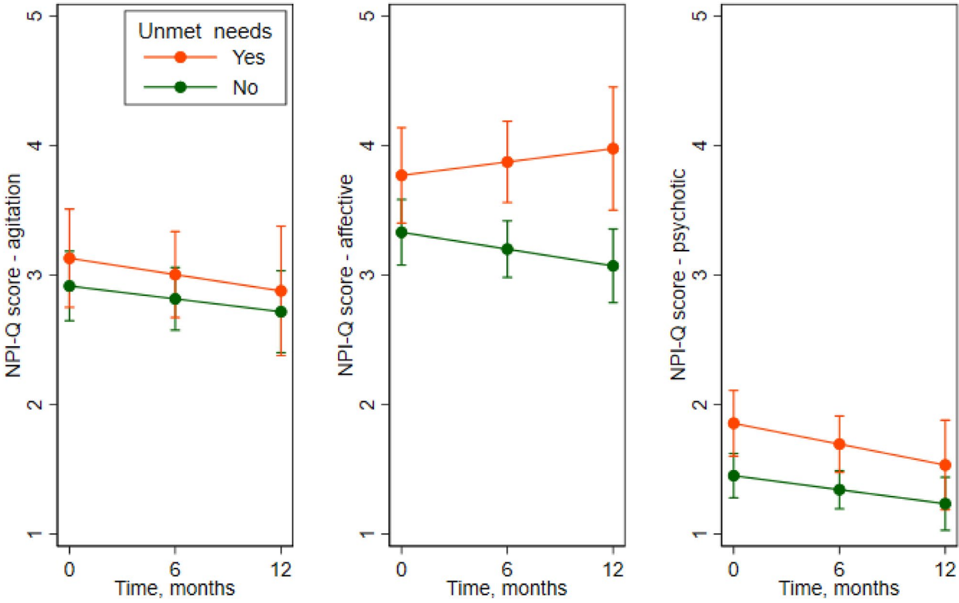
Objectives To examine prospectively the association between unmet needs for daytime activities and company and behavioural and psychological symptoms of dementia.Methods We included 451 people with mild or moderate dementia, from eight European countries, who were assessed three times over 12 months. Unmet needs were measured with the Camberwell Assessment of Need for the Elderly. Three sub-syndromes of the Neuropsychiatric Inventory-Questionnaire were regressed, one-by-one, against unmet needs for daytime activities and company, adjusting for demographic and clinical-functional covariates.Results Unmet needs for daytime activities were associated with more affective symptoms at baseline, six and twelve months, mean 0.74 (p < 0.001), 0.76 (p < 0.001) and 0.78 (p = 0.001) points higher score respectively, and with more psychotic symptoms at baseline (mean 0.39 points, p = 0.007) and at six months follow-up (mean 0.31 points, p = 0.006). Unmet needs for company were associated with more affective symptoms at baseline, six and twelve months, mean 0.44 (p = 0.033), 0.67 (p < 0.001) and 0.91 (p < 0.001) points higher score respectively, and with more psychotic symptoms at baseline (mean 0.40 points, p = 0.005) and at six months (mean 0.35 points, p = 0.002) follow-up.Conclusion Interventions to reduce unmet needs for daytime activities and company could reduce affective and psychotic symptoms in people with dementia.
Overview
The claims and statistics of this paper haven’t been checked yet.
Free: it reads the open-access text and checks the first 5 claims that cite a source we can check. Create a free account to check every claim.
Integrity signals
Registry
Cites
Statistics
Figures


Verification
Claims the paper makes
The claims and statistics of this paper haven’t been checked yet.
Free: it reads the open-access text and checks the first 5 claims that cite a source we can check. Create a free account to check every claim.
Claims other papers make about this one
Each is checked against this paper’s own text: does it say what the citing paper says it does?
The source backs part of the claim, not all of it — or backs it for a different population, condition or comparison.
In the citing paper
“When these needs remain unaddressed, they can lead to negative outcomes such as increased behavioral and psychological symptoms of dementia (BPSD), reduced quality of life, higher levels of distress, and even accelerated cognitive decline [3, 4].”
From Unmet Needs in Dementia Care: The Predictive Role of Caregiver Challenges (2025) · cites this paper as [4]
Experimental — accuracy not yet measured
Self-check
Percentages, sums and reported differences re-computed from the paper’s own numbers.
The self-check needs the paper’s full text.
Citations
Cites
Charlson, M. E., Pompei, P., Ales, K. L., & MacKenzie, C. R. (1987) · Journal of Chronic Diseases · doi:10.1016/0021-9681(87)90171-8 · Cited by 49,742
Assessment of Older People: Self-Maintaining and Instrumental Activities of Daily Living
Lawton, M. P., & Brody, E. M. (1969) · The Gerontologist · doi:10.1093/geront/9.3_part_1.179 · Cited by 18,540
A New Clinical Scale for the Staging of Dementia
Hughes, C. P., Berg, L., Danziger, W., Coben, L. A., & Martin, R. L. (1982) · British Journal of Psychiatry · doi:10.1192/bjp.140.6.566 · Cited by 7,056
Quan, H., Li, B., Couris, C. M., Fushimi, K., Graham, P., Hider, P., Januel, J.-M., & Sundararajan, V. (2011) · American Journal of Epidemiology · doi:10.1093/aje/kwq433 · Cited by 5,843
9 Dementia reconsidered: the person comes first
Kitwood, T. (2011) · Adult lives · doi:10.56687/9781447300458-013 · Cited by 3,103
Lyketsos, C. G., Lopez, O., Jones, B., Fitzpatrick, A. L., Breitner, J., & DeKosky, S. (2002) · JAMA · doi:10.1001/jama.288.12.1475 · Cited by 2,049
Validation of the NPI-Q, a Brief Clinical Form of the Neuropsychiatric Inventory
Kaufer, D., Cummings, J. L., Ketchel, P., Smith, V. M., MacMillan, A., Shelley, T., López, O. L., & DeKosky, S. T. (2000) · Journal of Neuropsychiatry · doi:10.1176/appi.neuropsych.12.2.233 · Cited by 1,973
COVID-19 and the consequences of isolating the elderly
Armitage, R., & Nellums, L. B. (2020) · The Lancet Public Health · doi:10.1016/s2468-2667(20)30061-x · Cited by 1,597 · cited 1×
“Studies have shown that social isolation and reduced access to their usual activities may increase the risk of mental health problems in older adults (Armitage & Nellums, 2020), and it is likely that people with dementia are at particular risk.”
Assessment and management of behavioral and psychological symptoms of dementia
Kales, H. C., Gitlin, L. N., & Lyketsos, C. G. (2015) · BMJ · doi:10.1136/bmj.h369 · Cited by 1,247 · cited 5×
“Enabling people with dementia to engage in meaningful activities as part of their everyday lives should be part of post-diagnostic support (Gitlin et al., 2009; Kales et al., 2015; Lobbia et al., 2019; Orgeta et al., 2017).”
BackgroundInfluentialO’Bryant, S. E. (2008) · Archives of Neurology · doi:10.1001/archneur.65.8.1091 · Cited by 884
Research works printed but not linked: 2
- American Psychiatric Association. (2000). Diagnostic and statistical manual of mental disorders: DSM-IV-TR (4th ed., text revision ed.). Washington, DC: American Psychiatric Association.
- Christiansen, H. C., & Townsend, E. A. (2011). Introduction to occupation The art and science of living (2nd ed.). Essex, England: Pearson Educational Limited.
Cited by
Warren, A. (2022) · Frontiers in Psychology · doi:10.3389/fpsyg.2022.875246 · Cited by 89
Gillis, K., van Diermen, L., Lahaye, H., Witte, M. D., Wit, Y. D., Roelant, E., Lips, D., Zhiri, A., Hockley, J., & Bogaert, P. V. (2023) · European Geriatric Medicine · doi:10.1007/s41999-023-00825-7 · Cited by 28
“Responding to these unmet needs results in a decrease of BPSD [15–17].”
BackgroundMöhler, R., Calo, S., Guiteras, A. R., Renom, H., & Meyer, G. (2023) · Cochrane Database of Systematic Reviews · doi:10.1002/14651858.cd009812.pub3 · Cited by 25
Gebhard, D., & Frank, J. I. (2024) · BMC Geriatrics · doi:10.1186/s12877-024-05641-7 · Cited by 16
Abdullah, J. M., Courtney‐Pratt, H., Doherty, K., & Andrews, S. (2023) · Dementia · doi:10.1177/14713012231198952 · Cited by 12
“…about needs of people with dementia related to social isolation, daytime activities, psychological distress, and dementia knowledge have also been reported by Miranda-Castillo et al. (2013) in their United Kingdom study and other European studies (Mazurek et al., 2019; Michelet et al., 2021).”
BackgroundBPSD reconsidered: diagnostic considerations to preserve personhood in persons with dementia
Warren, A. (2023) · Frontiers in Dementia · doi:10.3389/frdem.2023.1272400 · Cited by 13
Identifying and Addressing Unmet Needs in Dementia: The Role of Care Access and Psychosocial Support
Scharf, A., Michalowsky, B., Rädke, A., Kleinke, F., Schade, S., Platen, M., Buchholz, M., Pfaff, M., Iskandar, A., van den Berg, N., et al. (2025) · International Journal of Geriatric Psychiatry · doi:10.1002/gps.70066 · Cited by 14
Sorrentino, M., Mercogliano, M., Fiorilla, C., Stilo, I., Esposito, F., Moccia, M., Lavorgna, L., Affinito, G., Salvatore, E., Sormani, M. P., et al. (2025) · Frontiers in Public Health · doi:10.3389/fpubh.2025.1605993 · Cited by 12
Dolman, A. J., Kaliappan, S., Zhou, Y., Palleti, D., Marquard, J. L., Lee, S. I., Karkar, R., & Jimison, H. B. (2025) · Innovation in Aging · doi:10.1093/geroni/igaf106 · Cited by 5
Unmet Needs in Dementia Care: The Predictive Role of Caregiver Challenges
Bertola, L., da Mata, F., Ramos, A. A., Godoy, C., de Faria, F. M., Lucchetta, R., de Oliveira Junior, H. A., & Ferri, C. P. (2025) · International Journal of Geriatric Psychiatry · doi:10.1002/gps.70164 · Cited by 2
Activities of persons with dementia at home and after nursing home admission: A survey study
Groenendaal, M., Smaling, H. J. A., Achterberg, W. P., & Caljouw, M. A. A. (2024) · Geriatric Nursing · doi:10.1016/j.gerinurse.2024.10.056 · Cited by 2
Saito, Y., Sato, S., Nishikawa, Y., Oguro, F., Moriyama, N., Sato, K., Kobashi, Y., Sawano, T., Ozaki, A., Nakayama, T., et al. (2023) · FUKUSHIMA JOURNAL OF MEDICAL SCIENCE · doi:10.5387/fms.2023-01 · Cited by 1
“In addition, the amount of daytime activity is reportedly related to improvement in sleep disturbance 27) .”
BackgroundOkonogi, N., Hatano, M., Fuju, T., Yamagami, T., & Yamaguchi, H. (2024) · The Kitakanto Medical Journal · doi:10.2974/kmj.74.11 · Cited by 1
Tsukii, N., Nakamura, K., & Yamaguchi, H. (2023) · Nippon Ronen Igakkai Zasshi Japanese Journal of Geriatrics · doi:10.3143/geriatrics.60.424
Michalowsky, B., Rädke, A., Scharf, A., Mühlichen, F., Buchholz, M., Platen, M., Kleinke, F., Penndorf, P., Pfitzner, S., van den Berg, N., et al. (2024) · Journal of Alzheimer s Disease · doi:10.3233/jad-240025 · Cited by 1
You, D., Ramli, S. H., Ibrahim, R., Romli, M. H., Chu, Q., Yu, X., & Li, Z. (2025) · Disability and Rehabilitation Assistive Technology · doi:10.1080/17483107.2025.2484624 · Cited by 1
“Michelet et al. [69] emphasized the significance of fostering social engagement and meaningful activities, identifying these as crucial elements within various psychosocial interventions designed for the elderly with AD. the significance of the activities undertaken by individuals with AD is…”
Experiences and Support Needs of Informal Caregivers in Managing Behavioral Symptom of Dementia
Akintomide, M., Zhang, X., Iwuagwu, L., & Ramos, M. (2025) · OBM Geriatrics · doi:10.21926/obm.geriatr.2502306
Karacsony, S., Andrews, S., Abela, M., Rouhi, M., & Dinh, T. T. H. (2025) · Dementia · doi:10.1177/14713012251389433 · Cited by 3
“The absence of meaningful engagement activities for people with advanced/advancing dementia can contribute to disturbed behaviour, depression, apathy, boredom and social isolation (Cohen-Mans fi eld et al., 2010; Michelet et al., 2022).”
Metadata
- Authors
- Michelet, M., Selbaek, G., Strand, B. H., Lund, A., Engedal, K., Bieber, A., Gonçalves-Pereira, M., Hopper, L., Irving, K., Jelley, H., Marques, M. J., Orrell, M., Portolani, D. M., Sjölund, B.-M., Sköldunger, A., Stephan, A., Verhey, F., de Vugt, M., Wolfs, C., Woods, B., Zanetti, O., Bergh, S., & the Actifcare Consortium
- Affiliations
- Oslo University Hospital (NO)
- Norwegian National Advisory Unit on Ageing and Health, Vestfold Hospital Trust, Tønsberg, Norway
- Norwegian Institute of Public Health (NO)
- OsloMet – Oslo Metropolitan University (NO)
- Martin Luther University Halle-Wittenberg (DE)
- Comprehensive Health Research Centre (CHRC), CEDOC, Nova Medical School/Faculdade de Ciências Médicas, Universidade Nova de Lisboa, Lisbon, Portugal
- Dublin City University (IE)
- Bangor University (GB)
- Comprehensive Health Research Centre (PT)
- University of Nottingham (GB)
- IRCCS Istituto Centro San Giovanni di Dio Fatebenefratelli, Brescia, Italy
- Stockholm University (SE)
- Karolinska Institutet (SE)
- Maastricht University Medical Centre (NL)
- Department of Psychiatry and Neuropsychology, School for Mental Health and Neuroscience, Alzheimer Center Limburg, Maastricht University Medical Center, Maastricht, The Netherlands
- Centro San Giovanni di Dio Fatebenefratelli (IT)
- Innlandet Hospital Trust (NO)
- Corresponding author
- Michelet, Mona
- ORCID
- Michelet, Mona
- Selbaek, Geir
- Strand, Bjørn Heine
- Lund, Anne
- Engedal, Knut
- Bieber, Anja
- Gonçalves-Pereira, Manuel
- Hopper, Louise
- Irving, Kate
- Jelley, Hannah
- Marques, Maria J.
- Orrell, Martin
- Sjölund, Britt-Marie
- Sköldunger, Anders
- Stephan, Astrid
- Verhey, Frans
- de Vugt, Marjolein
- Wolfs, Claire
- Woods, Bob
- Zanetti, Orazio
- Bergh, Sverre
- Venue
- Aging & Mental Health
- Publisher
- Informa UK Limited
- Published
- 2021-04-16
- Volume
- 26
- Issue
- 4
- Pages
- 725-734
- ISSN
- 1360-7863 (ISSN-L)
- 1364-6915
- OpenAlex
- W3155438235
- Semantic Scholar
- 9a082b4d1898cdedbac6adbc77c2a560c068dc44
- Cited by
- 19
- References
- 41
- Citations by year
- 2025: 7 · 2024: 5 · 2023: 6 · 2022: 1
- FWCI
- 2.15
- Type
- journal article
- Language
- en
- Open access
- hybrid
- doi.org
- Licence
- Locations
- Aging & Mental Health (publishedVersion, cc-by-nc-nd)
- PubMed (publishedVersion)
- Dublin City University Open Access Institutional Repository (Dublin City University) (acceptedVersion)
- Portuguese National Funding Agency for Science, Research and Technology (RCAAP Project by FCT) (submittedVersion, other-oa)
- Arrow@dit (Dublin Institute of Technology) (submittedVersion)
- Diva portal (Dalarna University Library) (submittedVersion, other-oa)
- Research Publications (Maastricht University) (submittedVersion, cc-by-nc-nd)
- Dublin City University Open Access Institutional Repository (Dublin City University) (submittedVersion, cc-by)
- NORA - Norwegian Open Research Archives (submittedVersion, other-oa)
- NORA - Norwegian Open Research Archives (submittedVersion, cc-by)
- NORA - Norwegian Open Research Archives (submittedVersion, cc-by-nc-nd)
- Research Publications (Maastricht University) (submittedVersion, other-oa)
- Funders
- JPND
- Germany, Ministry of Education and Research, Ireland, Health research board
- Italy, Ministry of Health
- the Netherlands, The Netherlands Organization for Health Research and Development
- Sweden, The Swedish Research Council for Health, Working Life and Welfare
- Norway, The Research Council of Norway
- Portugal, Foundation for Science and Technology, FCT
- United Kingdom, Economic and Social Research Council
- Topics
- Health Sciences › Medicine › Psychiatry and Mental health › Dementia and Cognitive Impairment Research
- Health Sciences › Medicine › Public Health, Environmental and Occupational Health › Aging, Health, and Disability
- Health Sciences › Medicine › Geriatrics and Gerontology › Geriatric Care and Nursing Homes
- Keywords
- dementia, unmet needs, diurnal activity, social enterprises, behavioral and psychological symptoms of dementia, affective symptoms, psychotic symptoms, Camberwell Assessment of Need for the Elderly, Neuropsychiatric Inventory Questionnaire, mild to moderate dementia
- MeSH terms
- Aged, Dementia, Health Services Needs and Demand, Humans, Longitudinal Studies, Psychotic Disorders, Surveys and Questionnaires
About these checks
Registry, retraction, Cites and statistics results are computed, not judged, with one exception: a printed reference that no index lists is read once by a model before it counts as a citation error. Claims are extracted by a model and kept only when their quote appears verbatim in the text; each cited source is then checked, with a model’s help, for whether it says what the claim relies on. Those verdicts can be wrong — read the claim’s quote and the cited source before relying on one.
Statistics and arithmetic are recomputed, not judged.
Confidence bands are shown only for fields calibrated on our annotated test set. None is calibrated yet, so no band is shown.
What counts as a claim ›How we measure confidence ›How we check this ›
Are you an author, or do you see a problem with this page? Request a review
Data sources
Bibliographic data: Semantic Scholar, OpenAlex, Crossref.
Contains information from the Semantic Scholar Academic Graph Datasets, made available under the ODC Attribution License (ODC-BY 1.0).
Semantic Scholar’s data is described in: Kinney, R., et al. (2023). The Semantic Scholar Open Data Platform. arXiv:2301.10140.
