

Associations between unmet needs for daytime activities and company and scores on the Neuropsychiatric Inventory-Questionnaire in people with dementia: a longitudinal study
Open accessThe DOI matches its Crossref record; 42 of the 42 references it cites were found in a registry or an index.
Abstract
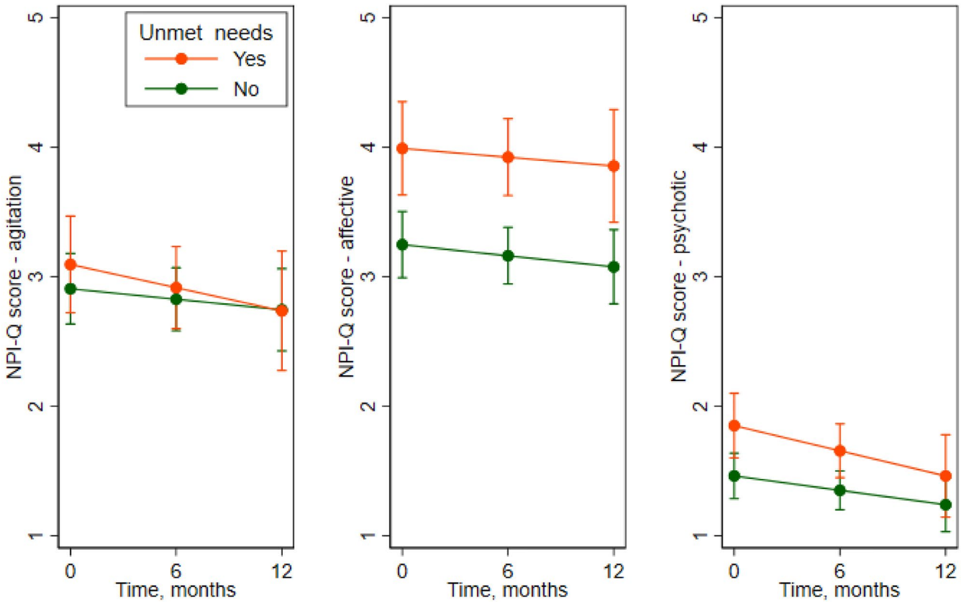
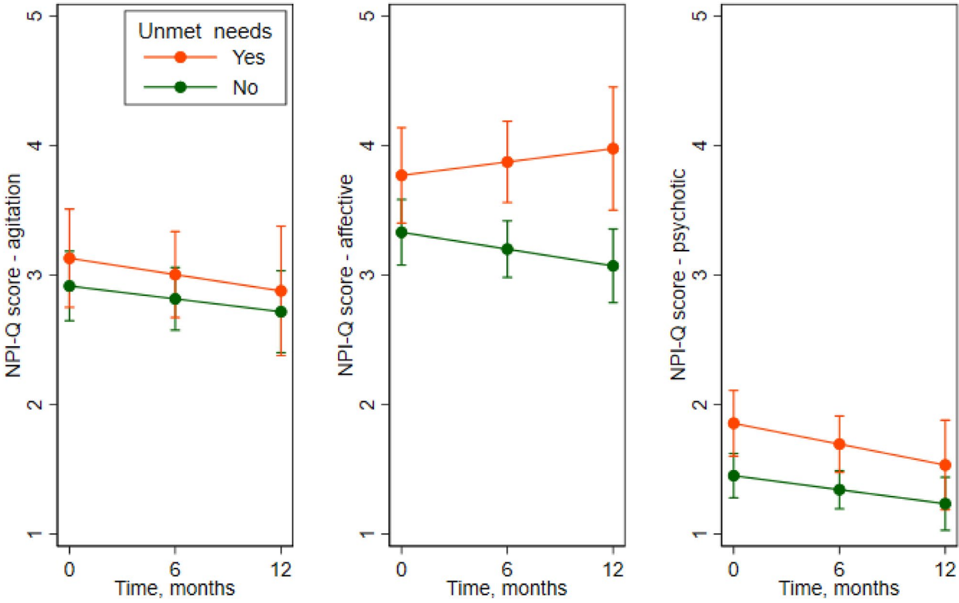
Objectives To examine prospectively the association between unmet needs for daytime activities and company and behavioural and psychological symptoms of dementia.Methods We included 451 people with mild or moderate dementia, from eight European countries, who were assessed three times over 12 months. Unmet needs were measured with the Camberwell Assessment of Need for the Elderly. Three sub-syndromes of the Neuropsychiatric Inventory-Questionnaire were regressed, one-by-one, against unmet needs for daytime activities and company, adjusting for demographic and clinical-functional covariates.Results Unmet needs for daytime activities were associated with more affective symptoms at baseline, six and twelve months, mean 0.74 (p < 0.001), 0.76 (p < 0.001) and 0.78 (p = 0.001) points higher score respectively, and with more psychotic symptoms at baseline (mean 0.39 points, p = 0.007) and at six months follow-up (mean 0.31 points, p = 0.006). Unmet needs for company were associated with more affective symptoms at baseline, six and twelve months, mean 0.44 (p = 0.033), 0.67 (p < 0.001) and 0.91 (p < 0.001) points higher score respectively, and with more psychotic symptoms at baseline (mean 0.40 points, p = 0.005) and at six months (mean 0.35 points, p = 0.002) follow-up.Conclusion Interventions to reduce unmet needs for daytime activities and company could reduce affective and psychotic symptoms in people with dementia.
Overview
The claims and statistics of this paper haven’t been checked yet.
Free: it reads the open-access text and checks the first 5 claims that cite a source we can check. Create a free account to check every claim.
Integrity signals
Registry
Cites
Statistics
Figures


Verification
Claims the paper makes
The claims and statistics of this paper haven’t been checked yet.
Free: it reads the open-access text and checks the first 5 claims that cite a source we can check. Create a free account to check every claim.
Claims other papers make about this one
Each is checked against this paper’s own text: does it say what the citing paper says it does?
The source backs part of the claim, not all of it — or backs it for a different population, condition or comparison.
In the citing paper
“When these needs remain unaddressed, they can lead to negative outcomes such as increased behavioral and psychological symptoms of dementia (BPSD), reduced quality of life, higher levels of distress, and even accelerated cognitive decline [3, 4].”
From Unmet Needs in Dementia Care: The Predictive Role of Caregiver Challenges (2025) · cites this paper as [4]
Experimental — accuracy not yet measured
Self-check
Percentages, sums and reported differences re-computed from the paper’s own numbers.
The self-check needs the paper’s full text.
Citations
Cites
Charlson, M. E., Pompei, P., Ales, K. L., & MacKenzie, C. R. (1987) · Journal of Chronic Diseases · doi:10.1016/0021-9681(87)90171-8 · Cited by 49,742
Assessment of Older People: Self-Maintaining and Instrumental Activities of Daily Living
Lawton, M. P., & Brody, E. M. (1969) · The Gerontologist · doi:10.1093/geront/9.3_part_1.179 · Cited by 18,540
A New Clinical Scale for the Staging of Dementia
Hughes, C. P., Berg, L., Danziger, W., Coben, L. A., & Martin, R. L. (1982) · British Journal of Psychiatry · doi:10.1192/bjp.140.6.566 · Cited by 7,056
Quan, H., Li, B., Couris, C. M., Fushimi, K., Graham, P., Hider, P., Januel, J.-M., & Sundararajan, V. (2011) · American Journal of Epidemiology · doi:10.1093/aje/kwq433 · Cited by 5,843
9 Dementia reconsidered: the person comes first
Kitwood, T. (2011) · Adult lives · doi:10.56687/9781447300458-013 · Cited by 3,103
Lyketsos, C. G., Lopez, O., Jones, B., Fitzpatrick, A. L., Breitner, J., & DeKosky, S. (2002) · JAMA · doi:10.1001/jama.288.12.1475 · Cited by 2,049
Validation of the NPI-Q, a Brief Clinical Form of the Neuropsychiatric Inventory
Kaufer, D., Cummings, J. L., Ketchel, P., Smith, V. M., MacMillan, A., Shelley, T., López, O. L., & DeKosky, S. T. (2000) · Journal of Neuropsychiatry · doi:10.1176/appi.neuropsych.12.2.233 · Cited by 1,973
COVID-19 and the consequences of isolating the elderly
Armitage, R., & Nellums, L. B. (2020) · The Lancet Public Health · doi:10.1016/s2468-2667(20)30061-x · Cited by 1,597 · cited 1×
“Studies have shown that social isolation and reduced access to their usual activities may increase the risk of mental health problems in older adults (Armitage & Nellums, 2020), and it is likely that people with dementia are at particular risk.”
Assessment and management of behavioral and psychological symptoms of dementia
Kales, H. C., Gitlin, L. N., & Lyketsos, C. G. (2015) · BMJ · doi:10.1136/bmj.h369 · Cited by 1,247 · cited 5×
“Enabling people with dementia to engage in meaningful activities as part of their everyday lives should be part of post-diagnostic support (Gitlin et al., 2009; Kales et al., 2015; Lobbia et al., 2019; Orgeta et al., 2017).”
BackgroundInfluentialO’Bryant, S. E. (2008) · Archives of Neurology · doi:10.1001/archneur.65.8.1091 · Cited by 884
Neuropsychiatric Syndromes in Dementia
Aalten, P., Verhey, F. R. J., Boziki, M., Bullock, R., Byrne, E. J., Camus, V., Caputo, M., Collins, D., De Deyn, P. P., Elina, K., et al. (2007) · Dementia and Geriatric Cognitive Disorders · doi:10.1159/000110738 · Cited by 383
Self-citationCamberwell Assessment of Need for the Elderly (CANE): Development, validity and reliability
Reynolds, T., Thornicroft, G., Abas, M., Woods, B., Hoe, J., Leese, M., & Orrell, M. (2000) · British Journal of Psychiatry · doi:10.1192/bjp.176.5.444 · Cited by 359
Self-citationDoing as much as I can do: The meaning of activity for people with dementia
Phinney, A., Chaudhury, H., & O’connor, D. L. (2007) · Aging & Mental Health · doi:10.1080/13607860601086470 · Cited by 334
Which unmet needs contribute to behavior problems in persons with advanced dementia?
Cohen-Mansfield, J., Dakheel-Ali, M., Marx, M. S., Thein, K., & Regier, N. G. (2015) · Psychiatry Research · doi:10.1016/j.psychres.2015.03.043 · Cited by 287
Quality of life of people with dementia in residential care homes
Hoe, J., Hancock, G., Livingston, G., & Orrell, M. (2006) · British Journal of Psychiatry · doi:10.1192/bjp.bp.104.007658 · Cited by 281
Self-citationvan der Roest, H. G., Meiland, F. J. M., Comijs, H. C., Derksen, E., Jansen, A. P. D., van Hout, H. P. J., Jonker, C., & Dröes, R.-M. (2009) · International Psychogeriatrics · doi:10.1017/s1041610209990147 · Cited by 241 · cited 1×
“For people with dementia, thorough assessments of individual needs are important for efficiently delivering high-quality health and social services that are individually tailored (Curnow, Rush, Maciver, Gorska, & Forsyth, 2021; van der Roest et al., 2009).”
BackgroundGitlin, L. N., Winter, L., Vause Earland, T., Adel Herge, E., Chernett, N. L., Piersol, C. V., & Burke, J. P. (2009) · The Gerontologist · doi:10.1093/geront/gnp087 · Cited by 188 · cited 2×
“Caregivers being taught to use activities individually tailored to the capabilities and interests of people with dementia in the Tailored Activity Program (TAP) report reduced behavioural symptoms (Gitlin et al., 2009).”
BackgroundGrouping of behavioural and psychological symptoms of dementia
van der Linde, R. M., Dening, T., Matthews, F. E., & Brayne, C. (2014) · International Journal of Geriatric Psychiatry · doi:10.1002/gps.4037 · Cited by 162
Black, B. S., Johnston, D., Leoutsakos, J., Reuland, M., Kelly, J., Amjad, H., Davis, K., Willink, A., Sloan, D., Lyketsos, C., et al. (2019) · International Psychogeriatrics · doi:10.1017/s1041610218002296 · Cited by 145
Unmet needs, quality of life and support networks of people with dementia living at home
Miranda-Castillo, C., Woods, B., Galboda, K., Oomman, S., Olojugba, C., & Orrell, M. (2010) · Health and Quality of Life Outcomes · doi:10.1186/1477-7525-8-132 · Cited by 139 · cited 1×
“The association between unmet needs for daytime activities and company and affective and psychotic symptoms According to previous studies, unmet needs are, in general, associated with BPSD (Miranda-Castillo et al., 2010).”
BackgroundSelf-citationLobbia, A., Carbone, E., Faggian, S., Gardini, S., Piras, F., Spector, A. E., & Borella, E. (2018) · European Psychologist · doi:10.1027/1016-9040/a000342 · Cited by 128 · cited 1×
“…found to offer several positive effects including reducing anxiety and depressive symptoms, improving quality of life and communication, reducing problematic behavioural symptoms, and increasing scores on ADL for community-dwelling people with dementia (Lobbia et al., 2019; Orgeta et al., 2017).”
BackgroundBehavioural activation for depression in older people: systematic review and meta-analysis
Orgeta, V., Brede, J., & Livingston, G. (2017) · British Journal of Psychiatry · doi:10.1192/bjp.bp.117.205021 · Cited by 116 · cited 1×
“…found to offer several positive effects including reducing anxiety and depressive symptoms, improving quality of life and communication, reducing problematic behavioural symptoms, and increasing scores on ADL for community-dwelling people with dementia (Lobbia et al., 2019; Orgeta et al., 2017).”
BackgroundKerpershoek, L., de Vugt, M., Wolfs, C., Woods, B., Jelley, H., Orrell, M., Stephan, A., Bieber, A., Meyer, G., Selbaek, G., et al. (2018) · Aging & Mental Health · doi:10.1080/13607863.2017.1390732 · Cited by 90
Self-citationWergeland, J. N., Selbæk, G., Bergh, S., Söderhamn, U., & Kirkevold, Ø. (2015) · Dementia and Geriatric Cognitive Disorders Extra · doi:10.1159/000437382 · Cited by 72
Self-citationCurnow, E., Rush, R., Maciver, D., Górska, S., & Forsyth, K. (2021) · Aging & Mental Health · doi:10.1080/13607863.2019.1695741 · Cited by 57 · cited 2×
“Other unmet needs frequently reported by people with dementia, as well as their caregivers, include needs related to memory problems, information and psychological distress (Curnow et al., 2021; Miranda-Castillo et al., 2010; van der Roest et al., 2009).”
Backgroundthe Actifcare Consortium, Kerpershoek, L., de Vugt, M., Wolfs, C., Jelley, H., Orrel, M., Woods, B., Stephan, A., Bieber, A., Meyer, G., et al. (2016) · BMC Health Services Research · doi:10.1186/s12913-016-1672-3 · Cited by 54
Self-citationHandels, R. L. H., Sköldunger, A., Bieber, A., Edwards, R. T., Gonçalves‐Pereira, M., Hopper, L., Irving, K., Jelley, H., Kerpershoek, L., Marques, M. J., et al. (2018) · Journal of Alzheimer s Disease · doi:10.3233/jad-180275 · Cited by 53 · cited 3×
“Identifying and seeking to meet unmet needs of people with dementia is important because unmet needs have been found to be associated with a lower health-related quality of life (Handels et al., 2018; Hoe, Hancock, Livingston, & Orrell, 2006; Janssen et al., 2018; Kerpershoek et al., 2018; Miranda-Castillo et al., 201…”
BackgroundSelf-citationEichler, T., Thyrian, J. R., Hertel, J., Richter, S., Wucherer, D., Michalowsky, B., Teipel, S., Kilimann, I., Dreier, A., & Hoffmann, W. (2016) · Journal of Alzheimer's Disease · doi:10.3233/jad-150935 · Cited by 52 · cited 1×
“Impairment in ADL has been found to be associated with a higher number of unmet needs (Eichler et al., 2016).”
BackgroundStrandenæs, M. G., Lund, A. D., & Rokstad, A. M. M. (2017) · Aging & Mental Health · doi:10.1080/13607863.2017.1304892 · Cited by 52
Self-citationLanguage paradigms when behaviour changes with dementia: #BanBPSD
Cunningham, C., Macfarlane, S., & Brodaty, H. (2019) · International Journal of Geriatric Psychiatry · doi:10.1002/gps.5122 · Cited by 39 · cited 1×
“Unmet needs are widely considered to be one of the contributory factors of BPSD (Black et al., 2019; Cohen-Mansfield, Dakheel-Ali, Marx, Thein, & Regier, 2015; Cunningham et al., 2019; Kales et al., 2015).”
BackgroundWolverson, E., Birtles, H., Moniz-Cook, E. D., James, I. A., Brooker, D., & Duffy, F. (2019) · OBM Geriatrics · doi:10.21926/obm.geriatr.1904080 · Cited by 37 · cited 2×
“The term BPSD has lately been raised as controversial, and there is an ongoing discussion to find a more psychosocial term that reflects the multiple causes of behaviour in dementia care (Cunningham, Macfarlane, & Brodaty, 2019; Wolverson et al., 2019).”
BackgroundPreez, J. D., Millsteed, J., Marquis, R., & Richmond, J. E. (2018) · Healthcare · doi:10.3390/healthcare6020043 · Cited by 35
Orrell, M. W., & Hancock, G. A. (2004) · Gaskell eBooks · Cited by 31
Self-citationKeogh, F., Mountain, G. A., Joddrell, P., & Lord, K. (2018) · American Journal of Geriatric Psychiatry · doi:10.1016/j.jagp.2018.12.027 · Cited by 29
Mazurek, J., Szcześniak, D. M., Lion, K., Dröes, R., Karczewski, M., & Rymaszewska, J. (2019) · Clinical Interventions in Aging · doi:10.2147/cia.s185683 · Cited by 27
Patterns of neuropsychiatric sub-syndromes in Brazilian and Norwegian patients with dementia
Truzzi, A., Ulstein, I. D., Valente, L., Engelhardt, E., Coutinho, E. S. F., Laks, J., & Engedal, K. (2012) · International Psychogeriatrics · doi:10.1017/s1041610212001640 · Cited by 25
Self-citationJanssen, N., Handels, R. L. H., Sköldunger, A., Woods, B. T., Jelley, H., Edwards, R. T., Orrell, M. W., Selbæk, G., Røsvik, J., Gonçalves‐Pereira, M., et al. (2018) · Journal of Alzheimer s Disease · doi:10.3233/jad-180531 · Cited by 24 · cited 1×
“Identifying and seeking to meet unmet needs of people with dementia is important because unmet needs have been found to be associated with a lower health-related quality of life (Handels et al., 2018; Hoe, Hancock, Livingston, & Orrell, 2006; Janssen et al., 2018; Kerpershoek et al., 2018; Miranda-Castillo et al., 201…”
BackgroundSelf-citationMichelet, M., Lund, A. D., Strand, B. H., Engedal, K., Selbæk, G., & Bergh, S. (2020) · Scandinavian Journal of Primary Health Care · doi:10.1080/02813432.2020.1753334 · Cited by 23
Self-citationStrandenæs, M. G., Lund, A. D., & Rokstad, A. M. M. (2019) · Journal of Multidisciplinary Healthcare · doi:10.2147/jmdh.s198024 · Cited by 16
Self-citationCipriani, G., Danti, S., Nuti, A., Fiorino, M. D., & Cammisuli, D. M. (2020) · Acta Neurologica Belgica · doi:10.1007/s13760-020-01352-z · Cited by 16
Alltag, S., Stein, J., Pabst, A., Weyerer, S. B., Werle, J., Maier, W., Miebach, L., Scherer, M., Stark, A., Wiese, B., et al. (2017) · Aging & Mental Health · doi:10.1080/13607863.2017.1328480 · Cited by 13 · cited 1×
“Company and daytime activities are both considered to be social needs, and unmet social needs have been found to be associated with higher levels of depression along with unmet psychological needs (Alltag et al., 2018).”
BackgroundBarbero (2014) · doi:10.1016/j · Cited by 1
Research works printed but not linked: 2
- American Psychiatric Association. (2000). Diagnostic and statistical manual of mental disorders: DSM-IV-TR (4th ed., text revision ed.). Washington, DC: American Psychiatric Association.
- Christiansen, H. C., & Townsend, E. A. (2011). Introduction to occupation The art and science of living (2nd ed.). Essex, England: Pearson Educational Limited.
Cited by
Warren, A. (2022) · Frontiers in Psychology · doi:10.3389/fpsyg.2022.875246 · Cited by 89
Gillis, K., van Diermen, L., Lahaye, H., Witte, M. D., Wit, Y. D., Roelant, E., Lips, D., Zhiri, A., Hockley, J., & Bogaert, P. V. (2023) · European Geriatric Medicine · doi:10.1007/s41999-023-00825-7 · Cited by 28
“Responding to these unmet needs results in a decrease of BPSD [15–17].”
BackgroundMöhler, R., Calo, S., Guiteras, A. R., Renom, H., & Meyer, G. (2023) · Cochrane Database of Systematic Reviews · doi:10.1002/14651858.cd009812.pub3 · Cited by 25
Gebhard, D., & Frank, J. I. (2024) · BMC Geriatrics · doi:10.1186/s12877-024-05641-7 · Cited by 16
Abdullah, J. M., Courtney‐Pratt, H., Doherty, K., & Andrews, S. (2023) · Dementia · doi:10.1177/14713012231198952 · Cited by 12
“…about needs of people with dementia related to social isolation, daytime activities, psychological distress, and dementia knowledge have also been reported by Miranda-Castillo et al. (2013) in their United Kingdom study and other European studies (Mazurek et al., 2019; Michelet et al., 2021).”
Background
Metadata
- Authors
- Michelet, M., Selbaek, G., Strand, B. H., Lund, A., Engedal, K., Bieber, A., Gonçalves-Pereira, M., Hopper, L., Irving, K., Jelley, H., Marques, M. J., Orrell, M., Portolani, D. M., Sjölund, B.-M., Sköldunger, A., Stephan, A., Verhey, F., de Vugt, M., Wolfs, C., Woods, B., Zanetti, O., Bergh, S., & the Actifcare Consortium
- Affiliations
- Oslo University Hospital (NO)
- Norwegian National Advisory Unit on Ageing and Health, Vestfold Hospital Trust, Tønsberg, Norway
- Norwegian Institute of Public Health (NO)
- OsloMet – Oslo Metropolitan University (NO)
- Martin Luther University Halle-Wittenberg (DE)
- Comprehensive Health Research Centre (CHRC), CEDOC, Nova Medical School/Faculdade de Ciências Médicas, Universidade Nova de Lisboa, Lisbon, Portugal
- Dublin City University (IE)
- Bangor University (GB)
- Comprehensive Health Research Centre (PT)
- University of Nottingham (GB)
- IRCCS Istituto Centro San Giovanni di Dio Fatebenefratelli, Brescia, Italy
- Stockholm University (SE)
- Karolinska Institutet (SE)
- Maastricht University Medical Centre (NL)
- Department of Psychiatry and Neuropsychology, School for Mental Health and Neuroscience, Alzheimer Center Limburg, Maastricht University Medical Center, Maastricht, The Netherlands
- Centro San Giovanni di Dio Fatebenefratelli (IT)
- Innlandet Hospital Trust (NO)
- Corresponding author
- Michelet, Mona
- ORCID
- Michelet, Mona
- Selbaek, Geir
- Strand, Bjørn Heine
- Lund, Anne
- Engedal, Knut
- Bieber, Anja
- Gonçalves-Pereira, Manuel
- Hopper, Louise
- Irving, Kate
- Jelley, Hannah
- Marques, Maria J.
- Orrell, Martin
- Sjölund, Britt-Marie
- Sköldunger, Anders
- Stephan, Astrid
- Verhey, Frans
- de Vugt, Marjolein
- Wolfs, Claire
- Woods, Bob
- Zanetti, Orazio
- Bergh, Sverre
- Venue
- Aging & Mental Health
- Publisher
- Informa UK Limited
- Published
- 2021-04-16
- Volume
- 26
- Issue
- 4
- Pages
- 725-734
- ISSN
- 1360-7863 (ISSN-L)
- 1364-6915
- OpenAlex
- W3155438235
- Cited by
- 19
- References
- 41
- Citations by year
- 2025: 7 · 2024: 5 · 2023: 6 · 2022: 1
- FWCI
- 2.15
- Type
- journal article
- Language
- en
- Open access
- hybrid
- doi.org
- Licence
- Locations
- Aging & Mental Health (publishedVersion, cc-by-nc-nd)
- PubMed (publishedVersion)
- Dublin City University Open Access Institutional Repository (Dublin City University) (acceptedVersion)
- Portuguese National Funding Agency for Science, Research and Technology (RCAAP Project by FCT) (submittedVersion, other-oa)
- Arrow@dit (Dublin Institute of Technology) (submittedVersion)
- Diva portal (Dalarna University Library) (submittedVersion, other-oa)
- Research Publications (Maastricht University) (submittedVersion, cc-by-nc-nd)
- Dublin City University Open Access Institutional Repository (Dublin City University) (submittedVersion, cc-by)
- NORA - Norwegian Open Research Archives (submittedVersion, other-oa)
- NORA - Norwegian Open Research Archives (submittedVersion, cc-by)
- NORA - Norwegian Open Research Archives (submittedVersion, cc-by-nc-nd)
- Research Publications (Maastricht University) (submittedVersion, other-oa)
- Funders
- JPND
- Germany, Ministry of Education and Research, Ireland, Health research board
- Italy, Ministry of Health
- the Netherlands, The Netherlands Organization for Health Research and Development
- Sweden, The Swedish Research Council for Health, Working Life and Welfare
- Norway, The Research Council of Norway
- Portugal, Foundation for Science and Technology, FCT
- United Kingdom, Economic and Social Research Council
- Topics
- Health Sciences › Medicine › Psychiatry and Mental health › Dementia and Cognitive Impairment Research
- Health Sciences › Medicine › Public Health, Environmental and Occupational Health › Aging, Health, and Disability
- Health Sciences › Medicine › Geriatrics and Gerontology › Geriatric Care and Nursing Homes
- Keywords
- dementia, unmet needs, diurnal activity, social enterprises, behavioral and psychological symptoms of dementia, affective symptoms, psychotic symptoms, Camberwell Assessment of Need for the Elderly, Neuropsychiatric Inventory Questionnaire, mild to moderate dementia
- MeSH terms
- Aged, Dementia, Health Services Needs and Demand, Humans, Longitudinal Studies, Psychotic Disorders, Surveys and Questionnaires
About these checks
Registry, retraction, Cites and statistics results are computed, not judged, with one exception: a printed reference that no index lists is read once by a model before it counts as a citation error. Claims are extracted by a model and kept only when their quote appears verbatim in the text; each cited source is then checked, with a model’s help, for whether it says what the claim relies on. Those verdicts can be wrong — read the claim’s quote and the cited source before relying on one.
Statistics and arithmetic are recomputed, not judged.
Confidence bands are shown only for fields calibrated on our annotated test set. None is calibrated yet, so no band is shown.
What counts as a claim ›How we measure confidence ›How we check this ›
Are you an author, or do you see a problem with this page? Request a review
Data sources
Bibliographic data: Semantic Scholar, OpenAlex, Crossref.
Contains information from the Semantic Scholar Academic Graph Datasets, made available under the ODC Attribution License (ODC-BY 1.0).
Semantic Scholar’s data is described in: Kinney, R., et al. (2023). The Semantic Scholar Open Data Platform. arXiv:2301.10140.
