

The DOI matches its Crossref record; 66 of the 66 references it cites were found in a registry or an index.
Transparent to whom? No algorithmic accountability without a critical audience
Open accessAbstract
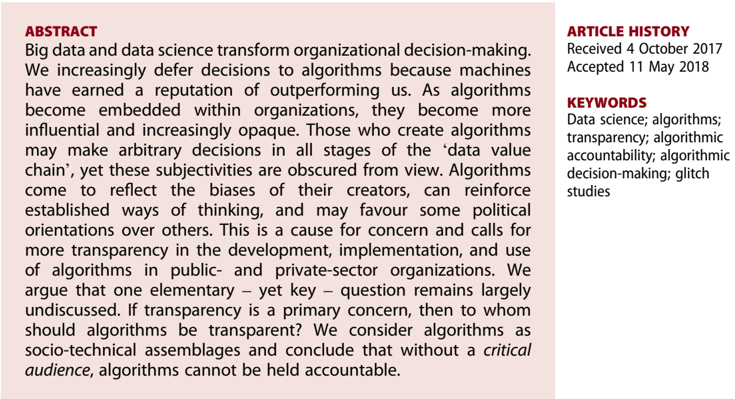
Big data and data science transform organizational decision-making. We increasingly defer decisions to algorithms because machines have earned a reputation of outperforming us. As algorithms become embedded within organizations, they become more influential and increasingly opaque. Those who create algorithms may make arbitrary decisions in all stages of the ‘data value chain’, yet these subjectivities are obscured from view. Algorithms come to reflect the biases of their creators, can reinforce established ways of thinking, and may favour some political orientations over others. This is a cause for concern and calls for more transparency in the development, implementation, and use of algorithms in public- and private-sector organizations. We argue that one elementary – yet key – question remains largely undiscussed. If transparency is a primary concern, then to whom should algorithms be transparent? We consider algorithms as socio-technical assemblages and conclude that without a critical audience, algorithms cannot be held accountable.
Overview
The claims and statistics of this paper haven’t been checked yet.
Run the check — free, no account needed. It reads the open-access text and checks the sources it cites.
Integrity signals
Registry
Cites
Statistics
Figures

Verification
Claims the paper makes
The claims and statistics of this paper haven’t been checked yet.
Run the check — free, no account needed. It reads the open-access text and checks the sources it cites.
Claims other papers make about this one
Each is checked against this paper’s own text: does it say what the citing paper says it does?
The cited source says what the claim attributes to it.
In the citing paper
“Crucially, a meaningful account cannot be given unless the forum can understand and critically engage with the subject matter [37,75].”
From Reviewable Automated Decision-Making: A Framework for Accountable Algorithmic Systems (2021) · cites this paper as [37]
Self-check
Percentages, sums and reported differences re-computed from the paper’s own numbers.
The self-check needs the paper’s full text.
Citations
Cites
Tversky, A., & Kahneman, D. (1974) · Science · doi:10.1126/science.185.4157.1124 · Cited by 28,810 · cited 1×
“In statistics and economics, the cognitive biases of people (e.g. con fi r-mation bias) and analytical pitfals (e.g. selection bias) have been subject of inquiry for many decades and are relatively well understood (see Tversky & Kahneman, 1974).”
null (2016) · Philosophy Study · doi:10.17265/2159-5313/2016.09.003 · Cited by 28,317
Judgment under Uncertainty: Heuristics and Biases
Tversky, A., & Kahneman, D. (1975) · Utility, Probability, and Human Decision Making · doi:10.1007/978-94-010-1834-0_8 · Cited by 22,650
The FAIR Guiding Principles for scientific data management and stewardship
Wilkinson, M. D., Dumontier, M., Aalbersberg, I. J., Appleton, G., Axton, M., Baak, A., Blomberg, N., Boiten, J.-W., da Silva Santos, L. B., Bourne, P. E., et al. (2016) · Scientific Data · doi:10.1038/sdata.2016.18 · Cited by 18,423 · cited 3×
“The FAIR acronym refers to data management that is Findable, Accessible, Interoperable, and Reusable (Wilkinson, 2016, p. 4; Wilkinson et al., 2017, p. 3): Findable ‒ data should be identi fi ed using globally unique, resolvable, and persistent identi fi ers, and should include machine-actionable…”
MethodBusiness intelligence and analytics: from big data to big impact
Chen, H., Chiang, R. H. L., & Storey, V. C. (2012) · MIS Quarterly · doi:10.2307/41703503 · Cited by 6,250
(2023) · doi:10.1126/science · Cited by 6,063
Beyond the hype: Big data concepts, methods, and analytics
Gandomi, A., & Haider, M. (2015) · International Journal of Information Management · doi:10.1016/j.ijinfomgt.2014.10.007 · Cited by 4,226 · cited 1×
“The resulting pervasive collection of data-centric innovations has been subjected to limited academic scrutiny, especially when compared to the dissemination of earlier statistical techniques (Gandomi & Haider, 2015).”
MethodThe Black Box Society: The Secret Algorithms That Control Money and Information
Pasquale, F. (2015) · doi:10.4159/harvard.9780674736061 · Cited by 3,796
Barocas, S., & Selbst, A. D. (2014) · doi:10.2139/ssrn.2477899 · Cited by 3,048 · cited 2×
“Despite the many advantages that these quanti fi cation objects may bring about, concerns have risen about the susceptibility of algorithmic models to human-like bias (Barocas & Selbst, 2016; Caliskan-Islam, Bryson, & Narayanan, 2016; van Doorn, 2017).”
BackgroundSemantics derived automatically from language corpora contain human-like biases
Caliskan, A., Bryson, J. J., & Narayanan, A. (2017) · Science · doi:10.1126/science.aal4230 · Cited by 2,887 · cited 1×
“…can learn to adopt similar discriminatory attitudes based on words associated with a particular gender or social group (Barocas & Selbst, 2016; Caliskan, Bryson, & Narayanan, 2017) ‒ similarly, algorithmic models have been demonstrated to potentially reproduce racialized and sex-ualized…”
Background
Research works printed but not linked: 14
- 10.15779/Z38BG31 · DOI · Paper page
- Bodó B., 2017, Yale Journal of Law & Technology, 19, 133
- 10.1126/science.aal4230 · DOI · Paper page
- Cloninger C., 2013, Slave to the algorithm., 16
- 10.17265/2159-5313/2016.09.003 · DOI · Paper page
- Knoespe K. J., 2008, Théorie, Littérature, Epistémologie, 25, 235
- Lazer D., 2014, Policy Forum, 343, 1203
- Macpherson N., 2013, Review of quality assurance of government models
- Manon H., 2011, World Picture, 6, 1
- Minsky M. L., 1965, Proceedings of International Federation of Information Processing Congress, 1, 45
- Miyazaki S., 2012, Computational Culture, 2
- 10.17265/2159-5313/2016.09.003 · DOI · Paper page
- Sandvig C., 2014, Paper presented to Data and Discrimination: Converting Critical Concerns into Productive Inquiry
- Seaver N., 2013, Media in Transition, 8, 1
Cited by
Sorted by citations
Items 101–200 of 259
Algorithmic policing accountability: eight sociotechnical challenges
Wessels, M. (2023) · Policing & Society · doi:10.1080/10439463.2023.2241965 · Cited by 14
“As a result, the datasets in the model cannot be questioned, interrogated or evaluated on their quality (Bennet Moses and Chan 2018, Kemper and Kolkman 2019, Busuioc 2021, Meijer and Grimmelikhuijsen 2021).”
How to Design a Governable Digital Health Ecosystem
Morley, J., & Floridi, L. (2019) · Digital ethics lab yearbook · doi:10.1007/978-3-030-80083-3_8 · Cited by 13
A Crisis of Data? Transparency Practices and Infrastructures of Value in Data Broker Platforms
Zook, M., & Spangler, I. (2022) · Annals of the American Association of Geographers · doi:10.1080/24694452.2022.2071201 · Cited by 10
Socially meaningful transparency in data-based systems: reflections and proposals from practice
Bates, J., Kennedy, H., Medina-Perea, I., Oman, S., & Pinney, L. (2023) · Journal of Documentation · doi:10.1108/jd-01-2023-0006 · Cited by 14
Explanations as governance? Investigating practices of explanation in algorithmic system design
Powell, A. B. (2021) · European Journal of Communication · doi:10.1177/02673231211028376 · Cited by 10
“This framing of transparency includes the ‘understandability of a specific model’ (Lepri et al., 2018: 9) and is seen as a requisite for algorithmic accountability (Kemper and Kolkman, 2019).”
BackgroundExplainable AI: Foundations, Applications, Opportunities for Data Management Research
Pradhan, R., Lahiri, A., Galhotra, S., & Salimi, B. (2022) · IEEE International Conference on Data Engineering (ICDE) · doi:10.1109/icde53745.2022.00300 · Cited by 10
„Computer says no“? Konsequenzen der Algorithmisierung von Entscheidungsprozessen
Kette, S. (2021) · Soziale Systeme · doi:10.1515/sosys-2021-0006 · Cited by 12
Febriyanti, D., Widianingsih, I., Sumaryana, A., & Buchari, R. A. (2023) · Cogent Social Sciences · doi:10.1080/23311886.2023.2269710 · Cited by 29
“First, the government needs to convince the public of their commitment to work in a professional and transparent (Kemper & Kolkman, 2019; Matheus & Janssen, 2020).”
BackgroundHauer, M. P., Krafft, T. D., & Zweig, K. A. (2023) · Data & Policy · doi:10.1017/dap.2023.30 · Cited by 10
“Instead, the resulting statistical model can be seen as a black box and experimentally examined by creating artificial input data sets and observing the resulting decisions (Diakopoulos, 2016; Kemper and Kolkman, 2019).”
BackgroundFour facets of AI transparency
Larsson, S., Haresamudram, K., Högberg, C., Lao, Y., Nyström, A., & Söderlund, K. (2023) · Edward Elgar Publishing eBooks · doi:10.4337/9781803928562.00047 · Cited by 9
Tackling Algorithmic Transparency in Communal Energy Accounting through Participatory Design
Cech, F. (2021) · International Conference on Communities and Technologies (C&T) · doi:10.1145/3461564.3461577 · Cited by 11
“[18, p. 1].”
BackgroundExplainable Hopfield Neural Networks Using an Automatic Video-Generation System
Rubio-Manzano, C., Segura-Navarrete, A., Martínez-Araneda, C., & Vidal‐Castro, C. (2021) · Applied Sciences · doi:10.3390/app11135771 · Cited by 8
The agency of the forum: Mechanisms for algorithmic accountability through the lens of agency
Cech, F. (2021) · Journal of Responsible Technology · doi:10.1016/j.jrt.2021.100015 · Cited by 13
“F. Cech Journal of Responsible Technology 7–8 (2021) 100015 contribute to elevating the stakeholders involved to a more “critical audience”, a prerequisite for algorithmic transparency as explained by Kemper and Kolkman (2018).”
BackgroundTowards a political theory of data justice: a public good perspective
Kwok, C., & Chan, N. K. (2021) · Journal of Information Communication and Ethics in Society · doi:10.1108/jices-11-2020-0117 · Cited by 8
Li, H., Sun, Z., & Xi, J. (2025) · Government Information Quarterly · doi:10.1016/j.giq.2025.102009 · Cited by 16
Söderlund, K. (2025) · Technology and Regulation · doi:10.71265/6bedar76 · Cited by 9
Jarke, J., Prietl, B., Egbert, S., Boeva, Y., Heuer, H., & Arnold, M. (2024) · Amsterdam University Press eBooks · doi:10.1515/9789048556908 · Cited by 18
Algorithms and Media Ethics in the AI Age
Chen, C., & Chekam, G. A. (2021) · Springer eBooks · doi:10.1007/978-3-319-32103-5_16 · Cited by 9
Artificial Intelligence’s Black Box: Posing New Ethical and Legal Challenges on Modern Societies
Papadouli, V. (2023) · Law, governance and technology series · doi:10.1007/978-3-031-41081-9_4 · Cited by 7
Sun, Y., Freeman, J., Shoenberger, H., & Shen, F. (2025) · International Journal of Human-Computer Interaction · doi:10.1080/10447318.2025.2495847 · Cited by 9
“Transparency has further been identified as a mediator between algorithm-based services and user disposition (Kemper & Kolkman, 2019).”
Social Identity Theory and Algorithmic Bias: Ingroup and Outgroup Acrophily in Recommender Systems
Carrasco-Farré, C., Grimaldi, D., Torrens, M., & Longobuco, E. (2025) · Journal of Management Information Systems · doi:10.1080/07421222.2025.2561382 · Cited by 10
“This insight is critical for ongoing debates in IS regarding platform accountability and regulatory interventions [6, 16, 67].”
Algorithmic Transparency from the South
Piderit, J. P. L., Iglesias, R. G., & Hermosilla, M. P. (2023) · ACM Conference on Fairness, Accountability, and Transparency (FAccT) · doi:10.1145/3593013.3593991 · Cited by 7
“The former seeks the publication of certain information either by legal means, as in the French case, which has a legal framework that requires open algorithms, so that the scope of what should or should not be made transparent is in the law [13].”
BackgroundEthical concerns of aging and gender in autonomous taxis
Jia, S., Chi, O. H., Jo, E. H., & Yu, M. (2025) · Annals of Tourism Research · doi:10.1016/j.annals.2025.103930 · Cited by 8
Robo-Advice (RA): implications for the sociology of the professions
Wexler, M. N., & Oberlander, J. (2021) · International Journal of Sociology and Social Policy · doi:10.1108/ijssp-09-2021-0245 · Cited by 8
Governing Transport in the Algorithmic Age
Forum, I. T. (2019) · International transport forum policy papers · doi:10.1787/eec0b9aa-en · Cited by 8
Kolkman, D., Lee, G. K., & van Witteloostuijn, A. C. (2024) · PLoS ONE · doi:10.1371/journal.pone.0309318 · Cited by 6
Self-citationSchwinges, A., van der Meer, T. G. L. A., & Vliegenthart, R. (2025) · Digital Journalism · doi:10.1080/21670811.2025.2485257 · Cited by 6
“For audiences, increased media literacy and engagement with critical sources are crucial (Kemper and Kolkman 2019), particularly for demanding better reporting.”
Nieuwenhuizen, E., Trehan, V., & Porumbescu, G. A. (2025) · Public Administration · doi:10.1111/padm.70034 · Cited by 6
“Second, while the “access to information about algorithms” approach to promoting trust is important, this information, even when simplified, is very difficult to understand for the average resident, thus raising concerns over the use of such solutions in the real world (Kemper and Kolkman 2019).”
AI and core electoral processes: Mapping the horizons
Deepak, P., Simoes, S., & MacCárthaigh, M. (2023) · AI Magazine · doi:10.1002/aaai.12105 · Cited by 13
TAPS Responsibility matrix: a tool for responsible data science by design
Urovi, V., Çelebi, R., Sun, C., Kumar, P., Rieswijk, L., Erard, M., Yılmaz, A., Moodley, K., & Dumontier, M. (2024) · Journal of Responsible Innovation · doi:10.1080/23299460.2024.2414530 · Cited by 6
Nuevos desafíos para la rendición de cuentas en tiempos de pandemia: populismo y algoritmocracia
Avaro, D., & y Sánchez, C. L. S. (2021) · Revista Mexicana de Ciencias Políticas y Sociales · doi:10.22201/fcpys.2448492xe.2021.242.79322 · Cited by 5
Hedler, L. (2021) · Soziale Systeme · doi:10.1515/sosys-2021-0014 · Cited by 8
An ethical intuitionist account of transparency of algorithms and its gradations
Hayes, P. (2020) · BuR - Business Research · doi:10.1007/s40685-020-00138-6 · Cited by 7
“Qualified transparency without the possibility of accountability could be an empty exercise (Ananny and Crawford 2018; Kemper and Kolkman 2018).”
BackgroundTrinidad, J. E. (2025) · Qualitative Sociology · doi:10.1007/s11133-024-09590-w · Cited by 6
“For example, scholars now focus on algorithmic accountability, or how to use and develop algorithms that are more transparent and have less biases (Kemper and Kolkman 2019; Wieringa 2020).”
Is data science a science? The essence of phenomenon and the role of theory in the emerging field
de Moura, P. J. (2021) · Kybernetes · doi:10.1108/k-03-2021-0205 · Cited by 5
An Introduction to the Principle of Transparency in Automated Decision-Making Systems
Rendón, L. G. (2022) · International Convention on Information and Communication Technology, Electronics and Microelectronics · doi:10.23919/mipro55190.2022.9803417 · Cited by 9
Improving candidate-based voting advice application design
Isotalo, V. (2021) · Informaatiotutkimus · doi:10.23978/inf.107215 · Cited by 5
“Kemper and Kolkman (2019) highlight the need for a critical audience that has sufficient skills to interpret algorithms in order to benefit from trans - parency.”
BackgroundCritical Engagement: The Value of Transparency of AI in Healthcare
Lim, J., Schaefer, G. O., & Savulescu, J. (2025) · Philosophy & Technology · doi:10.1007/s13347-025-01009-w · Cited by 4
Beyond Just Metrics: For a Renewed Approach to Assessment in Higher Education
Raffaghelli, J. E., & Grion, V. (2023) · Higher education dynamics · doi:10.1007/978-3-031-24193-2_4 · Cited by 4
Exploring Trade-Offs for Online Mental Health Matching: Agent-Based Modeling Study
Liu, Y., Fang, A., Moriarty, G., Firman, C., Kraut, R. E., & Zhu, H. (2024) · JMIR Formative Research · doi:10.2196/58241 · Cited by 4
“Indeed, this suggestion is supported by a plethora of past research that has found that model transparency is necessary for trust and understanding when deploying new algorithms in online communities for both community decision makers and community members [47-49].”
BackgroundMaking Sense of Platform Intermediation
Barns, S. (2019) · Springer eBooks · doi:10.1007/978-981-32-9725-8_6 · Cited by 4
Madhavi, M. V. D. N. S., Sasirooba, T., & Kumar, G. K. (2024) · Wireless Personal Communications · doi:10.1007/s11277-024-11342-6 · Cited by 4
Joy to the world : the satisfaction of post-truth.
Kalpokas, I. (2019) · Soft Power · doi:10.14718/softpower.2019.6.2.2 · Cited by 4
“In a general sense, Big data refers to unprecedently large agglomerations of data that include “emails, videos, audios, images, click streams, logs, posts, search queries, health records, and more” (Kemper & Kolkman, 2018, p. 1).”
BackgroundTransparency, Compliance, And Contestability When Code Is(n’t) Law
Hicks, A. (2022) · New Security Paradigms Workshop · doi:10.1145/3584318.3584854 · Cited by 6
“The importance of the audience of transparency has been discussed by Kemper and Kolkman [49] and Felzmann et al. [32], highlighting the need for transparency solutions that reflect the population it interacts with.”
Kappeler, K., Festic, N., Latzer, M., & Rüedy, T. (2023) · Journal of Digital Social Research · doi:10.33621/jdsr.v5i1.130 · Cited by 8
Hartong, S. (2023) · On Education Journal for Research and Debate · doi:10.17899/on_ed.2023.18.7 · Cited by 4
Algorithms, human decision-making and predictive policing
Phillips, P. J., & Pohl, G. (2021) · SN Social Sciences · doi:10.1007/s43545-021-00109-6 · Cited by 6
Political economy of smart cities and the Human Rights: from corporative technocracy to sensibility
Knebel, N. M. P., Fornasier, M. D. O., & Borges, G. S. (2022) · Revista de Direito Internacional · doi:10.5102/rdi.v19i1.8096 · Cited by 3
Participatory Accountability at the Dawn of Artificial IntelligencePreprint
Keller, P. (2019) · SSRN Electronic Journal · doi:10.2139/ssrn.3448315 · Cited by 4
Who evaluates the algorithms? An overview of the algorithmic accountability ecosystem
Criado, J. I., & Guevara-Gomez, A. (2024) · Annual International Conference on Digital Government Research · doi:10.1145/3657054.3657247 · Cited by 6
“Some authors [14–16, 34 ] stress Butregardless of the specific context, it is possible to identify some characteristics of stakeholder relations in the accountability ecosystem.”
BackgroundSneakerheads for Trump: information flows in the online news media
Dubois, D. (2024) · Online Information Review · doi:10.1108/oir-04-2024-0241 · Cited by 3
Digital corporate communication and the market for big data
Halff, G., & Gregory, A. (2023) · Edward Elgar Publishing eBooks · doi:10.4337/9781802201963.00038 · Cited by 5
Political studies of automated governing: A bird's eye (re)view
Öjehag‐Pettersson, A., Carlsson, V., & Rönnblom, M. (2023) · Regulation & Governance · doi:10.1111/rego.12569 · Cited by 4
The Rhythm of The Algorithm: Behavioural Influences and TikTok Users
Carkner, B. (2024) · Emerging Library & Information Perspectives · doi:10.5206/elip.v6i1.16753 · Cited by 8
A Conceptual Model for Implementing Explainable AI by Design: Results of an Empirical Study
Berg, M. V. D., Kuiper, O. X., van der Haas, Y. J., Gerlings, J., Sent, D., & Leijnen, S. (2023) · Frontiers in artificial intelligence and applications · doi:10.3233/faia230075 · Cited by 4
Some Current Aspects of Big Data Evolution
Balyakin, A. A., Nurbina, M. V., & Taranenko, S. B. (2021) · Advances in intelligent systems and computing · doi:10.1007/978-3-030-71782-7_39 · Cited by 3
Foundations of Data Protection Law
Ausloos, J. (2020) · doi:10.1093/oso/9780198847977.003.0002 · Cited by 3
Investigating Google dashboard's explainability to support individual privacy decision making
de Almeida, M. C. G., & Salgado, L. C. D. C. (2019) · Brazilian Symposium on Human Factors in Computing Systems (IHC) · doi:10.1145/3357155.3358438 · Cited by 3
“[32] Jakko Kemper e Daan Kolkman (2018).”
BackgroundAI Sustainability in Practice Part One: Foundations for Sustainable AI ProjectsPreprint
Leslie, D., Rincón, C., Briggs, M., Perini, A., Jayadeva, S., Borda, A., Bennett, S., Burr, C., Aitken, M., Katell, M. A., et al. (2024) · SSRN Electronic Journal · doi:10.2139/ssrn.4731832 · Cited by 3
AI ethical challenges: a perspective of AI developers in postcolonial countries
Abraham, I., Sutanto, J., Zhu, R., & Honary, M. (2026) · Information Technology and People · doi:10.1108/itp-11-2024-1466 · Cited by 2
The potentials of “new data” in border studies: A scoping review
Hippe, S., Pásztó, V., Burian, J., Chilla, T., Macků, K., & Voženílek, V. (2026) · Regional Science Policy & Practice · doi:10.1016/j.rspp.2026.100324 · Cited by 2
Fornasier, M. D. O., & Knebel, N. M. P. (2021) · Duc In Altum - Cadernos de Direito · doi:10.22293/2179-507x.v12i28.1435 · Cited by 2
Pacileo, F. (2022) · Springer eBooks · doi:10.1007/978-3-030-97054-3_10 · Cited by 2
Artificial Intelligence, Algorithmic Governance, and the Manufacturing of Suspicion and Risk
Kuldova, T. Ø. (2022) · Springer eBooks · doi:10.1007/978-3-031-19224-1_7 · Cited by 2
Toward Behavioral AI: Cognitive Factors Underlying the Public Psychology of Artificial Intelligence
Mukherjee, S., Senapati, D., & Mahajan, I. (2023) · Springer eBooks · doi:10.1007/978-981-99-3966-4_1 · Cited by 3
Leewis, S., & Smit, K. (2023) · Hawaii International Conference on System Sciences (HICSS) · doi:10.24251/hicss.2023.206 · Cited by 3
Algorithmic models through a representational lens
Kolkman, D., & van Maanen, G. (2024) · The Information Society · doi:10.1080/01972243.2024.2398046 · Cited by 2
“It is an example of an algorithm that Kemper and Kolkman (2019, 2091) consider “quite benign and procedural.””
Self-citationDiscovering operational decisions from data—a framework supporting decision discovery from data
Leewis, S., Smit, K., & Versendaal, J. (2024) · DECISION · doi:10.1007/s40622-024-00402-2 · Cited by 2
“First, this is subject to laws and regulations (European Union 2016) and second, to increase trust in a system and increase trust in the decision-making of an organization (Responsible Data Science Initiative 2016; Wilkinson et al. 2016, 2017; Kemper and Kolkman 2018).”
Neurosurgery, Explainable AI, and Legal Liability
Matulionytė, R., Molina, E. S., & Ieva, A. D. (2024) · Advances in experimental medicine and biology · doi:10.1007/978-3-031-64892-2_34 · Cited by 2
The Politics of Governance by Quantification Infrastructure
Liu, J., & Liu, C. (2024) · Critical Sociology · doi:10.1177/08969205241298291 · Cited by 2
“…and Treem, 2020; Rottenburg et al., 2015; Sadowski, 2019), and subsequently raised questions about issues of accountability, fairness, credibility, equity, and legitimacy of quantification systems (e.g. Ananny and Crawford, 2018; Brayne, 2020; Huq, 2018; Kemper and Kolkman, 2019; Witteborn, 2022).”
Kalpokas, I. (2019) · Springer eBooks · doi:10.1007/978-3-030-31922-9_3 · Cited by 2
Tackling the Grand Challenge of Algorithmic Opacity Through Principled Robust Action
Buhmann, A., & Fieseler, C. (2021) · Morals & Machines · doi:10.5771/2747-5174-2021-1-74 · Cited by 4
Kleizen, B., Dooren, W. V., & Verhoest, K. (2022) · Wageningen Academic Publishers eBooks · doi:10.3920/978-90-8686-930-5_6 · Cited by 2
de Andrade, M. C., Gonçalez, P. R. V. A., Junior, D. W. B., Baptista, A. A., & Coneglian, C. S. (2020) · Informação & Informação · doi:10.5433/1981-8920.2020v25n2p26 · Cited by 2
Some Features of Social Structures and Institutions Transformation in the Digital Age
Balyakin, A. A., Nurbina, M. V., & Taranenko, S. B. (2022) · Journal of Digital Science · doi:10.33847/2686-8296.4.1_3 · Cited by 2
Facilitating Organisational Fluidity with Computational Social Matching
Huhtamäki, J., Olsson, T., & Laaksonen, S.-M. (2020) · Translational systems sciences · doi:10.1007/978-981-15-0069-5_11 · Cited by 2
Transparency in Predictive Algorithms: A Judicial PerspectivePreprint
Malek, A. (2021) · doi:10.31124/advance.14699937.v1 · Cited by 2
Application of the General Data Protection Regulation on Household Social Robots
Gültekin-Várkonyi, G. (2020) · doi:10.14232/phd.10627 · Cited by 2
2. Revisiting Transparency Efforts in Algorithmic Regimes
Eslami, M., & Heuer, H. (2024) · Amsterdam University Press eBooks · doi:10.1515/9789048556908-002 · Cited by 2
El derecho a la transparencia algorítmica como estándar ético en una democracia liberal
Camacho, W. C. (2024) · Revista Jurídica Austral · doi:10.26422/rja.2024.0501.con · Cited by 2
Markus, A., Baumann, M., Pfister, J., Andreas Hotho, A., Carolus, A., & Wienrich, C. (2025) · Discover Education · doi:10.1007/s44217-025-00522-6 · Cited by 3
“As a result, little formal information is available to raise algorithm awareness, reinforcing the perception of algorithms as black boxes [38, 40, 41].”
Орлов, О. (2025) · Public administration aspects · doi:10.15421/152520 · Cited by 8
Sztandar‐Sztanderska, K., & Mazur, J. (2025) · International Journal of Law in Context · doi:10.1017/s1744552325100141 · Cited by 2
Lin, Z., Jin, Q., & Lan, J. (2026) · Telecommunications Policy · doi:10.1016/j.telpol.2026.103190 · Cited by 1
The power of algorithms and keys of participation
Esteves, J. (2022) · Routledge eBooks · doi:10.4324/9781003134176-4 · Cited by 2
Schotman, E. H. H., & İren, D. (2022) · IEEE Conference on Business Informatics · doi:10.1109/cbi54897.2022.00032 · Cited by 1
“Other researchers also voice concerns regarding challenges, threats, and costs associated with ADM transparency including the potential loss of privacy of the data subjects, attracting fraudulent behavior, loss of competitive advantage [24], complexity associated with systems that change over time [25], unclarity onto…”
BackgroundZilka, M., Ashurst, C., Chambers, L., Goodman, E., Ugwudike, P., & Oswald, M. (2023) · ACM Conference on Equity and Access in Algorithms, Mechanisms, and Optimization (EAAMO) · doi:10.1145/3617694.3623246 · Cited by 1
“In order to ensure that the tools employed by the police are trustworthy, improving Trans-parency is merely a first step: transparency mechanisms alone are no guarantee of meaningful engagement or accountability [2, 24].”
MethodAFTEA Framework for Supporting Dynamic Autonomous Driving Situation
Kim, S., Kang, J., & Yoon, Y.-I. (2024) · Electronics · doi:10.3390/electronics13173535 · Cited by 1
Michel, S., Bidan, M., & Gerbaix, S. (2024) · International Conference on Control, Decision and Information Technologies (CoDIT) · doi:10.1109/codit62066.2024.10708575 · Cited by 1
“Others [13] [16]; [32] stress that an organization should take responsibility for their algorithms regardless of how opaque they are [33].”
BackgroundReviewable Automated Decision-Making: A Framework for Accountable Algorithmic Systems
Cobbe, J., Lee, M. S. A., & Singh, J. P. (2021) · Apollo (University of Cambridge) · doi:10.17863/cam.65493 · Cited by 1
Tinkering: A Way Towards Designing Transparent Algorithmic User Interfaces.
Showkat, D. (2021) · IUI Workshops · Cited by 1
Seizing the Networked Crime: Legal Framework for the Governance of Social Media Crimes in India
Pareek, U., & Sole, N. A. (2021) · Springer eBooks · doi:10.1007/978-981-16-4729-1_9 · Cited by 1
Legal Issues of Big Data Application in the Russian Federation
Spanagel, F. F. (2021) · Lecture notes in networks and systems · doi:10.1007/978-3-030-83175-2_17 · Cited by 1
Planners navigating platform urbanism
Klein, L. (2023) · doi:10.32920/24084777 · Cited by 1
Data: The Premise of New Governance
Kalpokas, I. (2019) · Springer eBooks · doi:10.1007/978-3-030-31922-9_2 · Cited by 2
Ausloos, J. (2020) · doi:10.1093/oso/9780198847977.003.0005
Conditions of the Right to Erasure
Ausloos, J. (2020) · doi:10.1093/oso/9780198847977.003.0004
Open Questions on Balancing in the GDPR
Ausloos, J. (2020) · doi:10.1093/oso/9780198847977.003.0007
The Right to Erasure in Practice
Ausloos, J. (2020) · doi:10.1093/oso/9780198847977.003.0008
Ausloos, J. (2020) · doi:10.1093/oso/9780198847977.003.0003
Metadata
- Authors
- Kemper, J., & Kolkman, D.
- Affiliations
- University of Amsterdam (NL)
- Eindhoven University of Technology (NL)
- Corresponding author
- Kemper, Jakko
- Venue
- Information, Communication & Society
- Publisher
- Informa UK Limited
- Published
- 2018-06-18
- Volume
- 22
- Issue
- 14
- Pages
- 2081-2096
- ISSN
- 1369-118X (ISSN-L)
- 1468-4462
- OpenAlex
- W2809386502
- Cited by
- 260
- References
- 66
- Citations by year
- 2026: 26 · 2025: 26 · 2024: 30 · 2023: 36 · 2022: 32 · 2021: 51 · 2020: 39 · 2019: 19 · 2018: 1
- FWCI
- 54.68
- Type
- journal article
- Language
- en
- Open access
- hybrid
- doi.org
- Licence
- Locations
- Information Communication & Society (publishedVersion, cc-by-nc-nd)
- UvA-DARE (University of Amsterdam) (publishedVersion, cc-by-nc-nd)
- TU/e Research Portal (submittedVersion, other-oa)
- Data Archiving and Networked Services (DANS) (submittedVersion, other-oa)
- Topics
- Physical Sciences › Computer Science › Artificial Intelligence › Ethics and Social Impacts of AI
- Physical Sciences › Computer Science › Artificial Intelligence › Explainable Artificial Intelligence (XAI)
- Social Sciences › Political Science and International Relations › E-Government and Public Services
- Keywords
- algorithmic accountability, algorithmic transparency, critical audiences, algorithmic decision-making, algorithmic bias, data value chain, sociotechnical assemblages, organizational decision-making, big data, political orientation, public and private institutions
About these checks
Registry, retraction, Cites and statistics results are computed, not judged, with one exception: a printed reference that no index lists is read once by a model before it counts as a citation error. Claims are extracted by a model and kept only when their quote appears verbatim in the text; each cited source is then checked, with a model’s help, for whether it says what the claim relies on. Those verdicts can be wrong — read the claim’s quote and the cited source before relying on one.
Statistics and arithmetic are recomputed, not judged.
Confidence bands are shown only for fields calibrated on our annotated test set. None is calibrated yet, so no band is shown.
What counts as a claim ›How we measure confidence ›How we check this ›
Are you an author, or do you see a problem with this page? Request a review
