

Task shifting in primary care to tackle healthcare worker shortages: An umbrella review
Open accessThe DOI matches its Crossref record; 46 of the 46 references it cites were found in a registry or an index.
Abstract
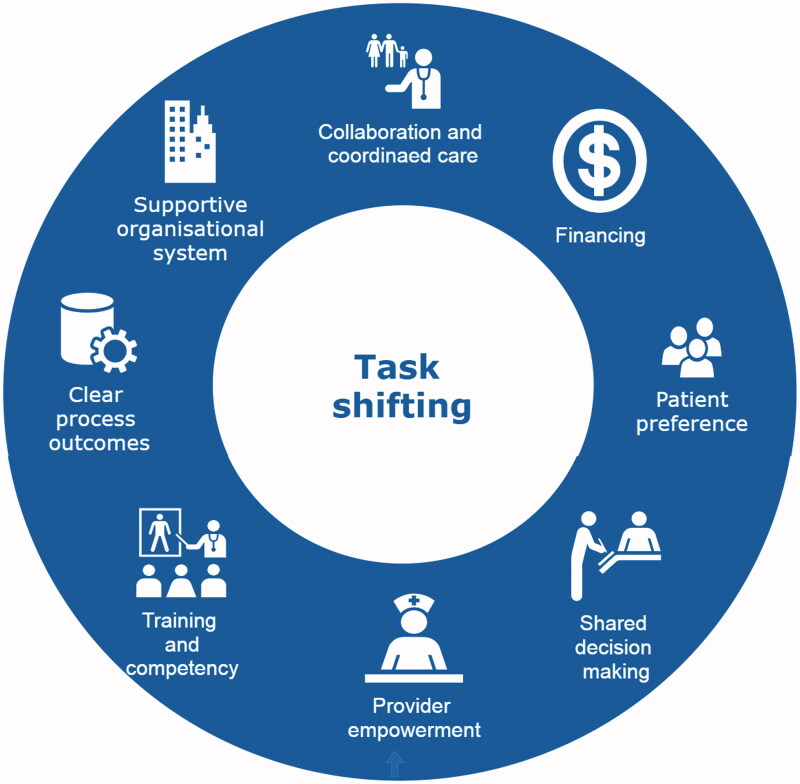
BACKGROUND: Task shifting is an approach to help address the shortage of healthcare workers through reallocating human resources but its impact on primary care is unclear. OBJECTIVES: To provide an overview of reviews describing task shifts from physicians to allied healthcare workers in primary care and its impact on clinical outcomes. METHODS: Six electronic databases were searched up to 15 December 2020, to identify reviews describing task shifting in primary care. Two reviewers independently screened the references for relevant studies, extracted the data and assessed the methodological quality of included reviews using AMSTAR-2. RESULTS: Twenty-one reviews that described task shifting in primary care were included. Task shifted include provision of care for people with chronic conditions, medication prescribing, and health education. We found that task shifting could potentially improve several health outcomes such as blood pressure, HbA1c, and mental health while achieving cost savings. Key elements for successful implementation of task shifting include collaboration among all parties, a system for coordinated care, provider empowerment, patient preference, shared decision making, training and competency, supportive organisation system, clear process outcome, and financing. CONCLUSION: Evidence suggests that allied healthcare workers such as pharmacists and nurses can potentially undertake substantially expanded roles to support physicians in primary care in response to the changing health service demand. Tasks include providing care to patients, independent prescribing, counselling and education, with comparable quality of care.
Overview
The claims and statistics of this paper haven’t been checked yet.
Free: it reads the open-access text and checks the first 5 claims that cite a source we can check. Create a free account to check every claim.
Integrity signals
Registry
Cites
Statistics
Figures
Verification
Claims the paper makes
The claims and statistics of this paper haven’t been checked yet.
Free: it reads the open-access text and checks the first 5 claims that cite a source we can check. Create a free account to check every claim.
Claims other papers make about this one
Each is checked against this paper’s own text: does it say what the citing paper says it does?
The cited source says what the claim attributes to it.
In the citing paper
“Task-shifting represents a critical mechanism for expanding healthcare capacity in resource-constrained settings [19–21].”
From Telemedicine implementation and healthcare utilization in Rwanda: interrupted time series of Babyl digital health services from 2015 to 2024 (2026) · cites this paper as [19]
Self-check
Percentages, sums and reported differences re-computed from the paper’s own numbers.
The self-check needs the paper’s full text.
Citations
Cites
The PRISMA 2020 statement: An updated guideline for reporting systematic reviews
Page, M. J., McKenzie, J. E., Bossuyt, P. M., Boutron, I., Hoffmann, T. C., Mulrow, C. D., Shamseer, L., Tetzlaff, J. M., Akl, E. A., Brennan, S. E., et al. (2021) · BMJ · doi:10.1136/bmj.n71 · Cited by 108,283
Preferred Reporting Items for Systematic Reviews and Meta-Analyses: the PRISMA statement
Moher, D., Liberati, A., Tetzlaff, J., Altman, D. G., & for the PRISMA Group (2009) · BMJ · doi:10.1136/bmj.b2535 · Cited by 83,823
Preferred Reporting Items for Systematic Reviews and Meta-Analyses: The PRISMA Statement
Moher, D., Liberati, A., Tetzlaff, J., Altman, D. G., & The PRISMA Group (2009) · PLoS Medicine · doi:10.1371/journal.pmed.1000097 · Cited by 64,042 · cited 1×
“We followed the PRISMA reporting guideline [19].”
Wang, G., Ma, R., Qiao, G., Wada, K., Aizawa, Y., & Satoh, T. (2015) · Integrative Medicine International · doi:10.1159/000368408 · Cited by 18,657
Shea, B. J., Reeves, B. C., Wells, G., Thuku, M., Hamel, C., Moran, J., Moher, D., Tugwell, P., Welch, V., Kristjansson, E., et al. (2017) · BMJ · doi:10.1136/bmj.j4008 · Cited by 10,636
The PRISMA 2020 statement: an updated guideline for reporting systematic reviews
Page, M. J., McKenzie, J., Bossuyt, P., Boutron, I., Hoffmann, T., mulrow, C., Shamseer, L., Tetzlaff, J., Akl, E., Brennan, S. E., et al. (2020) · doi:10.31222/osf.io/v7gm2_v1 · Cited by 8,090
The PRISMA 2020 statement: an updated guideline for reporting systematic reviews
Page, M. J., McKenzie, J., Bossuyt, P., Boutron, I., Hoffmann, T., mulrow, C., Shamseer, L., Tetzlaff, J., Akl, E., Brennan, S. E., et al. (2020) · doi:10.31222/osf.io/v7gm2 · Cited by 5,177
The United Nations Development Programme
Oestreich, J. E. (2017) · Development and Human Rights · doi:10.1093/acprof:oso/9780190637347.003.0003 · Cited by 4,894
Publication and related bias in meta-analysis
Sterne, J. A. C., Gavaghan, D., & Egger, M. (2000) · Journal of Clinical Epidemiology · doi:10.1016/s0895-4356(00)00242-0 · Cited by 2,282 · cited 1×
“This was mainly due to the lack of primary studies in each review as most contained fewer than ten studies reporting on the same outcome, where Egger’s test is not recommended [43].”
BackgroundHuman resources for health: overcoming the crisis
Chen, L., Evans, T., Anand, S., Boufford, J. I., Brown, H., Chowdhury, M., Cueto, M., Dare, L., Dussault, G., Elzinga, G., et al. (2004) · The Lancet · doi:10.1016/s0140-6736(04)17482-5 · Cited by 1,552 · cited 1×
“Task shifting involves the rational redistribution of tasks to individuals within the healthcare team with fewer qualifications that conventionally were not within their scope of work [5,6].”
Background
Research works printed but not linked: 2
- Aromataris E, Munn Z, editors. Joanna Briggs Institute reviewer's manual. Adelaide: The Joanna Briggs Institute; 2017.
- United Nations. United Nations sustainable development goals. In: United Nations, editor. Division for sustainable development goals. New York: United Nations; 2019.
Cited by
Items 201–227 of 227
Kim, B. (2026) · Preventing Chronic Disease · doi:10.5888/pcd23.260152
Singh, S., Sethi, A. K., Biswas, R., Gilhotra, P., Sankar, P., Manu, R. M., Das, S., Manalil, S. V., Nongkynrih, B., & Kaur, R. (2026) · BMJ Paediatrics Open · doi:10.1136/bmjpo-2026-004678
Kahn‐John, M., Sivaramakrishnan, B., Nelson, K. E., Allison‐Burbank, J. D., Bambrick, N., D’Aoust, R., Dickson, L., Kazemi, M., Eagle, D. K., Kverno, K. S., et al. (2026) · Nursing Reports · doi:10.3390/nursrep16080260
“This approach fortifies the infrastructure of under-resourced health systems by increasing access to MH resources while expanding care coordination capacity for existing healthcare providers [21].”
Somerville, J. G., Mustafa, M. H., Seweid, M. M., & Arab, R. A. E. (2026) · Diagnostics · doi:10.3390/diagnostics16152389 · Cited by 2
“…value case for paediatric AI is also only partially built beyond headline AUCs; decision-grade evidence on throughput, task-shifting, referral impact, and costs in real service pathways is limited, even as global commissions urge digital solutions that extend primary eye care [30,34–36].”
Beyond emergencies: shifting identities and expectations
Delport, S., Judd, J. A., Baldwin, A., & Byrne, A. (2026) · Journal of Paramedic Practice · doi:10.12968/jpar.2025.0127
Purnamasari, N., Adliah, F., Rapley, T., Pennington, L., & Basu, A. P. (2026) · Developmental Medicine & Child Neurology · doi:10.1111/dmcn.70436
Bashir, S., Salad, H. A., Abdullahi, Y. B., Abdi, Y. H., Abdi, M. S., & Ahmed, N. (2026) · Frontiers in Global Women s Health · doi:10.3389/fgwh.2026.1859985
“…into perinatal care, using stepped-care models and WHO’s mhGAP guidance, is both feasible and cost-effective in relatively stable settings (6, 12); however, Somalia’s low ANC attendance rates, particularly in rural and conflict-affected areas, mean that antenatal contact alone cannot be…”
Cairney, T. M., Harrison, H., McLean, M.-A., Ramos, T. A., Kernaghan, D., & Johnson, C. F. A. (2026) · International Journal of Clinical Pharmacy · doi:10.1007/s11096-026-02198-w
Akkunje, P. S., Dodderi, T., & Chitnis, S. V. (2026) · Springer eBooks · doi:10.1007/978-981-92-0403-8_6
Hari, H. M., Robinson, A., & Husband, A. (2026) · PLOS Global Public Health · doi:10.1371/journal.pgph.0006809
“[51] This model allowed for community-based care to deliver services directly in patients homes or local settings, thereby tackling logistical barriers and increasing accessibility.”
Beyond the backlog: standardizing clinical task-shifting for specialist care shortages in LMICs
Siddiqui, S. A. (2026) · Tropical Doctor · doi:10.1177/00494755261478154
Shen, L., & Guo, Y. (2026) · Journal of Pediatric Nursing · doi:10.1016/j.pedn.2026.08.002
Wiens, C. A., Lässig, F., Frese, T., Heise, M., Schildmann, J., Mikolajczyk, R., & Weise, S. (2026) · European Journal of General Practice · doi:10.1080/13814788.2026.2716980
Chatha, G., Chilumpha, M., Umar, E., Balabanova, D., & Hutchinson, E. (2026) · SSM - Health Systems · doi:10.1016/j.ssmhs.2026.100302
Robotteknologi kan gi sykepleiere mer tid til pasientene
Enerstvedt, C., Fossum, M., & Thygesen, E. (2026) · Sykepleien Forskning · doi:10.4220/sykepleiens.2026.109539
Exploring the use of nutrition professionals in the WIC workforce: a landscape policy analysis
Annan, E., Iqbal, A., Han, J. Y., Fox, E., & Meredith, G. R. (2026) · Frontiers in Public Health · doi:10.3389/fpubh.2026.1941155
Ihirwe, E., Ripa, S. D., Bell, J., Ojiambo, R., & Dusingizimana, V. (2026) · Research Square · doi:10.21203/rs.3.rs-10425588/v1
From mortality patterns to regional action in ASEAN
Low, W. Y., & Tong, W. T. (2026) · The Lancet Public Health · doi:10.1016/s2468-2667(26)00189-1
Task-shifting among nurses and therapists in an acute hospital setting
Nielsen, J. R., Bay, M. V., Sørensen, D., & Rolving, N. (2026) · Journal of Interprofessional Education & Practice · doi:10.1016/j.xjep.2026.100856
Nakarmi, C. S., Bhattarai, S., Rhodes, E., Dhimal, M., Baral, P. P., Poudel, B., Rai, B. K., Bishwokarma, A., Mali, S., Adhikari, A., et al. (2026) · Discover Public Health · doi:10.1186/s12982-026-02812-2 · Cited by 2
“Furthermore, task shifting should be implemented by redistributing specific tasks, such as NCD screening, counseling, and follow-up, from highly trained health service providers (e.g., doctors) to mid-level providers (e.g., paramedics) [50, 51].”
The lack of creative destruction in healthcare systems makes innovation a cost driver
Westermann-Lammers, C., & Hohenauer, J. (2026) · Wiener klinische Wochenschrift · doi:10.1007/s00508-026-02825-6
Findings of the Sixth Saxon Epidemiological Study in General Medicine (SESAM-6)
Gräfe, W., Liebig, L., Bergmann, A., Bleckwenn, M., Deutsch, T., Brütting, C., Frese, T., & Riemenschneider, H. (2026) · Deutsches Ärzteblatt international · doi:10.3238/arztebl.m2026.0137
Doogue, R., Greene, M., Harney, S., & Glynn, L. G. (2026) · Nurse Education in Practice · doi:10.1016/j.nepr.2026.104991
Subramaniam, A., Ginting, M. L., Tang, J. Y., Lim, C. Z. Q., Chua, S., Rodrigues, E. E., Tan, W. S., Lim, W. S., Ding, Y. Y., Sum, G., et al. (2026) · Geriatric Nursing · doi:10.1016/j.gerinurse.2026.104370
Artificial Emotional Intelligence
Chen, A., & Ciriello, R. (2026) · Business & Information Systems Engineering · doi:10.1007/s12599-026-01026-9
Fischer, M., SQUALLI, L., ZABAR, C., & François, M. (2026) · Journal of Evaluation in Clinical Practice · doi:10.1111/jep.70675
Quantifying the value of healthcare volunteers: A scoping review
den Besten, M. J., Deger, M. L., Stadhouders, N. W., Jeurissen, P. P. J., Batenburg, R., & Grutters, J. P. C. (2026) · Health Policy · doi:10.1016/j.healthpol.2026.105814
Metadata
- Authors
- Leong, S. L., Teoh, S. L., Fun, W. H., & Lee, S. W. H.
- Affiliations
- University of Cyberjaya (MY)
- Monash University Malaysia (MY)
- Corresponding author
- Lee, Shaun Wen Huey
- Venue
- European Journal of General Practice
- Publisher
- Informa UK Limited
- Published
- 2021-01
- Volume
- 27
- Issue
- 1
- Pages
- 198-210
- ISSN
- 1381-4788 (ISSN-L)
- 1751-1402
- PMC
- PMC8330741
- OpenAlex
- W3187079944
- Semantic Scholar
- 976fe731a42cca65245a6508752f7f629f95a271
- Cited by
- 228
- References
- 44
- Citations by year
- 2026: 72 · 2025: 60 · 2024: 53 · 2023: 29 · 2022: 14
- FWCI
- 4.96
- Type
- journal article
- Language
- en
- Open access
- gold
- doi.org
- Licence
- Locations
- European Journal of General Practice (publishedVersion, cc-by)
- PubMed Central (publishedVersion, cc-by)
- PubMed (publishedVersion)
- Monash University Research Portal (Monash University) (submittedVersion, cc-by)
- DOAJ (DOAJ: Directory of Open Access Journals) (submittedVersion, cc-by-sa)
- Topics
- Health Sciences › Health Professions › General Health Professions › Nursing Roles and Practices
- Health Sciences › Medicine › Public Health, Environmental and Occupational Health › Global Health Workforce Issues
- Health Sciences › Medicine › Family Practice › Primary Care and Health Outcomes
- Keywords
- task shifting, health workforce shortage, primary care, nurses, pharmacists, chronic disease, drug prescribing, health education, blood pressure, HbA1c, mental health, cost reduction, implementation, shared decision-making
- MeSH terms
- Delivery of Health Care, Health Personnel, Humans, Pharmacists, Drug Prescriptions, Primary Health Care
About these checks
Registry, retraction, Cites and statistics results are computed, not judged, with one exception: a printed reference that no index lists is read once by a model before it counts as a citation error. Claims are extracted by a model and kept only when their quote appears verbatim in the text; each cited source is then checked, with a model’s help, for whether it says what the claim relies on. Those verdicts can be wrong — read the claim’s quote and the cited source before relying on one.
Statistics and arithmetic are recomputed, not judged.
Confidence bands are shown only for fields calibrated on our annotated test set. None is calibrated yet, so no band is shown.
What counts as a claim ›How we measure confidence ›How we check this ›
Are you an author, or do you see a problem with this page? Request a review
Data sources
Bibliographic data: Semantic Scholar, OpenAlex, Crossref.
Contains information from the Semantic Scholar Academic Graph Datasets, made available under the ODC Attribution License (ODC-BY 1.0).
Semantic Scholar’s data is described in: Kinney, R., et al. (2023). The Semantic Scholar Open Data Platform. arXiv:2301.10140.
