

Problematizing ‘wickedness’: a critique of the wicked problems concept, from philosophy to practice
Open accessThe DOI matches its Crossref record; 94 of the 97 references it cites were found in a registry or an index, and 1 are not checked yet; 12 of the 59 sources its claims cite were checked for support.
Abstract
The concept of ‘wicked problems’ is a major current in the fields of policy analysis and planning. However, the basis of the concept has been insufficiently examined. This re-examination of its conceptual basis explains the origins of the limitations and flaws in the wicked problems concept. This paper analyses and rejects the notion of ‘wicked problems’ on philosophical and practical grounds. We argue instead that the policy sciences already had better conceptualizations of public problems before Rittel and Webber’s flawed formulation. We return to this literature, and build upon it by reframing ‘wickedness’ in terms of higher and lower levels of problematicity in problem structuring efforts. In doing so, we offer an alternative, novel combination of the philosophy of questioning and the policy work approach to policy practice. ‘Wickedness’ is re-conceptualized as problematicity, conceived as the distance between those who question or inquire into a policy problem. This is primarily a political distance, articulated in terms of ideas, interests, institutions and practices. High problematicity arises only when wide political distances are explicitly maintained, such that partial answers cannot be reached. Practitioners deal with problematicity by a dual practical strategy of balancing closing-down and opening-up sub-questions to the problem in order to structure them such that they become amenable to action through partial answers. This simultaneously incorporates a politics of negotiating political distance via partisan adjustment and serial strategic analysis. The argument constitutes a theoretically and practically superior alternative to the ‘wicked problems’ perspective.
Verified 2026-11-25 · 1 reference not checked yet
Overview
CoChat Summary
TL;DR
The paper argues that the “wicked problems” concept is philosophically incoherent and should be rejected as an ontological class of policy problems. It reframes wickedness as degrees of problematicity and political distance, proposing a questioning-distance framework for policy work illustrated with car mobility.
Key findings
- The wicked/tame distinction is not a distinction among types of policy problems; the authors argue it is Rittel and Webber’s contrast between societal problems and natural-science problems, calling it “the old false distinction between social and natural sciences, rewritten in the language of policy and planning.”
- “Wicked” is rhetorical rather than ontological: it labels persistent problematicity or wide stakeholder distances and can be used to justify lack of progress or attract attention and resources.
- The authors replace wicked/tame with a continuum from unstructured to structured problems (problematicity) plus political distance among actors in ideas/values, institutions, interests, and practices; high problematicity arises when wide political distances are explicitly maintained so partial answers cannot be reached.
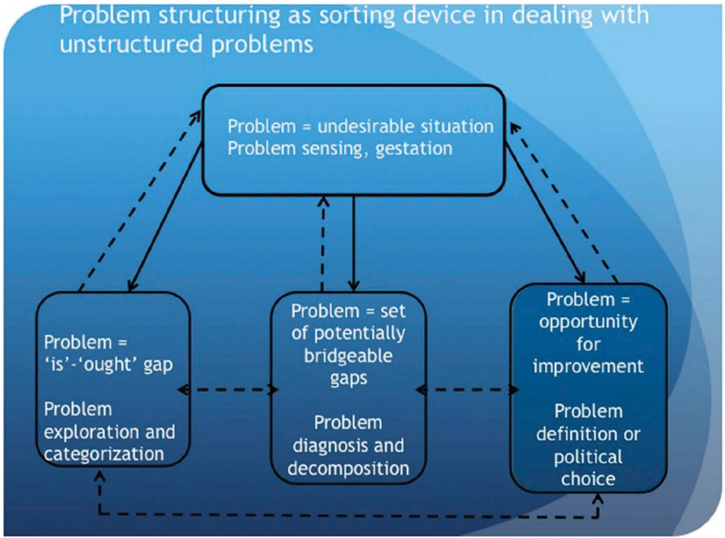
- Policy workers deal with problems through problem structuring, balancing closing-down and opening-up sub-questions; the car mobility example decomposes into egalitarian, hierarchist, and individualist frames, each generating two sub-problems (six total), with partial answers and negotiated political distance.
Methods
- Conceptual and philosophical critique with historical contextualization of Rittel and Webber (1973), drawing on policy sciences, STS, and social-constructivist scholarship; no empirical sample or statistical analysis is reported.
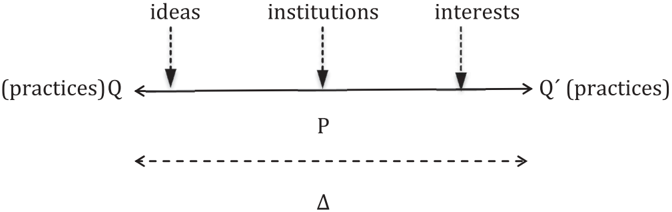
- Develops an alternative “questioning-distance framework” combining the philosophy of questioning, the policy work perspective, and political distance, then applies it illustratively to car mobility as an unstructured problem.
- Uses textual examples, textboxes, and figures—e.g., Figure 1 questioning-distance framework and Figure 2 problem structuring—rather than formal data collection.
Limitations
- The paper states no limitations section or explicit limitations.
- Evident from the text: the argument is theoretical/conceptual, and the car mobility case is illustrative rather than an empirical test; the authors note that in reality frames are “less articulate and more fuzzy and hybrid.”
- Evident from the text: no systematic data, sample, or comparative empirical validation of the proposed framework is reported.
Model-written summary. Check it against the paper before relying on it.
Integrity signals
Registry
Cites
Statistics
Figures
Verification
Claims the paper makes
9 Valid · 2 Not valid · 31 Not checked · 129 Own results and interpretations
Every source the paper cites for this claim was checked and supports it.
In the paper
“On rereading Rittel and Webber's contemporaneous 1973 work, we see that it was closely integrated within the context of these debates.”
§ Problematizing 'wickedness': a critique of the wicked problems concept, from philosophy to practice > 2. Problems with the wicked/tame problem distinction
What the sources say
- Supportedcites Rittel and Webber (1973) matched to “Dilemmas in a general theory of planning” (1973) source
In “Dilemmas in a General Theory of Planning” (page unavailable), Rittel and Webber explicitly connect systems analysis and policy programs to contemporary debates about goals and governmental priorities. Section III discusses the failure of planners and other social professionals to solve problems they had claimed they could solve. These passages support the citing sentence’s characterization of the work’s context. (LLM, conf=0.91)
plainstates an association- Asserted: passes — The authors put it forward as true.
- Checkable: passes — It can be checked against evidence.
- Load-bearing: passes — The paper’s conclusions depend on it.
- Based: passes — The paper gives a reason why it holds.
- Supported
The cited sources that could be checked couldn’t confirm or dispute this claim.
In the paper
“Their work was formed solely with regard to a debate within RAND and in the context of systems analysis failures.”
§ Problematizing 'wickedness': a critique of the wicked problems concept, from philosophy to practice > 2. Problems with the wicked/tame problem distinction
What the sources say
- Could not verifycites Brewer (2017) matched to “There at the beginning: we’re still “emerging,” maybe forever” (2017) sourceExperimental — accuracy not yet measured
The Systems analysis and Changes in the landscape sections discuss RAND and differences between systems analysis and the policy sciences, but do not discuss Rittel and Webber or the origins of their work. Searches for their names alongside RAND, systems-analysis failures, and wicked problems found no passage addressing the claimed debate. (LLM, conf=0.76)
plainstates a cause- Asserted: passes — The authors put it forward as true.
- Checkable: passes — It can be checked against evidence.
- Load-bearing: passes — The paper’s conclusions depend on it.
- Based: passes — The paper gives a reason why it holds.
- Could not verify
Every source the paper cites for this claim was checked and supports it.
In the paper
“In actuality, they use the distinction to differentiate between societal problems and those of the natural sciences.”
§ Problematizing 'wickedness': a critique of the wicked problems concept, from philosophy to practice > 2. Problems with the wicked/tame problem distinction
What the sources say
- Supportedcites Rittel and Webber (1973) matched to “Dilemmas in a general theory of planning” (1973) source
Section III explicitly contrasts problems in the natural sciences with problems of governmental and social planning. It describes the problems scientists usually address as mostly “tame” and nearly all public-policy issues as “wicked,” supporting the attributed use of the distinction. (LLM, conf=0.94)
plain- Asserted: passes — The authors put it forward as true.
- Checkable: passes — It can be checked against evidence.
- Load-bearing: passes — The paper’s conclusions depend on it.
- Based: passes — The paper gives a reason why it holds.
- Supported
Every source the paper cites for this claim was checked and supports it.
In the paper
“Contrary to what is presupposed in much of the subsequent literature, Rittel and Webber's wicked/tame problem distinction does not, in fact, aim to distinguish different types of policy problems.”
§ Problematizing 'wickedness': a critique of the wicked problems concept, from philosophy to practice > 2. Problems with the wicked/tame problem distinction
What the sources say
- Supportedcites Rittel and Webber (1973) matched to “Dilemmas in a general theory of planning” (1973) source
Section III explicitly describes the intended distinction as one between mostly tame problems studied by scientists and engineers and wicked problems that include nearly all public policy issues. It does not present the distinction as a way to sort policy problems into types. (LLM, conf=0.91)
plain- Asserted: passes — The authors put it forward as true.
- Checkable: passes — It can be checked against evidence.
- Load-bearing: passes — The paper’s conclusions depend on it.
- Based: passes — The paper gives a reason why it holds.
- Supported
The cited sources support only part of this claim — read each source’s verdict below.
In the paper
“Importantly, the idea that problems are either wicked or tame rules out 'degrees' of wickedness, or even 'tendencies' toward wickedness, which might be more helpful (Alford & Head, 2017;Daviter, 2017;Farrell & Hooker, 2013;Newman & Head, 2017).”
§ Problematizing 'wickedness': a critique of the wicked problems concept, from philosophy to practice > 2. Problems with the wicked/tame problem distinction
What the sources say
- Supportedcites Alford & Head, 2017 matched to “Wicked and less wicked problems: a typology and a contingency framework” (2017) source
The 'Shortcomings of the wicked problems framework' section states verbatim that the generic discourse 'has not encouraged or facilitated thinking about degrees of wickedness. Instead, each situation has been seen in binary terms as either wicked or tame' — the exact point the citing sentence attributes. The same passage adds that the binary framing leaves open 'mixed situations between these two extremes', and 'A typology of problems' (nine possibilities 'as a continuum', 'from moderately tame to moderately wicked') plus 'Towards a more finely grained typology' ('vary in their degree of difficulty', 'degree and types of wickedness') supply the 'tendencies' idea, though the paper uses continuum/degree language rather than the word 'tendencies'. (LLM, conf=0.85)
- Partly supportedcites Daviter, 2017 matched to “Coping, Taming or Solving: Alternative approaches to the governance of wicked problems” (2017) sourceExperimental — accuracy not yet measured
Our copy supports the general drift of the claim: the article calls for 'breaking down the monolithic notion of wickedness into more analytically useful units' and for a reorientation 'away from the conception of wicked problems as a singular type of highly complex and interrelated policy issue to the analysis of different types of problem wickedness' (Rethinking the governance of wicked problem; Introduction), and it notes that wicked problems differ in degree ('do not exhibit the same degree of indivisibility'), with dimensions making them 'more or less amenable' to different strategies — i.e. that such differentiation 'may offer a way out of the dilemma'. But the source does not frame the limitation as arising from a dichotomy in which problems are 'either wicked or tame': in this paper 'taming' is a strategy of problem governance (treating ill-structured problems as if they were tame, Taming wicked problems), not a binary classification, and it nowhere speaks of 'tendencies' toward wickedness. That specific wicked/tame-dichotomy premise is therefore not attributable to this source. (LLM, conf=0.68)
- Supportedcites Newman & Head, 2017 matched to “Wicked tendencies in policy problems: rethinking the distinction between social and technical problems” (2017) source
In the “Wicked problems” section, Newman and Head describe the wicked-versus-tame binary and contrast it with an approach that allows degrees of wickedness. They propose referring to the “wicked tendencies of all problems” rather than treating wicked problems as a distinct subset. The supplied passages have no page numbers. (LLM, conf=0.93)
plainstates a cause- Asserted: passes — The authors put it forward as true.
- Checkable: passes — It can be checked against evidence.
- Load-bearing: passes — The paper’s conclusions depend on it.
- Based: passes — The paper gives a reason why it holds.
- Supported
47 more claims · 2 with their cited sources checked
Create a free account to see all 171 claims and to verify the 3 references still open.
- Probably not a substantial claim. 97
- It may state two separate claims as one. 43
- The quote only partly states this claim. 3
Citations
Cites
The social construction of reality : a treatise in the sociology of knowledge
Simpson, G., Berger, P. L., & Luckmann, T. (1967) · American Sociological Review · doi:10.2307/2091739 · Cited by 16,462
Dilemmas in a general theory of planning
Rittel, H. W. J., & Webber, M. M. (1973) · Policy Sciences · doi:10.1007/bf01405730 · Cited by 16,338 · cited 1×
“…problems are particularly resistant to ‘solutions’ and are ‘thus’ to be categorically differentiated from other problems.1 The originators of the term, Rittel and Webber (1973), were not policy specialists but urban planners who, frustrated by the inability of CONTACT Nick Turnbull…”
BackgroundTHE SCIENCE OF MUDDLING THROUGH
Lindblom, C. (1959) · Elsevier eBooks · doi:10.1016/b978-0-08-017066-4.50015-1 · Cited by 8,690
The Science of “Muddling Through”
Lindblom, C. E. (1959) · Public Administration Review · doi:10.2307/973677 · Cited by 8,513
A Behavioral Theory of the Firm
Day, R. H., Cyert, R. M., March, J. G., Clarkson, Cohen, Feigenbaum, D., Greenberg, Moore, Soelberg, Starbuck, et al. (1964) · Econometrica · doi:10.2307/1913056 · Cited by 7,791
The New production of knowledge: the dynamics of science and research in contemporary societies
(1995) · Choice Reviews Online · doi:10.5860/choice.32-4463 · Cited by 7,046
Laboratory life: The social construction of scientific facts
Austin, J. (1982) · Social Science & Medicine · doi:10.1016/0277-9536(82)90228-3 · Cited by 2,883
The structure of ill structured problems
Simon, H. A. (1973) · Artificial Intelligence · doi:10.1016/0004-3702(73)90011-8 · Cited by 2,600 · cited 2×
“As convincingly argued and demonstrated by Simon (1973), their difference depends upon constraints on the elements that define a problem; they are either ‘given’ and ‘closed’ (strong, repressing or commanding answers) or ‘open’ and ‘amenable to further choice’ (weak answers, which invite and elicit…”
BackgroundThe Honest Broker: Making Sense of Science in Policy and Politics
Pielke, Jr. (2007) · doi:10.1017/cbo9780511818110 · Cited by 2,020 · cited 1×
“…policy interaction (Jasanoff, 1990, Guston 2014), boundary work and boundary organization (Guston, 2001; Hoppe, 2010), styles of science advice (Pielke, 2007) and advisory systems (Halligan, 1995; Hoppe, 2014), or post-normal science (Ravetz, 2006) and Mode-2 science (Gibbons, Nowotny, Scott,…”
BackgroundLevin, K., Cashore, B., Bernstein, S., & Auld, G. (2012) · Policy Sciences · doi:10.1007/s11077-012-9151-0 · Cited by 1,839
Research works printed but not linked: 12
- 11. Collins, H. M. (1985). Changing Order. London: Sage.
- 16. De Jouvenel, B. (1963). The pure theory of politics. New Haven: Yale University Press.
- 23. Geiselberger, H. (2017). The great regression. Cambridge: Polity.
- 40. Kooiman, J. (1988). Besturen: overheid en maatschappij in wisselwerking. Assen: Van Gorcum.
- 41. Krieger, M. H. (1981). Advice and planning. Philadelphia: Temple University Press.
- 50. Lindblom, C. E. (1968). The policymaking process. Englewood Cliffs NJ: Prentice Hall.
- 52. Lindblom, C. E., & Woodhouse, E. J. (1993). The policy-making process (3rd ed.). Englewood Cliffs, NJ: Prentice-Hall.
- 70. Schön, D. A., & Rein, M. (1994). Frame reflection: Towards the resolution of intractable policy controversies. New York: Basic Books.
- 71. Simmons, H. (1982). From asylum to welfare. Ontario: National Institute on Mental Retardation.
- 79. Vickers, G. (1965). The art of judgment: A study of policymaking. London: Methuen.
- 81. Wildavsky, A. (1971). Does planning work? Public Interest, 24, 95-105.
- 83. Wildavsky, A. (1976). Review: The strategic retreat on objectives. Policy Analysis, 2, 499-526.
Cited by
Wicked problems: a mapping review of the literature
Lönngren, J., & van Poeck, K. (2021) · International Journal of Sustainable Development & World Ecology · doi:10.1080/13504509.2020.1859415 · Cited by 362
“Our review supports Turnbull and Hoppe’s claim that the wicked problems literature lacks a firm theoretical and conceptual base (Turnbull and Hoppe 2019): there is a large degree of variation in how the concept is used with regard to theoretical status, range of meanings, epistemological…”
BackgroundMethodInfluentialWicked Problems in Public Policy: Understanding and Responding to Complex Challenges
Head, B. W. (2022) · Springer eBooks · doi:10.1007/978-3-030-94580-0 · Cited by 351
Termeer, C. J. A. M., Dewulf, A., & Biesbroek, R. (2019) · Policy and Society · doi:10.1080/14494035.2019.1617971 · Cited by 260
“According to Turnbull and Hoppe (2019), ‘wicked’ is a rhetorical term ‘used by scholars to help them think about the most difficult, unstructured policy problems and used by practitioners to label persistently problematic distances between stakeholders to a problem, a labelling which itself has political aims’ (p.”
BackgroundInfluentialSmall wins for grand challenges. A bottom-up governance approach to regional innovation policy
Bours, S., Wanzenböck, I., & Frenken, K. (2021) · European Planning Studies · doi:10.1080/09654313.2021.1980502 · Cited by 153
“The reason is the wicked, unstructured and multi-dimensional nature of underlying problem structures, which can easily overwhelm policy-makers (Peters 2017; Turnbull and Hoppe 2019).”
BackgroundFlanagan, K., Uyarra, E., & Wanzenböck, I. (2022) · Regional Studies · doi:10.1080/00343404.2021.2016680 · Cited by 148
Why Isn't Government Policy More Preventive?
Cairney, P., & Denny, E. S. (2020) · doi:10.1093/oso/9780198793298.001.0001 · Cited by 130
Weaknesses of wickedness: a critical perspective on wickedness theory
Noordegraaf, M., Douglas, S., Geuijen, K., & van der Steen, M. (2019) · Policy and Society · doi:10.1080/14494035.2019.1617970 · Cited by 132
“We champion a daily, situated, people-centered perspective on wickedness, continuing the ideas pursued by Rein and Schön (examining the work of professionals), Glidewell and Hargrove (studying impossible jobs) and other studies of how people attempt to tame wicked problems (Turnbull & Hoppe, 2018).”
BackgroundInfluentialSøraa, R. A., Nyvoll, P. S., Tøndel, G., Fosch‐Villaronga, E., & Serrano, J. A. (2021) · Technological Forecasting and Social Change · doi:10.1016/j.techfore.2021.120678 · Cited by 128
Robust Governance in Turbulent Times
Ansell, C., Sørensen, E., Torfing, J., & Trondal, J. (2024) · Cambridge University Press eBooks · doi:10.1017/9781009433006 · Cited by 135
Botequilha-Leitão, A., & Varela, E. R. D. (2020) · Sustainable Cities and Society · doi:10.1016/j.scs.2020.102089 · Cited by 98
Administrative coordination capacity; does the wickedness of policy areas matter?
Christensen, T., Lægreid, O. M., & Lægreid, P. (2019) · Policy and Society · doi:10.1080/14494035.2019.1584147 · Cited by 125
“One way of doing it is to reconceptualize wickedness by including different degrees of structuredness (Turnbull & Hoppe, 2018).”
BackgroundA scoping review of problems and challenges faced by school leaders (2003–2019)
Tintoré, M., Cunha, R. S., Cabral, I., & Alves, J. M. (2020) · Educational Management Administration & Leadership · doi:10.1177/1741143220942527 · Cited by 129
“Finally, school principals’ problems can be described as undesirable and unsatisfactory situations for principals that can also be an ‘opportunity for improvement’ (Turnbull and Hoppe, 2018: 13).”
BackgroundAddo, A. (2022) · Journal of Information Technology · doi:10.1177/02683962221088333 · Cited by 107
“…could be contrasted with simple, “benign” or “tame” problems—problems whose definition and solution are readily arrived at or “eminently solvable” (Turnbull and Hoppe, 2019: 316); or complex problems—problems that might have agreement on the nature of the problem but conflict over the potential…”
BackgroundWhat's the Problem? Multilevel Governance and Problem‐Solving
Thomann, E., Trein, P., & Maggetti, M. (2019) · European Policy Analysis · doi:10.1002/epa2.1062 · Cited by 82
“Hisschemöller and Hoppe (1995) reiterated in Turnbull and Hoppe (2018), argue instead that problems differ in the degree they are well-defined or structured .”
BackgroundInfluentialWoolway, T., Lazuras, L., Barkoukis, V., & Petróczi, A. (2020) · International Journal of Drug Policy · doi:10.1016/j.drugpo.2020.102865 · Cited by 67
The Multilevel Regulation of Complex Policy Problems: Uncertainty and the Swine Flu Pandemic
Versluis, E., van Asselt, M. B. A., & Kim, J. (2019) · European Policy Analysis · doi:10.1002/epa2.1064 · Cited by 50
“…dichotomy, arguing that most policy problems inherently show some wicked elements – “almost any problem is difficult to solve” (Peters, 2017, 386) – and we should better understand complex policy problems as an index of degrees of problematicity or structuredness (Turnbull & Hoppe, 2018, 12).”
BackgroundVeltman, M. E., van Keulen, H., & Voogt, J. M. (2019) · Journal of Education and Work · doi:10.1080/13639080.2019.1610165 · Cited by 63
“After 40 years of wicked problems literature, there is agreement among scholars that complexity, uncertainty, and the need for open-ended, creative thinking are important elements of wickedness, as well as the relations between the multiple stakeholders with diverging perceptions, perspectives, and values (Head 2018;…”
BackgroundInfluentialGeographies of mission-oriented innovation policy
Uyarra, E., Bugge, M. M., Coenen, L., Flanagan, K., & Wanzenböck, I. (2025) · Environmental Innovation and Societal Transitions · doi:10.1016/j.eist.2025.100970 · Cited by 77
Petróczi, A., & Boardley, I. D. (2022) · Frontiers in Sports and Active Living · doi:10.3389/fspor.2022.869704 · Cited by 52
Governance Networks in the Public Sector
Klijn, E., Koppenjan, J. F. M., Spekkink, W., & Warsen, R. (2025) · Routledge eBooks · doi:10.4324/9781003402138 · Cited by 94
Problématologie des questions socialement vives. Repères épistémologiques pour l’école
Fabre, M. (2021) · Revue française de pédagogie · doi:10.4000/rfp.10118 · Cited by 65
Liu, H.-Y., & Maas, M. M. (2021) · Futures · doi:10.1016/j.futures.2020.102672 · Cited by 51
“See for instance (Noordegraaf, Douglas, Geuijen, & Van Der Steen, 2019; Peters & Tarpey, 2019; Turnbull & Hoppe, 2019).”
Wicked problems and sociology: building a missing bridge through processual relationalism
Selg, P., Klasche, B., & Nõgisto, J. (2022) · International Review of Sociology · doi:10.1080/03906701.2022.2035909 · Cited by 48
“Some recent attempts to bring in approaches to policy problems that use notions like ‘ relational distance ’ or ‘ relational logic ’ (see Turnbull & Hoppe, 2019, pp. 323 – 324) remain inattentive to the potential of relational sociology.”
BackgroundInfluentialPublic Policy to Reduce Inequalities across Europe: Hope Versus Reality
Cairney, P., Keating, M. J., Kippin, S., & Denny, E. S. (2022) · doi:10.1093/oso/9780192898586.001.0001 · Cited by 56
The wicked city: Genealogies of interdisciplinary hubris in urban thought
Barnett, C. (2021) · Transactions of the Institute of British Geographers · doi:10.1111/tran.12483 · Cited by 52
Ten lessons from the frontlines of science in support of fisheries management
Hare, J. A. (2020) · ICES Journal of Marine Science · doi:10.1093/icesjms/fsaa025 · Cited by 34
“The wicked problem concept has recently been reviewed and reframed as problematicity (Turnbull and Hoppe, 2019).”
BackgroundHartley, K. (2020) · International Review of Public Policy · doi:10.4000/irpp.1242 · Cited by 35
“However, policy issues having a high degree of ‘wickedness’ (Hartley et al. 2019; Head 2019) and ‘problemacity’ (lacking in structure; see Turnbull and Hoppe 2019) elude full reduction to measurable terms and are thus mismatched with positivist, technocratic, and even managerialist ways of thinking…”
BackgroundWicked Problems in Africa: A Systematic Literature Review
Niskanen, V., Rask, M., & Raisio, H. (2021) · SAGE Open · doi:10.1177/21582440211032163 · Cited by 40
“• Issues described as wicked do not fulfill all the criteria of wicked problems (Peters, 2017; Peters & Tarpey, 2019) • Wicked problems are “a fad” or used for rhetorical purposes (Peters, 2017; Peters & Tarpey, 2019; Turnbull & Hoppe, 2019).”
BackgroundInfluentialProblem-Solving as a Governing Knowledge: “Skills”-Testing in PISA and PIAAC
Bacchi, C. L. (2019) · Open Journal of Political Science · doi:10.4236/ojps.2020.101007 · Cited by 43
“As an analytic strategy, therefore, the WPR approach goes further than critiques that refer to the “elusiveness of the search to define the ‘true’ nature of a policy problem” (Gottweis, 2003: p. 263) or to problems as “wicked” (Head, 2008, 2018) or to “problematicity” (Turnbull & Hoppe, 2018).”
MethodChowdhury, A. R. (2019) · Policy Studies · doi:10.1080/01442872.2018.1557623 · Cited by 26
“Turnbull and Hoppe (2018) have problematized the concept of “wickedness” and proposed the alternative of “problematicity”, or the distance between those who question or enquire into a policy problem.”
BackgroundWhen to conduct, and when not to conduct, management strategy evaluations
Walter, J. F., Peterson, C. D., Marshall, K. N., Deroba, J. J., Gaichas, S., Williams, B. C., Stohs, S. M., Tommasi, D., & Ahrens, R. (2023) · ICES Journal of Marine Science · doi:10.1093/icesjms/fsad031 · Cited by 32
The discursive blinkers of climate change: Energy transition as a wicked problem
Schwab, J. L., & Diaz, N. C. C. (2023) · The Extractive Industries and Society · doi:10.1016/j.exis.2023.101319 · Cited by 43
Hopeful approaches to teaching and learning environmental “wicked problems”
Sharp, E. L., Fagan, J. B., Kah, M., McEntee, M., & Salmond, J. (2021) · Journal of Geography in Higher Education · doi:10.1080/03098265.2021.1900081 · Cited by 37
“The approach of “wicked problems” for policy development and societal change has been critiqued for its ineffectiveness (e.g., Termeer et al., 2019; Turnbull & Hoppe, 2019).”
BackgroundWelfare economics and wicked problems in coastal and marine governance
Groeneveld, R. A. (2020) · Marine Policy · doi:10.1016/j.marpol.2020.103945 · Cited by 27
Rethinking Oral Health in Aging: Ecosocial Theory and Intersectionality
Slack-Smith, L. M., Ng, T., Macdonald, M. E., & Durey, A. (2023) · Journal of Dental Research · doi:10.1177/00220345231175061 · Cited by 23
Systems Leadership: a qualitative systematic review of advice for policymakers
Cairney, P., & Toomey, C. (2025) · Open Research Europe · doi:10.12688/openreseurope.18982.1 · Cited by 44
Veltman, M. E., van Keulen, H., & Voogt, J. M. (2021) · The Curriculum Journal · doi:10.1002/curj.100 · Cited by 30
A Bibliometric Analysis of Wicked Problems: From Single Discipline to Transdisciplinarity
Hou, X., Li, R., & Song, Z. (2022) · Fudan Journal of the Humanities and Social Sciences · doi:10.1007/s40647-022-00346-w · Cited by 27
Weaver, D., Moyle, B., McLennan, C.-L., & Casali, G. L. (2023) · Journal of Environmental Management · doi:10.1016/j.jenvman.2023.119136 · Cited by 46
Murphy, B. M., Russell, K., Stillwell, C. C., Hawley, R. J., Scoggins, M., Hopkins, K. G., Burns, M. J., Taniguchi‐Quan, K. T., Macneale, K. H., & Smith, R. F. (2022) · Freshwater Science · doi:10.1086/721134 · Cited by 30
“Wicked problems are defined as being unsolvable, untamed problems (Turnbull and Hoppe 2019) and are rooted in a deep disagreement of underlying values between stakeholders (Balint et al. 2011).”
BackgroundRights, justice and climate resilience: lessons from fieldwork in urban Southeast Asia
McMillan, R., Kocsis, J., & Danière, A. (2021) · Environment and Urbanization · doi:10.1177/09562478211035644 · Cited by 27
After COVID-19: What Can We Learn About Wicked Problem Governance?
Klasche, B. (2020) · Social Sciences & Humanities Open · doi:10.1016/j.ssaho.2021.100173 · Cited by 30
Thompson, J., & Houston, D. J. (2022) · Quality in Higher Education · doi:10.1080/13538322.2022.2124587 · Cited by 19
Rašković, M. M. (2023) · Critical Perspectives on International Business · doi:10.1108/cpoib-09-2021-0081 · Cited by 18
“…application (Turnbull and Hoppe, 2019; Head, 2022); especially when wicked problem thinking is taken out of the science and policymaking domains (Turnbull and Hoppe, 2019) and applied to large-scale corporate settings with far from neutral corporate actors pursuing shareholder maximization and…”
BackgroundInfluentialTransformability as a Wicked Problem: A Cautionary Tale?
Sediri, S., Trommetter, M., Frascaria‐Lacoste, N., & Fernández-Manjarrés, J. F. (2020) · Sustainability · doi:10.3390/su12155895 · Cited by 24
Re-examining the informal housing problem in Delhi: A wicked problem perspective
Mahdi, Z., & Mazumder, T. N. (2023) · Cities · doi:10.1016/j.cities.2023.104419 · Cited by 17
Reframing the wicked problem of pre-harvest burning: A case study of Thailand's sugarcane
Chaya, W. (2024) · Heliyon · doi:10.1016/j.heliyon.2024.e29327 · Cited by 17
Why policy failure is a prerequisite for innovation in the public sector
Trein, P., & Vagionaki, T. (2024) · Policy & Politics · doi:10.1332/03055736y2023d000000012 · Cited by 21
Shkaruba, A., Mnatsakanian, R., Molodikova, I. N., Kireyeu, V., & Sepp, K. (2024) · Land Use Policy · doi:10.1016/j.landusepol.2024.107136 · Cited by 15
Reconstructing Powerful Knowledge in an era of climate change
Kirby, A. M. (2020) · Revista Produção e Desenvolvimento · doi:10.32358/rpd.2020.v6.427 · Cited by 14
“…which are situated within the policy sciences, which reject the claim that there exist problems which are not amenable to analysis and resolution (Turnbull and Hoppe, 2019) Critics also point to the importance of dismantling grand challenges and re-constituting them as a mosaic of local…”
BackgroundTheorizing “Wicked Concept” and Reconceptualizing Wisdom as Wicked
Kutor, S. K., Amoak, D., Owusu, B., & Kyeremeh, E. (2021) · The Professional Geographer · doi:10.1080/00330124.2021.1933553 · Cited by 14
Hoppe, R., & Turnbull, N. (2023) · Public Policy and Administration · doi:10.1177/09520767231177577 · Cited by 15
“Looking for stable properties of ontologized problems will always be in vain (Head 2022; Turnbull and Hoppe 2019).”
Self-citationSchädeli, D., & Ritz, A. (2024) · International Journal of Public Sector Management · doi:10.1108/ijpsm-11-2023-0330 · Cited by 19
Clark, M., Cornes, M., Whiteford, M., Aldridge, R. W., Biswell, E., Byng, R., Foster, G. R., Fuller, J. S., Hayward, A. C., Hewett, N., et al. (2021) · Journal of Integrated Care · doi:10.1108/jica-03-2021-0012 · Cited by 14
Rosén, A., Peters, A.-K., Daniels, M., Danielsson, M., Hemphälä, J., Håkansson, M., & Sandström, G. Ö. (2022) · IEEE Frontiers in Education Conference (FIE) · doi:10.1109/fie56618.2022.9962541 · Cited by 14
Can Brexit Improve Our Understanding of “Wicked Problems”? Reflections on Policy and Political Order
Fossum, J. E. (2019) · European Policy Analysis · doi:10.1002/epa2.1065 · Cited by 8
Is urban stream restoration really a wicked problem?
Herrington, C. S., & Horndeski, K. A. (2022) · Urban Ecosystems · doi:10.1007/s11252-022-01307-7 · Cited by 13
“Wicked problems are defined by not being “tame”, or solvable problems (Turnbull and Hoppe 2019), and may be characterized as problems rooted in a deep disagreement of underlying values (Balint et al.”
BackgroundDesign Strategy: Challenges in Wicked Problem Territory
Roberts, N. (2023) · The MIT Press eBooks · doi:10.7551/mitpress/14842.001.0001 · Cited by 14
Olofsson, K. L., Selvakumar, P. P., Peach, K., León-Corwin, M., Stormer, S., Gupta, K., Carlson, N., & Sibley, M. (2023) · Environmental Challenges · doi:10.1016/j.envc.2023.100755 · Cited by 13
Ministerial Leadership: Practice, Performance and Power
Andrews, L. (2024) · Understanding governance · doi:10.1007/978-3-031-50008-4 · Cited by 9
Knowledge Conditions in the Co-creation of Social Innovation: A Theory-driven Review
Centeno, J. P. (2025) · Administration & Society · doi:10.1177/00953997251334810 · Cited by 9
“As such, contextual conditions are defined here as a function of the wickedness of the problem that is being addressed (Lönngren & van Poeck, 2021; Turnbull & Hoppe, 2019).”
Des “éducations à” aux problèmes pernicieux : repères pour une éducation au politique à l’école.
Chauvigné, C., & Fabre, M. (2024) · Travail et Apprentissages · doi:10.3917/ta.026.0140 · Cited by 9
Rao, M., Luger, J., Regeer, B. J., López, C. Y., Wilde, D., Wilde, D. H., Ayalp, E. K., Gil, J. P., Moeller, N. I., Cive, Y. Ö., et al. (2024) · Food Policy · doi:10.1016/j.foodpol.2024.102761 · Cited by 9
“For instance, Turnbull & Hoppe (2019) warn that labelling issues as inherently wicked can hinder creativity and overlook context-specific nuances for effective problem resolution.”
Wicked Problems: Flexible Characterizations and Visual Representations
Crilly, N. (2025) · She ji · doi:10.1016/j.sheji.2025.01.002 · Cited by 11
Nilsson, S., & Ritzén, S. (2023) · Creativity and Innovation Management · doi:10.1111/caim.12570 · Cited by 11
Ziembla, M., Uyarra, E., & Pinkse, J. (2024) · Environmental Innovation and Societal Transitions · doi:10.1016/j.eist.2024.100915 · Cited by 10
The rural development trilemma
Vik, J., Johnsen, J. P., & Sønvisen, S. A. (2024) · Journal of Rural Studies · doi:10.1016/j.jrurstud.2024.103504 · Cited by 20
Rethinking disproportionate policy making by introducing proportionate politics
Daugbjerg, C., & McConnell, A. (2021) · Policy Sciences · doi:10.1007/s11077-021-09426-2 · Cited by 9
“Further political drivers of policy making are desires to take initiatives that ease the business of governing by redefining difficult and even wicked issues making them manageable (McConnell, 2018a; Turnbull & Hoppe, 2019).”
BackgroundOrganisational Conditions for Boundary Spanning in Public Health
Kiland, C., Karlsen, T., & Kvåle, G. (2024) · Scandinavian Journal of Public Administration · doi:10.58235/sjpa.2023.12541 · Cited by 8
Korsten, A. F. A. (2019) · Beleidsonderzoek Online · doi:10.5553/bo/221335502019000002001 · Cited by 10
On Beyond Wicked: Exploring the Uses of "Wicked Problems"
Schuler, D. (2021) · LIMITS Workshop on Computing within Limits · doi:10.21428/bf6fb269.26fb2aec · Cited by 5
“resisting analysis and promoting an impossible idea of ‘success’ [26].”
BackgroundInfluentialWicked Problems: A Novel Approach Using Artificial Intelligence and Scenarios
Locklear, K. (2025) · Journal of Leadership & Organizational Studies · doi:10.1177/15480518251330728 · Cited by 9
“Other suggestions include that the concept is ambiguous and used in a counter-productive way to advance political agendas (Noordegraaf et al., 2019; Peters & Tarpey, 2019; Termeer et al., 2019; Turnbull & Hoppe, 2019).”
Stacking Complexities: Reframing Uncertainty through Hybrid Literacies
Marenko, B. (2021) · Design and Culture · doi:10.1080/17547075.2021.1916856 · Cited by 5
Making sense of wickedness: Directionality heuristics for challenge-led innovation policy
Mueller, M., Schlaile, M. P., Lang, S., Janssen, M. J., Wanzenböck, I., Bogner, K., Zscheischler, J., Schramm, M., & Pyka, A. (2026) · Research Policy · doi:10.1016/j.respol.2026.105513 · Cited by 8
Ooi, Y. M., & Husted, K. (2022) · Innovation The European Journal of Social Science Research · doi:10.1080/13511610.2022.2097054 · Cited by 7
“Importantly, this implies that addressing the wickedness of challenge-based programmes involves less ‘ taming ’ (Rittel and Webber 1973; Head 2019), as taming wicked problems risks oversimplifying the underlying problem for the sake of deriving a solution.”
InfluentialStrategies to Reduce Inequalities in Education
Cairney, P., Keating, M. J., Kippin, S., & Denny, E. S. (2022) · Oxford University Press eBooks · doi:10.1093/oso/9780192898586.003.0007 · Cited by 6
11. Epilog: Når samarbeid blir både løsning og problem
Olesen, E., & Lo, C. (2022) · Universitetsforlaget eBooks · doi:10.18261/9788215045030-2022-11 · Cited by 5
Smit, J. P., Westerduin, H., & van Buuren, A. (2023) · Evidence & Policy · doi:10.1332/17442648y2023d000000015 · Cited by 4
Teichgräber, U. K.-M., Ingwersen, M., Sturm, M.-J., Giesecke, J., Allwang, M., Herzog, I., von Gierke, F., Schellong, P., Kolleg, M., Lange, K. S., et al. (2024) · BMC Medical Education · doi:10.1186/s12909-024-05274-9 · Cited by 7
“Instead, problem descriptions should be matched with feasible solutions and intervention perspectives [15].”
BackgroundZhu, T., Yang, X., Haugen, S., & Liu, Y. (2023) · Journal of Loss Prevention in the Process Industries · doi:10.1016/j.jlp.2023.105235 · Cited by 6
Mission invisible? Managing boundaries for flood protection
Martinius, E. (2023) · Public Policy and Administration · doi:10.1177/09520767231191825 · Cited by 3
“…with the premise and promise of collaborative governance itself, which poses that divergent interests and logics are inherent to collaboration in the face of wicked problems, and are prerequisite to its promising potential (Alford and Head, 2017; Termeer and Dewulf, 2019; Turnbull and Hoppe, 2019).”
InfluentialBafarasat, A. Z. (2024) · Sustainable Development · doi:10.1002/sd.3078 · Cited by 5
The role of ideations in de-problematizing migration crises (and other wicked problems)
Klasche, B. (2023) · Frontiers in Political Science · doi:10.3389/fpos.2023.1134457 · Cited by 7
“After the inception of the concept by Rittel and Webber (1973), it has been frequently discussed, especially in public administration (e.g., Roberts, 2000; Head, 2008; Peters, 2017; Turnbull and Hoppe, 2018).”
MethodDriving Social Sustainability Through Storytelling
Rašković, M. M., & Nagar, S. (2024) · Springer eBooks · doi:10.1007/978-3-031-50168-5_12 · Cited by 3
Structuring wicked problems in science communication
Kirschke, S., & Kosow, H. (2025) · Review of Policy Research · doi:10.1111/ropr.12641 · Cited by 5
Who makes the world? Academics and (un)cancelling the future
Holthaus, L., & Stockmann, N. (2020) · New Perspectives · doi:10.1177/2336825x20935246 · Cited by 3
D’Ambruoso, L., Chu, K., Tako, A. A., Bojke, L., English, R., Geduld, H. I., Lahri, S., Mahomed, H., Matzopoulos, R., & Jc, D. (2026) · Critical Public Health · doi:10.1080/09581596.2026.2626182 · Cited by 3
Balla, E., Madureira, A. M., & Zevenbergen, J. A. (2025) · Land · doi:10.3390/land14020282 · Cited by 6
The wickedness of net-zero policy: scales in policy discourse
Kranert, M. (2025) · Critical Discourse Studies · doi:10.1080/17405904.2025.2463626 · Cited by 4
“…of policy research, the category ‘wicked problem’ was often used as a rhetorical resource to draw attention to certain problems – although, as Turnbull and Hoppe (2019) point out, this was already the case in Rittel and Webber’s original article, as they used it to critique a reductionist…”
Lock, I. (2025) · Public Relations Review · doi:10.1016/j.pubrev.2025.102601 · Cited by 2
Bettin, S., & Dorsch, M. (2025) · Environmental Innovation and Societal Transitions · doi:10.1016/j.eist.2025.101056 · Cited by 4
Wicked problems or second-order problem? A phenomenological stance
Herrera, R. J. (2025) · Critical Policy Studies · doi:10.1080/19460171.2025.2560388 · Cited by 2
“In a similar vein, Turnbull and Hoppe (2019) have posited that the notion of a ‘wicked problem’ is ontologically vacuous, in the sense that it does not refer to any real phenomena and therefore cannot underpin a scientific research program.”
InfluentialBa, Y., Xia, Y., & Wang, S. (2026) · Policy and Society · doi:10.1093/polsoc/puag019 · Cited by 2
Gobernanza y problemas retorcidos. Consideraciones teóricas para abordar problemas del turismo
Escobedo, S. I. O., Jiménez, G. C., & Sánchez, F. J. P. (2021) · Investigaciones Turísticas · doi:10.14198/inturi2021.22.8 · Cited by 8
Managing ‘Wicked’ Technoscientific Problems: The Postnormal Science of Risk Narratives
Lee, C. A. L. (2023) · East Asian Science Technology and Society An International Journal · doi:10.1080/18752160.2023.2167486 · Cited by 3
Learning to Engage With Wicked Problems in Teams
Hoffmann, M. H. G. (2024) · Journal of Didactics of Philosophy · doi:10.46586/jdph.2024.11216 · Cited by 3
Cascading risks in a social-ecological system: the South China Sea disputes
Ortuoste, M. C. C. (2024) · Third World Quarterly · doi:10.1080/01436597.2024.2357658 · Cited by 2
“…does not subscribe to that division; rather, it argues that developments in the SCS are better seen as falling along a spectrum of intractability where risks and opportunities co-exist, and where one may be weightier than another at different points in time (Turnbull and hoppe 2019; head 2022).”
Sustainability Accounting as a Wicked Problem
Letiche, H. K., & Boucaud, L. (2024) · She ji · doi:10.1016/j.sheji.2024.07.001 · Cited by 5
A Complex Intergovernmental Problem: Why Asylum Seekers Challenge Canada’s Immigration System
Paquet, M., & Schertzer, R. (2025) · Publius The Journal of Federalism · doi:10.1093/publius/pjaf009 · Cited by 4
Metadata
- Authors
- Turnbull, N., & Hoppe, R.
- Affiliations
- University of Manchester (GB)
- University of Twente (NL)
- Corresponding author
- Turnbull, Nick
- Venue
- Policy and Society
- Publisher
- Oxford University Press (OUP)
- Published
- 2018-07-02
- Volume
- 38
- Issue
- 2
- Pages
- 315-337
- ISSN
- 1449-4035 (ISSN-L)
- 1839-3373
- OpenAlex
- W2808132182
- Semantic Scholar
- fa472c535679dbe0e723904677989c2ae055133d
- Cited by
- 181
- References
- 96
- Citations by year
- 2026: 27 · 2025: 26 · 2024: 31 · 2023: 21 · 2022: 25 · 2021: 16 · 2020: 24 · 2019: 10 · 2018: 1
- FWCI
- 10.16
- Type
- journal article
- Language
- en
- Open access
- gold
- doi.org
- Licence
- Locations
- Policy and Society (publishedVersion, cc-by-nc)
- Research Explorer (The University of Manchester) (publishedVersion, cc-by-nc)
- University of Twente Research Information (submittedVersion, public-domain)
- DOAJ (DOAJ: Directory of Open Access Journals) (submittedVersion, cc-by-sa)
- University of Twente Research Information (submittedVersion, cc-by-nc)
- Topics
- Social Sciences › Decision Sciences › Management Science and Operations Research › Complex Systems and Decision Making
- Social Sciences › Public Administration › Public Policy and Administration Research
- Social Sciences › Political Science and International Relations › Public Administration and Political Analysis
- Keywords
- wicked problems, public problems, problem structuring, policy work, political distance, policy analysis, policy practice
About these checks
Registry, retraction, Cites and statistics results are computed, not judged, with one exception: a printed reference that no index lists is read once by a model before it counts as a citation error. Claims are extracted by a model and kept only when their quote appears verbatim in the text; each cited source is then checked, with a model’s help, for whether it says what the claim relies on. Those verdicts can be wrong — read the claim’s quote and the cited source before relying on one.
The claim verdicts this report counts are experimental: their accuracy is not yet measured.
A language model drew the claims from the paper on 2026-10-04, under version 3 of the claim definition (model deepseek-v4.1-flash, prompt extract-v3).
A second model labelled each claim on 2026-10-04 (model jev-1.13-20260917, definition revision gold-guideline-v0.2).
Cited sources are checked with a language model’s help (gpt-6-sol and qwen3.8-omni-flash).
Statistics and arithmetic are recomputed, not judged.
Confidence bands are shown only for fields calibrated on our annotated test set. None is calibrated yet, so no band is shown.
What counts as a claim ›How we measure confidence ›How we check this ›
Are you an author, or do you see a problem with this page? Request a review
Data sources
Bibliographic data: Semantic Scholar, OpenAlex, Crossref.
Contains information from the Semantic Scholar Academic Graph Datasets, made available under the ODC Attribution License (ODC-BY 1.0).
Semantic Scholar’s data is described in: Kinney, R., et al. (2023). The Semantic Scholar Open Data Platform. arXiv:2301.10140.
