

Problematizing ‘wickedness’: a critique of the wicked problems concept, from philosophy to practice
Open accessThe DOI matches its Crossref record; 94 of the 97 references it cites were found in a registry or an index, and 1 are not checked yet; 10 of the 59 sources its claims cite were checked for support.
Abstract
The concept of ‘wicked problems’ is a major current in the fields of policy analysis and planning. However, the basis of the concept has been insufficiently examined. This re-examination of its conceptual basis explains the origins of the limitations and flaws in the wicked problems concept. This paper analyses and rejects the notion of ‘wicked problems’ on philosophical and practical grounds. We argue instead that the policy sciences already had better conceptualizations of public problems before Rittel and Webber’s flawed formulation. We return to this literature, and build upon it by reframing ‘wickedness’ in terms of higher and lower levels of problematicity in problem structuring efforts. In doing so, we offer an alternative, novel combination of the philosophy of questioning and the policy work approach to policy practice. ‘Wickedness’ is re-conceptualized as problematicity, conceived as the distance between those who question or inquire into a policy problem. This is primarily a political distance, articulated in terms of ideas, interests, institutions and practices. High problematicity arises only when wide political distances are explicitly maintained, such that partial answers cannot be reached. Practitioners deal with problematicity by a dual practical strategy of balancing closing-down and opening-up sub-questions to the problem in order to structure them such that they become amenable to action through partial answers. This simultaneously incorporates a politics of negotiating political distance via partisan adjustment and serial strategic analysis. The argument constitutes a theoretically and practically superior alternative to the ‘wicked problems’ perspective.
Verified 2026-11-22 · 1 reference not checked yet
Overview
CoChat Summary
TL;DR
The paper argues that the “wicked problems” concept is philosophically incoherent and should be rejected as an ontological class of policy problems. It reframes wickedness as degrees of problematicity and political distance, proposing a questioning-distance framework for policy work illustrated with car mobility.
Key findings
- The wicked/tame distinction is not a distinction among types of policy problems; the authors argue it is Rittel and Webber’s contrast between societal problems and natural-science problems, calling it “the old false distinction between social and natural sciences, rewritten in the language of policy and planning.”
- “Wicked” is rhetorical rather than ontological: it labels persistent problematicity or wide stakeholder distances and can be used to justify lack of progress or attract attention and resources.
- The authors replace wicked/tame with a continuum from unstructured to structured problems (problematicity) plus political distance among actors in ideas/values, institutions, interests, and practices; high problematicity arises when wide political distances are explicitly maintained so partial answers cannot be reached.
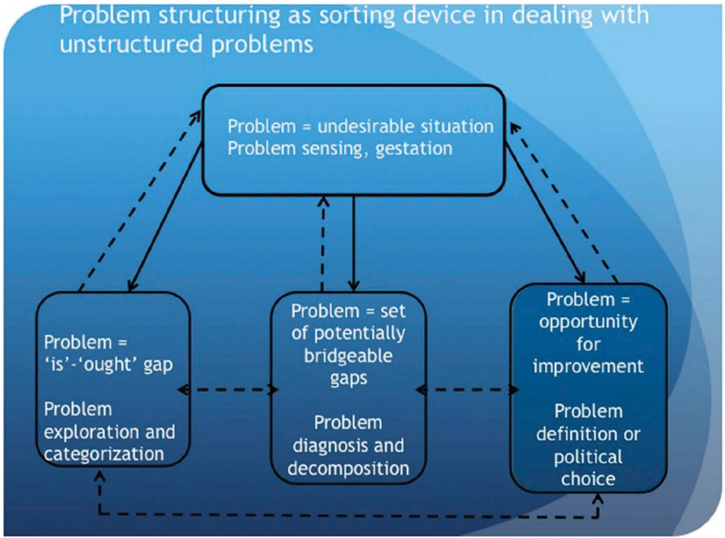
- Policy workers deal with problems through problem structuring, balancing closing-down and opening-up sub-questions; the car mobility example decomposes into egalitarian, hierarchist, and individualist frames, each generating two sub-problems (six total), with partial answers and negotiated political distance.
Methods
- Conceptual and philosophical critique with historical contextualization of Rittel and Webber (1973), drawing on policy sciences, STS, and social-constructivist scholarship; no empirical sample or statistical analysis is reported.
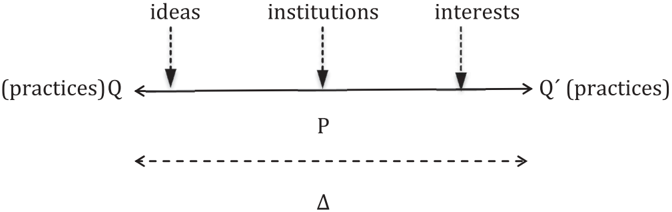
- Develops an alternative “questioning-distance framework” combining the philosophy of questioning, the policy work perspective, and political distance, then applies it illustratively to car mobility as an unstructured problem.
- Uses textual examples, textboxes, and figures—e.g., Figure 1 questioning-distance framework and Figure 2 problem structuring—rather than formal data collection.
Limitations
- The paper states no limitations section or explicit limitations.
- Evident from the text: the argument is theoretical/conceptual, and the car mobility case is illustrative rather than an empirical test; the authors note that in reality frames are “less articulate and more fuzzy and hybrid.”
- Evident from the text: no systematic data, sample, or comparative empirical validation of the proposed framework is reported.
Model-written summary. Check it against the paper before relying on it.
Integrity signals
Registry
Cites
Statistics
Figures
Verification
Claims the paper makes
9 Valid · 2 Not valid · 31 Not checked · 129 Own results and interpretations
Every source the paper cites for this claim was checked and supports it.
In the paper
“On rereading Rittel and Webber's contemporaneous 1973 work, we see that it was closely integrated within the context of these debates.”
§ Problematizing 'wickedness': a critique of the wicked problems concept, from philosophy to practice > 2. Problems with the wicked/tame problem distinction
What the sources say
- Supportedcites Rittel and Webber (1973) matched to “Dilemmas in a general theory of planning” (1973) source
In “Dilemmas in a General Theory of Planning” (page unavailable), Rittel and Webber explicitly connect systems analysis and policy programs to contemporary debates about goals and governmental priorities. Section III discusses the failure of planners and other social professionals to solve problems they had claimed they could solve. These passages support the citing sentence’s characterization of the work’s context. (LLM, conf=0.91)
plainstates an association- Asserted: passes — The authors put it forward as true.
- Checkable: passes — It can be checked against evidence.
- Load-bearing: passes — The paper’s conclusions depend on it.
- Based: passes — The paper gives a reason why it holds.
- Supported
The cited sources that could be checked couldn’t confirm or dispute this claim.
In the paper
“Their work was formed solely with regard to a debate within RAND and in the context of systems analysis failures.”
§ Problematizing 'wickedness': a critique of the wicked problems concept, from philosophy to practice > 2. Problems with the wicked/tame problem distinction
What the sources say
- Could not verifycites Brewer (2017) matched to “There at the beginning: we’re still “emerging,” maybe forever” (2017) sourceExperimental — accuracy not yet measured
The Systems analysis and Changes in the landscape sections discuss RAND and differences between systems analysis and the policy sciences, but do not discuss Rittel and Webber or the origins of their work. Searches for their names alongside RAND, systems-analysis failures, and wicked problems found no passage addressing the claimed debate. (LLM, conf=0.76)
plainstates a cause- Asserted: passes — The authors put it forward as true.
- Checkable: passes — It can be checked against evidence.
- Load-bearing: passes — The paper’s conclusions depend on it.
- Based: passes — The paper gives a reason why it holds.
- Could not verify
Every source the paper cites for this claim was checked and supports it.
In the paper
“In actuality, they use the distinction to differentiate between societal problems and those of the natural sciences.”
§ Problematizing 'wickedness': a critique of the wicked problems concept, from philosophy to practice > 2. Problems with the wicked/tame problem distinction
What the sources say
- Supportedcites Rittel and Webber (1973) matched to “Dilemmas in a general theory of planning” (1973) source
Section III explicitly contrasts problems in the natural sciences with problems of governmental and social planning. It describes the problems scientists usually address as mostly “tame” and nearly all public-policy issues as “wicked,” supporting the attributed use of the distinction. (LLM, conf=0.94)
plain- Asserted: passes — The authors put it forward as true.
- Checkable: passes — It can be checked against evidence.
- Load-bearing: passes — The paper’s conclusions depend on it.
- Based: passes — The paper gives a reason why it holds.
- Supported
Every source the paper cites for this claim was checked and supports it.
In the paper
“Contrary to what is presupposed in much of the subsequent literature, Rittel and Webber's wicked/tame problem distinction does not, in fact, aim to distinguish different types of policy problems.”
§ Problematizing 'wickedness': a critique of the wicked problems concept, from philosophy to practice > 2. Problems with the wicked/tame problem distinction
What the sources say
- Supportedcites Rittel and Webber (1973) matched to “Dilemmas in a general theory of planning” (1973) source
Section III explicitly describes the intended distinction as one between mostly tame problems studied by scientists and engineers and wicked problems that include nearly all public policy issues. It does not present the distinction as a way to sort policy problems into types. (LLM, conf=0.91)
plain- Asserted: passes — The authors put it forward as true.
- Checkable: passes — It can be checked against evidence.
- Load-bearing: passes — The paper’s conclusions depend on it.
- Based: passes — The paper gives a reason why it holds.
- Supported
The sources with a verdict support this claim; the rest weren’t checked yet, have no full text we could read, or their verdicts aren’t rated yet.
In the paper
“Importantly, the idea that problems are either wicked or tame rules out 'degrees' of wickedness, or even 'tendencies' toward wickedness, which might be more helpful (Alford & Head, 2017;Daviter, 2017;Farrell & Hooker, 2013;Newman & Head, 2017).”
§ Problematizing 'wickedness': a critique of the wicked problems concept, from philosophy to practice > 2. Problems with the wicked/tame problem distinction
What the sources say
- Not checked yetcites Alford & Head, 2017 matched to “Wicked and less wicked problems: a typology and a contingency framework” (2017) source
Checked before — its earlier verdict is held back until a new check runs.
- Not checked yetcites Daviter, 2017 matched to “Coping, Taming or Solving: Alternative approaches to the governance of wicked problems” (2017) source
Checked before — its earlier verdict is held back until a new check runs.
- Supportedcites Newman & Head, 2017 matched to “Wicked tendencies in policy problems: rethinking the distinction between social and technical problems” (2017) source
In the “Wicked problems” section, Newman and Head describe the wicked-versus-tame binary and contrast it with an approach that allows degrees of wickedness. They propose referring to the “wicked tendencies of all problems” rather than treating wicked problems as a distinct subset. The supplied passages have no page numbers. (LLM, conf=0.93)
plainstates a cause- Asserted: passes — The authors put it forward as true.
- Checkable: passes — It can be checked against evidence.
- Load-bearing: passes — The paper’s conclusions depend on it.
- Based: passes — The paper gives a reason why it holds.
- Not checked yet
47 more claims · 2 with their cited sources checked
Create a free account to see all 171 claims and to verify the 5 references still open.
- Probably not a substantial claim. 97
- It may state two separate claims as one. 43
- The quote only partly states this claim. 3
Citations
Cites
The social construction of reality : a treatise in the sociology of knowledge
Simpson, G., Berger, P. L., & Luckmann, T. (1967) · American Sociological Review · doi:10.2307/2091739 · Cited by 16,462
Dilemmas in a general theory of planning
Rittel, H. W. J., & Webber, M. M. (1973) · Policy Sciences · doi:10.1007/bf01405730 · Cited by 16,338 · cited 1×
“…problems are particularly resistant to ‘solutions’ and are ‘thus’ to be categorically differentiated from other problems.1 The originators of the term, Rittel and Webber (1973), were not policy specialists but urban planners who, frustrated by the inability of CONTACT Nick Turnbull…”
BackgroundTHE SCIENCE OF MUDDLING THROUGH
Lindblom, C. (1959) · Elsevier eBooks · doi:10.1016/b978-0-08-017066-4.50015-1 · Cited by 8,690
The Science of “Muddling Through”
Lindblom, C. E. (1959) · Public Administration Review · doi:10.2307/973677 · Cited by 8,513
A Behavioral Theory of the Firm
Day, R. H., Cyert, R. M., March, J. G., Clarkson, Cohen, Feigenbaum, D., Greenberg, Moore, Soelberg, Starbuck, et al. (1964) · Econometrica · doi:10.2307/1913056 · Cited by 7,791
The New production of knowledge: the dynamics of science and research in contemporary societies
(1995) · Choice Reviews Online · doi:10.5860/choice.32-4463 · Cited by 7,046
Laboratory life: The social construction of scientific facts
Austin, J. (1982) · Social Science & Medicine · doi:10.1016/0277-9536(82)90228-3 · Cited by 2,883
The structure of ill structured problems
Simon, H. A. (1973) · Artificial Intelligence · doi:10.1016/0004-3702(73)90011-8 · Cited by 2,600 · cited 2×
“As convincingly argued and demonstrated by Simon (1973), their difference depends upon constraints on the elements that define a problem; they are either ‘given’ and ‘closed’ (strong, repressing or commanding answers) or ‘open’ and ‘amenable to further choice’ (weak answers, which invite and elicit…”
BackgroundThe Honest Broker: Making Sense of Science in Policy and Politics
Pielke, Jr. (2007) · doi:10.1017/cbo9780511818110 · Cited by 2,020 · cited 1×
“…policy interaction (Jasanoff, 1990, Guston 2014), boundary work and boundary organization (Guston, 2001; Hoppe, 2010), styles of science advice (Pielke, 2007) and advisory systems (Halligan, 1995; Hoppe, 2014), or post-normal science (Ravetz, 2006) and Mode-2 science (Gibbons, Nowotny, Scott,…”
BackgroundLevin, K., Cashore, B., Bernstein, S., & Auld, G. (2012) · Policy Sciences · doi:10.1007/s11077-012-9151-0 · Cited by 1,839
The Politics of the Budgetary Process
Groves, H. M., & Wildavsky, A. (1965) · Southern Economic Journal · doi:10.2307/1055574 · Cited by 1,638
Still Muddling, Not Yet Through
Lindblom, C. E. (1979) · Public Administration Review · doi:10.2307/976178 · Cited by 1,629 · cited 1×
“We introduce an empirical question–answer model of strategic policy analysis (in the sense Lindblom (1979) used this term) and apply it to an example of car mobility as an unstructured problem.”
MethodThe Social Construction of Reality: A Treatise in the Sociology of Knowledge
Light, D. W., Berger, P. L., & Luckmann, T. (1967) · Sociological Analysis · doi:10.2307/3710424 · Cited by 1,612
The fifth branch: science advisers as policymakers
(1991) · Choice Reviews Online · doi:10.5860/choice.28-4501 · Cited by 1,610
Wicked Problems: Implications for Public Policy and Management
Head, B. W., & Alford, J. (2015) · Administration & Society · doi:10.1177/0095399713481601 · Cited by 1,514
The specificity of the scientific field and the social conditions of the progress of reason
Bourdieu, P. (1975) · Social Science Information · doi:10.1177/053901847501400602 · Cited by 1,483 · cited 1×
“Works by prominent scholars such as Ravetz (1971), Bourdieu (1975), Latour and Woolgar (1979), Collins (1985), Fuller (1993) and Ziman (2000) recount the extent to which scientific practice is a social process, one conducted through intuitive, habituated actions, infused with sociocultural norms…”
BackgroundThe Two Cultures and the Scientific Revolution
Snow, C. P., & Smoluchowski, R. (1961) · Physics Today · doi:10.1063/1.3057748 · Cited by 1,479 · cited 1×
“dealing with ‘tame’ or ‘benign’ problems reiterates the misunderstanding belonging to both sides of these ‘two cultures’ (Snow, 1959).”
BackgroundPlanning in the Public Domain: From Knowledge to Action
Friedmann, J. R. P. (2020) · Project Muse (Johns Hopkins University) · Cited by 1,479
Boundary Organizations in Environmental Policy and Science: An Introduction
Guston, D. H. (2001) · Science, Technology, & Human Values · doi:10.1177/016224390102600401 · Cited by 1,474 · cited 1×
“…topic in STS (Sismondi, 2008) under headings like science– policy interaction (Jasanoff, 1990, Guston 2014), boundary work and boundary organization (Guston, 2001; Hoppe, 2010), styles of science advice (Pielke, 2007) and advisory systems (Halligan, 1995; Hoppe, 2014), or post-normal science…”
Background(2005) · Medical Entomology and Zoology · Cited by 972
Using Social Research in Public Policy Making.
Rieker, P. P., & Weiss, C. H. (1979) · Contemporary Sociology · doi:10.2307/2065222 · Cited by 934
The Art and Craft of Policy Analysis
Wildavsky, A. (1979) · doi:10.1007/978-1-349-04955-4 · Cited by 896 · cited 1×
“Reaffirming earlier analyses of the disciplinary genealogy of the policy sciences (e.g. Friedmann, 1987, p. 137–179; Wildavsky, 1980; p. 26–40), Garry Brewer’s (2017) recent contribution to Policy Sciences explains the close involvement of The RAND Corporation in the institution of this journal,…”
Background(1971) · Medical Entomology and Zoology · Cited by 863
Russell, C. M., & Simon, H. A. (1950) · The American Journal of Nursing · doi:10.2307/3467497 · Cited by 812
Real Science: What it Is and What it Means
Ziman, J. (2000) · doi:10.1017/cbo9780511541391 · Cited by 760 · cited 2×
“Works by prominent scholars such as Ravetz (1971), Bourdieu (1975), Latour and Woolgar (1979), Collins (1985), Fuller (1993) and Ziman (2000) recount the extent to which scientific practice is a social process, one conducted through intuitive, habituated actions, infused with sociocultural norms…”
BackgroundReal science what it is, and what it means
Ziman, J. M. (2000) · Cited by 759
The Intelligence of Democracy: Decision Making through Mutual Adjustment
White, O., & Lindblom, C. E. (1965) · The Western Political Quarterly · doi:10.2307/445925 · Cited by 749
Understanding ‘anticipatory governance’
Guston, D. H. (2014) · Social Studies of Science · doi:10.1177/0306312713508669 · Cited by 749
Wicked Problems in Public Policy
Head, B. W. (2023) · Encyclopedia of Public Policy · doi:10.1007/978-3-030-90434-0_43-1 · Cited by 731
Scientific Knowledge and Its Social Problems
McConnell, J. R., & Philosophical Studies, W. S. F. T. N. U. O. I. (1972) · Philosophical Studies · doi:10.5840/philstudies1972214 · Cited by 696
Super Wicked Problems and Climate Change: Restraining the Present to Liberate the Future
Lazarus, R. J. (2008) · Digital Access to Scholarship at Harvard (DASH) (Harvard University) · Cited by 635
An introduction to science and technology studies
(2004) · Choice Reviews Online · doi:10.5860/choice.41-3396 · Cited by 581
(2000) · International public management review · Cited by 573
Wicked and less wicked problems: a typology and a contingency framework
Alford, J., & Head, B. W. (2017) · Policy and Society · doi:10.1080/14494035.2017.1361634 · Cited by 528 · cited 3×
“Importantly, the idea that problems are either wicked or tame rules out ‘degrees’ of wickedness, or even ‘tendencies’ toward wickedness, which might be more helpful (Alford & Head, 2017; Daviter, 2017; Farrell & Hooker, 2013; Newman & Head, 2017).”
BackgroundWhat is so wicked about wicked problems? A conceptual analysis and a research program
Peters, B. G. (2017) · Policy and Society · doi:10.1080/14494035.2017.1361633 · Cited by 475 · cited 5×
“That is, the problem ‘as such’ is assumed to have an autonomous, unique nature of its own (e.g. Hoornbeek and Peters, 2017), which can be discovered, much like bacteria observed by a scientist through a microscope.”
BackgroundInfluentialPlanning in the Public Domain: From Knowledge to Action
Friedmann, J. (1988) · Princeton University Press eBooks · doi:10.1515/9780691214009 · Cited by 433
The Art of Judgment: A Study of Policy Making
Friedmann, W., & Vickers, G. (1966) · Columbia Law Review · doi:10.2307/1120993 · Cited by 404 · cited 1×
“…which led policy scientists to re-engage with work by scholars such as Lerner and Lasswell (1951), Lindblom (1968), Simon (1947), Cyert and March (1963), Vickers (1965) and Wildavsky (1971), who had all already questioned the primacy of goal-setting and the solutions focus of systems planning.”
BackgroundThe Politics of the Budgetary Process
Peters, B. G. (2018) · The Politics of Bureaucracy · doi:10.4324/9781315813653-7 · Cited by 388
Beyond Empiricism: Policy Inquiry in Post positivist Perspective
Fischer, F. (1998) · Policy Studies Journal · doi:10.1111/j.1541-0072.1998.tb01929.x · Cited by 353 · cited 1×
“But this isolates the problem itself from the surrounding context, including from the theory-dependence of the observer (Fischer, 1998).”
BackgroundWicked Problems in Public Policy: Understanding and Responding to Complex Challenges
Head, B. W. (2022) · Springer eBooks · doi:10.1007/978-3-030-94580-0 · Cited by 351
Policy analysis, science and politics: from 'speaking truth to power' to 'making sense together'
Hoppe, R. (1999) · Science and Public Policy · doi:10.3152/147154399781782482 · Cited by 346
Self-citationHisschemöller, M., & Hoppe, R. (1995) · Knowledge and Policy · doi:10.1007/bf02832229 · Cited by 344
Self-citationProblem Definition in Policy Analysis
Déry, D. (1984) · Medical Entomology and Zoology · Cited by 335
(2008) · LA Referencia (Red Federada de Repositorios Institucionales de Publicaciones Científicas) · Cited by 311
Arrow, K. J. (1964) · Political Science Quarterly · doi:10.2307/2146703 · Cited by 305
Governance Capabilities for Dealing Wisely With Wicked Problems
Termeer, C. J. A. M., Dewulf, A., Breeman, G., & Stiller, S. J. (2015) · Administration & Society · doi:10.1177/0095399712469195 · Cited by 304
Mind and Body Spaces: Geographies of Illness, Impairment and Disability
Simpson, M. K. (2001) · Journal of Applied Research in Intellectual Disabilities · doi:10.1046/j.1468-3148.2001.0044e.x · Cited by 300
Hisschemöller, M., & Hoppe, R. (2018) · Knowledge, Power, and Participation in Environmental Policy Analysis · doi:10.4324/9781351325721-4 · Cited by 300
Self-citationBevir, M., & Rhodes, R. (2006) · Routledge eBooks · doi:10.4324/9780203969090 · Cited by 292
The governance of problems: Puzzling, powering and participation
Hoppe, R. (2010) · doi:10.1332/policypress/9781847429629.001.0001 · Cited by 286
Self-citationKnowledge and Policy: The Uncertain Connection.
Sills, D. L., & Lynn, L. E. (1980) · Contemporary Sociology · doi:10.2307/2065641 · Cited by 259
Developing a process model of problem recognition
Cowan, D. A. (1986) · The Academy of Management Review · doi:10.2307/258395 · Cited by 257 · cited 2×
“Figure 2, inspired by Schön (1983), Cowan (1986) and Hoppe (1999), presents a model of problem structuring by policy workers in which the dialectic trajectories of opening-up and closing-down moments are clearly displayed.”
BackgroundPolicy Advice and the Public Service
Halligan, J. (1995) · Governance in a Changing Environment · doi:10.1515/9780773565500-008 · Cited by 242
The Problem of Policy Problems
Peters, G. B. (2005) · Journal of Comparative Policy Analysis: Research and Practice · doi:10.1080/13876980500319204 · Cited by 234 · cited 1×
“…the wicked terminology altogether include, for example, the excellent book on policy ‘messes’ by Roe (2013) and the more generalizable and productive work about difficult and complex policy problems (Hoornbeek & Guy Peters, 2017; Peters, 2005), or governance ‘dilemmas’ (Bevir & Rhodes, 2006).”
BackgroundBurke, F. T., & McColl, E. (2024) · Dental Update · doi:10.12968/denu.2024.51.4.221 · Cited by 225
The Fifth Branch: Science Advisors as Policymakers
Jasanoff, S., & Primack, J. R. (1991) · Physics Today · doi:10.1063/1.2810251 · Cited by 224
The Work of policy: an international survey
(2007) · Choice Reviews Online · doi:10.5860/choice.44-2937 · Cited by 188 · cited 1×
“…new conceptual approach together with the idea of policy work, the practical questioning by (teams of) individuals who, in settings of the governance of collective action and change, distinguish between what is problematic and what is not (Colebatch, 2006; Colebatch, Hoppe, & Noordegraaf, 2010).”
BackgroundThe policy sciences emerge: To nurture and structure a discipline
Brewer, G. D. (1974) · Policy Sciences · doi:10.1007/bf00144283 · Cited by 184 · cited 1×
“He then published his still-cited paper on the ‘emerging’ policy sciences in the journal and also as a RAND report (Brewer, 1974).”
BackgroundThe Policy Sciences: Recent Developments in Scope and Method
Bartlett, F. C. (1952) · International Affairs · doi:10.2307/2607508 · Cited by 174
Snow, C. P. (1959) · Science · doi:10.1126/science.130.3373.419 · Cited by 172
The Policy Sciences. Recent Developments in Scope and Method
Sieber, S. A., Lerner, D., & Lasswell, H. D. (1953) · The American Catholic Sociological Review · doi:10.2307/3707874 · Cited by 164
Metze, T. A. P., Colebatch, H. K., Hoppe, R., & Noordegraaf, M. (2010) · Amsterdam University Press eBooks · doi:10.5117/9789089642530 · Cited by 140
Self-citationWeaknesses of wickedness: a critical perspective on wickedness theory
Noordegraaf, M., Douglas, S., Geuijen, K., & van der Steen, M. (2019) · Policy and Society · doi:10.1080/14494035.2019.1617970 · Cited by 132
A Strategy of Decision: Policy Evaluation As a Social Process.
Parenton, V. J., Braybrooke, D., & Lindblom, C. E. (1964) · Social Forces · doi:10.2307/2575996 · Cited by 123
Design, science and wicked problems
Farrell, R., & Hooker, C. (2013) · Design Studies · doi:10.1016/j.destud.2013.05.001 · Cited by 122 · cited 1×
“Importantly, the idea that problems are either wicked or tame rules out ‘degrees’ of wickedness, or even ‘tendencies’ toward wickedness, which might be more helpful (Alford & Head, 2017; Daviter, 2017; Farrell & Hooker, 2013; Newman & Head, 2017).”
BackgroundCoping, Taming or Solving: Alternative approaches to the governance of wicked problems
Daviter, F. (2017) · Policy Studies · doi:10.1080/01442872.2017.1384543 · Cited by 122 · cited 3×
“Importantly, the idea that problems are either wicked or tame rules out ‘degrees’ of wickedness, or even ‘tendencies’ toward wickedness, which might be more helpful (Alford & Head, 2017; Daviter, 2017; Farrell & Hooker, 2013; Newman & Head, 2017).”
BackgroundUnderstanding policy problems: a refinement of past work
Hoornbeek, J., & Peters, B. G. (2017) · Policy and Society · doi:10.1080/14494035.2017.1361631 · Cited by 118 · cited 1×
“That is, the problem ‘as such’ is assumed to have an autonomous, unique nature of its own (e.g. Hoornbeek and Peters, 2017), which can be discovered, much like bacteria observed by a scientist through a microscope.”
BackgroundThe No-Nonsense Guide to Science
Ravetz, J. R. (2006) · Cited by 107
Hoppe, R. (2010) · Springer eBooks · doi:10.1007/978-3-642-11381-9_13 · Cited by 99
Self-citationPhilosophy, rhetoric, and the end of knowledge: the coming of science and technology studies
(1994) · Choice Reviews Online · doi:10.5860/choice.31-2654 · Cited by 98
Newman, J., & Head, B. W. (2017) · Policy and Society · doi:10.1080/14494035.2017.1361635 · Cited by 96 · cited 1×
“Importantly, the idea that problems are either wicked or tame rules out ‘degrees’ of wickedness, or even ‘tendencies’ toward wickedness, which might be more helpful (Alford & Head, 2017; Daviter, 2017; Farrell & Hooker, 2013; Newman & Head, 2017).”
BackgroundPhilosophy, Rhetoric, and the End of Knowledge: The Coming of Science and Technology Studies.
Lynch, M., & Fuller, S. (1994) · Contemporary Sociology A Journal of Reviews · doi:10.2307/2075277 · Cited by 90 · cited 1×
“Works by prominent scholars such as Ravetz (1971), Bourdieu (1975), Latour and Woolgar (1979), Collins (1985), Fuller (1993) and Ziman (2000) recount the extent to which scientific practice is a social process, one conducted through intuitive, habituated actions, infused with sociocultural norms…”
BackgroundHeuristics for practitioners of policy design: Rules-of-thumb for structuring unstructured problems
Hoppe, R. (2017) · Public Policy and Administration · doi:10.1177/0952076717709338 · Cited by 87 · cited 6×
“We abandon the ‘mutual’ adjective to indicate that, as Lindblom also later observed (Lindblom & Woodhouse, 1993), its pluralist assumptions are actually replaced by a logic of exclusion and mutual provocation (Hoppe, 2017b).”
BackgroundInfluentialSelf-citationThe governance of problems: Puzzling, powering and participation
Hoppe, R. (2010) · Bristol University Press eBooks · doi:10.2307/j.ctt9qgx59 · Cited by 84
Self-citation"Introduction To Science and Technology Studies"
Sturchio, J. L. (1985) · Bulletin of Science Technology & Society · doi:10.1177/027046768500500405 · Cited by 81
Dirty Rotten Strategies: How We Trick Ourselves and Others into Solving the Wrong Problems Precisely
Silvers, A., & Mitroff, I. I. (2009) · Medical Entomology and Zoology · Cited by 74
The Problem of Policy Problems
Peters, B. G., & Hoornbeek, J. (2005) · McGill-Queen's University Press eBooks · doi:10.1515/9780773581708-006 · Cited by 55
The Pure Theory of Politics, by Bertrand de Jouvenel
Macpherson, C. B. (1967) · Political Science Quarterly · doi:10.2307/2147332 · Cited by 54
Problem Solving and Institutional Design
(1995) · Journal of Public Administration Research and Theory · doi:10.1093/oxfordjournals.jpart.a037259 · Cited by 51 · cited 1×
“Frequently, problems-as-processed by authoritative policymakers entail path-dependent, pre-structured problem definitions (Chisholm, 1995) that exclude newly emerging and promising alternative solutions seriously considered by other actors.”
Background(1995) · Cited by 44
The questioning theory of policy practice: Outline of an integrated analytical framework
Turnbull, N. (2013) · Critical Policy Studies · doi:10.1080/19460171.2013.776501 · Cited by 33 · cited 2×
“‘Wicked’ is thus a rhetorical term (similar to ‘fuzzy’, ‘messy’ and even ‘complex’, but with additional rhetorical force in persuasively garnering attention), both in practice and in scholarship (cf. Turnbull, 2013), as our historical depiction of Rittel and Webber reveals.”
BackgroundSelf-citationMaking the Most of Mess: Reliability and Policy in Today’s Management Challenges
Roe, E. (2013) · doi:10.1215/9780822395690 · Cited by 30 · cited 1×
“Other notable works that eschew the wicked terminology altogether include, for example, the excellent book on policy ‘messes’ by Roe (2013) and the more generalizable and productive work about difficult and complex policy problems (Hoornbeek & Guy Peters, 2017; Peters, 2005), or governance…”
BackgroundMaking the most of mess: reliability and policy in today's management challenges
Roe, E. (2013) · Choice Reviews Online · doi:10.5860/choice.51-2155 · Cited by 29
Politiek, participatie en experts in de besluitvorming over super wicked problems
Metze, T. A. P., & Turnhout, E. (2014) · Bestuurskunde · doi:10.5553/bk/092733872014023002001 · Cited by 28 · cited 1×
“…2009, Levin, Cashore, Bernstein, & Auld, 2012), such as the role of disciplinary, territorial and administrative-political boundaries, near-immovable structural inertia, severe time constraints and the inexpressibility of ‘unknown unknowns’ in the current symbolic order (Metze & Turnhout, 2014).”
BackgroundMeyer, M. (2017) · doi:10.1093/oso/9780199691821.001.0001 · Cited by 24 · cited 1×
“Common to all three dimensions is a generalized persistence in their problematic qualities – in other words, their problematicalness or ‘problematicity’ (Meyer, 1995; 2017, p. 83, 113).”
BackgroundMarshall, D. R. (1982) · American Political Science Review · doi:10.2307/1963081 · Cited by 23
Parallel experimentation: A basic scheme for dynamic efficiency
Ellerman, D. (2014) · Journal of Bioeconomics · doi:10.1007/s10818-014-9175-y · Cited by 21 · cited 1×
“As in evolutionary biology (Ellerman, 2014), the system is supposed to balance attention to generating variety (questioning, openingup alternatives) with selection mechanisms (closing-down or repressing moments through authority, democratic procedure, scientific expertise, or violent repressive…”
BackgroundBook review: Jerome Ravetz, “The No-Nonsense Guide to Science,” New Internationalist Publications
Børsen, T. (2006) · VBN Forskningsportal (Aalborg Universitet) · Cited by 14
Michel Meyer’s Problematology : Questioning and Society
(2014) · Bloomsbury Academic eBooks · doi:10.5040/9781472594129 · Cited by 10
There at the beginning: we’re still “emerging,” maybe forever
Brewer, G. D. (2017) · Policy Sciences · doi:10.1007/s11077-017-9282-4 · Cited by 9
Lindblom on Limits to Policy Change: The Tragic Dilemma Between Understanding and Shaping the World
Hoppe, R. (2017) · European Policy Analysis · doi:10.1002/epa2.1021 · Cited by 9 · cited 6×
“We abandon the ‘mutual’ adjective to indicate that, as Lindblom also later observed (Lindblom & Woodhouse, 1993), its pluralist assumptions are actually replaced by a logic of exclusion and mutual provocation (Hoppe, 2017b).”
BackgroundInfluentialSelf-citationPatterns of science–policy interaction
Hoppe, R. (2017) · Bristol University Press eBooks · doi:10.2307/j.ctt1t89169.11 · Cited by 3 · cited 1×
“…(Jasanoff, 1990, Guston 2014), boundary work and boundary organization (Guston, 2001; Hoppe, 2010), styles of science advice (Pielke, 2007) and advisory systems (Halligan, 1995; Hoppe, 2014), or post-normal science (Ravetz, 2006) and Mode-2 science (Gibbons, Nowotny, Scott, & Trow, 1994).”
BackgroundSelf-citationPolicy Analysis in the Netherlands
(2014) · Bristol University Press eBooks · doi:10.46692/9781447313342 · Cited by 1
Patterns of science–policy interaction
Hoppe, R. (2014) · Policy Press eBooks · doi:10.1332/policypress/9781447313335.003.0004 · Cited by 1
Self-citationDirty Rotten Strategies: How We Trick Ourselves and Others into Solving the Wrong Problems Precisely
Mitroff, I., & Silvers, A. (2009) · doi:10.1515/9781503627260
From fragmentation to configuration
Lasswell, H. D. (1971) · Policy Sciences · doi:10.1007/bf01406144
Wildavsky, A. (1979) · The Art and Craft of Policy Analysis · doi:10.1007/978-1-349-04955-4_17
Research works printed but not linked: 12
- 11. Collins, H. M. (1985). Changing Order. London: Sage.
- 16. De Jouvenel, B. (1963). The pure theory of politics. New Haven: Yale University Press.
- 23. Geiselberger, H. (2017). The great regression. Cambridge: Polity.
- 40. Kooiman, J. (1988). Besturen: overheid en maatschappij in wisselwerking. Assen: Van Gorcum.
- 41. Krieger, M. H. (1981). Advice and planning. Philadelphia: Temple University Press.
- 50. Lindblom, C. E. (1968). The policymaking process. Englewood Cliffs NJ: Prentice Hall.
- 52. Lindblom, C. E., & Woodhouse, E. J. (1993). The policy-making process (3rd ed.). Englewood Cliffs, NJ: Prentice-Hall.
- 70. Schön, D. A., & Rein, M. (1994). Frame reflection: Towards the resolution of intractable policy controversies. New York: Basic Books.
- 71. Simmons, H. (1982). From asylum to welfare. Ontario: National Institute on Mental Retardation.
- 79. Vickers, G. (1965). The art of judgment: A study of policymaking. London: Methuen.
- 81. Wildavsky, A. (1971). Does planning work? Public Interest, 24, 95-105.
- 83. Wildavsky, A. (1976). Review: The strategic retreat on objectives. Policy Analysis, 2, 499-526.
Cited by
Wicked problems: a mapping review of the literature
Lönngren, J., & van Poeck, K. (2021) · International Journal of Sustainable Development & World Ecology · doi:10.1080/13504509.2020.1859415 · Cited by 362
“Our review supports Turnbull and Hoppe’s claim that the wicked problems literature lacks a firm theoretical and conceptual base (Turnbull and Hoppe 2019): there is a large degree of variation in how the concept is used with regard to theoretical status, range of meanings, epistemological…”
BackgroundMethodInfluentialWicked Problems in Public Policy: Understanding and Responding to Complex Challenges
Head, B. W. (2022) · Springer eBooks · doi:10.1007/978-3-030-94580-0 · Cited by 351
Termeer, C. J. A. M., Dewulf, A., & Biesbroek, R. (2019) · Policy and Society · doi:10.1080/14494035.2019.1617971 · Cited by 260
“According to Turnbull and Hoppe (2019), ‘wicked’ is a rhetorical term ‘used by scholars to help them think about the most difficult, unstructured policy problems and used by practitioners to label persistently problematic distances between stakeholders to a problem, a labelling which itself has political aims’ (p.”
BackgroundInfluentialSmall wins for grand challenges. A bottom-up governance approach to regional innovation policy
Bours, S., Wanzenböck, I., & Frenken, K. (2021) · European Planning Studies · doi:10.1080/09654313.2021.1980502 · Cited by 153
“The reason is the wicked, unstructured and multi-dimensional nature of underlying problem structures, which can easily overwhelm policy-makers (Peters 2017; Turnbull and Hoppe 2019).”
BackgroundFlanagan, K., Uyarra, E., & Wanzenböck, I. (2022) · Regional Studies · doi:10.1080/00343404.2021.2016680 · Cited by 148
Metadata
- Authors
- Turnbull, N., & Hoppe, R.
- Affiliations
- University of Manchester (GB)
- University of Twente (NL)
- Corresponding author
- Turnbull, Nick
- Venue
- Policy and Society
- Publisher
- Oxford University Press (OUP)
- Published
- 2018-07-02
- Volume
- 38
- Issue
- 2
- Pages
- 315-337
- ISSN
- 1449-4035 (ISSN-L)
- 1839-3373
- OpenAlex
- W2808132182
- Semantic Scholar
- fa472c535679dbe0e723904677989c2ae055133d
- Cited by
- 181
- References
- 96
- Citations by year
- 2026: 27 · 2025: 26 · 2024: 31 · 2023: 21 · 2022: 25 · 2021: 16 · 2020: 24 · 2019: 10 · 2018: 1
- FWCI
- 10.16
- Type
- journal article
- Language
- en
- Open access
- gold
- doi.org
- Licence
- Locations
- Policy and Society (publishedVersion, cc-by-nc)
- Research Explorer (The University of Manchester) (publishedVersion, cc-by-nc)
- University of Twente Research Information (submittedVersion, public-domain)
- DOAJ (DOAJ: Directory of Open Access Journals) (submittedVersion, cc-by-sa)
- University of Twente Research Information (submittedVersion, cc-by-nc)
- Topics
- Social Sciences › Decision Sciences › Management Science and Operations Research › Complex Systems and Decision Making
- Social Sciences › Public Administration › Public Policy and Administration Research
- Social Sciences › Political Science and International Relations › Public Administration and Political Analysis
- Keywords
- wicked problems, public problems, problem structuring, policy work, political distance, policy analysis, policy practice
About these checks
Registry, retraction, Cites and statistics results are computed, not judged, with one exception: a printed reference that no index lists is read once by a model before it counts as a citation error. Claims are extracted by a model and kept only when their quote appears verbatim in the text; each cited source is then checked, with a model’s help, for whether it says what the claim relies on. Those verdicts can be wrong — read the claim’s quote and the cited source before relying on one.
The claim verdicts this report counts are experimental: their accuracy is not yet measured.
A language model drew the claims from the paper on 2026-10-04, under version 3 of the claim definition (model deepseek-v4.1-flash, prompt extract-v3).
A second model labelled each claim on 2026-10-04 (model jev-1.13-20260917, definition revision gold-guideline-v0.2).
Cited sources are checked with a language model’s help (gpt-6-sol).
Statistics and arithmetic are recomputed, not judged.
Confidence bands are shown only for fields calibrated on our annotated test set. None is calibrated yet, so no band is shown.
What counts as a claim ›How we measure confidence ›How we check this ›
Are you an author, or do you see a problem with this page? Request a review
Data sources
Bibliographic data: Semantic Scholar, OpenAlex, Crossref.
Contains information from the Semantic Scholar Academic Graph Datasets, made available under the ODC Attribution License (ODC-BY 1.0).
Semantic Scholar’s data is described in: Kinney, R., et al. (2023). The Semantic Scholar Open Data Platform. arXiv:2301.10140.
