

The discovery of novel HDAC3 inhibitors via virtual screening and in vitro bioassay
Open accessThe DOI matches its Crossref record; 52 of the 52 references it cites were found in a registry or an index.
Abstract
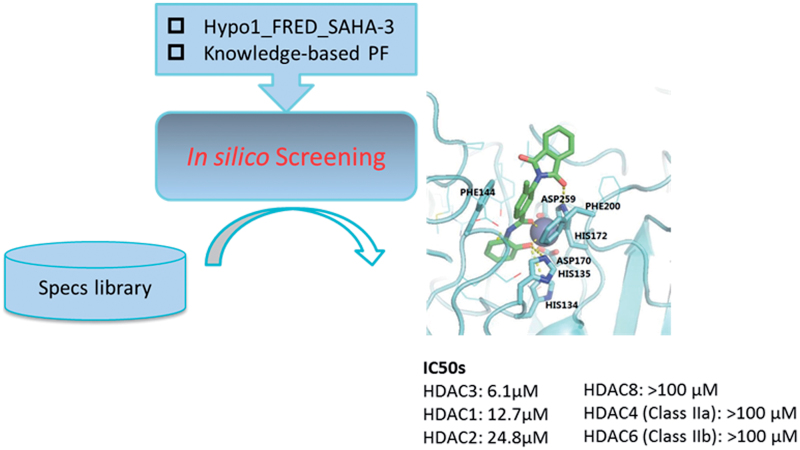
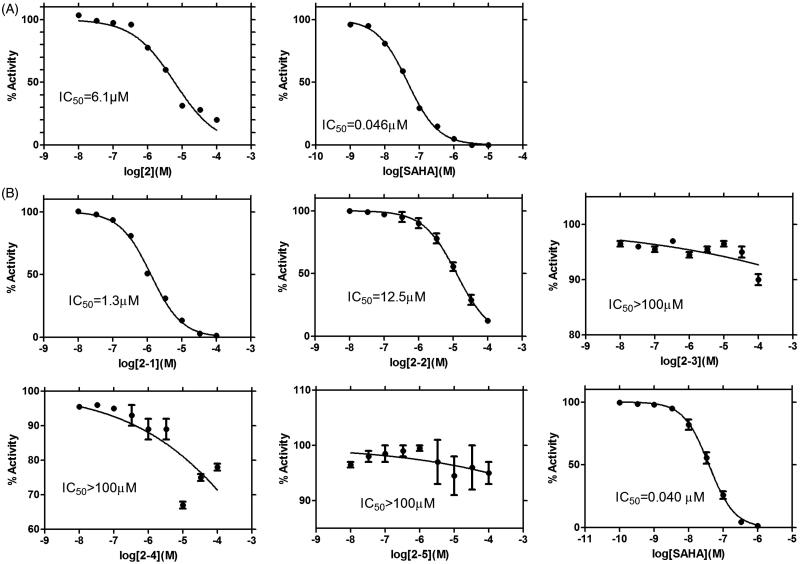
Histone deacetylase 3 (HDAC3) is a potential target for the treatment of human diseases such as cancers, diabetes, chronic inflammation and neurodegenerative diseases. Previously, we proposed a virtual screening (VS) pipeline named “Hypo1_FRED_SAHA-3” for the discovery of HDAC3 inhibitors (HDAC3Is) and had thoroughly validated it by theoretical calculations. In this study, we attempted to explore its practical utility in a large-scale VS campaign. To this end, we used the VS pipeline to hierarchically screen the Specs chemical library. In order to facilitate compound cherry-picking, we then developed a knowledge-based pose filter (PF) by using our in-house quantitative structure activity relationship- (QSAR-) modelling approach and coupled it with FRED and Autodock Vina. Afterward, we purchased and tested 11 diverse compounds for their HDAC3 inhibitory activity in vitro. The bioassay has identified compound 2 (Specs ID: AN-979/41971160) as a HDAC3I (IC50 = 6.1 μM), which proved the efficacy of our workflow. As a medicinal chemistry study, we performed a follow-up substructure search and identified two more hit compounds of the same chemical type, i.e. 2–1 (AQ-390/42122119, IC50 = 1.3 μM) and 2–2 (AN-329/43450111, IC50 = 12.5 μM). Based on the chemical structures and activities, we have demonstrated the essential role of the capping group in maintaining the activity for this class of HDAC3Is. In addition, we tested the hit compounds for their in vitro activities on other HDACs, including HDAC1, HDAC2, HDAC8, HDAC4 and HDAC6. We have identified these compounds are HDAC1/2/3 selective inhibitors, of which compound 2 show the best selectivity profile. Taken together, the present study is an experimental validation and an update to our earlier VS strategy. The identified hits could be used as starting structures for the development of highly potent and selective HDAC3Is.
Overview
Integrity signals
Registry
Cites
Statistics
Figures

Verification
Claims the paper makes
Self-check
Percentages, sums and reported differences re-computed from the paper’s own numbers.
The text we found for this paper looks like another document, so the self-check wasn’t run.
Citations
Cites
LIBSVM: A library for support vector machines
Chang, C.-C., & Lin, C.-J. (2011) · ACM Transactions on Intelligent Systems and Technology · doi:10.1145/1961189.1961199 · Cited by 40,918
Lipinski, C. A., Lombardo, F., Dominy, B. W., & Feeney, P. J. (2001) · Advanced Drug Delivery Reviews · doi:10.1016/s0169-409x(00)00129-0 · Cited by 18,139
Parr, R. G., Szentpály, L. V., & Liu, S. (1999) · Journal of the American Chemical Society · doi:10.1021/ja983494x · Cited by 7,465
ChEMBL: a large-scale bioactivity database for drug discovery
Gaulton, A., Bellis, L. J., Bento, A. P., Chambers, J., Davies, M., Hersey, A., Light, Y., McGlinchey, S., Michalovich, D., Al-Lazikani, B., et al. (2012) · Nucleic Acids Research · doi:10.1093/nar/gkr777 · Cited by 4,382
Hawkins, P. C. D., Skillman, A. G., Warren, G. L., Ellingson, B. A., & Stahl, M. T. (2010) · Journal of Chemical Information and Modeling · doi:10.1021/ci100031x · Cited by 1,607
Histone deacetylases and their inhibitors in cancer, neurological diseases and immune disorders
Falkenberg, K. J., & Johnstone, R. W. (2014) · Nature Reviews Drug Discovery · doi:10.1038/nrd4360 · Cited by 1,564 · cited 1×
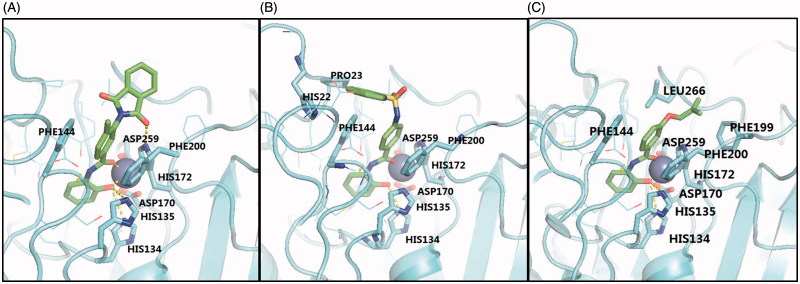
“(3) Due to the substitution of 2-methylallyl-oxyl group at the ortho-position, the core scaffold of compound 2–3, i.”
BackgroundHistone-deacetylase inhibitors: novel drugs for the treatment of cancer
Johnstone, R. W. (2002) · Nature Reviews Drug Discovery · doi:10.1038/nrd772 · Cited by 1,515
New and emerging HDAC inhibitors for cancer treatment
West, A. C., & Johnstone, R. W. (2014) · Journal of Clinical Investigation · doi:10.1172/jci69738 · Cited by 1,404
Histone Deacetylase Inhibitors as Anticancer Drugs
Eckschlager, T., Plch, J., Stiborova, M., & Hrabeta, J. (2017) · International Journal of Molecular Sciences · doi:10.3390/ijms18071414 · Cited by 1,206
Structure-Based Virtual Screening for Drug Discovery: Principles, Applications and Recent Advances
Lionta, E., Spyrou, G., Vassilatis, D., & Cournia, Z. (2014) · Current Topics in Medicinal Chemistry · doi:10.2174/1568026614666140929124445 · Cited by 1,165
Cited by
Lanka, G., Begum, D., Banerjee, S., Adhikari, N., Yogeeswari, P., & Ghosh, B. (2023) · Computers in Biology and Medicine · doi:10.1016/j.compbiomed.2023.107481 · Cited by 112
Butyrate modulates diabetes-linked gut dysbiosis: epigenetic and mechanistic modifications
Noureldein, M. H., Bitar, S., Youssef, N., Azar, S., & Eid, A. A. (2020) · Journal of Molecular Endocrinology · doi:10.1530/jme-19-0132 · Cited by 84
“The work on HDAC3 inhibitors has been culminated with the virtual screening and in vitro testing of novel inhibitors that can be used as anti-diabetic drugs (Xia et al. 2018).”
BackgroundKumbhar, N., Nimal, S., Barale, S. S., Kamble, S. A., Bavi, R., Sonawane, K. D., & Gacche, R. N. (2022) · Scientific Reports · doi:10.1038/s41598-022-05698-7 · Cited by 41
HDAC3i‐Finder: A Machine Learning‐based Computational Tool to Screen for HDAC3 Inhibitors
Li, S., Ding, Y., Chen, M., Chen, Y., Kirchmair, J., Zhu, Z., Wu, S., & Xia, J. (2020) · Molecular Informatics · doi:10.1002/minf.202000105 · Cited by 33
Self-citationTwo New 1,3,4-Oxadiazoles With Effective Antifungal Activity Against Candida albicans
Capoci, I. R. G., Sakita, K. M., Faria, D. R., Rodrigues-Vendramini, F. A. V., Arita, G. S., de Oliveira, A. G., Felipe, M. S. S., Maigret, B., Mendonca, P., Kioshima, É. S., et al. (2019) · Frontiers in Microbiology · doi:10.3389/fmicb.2019.02130 · Cited by 36
“through a known target for various diseases (Tripathi and Khan, 2018; Verma et al., 2018; Xia et al., 2018).”
BackgroundShoombuatong, W., Meewan, I., Mookdarsanit, L., & Schaduangrat, N. (2024) · Methods · doi:10.1016/j.ymeth.2024.08.003 · Cited by 24
Pedretti, A., Mazzolari, A., Gervasoni, S. I., & Vistoli, G. (2019) · International Journal of Molecular Sciences · doi:10.3390/ijms20092060 · Cited by 24
“These approaches usually combine different methods which can be arranged in parallel, when combining, for example, docking results produced by different docking programs [8] or in series when docking simulations are preceded by ligand-based approaches for initial filtering analyses [9] and/or followed by post-docking…”
MethodMedicinal chemistry advances in targeting class I histone deacetylases
Abdallah, D. I., de Araujo, E. D., Patel, N. H., Hasan, L. S., Moriggl, R., Krämer, O. H., & Gunning, P. T. (2023) · Exploration of Targeted Anti-tumor Therapy · doi:10.37349/etat.2023.00166 · Cited by 17
Computational representations of protein–ligand interfaces for structure-based virtual screening
Tong, Q., Zhu, Z., Wang, X. S., Xia, J., & Wu, S. (2021) · Expert Opinion on Drug Discovery · doi:10.1080/17460441.2021.1929921 · Cited by 20
“screening of the SPECS chemical library and identified AN-979/ 41,971,160 as an HDAC3 inhibitor [78].”
BackgroundSelf-citationHydroxamic acid derivatives as selective HDAC3 inhibitors: computer-aided drug design strategies
Patel, P., Shrivastava, S. K., Sharma, P. A., Kurmi, B. D., Shirbhate, E., & Rajak, H. (2023) · Journal of Biomolecular Structure and Dynamics · doi:10.1080/07391102.2023.2192804 · Cited by 12
“During the screening of compound, XP (extra precision) docking was employed to analyze the active binding modes between the drug-like compounds and specific HDAC3 receptor (Adhikari et al., 2018; Xia et al., 2018).”
MethodHDAC3 inhibitors: a patent review of their broad-spectrum applications as therapeutic agents
Makgoba, T. B., Kapp, E., Egieyeh, S. A., & Joubert, J. (2024) · Expert Opinion on Therapeutic Patents · doi:10.1080/13543776.2024.2363890 · Cited by 14
“The studies managed to identify promising hits using in silico models; however, only one study provided a proof-of-concept of the developed virtual screen pipeline which identified an HDAC3-selective molecule with micromolar activity [102].”
BackgroundHybrid inhibitors of DNA and HDACs remarkably enhance cytotoxicity in leukaemia cells
Song, Y., Park, S. Y., Wu, Z., Liu, K., & Seo, Y. H. (2020) · Journal of Enzyme Inhibition and Medicinal Chemistry · doi:10.1080/14756366.2020.1754812 · Cited by 11
Jha, T., Jana, R., Banerjee, S., Baidya, S. K., Amin, S. A., Gayen, S., Ghosh, B., & Adhikari, N. (2024) · SAR and QSAR in environmental research · doi:10.1080/1062936x.2024.2350504 · Cited by 8
“To date, several in silico computational techniques have been used to design and develop novel HDAC3-selective inhibitors [17,19–24].”
MethodFakhimahmadi, A., Hasanaj, I., Hofstetter, G., Pogner, C., Gorfer, M., Wiederstein, M., Szepannek, N., Bianchini, R., Dvořák, Z., Jensen, S. A., et al. (2023) · International Journal of Molecular Sciences · doi:10.3390/ijms241511934 · Cited by 7
Khan, S. U., Khan, S. U., Khan, A., Junaid, M., Rafiq, H., Htar, T. T., Zhao, Y., Shah, S. A. A., & Wadood, A. (2021) · Molecular Diversity · doi:10.1007/s11030-021-10263-x · Cited by 6
Amin, S. A., Sessa, L., Tarafdar, R., Gayen, S., & Piotto, S. (2025) · Biophysical Chemistry · doi:10.1016/j.bpc.2025.107409 · Cited by 6
Egieyeh, S. A., Malan, S. F., & Christoffels, A. G. (2019) · Physical Sciences Reviews · doi:10.1515/psr-2018-0130 · Cited by 4
Yu, C., Hu, J., Luyten, W. H. M. L., Sun, D., & Jiang, T. (2021) · Chemical Biology & Drug Design · doi:10.1111/cbdd.13927 · Cited by 4
Ahmad, S., Schaduangrat, N., Meewan, I., & Shoombuatong, W. (2025) · IEEE Transactions on Computational Biology and Bioinformatics · doi:10.1109/tcbbio.2025.3602433 · Cited by 3
“This enzyme plays a pivotal role in diverse biological processes, including inflammatory responses, cognitive function, and metabolic regulation, with particular implications for memory formation and diabetic pathogenesis [15], [16].”
HDAC3_VS_assistant: cheminformatics-driven discovery of histone deacetylase 3 inhibitors
Tinkov, O. V., & Grigorev, V. Y. (2024) · Molecular Diversity · doi:10.1007/s11030-024-11066-6 · Cited by 3
“Xia et al. [3] proposed a combined approach to search for promising HDAC3 inhibitors among the chemical compound libraries, which combines pharmacophore analysis, QSAR, and molecular docking.”
Targeting HDAC3 dynamics: Allosteric role of Phe200 in inhibitor binding and breast cancer therapy
Bahena-Culhuac, E., Ávila‐Avilés, R. D., & Bello, M. (2025) · Journal of Molecular Graphics and Modelling · doi:10.1016/j.jmgm.2025.109226 · Cited by 1
Khan, S. U., Khan, A. U., Kamal, M. A., & Htar, T. T. (2023) · Elsevier eBooks · doi:10.1016/b978-0-323-99137-7.00005-8
Zhang, L., Yang, Y., Yang, Y., & Xiao, Z. (2024) · Molecules · doi:10.3390/molecules29051096
Makgoba, T. B., Egieyeh, S. A., Kapp, E., & Joubert, J. (2026) · Bioorganic & Medicinal Chemistry · doi:10.1016/j.bmc.2026.118810
Metadata
- Authors
- Xia, J., Hu, H., Xue, W., Wang, X. S., & Wu, S.
- Affiliations
- Chinese Academy of Medical Sciences & Peking Union Medical College (CN)
- Howard University (US)
- Corresponding author
- Xia, Jie
- Wu, Song
- Venue
- Journal of Enzyme Inhibition and Medicinal Chemistry
- Publisher
- Informa UK Limited
- Published
- 2018-01-01
- Volume
- 33
- Issue
- 1
- Pages
- 525-535
- ISSN
- 1475-6366 (ISSN-L)
- 1475-6374
- PMC
- PMC5978667
- OpenAlex
- W2793548260
- Cited by
- 24
- References
- 52
- Citations by year
- 2026: 1 · 2025: 3 · 2024: 5 · 2023: 5 · 2022: 1 · 2021: 3 · 2020: 2 · 2019: 4
- FWCI
- 0.80
- Type
- journal article
- Language
- en
- Open access
- gold
- doi.org
- Licence
- cc-by
- Locations
- Journal of Enzyme Inhibition and Medicinal Chemistry (publishedVersion, cc-by)
- Europe PMC (PubMed Central) (publishedVersion, cc-by)
- PubMed Central (publishedVersion, cc-by)
- PubMed (publishedVersion)
- DOAJ (DOAJ: Directory of Open Access Journals) (submittedVersion)
- Funders
- Fundamental Research Funds for the Central Universities (2016ZX350036)
- National Natural Science Foundation of China (81603027)
- CAMS Innovation Fund for Medical Sciences (2017-I2M-2-004)
- State Administration of Foreign Experts Affairs P.R. China (T2017069)
- District of Columbia Developmental Center for AIDS Research (P30AI087714)
- Topics
- Life Sciences › Biochemistry, Genetics and Molecular Biology › Molecular Biology › Histone Deacetylase Inhibitors Research
- Life Sciences › Pharmacology, Toxicology and Pharmaceutics › Drug Discovery › Computational Drug Discovery Methods
- Health Sciences › Medicine › Pharmacology (medical) › Cholinesterase and Neurodegenerative Diseases
- Keywords
- HDAC3 inhibitors, HDAC3, virtual screening, QSAR models, FRED, AutoDock Vina, capping groups, substructure search, hit identification
- MeSH terms
- Histone Deacetylase 3, Biological Assay, Dose-Response Relationship, Drug, Histone Deacetylases, Humans, Models, Molecular, Molecular Structure, Quantitative Structure-Activity Relationship, Drug Discovery, Histone Deacetylase Inhibitors
About these checks
Registry, retraction, Cites and statistics results are computed, not judged, with one exception: a printed reference that no index lists is read once by a model before it counts as a citation error. Claims are extracted by a model and kept only when their quote appears verbatim in the text; each cited source is then checked, with a model’s help, for whether it says what the claim relies on. Those verdicts can be wrong — read the claim’s quote and the cited source before relying on one.
Statistics and arithmetic are recomputed, not judged.
Confidence bands are shown only for fields calibrated on our annotated test set. None is calibrated yet, so no band is shown.
What counts as a claim ›How we measure confidence ›How we check this ›
Are you an author, or do you see a problem with this page? Request a review
Data sources
Bibliographic data: Semantic Scholar, OpenAlex, Crossref.
Contains information from the Semantic Scholar Academic Graph Datasets, made available under the ODC Attribution License (ODC-BY 1.0).
Semantic Scholar’s data is described in: Kinney, R., et al. (2023). The Semantic Scholar Open Data Platform. arXiv:2301.10140.
