

The DOI matches its Crossref record; 66 of the 68 references it cites were found in a registry or an index.
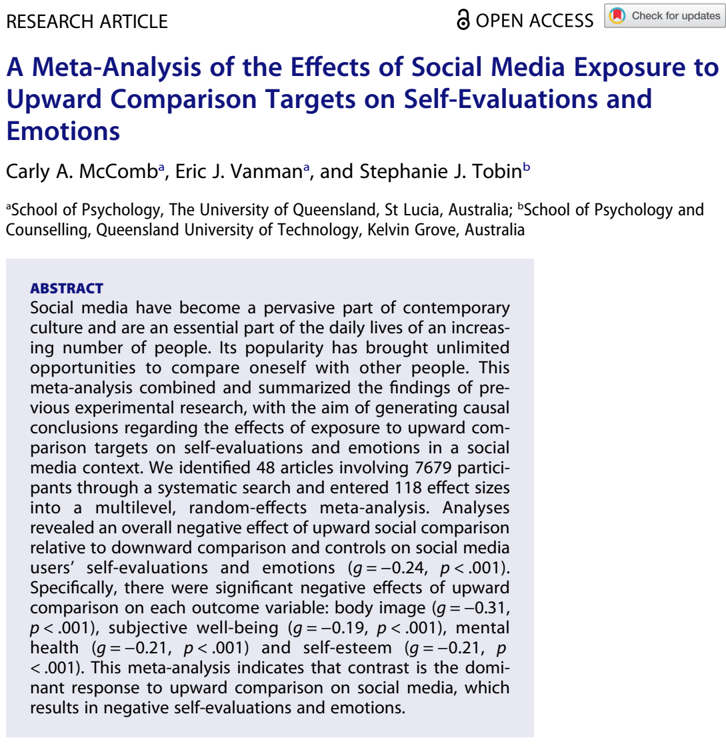
A Meta-Analysis of the Effects of Social Media Exposure to Upward Comparison Targets on Self-Evaluations and Emotions
Open accessAbstract
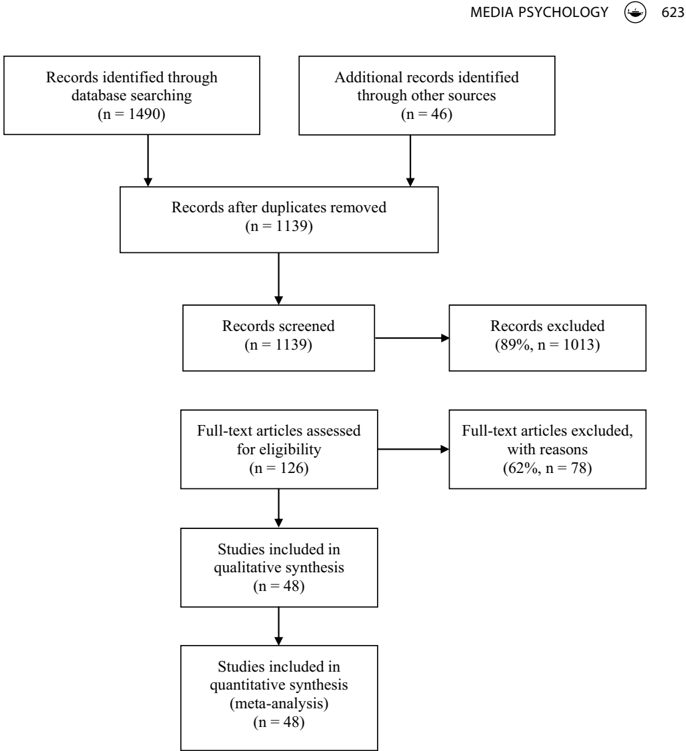
Social media have become a pervasive part of contemporary culture and are an essential part of the daily lives of an increasing number of people. Its popularity has brought unlimited opportunities to compare oneself with other people. This meta-analysis combined and summarized the findings of previous experimental research, with the aim of generating causal conclusions regarding the effects of exposure to upward comparison targets on self-evaluations and emotions in a social media context. We identified 48 articles involving 7679 participants through a systematic search and entered 118 effect sizes into a multilevel, random-effects meta-analysis. Analyses revealed an overall negative effect of upward social comparison relative to downward comparison and controls on social media users’ self-evaluations and emotions (g = −0.24, p < .001). Specifically, there were significant negative effects of upward comparison on each outcome variable: body image (g = −0.31, p < .001), subjective well-being (g = −0.19, p < .001), mental health (g = −0.21, p < .001) and self-esteem (g = −0.21, p < .001). This meta-analysis indicates that contrast is the dominant response to upward comparison on social media, which results in negative self-evaluations and emotions.
Overview
The claims and statistics of this paper haven’t been checked yet.
Run the check — free, no account needed. It reads the open-access text and checks the sources it cites.
Integrity signals
Registry
Cites
Statistics
Figures



Verification
Claims the paper makes
The claims and statistics of this paper haven’t been checked yet.
Run the check — free, no account needed. It reads the open-access text and checks the sources it cites.
Claims other papers make about this one
Each is checked against this paper’s own text: does it say what the citing paper says it does?
The cited source says what the claim attributes to it.
In the citing paper
“This finding is in line with previous evidence that social comparisons on social networking sites negatively influence self-esteem”
From The associations between social comparison on social media and young adults’ mental health (2025) · cites this paper as McComb et al., 2023
Self-check
Percentages, sums and reported differences re-computed from the paper’s own numbers.
The self-check needs the paper’s full text.
Citations
Cites
Bias in meta-analysis detected by a simple, graphical test
Egger, M., Smith, G. D., Schneider, M., & Minder, C. (1997) · BMJ · doi:10.1136/bmj.315.7109.629 · Cited by 56,722 · cited 1×
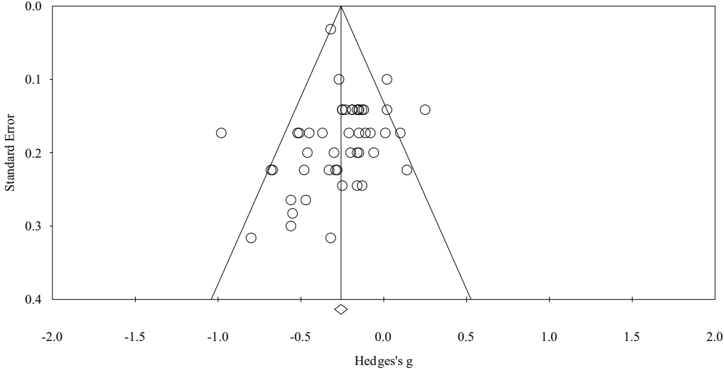
“Egger’s regression test is appropriate for small metaanalyses and assesses symmetry of the publication bias funnel plot (Egger et al., 1997).”
BackgroundA theory of social comparison processes
Festinger, L. (1954) · Human Relations · doi:10.1177/001872675400700202 · Cited by 20,926
Operating characteristics of a rank correlation test for publication bias
Begg, C. B., & Mazumdar, M. (1994) · Biometrics · doi:10.2307/2533446 · Cited by 16,955
Borenstein, M., Hedges, L. V., Higgins, J. P. T., & Rothstein, H. R. (2009) · doi:10.1002/9780470743386 · Cited by 14,225
Duval, S., & Tweedie, R. (2000) · Biometrics · doi:10.1111/j.0006-341x.2000.00455.x · Cited by 14,099
Erikson, E. H. (2026) · Zenodo (CERN European Organization for Nuclear Research) · doi:10.5281/zenodo.18614668 · Cited by 13,081
Subjective well-being: Three decades of progress.
Diener, E., Suh, E. M., Lucas, R. E., & Smith, H. L. (1999) · Psychological Bulletin · doi:10.1037/0033-2909.125.2.276 · Cited by 12,910
The Content Analysis Guidebook
Neuendorf, K. A. (2017) · doi:10.4135/9781071802878 · Cited by 9,286
Downs, S. H., & Black, N. (1998) · Journal of Epidemiology and Community Health · doi:10.1136/jech.52.6.377 · Cited by 8,252
Models of the self: self-construals and gender.
Cross, S., & Madson, L. (1997) · Psychological bulletin · doi:10.1037/0033-2909.122.1.5 · Cited by 2,851
Cited by
Sorted by citations
Bonfanti, R. C., Melchiori, F., Teti, A., Albano, G., Raffard, S., Rodgers, R., & Lo Coco, G. (2025) · Body Image · doi:10.1016/j.bodyim.2024.101841 · Cited by 154
Depressive symptoms and upward social comparisons during Instagram use: A vicious circle
Aubry, R., Quiamzade, A., & Meier, L. L. (2023) · Personality and Individual Differences · doi:10.1016/j.paid.2023.112458 · Cited by 62
Steinsbekk, S., Bjørklund, O., Valkenburg, P. M., Nesi, J. L., & Wichstrøm, L. (2024) · Computers in Human Behavior · doi:10.1016/j.chb.2024.108235 · Cited by 75
Madigan, S., Vaillancourt, T., Dimitropoulos, G., Premji, S., Kahlert, S. M., Zumwalt, K., Korczak, D. J., von Ranson, K. M., Pador, P., Ganshorn, H., et al. (2025) · Journal of the American Academy of Child & Adolescent Psychiatry · doi:10.1016/j.jaac.2024.02.009 · Cited by 48
Yan, N., Long, Y., Yuan, H., Zhou, X.-F., Xie, B., & Wang, Y. (2024) · Psychology Research and Behavior Management · doi:10.2147/prbm.s447372 · Cited by 22
Metadata
- Authors
- McComb, C. A., Vanman, E. J., & Tobin, S. J.
- Affiliations
- The University of Queensland (AU)
- Queensland University of Technology (AU)
- Corresponding author
- McComb, Carly A.
- Venue
- Media Psychology
- Publisher
- Informa UK Limited
- Published
- 2023-02-23
- Volume
- 26
- Issue
- 5
- Pages
- 612-635
- ISSN
- 1521-3269 (ISSN-L)
- 1532-785X
- OpenAlex
- W4321788928
- Cited by
- 167
- References
- 66
- Citations by year
- 2026: 83 · 2025: 58 · 2024: 21 · 2023: 5
- FWCI
- 8.49
- Type
- journal article
- Language
- en
- Open access
- hybrid
- doi.org
- Licence
- Locations
- Media Psychology (publishedVersion, cc-by-nc-nd)
- QUT ePrints (Queensland University of Technology) (submittedVersion, cc-by-nc)
- OSF Preprints (OSF Preprints) (submittedVersion)
- Funders
- specific grant from funding agencies
- Topics
- Social Sciences › Sociology and Political Science › Impact of Technology on Adolescents
- Social Sciences › Psychology › Clinical Psychology › Body Image and Dysmorphia Studies
- Social Sciences › Communication › Media and Digital Communication
- Keywords
- upward social comparison, social media exposure, self-assessment, emotions, body image, subjective well-being, mental health, self-esteem, downward social comparison, contrast effects
About these checks
Registry, retraction, Cites and statistics results are computed, not judged, with one exception: a printed reference that no index lists is read once by a model before it counts as a citation error. Claims are extracted by a model and kept only when their quote appears verbatim in the text; each cited source is then checked, with a model’s help, for whether it says what the claim relies on. Those verdicts can be wrong — read the claim’s quote and the cited source before relying on one.
Statistics and arithmetic are recomputed, not judged.
Confidence bands are shown only for fields calibrated on our annotated test set. None is calibrated yet, so no band is shown.
What counts as a claim ›How we measure confidence ›How we check this ›
Are you an author, or do you see a problem with this page? Request a review
