

The DOI matches its Crossref record; 66 of the 68 references it cites were found in a registry or an index.
A Meta-Analysis of the Effects of Social Media Exposure to Upward Comparison Targets on Self-Evaluations and Emotions
Open accessAbstract
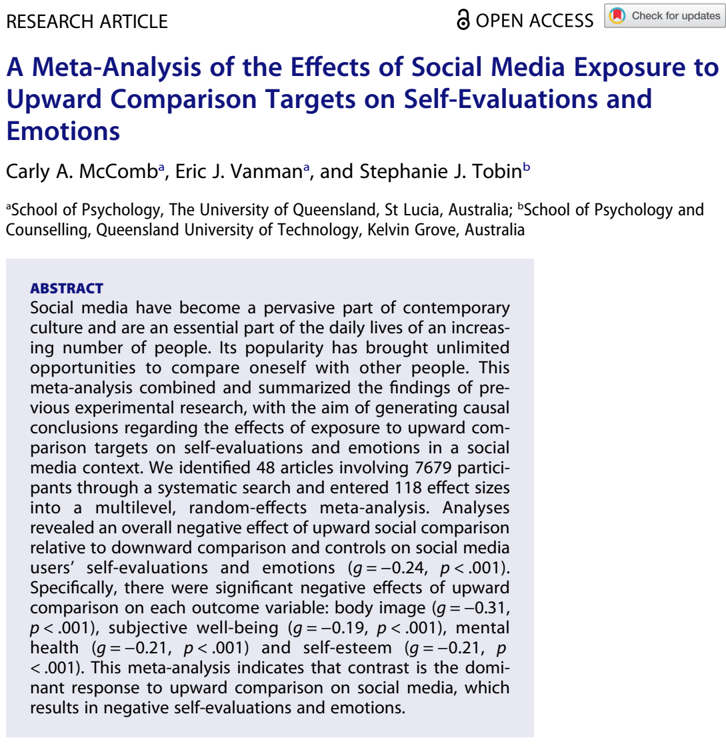
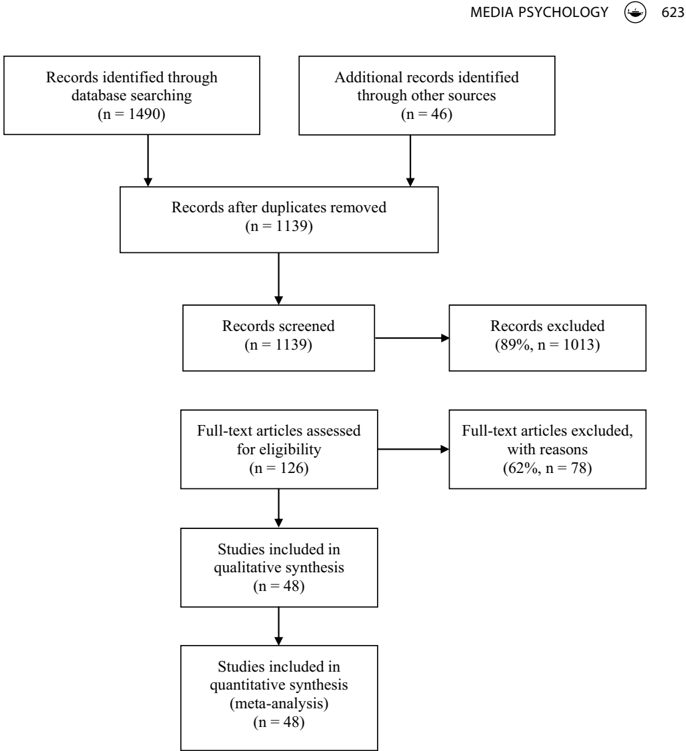
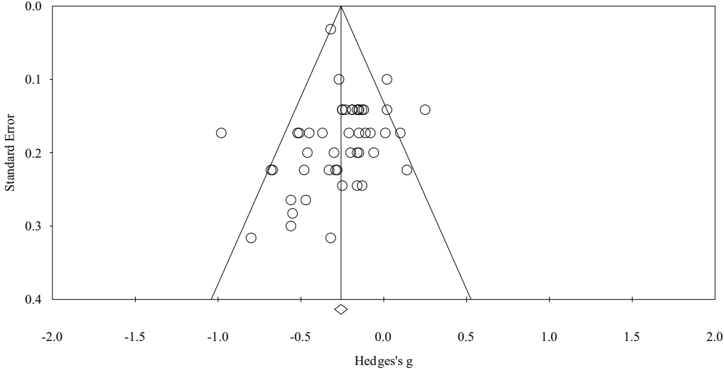
Social media have become a pervasive part of contemporary culture and are an essential part of the daily lives of an increasing number of people. Its popularity has brought unlimited opportunities to compare oneself with other people. This meta-analysis combined and summarized the findings of previous experimental research, with the aim of generating causal conclusions regarding the effects of exposure to upward comparison targets on self-evaluations and emotions in a social media context. We identified 48 articles involving 7679 participants through a systematic search and entered 118 effect sizes into a multilevel, random-effects meta-analysis. Analyses revealed an overall negative effect of upward social comparison relative to downward comparison and controls on social media users’ self-evaluations and emotions (g = −0.24, p < .001). Specifically, there were significant negative effects of upward comparison on each outcome variable: body image (g = −0.31, p < .001), subjective well-being (g = −0.19, p < .001), mental health (g = −0.21, p < .001) and self-esteem (g = −0.21, p < .001). This meta-analysis indicates that contrast is the dominant response to upward comparison on social media, which results in negative self-evaluations and emotions.
Overview
The claims and statistics of this paper haven’t been checked yet.
Run the check — free, no account needed. It reads the open-access text and checks the sources it cites.
Integrity signals
Registry
Cites
Statistics
Figures



Verification
Claims the paper makes
The claims and statistics of this paper haven’t been checked yet.
Run the check — free, no account needed. It reads the open-access text and checks the sources it cites.
Claims other papers make about this one
Each is checked against this paper’s own text: does it say what the citing paper says it does?
The cited source says what the claim attributes to it.
In the citing paper
“This finding is in line with previous evidence that social comparisons on social networking sites negatively influence self-esteem”
From The associations between social comparison on social media and young adults’ mental health (2025) · cites this paper as McComb et al., 2023
Self-check
Percentages, sums and reported differences re-computed from the paper’s own numbers.
The self-check needs the paper’s full text.
Citations
Cites
Bias in meta-analysis detected by a simple, graphical test
Egger, M., Smith, G. D., Schneider, M., & Minder, C. (1997) · BMJ · doi:10.1136/bmj.315.7109.629 · Cited by 56,722 · cited 1×
“Egger’s regression test is appropriate for small metaanalyses and assesses symmetry of the publication bias funnel plot (Egger et al., 1997).”
BackgroundA theory of social comparison processes
Festinger, L. (1954) · Human Relations · doi:10.1177/001872675400700202 · Cited by 20,926
Operating characteristics of a rank correlation test for publication bias
Begg, C. B., & Mazumdar, M. (1994) · Biometrics · doi:10.2307/2533446 · Cited by 16,955
Borenstein, M., Hedges, L. V., Higgins, J. P. T., & Rothstein, H. R. (2009) · doi:10.1002/9780470743386 · Cited by 14,225
Duval, S., & Tweedie, R. (2000) · Biometrics · doi:10.1111/j.0006-341x.2000.00455.x · Cited by 14,099
Erikson, E. H. (2026) · Zenodo (CERN European Organization for Nuclear Research) · doi:10.5281/zenodo.18614668 · Cited by 13,081
Subjective well-being: Three decades of progress.
Diener, E., Suh, E. M., Lucas, R. E., & Smith, H. L. (1999) · Psychological Bulletin · doi:10.1037/0033-2909.125.2.276 · Cited by 12,910
The Content Analysis Guidebook
Neuendorf, K. A. (2017) · doi:10.4135/9781071802878 · Cited by 9,286
Downs, S. H., & Black, N. (1998) · Journal of Epidemiology and Community Health · doi:10.1136/jech.52.6.377 · Cited by 8,252
Models of the self: self-construals and gender.
Cross, S., & Madson, L. (1997) · Psychological bulletin · doi:10.1037/0033-2909.122.1.5 · Cited by 2,851
Cited by
Sorted by citations
Bonfanti, R. C., Melchiori, F., Teti, A., Albano, G., Raffard, S., Rodgers, R., & Lo Coco, G. (2025) · Body Image · doi:10.1016/j.bodyim.2024.101841 · Cited by 154
Depressive symptoms and upward social comparisons during Instagram use: A vicious circle
Aubry, R., Quiamzade, A., & Meier, L. L. (2023) · Personality and Individual Differences · doi:10.1016/j.paid.2023.112458 · Cited by 62
Steinsbekk, S., Bjørklund, O., Valkenburg, P. M., Nesi, J. L., & Wichstrøm, L. (2024) · Computers in Human Behavior · doi:10.1016/j.chb.2024.108235 · Cited by 75
Madigan, S., Vaillancourt, T., Dimitropoulos, G., Premji, S., Kahlert, S. M., Zumwalt, K., Korczak, D. J., von Ranson, K. M., Pador, P., Ganshorn, H., et al. (2025) · Journal of the American Academy of Child & Adolescent Psychiatry · doi:10.1016/j.jaac.2024.02.009 · Cited by 48
Yan, N., Long, Y., Yuan, H., Zhou, X.-F., Xie, B., & Wang, Y. (2024) · Psychology Research and Behavior Management · doi:10.2147/prbm.s447372 · Cited by 22
Digital Detox Strategies and Mental Health: A Comprehensive Scoping Review of Why, Where, and How
Setia, S., Gilbert, F., Tichy, M. L., Redpath, J., Shahzad, N., & Marraccini, M. E. (2025) · Cureus · doi:10.7759/cureus.78250 · Cited by 34
Qi, X., Jiang, Y., & Lian, R. (2024) · BMC Psychology · doi:10.1186/s40359-024-01621-z · Cited by 26
“A meta-analysis further confirmed these significant negative effects [29].”
BackgroundAdolescents’ Social Comparison on Social Media: Links with Momentary Self-Evaluations
Burnell, K., Trekels, J., Prinstein, M. J., & Telzer, E. H. (2024) · Affective Science · doi:10.1007/s42761-024-00240-6 · Cited by 42
“Nonetheless, in line with past research (McComb et al., 2023), adolescents who engaged in a greater proportion of upward comparisons (relative to both downward and lateral comparisons) compared to their peers also reported lower self-esteem, appearance satisfaction, and social connected-ness.”
The associations between social comparison on social media and young adults’ mental health
Le Blanc-Brillon, J., Fortin, J.-S., Lafrance, L., & Hétu, S. (2025) · Frontiers in Psychology · doi:10.3389/fpsyg.2025.1597241 · Cited by 16
Ahmed, O., Dawel, A., Walsh, E., & Cherbuin, N. (2025) · Addictive Behaviors · doi:10.1016/j.addbeh.2025.108446 · Cited by 25
Behera, N., Khuntia, S., Pandey, K., & Shankar, S. (2025) · International Journal of Behavioral Medicine · doi:10.1007/s12529-025-10411-9 · Cited by 19
Rethinking social media and mental health: The role of emotion regulation difficulties
Brown, D. J., Scott, R. A., Ireland, R. E. E., Harness, J., Phipps, D. J., & Keech, J. J. (2025) · Computers in Human Behavior · doi:10.1016/j.chb.2025.108825 · Cited by 16
Maltby, J., Rayes, T., Nage, A., Sharif, S., Omar, M., & Nichani, S. (2024) · PLoS ONE · doi:10.1371/journal.pone.0307164 · Cited by 31
“This convergence indicates a universal effect of social media in moulding young people’s self-conception across all ages [66–70].”
BackgroundCao, H., Zhou, N., Wang, Y., & Liu, Y. (2025) · Child Development · doi:10.1111/cdev.70000 · Cited by 14
The Power of Social Media: Stigmatizing Content Affects Perceptions of Mental Health Care
Competiello, S. K., Bizer, G. Y., & Walker, D. C. (2023) · Social Media + Society · doi:10.1177/20563051231207847 · Cited by 22
“For example, McComb et al. (2023) found evidence that social media use is associated with heightened upward social comparison, which in turn predicts worse self-perceptions of body image, subjective well-being, self-esteem, and overall mental health.”
BackgroundLópez‐Gil, J. F., Solmi, M., García‐Hermoso, A., Vancampfort, D., Fabiano, N., Schuch, F. B., Stubss, B., Smith, L., Torous, J. B., & Firth, J. (2025) · European Child & Adolescent Psychiatry · doi:10.1007/s00787-025-02663-3 · Cited by 11
“Furthermore, prolonged exposure to social media can lead to negative social comparisons, where adolescents compare themselves unfavorably to others, and this can affect body image, subjective well-being, mental health, and self-esteem [53].”
Niu, X., Gou, L.-X., Han, Y., Zhou, X., & Wang, J. (2024) · British Journal of Developmental Psychology · doi:10.1111/bjdp.12538 · Cited by 10
Borgdorf, K. S. A., Küchler, G., Wrzus, C., & Aguilar‐Raab, C. (2024) · Mindfulness · doi:10.1007/s12671-024-02472-w · Cited by 9
“…(Morina, 2021): Two recent meta-analyses indicate that most social comparisons are upward, result in less favorable self-evaluations, and are therefore accompanied by negative consequences such as negative emotions or a deflated sense of self-worth (Ger-ber et al., 2018; McComb et al., 2023).”
Yu, T., & Gen, Z. (2025) · BMC Psychology · doi:10.1186/s40359-025-02601-7 · Cited by 10
“Research has also shown a significant correlation between social media exposure and upward social media appearance comparison [38].”
Chen, Y.-H. (2025) · Frontiers in Psychology · doi:10.3389/fpsyg.2025.1625771 · Cited by 29
Self-concept clarity and appearance comparisons in everyday life
Vartanian, L. R., Pinkus, R. T., & Fardouly, J. (2024) · Body Image · doi:10.1016/j.bodyim.2024.101820 · Cited by 13
Wen, R., & Jin, Q. (2025) · Behavioral Sciences · doi:10.3390/bs15111515 · Cited by 8
“According to the social comparison theory, a significant contrast effect of upward social comparison will lead to a decrease in individual self-evaluation and an increase in negative emotions (McComb et al., 2023).”
Social Media Self-Effects on Adolescents’ Self-Esteem: A 100-Day Diary StudyPreprint
de Vaate, N. A. J. D. B., Valkenburg, P. M., Janssen, L. H. C., van der Wal, A., Keijsers, L., & Beyens, I. (2023) · doi:10.31234/osf.io/qre85 · Cited by 11
Vartanian, L. R., & Nicholls, K. (2024) · Self and Identity · doi:10.1080/15298868.2024.2416657 · Cited by 8
“…showing that engaging in such appearance comparisons, and in particular comparisons to individuals who are more attractive than oneself (such as fashion models and celebrities), is associated with more negative body image (e.g., Fardouly et al., 2017; McComb et al., 2023; Myers & Crowther, 2009).”
Yuan, M., Sun, Y., Wang, Y., & Yu, L. (2025) · Development and Psychopathology · doi:10.1017/s0954579424001913 · Cited by 10
The Anti-social Network: The Role of the Social Media Manosphere in Young Men’s Lives
Wilson, M. J., Fisher, K., & Seidler, Z. E. (2024) · Springer eBooks · doi:10.1007/978-3-031-64053-7_6 · Cited by 7
An experimental study on the impact of social media images on users’ online social anxiety in China
Jia, Z. (2025) · Discover Psychology · doi:10.1007/s44202-025-00337-4 · Cited by 6
US State Policies Regarding Social Media: Do Policies Match the Evidence?
Thimm-Kaiser, M., & Keyes, K. M. (2025) · Milbank Quarterly · doi:10.1111/1468-0009.70021 · Cited by 7
Yusainy, C., Fitria, I., Sarirah, T., Barlaman, M. H. A., Timothy, J. A., Effendi, M. G., Setiawati, Y., Silvana, N., Wicaksono, W., & Santosoputro, A. (2024) · The Journal of General Psychology · doi:10.1080/00221309.2024.2404399 · Cited by 10
“A recent meta-analysis specifically on experimental studies concludes that viewing upward comparison targets on social media has a significant impact on the viewers’ emotional states and self-evaluations (McComb et al., 2023).”
Weber, S., Sadler, M., & Mengelkamp, C. (2025) · Social Sciences · doi:10.3390/socsci14080450 · Cited by 6
Xiong, S., Yi, X., Xiong, G., & Zhang, B. (2025) · Journal of Youth and Adolescence · doi:10.1007/s10964-025-02232-6 · Cited by 5
“This form of presentation fosters an overly optimistic informational environment, making viewers of social media more prone to upward social comparison (McComb et al., 2023).”
Patel, T. A., Perez, A., & Cougle, J. R. (2025) · Cyberpsychology Behavior and Social Networking · doi:10.1177/21522715251371095 · Cited by 4
“43 This study is one of the fi rst to closely examine overvalua-tion of appearance ’ s connection with SM, and with the use of a lab-based task measure as well as a self-report survey.”
Feng, W., Zhang, M., Bu, Y., & Wang, C. (2025) · Scientific Reports · doi:10.1038/s41598-025-25327-3 · Cited by 9
“Social network addiction often exposes users to idealized and selectively curated social content, thereby intensifying upward comparisons and heightening comparison orientation 50 .”
Goldfield, G. S., Lopes, M. V., Mahboob, W., Perry, S., & Davis, C. G. (2026) · Journal of Affective Disorders · doi:10.1016/j.jad.2026.121331 · Cited by 4
Social Comparison, Social Media, and Consumer Well-Being
Cruz, R. E., Serin, N., Chan, S. S., & van Solt, M. (2024) · International series on consumer science · doi:10.1007/978-3-031-59144-0_13 · Cited by 4
Measuring dynamic emotional experiences in response to media stimuli
Winkler, J. R., & Appel, M. (2024) · Frontiers in Psychology · doi:10.3389/fpsyg.2024.1436918 · Cited by 13
Küchler, G., Borgdorf, K. S. A., Aguilar‐Raab, C., & Wrzus, C. (2025) · Journal of Personality · doi:10.1111/jopy.13016 · Cited by 7
“In general, upward comparisons are more frequent than down-ward comparisons on dimensions such as body image, attractiveness, and well-being (Gerber et al. 2018; McComb et al. 2023; Midgley et al. 2021).”
Berkout, O. V., & Flynn, M. K. (2024) · Journal of Technology in Behavioral Science · doi:10.1007/s41347-024-00411-z · Cited by 5
“Upward social comparison on social media has been associated with lower subjective well-being, poorer mental health, and greater psychological distress (McComb et al., 2023; Verduyn et al., 2020; Wang et al., 2020).”
Interpersonal Goal Contagion Through Social Media Posts
Tobin, S. J., Crocker, J., & Jiang, T. (2025) · Cyberpsychology Behavior and Social Networking · doi:10.1089/cyber.2024.0480 · Cited by 4
“28,29 However, certain types of self-promoting posts could be viewed positively 30 and lead to professional bene-fi ts, 31 and under certain conditions, exposure to self-promoting content can increase positive affect and motivation (e.g., when an admired, higher-ranked person shares their relevant…”
Self-citationKnight, R., & Preston, C. (2025) · Journal of Social Media Research · doi:10.29329/jsomer.33 · Cited by 4
“Social comparison theory, which indicates that we compare ourselves to others as a form of self-exploration, suggests that media and social media may be especially ripe for comparisons, since we perceive other users as peers (McComb et al., 2023).”
Aubry, R., Quiamzade, A., & Meier, L. L. (2025) · Cyberpsychology Behavior and Social Networking · doi:10.1089/cyber.2024.0565 · Cited by 4
“Moreover, although social comparisons on social media predominantly lead to contrastive rather than assimilative effects, thereby inducing threats to the self, 20 they can also induce assimilation processes promoting well-being.”
Yu, M., & Cingel, D. P. (2025) · Behavioral Sciences · doi:10.3390/bs15060743 · Cited by 5
“Second, results of recent meta-analysis research suggest that age is not related with the tendency of engaging in either ability-based assimilative or ability-based contrastive upward state social comparison on social media (McComb et al., 2023).”
InfluentialZhu, L., Omar, B., & Qi, F. (2025) · Computers in Human Behavior Reports · doi:10.1016/j.chbr.2025.100832 · Cited by 3
Wang, J., Xun, J.-J., & Zhao, F.-F. (2026) · Frontiers in Public Health · doi:10.3389/fpubh.2025.1724546 · Cited by 3
Ang, C.-S. (2026) · Behaviour and Information Technology · doi:10.1080/0144929x.2026.2654493 · Cited by 5
Lei, Y., Hu, S., Sun, Y., & Zheng, L. (2026) · Frontiers in Psychology · doi:10.3389/fpsyg.2026.1825169 · Cited by 3
Firth, J., Linardon, J., Sawyer, C. S., French, C., Stubbs, B., Firth, J. A., Solmi, M., Torous, J. B., Berhe, K., Hallal, P. C., et al. (2026) · Journal of Physical Activity and Health · doi:10.1123/jpah.2026-0550 · Cited by 3
Body image in the workplace: Assessing the impact on self-esteem and employee engagement
Kertechian, K. S., & El-Farr, H. (2025) · Acta Psychologica · doi:10.1016/j.actpsy.2025.105355 · Cited by 5
Neural representations of self-beliefs and the self-concept
Zahn, R., Fischer, R. D., de Oliveira‐Souza, R., & Moll, J. (2024) · Elsevier eBooks · doi:10.1016/b978-0-12-820480-1.00146-7 · Cited by 3
Lassota, I., Oleksy, T., Wnuk, A., & Gambin, M. (2025) · Current Psychology · doi:10.1007/s12144-025-07893-x · Cited by 2
“…con - nection and engagement, they are also related to different psychological risks, such as intensified social comparisons (Andrade et al., 2023 ; McComb et al., 2023) and cognitive overload (Li et al., 2024 ; Schmitt et al., 2021), and disen-gagement from real-world responsibilities (Bouffard…”
Kim, Y., Kim, J., Kenyon, J. D., Geller, J., & Lee, J. (2025) · The Journals of Gerontology Series B · doi:10.1093/geronb/gbaf177 · Cited by 2
Lu, Z., Liu, Z., & Lin, D. (2025) · Journal of Behavioral Addictions · doi:10.1556/2006.2025.00091 · Cited by 2
“…a dual role: it provides compensatory outlet for seeking alternative reference groups or aspirational identities, yet simultaneously exacerbates feelings of disadvantage through exposure to curated, idealized representations that foster upward social comparisons (McComb, Vanman, & Tobin, 2023).”
Aljadani, A., Alnomsi, A. S., Alswaida, M. I., & Abouzed, M. A. (2025) · Cogent Psychology · doi:10.1080/23311908.2025.2596287 · Cited by 3
“…are required to establish temporal relationships. in addition, platform heterogeneity is often overlooked. instagram’s curated content may fuel social comparison and anxiety, whereas Whatsapp’s utilitarian messaging may incur lower cognitive costs (aharony & Zion, 2019; Mccomb & Mills, 2023).”
Momentary fluctuations in body image dissatisfaction among women: The role of self-concept clarity
Tang, M. C. Y., Vartanian, L. R., & Pinkus, R. T. (2026) · Self and Identity · doi:10.1080/15298868.2026.2619136 · Cited by 2
“…that comparison targets who embody societally-valued attractiveness ideals are particularly salient, as they serve as aspirational reference points for evaluating one’s own appearance and a benchmark that one might strive to achieve (McComb et al., 2023; Mills et al., 2002; Vartanian et al., 2025).”
Not all clicks are equal: digital dose, content, and user disposition in mental health
Gupta, L., Bharti, D., & Singhal, S. (2026) · Academia Mental Health and Well-Being · doi:10.20935/mhealthwellb8208 · Cited by 2
The relationship between social media use and social isolation in young adults: a systematic review
Liu, Y., Pradhan, S., & Wang, X. D. (2026) · Information Communication & Society · doi:10.1080/1369118x.2026.2674934 · Cited by 2
de Vaate, A. B. D., Veldhuis, J., & Konijn, E. (2024) · Telematics and informatics · doi:10.1016/j.tele.2024.102160 · Cited by 5
Kim, H. H. (2025) · Social Indicators Research · doi:10.1007/s11205-025-03537-6 · Cited by 2
“Closely related to this argument is the idea that unfavorable (i.e., upward) social comparison can reduce health outcomes by worsening relative deprivation because of those perceived to be better off (Aubry et al., 2024; Kim & Kim, 2023; McComb et al., 2023).”
Role of social media dependency and online reputation in instituting stress among social media users
Karunarathne, E. A. C. P., Wijesundara, W. M. T. H., Athukorala, A. D. M. P., & Chithrananda, K. P. S. P. (2025) · Asian Education and Development Studies · doi:10.1108/aeds-09-2024-0200 · Cited by 4
Idols Within Reach: Measuring Perceptions of Media Role Models’ Attainability
Harff, D., Dekoninck, H., & Schmuck, D. (2025) · Journalism & Mass Communication Quarterly · doi:10.1177/10776990251336388 · Cited by 2
Vanhoffelen, G., Gonzalez, A. J., Schreurs, L., Giraudeau, C., & Vandenbosch, L. (2025) · Communication Research · doi:10.1177/00936502251337650 · Cited by 2
Putri, A. P., Purnama, N., Andini, P. F., & Riany, Y. E. (2024) · Jurnal Ilmu Sosial dan Humaniora · doi:10.23887/jish.v13i1.71218 · Cited by 1
“McComb, et al (2023) discussed a meta-analysis of the social comparison impact of social media exposure, including Facebook, Instagram, and WeChat causing negative effects on users' emotions and self-evaluation.”
BackgroundWang, Y., Liu, Y., Wang, H., & Li, R. (2025) · Current Psychology · doi:10.1007/s12144-025-07288-y · Cited by 3
“Individuals engaging in upward social comparison, comparing themselves to others they perceive as superior, often experience a range of negative emotions, such as anger, fear, anxiety, and jeal-ousy (Lewis, 2021; McCarthy & Morina, 2020; McComb et al., 2023; Villanueva-Moya et al., 2023).”
Rodríguez‐de‐Dios, I. (2025) · Lecture notes in educational technology · doi:10.1007/978-981-96-5658-5_79 · Cited by 1
Beyond virtual proximity: loneliness in the world of social media
Fakhri, N., Rahmadiani, V., Irdianti, & Buchori, S. (2025) · Qualitative Research Reports in Communication · doi:10.1080/17459435.2025.2539115 · Cited by 1
“Social comparison theory suggests that frequent exposure to carefully curated online presentations of others’ lives may contribute to feelings of inadequacy and social disconnection (Han, 2022; McComb et al., 2023).”
The Mediating Role of Social Media Usage in Mental Well-Being: A Gender Perspective
Uygurtaş, M., & Akdemir, N. (2025) · OPUS Toplum Araştırmaları Dergisi · doi:10.26466/opusjsr.1686931 · Cited by 3
Boeckxstaens, I., Schokkenbroek, J. M., Noë, M., & Schreurs, L. (2025) · Social Science Computer Review · doi:10.1177/08944393251366234 · Cited by 1
“The positively-biased and idealized self-presentations that are characteristic of social media often trigger upward contrastive social comparison processes (McComb et al., 2023), which can negatively impact well-being (Verduyn et al., 2020).”
Husain, W., Husain, M. A., Ijaz, F., Farrukh, J., Batool, F., Tahir, N., Trabelsi, K., Ammar, A., & Jahrami, H. A. (2025) · BMC Psychology · doi:10.1186/s40359-025-03208-8 · Cited by 1
“Research further indicates that upward social comparisons in the romantic domain, such as observing peers in seemingly happy relationships, can exacerbate feelings of exclusion and lower self-esteem, reinforcing romantic loneliness [44].”
From intervention to prevention! Effects of peer progress information on user engagement
Yin, Q., Guo, C., & Yan, Z. (2025) · Internet Research · doi:10.1108/intr-05-2024-0817 · Cited by 1
Rethinking Social Comparison Through Self-Cultivation: An East Asian Perspective
Chou, S. C.-M. (2025) · Journal of Humanistic Psychology · doi:10.1177/00221678251367792 · Cited by 1
Photo editing on Instagram: Effects on body image, coping and well-being in young Spanish women
Rodríguez, D. A., & Abella, M. C. (2025) · Universitas Psychologica · doi:10.11144/javeriana.upsy24.peie · Cited by 1
“Second, the study's cross-sectional design precludes causal inferences (McComb et al., 2023).”
Li, Q., & Chen, J. (2025) · Basic and Applied Social Psychology · doi:10.1080/01973533.2025.2598246 · Cited by 1
“…(Butera & Darnon, 2017), high-competence actors as upward comparison targets can inherently represent a threat to observers’ self-worth (Collins, 1996; McComb et al., 2023), yet witnessing their unethical acts appears to create opportunities for moral contrast via downward comparison, often…”
Tadpatrikar, A., Sharma, M. K., & Murthy, P. (2025) · Indian Journal of Psychiatry · doi:10.4103/indianjpsychiatry_409_25 · Cited by 1
Tall orders online: social media engagement is associated with height dissatisfaction
Hansson, A. M., Condello, S., Khamisi, A., & Talbot, D. (2026) · The Journal of Social Psychology · doi:10.1080/00224545.2025.2608305 · Cited by 2
“This environment fosters internalization of unrealistic body ideals (Jarman et al., 2021) and frequent upward social comparisons (McComb et al., 2023), both of which have been linked to increased body dissatisfaction and associated mental health concerns (Fardouly & Vartanian, 2016; Vandenbosch et…”
Mapping the knowledge landscape of body image research: A bibliometric and visualized study
Ren, Y., Tian, X., Li, Z., Li, X., Zhao, B., Wang, Z., & Peng, C. (2026) · Body Image · doi:10.1016/j.bodyim.2026.102039 · Cited by 1
Díaz-Moreno, A., Bonilla, I., & Lusar, A. C. (2026) · Psychology Society & Education · doi:10.21071/pse.v18i1.18478 · Cited by 1
“This, in turn, may lead to decreased mental health, self-esteem, and subjective well-being (McComb et al., 2023).”
Lao, C. H., Skandalakis, A., & Marshall, T. C. (2026) · Media Psychology · doi:10.1080/15213269.2026.2626701 · Cited by 2
Digital age triggers: the role of social media evaluation in music performance anxiety
Ma, X., Lu, L., Luo, C., & Gao, Q. (2026) · Frontiers in Psychology · doi:10.3389/fpsyg.2026.1742379 · Cited by 1
“In particular, McComb et al. (2023) demonstrated, through a meta-analytic review, that exposure to social media comparison systematically undermines self-evalua-tions and emotional well-being.”
Einstein, D. A., Marsh, S., Moshel, M. L., Sinani, T., & Burrell, T. (2026) · International Journal of Environmental Research and Public Health · doi:10.3390/ijerph23030364 · Cited by 3
Wang, H., Xiang, J., & Xie, T. (2026) · Frontiers in Psychology · doi:10.3389/fpsyg.2026.1689646 · Cited by 1
“Recent research suggests that social media environments create new forms of social comparison pressure that influence individuals’ psychological experiences (Arigo et al., 2024; McComb et al., 2023).”
InfluentialArandi, N. Z., & Qtait, F. (2026) · BDJ Open · doi:10.1038/s41405-026-00445-w · Cited by 1
“This may re fl ect greater awareness of case selection, periodontal and restorative limitations, material behaviour, and patient-speci fi c constraints [29 – 32].”
Zhou, A., Dai, Y.-L., Liu, Y., & Liu, J. (2026) · International Journal of Advertising · doi:10.1080/02650487.2026.2670869 · Cited by 1
Chen, C., & Xie, J. (2026) · Current Psychology · doi:10.1007/s12144-026-09706-1 · Cited by 1
“According to Social Comparison Theory, these online social comparison experiences may lead to increasing negative affect and diminishing self-worth (McComb et al., 2023).”
Celik, S., Gracia, P., Gonzalez-Vila, P., & Tarantino, G. (2026) · Adolescent Research Review · doi:10.1007/s40894-026-00287-5 · Cited by 2
“…prevalent in adolescents’ lives (Scott et al., 2024; Verduyn et al., 2022 ), offering a wide range of online activities (e.g., socializing, gaming, sharing out, and exposure to harmful content (Burnell et al., 2019; Fioravanti et al., 2021; Livingstone et al., 2017 ; McComb et al., 2023).”
Your pain, my gain: Schadenfreude as a driving mechanism of online “liking” behavior
Lunt, D. C., Lunt, L. D., Wood, A. D., & Highley, Z. C. (2026) · Acta Psychologica · doi:10.1016/j.actpsy.2026.107413 · Cited by 1
Tølbøll, K. B. (2026) · Clinical Child and Family Psychology Review · doi:10.1007/s10567-026-00577-3 · Cited by 1
“For these individuals, digital platforms like social media that promote self-surveillance, social comparisons and validation seeking can exacerbate anxiety and depression levels for at-risk youth, creating a negative spiral (Cataldo et al., 2022; McComb et al., 2023).”
A review of foreign research on the development of professional identity of students
Voronina, M. A. (2026) · Psychological Science and Education · doi:10.17759/pse.2026310417 · Cited by 1
How time orientation matters for happiness: The nonmonotonic relations featured with a middle valley
Lu, J., Zhang, S., & He, G. (2023) · Applied Psychology Health and Well-Being · doi:10.1111/aphw.12460 · Cited by 1
When I Hate to Follow You: Hate-Following, Envy, and Schadenfreude on Instagram
Yusainy, C., Adila, I., Kusumastuti, A., Hikmiah, Z., Faradisa, K. R., & Konstantinov, V. V. (2023) · Jurnal Psikologi · doi:10.22146/jpsi.84357 · Cited by 1
“As concluded in a recent meta-analysis, social media posts provide opportunities for viewers to make more frequent and more extreme upward comparisons (McComb et al., 2023).”
BackgroundCommunication and the self: past, present, and future
Appel, M., & Holmstrom, A. J. (2025) · Human Communication Research · doi:10.1093/hcr/hqaf013 · Cited by 1
Motshware, P., Francke, E., & Makwambeni, B. (2025) · Language, Technology, and Social Media. · doi:10.70211/ltsm.v3i2.226 · Cited by 1
Generative AI Use but not Social Media and Smartphone is Associated with Higher Well-beingPreprint
Lau, G. R., & Hartanto, A. (2025) · SSRN Electronic Journal · doi:10.2139/ssrn.5893625 · Cited by 2
Risk-Seeking Motives and Speculative InvestmentPreprint
Arkolakis, C., Kwon, S., Russel, D., Shi, C., & Yang, H. (2025) · SSRN Electronic Journal · doi:10.2139/ssrn.5761702 · Cited by 1
WeChat usage, social comparison, and self-esteem among Chinese college students
Zou, X., & Lopez, E. R. (2024) · International Journal of Research Studies in Education · doi:10.5861/ijrse.2024.24757
Fitspiration and Thinspiration on Twitter: A Content Analysis
Kwan, M. Y., Gioia, A. N., Braverman, R., & Drumheller, K. (2025) · European Eating Disorders Review · doi:10.1002/erv.3190
Wallhead, G., Furnham, A. F., & McClelland, A. (2025) · Frontiers in Communication · doi:10.3389/fcomm.2025.1529650 · Cited by 1
Imitation, Rivalry, and Escalation: Rethinking Adolescent Self-Harm Through Mimetic Theory
Sweetmore, A. (2025) · Culture Medicine and Psychiatry · doi:10.1007/s11013-025-09926-3
“Continuous exposure to idealised peers on social media may heighten feelings of inadequacy and exclusion (McComb et al. 2023), which, combined with mimetic rivalry, may drive some adolescents to self-harm as a way of managing emotional distress.”
Digital Communication in the Age of TikTok
Seceleanu, A., Garabet, B. I., & SUNDA, I. (2025) · IGI Global eBooks · doi:10.4018/979-8-3373-1702-1.ch005
Nitschinsk, L., Tobin, S. J., Gugushvili, N., McComb, C., & Verduyn, P. (2025) · Cyberpsychology Journal of Psychosocial Research on Cyberspace · doi:10.5817/cp2025-4-3
“…the content of others without engaging with them) can diminish well-being as it may lead to feeling that SNS use is a waste of time (Sagioglou & Greitemeyer, 2014), or damaging upward social comparisons (McComb et al., 2023), though this effect may critically depend on the content being monitored.”
Self-citationปจจยทมความสมพนธกบความวตกกงวลทางสงคมจากการใชเครอขายสงคมออนไลนของนกศกษาพยาบาล
ผ่องแผ้ว, ไ., คติชอบ, ณ., & สันประโคน, ป. (2025) · Thai Red Cross Nursing Journal · doi:10.64767/trcn.2025.272867
Metadata
- Authors
- McComb, C. A., Vanman, E. J., & Tobin, S. J.
- Affiliations
- The University of Queensland (AU)
- Queensland University of Technology (AU)
- Corresponding author
- McComb, Carly A.
- Venue
- Media Psychology
- Publisher
- Informa UK Limited
- Published
- 2023-02-23
- Volume
- 26
- Issue
- 5
- Pages
- 612-635
- ISSN
- 1521-3269 (ISSN-L)
- 1532-785X
- OpenAlex
- W4321788928
- Cited by
- 167
- References
- 66
- Citations by year
- 2026: 83 · 2025: 58 · 2024: 21 · 2023: 5
- FWCI
- 8.49
- Type
- journal article
- Language
- en
- Open access
- hybrid
- doi.org
- Licence
- Locations
- Media Psychology (publishedVersion, cc-by-nc-nd)
- QUT ePrints (Queensland University of Technology) (submittedVersion, cc-by-nc)
- OSF Preprints (OSF Preprints) (submittedVersion)
- Funders
- specific grant from funding agencies
- Topics
- Social Sciences › Sociology and Political Science › Impact of Technology on Adolescents
- Social Sciences › Psychology › Clinical Psychology › Body Image and Dysmorphia Studies
- Social Sciences › Communication › Media and Digital Communication
- Keywords
- upward social comparison, social media exposure, self-assessment, emotions, body image, subjective well-being, mental health, self-esteem, downward social comparison, contrast effects
About these checks
Registry, retraction, Cites and statistics results are computed, not judged, with one exception: a printed reference that no index lists is read once by a model before it counts as a citation error. Claims are extracted by a model and kept only when their quote appears verbatim in the text; each cited source is then checked, with a model’s help, for whether it says what the claim relies on. Those verdicts can be wrong — read the claim’s quote and the cited source before relying on one.
Statistics and arithmetic are recomputed, not judged.
Confidence bands are shown only for fields calibrated on our annotated test set. None is calibrated yet, so no band is shown.
What counts as a claim ›How we measure confidence ›How we check this ›
Are you an author, or do you see a problem with this page? Request a review
