

Characterizing bioeconomy policy instruments: A global comparative analysis of bioeconomy strategies
Open accessThe DOI matches its Crossref record; 57 of the 57 references it cites were found in a registry or an index; 1 of the 31 sources its claims cite were checked for support.
Abstract
Over the past two decades, the concept of the bioeconomy has gained significant traction in policy making and research. While the visions and goals of bioeconomy policy strategies are well-researched, the policy instruments used to promote them have received little attention. Addressing this research gap, this paper presents a comprehensive analysis of bioeconomy-related policy instruments as articulated in 78 governmental bioeconomy policy documents from 50 countries around the world. Qualitative content analysis was used to identify the stated policy instruments and to assess the prevalence, density, choice of instrument type, balance, and calibration of the instrument mix across policy documents as a whole, but also disaggregated by substantive policy focus, time, country income groups, and individual strategies. We find that bioeconomy policies are dominated by economic and nodal instruments focused on promoting innovation, research and development, while regulatory instruments, particularly those addressing environmental issues, are rare within the strategies themselves. Moreover, while bioeconomy strategies contain a significant number of statements about instruments, they rarely specify their calibration. These patterns suggest that while bioeconomy strategies play important agenda-setting and signaling roles, their limited balance and calibration may constrain their ability to provide actionable policy guidance.
Overview
CoChat Summary
TL;DR
This study analyzes policy instruments in 78 governmental bioeconomy policy documents from 50 countries, coding 2,978 instrument observations. It finds bioeconomy strategies emphasize economic and nodal instruments for innovation and R&D, with rare environmental regulation, limited instrument balance, and weak calibration.
Key findings
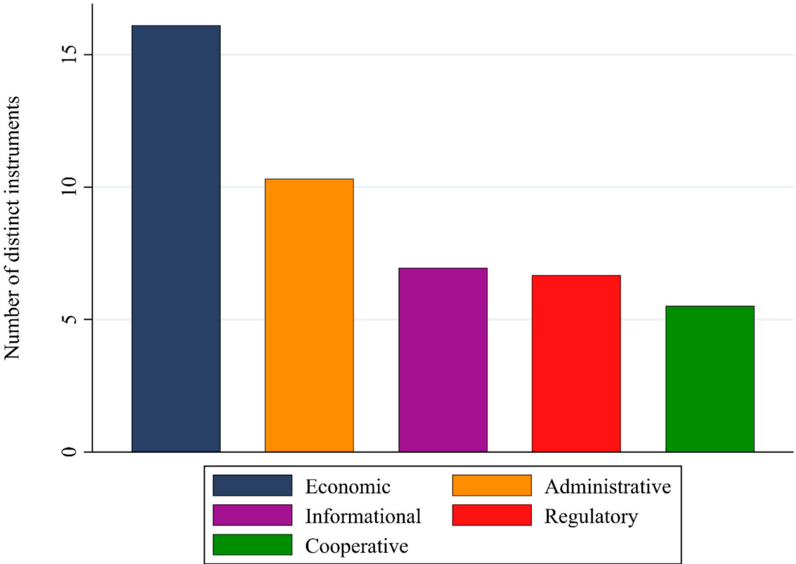
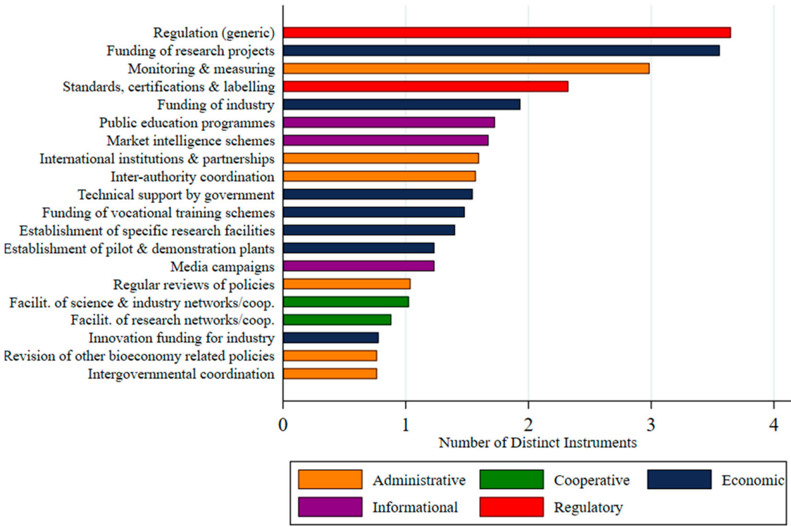
- Economic instruments dominate: the average document mentions 16 economic instruments, 10 administrative, about 7 informational, 6 regulatory, and 5 cooperative instruments; informational and cooperative instruments combined (Hood’s nodal type) average 12. Regulatory instruments, especially environmental regulation, are rare, and the most salient regulatory code is generic regulation aimed at improving the investment and operational environment rather than environmental protection.
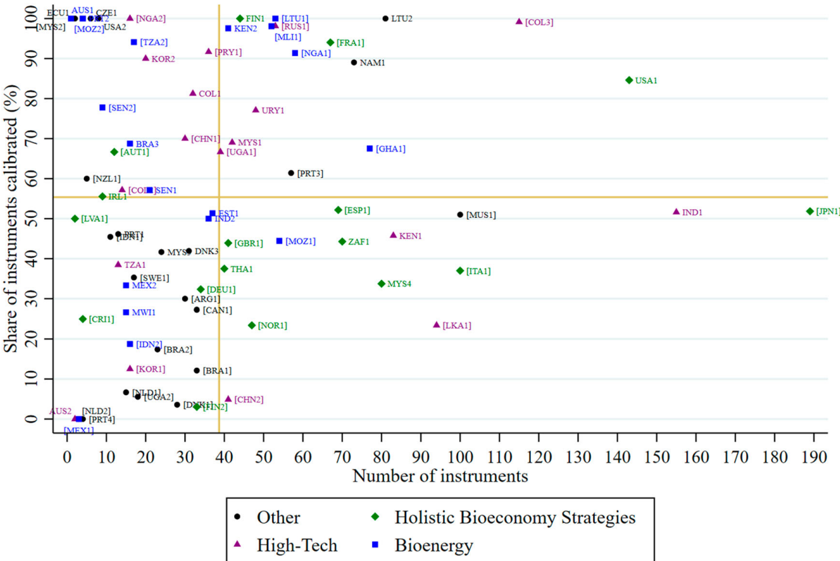
- Instrument density is high but balance is moderate: documents average 38.68 distinct instrument observations (median 31; range 1–189), and instrument-related text makes up 23.35% of texts on average. Documents cover 4.338 of five instrument types and 18.44 of 71 instrument subtypes on average; the Gini-Simpson balance index is 0.620, lower than the 0.8–0.9 Schmidt and Sewerin found for renewable energy policy mixes.
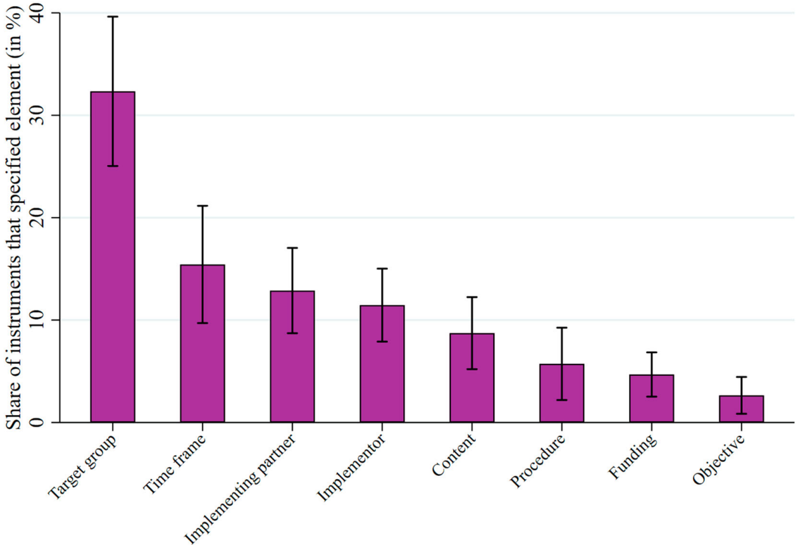
- Calibration is weak: 55.37% of instrument observations specify at least one of eight calibration dimensions, and instruments average only 0.938 specified dimensions. Among calibrated instruments, implementers are specified in slightly more than 30% of cases, while all other dimensions fall below 15%, with measurable objectives, implementing partners, funding, and procedures particularly rare.
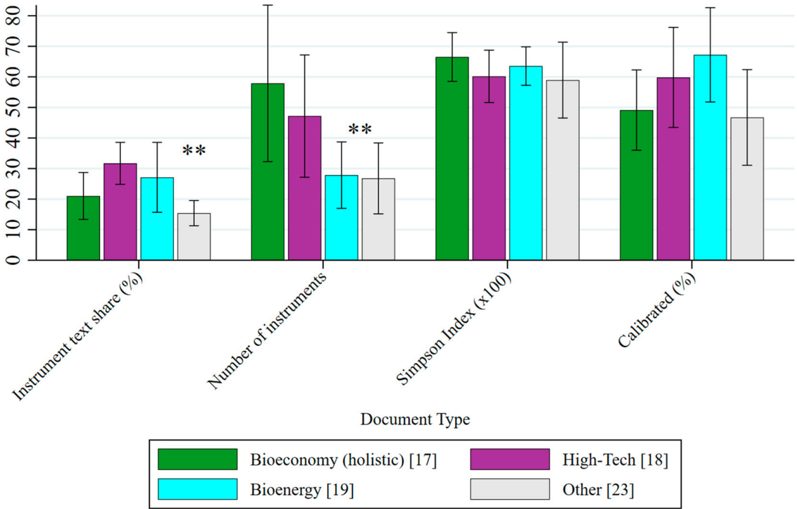
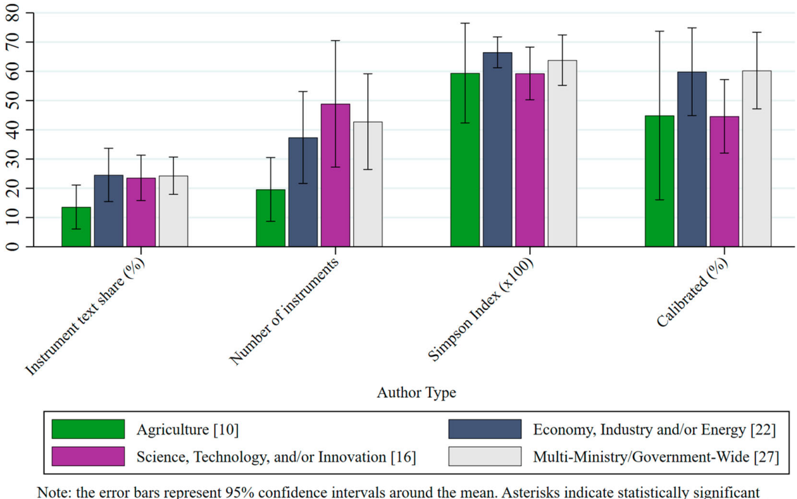
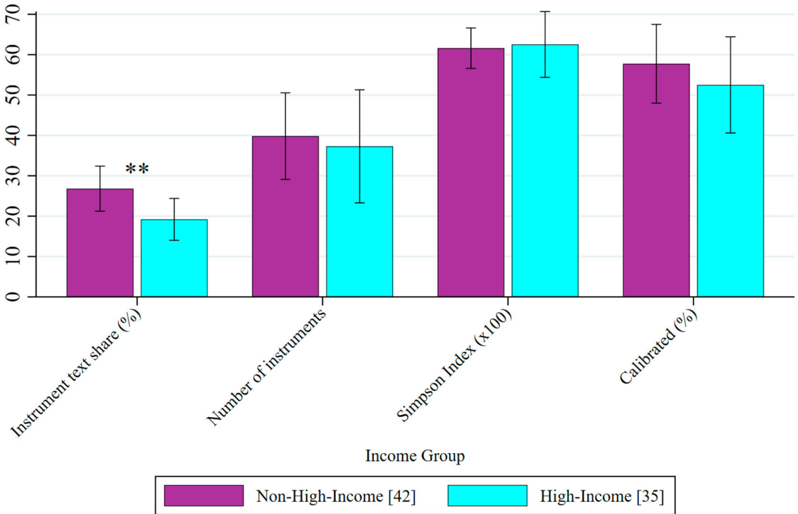
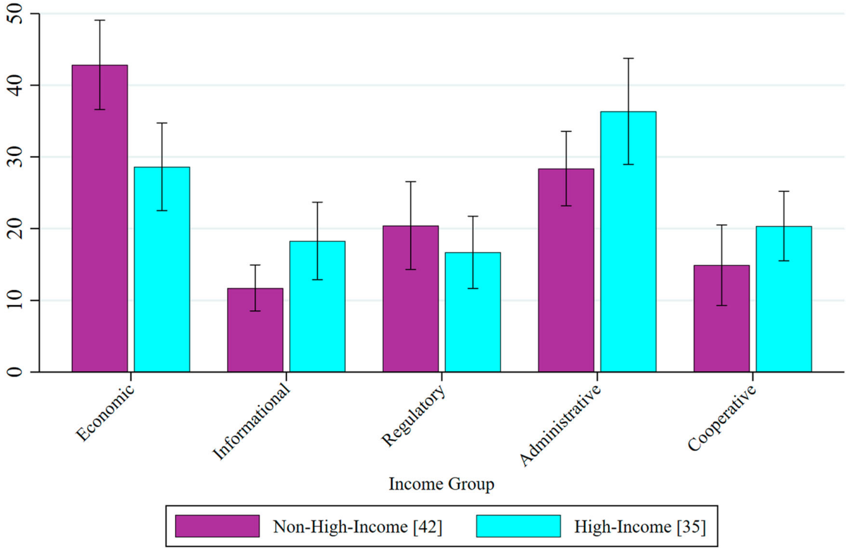
- Disaggregation shows high-tech and bioenergy strategies allocate more text to instruments and are more calibrated than holistic bioeconomy strategies; holistic strategies name the most instruments and have slightly higher balance, though not significantly. High-income countries have a significantly lower instrument-related text share and calibrate a smaller share of instruments; lower-income countries show higher shares of economic and regulatory instruments, while high-income countries show higher administrative, informational, and cooperative shares, though these differences are not statistically significant. No systematic temporal patterns emerged.
Methods
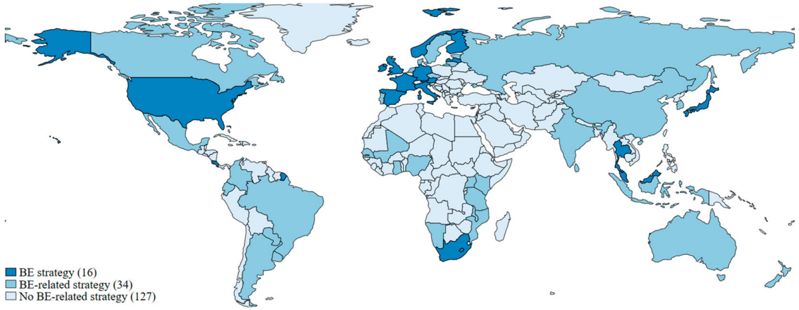
- Systematic qualitative-quantitative content analysis of 78 bioeconomy-related policy documents from 50 countries, with a 2020 sampling cut-off. From 288 potentially relevant documents, the authors used the most recent overarching bioeconomy strategy for 16 countries and included relevant bioeconomy-related documents for others; 58 documents came from high- or upper-middle-income countries, 61 were published after 2010, and 39 after 2015. One Danish strategy was excluded because it contained no identifiable policy instruments.
- Coding in MAXQDA 2022 identified 2,978 instrument observations. The coding scheme included 71 instrument subtypes grouped into five main types (informational, cooperative, economic, regulatory, administrative) and eight calibration dimensions coded binary (0 = absent, 1 = present) and summed from 0 to 8. Intercoder reliability checks were conducted.
- Descriptive statistics in Stata 17 assessed instrument density, balance, and calibration, including number of distinct instruments, number of instrument types and subtypes, and a Gini-Simpson balance index. Results were disaggregated by document type, authoring authority, country income group, and time. The authors did not check whether instruments were actually implemented.
Limitations
- The paper states that it did not check whether the coded instruments were actually implemented; calibration coding was limited to presence/absence of eight dimensions and did not assess stringency or target-group tailoring; strategies are high-level documents that may intentionally remain abstract; and the sample cut-off was 2020, using only policy documents rather than other relevant sources.
- The text makes evident that the sample is skewed toward high- and upper-middle-income countries (58 of 78) and OECD contexts (only three of 16 overarching bioeconomy strategies were launched outside the OECD), and many documents are sector-specific, which may limit generalizability.
- The text also makes evident that findings are descriptive and cannot establish causal effects or implementation outcomes; one document was excluded for lacking identifiable instruments; no formal calibration index was constructed; and some instrument codes could plausibly fit other types, such as pilot and demonstration plants as economic or informational instruments.
Model-written summary. Check it against the paper before relying on it.
Integrity signals
Registry
Cites
Statistics
Figures




Verification
Claims the paper makes
1 Valid · 1 Not valid · 20 Not checked · 78 Own results and interpretations
The cited sources support only part of this claim — read each source’s verdict below.
In the paper
“The vast majority of these strategies promote a vision which prioritizes economic growth, based on either the substitution of fossil resources with biomass (the 'bioresource' vision) or the commercial exploitation of biotechnologies to reap the benefits of the 'life science revolution' (the 'biotechnology' vision).”
§ Characterizing bioeconomy policy instruments: A global comparative analysis of bioeconomy strategies > 1. Introduction
What the sources say
- Partly supportedcites Dietz et al., 2018 matched to “Governance of the Bioeconomy: A Global Comparative Study of National Bioeconomy Strategies” (2018) sourceExperimental — accuracy not yet measured
Our copy supports the growth-oriented part of the claim: Section 5.2 ('Strategies to Enable the Bioeconomy') reports that almost all states with an explicit bioeconomy strategy deploy R&D strategies and subsidies 'to improve the competitiveness of their bioeconomy', and the Introduction states that only a minority of national strategies even mention the potentially negative consequences of bio-based transformations, with enabling governance dominating constraining governance. It also contains the two substantive orientations named in the claim, but as two of four transformation paths, not as two competing 'visions': TP1 is the substitution of fossil fuels with bio-based raw materials and TP4 the application of biological principles and processes largely independent of biomass streams, for which 'many countries with bioeconomic ambitions have high expectations' (Section 2.2 / Transformation Path descriptions). However, the paper never uses a 'bioresource' vs 'biotechnology' vision dichotomy, never says the vast majority of the 41 strategies prioritize economic growth, and indeed states that 'the majority of industrial nations, as well as some emerging economies, envisage or currently implement more diversified strategies along all four TPs', so the either/or framing and the 'vast majority' quantifier are not attributable to this source. (LLM, conf=0.70)
- Not checked yetcites Hausknost et al., 2017 matched to “A Transition to Which Bioeconomy? An Exploration of Diverging Techno-Political Choices” (2017) source
- Not checked yetcites Proestou et al., 2023 matched to “A global analysis of bioeconomy visions in governmental bioeconomy strategies” (2024) source
plain- Asserted: passes — The authors put it forward as true.
- Checkable: passes — It can be checked against evidence.
- Load-bearing: passes — The paper’s conclusions depend on it.
- Based: passes — The paper gives a reason why it holds.
- Partly supported
A result the paper states — it cites no source for it, so there is none to check. The quote shows it is in the paper.
In the paper
“Most of the instruments coded under this category refer to regulations aimed at improving the investment and operational environment for the bioeconomy, rather than, for example, environmental regulations.”
§ Characterizing bioeconomy policy instruments: A global comparative analysis of bioeconomy strategies > 4.1. Policy characteristics across bioeconomy policy documents
plain- Asserted: passes — The authors put it forward as true.
- Checkable: passes — It can be checked against evidence.
- Load-bearing: unclear — It is unclear whether the paper’s conclusions depend on it.
- Based: passes — The paper gives a reason why it holds.
A result the paper reports from its own data — it cites no other source for it, so there is none to check. The quote shows it is in the paper.
In the paper
“However, there is a wide variation in instrument density, ranging from the mentioning of only one to 189 instruments”
§ Characterizing bioeconomy policy instruments: A global comparative analysis of bioeconomy strategies > 4.1. Policy characteristics across bioeconomy policy documents
plain- Asserted: passes — The authors put it forward as true.
- Checkable: passes — It can be checked against evidence.
- Load-bearing: unclear — It is unclear whether the paper’s conclusions depend on it.
- Based: passes — The paper gives a reason why it holds.
A result the paper reports from its own data — it cites no other source for it, so there is none to check. The quote shows it is in the paper.
In the paper
“Finally, 'facilitation of science and industry' and 'intra-science cooperation' represent the two most salient groups of cooperative instruments.”
§ Characterizing bioeconomy policy instruments: A global comparative analysis of bioeconomy strategies > 4.1. Policy characteristics across bioeconomy policy documents
plain- Asserted: passes — The authors put it forward as true.
- Checkable: passes — It can be checked against evidence.
- Load-bearing: unclear — It is unclear whether the paper’s conclusions depend on it.
- Based: passes — The paper gives a reason why it holds.
A result the paper reports from its own data — it cites no other source for it, so there is none to check. The quote shows it is in the paper.
In the paper
“The most frequent economic instruments relate to the funding of research and development projects, as indicated by codes such as 'funding of research projects' or 'establishment of pilot and demonstration plants'.”
§ Characterizing bioeconomy policy instruments: A global comparative analysis of bioeconomy strategies > 4.1. Policy characteristics across bioeconomy policy documents
hedged- Asserted: passes — The authors put it forward as true.
- Checkable: passes — It can be checked against evidence.
- Load-bearing: unclear — It is unclear whether the paper’s conclusions depend on it.
- Based: passes — The paper gives a reason why it holds.
57 more claims
Create a free account to see all 100 claims and to verify the 29 references still open.
- It may state two separate claims as one. 27
- Probably not a substantial claim. 17
- The quote only partly states this claim. 1
Self-check
Percentages, sums and reported differences re-computed from the paper’s own numbers.
Each contradiction between two passages listed here was confirmed by an independent check.
Rated minor: it would not touch a result — a value no result rests on, a p-value that stays on the same side of the significance level, or a conflict that is clerical, resolved elsewhere in the paper, or outside its own findings.
In the paper
§ Characterizing bioeconomy policy instruments: A global comparative analysis of bioeconomy strategies > Content
“Third, we calculate a Gini-Simpson index (Schmidt & Sewerin, 2019, p. 3), which reflects the probability that two randomly drawn instruments from a strategy belong to the same instrument type.”
§ Characterizing bioeconomy policy instruments: A global comparative analysis of bioeconomy strategies > 2. Conceptualizing policy instrument characteristics
“It measures the likelihood that two randomly selected policy instruments in a policy mix represent different types of instruments.”
Citations
Cites
Content Analysis: An Introduction to Its Methodology
Krippendorff, K. (2019) · doi:10.4135/9781071878781 · Cited by 15,448
Policy mixes for sustainability transitions: an extended concept and framework for analysis
Rogge, K. S., & Reichardt, K. (2016) · Research Policy · doi:10.1016/j.respol.2016.04.004 · Cited by 1,524 · cited 3×
“A closer look at the policy strategy literature (Quitzow, 2015; Rogge & Reichardt, 2016) suggests several possible reasons for the vagueness observed in the design of policy instruments within the strategies.”
LASCOUMES, P., & LE GALES, P. (2007) · Governance · doi:10.1111/j.1468-0491.2007.00342.x · Cited by 1,494
The role of biomass and bioenergy in a future bioeconomy: policies and facts
Scarlat, N., Dallemand, J.-F., Monforti-Ferrario, F., & Nita, V. (2015) · Environmental Development · doi:10.1016/j.envdev.2015.03.006 · Cited by 895
The choice of innovation policy instruments
Borrás, S., & Edquist, C. (2013) · Technological Forecasting and Social Change · doi:10.1016/j.techfore.2013.03.002 · Cited by 890
Behavioral Assumptions of Policy Tools
Schneider, A., & Ingram, H. (1990) · The Journal of Politics · doi:10.2307/2131904 · Cited by 882
The Tools of Government in the Digital Age
Hood, C. C., & Margetts, H. Z. (2007) · doi:10.1007/978-1-137-06154-6 · Cited by 775
Policy Instruments: Typologies and Theories
Vedung, E. (2017) · Carrots, Sticks & Sermons · doi:10.4324/9781315081748-2 · Cited by 572
The Content Analysis Guidebook
Neuendorf, K. A. (2017) · doi:10.4135/9781071873045 · Cited by 480
Capano, G., & Howlett, M. (2020) · Sage Open · doi:10.1177/2158244019900568 · Cited by 431
Staffas, L., Gustavsson, M., & McCormick, K. (2013) · Sustainability · doi:10.3390/su5062751 · Cited by 418
Visions of sustainability in bioeconomy research
Pfau, S., Hagens, J., Dankbaar, B., & Smits, A. (2014) · Sustainability · doi:10.3390/su6031222 · Cited by 398 · cited 3×
“…found a lack of regulations to address environmental concerns and to align the development of the bioeconomy with sustainability principles (Birch, 2006; Boyer et al., 2022; Eversberg et al., 2023; Juerges & Hansjür-gens, 2018; Lühmann & Vogelpohl, 2023; Pfau et al., 2014; Proestou et al., 2023).”
Designing Public Policies: Principles and Instruments
Howlett, M. (2019) · doi:10.4324/9781315232003 · Cited by 365
Schmidt, T. S., & Sewerin, S. (2019) · Research Policy · doi:10.1016/j.respol.2018.03.012 · Cited by 347
Policy Recommendations for Multi-Actor Implementation: An Assessment of the Field
O'Toole, L. J. (1986) · Journal of Public Policy · doi:10.1017/s0143814x00006486 · Cited by 346
Howlett, M., Mukherjee, I., & Woo, J. J. (2015) · Policy & Politics · doi:10.1332/147084414x13992869118596 · Cited by 311
Mayring, P. (2022) · SAGE Publications Ltd eBooks · doi:10.4135/9781036231798 · Cited by 294
Governance of the Bioeconomy: A Global Comparative Study of National Bioeconomy Strategies
Dietz, T., Börner, J., Förster, J. J., & Von Braun, J. (2018) · Sustainability · doi:10.3390/su10093190 · Cited by 288
Regulatory policy outputs and impacts: Exploring a complex relationship
Knill, C., Schulze, K., & Tosun, J. (2012) · Regulation & Governance · doi:10.1111/j.1748-5991.2012.01150.x · Cited by 271
Sustainable development – A ‘selling point’ of the emerging EU bioeconomy policy framework?
Ramcilovic-Suominen, S., & Pülzl, H. (2018) · Journal of Cleaner Production · doi:10.1016/j.jclepro.2016.12.157 · Cited by 254
A Framework for Evaluating Environmental Policy Instruments: Context and Key Concepts
Mickwitz, P. (2003) · Evaluation · doi:10.1177/135638900300900404 · Cited by 249
Toward a Comparative Measure of Climate Policy Output
Schaffrin, A., Sewerin, S., & Seubert, S. (2015) · Policy Studies Journal · doi:10.1111/psj.12095 · Cited by 228
Bioeconomy strategies: contexts, visions, guiding implementation principles and resulting debates
Meyer, R. (2017) · Sustainability · doi:10.3390/su9061031 · Cited by 215 · cited 5×
“This result extends and systematizes fi ndings from earlier case studies that bioeconomy strategies often tilt towards voluntary and incentive instruments and provide little guidance for policy implementation (Hausknost et al., 2017; Meyer, 2017; Töller et al., 2021).”
InfluentialA DESIGN PERSPECTIVE ON POLICY IMPLEMENTATION: THE FALLACIES OF MISPLACED PRESCRIPTION
Linder, S. H., & Peters, B. G. (1987) · Review of Policy Research · doi:10.1111/j.1541-1338.1987.tb00761.x · Cited by 208
The criteria for effective policy design: character and context in policy instrument choice
Howlett, M. P. (2017) · Journal of Asian Public Policy · doi:10.1080/17516234.2017.1412284 · Cited by 205
A theoretical framework for explaining the choice of instruments in environmental policy
Böcher, M. (2011) · Forest Policy and Economics · doi:10.1016/j.forpol.2011.03.012 · Cited by 203
A Transition to Which Bioeconomy? An Exploration of Diverging Techno-Political Choices
Hausknost, D., Schriefl, E., Lauk, C., & Kalt, G. (2017) · Sustainability · doi:10.3390/su9040669 · Cited by 200
Bauer, M. W., & Knill, C. (2014) · Journal of Comparative Policy Analysis: Research and Practice · doi:10.1080/13876988.2014.885186 · Cited by 182
The Bioeconomy to 2030: Designing a Policy Agenda
OECD (2009) · OECD eBooks · doi:10.1787/9789264056886-en · Cited by 181
Quitzow, R. (2014) · Research Policy · doi:10.1016/j.respol.2014.09.003 · Cited by 164
Policy instruments at work: A meta‐analysis of their applications
Acciai, C., & Capano, G. (2020) · Public Administration · doi:10.1111/padm.12673 · Cited by 131
Soil governance in the transition towards a sustainable bioeconomy – A review
Juerges, N., & Hansjürgens, B. (2016) · Journal of Cleaner Production · doi:10.1016/j.jclepro.2016.10.143 · Cited by 110
Birch, K. (2006) · Genomics Society and Policy · doi:10.1186/1746-5354-2-3-1 · Cited by 109
Blattert, C., Mönkkönen, M., Burgas, D., Fulvio, F. D., Caicoya, A. T., Vergarechea, M., Klein, J., Hartikainen, M. E., Antón‐Fernández, C., Astrup, R., et al. (2023) · Communications Earth & Environment · doi:10.1038/s43247-023-00771-z · Cited by 104
Imbert, E., Ladu, L., Morone, P., & Quitzow, R. (2017) · Energy Research & Social Science · doi:10.1016/j.erss.2017.08.006 · Cited by 100
The bioeconomy and its untenable growth promises: reality checks from research
Eversberg, D., Holz, J., & Pungas, L. (2022) · Sustainability Science · doi:10.1007/s11625-022-01237-5 · Cited by 99
Mapping the mix: Linking instruments, settings and target groups in the study of policy mixes
Mavrot, C., Hadorn, S., & Sager, F. (2019) · Research Policy · doi:10.1016/j.respol.2018.06.012 · Cited by 90
The Routledge Handbook of Policy Tools
Howlett, M. (2022) · Routledge eBooks · doi:10.4324/9781003163954 · Cited by 89
Bioeconomy imaginaries: A review of forest-related social science literature
Holmgren, S., D’Amato, D., & Giurca, A. (2020) · AMBIO · doi:10.1007/s13280-020-01398-6 · Cited by 83
Reviewing the interface of bioeconomy and ecosystem service research
D’Amato, D., Bartkowski, B., & Droste, N. (2020) · AMBIO · doi:10.1007/s13280-020-01374-0 · Cited by 75
Hood, C. (1983) · Public Administration · doi:10.1111/j.1467-9299.1983.tb00513.x · Cited by 75
Giving less by doing more? Dynamics of social policy expansion and dismantling in 18 OECD countries
Jensen, C., Knill, C., Schulze, K., & Tosun, J. (2014) · Journal of European Public Policy · doi:10.1080/13501763.2013.866262 · Cited by 61
A global analysis of bioeconomy visions in governmental bioeconomy strategies
Proestou, M., Schulz, N., & Feindt, P. H. (2024) · Ambio · doi:10.1007/s13280-023-01958-6 · Cited by 49
Self-citationTöller, A. E., Vogelpohl, T., Beer, K., & Böcher, M. (2021) · Journal of Environmental Policy & Planning · doi:10.1080/1523908x.2021.1893163 · Cited by 44
Boyer, M., Kusche, F., Hackfort, S. K., Prause, L., & Engelbrecht-Bock, F. (2022) · Sustainability Science · doi:10.1007/s11625-022-01254-4 · Cited by 44
Grohmann, P., & Feindt, P. H. (2024) · Environmental Policy and Governance · doi:10.1002/eet.2052 · Cited by 44
Self-citationThe bioeconomy in Germany: A failing political project?
Lühmann, M., & Vogelpohl, T. (2023) · Ecological Economics · doi:10.1016/j.ecolecon.2023.107783 · Cited by 40
Vogelpohl, T. (2023) · Sustainability Science · doi:10.1007/s11625-022-01256-2 · Cited by 38
Howlett, M., Ramesh, M., & Capano, G. (2024) · Journal of Asian Public Policy · doi:10.1080/17516234.2022.2030276 · Cited by 30
Dietz, T., Rubio Jovel, K., Deciancio, M., Boldt, C., & Börner, J. (2023) · EFB Bioeconomy Journal · doi:10.1016/j.bioeco.2023.100058 · Cited by 28
Benner, M., & Löfgren, H. (2007) · New Political Science · doi:10.1080/07393140601170842 · Cited by 27
Skogstad, G. (2020) · Policy Sciences · doi:10.1007/s11077-020-09378-z · Cited by 25
Bioeconomy as a promise of development? The cases of Argentina and Malaysia
Puder, J., & Tittor, A. (2023) · Sustainability Science · doi:10.1007/s11625-022-01284-y · Cited by 25
“Donate your organs, donate life!” Explicitness in policy instruments
Thomann, E. (2018) · Policy Sciences · doi:10.1007/s11077-018-9324-6 · Cited by 20
Rules as policy data? Measuring and linking policy substance and legislative context
Hurka, S., Knill, C., & Steinebach, Y. (2023) · Regulation & Governance · doi:10.1111/rego.12528 · Cited by 18
Varanini, G., Proestou, M., Goritz, N., & Feindt, P. H. (2024) · Earth System Governance · doi:10.1016/j.esg.2024.100218 · Cited by 16
Self-citationDevil in the details? Policy settings and calibrations of national excellence-centers
Gofen, A., Wellstead, A. M., & Tal, N. (2023) · Policy Sciences · doi:10.1007/s11077-023-09496-4 · Cited by 11
Research works printed but not linked: 1
- Bemelmans-Videc, M.-L., Rist, R. C., & Vedung, E. O. (Eds.). (1998). Comparative policy analysis series. Carrots, sticks, and sermons: Policy instruments and their evaluation. Transaction Publishers.
Cited by
Exploring the geography of innovation and sustainability transitions in the bioeconomy
Losacker, S., Hansen, T., & Schiller, D. (2025) · Progress in Economic Geography · doi:10.1016/j.peg.2025.100055 · Cited by 6
Exploring discourses in the German forest-based bioeconomy: A Q-methodological approach
Lobensteiner, C., & Losacker, S. (2026) · Forest Policy and Economics · doi:10.1016/j.forpol.2026.103789 · Cited by 4
ПЕТРУХА, Н. М., Petrukha, S., Akimova, L., Столяренко, О. М., & Акімов, О. О. (2026) · JOURNAL OF EUROPEAN ECONOMY · doi:10.35774/jee2026.02.260 · Cited by 3
Resilience Challenges in Bioeconomy Policies: A Global Comparative Analysis
Goritz, N., Proestou, M., & Feindt, P. H. (2026) · Environmental Management · doi:10.1007/s00267-026-02432-1 · Cited by 2
Self-citationCoca, J., Ferreira, V., & Pié, L. (2026) · Sustainable Development · doi:10.1002/sd.71421
Metadata
- Authors
- Goritz, N., von Pfister, J., Proestou, M., & Feindt, P. H.
- Affiliations
- Humboldt-Universität zu Berlin (DE)
- Corresponding author
- Goritz, Nicolai
- Venue
- Journal of Environmental Policy & Planning
- Publisher
- Informa UK Limited
- Published
- 2025-09-29
- Volume
- 28
- Issue
- 2
- Pages
- 344-367
- ISSN
- 1522-7200 (ISSN-L)
- 1523-908X
- OpenAlex
- W4414624105
- Semantic Scholar
- fa6b1f71645f39e1b63333caddaeabb60ea314ab
- Cited by
- 9
- References
- 55
- Citations by year
- 2026: 8 · 2025: 1
- FWCI
- 6.65
- Type
- journal article
- Language
- en
- Open access
- hybrid
- doi.org
- Licence
- Locations
- Journal of Environmental Policy & Planning (publishedVersion, cc-by)
- Funders
- Federal Ministry of Education and Research
- Bundesministerium für Bildung und Forschung) (031B0789)
- Topics
- Life Sciences › Agricultural and Biological Sciences › General Agricultural and Biological Sciences › Bioeconomy and Sustainability Development
- Physical Sciences › Environmental Science › Global and Planetary Change › Sustainability and Climate Change Governance
- Physical Sciences › Chemical Engineering › Catalysis › Catalysis for Biomass Conversion
- Keywords
- bioeconomy policy, policy instruments, bioeconomy strategy, economic instruments, regulatory instruments, innovation policy, research and development, environmental regulation, policy calibration, agenda setting, signaling, country income groups
About these checks
Registry, retraction, Cites and statistics results are computed, not judged, with one exception: a printed reference that no index lists is read once by a model before it counts as a citation error. Claims are extracted by a model and kept only when their quote appears verbatim in the text; each cited source is then checked, with a model’s help, for whether it says what the claim relies on. Those verdicts can be wrong — read the claim’s quote and the cited source before relying on one.
The claim verdicts this report counts are experimental: their accuracy is not yet measured.
A language model drew the claims from the paper on 2026-11-21, under version 3 of the claim definition (model deepseek-v4.1-flash, prompt extract-v3).
A second model labelled each claim on 2026-11-21 (model jev-1.13-20260917, definition revision gold-guideline-v0.2).
Cited sources are checked with a language model’s help (qwen3.8-omni-flash).
Statistics and arithmetic are recomputed, not judged.
Confidence bands are shown only for fields calibrated on our annotated test set. None is calibrated yet, so no band is shown.
What counts as a claim ›How we measure confidence ›How we check this ›
Are you an author, or do you see a problem with this page? Request a review
Data sources
Bibliographic data: Semantic Scholar, OpenAlex, Crossref.
Contains information from the Semantic Scholar Academic Graph Datasets, made available under the ODC Attribution License (ODC-BY 1.0).
Semantic Scholar’s data is described in: Kinney, R., et al. (2023). The Semantic Scholar Open Data Platform. arXiv:2301.10140.
