

Acute caffeine supplementation enhances several aspects of shot put performance in trained athletes
Open accessThe DOI matches its Crossref record; 43 of the 43 references it cites were found in a registry or an index.
Abstract
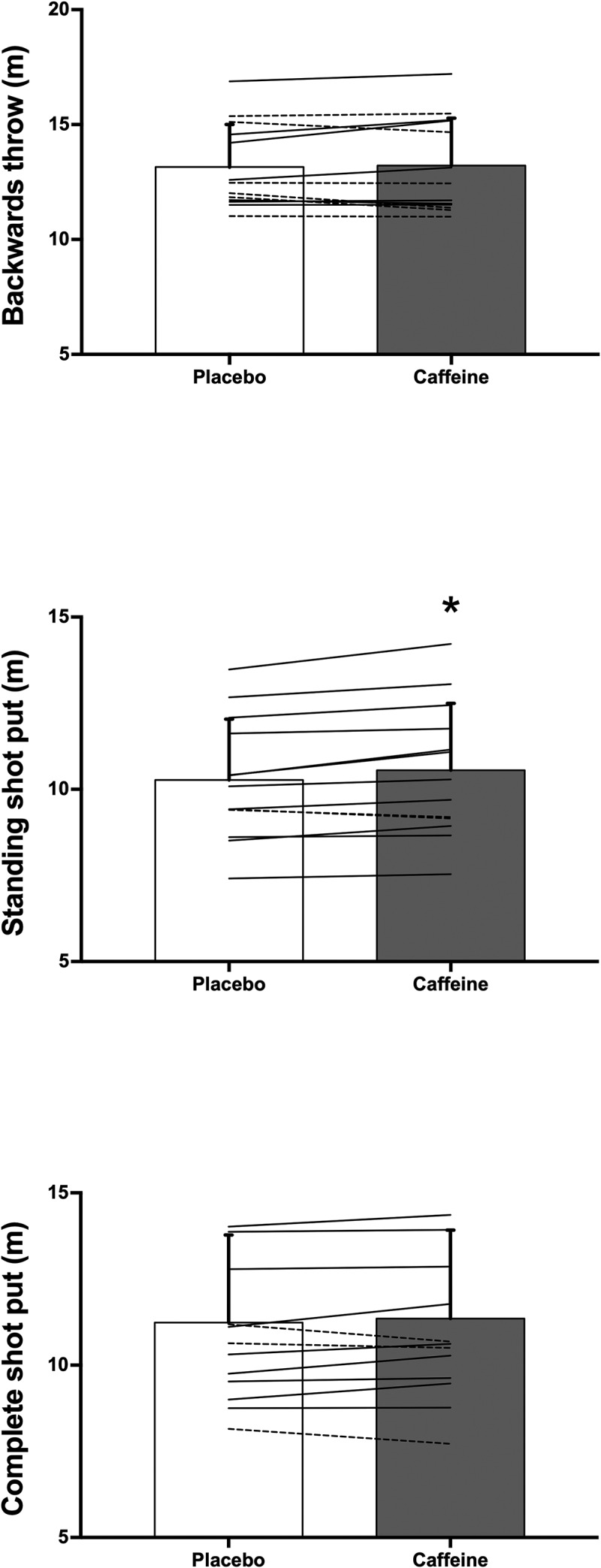
The aim of this investigation was to determine the effect of a moderate dose of caffeine (3 mg/kg/b.m.) on muscular power and strength and shot put performance in trained athletes. METHODS: Thirteen shot putters (eight men and five women) participated in a double-blind, placebo-controlled, randomized experiment. In two different trials, participants ingested either 3 mg/kg/b.m. of caffeine or a placebo. Forty-five min after substance ingestion, athletes performed a handgrip dynamometry test, a countermovement jump (CMJ), a squat jump (SJ), and a maximum-velocity push-up. The athletes also performed three types of throws: a backwards throw, a standing shot put and a complete shot put. RESULTS: . 10.55 ± 1.94 m; ES = 0.87, p = 0.009; +2.6%). However, caffeine ingestion did not increase strength in the handgrip test, power in the ballistic push-up, or distance in the backwards throw (all p > 0.05). Shot put performance changed from 11.24 ± 2.54 to 11.35 ± . 2.57 m (ES = 0.33, p = 0.26; +1.0%), although the difference did not reach statistically significant differences. Caffeine ingestion did not increase the prevalence of side effects (nervousness, gastrointestinal problems, activeness, irritability, muscular pain, headache, and diuresis) in comparison with the placebo (p > 0.05). CONCLUSION: In summary, caffeine ingestion with a dose equivalent to 3 mg/kg/b.m. elicited moderate improvements in several aspects of physical performance in trained shot putters but with a small effect on distance in a complete shot put.
Overview
The claims and statistics of this paper haven’t been checked yet.
Free: it reads the open-access text and checks the first 5 claims that cite a source we can check. Create a free account to check every claim.
Integrity signals
Registry
Cites
Statistics
Figures
Verification
Claims the paper makes
The claims and statistics of this paper haven’t been checked yet.
Free: it reads the open-access text and checks the first 5 claims that cite a source we can check. Create a free account to check every claim.
Self-check
Percentages, sums and reported differences re-computed from the paper’s own numbers.
The self-check needs the paper’s full text.
Citations
Cites
IOC Consensus Statement: Dietary Supplements and the High-performance Athlete
Maughan, R. J., Burke, L. M., Dvorak, J., Larson-Meyer, D. E., Peeling, P., Phillips, S. M., Rawson, E. S., Walsh, N. P., Garthe, I., Geyer, H., et al. (2018) · British Journal of Sports Medicine · doi:10.1136/bjsports-2018-099027 · Cited by 1,004 · cited 3×
“In fact, the International Olympic Committee [19] and the International Society of Sports Nutrition [3] recommend the use of at least 3 to 6 mg/kg/b.m. of caffeine to enhance physical performance and, therefore, it is unknown if caffeine can enhance shot put performance when used in the dose recommended.”
BackgroundInternational society of sports nutrition position stand: caffeine and performance
Goldstein, E. R., Ziegenfuss, T., Kalman, D., Kreider, R., Campbell, B., Wilborn, C., Taylor, L., Willoughby, D., Stout, J., Graves, B. S., et al. (2010) · Journal of the International Society of Sports Nutrition · doi:10.1186/1550-2783-7-5 · Cited by 686
Assessment of blinding in clinical trials
Bang, H., Ni, L., & Davis, C. E. (2004) · Controlled Clinical Trials · doi:10.1016/j.cct.2003.10.016 · Cited by 682 · cited 1×
“The blinding assessment was performed with Kappa index and Bang’s Index [32].”
MethodInternational Society of Sports Nutrition Position Stand: Caffeine and Exercise Performance
Guest, N. S., VanDusseldorp, T. A., Nelson, M. T., Grgic, J., Schoenfeld, B. J., Jenkins, N. D. M., Arent, S. M., Antonio, J., Stout, J. R., Trexler, E. T., et al. (2021) · Journal of the International Society of Sports Nutrition · doi:10.1186/s12970-020-00383-4 · Cited by 665 · cited 5×
“, are needed to effectively increase maximal muscle strength, power output, and strength-endurance [3,10,20].”
BackgroundMethodInfluentialGrgic, J., Grgic, I., Pickering, C., Schoenfeld, B. J., Bishop, D. J., & Pedisic, Z. (2020) · British Journal of Sports Medicine · doi:10.1136/bjsports-2018-100278 · Cited by 375 · cited 1×
“performance [2–7], including aerobic [3,5] and anaerobic [8,9] activities, and strength and power [3,10,11].”
BackgroundEffects of caffeine intake on muscle strength and power: a systematic review and meta-analysis
Grgic, J., Trexler, E. T., Lazinica, B., & Pedisic, Z. (2018) · Journal of the International Society of Sports Nutrition · doi:10.1186/s12970-018-0216-0 · Cited by 362 · cited 2×
“, are needed to effectively increase maximal muscle strength, power output, and strength-endurance [3,10,20].”
BackgroundInternational Association of Athletics Federations Consensus Statement 2019: Nutrition for Athletics
Burke, L. M., Castell, L. M., Casa, D. J., Close, G. L., Costa, R. J. S., Desbrow, B., Halson, S. L., Lis, D. M., Melin, A. K., Peeling, P., et al. (2019) · International Journal of Sport Nutrition and Exercise Metabolism · doi:10.1123/ijsnem.2019-0065 · Cited by 258 · cited 9×
“While the International Association of Athletics Federations Consensus Statement recommends caffeine as an ergogenic aid for different event groups in Athletics [12], the truth is that running disciplines with a more aerobic-like nature, such as middle-”
BackgroundInfluentialInternational Society of Sports Nutrition position stand: energy drinks
Campbell, B., Wilborn, C., La Bounty, P., Taylor, L., Nelson, M. T., Greenwood, M., Ziegenfuss, T. N., Lopez, H. L., Hoffman, J. R., Stout, J. R., et al. (2013) · Journal of the International Society of Sports Nutrition · doi:10.1186/1550-2783-10-1 · Cited by 198
Salinero, J. J., Lara, B., & Del Coso, J. (2019) · Research in Sports Medicine · doi:10.1080/15438627.2018.1552146 · Cited by 176
Self-citationCaffeine ingestion enhances Wingate performance: a meta‐analysis
Grgic, J. (2018) · European Journal of Sport Science · doi:10.1080/17461391.2017.1394371 · Cited by 165 · cited 1×
“performance [2–7], including aerobic [3,5] and anaerobic [8,9] activities, and strength and power [3,10,11].”
BackgroundThe influence of caffeine supplementation on resistance exercise: a review
Grgic, J., Mikulic, P., Schoenfeld, B. J., Bishop, D. J., & Pedisic, Z. (2019) · Sports Medicine · doi:10.1007/s40279-018-0997-y · Cited by 153
Urine Caffeine Concentration in Doping Control Samples from 2004 to 2015
Aguilar-Navarro, M., Muñoz, G., Salinero, J. J., Muñoz-Guerra, J., Fernández-Álvarez, M., Plata, M. D. M., & Del Coso, J. (2019) · Nutrients · doi:10.3390/nu11020286 · Cited by 147
Self-citationTime course of tolerance to the performance benefits of caffeine
Lara, B., Ruiz-Moreno, C., Salinero, J. J., & Del Coso, J. (2019) · PLOS ONE · doi:10.1371/journal.pone.0210275 · Cited by 142
Self-citationSalinero, J. J., Lara, B., Abian-Vicen, J., Gonzalez-Millán, C., Areces, F., Gallo-Salazar, C., Ruiz-Vicente, D., & Del Coso, J. (2014) · British Journal of Nutrition · doi:10.1017/s0007114514002189 · Cited by 131 · cited 1×
“These questionnaires have been previously used to assess perceived ergogenicity and the prevalence of side effects after the intake of caffeine in the sports context [30].”
MethodSelf-citationFilip, A., Wilk, M., Krzysztofik, M., & Del Coso, J. (2020) · Nutrients · doi:10.3390/nu12041087 · Cited by 120
The Influence of the Menstrual Cycle on Muscle Strength and Power Performance
Romero-Moraleda, B., Coso, J. D., Gutiérrez-Hellín, J., Ruiz-Moreno, C., Grgic, J., & Lara, B. (2019) · Journal of Human Kinetics · doi:10.2478/hukin-2019-0061 · Cited by 120
GRANFORS, M., BACKMAN, J., LAITILA, J., & NEUVONEN, P. (2005) · Clinical Pharmacology & Therapeutics · doi:10.1016/j.clpt.2005.06.009 · Cited by 113 · cited 1×
“Participants were excluded if they reported a) sport injury within the previous two months; b) medication usage within the previous month; c) allergy to caffeine; or d) use of oral contraceptive pills, as they may interfere with caffeine pharmacokinetics [28].”
BackgroundEnhancing Physical Performance in Male Volleyball Players with a Caffeine-Containing Energy Drink
Coso, J. D., Pérez-López, A., Abian-Vicen, J., Salinero, J. J., Lara, B., & Valadés, D. (2014) · International Journal of Sports Physiology and Performance · doi:10.1123/ijspp.2013-0448 · Cited by 111
Self-citationGrgic, J., & Mikulic, P. (2017) · European Journal of Sport Science · doi:10.1080/17461391.2017.1330362 · Cited by 106 · cited 1×
“) have found ergogenic effects in simpler throw tasks, such as seated medicine ball throwing [34], bench press throw [35], or handball throws [36].”
BackgroundEffects of caffeine on resistance exercise: a review of recent research
Grgic, J. (2021) · Sports Medicine · doi:10.1007/s40279-021-01521-x · Cited by 96 · cited 3×
“was selected according to current evidence about the dose of caffeine to produce an ergogenic effect on sports performance [3,11,19].”
BackgroundTerzis, G. D., Georgiadis, G., Vassiliadou, E., & Manta, P. (2003) · European Journal of Applied Physiology · doi:10.1007/s00421-003-0847-x · Cited by 75
The Effects of Caffeine on Vertical Jump Height and Execution in Collegiate Athletes
Bloms, L. P., Fitzgerald, J. S., Short, M. W., & Whitehead, J. R. (2016) · Journal of Strength and Conditioning Research · doi:10.1519/jsc.0000000000001280 · Cited by 69
Sabol, F., Grgic, J., & Mikulic, P. (2019) · International Journal of Sports Physiology and Performance · doi:10.1123/ijspp.2018-0884 · Cited by 64
Kyriazis, T., Terzis, G. D., Boudolos, K. D., & Georgiadis, G. (2009) · The Journal of Strength and Conditioning Research · doi:10.1519/jsc.0b013e3181b3f91e · Cited by 62 · cited 1×
“In each jump, peak power, and peak velocity during the concentric phase of the movement were recorded as muscular power and velocity at take off have been associated with shot put distance during the competition period [26].”
BackgroundAcute caffeine intake increases performance in the 15‐s Wingate test during the menstrual cycle
Lara, B., Gutiérrez Hellín, J., Ruíz‐Moreno, C., Romero‐Moraleda, B., & Del Coso, J. (2020) · British Journal of Clinical Pharmacology · doi:10.1111/bcp.14175 · Cited by 52 · cited 1×
“of caffeine produces a similar benefit during all phases of the menstrual cycle [42,43].”
BackgroundGarcía‐Pinillos, F., Bujalance-Moreno, P., Lago‐Fuentes, C., Ruiz‐Alias, S. A., Azpíroz, I. D., Mecías‐Calvo, M., & Ramírez‐Campillo, R. (2021) · International Journal of Environmental Research and Public Health · doi:10.3390/ijerph18094830 · Cited by 52
Muñoz, A., López-Samanes, Á., Pérez-López, A., Aguilar-Navarro, M., Moreno-Heredero, B., Rivilla-García, J., González-Frutos, P., Pino-Ortega, J., Morencos, E., & Del Coso, J. (2020) · International Journal of Sports Physiology and Performance · doi:10.1123/ijspp.2019-0847 · Cited by 47 · cited 1×
“) have found ergogenic effects in simpler throw tasks, such as seated medicine ball throwing [34], bench press throw [35], or handball throws [36].”
BackgroundSelf-citationA Systematic Review of the Efficacy of Ergogenic Aids for Improving Running Performance
Schubert, M. M., & Astorino, T. A. (2013) · Journal of Strength and Conditioning Research · doi:10.1519/jsc.0b013e31826cad24 · Cited by 46
Ergogenic effects of caffeine on peak aerobic cycling power during the menstrual cycle
Lara, B., Gutiérrez-Hellín, J., García-Bataller, A., Rodríguez-Fernández, P., Romero-Moraleda, B., & Del Coso, J. (2020) · European Journal of Nutrition · doi:10.1007/s00394-019-02100-7 · Cited by 45 · cited 1×
“of caffeine produces a similar benefit during all phases of the menstrual cycle [42,43].”
BackgroundImpact of Caffeine Intake on 800-m Running Performance and Sleep Quality in Trained Runners
Ramos-Campo, D. J., Pérez, A., Ávila-Gandía, V., Pérez-Piñero, S., & Rubio-Arias, J. Á. (2019) · Nutrients · doi:10.3390/nu11092040 · Cited by 43
Rotational shot put: a phase analysis of current kinematic knowledge
Schofield, M., Cronin, J. B., Macadam, P., & Hébert‐Losier, K. (2019) · Sports Biomechanics · doi:10.1080/14763141.2019.1636130 · Cited by 42 · cited 3×
“The application of power over a full range of multiple joint movements requires properly timed coordination of acceleration of all body segments in a sequence of action in order to produce a maximum velocity of the throwing hand [21,37,38].”
BackgroundHurst, P., Schipof-Godart, L., Hettinga, F., Roelands, B., & Beedie, C. (2020) · International Journal of Sports Physiology and Performance · doi:10.1123/ijspp.2019-0230 · Cited by 37
Wilk, M., Filip, A., Krzysztofik, M., Gepfert, M., Zajac, A., & Del Coso, J. (2020) · Nutrients · doi:10.3390/nu12020406 · Cited by 36 · cited 1×
“) have found ergogenic effects in simpler throw tasks, such as seated medicine ball throwing [34], bench press throw [35], or handball throws [36].”
BackgroundEffects of caffeine on rate of force development: A meta‐analysis
Grgić, J., & Mikulić, P. (2021) · Scandinavian Journal of Medicine and Science in Sports · doi:10.1111/sms.14109 · Cited by 30 · cited 2×
“, are needed to effectively increase maximal muscle strength, power output, and strength-endurance [3,10,20].”
BackgroundHanson, N., Martinez, S. C., Byl, E. N., Maceri, R. M., & Miller, M. G. (2018) · International Journal of Sports Physiology and Performance · doi:10.1123/ijspp.2018-0263 · Cited by 29
Infographic. The road to the ergogenic effect of caffeine on exercise performance
Baltazar-Martins, J. G., de Souza, D. B., Aguilar, M., Grgić, J., & Coso, J. D. (2019) · British Journal of Sports Medicine · doi:10.1136/bjsports-2019-101018 · Cited by 29
Bellar, D. M., Kamimori, G., Judge, L., Barkley, J. E., Ryan, E. J., Muller, M., & Glickman, E. L. (2012) · European Journal of Sport Science · doi:10.1080/17461391.2010.536585 · Cited by 24 · cited 7×
“Additionally, in Bellar’s investigation [18], the dose of caffeine employed was not individualized by body mass and it was, on average, 0.”
BackgroundMethodInfluentialTransfer of mechanical energy during the shot put
Błażkiewicz, M., Łysoń-Ukłańska, B., Chmielewski, A., & Wit, A. (2016) · Journal of Human Kinetics · doi:10.1515/hukin-2016-0001 · Cited by 22 · cited 1×
“The application of power over a full range of multiple joint movements requires properly timed coordination of acceleration of all body segments in a sequence of action in order to produce a maximum velocity of the throwing hand [21,37,38].”
Judge, L. W., Bellar, D. M., Thrasher, A. B., Simon, L. S., Hindawi, O. S., & Wanless, E. A. (2013) · International journal of exercise science · doi:10.70252/xntz5949 · Cited by 21
Mastalerz, А., & Sadowski, J. (2022) · International Journal of Environmental Research and Public Health · doi:10.3390/ijerph19031751 · Cited by 18 · cited 1×
“Hence, strength, speed, and power are keys to better performance [21,22] but the movements have to be performed with an established technique to obtain maximal distance [23].”
Campbell, B. (2013) · CRC Press eBooks · doi:10.1201/b16045 · Cited by 10
Effects of Caffeine on Performance During High- and Long-Jump Competitions
Santos-Mariano, A. C., Tomazini, F., Rodacki, C. D. L. N., Bertuzzi, R., De-Oliveira, F. R., & Lima‐Silva, A. E. (2021) · International Journal of Sports Physiology and Performance · doi:10.1123/ijspp.2020-0755 · Cited by 9 · cited 1×
“One recent investigation concluded that acute caffeine ingestion improves high-jump but not long-jump performance [17].”
BackgroundNewton, H. (1984) · National Strength & Conditioning Association Journal · doi:10.1519/0744-0049(1984)006<0004:tspmts>2.3.co;2 · Cited by 4 · cited 4×
“The application of power over a full range of multiple joint movements requires properly timed coordination of acceleration of all body segments in a sequence of action in order to produce a maximum velocity of the throwing hand [21,37,38].”
BackgroundInfluential
Research works printed but not linked: 5
- 21. O’Shea P, Elam R. The shot put—Mechanics, techniques, strength and conditioning programs. National Strength Conditioning Assoc J. 1984; 6: 4– 9. · doi:10.1519/0744-0049(1984)006
- 22. Reis VM, and Ferreira AJ. The validity of general and specific strength tests to predict the shot put performance – a pilot study. Int J Perf Anal. 2017; 3: 112– 120.
- 27. Judge LW, and Bellar D. Variables associated with the of personal best performance in the glide and spin shot put for U.S collegiate throwers. Int J Perf Anal. 2017; 12: 37– 51.
- 29. Bühler E, Lachenmeier DW, Schlegel K, et al. Entwicklung eines instruments zur Abschätzung der Koffeinaufnahme von Jugendlichen und jungen Erwachsenen. Ernahr Umsch. 2014; 61: 58– 63.
- 33. Hopkins WG. Competitive Performance of Elite Track-and-Field Athletes: Variability and Smallest Worthwhile Enhancements. SPORTSCIENCE. 2005; 9: 17– 20. [ cited 2022 May 10]. http://sportsci.org/jour/05/wghtrack.htm
Cited by
Wang, J., Dewi, L., Peng, Y., Hou, C., Song, Y., & Condello, G. (2023) · Journal of sport and health science/Journal of Sport and Health Science · doi:10.1016/j.jshs.2023.12.005 · Cited by 31
Zhang, Y., Diao, P., Wang, J., Li, S., Fan, Q., Han, Y., Liang, Y., Wang, Z., & Coso, J. D. (2024) · Nutrients · doi:10.3390/nu16020235 · Cited by 30
Ergogenic Effects of Caffeine on Ballistic (Throwing) Performance: A Meta-Analytical Review
Grgić, J., & Varović, D. (2022) · Nutrients · doi:10.3390/nu14194155 · Cited by 13
“2022 [14] 13 shot putters (8 males/5 females) 3 mg/kg in capsules, 45 min before exercise BT, SSP, and SP (4 kg for females, 7.”
BackgroundQiu, B., Wang, Z., Zhang, Y., Cui, Y., Diao, P., Liu, K., Coso, J. D., & Liu, C. (2025) · Nutrients · doi:10.3390/nu17020351 · Cited by 13
“The Bang Index was used to check the validity of the blinded caffeine intake procedure implementation [48].”
Caffeine’s influence on vertical jump height: a real-life collegiate student-athlete approach
Papadakis, Z., Panoutsakopoulos, V., Schwarz, A. V., & António, J. (2025) · Journal of the International Society of Sports Nutrition · doi:10.1080/15502783.2025.2501063 · Cited by 11
“[1,5,11,55,56,59].”
Metadata
- Authors
- Giráldez-Costas, V., Aguilar-Navarro, M., González-García, J., Del Coso, J., & Salinero, J. J.
- Affiliations
- Camilo José Cela University, Exercise Physiology Laboratory, Madrid, Spain
- Universidad Francisco de Vitoria, Faculty of Health Science, Madrid, Spain
- University of Castilla-La Mancha (ES)
- ORCID
- Venue
- Journal of the International Society of Sports Nutrition
- Publisher
- Informa UK Limited
- Published
- 2022-07-06
- Volume
- 19
- Issue
- 1
- Pages
- 366-380
- ISSN
- 1550-2783 (ISSN-L)
- PMC
- PMC9261737
- OpenAlex
- W4285025802
- Semantic Scholar
- f19e3fdd38e65d574214d7ef21b153d928c6941b
- Cited by
- 18
- References
- 43
- Citations by year
- 2026: 4 · 2025: 5 · 2024: 3 · 2023: 4 · 2022: 2
- FWCI
- 2.09
- Type
- journal article
- Language
- en
- Open access
- gold
- doi.org
- Locations
- Journal of the International Society of Sports Nutrition (publishedVersion, cc-by)
- PubMed Central (publishedVersion, cc-by)
- PubMed (publishedVersion)
- Depósito Digital e-UCJC (submittedVersion, cc-by-nc-nd)
- Deposito Digital UFV (Francisco de Vitoria University) (submittedVersion, cc-by-nc-nd)
- DOAJ (DOAJ: Directory of Open Access Journals) (submittedVersion)
- RUIdeRA - Institutional University Repository (University of Castilla-La Mancha) (submittedVersion, other-oa)
- Topics
- Health Sciences › Medicine › Pharmacology (medical) › Coffee research and impacts
- Health Sciences › Medicine › Orthopedics and Sports Medicine › Sports Performance and Training
- Health Sciences › Nursing › Nutrition and Dietetics › Muscle metabolism and nutrition
- Keywords
- caffeine supplementation, shot put performance, muscle power, muscle strength, trained athletes, countermovement jump, squat jump, grip strength, caffeine side effects, throwing distance
- MeSH terms
- Caffeine, Double-Blind Method, Female, Humans, Male, Hand Strength, Dietary Supplements, Muscle Strength, Athletic Performance, Athletes
About these checks
Registry, retraction, Cites and statistics results are computed, not judged, with one exception: a printed reference that no index lists is read once by a model before it counts as a citation error. Claims are extracted by a model and kept only when their quote appears verbatim in the text; each cited source is then checked, with a model’s help, for whether it says what the claim relies on. Those verdicts can be wrong — read the claim’s quote and the cited source before relying on one.
Statistics and arithmetic are recomputed, not judged.
Confidence bands are shown only for fields calibrated on our annotated test set. None is calibrated yet, so no band is shown.
What counts as a claim ›How we measure confidence ›How we check this ›
Are you an author, or do you see a problem with this page? Request a review
Data sources
Bibliographic data: Semantic Scholar, OpenAlex, Crossref.
Contains information from the Semantic Scholar Academic Graph Datasets, made available under the ODC Attribution License (ODC-BY 1.0).
Semantic Scholar’s data is described in: Kinney, R., et al. (2023). The Semantic Scholar Open Data Platform. arXiv:2301.10140.
