

Management of emotional distress following a myocardial infarction: a qualitative content analysis
Open accessThe DOI matches its Crossref record; 36 of the 36 references it cites were found in a registry or an index; 3 of the 22 sources its claims cite were checked for support.
Abstract
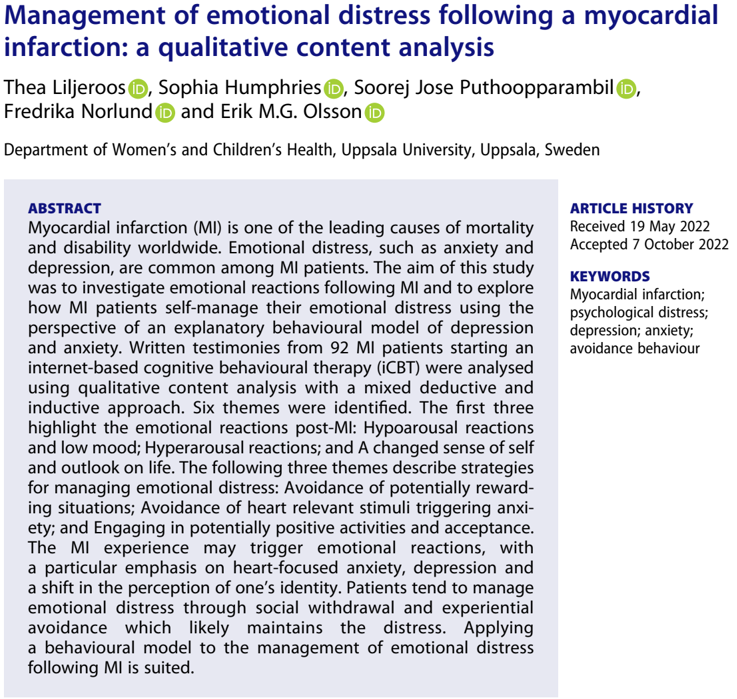
Myocardial infarction (MI) is one of the leading causes of mortality and disability worldwide. Emotional distress, such as anxiety and depression, are common among MI patients. The aim of this study was to investigate emotional reactions following MI and to explore how MI patients self-manage their emotional distress using the perspective of an explanatory behavioural model of depression and anxiety. Written testimonies from 92 MI patients starting an internet-based cognitive behavioural therapy (iCBT) were analysed using qualitative content analysis with a mixed deductive and inductive approach. Six themes were identified. The first three highlight the emotional reactions post-MI: Hypoarousal reactions and low mood; Hyperarousal reactions; and A changed sense of self and outlook on life. The following three themes describe strategies for managing emotional distress: Avoidance of potentially rewarding situations; Avoidance of heart relevant stimuli triggering anxiety; and Engaging in potentially positive activities and acceptance. The MI experience may trigger emotional reactions, with a particular emphasis on heart-focused anxiety, depression and a shift in the perception of one’s identity. Patients tend to manage emotional distress through social withdrawal and experiential avoidance which likely maintains the distress. Applying a behavioural model to the management of emotional distress following MI is suited. © 2022 The Author(s). Published by Informa UK Limited, trading as Taylor & Francis Group.
Overview
CoChat Summary
## TL;DR
This qualitative content analysis of 92 worksheet responses from MI patients in the U-CARE Heart intervention found that emotional distress after myocardial infarction was dominated by heart-focused anxiety, depression, and a changed self-image. Patients commonly managed distress through withdrawal and avoidance, while some used positive activities, relaxation, acceptance, and social/healthcare support.
## Key findings
- The analysis of 92 worksheets produced 6 themes and 23 categories.
- In the quantitative summary, the largest emotional-reaction categories were heart-focused anxiety (89%, 82/92), depression (59%, 54/92), and experiencing a changed self-image (49%, 45/92).
- The most common distress-management categories were withdrawal from social situations (33%, 30/92), avoiding emotions (29%, 27/92), and adopting a mindful coping approach (21%, 19/92).
- The authors conclude that the reported experiences fit a behavioural model of emotional distress after MI, with experiential avoidance and withdrawal likely helping maintain distress.
## Methods
- Qualitative secondary analysis of written worksheet data from the intervention arm of the U-CARE Heart randomized controlled trial; the parent trial recruited 239 MI patients, and 117 were randomized to iCBT.
- The present sample included 92 responders out of 117 intervention participants; participants were recruited from 25 heart clinics in Sweden and were <75 years old, had an MI <3 months prior, and scored >7 on HADS anxiety and/or depression subscales.
- The team conducted a conventional qualitative content analysis with a deductive approach, then added inductive categories as needed; they also quantified coding frequencies in NVivo 12 Pro.
## Limitations
- The paper states that some worksheet responses were short and lacking in depth, which could make meaning difficult to interpret.
- The worksheet asked about strategies with examples, which the authors say could have had a leading effect on responses; they also note that prior consent to a CBT self-management programme may have biased answers.
- Evidence evident from the text: because the study analyzed written worksheet data collected later rather than interviews, the authors note they could not return to participants for verification, and the data may not capture the depth or nuance of lived experience.
Model-written summary. Check it against the paper before relying on it.
Integrity signals
Registry
Cites
Statistics
Figures



Verification
Claims the paper makes
2 Valid · 0 Not valid · 15 Not checked · 120 Own results and interpretations
A result the paper reports from its own data — it cites no other source for it, so there is none to check. The quote shows it is in the paper.
In the paper
“They often find support in their immediate proximity in the form of partners, family members and friends with whom they can share thoughts and emotions during the rehabilitation process and find reassurance.”
plainstates an association- Asserted: passes — The authors put it forward as true.
- Checkable: passes — It can be checked against evidence.
- Load-bearing: unclear — It is unclear whether the paper’s conclusions depend on it.
- Based: passes — The paper gives a reason why it holds.
A result the paper reports from its own data — it cites no other source for it, so there is none to check. The quote shows it is in the paper.
In the paper
“The degree to which the MI event is perceived to be significant and unexpected, varies among the participants.”
plain- Asserted: passes — The authors put it forward as true.
- Checkable: passes — It can be checked against evidence.
- Load-bearing: unclear — It is unclear whether the paper’s conclusions depend on it.
- Based: passes — The paper gives a reason why it holds.
A result the paper reports from its own data — it cites no other source for it, so there is none to check. The quote shows it is in the paper.
In the paper
“In the analysis, heart-focused fear and anxiety in particular were identified as drivers for avoidance.”
plainstates a cause- Asserted: passes — The authors put it forward as true.
- Checkable: passes — It can be checked against evidence.
- Load-bearing: passes — The paper’s conclusions depend on it.
- Based: passes — The paper gives a reason why it holds.
A result the paper reports from its own data — it cites no other source for it, so there is none to check. The quote shows it is in the paper.
In the paper
“With regard to emotional reactions following the MI three categories had the largest proportion of participants represented: the deductively generated categories Heart-focused anxiety (89%) and Depression (59%); as well as the inductively generated category Experiencing a changed self-image (49%).”
plain- Asserted: passes — The authors put it forward as true.
- Checkable: passes — It can be checked against evidence.
- Load-bearing: unclear — It is unclear whether the paper’s conclusions depend on it.
- Based: passes — The paper gives a reason why it holds.
A result the paper reports from its own data — it cites no other source for it, so there is none to check. The quote shows it is in the paper.
In the paper
“Furthermore, some participants describe how they become quiet and hide their emotions from family and friends.”
plain- Asserted: passes — The authors put it forward as true.
- Checkable: passes — It can be checked against evidence.
- Load-bearing: unclear — It is unclear whether the paper’s conclusions depend on it.
- Based: passes — The paper gives a reason why it holds.
60 more claims
Create a free account to see all 137 claims and to verify the 1 reference still open.
- Probably not a substantial claim. 36
- It may state two separate claims as one. 47
Citations
Cites
The Hospital Anxiety and Depression Scale
Zigmond, A. S., & Snaith, R. P. (1983) · Acta Psychiatrica Scandinavica · doi:10.1111/j.1600-0447.1983.tb09716.x · Cited by 47,139 · cited 3×
“The following inclusion criteria were applied: (1) age <75 years, (2) recent myocardial infarction <3 months, and (3) score >7 on one or both of the HADS subscales.”
MethodInfluentialThe qualitative content analysis process
Elo, S., & Kyngäs, H. (2008) · Journal of Advanced Nursing · doi:10.1111/j.1365-2648.2007.04569.x · Cited by 22,617 · cited 5×
“The data analysis process followed the phases described by Elo and Kyngäs (2008): preparation , organizing and reporting .”
InfluentialMaslow, A. H. (1943) · Psychological Review · doi:10.1037/h0054346 · Cited by 21,563 · cited 1×
“Social interaction is generally believed to be one of our basic needs (Maslow, 1943) and its importance for reward and reinforcement has been confirmed even on a neurological level (Rilling & Sanfey, 2011).).”
Graneheim, U. H., & Lundman, B. (2004) · Nurse Education Today · doi:10.1016/j.nedt.2003.10.001 · Cited by 20,772 · cited 5×
“…within the sample regarding for example age and gender (see Table 1), as well as the variety in recruitment context were deemed to facilitate an exploration of the research questions from different perspectives, and thus increase the credibility of the findings (Graneheim & Lundman, 2004).”
InfluentialVos, T., Lim, S. S., Abbafati, C., Abbas, K. M., Abbasi, M., Abbasifard, M., Abbasi-Kangevari, M., Abbastabar, H., Abd-Allah, F., Abdelalim, A., et al. (2020) · The Lancet · doi:10.1016/s0140-6736(20)30925-9 · Cited by 19,358 · cited 1×
“Even though the prognosis after an MI has greatly improved over the last decades, ischaemic heart disease was in 2019 still among the leading causes of mortality and the top-ranked cause of disability among persons aged >50 years worldwide (Vos et al., 2020).”
BackgroundStandards for Reporting Qualitative Research: A Synthesis of Recommendations
O’Brien, B. C., Harris, I. B., Beckman, T. J., Reed, D. A., & Cook, D. A. (2014) · Academic Medicine · doi:10.1097/acm.0000000000000388 · Cited by 12,211
TARGET ARTICLE: "Posttraumatic Growth: Conceptual Foundations and Empirical Evidence"
Tedeschi, R. G., & Calhoun, L. G. (2004) · Psychological Inquiry · doi:10.1207/s15327965pli1501_01 · Cited by 7,154 · cited 1×
“This can possibly be understood in line with the theory of post-traumatic growth but is beyond the scope of this article (Tedeschi & Calhoun, 2004).”
ResultLearned helplessness: Theory and evidence
Maier, S. F., & Seligman, M. E. (1976) · Journal of Experimental Psychology: General · doi:10.1037/0096-3445.105.1.3 · Cited by 2,494 · cited 1×
“The learned helplessness theory states that helplessness is learned after enduring aversive situations failing to control or prevent them (Maier & Seligman, 1976).”
BackgroundUsing Numbers in Qualitative Research
Maxwell, J. A. (2010) · Qualitative Inquiry · doi:10.1177/1077800410364740 · Cited by 985 · cited 2×
“…of the data quantification was to provide an overview of the diversity of perceptions and experiences represented within the data set and to contribute to the internal generalizability of the findings, i.e. that the identified findings are characteristic of the study participants (Maxwell, 2010).”
A functional analysis of depression.
Ferster, C. B. (1973) · American Psychologist · doi:10.1037/h0035605 · Cited by 918 · cited 2×
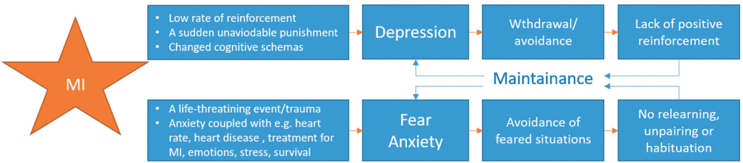
“From a learning theory perspective, depression is best explained by Lewinsohn’s behaviour model of depression (Lewinsohn, 1986), which in turn expands on the works of Ferster (Ferster, 1973).”
Petrie, K. J., Cameron, L. D., Ellis, C. J., Buick, D., & Weinman, J. (2002) · Psychosomatic Medicine · doi:10.1097/00006842-200207000-00007 · Cited by 851 · cited 1×
“The importance of illness perception has been stressed in other studies, and to intervene on illness perception has been found favourable for recovery after MI (Petrie et al., 2002).”
BackgroundThe Neuroscience of Social Decision-Making
Rilling, J. K., & Sanfey, A. G. (2011) · Annual Review of Psychology · doi:10.1146/annurev.psych.121208.131647 · Cited by 775 · cited 1×
“Social interaction is generally believed to be one of our basic needs (Maslow, 1943) and its importance for reward and reinforcement has been confirmed even on a neurological level (Rilling & Sanfey, 2011).).”
BackgroundConducting secondary analysis of qualitative data: Should we, can we, and how?
Ruggiano, N., & Perry, T. E. (2019) · Qualitative Social Work · doi:10.1177/1473325017700701 · Cited by 582 · cited 1×
“As data is shaped by the context in which it was originally collected, performing a data analysis at a later point in time may pose a risk of misinterpretation (Ruggiano & Perry, 2019).”
Meijer, A., Conradi, H. J., Bos, E. H., Thombs, B. D., van Melle, J. P., & de Jonge, P. (2011) · General Hospital Psychiatry · doi:10.1016/j.genhosppsych.2011.02.007 · Cited by 547 · cited 1×
“Emotional distress post MI is in turn a risk-factor for recurrent cardiac events and mortality (Lissåker et al., 2019; Meijer et al., 2011).”
BackgroundCognitive-behavioral therapy for anxiety disorders: An update on the empirical evidence
Kaczkurkin, A. N., & Foa, E. B. (2015) · Dialogues in Clinical Neuroscience · doi:10.31887/dcns.2015.17.3/akaczkurkin · Cited by 523 · cited 1×
“When it comes to anxiety, learning theory has been particularly influential and successful in generating effective exposure-based CBT-labelled treatments (Kaczkurkin & Foa, 2015).”
BackgroundBehavioral Activation for Depression: A Clinician's Guide
Rodgman, C. (2012) · Psychiatric Services · doi:10.1176/appi.ps.2012p837a · Cited by 205
Mowrer, O. H. (1956) · Psychological Review · doi:10.1037/h0040613 · Cited by 178 · cited 4×
“These treatments can be traced back to Mowrer’s two-factor theory (Krypotos, 2015; Mowrer, 1956).”
InfluentialCarvalho, J. P., & Hopko, D. R. (2011) · Journal of Behavior Therapy and Experimental Psychiatry · doi:10.1016/j.jbtep.2010.10.001 · Cited by 176 · cited 1×
“According to Lewinsohns’ model, depression starts with a disruption in the normal behavioural pattern leading to a change in contingent positive reinforcement (Carvalho & Hopko, 2011; Lewinsohn, 1986).”
BackgroundMyocardial infarction and generalised anxiety disorder: 10-year follow-up
Roest, A. M., Zuidersma, M., & de Jonge, P. (2012) · British Journal of Psychiatry · doi:10.1192/bjp.bp.111.103549 · Cited by 149 · cited 1×
“…stress disorder (PTSD), different phobias (e.g. kinesiophobia and agoraphobia), generalised anxiety disorder (GAD) or at least subclinical indications of the same, can also be expected after an MI (Brunetti et al., 2017; Bäck et al., 2018; Jacquet-Smailovic et al., 2021; Roest et al., 2012).”
Norlund, F., Wallin, E., Olsson, E. M. G., Wallert, J., Burell, G., von Essen, L., & Held, C. (2018) · Journal of Medical Internet Research · doi:10.2196/jmir.9710 · Cited by 110 · cited 7×
“U-CARE Heart, which is the base of the present study, was a clinical trial aiming at treating depressed and anxious MI patients with internet-based CBT (iCBT) (Norlund et al., 2018).”
BackgroundMethodResultInfluentialSelf-citationEssential papers on depression
Coyne, J. C. (1986) · New York University Press eBooks · Cited by 106
Heart-focused anxiety before and after cardiac surgery
Hoyer, J., Eifert, G. H., Einsle, F., Zimmermann, K., Krauss, S., Knaut, M., Matschke, K., & Köllner, V. (2008) · Journal of Psychosomatic Research · doi:10.1016/j.jpsychores.2007.09.009 · Cited by 97 · cited 1×
“As expected, our results are thus in line with previous findings of elevated levels of HFA among cardiac patients (Hoyer et al., 2008; Rosman et al., 2015).”
ResultHeart-focused anxiety and chest pain: A conceptual and clinical review.
Eifert, G. H., Zvolensky, M. J., & Lejuez, C. W. (2000) · Clinical Psychology: Science and Practice · doi:10.1093/clipsy.7.4.403 · Cited by 90 · cited 2×
“HFA has been defined as “excessive” and selective attention, fear and avoidance of cardiac related sensations and stimuli based on their perceived negative consequences for cardiac health (Eifert et al., 2000).”
BackgroundPosttraumatic Stress Disorder Following Myocardial Infarction: A Systematic Review
Jacquet‐Smailovic, M., Tarquinio, C., Alla, F., Denis, I., Kirche, A., Tarquinio, C., & Brennstuhl, M. (2020) · Journal of Traumatic Stress · doi:10.1002/jts.22591 · Cited by 54 · cited 1×
“kinesiophobia and agoraphobia), generalised anxiety disorder (GAD) or at least subclinical indications of the same, can also be expected after an MI (Brunetti et al., 2017; Bäck et al., 2018; Jacquet-Smailovic et al., 2021; Roest et al., 2012).”
BackgroundCardiac anxiety after sudden cardiac arrest: Severity, predictors and clinical implications
Rosman, L., Whited, A., Lampert, R., Mosesso, V. N., Lawless, C., & Sears, S. F. (2015) · International Journal of Cardiology · doi:10.1016/j.ijcard.2014.11.115 · Cited by 52 · cited 1×
“As expected, our results are thus in line with previous findings of elevated levels of HFA among cardiac patients (Hoyer et al., 2008; Rosman et al., 2015).”
ResultBrunetti, N. D., Guerra, A., Ieva, R., Correale, M., Santoro, F., Tarantino, N. M., & Biase, M. D. (2017) · Clinical Cardiology · doi:10.1002/clc.22682 · Cited by 51 · cited 1×
“…stress disorder (PTSD), different phobias (e.g. kinesiophobia and agoraphobia), generalised anxiety disorder (GAD) or at least subclinical indications of the same, can also be expected after an MI (Brunetti et al., 2017; Bäck et al., 2018; Jacquet-Smailovic et al., 2021; Roest et al., 2012).”
Bäck, M., Lundberg, M., Cider, Å., Herlitz, J. D., & Jansson, B. (2017) · Journal of Cardiopulmonary Rehabilitation and Prevention · doi:10.1097/hcr.0000000000000265 · Cited by 47 · cited 1×
“…stress disorder (PTSD), different phobias (e.g. kinesiophobia and agoraphobia), generalised anxiety disorder (GAD) or at least subclinical indications of the same, can also be expected after an MI (Brunetti et al., 2017; Bäck et al., 2018; Jacquet-Smailovic et al., 2021; Roest et al., 2012).”
BackgroundNorlund, F., Lissåker, C., Wallert, J., Held, C., & Olsson, E. M. (2018) · European Journal of Preventive Cardiology · doi:10.1177/2047487318770510 · Cited by 45 · cited 7×
“U-CARE Heart, which is the base of the present study, was a clinical trial aiming at treating depressed and anxious MI patients with internet-based CBT (iCBT) (Norlund et al., 2018).”
InfluentialSelf-citationThe Experience of Younger Adults Following Myocardial Infarction
Andersson, E. K., Borglin, G., & Willman, A. (2013) · Qualitative Health Research · doi:10.1177/1049732313482049 · Cited by 40 · cited 1×
“The stressful and life-altering nature of an MI has been recognised in previous research (Andersson et al., 2013; Petriček et al., 2017) and is evident also in the results from the present study.”
ResultSocial Support, Self-Efficacy, and Helplessness Following Myocardial Infarctions
Smallheer, B., & Dietrich, M. S. (2019) · Critical Care Nursing Quarterly · doi:10.1097/cnq.0000000000000265 · Cited by 37 · cited 1×
“Learned helplessness and low self-efficacy among MI-patients has been found also in previous research (Smallheer & Dietrich, 2019).”
Lissåker, C. T., Norlund, F., Wallert, J., Held, C., & Olsson, E. M. (2019) · European Journal of Preventive Cardiology · doi:10.1177/2047487319841475 · Cited by 37 · cited 1×
“Emotional distress post MI is in turn a risk-factor for recurrent cardiac events and mortality (Lissåker et al., 2019; Meijer et al., 2011).”
BackgroundSelf-citationDu, R., Wang, P., Ma, L., Larcher, L. M., Wang, T., & Chen, C. (2020) · Health and Quality of Life Outcomes · doi:10.1186/s12955-020-01447-4 · Cited by 37 · cited 1×
“Previous research indicates that avoidant coping strategies are fairly common among MI patients (Du et al., 2020; Fuochi & Foà, 2018).”
BackgroundFuochi, G., & Foà, C. (2017) · Scandinavian Journal of Caring Sciences · doi:10.1111/scs.12435 · Cited by 26 · cited 1×
“Previous research indicates that avoidant coping strategies are fairly common among MI patients (Du et al., 2020; Fuochi & Foà, 2018).”
Amirova, A., Lucas, R., Cowie, M. R., & Haddad, M. (2022) · PLOS ONE · doi:10.1371/journal.pone.0271743 · Cited by 17 · cited 1×
“For example, this was supported in another recent qualitative study where an MI was suggested to cause habit-breaking (Amirova et al., 2022).”
ResultPetriček, G., Buljan, J., Prljević, G., & Vrcić-Keglević, M. (2017) · European Journal of General Practice · doi:10.1080/13814788.2016.1274726 · Cited by 13 · cited 2×
“…findings suggest that the MI may constitute a stressful and disruptive event, triggering emotions, such as anxiety and depression, as well as a shift in the perception of the self and one’s own identity, thus adding to the findings of previous research (Norlund et al., 2018; Petriček et al., 2017).”
Norlund, F., Lissaker, C., Olsson, E. M., et al. (2017) · European Heart Journal · doi:10.1093/eurheartj/ehx502.p2509
Self-citation
Research works printed but not linked: 3
- Beck, A. T., Rush, A. J., Shaw, B. F., & Emery, G. (1979). Cognitive Therapy of Depression (pp. 435). New York: The Guilford Press.
- Krypotos A.-M., 2015, Frontiers in Behavioral Neuroscience, 9
- Spencer, L., Ritchie, J., Ormston, R., O'Connor, W., & Barnard, M. (2014). Analysis: Principles and processes. In J. Ritchie, J. Lewis, C. McNaughton Nocholls, & R. Ormston (Eds.), Qualitative research practice: A guide for social science students & researchers (2nd ed., pp. 456). SAGE Publications Ltd.
Cited by
Levine, G. N., Carney, R. M., Cohen, B. E., Dunn, S. L., Gaffey, A. E., Kronish, I. M., Olsson, E. M. G., & Huffman, J. C. (2025) · Circulation · doi:10.1161/cir.0000000000001381 · Cited by 57
Self-citationWang, Z., Shalihaer, K., Hofmann, S. G., Feng, S., & Liu, X. (2024) · Clinical Psychology & Psychotherapy · doi:10.1002/cpp.2981 · Cited by 14
Sustainable Fashion in New Era: Exploring Consumer Resilience and Goals in the Post-Pandemic
Hwang, J., Sun, X., Zhao, L., & Youn, S. (2024) · Sustainability · doi:10.3390/su16083140 · Cited by 22
Chew, T. R., Yeo, T. M., Teo, J. Y. C., Seah, A. C. W., Soh, C. K., Meng, J., & Wang, W. (2025) · European Journal of Cardiovascular Nursing · doi:10.1093/eurjcn/zvae179 · Cited by 13
Cruciani, G., Buglio, G. L., Tanzilli, A., Liotti, M., Scalzeri, M., Tanzilli, G., Galli, F., & Lingiardi, V. (2025) · Behavioral Sciences · doi:10.3390/bs15040528 · Cited by 8
“…than healthy controls, as shown by previous research on coping and emotion regulation strategies (Colovic et al., 2016; Fiorentino et al., 2024; Liljeroos et al., 2023); (2) to investigate the associations between depressive and anxiety symptoms, defensive functioning, and mentalized…”
Metadata
- Authors
- Liljeroos, T., Humphries, S., Puthoopparambil, S. J., Norlund, F., & Olsson, E. M. G.
- Affiliations
- Uppsala University (SE)
- Corresponding author
- Olsson, Erik M.G.
- Venue
- Cognitive Behaviour Therapy
- Publisher
- Informa UK Limited
- Published
- 2022-11-28
- Volume
- 52
- Issue
- 1
- Pages
- 47-64
- ISSN
- 1650-6073 (ISSN-L)
- 1651-2316
- OpenAlex
- W4310032401
- Semantic Scholar
- f9b5181b5ab0507af7835b9a566c770eaf89bcd8
- Cited by
- 15
- References
- 35
- Citations by year
- 2026: 1 · 2025: 8 · 2024: 5 · 2023: 1
- FWCI
- 2.44
- Type
- journal article
- Language
- en
- Open access
- hybrid
- doi.org
- Locations
- Cognitive Behaviour Therapy (publishedVersion, cc-by)
- PubMed (publishedVersion)
- Diva portal (Dalarna University Library) (submittedVersion, other-oa)
- KTH Publication Database DiVA (KTH Royal Institute of Technology) (submittedVersion, other-oa)
- Funders
- the Swedish Research Council (2009-1093)
- Uppsala-Örebro Regional Research Council (22 86 61)
- Swedish Research Council for Health, Working Life, and Welfare (2014-4947)
- the Vårdal foundation (2014-0114)
- Topics
- Health Sciences › Medicine › Cardiology and Cardiovascular Medicine › Cardiac Health and Mental Health
- Social Sciences › Psychology › Experimental and Cognitive Psychology › Anxiety, Depression, Psychometrics, Treatment, Cognitive Processes
- Health Sciences › Medicine › Oncology › Cancer survivorship and care
- Keywords
- myocardial infarction, emotional distress, anxiety, depression, self-management, internet-based cognitive behavioral therapy, hypervigilance, avoidance, social withdrawal, personal transformation
- MeSH terms
- Psychological Distress, Anxiety, Anxiety Disorders, Depression, Emotions, Humans, Myocardial Infarction
About these checks
Registry, retraction, Cites and statistics results are computed, not judged, with one exception: a printed reference that no index lists is read once by a model before it counts as a citation error. Claims are extracted by a model and kept only when their quote appears verbatim in the text; each cited source is then checked, with a model’s help, for whether it says what the claim relies on. Those verdicts can be wrong — read the claim’s quote and the cited source before relying on one.
A language model drew the claims from the paper on 2026-10-11, under version 3 of the claim definition (model deepseek-v4.1-flash, prompt extract-v3).
A second model labelled each claim on 2026-10-11 (model jev-1.13-20260917, definition revision gold-guideline-v0.2).
Statistics and arithmetic are recomputed, not judged.
Confidence bands are shown only for fields calibrated on our annotated test set. None is calibrated yet, so no band is shown.
What counts as a claim ›How we measure confidence ›How we check this ›
Are you an author, or do you see a problem with this page? Request a review
Data sources
Bibliographic data: Semantic Scholar, OpenAlex, Crossref.
Contains information from the Semantic Scholar Academic Graph Datasets, made available under the ODC Attribution License (ODC-BY 1.0).
Semantic Scholar’s data is described in: Kinney, R., et al. (2023). The Semantic Scholar Open Data Platform. arXiv:2301.10140.
