

The effects of fasting on drug metabolism
Open accessThe DOI matches its Crossref record; 60 of the 61 references it cites were found in a registry or an index.
Abstract
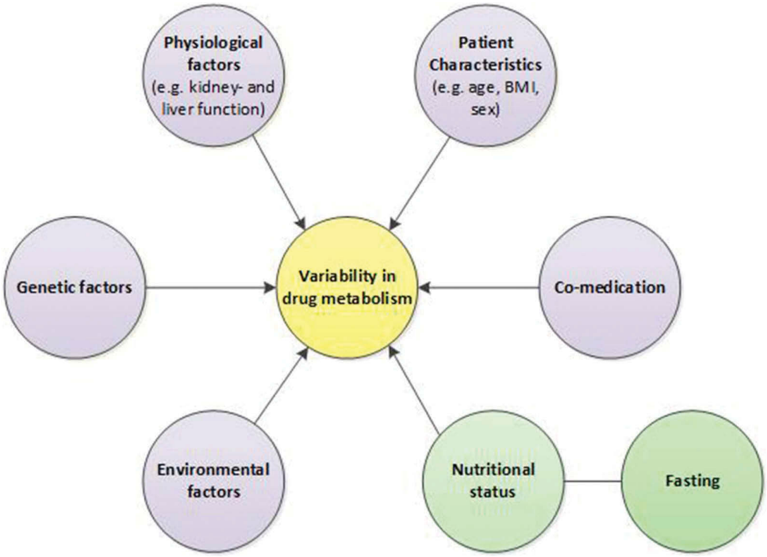
Introduction: There is considerable variability in the rates and extent of drug metabolism between patients due to physiological, genetic, pharmacologic, environmental and nutritional factors such as fasting. This variability in drug metabolism may result in treatment failure or, conversely, in increased side effects or toxicity. Preclinical studies have shown that fasting alters drug metabolism by modulating the activity of drug metabolizing enzymes involved. However, until recently little was known about the effects of fasting on drug metabolism in humans.Areas covered: This review describes the effects of fasting on drug metabolism based on both preclinical studies and studies performed in humans.Expert opinion: A better understanding of the effects of fasting may improve the efficacy and safety of pharmacotherapy for individual patients. Fasting contributes to variability in human drug metabolism by differentially affecting drug metabolizing enzymes. Although the effects of fasting on drug metabolism appear to be small (between 10-20%), fasting may be relevant for drugs with a small therapeutic range and/or in combination with other factors that contribute to variability in drug metabolism such as physiological, genetic or pharmacological factors. Therefore, additional research on this topic is warranted.
Overview
The claims and statistics of this paper haven’t been checked yet.
Free: it reads the open-access text and checks the first 5 claims that cite a source we can check. Create a free account to check every claim.
Integrity signals
Registry
Cites
Statistics
Figures


Verification
Claims the paper makes
The claims and statistics of this paper haven’t been checked yet.
Free: it reads the open-access text and checks the first 5 claims that cite a source we can check. Create a free account to check every claim.
Claims other papers make about this one
Each is checked against this paper’s own text: does it say what the citing paper says it does?
The source backs part of the claim, not all of it — or backs it for a different population, condition or comparison.
In the citing paper
“Tobacco smoking [43], alcohol consumption [44], fasting [55], and concomitant drug use [56, 57] may influence antidepressant metabolization and thus the bioavailability of the drugs”
From The relationship between dose and serotonin transporter occupancy of antidepressants—a systematic review (2022) · cites this paper as [55]
Experimental — accuracy not yet measured
Self-check
Percentages, sums and reported differences re-computed from the paper’s own numbers.
The self-check needs the paper’s full text.
Citations
Cites
Zanger, U. M., & Schwab, M. (2013) · Pharmacology & Therapeutics · doi:10.1016/j.pharmthera.2012.12.007 · Cited by 4,169 · cited 2×
“introduced into drug substrates by oxidation, reduction or hydrolysis [8].”
BackgroundMartignoni, M., Groothuis, G. M. M., & de Kanter, R. (2006) · Expert Opinion on Drug Metabolism & Toxicology · doi:10.1517/17425255.2.6.875 · Cited by 1,478
Induction of phase I, II and III drug metabolism/transport by xenobiotics
Xu, C., Li, C. Y.-T., & Kong, A.-N. T. (2005) · Archives of Pharmacal Research · doi:10.1007/bf02977789 · Cited by 1,279 · cited 2×
“gastrointestinal tract, kidney and lungs [9].”
BackgroundWilliams, J. A., Hyland, R., Jones, B. C., Smith, D. A., Hurst, S., Goosen, T. C., Peterkin, V., Koup, J. R., & Ball, S. E. (2004) · Drug Metabolism and Disposition · doi:10.1124/dmd.104.000794 · Cited by 928 · cited 3×
“UGTs represent the majority of phase II metabolizing enzymes.”
BackgroundClinical pharmacokinetics and metabolism of irinotecan (CPT-11).
Mathijssen, R. H. J., van Alphen, R. J., Verweij, J., Loos, W. J., Nooter, K., Stoter, G., & Sparreboom, A. (2001) · EUR Research Repository (Erasmus University Rotterdam) · Cited by 911
Brandhorst, S., Choi, I. Y., Wei, M., Cheng, C. W., Sedrakyan, S., Navarrete, G., Dubeau, L., Yap, L. P., Park, R., Vinciguerra, M., et al. (2015) · Cell Metabolism · doi:10.1016/j.cmet.2015.05.012 · Cited by 850 · cited 1×
“of oncology with low protein fasting mimicking diets to ease the burden of prolonged fasting [58,60].”
BackgroundNomenclature update for the mammalian UDP glycosyltransferase (UGT) gene superfamily
Mackenzie, P. I., Walter Bock, K., Burchell, B., Guillemette, C., Ikushiro, S.-I., Iyanagi, T., Miners, J. O., Owens, I. S., & Nebert, D. W. (2005) · Pharmacogenetics and Genomics · doi:10.1097/01.fpc.0000173483.13689.56 · Cited by 821 · cited 1×
“These enzymes represent two families (UGT1 and UGT2) including 9 human family UGT1 enzymes, 3 subfamily UGT2A and 8 UGT2B enzymes [13].”
BackgroundThe Human Nuclear Xenobiotic Receptor PXR: Structural Determinants of Directed Promiscuity
Watkins, R. E., Wisely, G. B., Moore, L. B., Collins, J. L., Lambert, M. H., Williams, S. P., Willson, T. M., Kliewer, S. A., & Redinbo, M. R. (2001) · Science · doi:10.1126/science.1060762 · Cited by 760 · cited 1×
“rifampicin), antimycotics, bile acids and many herbal compounds [33,34].”
BackgroundMcGill, M. R., & Jaeschke, H. (2013) · Pharmaceutical Research · doi:10.1007/s11095-013-1007-6 · Cited by 704 · cited 1×
“UGT1A1 is also involved in acetaminophen (paracetamol) metabolism [15].”
BackgroundOverview of Therapeutic Drug Monitoring
Kang, J.-S., & Lee, M.-H. (2009) · The Korean journal of internal medicine · doi:10.3904/kjim.2009.24.1.1 · Cited by 669 · cited 1×
“levels within an established therapeutic range [64].”
Research works printed but not linked: 2
- 4. Berg JMTJ, Stryer L. Biochemistry. 5th ed. New York: W H Freeman; 2002.
- 14. Pratt V, McLeod H, Dean L, et al., editors Medical genetics summaries [Internet]. Bethesda (MD): National Center for Biotechnology Information (US). 2012.
Cited by
The Gut Microbiota (Microbiome) in Cardiovascular Disease and Its Therapeutic Regulation
Rahman, M. M., Islam, F., -Or-Rashid, M. H., Mamun, A. A., Rahaman, M. S., Islam, M. M., Meem, A. F. K., Sutradhar, P. R., Mitra, S., Mimi, A. A., et al. (2022) · Frontiers in Cellular and Infection Microbiology · doi:10.3389/fcimb.2022.903570 · Cited by 253
“Individual therapeutic responses and drug-related side effects differ based on various factors such as gender, age, BMI, disease state, environmental factors, and genetic polymorphisms (Lammers et al., 2020).”
BackgroundA cross-talk between gut microbiome, salt and hypertension
Naqvi, S., Asar, T. O., Kumar, V., Al-Abbasi, F. A., Alhayyani, S., Kamal, M. A., & Anwar, F. (2021) · Biomedicine & Pharmacotherapy · doi:10.1016/j.biopha.2020.111156 · Cited by 99
Sørensen, A., Ruhé, H. G., & Munkholm, K. (2022) · Molecular Psychiatry · doi:10.1038/s41380-021-01285-w · Cited by 65
Veldscholte, K., Cramer, A. B. G., Joosten, K., & Verbruggen, S. C. A. T. (2021) · Clinical Nutrition · doi:10.1016/j.clnu.2021.07.030 · Cited by 20
“Additionally, fasting might contribute to variability in drug metabolism, and thus drug levels, by its effects on metabolizing enzyme activity [158].”
Hasan, M. S. A., Bhuia, M. S., Chowdhury, R., Husain, Z., Saifuzzaman, M., Mia, E., Akbor, M. S., Yana, N. T., Islam, M. A., Ansari, S. A., et al. (2025) · Neuroscience · doi:10.1016/j.neuroscience.2025.03.004 · Cited by 21
Säll, C., Alifrangis, L., Dahl, K., Friedrichsen, M. H., Nygård, S. B., & Kristensen, K. (2022) · Drug Metabolism and Disposition · doi:10.1124/dmd.122.000865 · Cited by 17
“Finally, short-term fasting is known to alter the activity of drug metabolising enzymes (Lammers et al., 2020).”
BackgroundShort-term fasting and fasting mimicking diets combined with chemotherapy: a narrative review
Kikomeko, J., Schutte, T., van Velzen, M. J. M., Seefat, R. L., & van Laarhoven, H. W. M. (2023) · Therapeutic Advances in Medical Oncology · doi:10.1177/17588359231161418 · Cited by 23
Yassin, M. A., Al‐Rasheed, M., Al-Khabori, M. K., Marashi, M., Osman, H. Y., Wali, Y. A. M. S., Alkindi, S. S. A., Alsayegh, F., & Provan, D. (2023) · Frontiers in Cardiovascular Medicine · doi:10.3389/fcvm.2023.1260487 · Cited by 13
“Fasting was found to be one of the factors that affect drugs ’ metabolism and response (24).”
BackgroundDosage Forms - Innovation and Future Perspectives
Ahmad, U. (2022) · IntechOpen eBooks · doi:10.5772/intechopen.95734 · Cited by 11
Integration of infrared spectroscopy and forensic entomology: a review of three research directions
Zhang, R., & Wang, Y. (2023) · Applied Spectroscopy Reviews · doi:10.1080/05704928.2023.2280583 · Cited by 10
“…variations in drug concentrations, [128,129] both intrinsic factors such as species, sex, [130] age, [131] gut flora, [132] pregnancy, [133] disease, [134] genes [135] and extrinsic factors such as geographic location, [136] temperature, humidity, and diet [137] affect drug metabolism rates.”
Rabea, E. M., Abbas, K. S., Awad, D. M., Elgoweini, N. H., El‐Sakka, A. A., Mahmoud, N., & Abdelazeem, B. (2022) · European Journal of Clinical Pharmacology · doi:10.1007/s00228-022-03281-7 · Cited by 10
“In addition, fasting may be associated with weight loss, which may contribute to variability in drug metabolism [28].”
BackgroundIn Vitro Drug Metabolism Studies Using Human Liver Microsomes
Gajula, S. N. R., Vora, S. A., Dikundwar, A. G., & Sonti, R. (2022) · IntechOpen eBooks · doi:10.5772/intechopen.108246 · Cited by 23
Alper, A. T., Istanbul-Turkey, Akboğa, M. K., Özcan, K. S., Tengiz, İ., Türk, U. Ö., Yildiz, M., Yılmaz, M. B., Kayıkçıoğlu, M., Gazı, E., et al. (2021) · The Anatolian Journal of Cardiology · doi:10.5152/anatoljcardiol.2021.206 · Cited by 11
“Maintaining the plasma drug concentration in the therapeutic window is an essential requirement for drug safety and also effectiveness (62).”
BackgroundInfluentialAlwhaibi, A. M., Alenazi, M. A., Alwagh, F., Al‐Ghayhab, A., Alghadeer, S. M., Bablghaith, S. D., Syed, W., & Al-Arifi, M. N. (2021) · International Journal of Clinical Practice · doi:10.1111/ijcp.14796 · Cited by 8
Fasting Enhances the Acute Toxicity of Acrylonitrile in Mice via Induction of CYP2E1
Wang, S., Xing, G., Li, F., Yang, B., Zhang, Y., Aschner, M., & Lu, R. (2022) · Toxics · doi:10.3390/toxics10060337 · Cited by 7
Balasmeh, R., Jarrar, Y. B., Al-Sheikh, I., Alshaiah, H., Jarrar, Q., Alani, R., & Abudahab, S. (2022) · Current Drug Metabolism · doi:10.2174/1389200223666220820105330 · Cited by 6
Kwon, D.-Y., Seo, H., Kim, S. H., Chung, K. W., Lee, J., & Jung, Y. (2024) · Food and Chemical Toxicology · doi:10.1016/j.fct.2024.114624 · Cited by 5
Mišı́k, V., & Boleček, M. (2023) · IntechOpen eBooks · doi:10.5772/intechopen.1001279 · Cited by 4
Yassin, M. A., AlRasheed, M., Al-Eisa, T., Alhashim, N., Alsayegh, F., Abouzeid, T., Fattah, M. A. E., Alfili, M., Shalaby, N., Alotaibi, A., et al. (2025) · Frontiers in Nutrition · doi:10.3389/fnut.2025.1434484 · Cited by 3
Ethics - Scientific Research, Ethical Issues, Artificial Intelligence and Education [Working Title]
Radenković, M. (2023) · IntechOpen eBooks · doi:10.5772/intechopen.1001548 · Cited by 4
Simulation of the crosstalk between glucose and acetaminophen metabolism in a liver zonation model
Maeda, K., Hagimori, S., Masahiro, S., Sakai, Y., & Nishikawa, M. (2022) · Frontiers in Pharmacology · doi:10.3389/fphar.2022.995597 · Cited by 3
“The blood concentrations of glucose and APAP under different conditions, such as fasting, feeding, and moderate- and over-doses, were determined according to previous reports (Kennedy et al., 2019; Means and Ho, 2019; Lammers et al., 2020).”
ResultShah, A., Bazemore, T. C., Wolf, H. M., Yang, H., Liu, Y., & Stouffer, G. A. (2021) · The American Journal of Cardiology · doi:10.1016/j.amjcard.2021.08.017 · Cited by 3
Simeone, C. A., Scott, G. N., Navarro, R. A., & Procter, D. (2022) · Oceans · doi:10.3390/oceans3030023 · Cited by 1
Remedies Against Plausible Adverse Interactions
Moreira, C. V. D. L., Saavedra-Rodríguez, R., & Fajemiroye, J. O. (2025) · Springer eBooks · doi:10.1007/978-3-031-80107-5_14 · Cited by 1
Factors Affecting Plasma Concentrations
Curry, S. H., & Whelpton, R. (2022) · Wiley eBooks · doi:10.1002/9781119589181.ch10
Rairat, T., Hsieh, M., Lu, Y., Ho, W., Wu, H., & Chou, C. (2023) · Journal of Veterinary Pharmacology and Therapeutics · doi:10.1111/jvp.13115
There is no need for overnight fasting of rats in regulatory toxicology studies
Arnouts, S. J. A. C., Crezee, T., van Dycke, K., & Beekhuijzen, M. E. W. (2024) · Toxicology · doi:10.1016/j.tox.2024.153937
Pharmacokinetics of Antibiotics in Crocodiles: A Review
Laut, S., Poapolathep, S., Sitthiangkool, P., Klangkaew, N., Phaochoosak, N., Gıorgı, M., Badillo, E., Escudero, E., Marı́n, P., & Poapolathep, A. (2025) · Animals · doi:10.3390/ani15101363
“These enzymes play a crucial role in drug metabolism; fasting can either increase or decrease the activity of certain CYP enzymes and phase II enzymes, affecting drug clearance and therapeutic effectiveness [72].”
Faith and fasting in dermatology: Ethical dilemmas in pharmacologic treatment
Zieneldien, T., Ma, S., Kim, J., Tan, I. J., & Grant-Kels, J. M. (2026) · Clinics in Dermatology · doi:10.1016/j.clindermatol.2026.01.003
Shojaei, S., Mousavi, A., Radkhah, H., Mahalleh, M., Rahmati, S., Soltani, P., Farooqi, M. A., Ashrafi, M. M., bozorgi, S. J., Moradi, A., et al. (2026) · Critical Pathways in Cardiology A Journal of Evidence-Based Medicine · doi:10.1097/hpc.0000000000000402
Kim, M., Yang, E., Chung, S.-J., Lee, W., & Jeong, Y. (2026) · Environment International · doi:10.1016/j.envint.2026.110475
Metadata
- Authors
- Lammers, L. A., Achterbergh, R., Mathôt, R. A. A., & Romijn, J. A.
- Affiliations
- Amsterdam UMC Location University of Amsterdam (NL)
- Corresponding author
- Lammers, Laureen A.
- Venue
- Expert Opinion on Drug Metabolism & Toxicology
- Publisher
- Informa UK Limited
- Published
- 2019-12-24
- Volume
- 16
- Issue
- 1
- Pages
- 79-85
- ISSN
- 1742-5255 (ISSN-L)
- 1744-7607
- OpenAlex
- W2994971940
- Cited by
- 32
- References
- 61
- Citations by year
- 2026: 3 · 2025: 4 · 2024: 2 · 2023: 6 · 2022: 10 · 2021: 7
- FWCI
- 0.67
- Type
- journal article
- Language
- en
- Open access
- hybrid
- doi.org
- Licence
- Locations
- Expert Opinion on Drug Metabolism & Toxicology (publishedVersion, cc-by-nc-nd)
- PubMed (publishedVersion)
- Pure Amsterdam UMC (submittedVersion, cc-by)
- Data Archiving and Networked Services (DANS) (submittedVersion, other-oa)
- Utrecht University Repository (Utrecht University) (submittedVersion, other-oa)
- Topics
- Life Sciences › Pharmacology, Toxicology and Pharmaceutics › Pharmacology › Pharmacogenetics and Drug Metabolism
- Health Sciences › Medicine › Physiology (medical) › Dietary Effects on Health
- Health Sciences › Medicine › Oncology › Drug Transport and Resistance Mechanisms
- Keywords
- fasting, drug metabolism, interindividual variability, drug-metabolizing enzymes, pharmacokinetics, drug therapy safety, therapeutic window, dietary factors
- MeSH terms
- Animals, Pharmaceutical Preparations, Fasting, Humans, Treatment Outcome, Treatment Failure, Drug-Related Side Effects and Adverse Reactions
About these checks
Registry, retraction, Cites and statistics results are computed, not judged, with one exception: a printed reference that no index lists is read once by a model before it counts as a citation error. Claims are extracted by a model and kept only when their quote appears verbatim in the text; each cited source is then checked, with a model’s help, for whether it says what the claim relies on. Those verdicts can be wrong — read the claim’s quote and the cited source before relying on one.
Statistics and arithmetic are recomputed, not judged.
Confidence bands are shown only for fields calibrated on our annotated test set. None is calibrated yet, so no band is shown.
What counts as a claim ›How we measure confidence ›How we check this ›
Are you an author, or do you see a problem with this page? Request a review
Data sources
Bibliographic data: Semantic Scholar, OpenAlex, Crossref.
Contains information from the Semantic Scholar Academic Graph Datasets, made available under the ODC Attribution License (ODC-BY 1.0).
Semantic Scholar’s data is described in: Kinney, R., et al. (2023). The Semantic Scholar Open Data Platform. arXiv:2301.10140.
