

A systematic review of the studies testing the integrated motivational-volitional model of suicidal behaviour
Open accessThe DOI matches its Crossref record, with a small difference in title or year; 60 of the 60 references it cites were found in a registry or an index.
Abstract
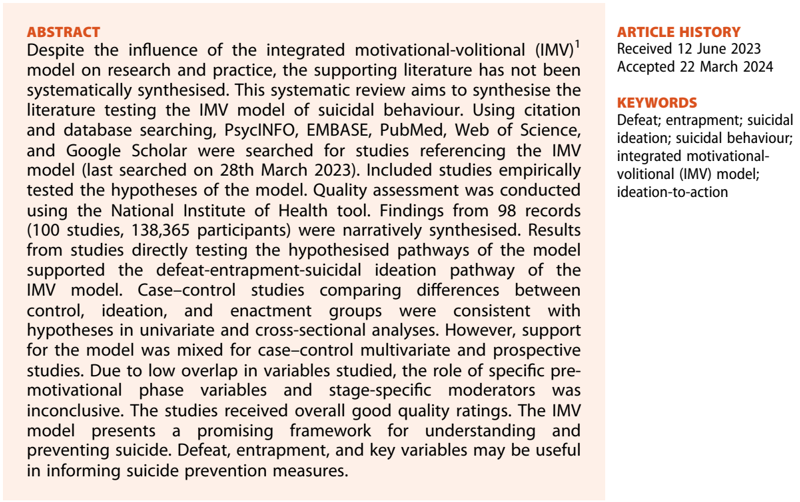
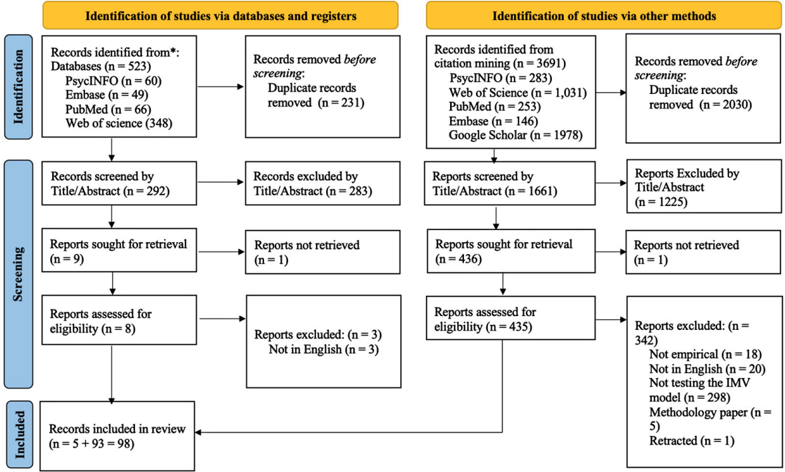
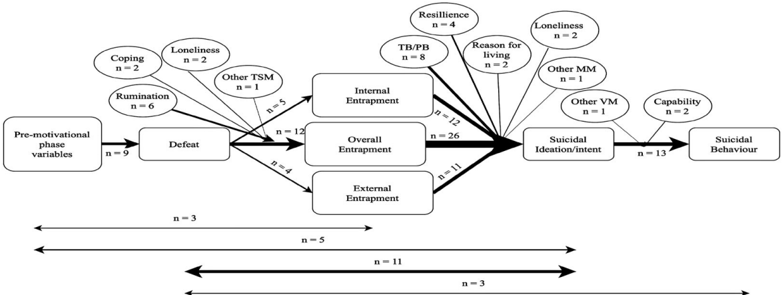
model on research and practice, the supporting literature has not been systematically synthesised. This systematic review aims to synthesise the literature testing the IMV model of suicidal behaviour. Using citation and database searching, PsycINFO, EMBASE, PubMed, Web of Science, and Google Scholar were searched for studies referencing the IMV model (last searched on 28th March 2023). Included studies empirically tested the hypotheses of the model. Quality assessment was conducted using the National Institute of Health tool. Findings from 98 records (100 studies, 138,365 participants) were narratively synthesised. Results from studies directly testing the hypothesised pathways of the model supported the defeat-entrapment-suicidal ideation pathway of the IMV model. Case-control studies comparing differences between control, ideation, and enactment groups were consistent with hypotheses in univariate and cross-sectional analyses. However, support for the model was mixed for case-control multivariate and prospective studies. Due to low overlap in variables studied, the role of specific pre-motivational phase variables and stage-specific moderators was inconclusive. The studies received overall good quality ratings. The IMV model presents a promising framework for understanding and preventing suicide. Defeat, entrapment, and key variables may be useful in informing suicide prevention measures.
Overview
The claims and statistics of this paper haven’t been checked yet.
Free: it reads the open-access text and checks the first 5 claims that cite a source we can check. Create a free account to check every claim.
Integrity signals
Registry
Cites
Statistics
Figures
Verification
Claims the paper makes
The claims and statistics of this paper haven’t been checked yet.
Free: it reads the open-access text and checks the first 5 claims that cite a source we can check. Create a free account to check every claim.
Claims other papers make about this one
Each is checked against this paper’s own text: does it say what the citing paper says it does?
The source backs part of the claim, not all of it — or backs it for a different population, condition or comparison.
In the citing paper
“Meta-analyses of two important theoretical models, the Interpersonal Theory of Suicidal Behavior (19) and the Integrative Motivational-Volitional Model of Suicidal Behavior (20, 21), show results that are consistent with the theories. The effects are, however, comparatively small (22, 23) and do not exceed the predictive power found in the other meta-analyses described above.”
From Suicide risk assessment: clinical implications of the unpredictability of suicidal behavior (2026) · cites this paper as [23]
Experimental — accuracy not yet measured
Self-check
Percentages, sums and reported differences re-computed from the paper’s own numbers.
The self-check needs the paper’s full text.
Citations
Cites
The PRISMA 2020 statement: An updated guideline for reporting systematic reviews
Page, M. J., McKenzie, J. E., Bossuyt, P. M., Boutron, I., Hoffmann, T. C., Mulrow, C. D., Shamseer, L., Tetzlaff, J. M., Akl, E. A., Brennan, S. E., et al. (2021) · BMJ · doi:10.1136/bmj.n71 · Cited by 108,283
Scoping studies: towards a methodological framework
Arksey, H., & O'Malley, L. (2005) · International Journal of Social Research Methodology · doi:10.1080/1364557032000119616 · Cited by 36,742 · cited 1×
“Additionally, we conducted a systematic review rather than a scoping review as our primary aim was to synthesise the evidence supporting clinically pertinent hypotheses with an aim to inform practice (Arksey & O ’ Malley, 2005; Munn et al., 2018).”
Munn, Z., Peters, M. D. J., Stern, C., Tufanaru, C., McArthur, A., & Aromataris, E. (2018) · BMC Medical Research Methodology · doi:10.1186/s12874-018-0611-x · Cited by 11,385 · cited 1×
“Additionally, we conducted a systematic review rather than a scoping review as our primary aim was to synthesise the evidence supporting clinically pertinent hypotheses with an aim to inform practice (Arksey & O ’ Malley, 2005; Munn et al., 2018).”
The interpersonal theory of suicide.
Van Orden, K. A., Witte, T. K., Cukrowicz, K. C., Braithwaite, S. R., Selby, E. A., & Joiner, T. E. (2010) · Psychological Review · doi:10.1037/a0018697 · Cited by 5,292 · cited 2×
“…theoretical models in suicide, health psychology literature, and empirical evidence to identify a common modi fi able pathway giving rise to suicidal thoughts and behaviour (Barzilay & Apter, 2014; Gilbert & Allan, 1998; Joiner, 2005; Schotte & Clum, 1987; Van Orden et al., 2010; Williams, 2001).”
Naghavi, M., Abajobir, A. A., Abbafati, C., Abbas, K. M., Abd-Allah, F., Abera, S. F., Aboyans, V., Adetokunboh, O., Afshin, A., Agrawal, A., et al. (2017) · The Lancet · doi:10.1016/s0140-6736(17)32152-9 · Cited by 4,821 · cited 1×
“Despite signi fi cant improvements in preventing other leading causes of death, our ability to predict and prevent suicide has shown little improvement over the past fi ve decades (Franklin et al., 2017; Naghavi et al., 2017).”
Risk factors for suicidal thoughts and behaviors: A meta-analysis of 50 years of research
Franklin, J. C., Ribeiro, J. D., Fox, K. R., Bentley, K. H., Kleiman, E. M., Huang, X., Musacchio, K. M., Jaroszewski, A. C., Chang, B. P., & Nock, M. K. (2017) · Psychological Bulletin · doi:10.1037/bul0000084 · Cited by 3,784 · cited 2×
“Despite signi fi cant improvements in preventing other leading causes of death, our ability to predict and prevent suicide has shown little improvement over the past fi ve decades (Franklin et al., 2017; Naghavi et al., 2017).”
Gusenbauer, M., & Haddaway, N. R. (2020) · Research Synthesis Methods · doi:10.1002/jrsm.1378 · Cited by 2,379 · cited 1×
“Several authors have suggested potential reproducibility issues on account of results dropping in and out of relevance (Bramer & Bain, 2017; Gusenbauer & Haddaway, 2020).”
The integrated motivational–volitional model of suicidal behaviour
O'Connor, R. C., & Kirtley, O. J. (2018) · Philosophical Transactions of the Royal Society B: Biological Sciences · doi:10.1098/rstb.2017.0268 · Cited by 1,781
Chu, C., Buchman-Schmitt, J. M., Stanley, I. H., Hom, M. A., Tucker, R. P., Hagan, C. R., Rogers, M. L., Podlogar, M. C., Chiurliza, B., Ringer, F. B., et al. (2017) · Psychological Bulletin · doi:10.1037/bul0000123 · Cited by 1,231 · cited 1×
“Recent research on suicide has highlighted that suicidal behaviours are likely in fl uenced by interrelationships between hundreds of biological, psychological, social, and cultural factors (Chu et al., 2017; Levi-Belz et al., 2019; O ’ Connor & Nock, 2014).”
The psychology of suicidal behaviour
O'Connor, R. C., & Nock, M. K. (2014) · The Lancet Psychiatry · doi:10.1016/s2215-0366(14)70222-6 · Cited by 1,193 · cited 1×
“Recent research on suicide has highlighted that suicidal behaviours are likely in fl uenced by interrelationships between hundreds of biological, psychological, social, and cultural factors (Chu et al., 2017; Levi-Belz et al., 2019; O ’ Connor & Nock, 2014).”
Research works printed but not linked: 5
- 10. Cleare, S. (2019). Exploring the role of self-compassion in self-harm and suicidal ideation [PhD thesis]. University of Glasgow. http://theses.gla.ac.uk/id/eprint/81292
- 20. Hollingsworth, D. W. (2012). An examination of the motivational phase of the integrated motivational-volitional model of suicide in african americans [Doctoral Thesis, Oklahoma State University]. APA PsycInfo. https://hdl.handle.net/11244/ 299513
- 23. Joiner, T. (2005). Why people die by suicide. Harvard University Press. · doi:10.1037//0022-0006x.64.2.264
- 45. O'Connor, R. C., Rasmussen, S., & Beautrais, A. (2011). Recognition of suicide risk, crisis helplines, and psychosocial inter- ventions: A selective review. In R. C. O'Connor, S. Platt, & J. Gordon (Eds.), International handbook of suicide prevention. https://doi.org/10.1002/9781119998556 · DOI · Paper page
- 63. Wetherall, K., Robb, K. A., & O'Connor, R. C. (2018). An examination of social comparison and suicide ideation through the lens of the integrated motivational-volitional model of suicidal behavior. Suicide and Life-Threatening Behavior, 49(1), 167-182. http://doi.org/10.1111/sltb.2019.49.issue-1 · doi:10.1111/sltb.2019.49.issue-1
Cited by
Winstone, L., Heron, J. E., John, A. M., Kirtley, O. J., Moran, P., Muehlenkamp, J. J., O’Connor, R. C., & Mars, B. (2024) · JMIR Mental Health · doi:10.2196/63132 · Cited by 28
Etherson, M. E., Lee, S., Loney, K. J., Steward, I. P., Ward, J., McClelland, H., Kandola, A. A., Mendes, J. A. D. A., Hollis, C. P., Townsend, E., et al. (2025) · PLoS ONE · doi:10.1371/journal.pone.0326381 · Cited by 17
Associations between somatic symptoms and suicidal behavior: a cohort study in Chinese adolescents
Ji, Y., Liu, Z.-Z., Jia, C.-X., & Liu, X. (2025) · BMC Psychology · doi:10.1186/s40359-025-03113-0 · Cited by 15
“For example, unaddressed emotional disturbance can present as medically unexplained pain or gastrointestinal dysfunction [32].”
Exploring the impact of child maltreatment on adult suicidal ideation and suicide attempts
Serebriakova, J., Forkmann, T., Teismann, T., Paashaus, L., Schreiber, D., Schönfelder, A., Juckel, G., & Glaesmer, H. (2025) · Journal of Affective Disorders · doi:10.1016/j.jad.2025.02.019 · Cited by 10
Christiansen, E., Konieczna, A., Larsen, C. P., Jakobsen, S. G., & O´Connor, R. C. (2026) · BMC Psychiatry · doi:10.1186/s12888-026-08049-2 · Cited by 5
“Other studies found similar results, highlighting the importance of the volitional factors [15, 34, 41].”
InfluentialVidal, I. N. S., Nieto, M., Ricarte, J. J., Alcantud, M. D. V., Hallford, D. J., & Ros, L. (2024) · PeerJ · doi:10.7717/peerj.18673 · Cited by 7
Oskouei, A. H., Sardarzehi, R., Zarchi, M. S. Z., Serjouie, F., Zavareh, S. A. T., Kianimoghadam, A. S., & Masjedi‐Arani, A. (2025) · BMC Psychiatry · doi:10.1186/s12888-025-07275-4 · Cited by 7
“Our results concerning mediating variables are consistent with the integrated-motivational volitional (IMV) model [38], interpersonal-psychological theory of suicide (IPTS) [25], and perfectionism social disconnection model (PDSM) [26], aligning with previous studies [17, 18].”
Köse, G., Evans, J. J., & O’Connor, R. C. (2025) · Frontiers in Psychology · doi:10.3389/fpsyg.2025.1574315 · Cited by 7
“The findings related to hypothesis 3 support the key constructs outlined in the IMV model (O'Connor and Kirtley, 2018) and replicate previous research (Souza et al., 2024; O'Connor and Nock, 2014).”
Perceived burdensomeness and suicidal ideation in cancer patients: A theoretical network perspective
Hirschmiller, J., Schwinn, T., Beurs, D. P. D., Wiltink, J., Zwerenz, R., Brähler, E., Beutel, M. E., & Ernst, M. (2025) · Journal of Affective Disorders · doi:10.1016/j.jad.2025.120908 · Cited by 5
Mendes, K. M., & Muehlenkamp, J. J. (2025) · Suicide and Life-Threatening Behavior · doi:10.1111/sltb.70000 · Cited by 6
Figueira, J. A. V., Andrade, M. A. E. D. L. M., Santiesteban, R. V., Ramírez, A., Parra, I. D. C., Martín-Delgado, J., Martínez-Suárez, P. C., Vargas, L. P. B., Hidalgo, M. E. A., & Rodas, J. A. (2025) · PLoS ONE · doi:10.1371/journal.pone.0320381 · Cited by 6
“Building on previous research that highlights the multifaceted nature of suicidal behaviour [1,3,4], this study aims to fill a critical gap in understanding the interplay between psychiatric diagnoses, demographic factors, and suicidal ideation or attempts in a high-risk population.”
InfluentialCleare, S., & O’Connor, R. C. (2026) · Journal of Psychiatric Research · doi:10.1016/j.jpsychires.2026.01.036 · Cited by 4
Suicide risk assessment: clinical implications of the unpredictability of suicidal behavior
Teismann, T., Janssen, W. C., & Heering, H. D. (2026) · Frontiers in Psychiatry · doi:10.3389/fpsyt.2026.1844322 · Cited by 3
Taliaferro, L. A., Muehlenkamp, J. J., Price, M. N., Eden, T. M., Cook, S., Moore, K. L., Dvorak, R. D., & Schrimshaw, E. W. (2025) · Mental Health Science · doi:10.1002/mhs2.70025 · Cited by 3
van Eijk, N. L., Creemers, D. H. M., Marchand, A. C. E., de Winter, R. F. P., Schweren, L., Gilissen, R., & van Ballegooijen, W. (2026) · Journal of Affective Disorders · doi:10.1016/j.jad.2026.121806 · Cited by 5
Cognitive and Socioenvironmental Factors Associated with Suicide Ideation in Adolescents
Brausch, A. M., Kalgren, T., Littlefield, A., Howd, C., & Wildman, M. (2026) · Journal of Youth and Adolescence · doi:10.1007/s10964-025-02307-4 · Cited by 2
“Interestingly, according to a recent systematic review of existing research evaluating the IMV model, there were no identified studies that assessed social support within the central pathway of the model (Souza et al., 2024).”
Cross-sectional study about suicide ideation and attempts among Brazilian pre-adolescents
da Silva, C. M. F. P., de Assis, S. G., & Avanci, J. Q. (2024) · BMC Psychiatry · doi:10.1186/s12888-024-06153-9 · Cited by 6
“Neverthe-less, screening during pre-adolescence serves as a crucial indicator for both immediate and future intervention and care children’s trajectories can vary based on the quality of care they receive and the adversities they encounter throughout their lives [35].”
BackgroundSelimbegović, L., & Chatard, A. (2024) · Advances in motivation science · doi:10.1016/bs.adms.2024.12.001 · Cited by 3
Dies, M. A., Sánchez-Reolid, D., Monferrer, M., Montes, M. J., Fernández‐Caballero, A., Fernández-Sotos, P., & Ricarte, J. J. (2025) · Psychiatric Quarterly · doi:10.1007/s11126-025-10187-x · Cited by 4
“…negative thinking, which are included in the Integrated Motivational-Volitional Model of Suicide [3], a framework that has been empirically supported in both the general population and clinical samples, as stated recently in a systematic review of 100 studies, including 138,000 participants [4].”
InfluentialZhao, D., Yang, Y., Sedikides, C., Han, Y., Hou, X., Yang, L., & Wang, L. (2025) · Journal of Environmental Psychology · doi:10.1016/j.jenvp.2025.102786 · Cited by 1
Rainbow, E., Russell, A. C., & Melia, R. (2025) · British Journal of Clinical Psychology · doi:10.1111/bjc.70030 · Cited by 2
Szücs, A., Campbell, E., Szántó, K., & Dombrovski, A. Y. (2025) · Comprehensive Psychiatry · doi:10.1016/j.comppsych.2025.152657 · Cited by 1
“However, studies building on these theories have not investigated whether either form of social defeat, loss of status or interpersonal conflict, is a more prominent precipitant in old age than in younger age [13,15].”
Wang, M., & Zhang, J. (2026) · Current Psychology · doi:10.1007/s12144-025-08927-0 · Cited by 1
“For perfectionism, a systematic review has concluded that higher levels of perfectionism are associated with greater degrees of defeat, and individuals with suicidal ideation report higher levels of perfectionism compared to those in the control group (Souza et al., 2024).”
Sizor, M., & Mercan, Ç. S. (2026) · Archives of Suicide Research · doi:10.1080/13811118.2026.2621303 · Cited by 1
“A systematic analysis of 100 studies (138,365 participants) (Souza et al., 2024) has revealed that the model offers a promising comprehensive approach to understanding and preventing not only suicidal ideation but also the process leading from ideation to action.”
Zhao, Z., Zhang, M., Liu, Y., Sun, L., & Li, Y. (2026) · BMC Psychology · doi:10.1186/s40359-026-04146-9 · Cited by 1
“The Integrated Motivational-Volitional Model of Suicidal Behaviors posits that guilt may initially fuel suicidal ideation, which, once formed, may escalate to suicidal attempts [41].”
Sempungu, J. K., Choi, M., Park, H., Lee, E. H., Han, J. H., Yu, S., Sohn, I. B., & Lee, Y. H. (2026) · Cambridge Prisms Global Mental Health · doi:10.1017/gmh.2026.10294 · Cited by 1
“These mental health risk factors have previously been found to have associations with entrapment and suicidal ideation, both of which are associated with suicidal behavior, including suicide attempt (Souza et al., 2024).”
Arco, A. H.-D., Izquierdo-Sotorrío, E., Ramírez-Uclés, I. M., Carrasco, M. Á., & Tello, F. P. H. (2025) · European Journal of Investigation in Health Psychology and Education · doi:10.3390/ejihpe15060111 · Cited by 1
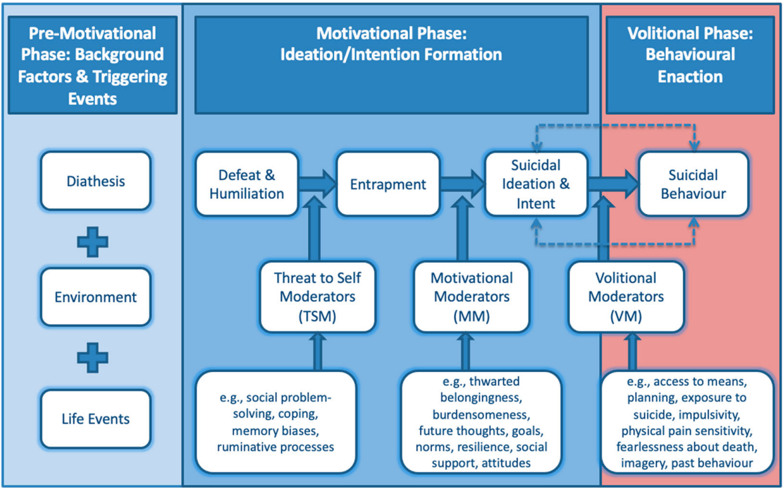
“Most recently, a systematic review by Souza et al. (2024) confirmed that internal entrapment consistently mediates the defeat–suicidal ideation link in both cross-sectional and longitudinal designs, whereas external entrapment demonstrates limited or inconsistent effects.”
Padmanabhanunni, A., & Pretorius, T. (2025) · Archives of Suicide Research · doi:10.1080/13811118.2025.2521543 · Cited by 1
“The model recognizes the role of predisposing factors that confer vulnerability to suicide including biological factors (e.g., genetics), adverse life events (e.g., exposure to trauma), and contextual factors such as socioeconomic status and access to resources (Souza et al., 2024).”
Behn, A. J., & Sharp, C. (2025) · Depression and personality · doi:10.1007/978-3-031-96037-6_4
Gužas, J., & Skruibis, P. (2025) · Death Studies · doi:10.1080/07481187.2025.2559730 · Cited by 1
Akpanekpo, E. I., Karystianis, G., Jones, J., & Butler, T. G. (2026) · General Hospital Psychiatry · doi:10.1016/j.genhosppsych.2026.01.012 · Cited by 1
O'Brien, E. J., BergWood, M., Bolner, J., Tucker, R. P., & Hill, R. M. (2026) · Journal of Affective Disorders · doi:10.1016/j.jad.2026.121406
Furman, M., Gradowska, A., Bliźniewska-Kowalska, K. M., Kunikowska, J., & Gałecka, M. (2026) · Journal of Clinical Medicine · doi:10.3390/jcm15041583 · Cited by 1
“Souza et al. (2024) report that individuals with borderline personality disorder, in particular, tend to display low emotional intelligence and high anxiety, which contributes to frequent emotional crises [13].”
Dies, M. A., Sánchez-Reolid, D., Monferrer, M., Montes, M. J., Fernández‐Caballero, A., Fernández-Sotos, P., & Ricarte, J. J. (2026) · Behavioral Psychology/Psicología Conductual · doi:10.31083/bp51209
“The IMV model has been empirically supported in both the general population and clinical samples, as stated recently in a systematic review of 100 studies, including 138,000 participants, where only 17 studies came from hospital samples (Souza et al., 2024).”
Neheteroseksualių studentų suicidiškumas
Gužas, J. (2026) · doi:10.15388/vu.thesis.897
Zhang, W., & Hou, J. (2026) · Current Psychology · doi:10.1007/s12144-026-09454-2
“Although many studies have validated the integrated motivational-volitional model, most of them are cross-sectional studies and only test two stages of the model (Souza et al., 2024).”
Chen, L. H., Ni, Y.-L., Hsu, S., & Kuo, C. (2026) · Psychology of sport and exercise · doi:10.1016/j.psychsport.2026.103145
Speakability of Suffering and Media Ecologies: A Coupled Model of Suicide Risk
Vilas, E. F., & Coca, J. R. (2026) · Psychiatry International · doi:10.3390/psychiatryint7030106
Keinonen, K., Tucker, R. P., Prowten, S. D., Cramer, R. J., Hill, R. M., & Rasmussen, S. (2026) · Archives of Suicide Research · doi:10.1080/13811118.2026.2666406 · Cited by 1
Self-citationSarita, M., Yosep, I., Rafiyah, I., Hazmi, H., & Hikmat, R. (2026) · Journal of Multidisciplinary Healthcare · doi:10.2147/jmdh.s609422 · Cited by 1
“14,15,18 However, limited attention has been given to mapping motivational moderators within the IMV model specifically among adolescents and young adults.”
Beyond headlines and sensationalism: Pilot suicide and aviation safety
George, B. (2026) · Aerospace traffic and safety. · doi:10.1016/j.aets.2026.05.001
Amaro, A., O’Connor, R. C., Cleare, S., & Beurs, D. P. D. (2026) · Behaviour Research and Therapy · doi:10.1016/j.brat.2026.105093
Tseng, Y. C. (2026) · Journal of American College Health · doi:10.1080/07448481.2026.2694638
“22,27,43,44 The interview protocol consisted of open-ended questions on participants’ opinions on the function, method, and moderators of NSSI.”
Theorien der Suizidalität und die Rolle psychischer Störungen
Michalak, J., & Teismann, T. (2026) · Springer eBooks · doi:10.1007/978-3-662-72796-6_2
Hu, L., & Su, Z. (2026) · Journal of Affective Disorders · doi:10.1016/j.jad.2026.122216
Wang, Z., Xu, X., Pan, Q., Li, Y., & Huang, L. (2026) · Behavioral Sciences · doi:10.3390/bs16081284 · Cited by 1
“…relevant in a daily diary context, as daily stressful experiences may be accompanied by temporary increases in self-rejection or perceived unacceptability, especially when these experiences are appraised as reflecting personal inadequacy or failure (O’Connor & Kirtley, 2018; Souza et al., 2024).”
Christiansen, E., Konieczna, A., Madsen, K. U., Larsen, C. P., Jakobsen, S. G., & O’Connor, R. C. (2026) · BJPsych Open · doi:10.1192/bjo.2026.12066
“11 Volitional moderators have been proposed as key factors in the transition from suicidal ideation to behaviour and may therefore be clinically relevant within psychosocial assessment approaches.”
Perceived Family Support in Adolescence and its Impact on Suicide risk: A Narrative Review
Caro‐Cañizares, I., Arco, A. H.-D., Laseca-Zaballa, G., Brenlla, M. E., & Carballo, J. J. (2026) · Current Psychiatry Reports · doi:10.1007/s11920-026-01713-0
“Risk factors include stressful life events, childhood abuse or maltreatment, bullying, the loss of significant relation - ships, hopelessness, impulsivity, access to lethal means, and the presence of mental disorders [33, 34].”
Teismann, T., & Lewitzka, U. (2026) · Springer Reference Medizin · doi:10.1007/978-3-642-45028-0_92-2
Lühr, M., Großmann, T., Bayer, N., Fegert, J. M., Gindele, V., Köster, S., Müller, S., Rassenhofer, M., Rauschenberg, C., Reininghaus, U., et al. (2026) · Journal of Affective Disorders · doi:10.1016/j.jad.2026.122392
Suicidology’s Faulty Paradigm: Suicide Overrides Superordinate Impetus for Survival (“SOSIS”)
Soper, C. A. (2026) · Evolutionary Psychological Science · doi:10.1007/s40806-026-00469-3
Brausch, A. M., Kalgren, T., Cleare, S., Clark, K. A., & O’Connor, R. C. (2026) · Archives of Suicide Research · doi:10.1080/13811118.2026.2724116
Shared and distinct psychosocial network patterns of suicidal ideation across four countries
Shim, E., Cho, D., Çankaya, B., & O'Connor, R. (2026) · Journal of Affective Disorders · doi:10.1016/j.jad.2026.122475
Türkmen, C., Schneider, C. L., Furukawa, Y., Saksvik, S. B., Vethe, D., van Dalfsen, J. H., McCall, W. V., Pigeon, W. R., Tubbs, A. S., Perlis, M. L., et al. (2026) · Nature Mental Health · doi:10.1038/s44220-026-00743-0
Cao, Y., Wang, J., Liu, X., Wang, X., Chen, W., Yu, Y., Gou, M., Li, W., Li, N., Tong, J., et al. (2026) · Journal of Psychiatric Research · doi:10.1016/j.jpsychires.2026.10.041
Sissenova, A., Mambetalina, A. S., Zhamaliyeva, L., Lawrence, K. C., & Assylbekova, L. (2026) · The Open Psychology Journal · doi:10.2174/0118743501505384261011074246
Metadata
- Authors
- Souza, K., Sosu, E. M., Thomson, S., & Rasmussen, S.
- Affiliations
- University of Strathclyde (GB)
- Corresponding author
- Souza, Kenvil
- Venue
- Health Psychology Review
- Publisher
- Informa UK Limited
- Published
- 2024-04-16
- Volume
- 18
- Issue
- 4
- Pages
- 698-722
- ISSN
- 1743-7199 (ISSN-L)
- 1743-7202
- OpenAlex
- W4394841045
- Cited by
- 56
- References
- 60
- Citations by year
- 2026: 35 · 2025: 17 · 2024: 4
- FWCI
- 4.99
- Type
- journal article
- Language
- en
- Open access
- hybrid
- doi.org
- Licence
- Locations
- Health Psychology Review (publishedVersion, cc-by-nc-nd)
- PubMed (publishedVersion)
- Strathprints: The University of Strathclyde institutional repository (University of Strathclyde) (submittedVersion)
- Funders
- Dean’s Global research award
- Topics
- Social Sciences › Psychology › Clinical Psychology › Suicide and Self-Harm Studies
- Social Sciences › Sociology and Political Science › Homicide, Infanticide, and Child Abuse
- Social Sciences › Psychology › Social Psychology › Death Anxiety and Social Exclusion
- Keywords
- integrated motivational-volitional model, suicidal behavior, suicidal ideation, suicide prevention, defeat, entrapment, suicide risk factors
- MeSH terms
- Humans, Models, Psychological, Motivation, Suicide, Suicide, Attempted, Suicidal Ideation
About these checks
Registry, retraction, Cites and statistics results are computed, not judged, with one exception: a printed reference that no index lists is read once by a model before it counts as a citation error. Claims are extracted by a model and kept only when their quote appears verbatim in the text; each cited source is then checked, with a model’s help, for whether it says what the claim relies on. Those verdicts can be wrong — read the claim’s quote and the cited source before relying on one.
Statistics and arithmetic are recomputed, not judged.
Confidence bands are shown only for fields calibrated on our annotated test set. None is calibrated yet, so no band is shown.
What counts as a claim ›How we measure confidence ›How we check this ›
Are you an author, or do you see a problem with this page? Request a review
Data sources
Bibliographic data: Semantic Scholar, OpenAlex, Crossref.
Contains information from the Semantic Scholar Academic Graph Datasets, made available under the ODC Attribution License (ODC-BY 1.0).
Semantic Scholar’s data is described in: Kinney, R., et al. (2023). The Semantic Scholar Open Data Platform. arXiv:2301.10140.
