

A systematic review of the studies testing the integrated motivational-volitional model of suicidal behaviour
Open accessThe DOI matches its Crossref record, with a small difference in title or year; 60 of the 60 references it cites were found in a registry or an index.
Abstract
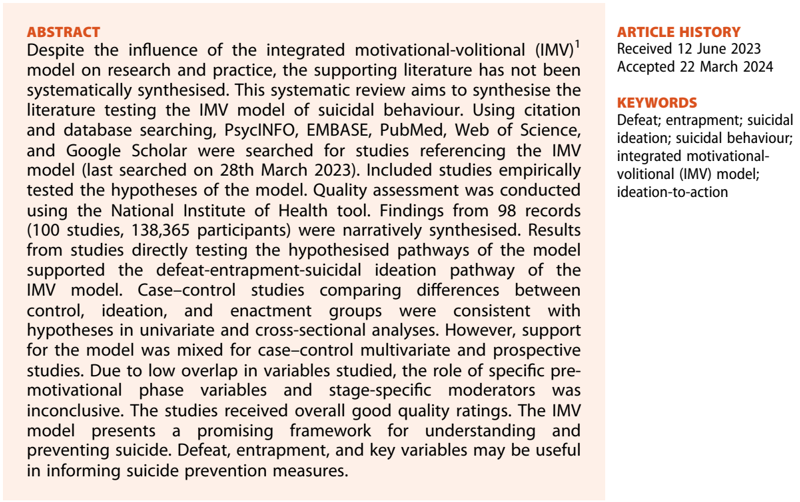
model on research and practice, the supporting literature has not been systematically synthesised. This systematic review aims to synthesise the literature testing the IMV model of suicidal behaviour. Using citation and database searching, PsycINFO, EMBASE, PubMed, Web of Science, and Google Scholar were searched for studies referencing the IMV model (last searched on 28th March 2023). Included studies empirically tested the hypotheses of the model. Quality assessment was conducted using the National Institute of Health tool. Findings from 98 records (100 studies, 138,365 participants) were narratively synthesised. Results from studies directly testing the hypothesised pathways of the model supported the defeat-entrapment-suicidal ideation pathway of the IMV model. Case-control studies comparing differences between control, ideation, and enactment groups were consistent with hypotheses in univariate and cross-sectional analyses. However, support for the model was mixed for case-control multivariate and prospective studies. Due to low overlap in variables studied, the role of specific pre-motivational phase variables and stage-specific moderators was inconclusive. The studies received overall good quality ratings. The IMV model presents a promising framework for understanding and preventing suicide. Defeat, entrapment, and key variables may be useful in informing suicide prevention measures.
Overview
The claims and statistics of this paper haven’t been checked yet.
Free: it reads the open-access text and checks the first 5 claims that cite a source we can check. Create a free account to check every claim.
Integrity signals
Registry
Cites
Statistics
Figures
Verification
Claims the paper makes
The claims and statistics of this paper haven’t been checked yet.
Free: it reads the open-access text and checks the first 5 claims that cite a source we can check. Create a free account to check every claim.
Claims other papers make about this one
Each is checked against this paper’s own text: does it say what the citing paper says it does?
The source backs part of the claim, not all of it — or backs it for a different population, condition or comparison.
In the citing paper
“Meta-analyses of two important theoretical models, the Interpersonal Theory of Suicidal Behavior (19) and the Integrative Motivational-Volitional Model of Suicidal Behavior (20, 21), show results that are consistent with the theories. The effects are, however, comparatively small (22, 23) and do not exceed the predictive power found in the other meta-analyses described above.”
From Suicide risk assessment: clinical implications of the unpredictability of suicidal behavior (2026) · cites this paper as [23]
Experimental — accuracy not yet measured
Self-check
Percentages, sums and reported differences re-computed from the paper’s own numbers.
The self-check needs the paper’s full text.
Citations
Cites
The PRISMA 2020 statement: An updated guideline for reporting systematic reviews
Page, M. J., McKenzie, J. E., Bossuyt, P. M., Boutron, I., Hoffmann, T. C., Mulrow, C. D., Shamseer, L., Tetzlaff, J. M., Akl, E. A., Brennan, S. E., et al. (2021) · BMJ · doi:10.1136/bmj.n71 · Cited by 108,283
Scoping studies: towards a methodological framework
Arksey, H., & O'Malley, L. (2005) · International Journal of Social Research Methodology · doi:10.1080/1364557032000119616 · Cited by 36,742 · cited 1×
“Additionally, we conducted a systematic review rather than a scoping review as our primary aim was to synthesise the evidence supporting clinically pertinent hypotheses with an aim to inform practice (Arksey & O ’ Malley, 2005; Munn et al., 2018).”
Munn, Z., Peters, M. D. J., Stern, C., Tufanaru, C., McArthur, A., & Aromataris, E. (2018) · BMC Medical Research Methodology · doi:10.1186/s12874-018-0611-x · Cited by 11,385 · cited 1×
“Additionally, we conducted a systematic review rather than a scoping review as our primary aim was to synthesise the evidence supporting clinically pertinent hypotheses with an aim to inform practice (Arksey & O ’ Malley, 2005; Munn et al., 2018).”
The interpersonal theory of suicide.
Van Orden, K. A., Witte, T. K., Cukrowicz, K. C., Braithwaite, S. R., Selby, E. A., & Joiner, T. E. (2010) · Psychological Review · doi:10.1037/a0018697 · Cited by 5,292 · cited 2×
“…theoretical models in suicide, health psychology literature, and empirical evidence to identify a common modi fi able pathway giving rise to suicidal thoughts and behaviour (Barzilay & Apter, 2014; Gilbert & Allan, 1998; Joiner, 2005; Schotte & Clum, 1987; Van Orden et al., 2010; Williams, 2001).”
Naghavi, M., Abajobir, A. A., Abbafati, C., Abbas, K. M., Abd-Allah, F., Abera, S. F., Aboyans, V., Adetokunboh, O., Afshin, A., Agrawal, A., et al. (2017) · The Lancet · doi:10.1016/s0140-6736(17)32152-9 · Cited by 4,821 · cited 1×
“Despite signi fi cant improvements in preventing other leading causes of death, our ability to predict and prevent suicide has shown little improvement over the past fi ve decades (Franklin et al., 2017; Naghavi et al., 2017).”
Risk factors for suicidal thoughts and behaviors: A meta-analysis of 50 years of research
Franklin, J. C., Ribeiro, J. D., Fox, K. R., Bentley, K. H., Kleiman, E. M., Huang, X., Musacchio, K. M., Jaroszewski, A. C., Chang, B. P., & Nock, M. K. (2017) · Psychological Bulletin · doi:10.1037/bul0000084 · Cited by 3,784 · cited 2×
“Despite signi fi cant improvements in preventing other leading causes of death, our ability to predict and prevent suicide has shown little improvement over the past fi ve decades (Franklin et al., 2017; Naghavi et al., 2017).”
Gusenbauer, M., & Haddaway, N. R. (2020) · Research Synthesis Methods · doi:10.1002/jrsm.1378 · Cited by 2,379 · cited 1×
“Several authors have suggested potential reproducibility issues on account of results dropping in and out of relevance (Bramer & Bain, 2017; Gusenbauer & Haddaway, 2020).”
The integrated motivational–volitional model of suicidal behaviour
O'Connor, R. C., & Kirtley, O. J. (2018) · Philosophical Transactions of the Royal Society B: Biological Sciences · doi:10.1098/rstb.2017.0268 · Cited by 1,781
Chu, C., Buchman-Schmitt, J. M., Stanley, I. H., Hom, M. A., Tucker, R. P., Hagan, C. R., Rogers, M. L., Podlogar, M. C., Chiurliza, B., Ringer, F. B., et al. (2017) · Psychological Bulletin · doi:10.1037/bul0000123 · Cited by 1,231 · cited 1×
“Recent research on suicide has highlighted that suicidal behaviours are likely in fl uenced by interrelationships between hundreds of biological, psychological, social, and cultural factors (Chu et al., 2017; Levi-Belz et al., 2019; O ’ Connor & Nock, 2014).”
The psychology of suicidal behaviour
O'Connor, R. C., & Nock, M. K. (2014) · The Lancet Psychiatry · doi:10.1016/s2215-0366(14)70222-6 · Cited by 1,193 · cited 1×
“Recent research on suicide has highlighted that suicidal behaviours are likely in fl uenced by interrelationships between hundreds of biological, psychological, social, and cultural factors (Chu et al., 2017; Levi-Belz et al., 2019; O ’ Connor & Nock, 2014).”
GILBERT, P., & ALLAN, S. (1998) · Psychological Medicine · doi:10.1017/s0033291798006710 · Cited by 972 · cited 4×
“…theoretical models in suicide, health psychology literature, and empirical evidence to identify a common modi fi able pathway giving rise to suicidal thoughts and behaviour (Barzilay & Apter, 2014; Gilbert & Allan, 1998; Joiner, 2005; Schotte & Clum, 1987; Van Orden et al., 2010; Williams, 2001).”
InfluentialIdeation-to-action theories of suicide: a conceptual and empirical update
Klonsky, E. D., Saffer, B. Y., & Bryan, C. J. (2018) · Current Opinion in Psychology · doi:10.1016/j.copsyc.2017.07.020 · Cited by 673 · cited 5×
“Understanding how di ff erent risk factors interact to give rise to suicidal thoughts and behaviours using theoretical frameworks is key to the e ff ective identi fi cation and prevention of suicide (Klonsky et al., 2018; Stanley et al., 2016).”
InfluentialRetrospective Studies – Utility and Caveats
Talari, K., & Goyal, M. (2020) · Journal of the Royal College of Physicians of Edinburgh · doi:10.4997/jrcpe.2020.409 · Cited by 658 · cited 1×
“Cross-sectional retrospective studies often limit the ability to identify causal relationships and results and may be limited by recall bias (Talari & Goyal, 2020).”
Towards an integrated motivational–volitional model of suicidal behaviour
O'connor, R. C. (2011) · International Handbook of Suicide Prevention · doi:10.1002/9781119998556.ch11 · Cited by 552 · cited 4×
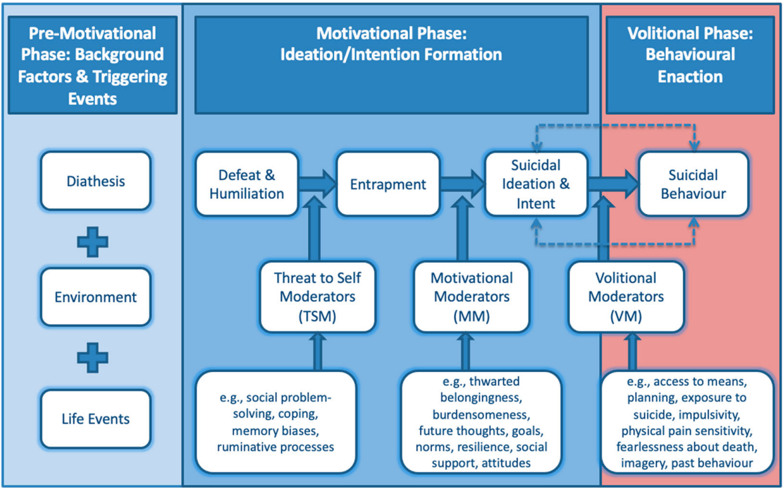
“The integrated motivational-volitional (IMV) model of suicidal behaviour (O ’ Connor, 2011a; O ’ Connor & Kirtley, 2018) draws from a range of established theoretical models in suicide, health psychology literature, and empirical evidence to identify a common modi fi able pathway giving rise to…”
InfluentialThe integrated motivational-volitional model of suicidal behavior
O’Connor, R. C. (2011) · Crisis · doi:10.1027/0227-5910/a000120 · Cited by 491
Problem-solving skills in suicidal psychiatric patients.
Schotte, D. E., & Clum, G. A. (1987) · Journal of Consulting and Clinical Psychology · doi:10.1037/0022-006x.55.1.49 · Cited by 485 · cited 2×
“…theoretical models in suicide, health psychology literature, and empirical evidence to identify a common modi fi able pathway giving rise to suicidal thoughts and behaviour (Barzilay & Apter, 2014; Gilbert & Allan, 1998; Joiner, 2005; Schotte & Clum, 1987; Van Orden et al., 2010; Williams, 2001).”
Childhood maltreatment and adult suicidality: a comprehensive systematic review with meta-analysis
Angelakis, I., Gillespie, E. L., & Panagioti, M. (2019) · Psychological Medicine · doi:10.1017/s0033291718003823 · Cited by 479 · cited 1×
“Variables like adverse childhood experiences, insecure attachment, and perfectionism have also displayed strong associations with suicide risk in other reviews (Angelakis et al., 2019; Angelakis et al., 2020; O ’ Connor, 2007; Zortea et al., 2021b).”
Maass, S. W. M. C., Roorda, C., Berendsen, A. J., Verhaak, P. F. M., & de Bock, G. H. (2015) · Maturitas · doi:10.1016/j.maturitas.2015.04.010 · Cited by 420 · cited 1×
“The percentage of a ffi rmative ratings was used to assess quality as follows (Maass et al., 2015): Poor (0% – 24.99%), fair (25% – 49.99%), good (50% – 74.99”
InfluentialSleep disturbances as an evidence-based suicide risk factor
Bernert, R. A., Kim, J. S., Iwata, N. G., & Perlis, M. L. (2015) · Current Psychiatry Reports · doi:10.1007/s11920-015-0554-4 · Cited by 406 · cited 1×
“Single-item dichotomised measures may not account for the di ff erences in frequency, recency, or intensity of suicidal thoughts or behaviours and may misrepresent the strength of associations (Bernert et al., 2015; Russell et al., 2019).”
Angelakis, I., Austin, J. L., & Gooding, P. (2020) · JAMA Network Open · doi:10.1001/jamanetworkopen.2020.12563 · Cited by 385 · cited 1×
“Variables like adverse childhood experiences, insecure attachment, and perfectionism have also displayed strong associations with suicide risk in other reviews (Angelakis et al., 2019; Angelakis et al., 2020; O ’ Connor, 2007; Zortea et al., 2021b).”
Carter, G., Milner, A., McGill, K., Pirkis, J., Kapur, N., & Spittal, M. J. (2017) · British Journal of Psychiatry · doi:10.1192/bjp.bp.116.182717 · Cited by 361 · cited 1×
“As risk assessment tools have been largely inadequate (Carter et al., 2017), self-report measures should ideally be used in conjunction with clinical interviews.”
Updating search strategies for systematic reviews using EndNote
Bramer, W., & Bain, P. (2017) · Journal of the Medical Library Association · doi:10.5195/jmla.2017.183 · Cited by 250 · cited 2×
“Several authors have suggested potential reproducibility issues on account of results dropping in and out of relevance (Bramer & Bain, 2017; Gusenbauer & Haddaway, 2020).”
The Relations between Perfectionism and Suicidality: A Systematic Review
O'Connor, R. C. (2007) · Suicide and Life-Threatening Behavior · doi:10.1521/suli.2007.37.6.698 · Cited by 245 · cited 1×
“Variables like adverse childhood experiences, insecure attachment, and perfectionism have also displayed strong associations with suicide risk in other reviews (Angelakis et al., 2019; Angelakis et al., 2020; O ’ Connor, 2007; Zortea et al., 2021b).”
Recent advances in differentiating suicide attempters from suicide ideators
Klonsky, E. D., Qiu, T., & Saffer, B. Y. (2017) · Current Opinion in Psychiatry · doi:10.1097/yco.0000000000000294 · Cited by 193 · cited 1×
“These results are consistent with other literature and reviews discussing the IMV model (Barzilay & Apter, 2014; Klonsky et al., 2017, 2018; Zortea et al., 2021a).”
International Handbook of Suicide Prevention: Research, Policy and Practice
(2011) · Wiley eBooks · doi:10.1002/9781119998556 · Cited by 183
Dhingra, K., Boduszek, D., & O’Connor, R. C. (2015) · Journal of Affective Disorders · doi:10.1016/j.jad.2015.07.007 · Cited by 169 · cited 1×
“…IMV model was fi rst proposed (O ’ Connor, 2011a, 2011b), a growing body of literature has aimed to test its predictions (e.g., del Carpio et al., 2020; Dhingra et al., 2015; Dhingra et al., 2016b; Forkmann & Teismann, 2017; Ordóñez-Carrasco et al., 2020a, 2021a; Russell et al., 2020c; Tucker et…”
Sleep problem, suicide and self-harm in university students: A systematic review
Russell, K., Allan, S., Beattie, L., Bohan, J., MacMahon, K., & Rasmussen, S. (2019) · Sleep Medicine Reviews · doi:10.1016/j.smrv.2018.12.008 · Cited by 168 · cited 1×
“Single-item dichotomised measures may not account for the di ff erences in frequency, recency, or intensity of suicidal thoughts or behaviours and may misrepresent the strength of associations (Bernert et al., 2015; Russell et al., 2019).”
Self-citationSystematic review and meta-analysis: a primer.
Impellizzeri, F. M., & Bizzini, M. (2012) · Europe PMC (PubMed Central) · Cited by 155
Advancing the Understanding of Suicide: The Need for Formal Theory and Rigorous Descriptive Research
Millner, A. J., Robinaugh, D. J., & Nock, M. K. (2020) · Trends in Cognitive Sciences · doi:10.1016/j.tics.2020.06.007 · Cited by 139 · cited 1×
“…to individual risk factors being limited in explaining the processes giving rise to suicidal ideation (thoughts about taking one ’ s life), and how they result in suicidal behaviours (any self-directed harm irrespective of intent to die as a result) (Franklin et al., 2017; Millner et al., 2020).”
Psychological Models of Suicide
Barzilay, S., & Apter, A. (2014) · Archives of Suicide Research · doi:10.1080/13811118.2013.824825 · Cited by 126 · cited 2×
“…theoretical models in suicide, health psychology literature, and empirical evidence to identify a common modi fi able pathway giving rise to suicidal thoughts and behaviour (Barzilay & Apter, 2014; Gilbert & Allan, 1998; Joiner, 2005; Schotte & Clum, 1987; Van Orden et al., 2010; Williams, 2001).”
Stanley, I. H., Hom, M. A., Rogers, M. L., Hagan, C. R., & Joiner, T. E. (2016) · Aging & Mental Health · doi:10.1080/13607863.2015.1012045 · Cited by 118 · cited 2×
“Understanding how di ff erent risk factors interact to give rise to suicidal thoughts and behaviours using theoretical frameworks is key to the e ff ective identi fi cation and prevention of suicide (Klonsky et al., 2018; Stanley et al., 2016).”
Nock, M. K., Kessler, R. C., & Franklin, J. C. (2016) · Clinical Psychology: Science and Practice · doi:10.1037/h0101734 · Cited by 110 · cited 1×
“It is also crucial that suicide theories explain the processes that in fl uence individuals with suicidal thoughts to act upon those thoughts (Klonsky et al., 2018; Nock et al., 2016).”
Suicide and attempted suicide : understanding the cry of pain
Williams, J. M. G. (2001) · Penguin Books · Cited by 106
A structural test of the integrated motivational-volitional model of suicidal behaviour
Dhingra, K., Boduszek, D., & O'Connor, R. C. (2016) · Psychiatry Research · doi:10.1016/j.psychres.2016.03.023 · Cited by 105 · cited 1×
“…was fi rst proposed (O ’ Connor, 2011a, 2011b), a growing body of literature has aimed to test its predictions (e.g., del Carpio et al., 2020; Dhingra et al., 2015; Dhingra et al., 2016b; Forkmann & Teismann, 2017; Ordóñez-Carrasco et al., 2020a, 2021a; Russell et al., 2020c; Tucker et al., 2016).”
O'Connor, R. C., Ferguson, E., Scott, F., Smyth, R., McDaid, D., Park, A.-L., Beautrais, A., & Armitage, C. J. (2017) · The Lancet Psychiatry · doi:10.1016/s2215-0366(17)30129-3 · Cited by 88
Branley-Bell, D., O'Connor, D. B., Green, J. A., Ferguson, E., O'Carroll, R. E., & O'Connor, R. C. (2019) · Journal of Psychiatric Research · doi:10.1016/j.jpsychires.2019.07.007 · Cited by 79 · cited 1×
“However, motivational moderators including resilience (Branley-Bell et al., 2019; Cleare, 2019; Wetherall et al., 2018), PB, and its interaction with TB (Hollings-worth, 2012; Li et al., 2021; Lucht et al., 2020; Ordóñez-Carrasco et al., 2020a, Scowcroft, 2019) found support as a motivational…”
Moore, F. R., Doughty, H., Neumann, T., McClelland, H., Allott, C., & O’Connor, R. C. (2022) · EClinicalMedicine · doi:10.1016/j.eclinm.2022.101307 · Cited by 78 · cited 2×
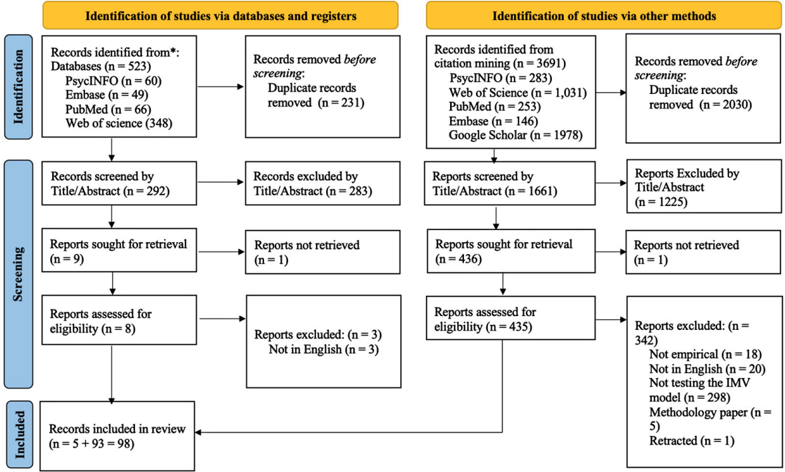
“Based on previous literature (Moore et al., 2022), 10% ( n = 29) of the papers were originally randomly selected using an online random sequence generator (https://www.random.org/) and independently screened by a second reviewer.”
Tucker, R. P., O’Connor, R. C., & Wingate, L. R. (2016) · Archives of Suicide Research · doi:10.1080/13811118.2016.1158682 · Cited by 74 · cited 1×
“…was fi rst proposed (O ’ Connor, 2011a, 2011b), a growing body of literature has aimed to test its predictions (e.g., del Carpio et al., 2020; Dhingra et al., 2015; Dhingra et al., 2016b; Forkmann & Teismann, 2017; Ordóñez-Carrasco et al., 2020a, 2021a; Russell et al., 2020c; Tucker et al., 2016).”
The Relationship Between Adult Attachment and Suicidal Thoughts and Behaviors: A Systematic Review
Zortea, T. C., Gray, C. M., & O’Connor, R. C. (2021) · Archives of Suicide Research · doi:10.1080/13811118.2019.1661893 · Cited by 71 · cited 1×
“Variables like adverse childhood experiences, insecure attachment, and perfectionism have also displayed strong associations with suicide risk in other reviews (Angelakis et al., 2019; Angelakis et al., 2020; O ’ Connor, 2007; Zortea et al., 2021b).”
Entrapment, perceived burdensomeness and thwarted belongingness as predictors of suicide ideation
Forkmann, T., & Teismann, T. (2017) · Psychiatry Research · doi:10.1016/j.psychres.2017.07.031 · Cited by 64 · cited 1×
“…was fi rst proposed (O ’ Connor, 2011a, 2011b), a growing body of literature has aimed to test its predictions (e.g., del Carpio et al., 2020; Dhingra et al., 2015; Dhingra et al., 2016b; Forkmann & Teismann, 2017; Ordóñez-Carrasco et al., 2020a, 2021a; Russell et al., 2020c; Tucker et al., 2016).”
Nuij, C., van Ballegooijen, W., Ruwaard, J., de Beurs, D., Mokkenstorm, J., van Duijn, E., de Winter, R. F. P., O'Connor, R. C., Smit, J. H., Riper, H., et al. (2018) · Internet Interventions · doi:10.1016/j.invent.2018.04.005 · Cited by 60 · cited 1×
“The IMV model has also played a key role in informing local and national suicide prevention policy (e.g., Scottish Government, 2022), risk screening (de Sousa et al., 2020; Sandford et al., 2022), and intervention development (Nuij et al., 2018; O ’ Connor et al., 2017).”
Understanding and managing suicide risk
Zortea, T. C., Cleare, S., Melson, A. J., Wetherall, K., & O’Connor, R. C. (2020) · British Medical Bulletin · doi:10.1093/bmb/ldaa013 · Cited by 58 · cited 1×
“Theoretical models such as the IMV model are also useful in developing interventions speci fi c to the stage of suicidal thoughts or behaviour (O ’ Connor & Kirtley, 2018; Zortea et al., 2020b).”
Editorial: The Psychology of Suicide: From Research Understandings to Intervention and Treatment
Levi‐Belz, Y., Gvion, Y., & Apter, A. (2019) · Frontiers in Psychiatry · doi:10.3389/fpsyt.2019.00214 · Cited by 56 · cited 1×
“Recent research on suicide has highlighted that suicidal behaviours are likely in fl uenced by interrelationships between hundreds of biological, psychological, social, and cultural factors (Chu et al., 2017; Levi-Belz et al., 2019; O ’ Connor & Nock, 2014).”
The role of mobile phone technology in understanding and preventing suicidal behavior
de Beurs, D., Kirtley, O., Kerkhof, A., Portzky, G., & O’Connor, R. C. (2015) · Crisis · doi:10.1027/0227-5910/a000316 · Cited by 47 · cited 1×
“Some authors have also suggested that ecological momentary assessments may be a method to address the issue with retrospective reporting (De Beurs et al., 2015).”
Lucht, L., Höller, I., Forkmann, T., Teismann, T., Schönfelder, A., Rath, D., Paashaus, L., Stengler, K., Juckel, G., & Glaesmer, H. (2020) · Journal of Affective Disorders · doi:10.1016/j.jad.2020.05.079 · Cited by 46 · cited 2×
“For example, a majority of studies have tested components of the model such as the motivational or volitional phase alone (Lucht et al., 2020, p. 17; McClelland et al., 2021; Ribiero et al., 2021).”
Testing the Integrated Motivational-Volitional Model of Suicidal Behavior in Chinese Adolescents
Li, X., Ren, Y., Zhang, X., Zhou, J., Su, B., Liu, S., Cai, H., Liu, J., & You, J. (2021) · Archives of Suicide Research · doi:10.1080/13811118.2019.1690607 · Cited by 39
Russell, K., Rasmussen, S. A., & Hunter, S. C. (2020) · International Journal of Environmental Research and Public Health · doi:10.3390/ijerph17186771 · Cited by 37 · cited 1×
“…was fi rst proposed (O ’ Connor, 2011a, 2011b), a growing body of literature has aimed to test its predictions (e.g., del Carpio et al., 2020; Dhingra et al., 2015; Dhingra et al., 2016b; Forkmann & Teismann, 2017; Ordóñez-Carrasco et al., 2020a, 2021a; Russell et al., 2020c; Tucker et al., 2016).”
Self-citationMcClelland, H., Evans, J. J., & O’Connor, R. C. (2021) · Journal of Psychiatric Research · doi:10.1016/j.jpsychires.2021.07.020 · Cited by 33 · cited 1×
“For example, a majority of studies have tested components of the model such as the motivational or volitional phase alone (Lucht et al., 2020, p. 17; McClelland et al., 2021; Ribiero et al., 2021).”
Ordóñez-Carrasco, J. L., Cuadrado, I., & Tejada, A. J. R. (2020) · Crisis · doi:10.1027/0227-5910/a000721 · Cited by 26 · cited 1×
“…was fi rst proposed (O ’ Connor, 2011a, 2011b), a growing body of literature has aimed to test its predictions (e.g., del Carpio et al., 2020; Dhingra et al., 2015; Dhingra et al., 2016b; Forkmann & Teismann, 2017; Ordóñez-Carrasco et al., 2020a, 2021a; Russell et al., 2020c; Tucker et al., 2016).”
Ribeiro, J. D., Linthicum, K. P., Joiner, T. E., Huang, X., Harris, L. M., & Bryen, C. P. (2021) · Journal of Abnormal Psychology · doi:10.1037/abn0000595 · Cited by 23
del Carpio, L., Rasmussen, S. A., & Paul, S. (2020) · Frontiers in Psychology · doi:10.3389/fpsyg.2020.01153 · Cited by 22 · cited 1×
“Since the IMV model was fi rst proposed (O ’ Connor, 2011a, 2011b), a growing body of literature has aimed to test its predictions (e.g., del Carpio et al., 2020; Dhingra et al., 2015; Dhingra et al., 2016b; Forkmann & Teismann, 2017; Ordóñez-Carrasco et al., 2020a, 2021a; Russell et al., 2020c;…”
Self-citationSandford, D. M., Thwaites, R., Kirtley, O. J., & O’Connor, R. C. (2022) · The Cognitive Behaviour Therapist · doi:10.1017/s1754470x22000344 · Cited by 19 · cited 2×
“…techniques speci fi c to addressing these risk factors could also be employed to address core beliefs that may be contributing to feelings of defeat and entrapment by understanding the events that trigger and maintain these feelings on an individual level and addressing them (Sandford et al., 2022).”
Clinical validation of the nursing diagnosis risk for suicide in the older adults
de Sousa, G. S., Perrelli, J. G. A., Mangueira, S. D. O., Lopes, M. V. D. O., & Sougey, É. B. (2020) · Archives of Psychiatric Nursing · doi:10.1016/j.apnu.2020.01.003 · Cited by 15 · cited 1×
“The IMV model has also played a key role in informing local and national suicide prevention policy (e.g., Scottish Government, 2022), risk screening (de Sousa et al., 2020; Sandford et al., 2022), and intervention development (Nuij et al., 2018; O ’ Connor et al., 2017).”
Ordóñez-Carrasco, J. L., Cuadrado, I., & Tejada, A. J. R. (2020) · Death Studies · doi:10.1080/07481187.2020.1783031 · Cited by 15 · cited 2×
“…including resilience (Branley-Bell et al., 2019; Cleare, 2019; Wetherall et al., 2018), PB, and its interaction with TB (Hollings-worth, 2012; Li et al., 2021; Lucht et al., 2020; Ordóñez-Carrasco et al., 2020a, Scowcroft, 2019) found support as a motivational moderator in multiple studies.”
Hong, H. J., & Shin, S. H. (2021) · International Journal of Environmental Research and Public Health · doi:10.3390/ijerph18073353 · Cited by 9 · cited 1×
“Studies conducted in speci fi c populations also raised concerns regarding generalizability to other populations (e.g., Hong & Shin, 2021).”
Reducing the Toll of Suicide: Resources for Communities, Groups, and Individuals
De Leo, D. 1., Poštuvan, V. 1., & GmbH, H. P. (2019) · Hogrefe Publishing eBooks · doi:10.1027/00569-000 · Cited by 7
Status of the integrated motivational-volitional model of suicidal behaviour
Wetherall, K., Cleare, S., Zortea, T. C., & O’Connor, R. C. (2020) · ENLIGHTEN (Jurnal Bimbingan dan Konseling Islam) · Cited by 4
Suicide Risk: From Psychological Processes to Clinical Assessment and Intervention
Zortea, T. C., Cleare, S., Wetherall, K., Melson, A. J., & O’Connor, R. C. (2021) · Elsevier eBooks · doi:10.1016/b978-0-12-818697-8.00073-x · Cited by 3 · cited 3×
“Variables like adverse childhood experiences, insecure attachment, and perfectionism have also displayed strong associations with suicide risk in other reviews (Angelakis et al., 2019; Angelakis et al., 2020; O ’ Connor, 2007; Zortea et al., 2021b).”
Scowcroft, L., Slade, K., Winder, B., & Oldfield, B. (2019) · doi:10.13140/rg.2.2.14957.92649 · Cited by 3
Barbero (2014) · doi:10.1016/j · Cited by 1
Research works printed but not linked: 5
- 10. Cleare, S. (2019). Exploring the role of self-compassion in self-harm and suicidal ideation [PhD thesis]. University of Glasgow. http://theses.gla.ac.uk/id/eprint/81292
- 20. Hollingsworth, D. W. (2012). An examination of the motivational phase of the integrated motivational-volitional model of suicide in african americans [Doctoral Thesis, Oklahoma State University]. APA PsycInfo. https://hdl.handle.net/11244/ 299513
- 23. Joiner, T. (2005). Why people die by suicide. Harvard University Press. · doi:10.1037//0022-0006x.64.2.264
- 45. O'Connor, R. C., Rasmussen, S., & Beautrais, A. (2011). Recognition of suicide risk, crisis helplines, and psychosocial inter- ventions: A selective review. In R. C. O'Connor, S. Platt, & J. Gordon (Eds.), International handbook of suicide prevention. https://doi.org/10.1002/9781119998556 · DOI · Paper page
- 63. Wetherall, K., Robb, K. A., & O'Connor, R. C. (2018). An examination of social comparison and suicide ideation through the lens of the integrated motivational-volitional model of suicidal behavior. Suicide and Life-Threatening Behavior, 49(1), 167-182. http://doi.org/10.1111/sltb.2019.49.issue-1 · doi:10.1111/sltb.2019.49.issue-1
Cited by
Winstone, L., Heron, J. E., John, A. M., Kirtley, O. J., Moran, P., Muehlenkamp, J. J., O’Connor, R. C., & Mars, B. (2024) · JMIR Mental Health · doi:10.2196/63132 · Cited by 28
Etherson, M. E., Lee, S., Loney, K. J., Steward, I. P., Ward, J., McClelland, H., Kandola, A. A., Mendes, J. A. D. A., Hollis, C. P., Townsend, E., et al. (2025) · PLoS ONE · doi:10.1371/journal.pone.0326381 · Cited by 17
Associations between somatic symptoms and suicidal behavior: a cohort study in Chinese adolescents
Ji, Y., Liu, Z.-Z., Jia, C.-X., & Liu, X. (2025) · BMC Psychology · doi:10.1186/s40359-025-03113-0 · Cited by 15
“For example, unaddressed emotional disturbance can present as medically unexplained pain or gastrointestinal dysfunction [32].”
Exploring the impact of child maltreatment on adult suicidal ideation and suicide attempts
Serebriakova, J., Forkmann, T., Teismann, T., Paashaus, L., Schreiber, D., Schönfelder, A., Juckel, G., & Glaesmer, H. (2025) · Journal of Affective Disorders · doi:10.1016/j.jad.2025.02.019 · Cited by 10
Christiansen, E., Konieczna, A., Larsen, C. P., Jakobsen, S. G., & O´Connor, R. C. (2026) · BMC Psychiatry · doi:10.1186/s12888-026-08049-2 · Cited by 5
“Other studies found similar results, highlighting the importance of the volitional factors [15, 34, 41].”
Influential
Metadata
- Authors
- Souza, K., Sosu, E. M., Thomson, S., & Rasmussen, S.
- Affiliations
- University of Strathclyde (GB)
- Corresponding author
- Souza, Kenvil
- Venue
- Health Psychology Review
- Publisher
- Informa UK Limited
- Published
- 2024-04-16
- Volume
- 18
- Issue
- 4
- Pages
- 698-722
- ISSN
- 1743-7199 (ISSN-L)
- 1743-7202
- OpenAlex
- W4394841045
- Cited by
- 56
- References
- 60
- Citations by year
- 2026: 35 · 2025: 17 · 2024: 4
- FWCI
- 4.99
- Type
- journal article
- Language
- en
- Open access
- hybrid
- doi.org
- Licence
- Locations
- Health Psychology Review (publishedVersion, cc-by-nc-nd)
- PubMed (publishedVersion)
- Strathprints: The University of Strathclyde institutional repository (University of Strathclyde) (submittedVersion)
- Funders
- Dean’s Global research award
- Topics
- Social Sciences › Psychology › Clinical Psychology › Suicide and Self-Harm Studies
- Social Sciences › Sociology and Political Science › Homicide, Infanticide, and Child Abuse
- Social Sciences › Psychology › Social Psychology › Death Anxiety and Social Exclusion
- Keywords
- integrated motivational-volitional model, suicidal behavior, suicidal ideation, suicide prevention, defeat, entrapment, suicide risk factors
- MeSH terms
- Humans, Models, Psychological, Motivation, Suicide, Suicide, Attempted, Suicidal Ideation
About these checks
Registry, retraction, Cites and statistics results are computed, not judged, with one exception: a printed reference that no index lists is read once by a model before it counts as a citation error. Claims are extracted by a model and kept only when their quote appears verbatim in the text; each cited source is then checked, with a model’s help, for whether it says what the claim relies on. Those verdicts can be wrong — read the claim’s quote and the cited source before relying on one.
Statistics and arithmetic are recomputed, not judged.
Confidence bands are shown only for fields calibrated on our annotated test set. None is calibrated yet, so no band is shown.
What counts as a claim ›How we measure confidence ›How we check this ›
Are you an author, or do you see a problem with this page? Request a review
Data sources
Bibliographic data: Semantic Scholar, OpenAlex, Crossref.
Contains information from the Semantic Scholar Academic Graph Datasets, made available under the ODC Attribution License (ODC-BY 1.0).
Semantic Scholar’s data is described in: Kinney, R., et al. (2023). The Semantic Scholar Open Data Platform. arXiv:2301.10140.
