

Acceptance and commitment therapy for co-occurring gambling disorder and posttraumatic stress disorder in veterans: a narrative review
Open accessThe DOI matches its Crossref record; 47 of the 47 references it cites were found in a registry or an index.
Abstract
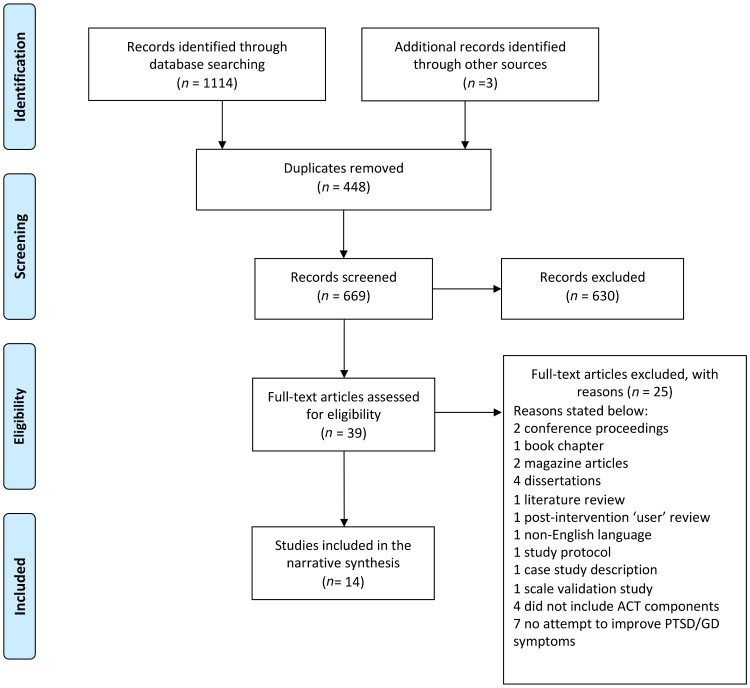
Background: PTSD and gambling disorder (GD) are frequently comorbid. Gambling may provide escape-based coping for the emotions experienced by PTSD sufferers. Military personnel may be at increased risk of PTSD and/or GD. Acceptance and Commitment Therapy (ACT) has been found to improve both PTSD and GD outcomes, yet research into the potential effectiveness of ACT for PTSD and/GD in veterans is scarce.Objective: This review aimed to systematically assess and describe the evidence relating to the use of ACT and acceptance-based therapy for military populations with PTSD and/or GD.Method: Six databases were searched. Selection criteria included studies that featured the armed forces/military, delivered ACT/acceptance-based therapy, and aimed to improve PTSD and/or GD outcomes. A narrative synthesis approach was adopted.Results: From 1,117 results, 39 studies were fully screened and 14 met inclusion criteria. All studies originated from the USA and 9 were associated with United States Department of Veterans Affairs. Therapy use within each study produced an improvement in PTSD and/or GD, yet only one study examined GD and no studies considered comorbid PTSD/GD. The broad range of study designs made it difficult to compare the findings or make generalisations from the collective results. It is unclear which method of ACT delivery is superior (app-based, telehealth, face-to-face, groups, one-to-one, manualised, or unstructured), or what the true effect size is of ACT for PTSD and/or GD.Conclusions: These preliminary findings are promising, yet more research is needed on the delivery format and content of ACT sessions, and whether findings generalise beyond USA-recruited military samples. The cost-effectiveness of remote-based ACT also warrants investigation.HIGHLIGHTS Among veterans, psychological interventions such as Acceptance and Commitment Therapy (ACT) may be effective for Post-Traumatic Stress Disorder (PTSD) and/or Gambling Disorder (GD).There is a paucity of evidence on ACT approaches for treating PTSD and GD in veterans.Further work is needed on context-specific delivery (in-person vs. group), method of ACT intervention (manualised vs unstructured, digital therapeutics) with non-US samples.
Overview
The claims and statistics of this paper haven’t been checked yet.
Free: it reads the open-access text and checks the first 5 claims that cite a source we can check. Create a free account to check every claim.
Integrity signals
Registry
Cites
Statistics
Figures
Verification
Claims the paper makes
The claims and statistics of this paper haven’t been checked yet.
Free: it reads the open-access text and checks the first 5 claims that cite a source we can check. Create a free account to check every claim.
Claims other papers make about this one
Each is checked against this paper’s own text: does it say what the citing paper says it does?
The source backs part of the claim, not all of it — or backs it for a different population, condition or comparison.
In the citing paper
“Both CBT and ACT have demonstrated transdiagnostic efficacy within veteran populations [43–47].”
From Feasibility, acceptability, and initial outcomes of a psychological adjustment and reintegration program for transitioned military veterans (2024) · cites this paper as [46]
Experimental — accuracy not yet measured
Self-check
Percentages, sums and reported differences re-computed from the paper’s own numbers.
The self-check needs the paper’s full text.
Citations
Cites
Diagnostic and Statistical Manual of Mental Disorders
American Psychiatric Association (2013) · doi:10.1176/appi.books.9780890425596 · Cited by 116,369
Preferred Reporting Items for Systematic Reviews and Meta-Analyses: the PRISMA statement
Moher, D., Liberati, A., Tetzlaff, J., Altman, D. G., & for the PRISMA Group (2009) · BMJ · doi:10.1136/bmj.b2535 · Cited by 83,823
Preferred Reporting Items for Systematic Reviews and Meta-Analyses: The PRISMA Statement
Moher, D., Liberati, A., Tetzlaff, J., & Altman, D. G. (2009) · Journal of Clinical Epidemiology · doi:10.1016/j.jclinepi.2009.06.005 · Cited by 19,575 · cited 1×
“This review was registered with PROSPERO (CRD42022327668) and followed PRISMA guidelines (Moher et al., 2009).”
A pathways model of problem and pathological gambling
Blaszczynski, A., & Nower, L. (2002) · Addiction · doi:10.1046/j.1360-0443.2002.00015.x · Cited by 2,013
Acceptance and commitment therapy.
Hayes, S. C., & Lillis, J. (2012) · American Psychological Association eBooks · doi:10.1037/17335-000 · Cited by 1,543
The empirical status of acceptance and commitment therapy: A review of meta-analyses
Gloster, A. T., Walder, N., Levin, M. E., Twohig, M. P., & Karekla, M. (2020) · Journal of Contextual Behavioral Science · doi:10.1016/j.jcbs.2020.09.009 · Cited by 622 · cited 3×
“To do this, ACT promotes ‘psychological flexibility’ through a series of structured components and experiential exercises (Daar & Dixon, 2015; Gloster et al., 2020; Hayes et al., 2012) such as reflecting on values, being in the present moment, acceptance versus change, and commitment to act in…”
BackgroundDowling, N. A., Cowlishaw, S., Jackson, A. C., Merkouris, S. S., Francis, K. L., & Christensen, D. R. (2015) · Australian & New Zealand Journal of Psychiatry · doi:10.1177/0004867415575774 · Cited by 350
Kantor, V., Knefel, M., & Lueger-Schuster, B. (2017) · Clinical Psychology Review · doi:10.1016/j.cpr.2016.12.001 · Cited by 294 · cited 2×
“The most commonly cited reasons for non-help seeking include perceived stigma and the practical accessibility of support (Hom et al., 2017; Kantor et al., 2017; Possemato et al., 2018).”
Gambling and public health: we need policy action to prevent harm
Wardle, H., Reith, G., Langham, E., & Rogers, R. D. (2019) · BMJ · doi:10.1136/bmj.l1807 · Cited by 257
Hom, M. A., Stanley, I. H., Schneider, M. E., & Joiner, T. E. (2017) · Clinical Psychology Review · doi:10.1016/j.cpr.2017.01.008 · Cited by 218
Thompson, E. M., Destree, L., Albertella, L., & Fontenelle, L. F. (2021) · Behavior Therapy · doi:10.1016/j.beth.2020.07.002 · Cited by 177 · cited 5×
“This aligns with Thompson et al. (2021) who found eighteen studies indicating that guided therapy was particularly effective.”
BackgroundResultInfluentialVeteran help-seeking behaviour for mental health issues: a systematic review
Randles, R., & Finnegan, A. P. (2021) · BMJ Military Health · doi:10.1136/bmjmilitary-2021-001903 · Cited by 147
Meyer, E. C., Walser, R., Hermann, B., La Bash, H., DeBeer, B. B., Morissette, S. B., Kimbrel, N. A., Kwok, O., Batten, S. V., & Schnurr, P. P. (2018) · Journal of Traumatic Stress · doi:10.1002/jts.22322 · Cited by 92 · cited 6×
“Six studies specifically focused on the PTSD cluster symptom of experiential avoidance (Meyer et al., 2018; Ramirez et al., 2021; Reyes et al., 2020a, 2020b, 2022; Smith et al., 2021).”
BackgroundMethodResultInfluentialSharman, S., Butler, K., & Roberts, A. D. L. (2019) · Addictive Behaviors · doi:10.1016/j.addbeh.2019.106071 · Cited by 92
Buchanan, T. W., McMullin, S. D., Baxley, C., & Weinstock, J. (2019) · Current Opinion in Behavioral Sciences · doi:10.1016/j.cobeha.2019.09.004 · Cited by 85
Lang, A. J., Schnurr, P. P., Jain, S., He, F., Walser, R. D., Bolton, E., Benedek, D. M., Norman, S. B., Sylvers, P., Flashman, L., et al. (2017) · Psychological Trauma: Theory, Research, Practice, and Policy · doi:10.1037/tra0000127 · Cited by 83 · cited 1×
“Moreover, the publications that focus on PTSD and/or GD interventions do not include ACT or acceptance-based approaches (Etuk et al., 2020; Levy & Tracy, 2018).”
BackgroundBisson, J. I., Ariti, C., Cullen, K., Kitchiner, N., Lewis, C., Roberts, N. P., Simon, N., Smallman, K., Addison, K., Bell, V., et al. (2022) · BMJ · doi:10.1136/bmj-2021-069405 · Cited by 80
Bowden‐Jones, H., Hook, R. W., Grant, J. E., Ioannidis, K., Corazza, O., Fineberg, N. A., Singer, B. F., Roberts, A., Bethlehem, R. A. I., Dymond, S., et al. (2022) · The Lancet Psychiatry · doi:10.1016/s2215-0366(21)00356-4 · Cited by 78
Self-citationPossemato, K., Wray, L. O., Johnson, E., Webster, B., & Beehler, G. P. (2018) · Journal of Traumatic Stress · doi:10.1002/jts.22327 · Cited by 67
Gambling Disorder and comorbid PTSD: A systematic review of empirical research
Moore, L. H., & Grubbs, J. B. (2020) · Addictive Behaviors · doi:10.1016/j.addbeh.2020.106713 · Cited by 62
Wharton, E., Edwards, K. S., Juhasz, K., & Walser, R. D. (2019) · Journal of Contextual Behavioral Science · doi:10.1016/j.jcbs.2019.09.006 · Cited by 60
Whiting, S. W., Potenza, M. N., Park, C. L., McKee, S. A., Mazure, C. M., & Hoff, R. A. (2016) · Journal of Behavioral Addictions · doi:10.1556/2006.5.2016.027 · Cited by 50
Dindo, L., Johnson, A. L., Lang, B., Rodrigues, M., Martin, L., & Jorge, R. (2020) · Contemporary Clinical Trials · doi:10.1016/j.cct.2020.105954 · Cited by 46 · cited 14×
“There was, therefore, considerable variation across the studies in the assessment of PTSD.”
BackgroundMethodResultInfluentialLife guard: evaluation of an ACT-based workshop to facilitate reintegration of OIF/OEF veterans.
Blevins, D., Roca, J. V., & Spencer, T. (2011) · Professional Psychology Research and Practice · doi:10.1037/a0022321 · Cited by 44 · cited 11×
“Most interventions were described as being based on ACT specifically, whereas some were ‘acceptancebased’ or centred around core components of ACT like ‘thought reframing’ (Blevins et al., 2011; Shipherd et al., 2016; Shirk et al., 2022).”
BackgroundMethodInfluentialReyes, A. T., Bhatta, T. R., Muthukumar, V., & Gangozo, W. J. (2020) · Archives of Psychiatric Nursing · doi:10.1016/j.apnu.2020.02.004 · Cited by 44
Murphy, D., Palmer, E., & Busuttil, W. (2016) · Journal of Clinical Medicine · doi:10.3390/jcm5080068 · Cited by 42
Self-citationGambling Problems in US Military Veterans
Etuk, R., Shirk, S. D., Grubbs, J. B., & Kraus, S. W. (2020) · Current Addiction Reports · doi:10.1007/s40429-020-00310-2 · Cited by 41
Dighton, G., Wood, K., Armour, C., Fossey, M. J., Hogan, L., Kitchiner, N., Larcombe, J., Rogers, R. D., & Dymond, S. (2022) · International Gambling Studies · doi:10.1080/14459795.2022.2063923 · Cited by 38
Self-citationGambling problems and the impact of family in UK armed forces veterans
Dighton, G., Roberts, E., Hoon, A. E., & Dymond, S. (2018) · Journal of Behavioral Addictions · doi:10.1556/2006.7.2018.25 · Cited by 36
Self-citationReyes, A. T., Muthukumar, V., Bhatta, T. R., Bombard, J. N., & Gangozo, W. J. (2020) · Community Mental Health Journal · doi:10.1007/s10597-020-00617-4 · Cited by 31
Gambling problems among military personnel after deployment
Cowlishaw, S., Metcalf, O., Lawrence‐Wood, E., Little, J., Sbisa, A. M., Deans, C. L., O'Donnell, M. L., Sadler, N., Hooff, M. V., Crozier, M., et al. (2020) · Journal of Psychiatric Research · doi:10.1016/j.jpsychires.2020.07.035 · Cited by 27
van der Maas, M., & Nower, L. (2020) · Addictive Behaviors · doi:10.1016/j.addbeh.2020.106725 · Cited by 26
Gambling Disorder in Veterans: A Review of the Literature and Implications for Future Research
Levy, L. B., & Tracy, J. K. (2018) · Journal of Gambling Studies · doi:10.1007/s10899-018-9749-z · Cited by 25
Reger, G. M., Harned, M., Stevens, E. S., Porter, S. A., Nguyen, J., & Norr, A. M. (2021) · Psychological Services · doi:10.1037/ser0000562 · Cited by 24
Augner, C., Vlasak, T., Aichhorn, W., & Barth, A. (2022) · Journal of Psychiatric Research · doi:10.1016/j.jpsychires.2022.04.006 · Cited by 24
Reyes, A. T., Song, H., Bhatta, T. R., & Kearney, C. A. (2021) · Perspectives In Psychiatric Care · doi:10.1111/ppc.12848 · Cited by 23
Shirk, S. D., Muquit, L. S., Deckro, J., Sweeney, P. J., & Kraus, S. W. (2021) · Clinical Case Studies · doi:10.1177/15346501211020122 · Cited by 21
Paterson, M., Whitty, M., & Leslie, P. (2020) · Journal of Gambling Studies · doi:10.1007/s10899-020-09951-4 · Cited by 20
Ramirez, M. W., Woodworth, C. A., Evans, W. R., Grace, G. A., Schobitz, R. P., Villarreal, S. A., Howells, C. J., Gissendanner, R. D., Katko, N. J., Jones, K. N., et al. (2021) · Journal of Contextual Behavioral Science · doi:10.1016/j.jcbs.2021.06.002 · Cited by 20
Shipherd, J. C., Salters-Pedneault, K., & Fordiani, J. (2016) · Journal of Consulting and Clinical Psychology · doi:10.1037/ccp0000136 · Cited by 17
Gobin, R. L., Strauss, J. L., Golshan, S., Allard, C. B., Bomyea, J., Schnurr, P. P., & Lang, A. J. (2019) · Women s Health Issues · doi:10.1016/j.whi.2019.03.003 · Cited by 16
Kelly, M. M., Reilly, E. D., Ahern, M., & Fukuda, S. (2020) · Clinical Case Studies · doi:10.1177/1534650120915781 · Cited by 16 · cited 2×
“As shown in Table 1, Kelly et al. (2020), Shirk et al. (2022) and Smith et al. (2021) reported case studies of groups of three veterans (Shirk et al.) or studies based on n = 1.”
BackgroundPrevalence of gambling problems, help-seeking, and relationships with trauma in veterans
Metcalf, O., Lawrence‐Wood, E., Baur, J., Hooff, M. V., Forbes, D., O'Donnell, M. L., Sadler, N., Hodson, S., Benassi, H. P., Varker, T., et al. (2022) · PLoS ONE · doi:10.1371/journal.pone.0268346 · Cited by 16
Smith, B. P., Coe, E., & Meyer, E. C. (2021) · Clinical Case Studies · doi:10.1177/1534650120963183 · Cited by 15 · cited 2×
“The longest intervention was 19 weeks/five months (Smith et al., 2021).”
BackgroundGambling Problems and Military- and Health-Related Behaviour in UK Armed Forces Veterans
Roberts, E., Dighton, G., Fossey, M. J., Hogan, L., Kitchiner, N., Rogers, R. D., & Dymond, S. (2019) · Military Behavioral Health · doi:10.1080/21635781.2019.1644263 · Cited by 14
Self-citationDemographic, Behavioral, and Proximal Risk Factors for Gambling Disorder in the US Military
Wilson, A. L. G., O'Gallagher, K. G., Liu, X., Greenberg, J. G., Otto, J. L., Campbell, M. S., Belsher, B. E., & Evatt, D. P. (2021) · American Journal on Addictions · doi:10.1111/ajad.13137 · Cited by 12
Conceptual, Experimental, and Therapeutic Approaches to Problem Gambling
Daar, J. H., & Dixon, M. R. (2015) · Elsevier eBooks · doi:10.1016/b978-0-12-420249-8.00015-0 · Cited by 3
Cited by
Yuan, J., Zheng, M., Liu, D., & Wang, L. (2024) · ALPHA PSYCHIATRY · doi:10.5152/alphapsychiatry.2024.231324 · Cited by 20
“18 The ACT also maintains an open attitude towards negative and irrational psychological events; that is, patients treat various experiential avoidances with an acceptable attitude and subsequently implement actions on the basis of the existence of pain.”
BackgroundGrubbs, J. B., Chapman, H., Milner, L. A., Floyd, C. G., & Kraus, S. W. (2023) · Addictive Behaviors · doi:10.1016/j.addbeh.2023.107840 · Cited by 15
Romaniuk, M., Saunders-Dow, E., Brown, K., & Batterham, P. J. (2024) · BMC Psychology · doi:10.1186/s40359-024-02097-7 · Cited by 7
Grubbs, J. B., Tahk, R., Chapman, H., Milner, L. A., & Kraus, S. W. (2024) · Journal of Psychiatric Research · doi:10.1016/j.jpsychires.2024.06.044 · Cited by 7
Recovery Blindness: The Concept of Recovery in Veterans with a Gambling Disorder – A Scoping Review*
Gavriel‐Fried, B., Vana, N., Xu, T., & Kraus, S. W. (2025) · Current Addiction Reports · doi:10.1007/s40429-025-00617-y · Cited by 3
“Given the high prevalence of at-risk/problem gambling and GD in military veterans [9, 13, 14, 16] and their unique characteristics of PTSD, suicide attempts, and suicide ideation [9, 10, 13], veterans may face unique challenges in their recovery process.”
Metadata
- Authors
- Hitch, C., Leightley, D., Murphy, D., Trompeter, N., & Dymond, S.
- Affiliations
- Swansea University (GB)
- King's College London (GB)
- Reykjavík University (IS)
- Corresponding author
- Dymond, Simon
- Venue
- European Journal of Psychotraumatology
- Publisher
- Informa UK Limited
- Published
- 2023-02-24
- Volume
- 14
- Issue
- 1
- Pages
- 2178203-2178203
- ISSN
- 2000-8066 (ISSN-L)
- PMC
- PMC9970237
- OpenAlex
- W4321786158
- Cited by
- 15
- References
- 47
- Citations by year
- 2026: 7 · 2025: 4 · 2024: 3 · 2023: 1
- FWCI
- 0.76
- Type
- journal article
- Language
- en
- Open access
- gold
- doi.org
- Licence
- Locations
- European Journal of Psychotraumatology (publishedVersion, cc-by-nc)
- PubMed Central (publishedVersion, cc-by-nc)
- PubMed (publishedVersion)
- Cronfa (Swansea University) (submittedVersion, cc-by-nc)
- DOAJ (DOAJ: Directory of Open Access Journals) (submittedVersion, cc-by-sa)
- Research Portal (King's College London) (submittedVersion, cc-by-nc)
- Funders
- Research Wales Innovation Fund
- Topics
- Social Sciences › Psychology › Clinical Psychology › Gambling Behavior and Treatments
- Social Sciences › Psychology › Clinical Psychology › Mindfulness and Compassion Interventions
- Social Sciences › Psychology › Clinical Psychology › Posttraumatic Stress Disorder Research
- Keywords
- acceptance and commitment therapy, gambling addiction, post-traumatic stress disorder, veterans, comorbidities, acceptance-based therapy, military personnel, telemedicine, digital therapeutics, treatment delivery format, coping
- MeSH terms
- Gambling, Humans, Military Personnel, Stress Disorders, Post-Traumatic, United States, Veterans, Acceptance and Commitment Therapy
About these checks
Registry, retraction, Cites and statistics results are computed, not judged, with one exception: a printed reference that no index lists is read once by a model before it counts as a citation error. Claims are extracted by a model and kept only when their quote appears verbatim in the text; each cited source is then checked, with a model’s help, for whether it says what the claim relies on. Those verdicts can be wrong — read the claim’s quote and the cited source before relying on one.
Statistics and arithmetic are recomputed, not judged.
Confidence bands are shown only for fields calibrated on our annotated test set. None is calibrated yet, so no band is shown.
What counts as a claim ›How we measure confidence ›How we check this ›
Are you an author, or do you see a problem with this page? Request a review
Data sources
Bibliographic data: Semantic Scholar, OpenAlex, Crossref.
Contains information from the Semantic Scholar Academic Graph Datasets, made available under the ODC Attribution License (ODC-BY 1.0).
Semantic Scholar’s data is described in: Kinney, R., et al. (2023). The Semantic Scholar Open Data Platform. arXiv:2301.10140.
