

Secondary traumatization in first responders: a systematic review
Open accessThe DOI matches its Crossref record; 71 of the 73 references it cites were found in a registry or an index.
Abstract
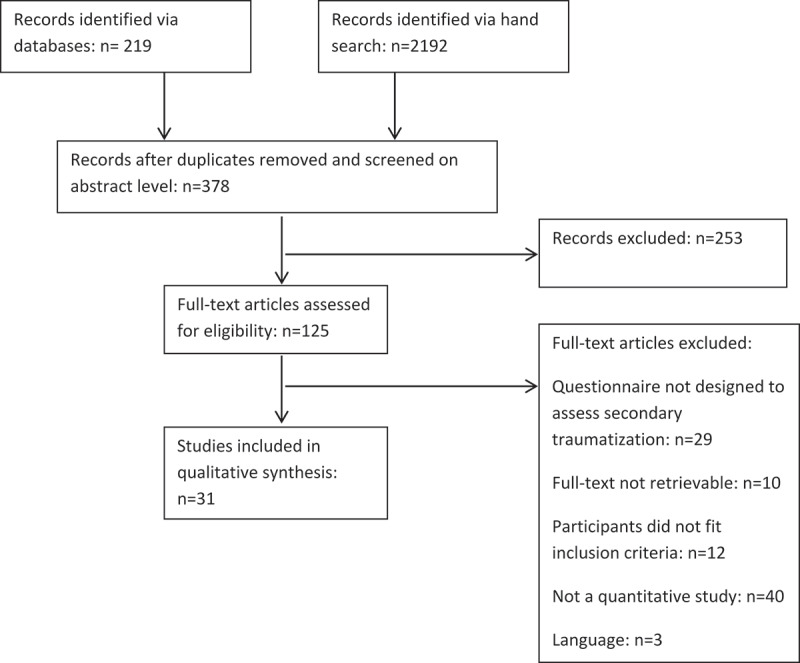
Background: Finding precise definitions of secondary traumatic stress, vicarious traumatization, and compassion fatigue is not easy. While some researchers define these terms differentially, others use them interchangeably. In the present review, we refer to all three phenomena as secondary traumatization.Objectives: This systematic review aims to provide an overview of prevalence rates of secondary traumatization in first responders and to shed light on corresponding resilience and risk factors.Methods: After identifying 219 studies within the searched databases and 2192 references via hand searching, 31 studies were included in this review. We systematically searched the electronic databases PubMed, PsychINFO, and PSYNDEX (German database). The following inclusion criteria were applied: (1) participants had to be first responders working on-site: police officers, firefighters, search and rescue personnel, or emergency and paramedic team members; (2) secondary traumatization (secondary traumatic stress/vicarious traumatization/compassion fatigue) was assessed quantitatively with a validated questionnaire or subscale explicitly measuring secondary traumatization; and (3) English or German language original papers.Results: We found low levels of secondary traumatization in first responders. Several studies describe protective and risk factors for secondary traumatization, including pretraumatic (e.g. age, gender), peritraumatic (e.g. exposure, emotional exhaustion), and post-traumatic factors (e.g. social support, alcohol and tobacco use).Conclusion: Next to an immunizing effect, the low prevalence of secondary traumatization in first responders could be explained by social desirability and job-loss concerns. Therefore, we may be underestimating the prevalence of secondary traumatization in first responders. Some resilience (social support) and risk factors (female gender) are consistent with previous research in other populations. However, owing to the cross-sectional study designs, we must interpret resilience and risk factors with caution. Future research should focus on longitudinal study designs and preventive as well as curative interventions.
Overview
The claims and statistics of this paper haven’t been checked yet.
Free: it reads the open-access text and checks the first 5 claims that cite a source we can check. Create a free account to check every claim.
Integrity signals
Registry
Cites
Statistics
Figures
Verification
Claims the paper makes
The claims and statistics of this paper haven’t been checked yet.
Free: it reads the open-access text and checks the first 5 claims that cite a source we can check. Create a free account to check every claim.
Claims other papers make about this one
Each is checked against this paper’s own text: does it say what the citing paper says it does?
The cited source says what the claim attributes to it.
In the citing paper
“Exposure to other people’s trauma at work can be detrimental to employees (Greinacher et al., 2019; Lee et al., 2018) and to the efficient fulfilment of their work.”
From The psychological impacts of content moderation on content moderators: A qualitative study (2023) · cites this paper as Greinacher et al., 2019
The cited source says what the claim attributes to it.
In the citing paper
“Nevertheless, this study suggests the psychological impacts experienced by commercial CMs are comparable to those experienced by professionals such as first responders and police tasked with analysing child exploitation material (Greinacher et al., 2019; Bourke & Craun, 2014).”
From The psychological impacts of content moderation on content moderators: A qualitative study (2023) · cites this paper as Greinacher et al., 2019
The check wasn’t confident either way, so it gives no verdict — never disputed.
In the citing paper
“Importantly for our purposes, Google Scholar also includes whitepapers, technical reports, and other gray literature published by civil society organizations [78], who have also conducted important research on content reviewer mental health.”
From Measuring the Mental Health of Content Reviewers, a Systematic Review (2025) · cites this paper as [78]
Experimental — accuracy not yet measured
Self-check
Percentages, sums and reported differences re-computed from the paper’s own numbers.
The self-check needs the paper’s full text.
Citations
Cites
Diagnostic and Statistical Manual of Mental Disorders
American Psychiatric Association (2013) · doi:10.1176/appi.books.9780890425596 · Cited by 116,369
Diagnostic and Statistical Manual of Mental Disorders(DSM)
(2008) · Encyclopedia of Counseling · doi:10.4135/9781412963978.n182 · Cited by 10,830
Diagnostic and Statistical Manual of Mental Disorders (DSM-IV)
Hu, R. J. (2003) · Encyclopedia of the Neurological Sciences · doi:10.1016/b0-12-226870-9/01070-4 · Cited by 9,117 · cited 12×
“American Psychiatric Association. (1994). Diagnostic and statistical manual of mental disorders: DSM-IV. Washington, DC: American Psychiatric Association Publishing. American Psychiatric Association. (2013). Diagnostic and statistical manual of mental disorders (DSM-5®). Washington, DC: American Psychiatric Associatio…”
BackgroundMethodInfluentialMeta-analysis of risk factors for posttraumatic stress disorder in trauma-exposed adults
Brewin, C. R., Andrews, B., & Valentine, J. D. (2000) · Journal of Consulting and Clinical Psychology · doi:10.1037/0022-006x.68.5.748 · Cited by 5,243
(1992) · Cited by 5,228
Figley, C. R. (1995) · Cited by 1,466
Deering, D. (1996) · Journal of Psychosocial Nursing and Mental Health Services · doi:10.3928/0279-3695-19961101-26 · Cited by 1,349
Prevalence of Secondary Traumatic Stress among Social Workers
Bride, B. E. (2007) · Social Work · doi:10.1093/sw/52.1.63 · Cited by 937 · cited 2×
“Two studies (Bourke & Craun, 2014; Turgoose et al., 2017) categorized scores into no/little, mild, moderate, high, and severe levels of secondary trauma, as suggested by Bride (2007).”
Background(1995) · Medical Entomology and Zoology · Cited by 927
Development and Validation of the Secondary Traumatic Stress Scale
Bride, B. E., Robinson, M. M., Yegidis, B., & Figley, C. R. (2004) · Research on Social Work Practice · doi:10.1177/1049731503254106 · Cited by 874
Research works printed but not linked: 11
- Crampton D. J. (2014). Comparison of PTSD and compassion fatigue between urban and rural paramedics. (Doctoral dissertation). The University of the Rockies, Denver, CO Retrieved from https://search.proquest.com/docview/1350627026?pq-origsite=gscholar
- Daniels J. (2006). Sekundäre Traumatisierung: Kritische Prüfung eines Konstruktes. (Doctoral dissertation). Retrieved from http://www.sekundaertraumatisierung.de/sfSimpleBlog/show/stripped_title/materialien-und-artikel.html
- Figley C. R. (1999). Compassion fatigue: Toward a new understanding of the cost of caring In Stamm B. H. (Ed.), Secondary traumatic stress (pp. 3– 28). Towson, MD: Sidran Institute.
- Hofmann P. (2009). Addressing compassion fatigue. Healthcare Executive, 24(5), 40– 41. 19764288
- Krieger C. N. III (2017). Understanding the impact of secondary traumatic stress on crimes against children investigators. (Master's thesis). Tarleton State University, Stephenville, Texas Retrieved from https://search.proquest.com/docview/1904391507?pq-origsite=gscholar
- Krutolewitsch A., Horn A. B., & Maercker A. (2015). Trauma-Ausmaß und ausgewählte Prädiktoren in einer Studie mit Feuerwehr- und Rettungskräften. [ Extent of trauma and some selected predictors in a study of rescue workers] Trauma. Zeitschrift für Psychotraumatologie und ihre Anwendungen, 13(3), 78– 91.
- Schmidt J. (2012). Feuerwehr. In C. Neitzel & K. Ladehof (Eds.), Taktische Medizin (pp. 307–311) Springer, Berlin: Heidelberg.
- Scott S. R. (2016). Prevalence of vicarious trauma in parole officers working with client specific caseloads. Ann Arbor, MI: ProQuest Information & Learning.
- Setti I., & Argentero P. (2012). Vicarious trauma: A contribution to the Italian adaptation of the secondary traumatic stress scale. Bollettino Di Psicologia Applicata, 264, 58– 64.
- Stamm B. H. (2005). The ProQol manual: The professional quality of life scale. Lutherville, MD: Sidran Press. Retrieved from http://compassionfatigue.org/pages/ProQOLManualOct05.pdf.
- Stamm B. H. (2010). The concise ProQOL manual. Pocatello, ID: Proqol.org.
Cited by
Items 201–285 of 285
Factors Associated With Physical Activity Levels Among Brazilian Military Law Enforcement Officers
Lan, F., Barbosa, W. G., Saint-Martin, D. R. F., Soares, E. D. M. K. V. K., Christophi, C. A., Kales, S. N., Molina, G. E., & Porto, L. G. G. (2025) · American Journal of Lifestyle Medicine · doi:10.1177/15598276251379843
Mevorach, T., de la Fontaine, N., Skavenski, S. V. W., Cohen, A. S., Chokroverty, L., & Benaroya-Milshtein, N. (2025) · Psychiatry Research · doi:10.1016/j.psychres.2025.116757 · Cited by 1
An Investigation of How Leadership Factors Impact the Mental Health of Emergency Service Workers
Dyer, M. (2025) · QUT ePrints (Queensland University of Technology) · doi:10.5204/thesis.eprints.260683
Sekundarna traumatizacija: pogled iznutra
istraživanja, I. Z. K. I. S., & Glomazić, H. (2025) · doi:10.47152/sektrauma2025
Duran, S., ÖZ, Y. C., & Keleş, B. (2025) · Research Square · doi:10.21203/rs.3.rs-7691854/v1
Psychological Factors in the Wellbeing of First Responder Populations
Parker, B. (2023) · Lancaster EPrints (Lancaster University) · doi:10.17635/lancaster/thesis/2019
Ericsson, C. R., Nordquist, H., Lindström, V., & Rudman, A. (2021) · Figshare · doi:10.6084/m9.figshare.16746760
PREVALENCE OF SECONDARY TRAUMA STRESS AND MENTAL HEALTH OF FIRST RESPONDERS
al, K. J. C. E. (2025) · Excellencia: International Multi-disciplinary Journal of Education (2994-9521) · doi:10.5281/zenodo.14920694
Ericsson, C. R., Nordquist, H., Lindström, V., & Rudman, A. (2021) · Figshare · doi:10.6084/m9.figshare.16746754
Polytechnic instructors as first responders to student crises : centring faculty voices
Westcott, M. (2025) · cIRcle (University of British Columbia) · doi:10.14288/1.0448345
Mental Well-Being of Volunteer Rescue Workers After a Terrorist Attack: A Longitudinal Survey Study
Scheers, H., Vanhove, A.-C., Stroobants, S., Buck, E. D. J. D., Lauwers, K., & Vandekerckhove, P. (2022) · TRC JOURNAL OF HUMANITARIAN ACTION · doi:10.55280/trcjha.2022.1.2.0001
Ericsson, C. R., Nordquist, H., Lindström, V., & Rudman, A. (2021) · Figshare · doi:10.6084/m9.figshare.16746745
Ericsson, C. R., Nordquist, H., Lindström, V., & Rudman, A. (2021) · Figshare · doi:10.6084/m9.figshare.16746748
Ericsson, C. R., Nordquist, H., Lindström, V., & Rudman, A. (2021) · Figshare · doi:10.6084/m9.figshare.16746739
Ericsson, C. R., Nordquist, H., Lindström, V., & Rudman, A. (2021) · Figshare · doi:10.6084/m9.figshare.16746751
A qualitative exploration of UK police investigative interviewers’ experiences of their role
Page, J. (2020) · University of Leicester · doi:10.25392/leicester.data.13317785
Ericsson, C. R., Nordquist, H., Lindström, V., & Rudman, A. (2021) · Figshare · doi:10.6084/m9.figshare.16746742
Ericsson, C. R., Nordquist, H., Lindström, V., & Rudman, A. (2021) · Figshare · doi:10.6084/m9.figshare.16746757
Batchelor, M. (2024) · ORCA Online Research @Cardiff (Cardiff University)
Áhyggjur aðstandenda og viðhorf þeirra til valdbeitingarheimilda lögreglunnar
Óskarsdóttir, E. R., Gunnarsson, E., & Guðmundsson, Á. (2023) · Skemman
Maloney, S. D. (2024) · ScholarWorks (Walden University)
Attentional Bias Toward Forest Fires-Related Stimuli Among Firefighters and General Population
Rodrigues, F., Bártolo, A., Santos, I., Pereira, A., & Silva, C. (2022) · Portuguese National Funding Agency for Science, Research and Technology (RCAAP Project by FCT)
Ensihoitajien psyykkinen jaksaminen ja sen edistäminen
Giers, J., & Pollari, P. (2024) · Theseus (Ammattikorkeakoulujen)
Firefighters' Perceptions and Experiences of Seeking Mental Health Treatment Services
Whitman, K. (2023) · ScholarWorks (Walden University) · Cited by 3
Berry, S., Sellwood, B., & Parry, S. L. (2024) · Lancaster EPrints (Lancaster University)
Áfallastreita neyðarvarða: Áfallahjálp á Íslandi í samanburði við tvö önnur lönd
Jakobsdóttir, L. B. (2023) · Skemman
Burton, L. A. (2025) · Scholars Crossing (Liberty University)
Fonseca, S. M. (2021) · Portuguese National Funding Agency for Science, Research and Technology (RCAAP Project by FCT) · doi:10.34626/temy-hg71 · Cited by 1
Ensihoitajan resilienssin tukeminen uhka- ja väkivaltatilanteiden jälkeen
Alatalo, N., & Nenonen, I. (2025) · Theseus (Ammattikorkeakoulujen)
Côté, K. (2025) · Le dépôt institutionnel (Université du Québec à Trois-Rivières)
Beršnak, J. V., Lobe, B., Jelušič, L., Juvan, J., Vinko, M., Roškar, S., Humer, Ž., Šlebir, M., Živoder, A., & Ferme, G. (2025) · doi:10.51936/9789612951368
Sisman, E., Gareayaghi, A., & Polat, A. Ö. (2025) · Journal of Clinical Psychiatry · doi:10.5505/kpd.2025.67864
Bakır, R. E., & Vural, M. (2025) · Ilahiyat Studies · doi:10.12730/is.1676110
Oppenheim, N., Aizik, U., Offenbacher, J., Cohen, A., Markovits, M., Shopen, N., Tal, O., Pachys, G., & Trotzky, D. (2026) · Frontiers in Public Health · doi:10.3389/fpubh.2026.1728587
Birger, L. (2026) · The British Journal of Social Work · doi:10.1093/bjsw/bcag013
Propuesta de intervención en resiliencia para personal de búsqueda de desaparecidos
Rodríguez, N. S. D. E. (2023) · e_Buah
Born, J., Williams, L., Xi, M., & Hopkins, R. (2026) · Journal of Military Veteran and Family Health · doi:10.3138/jmvfh-2025-0045
Blanding, A. (2026) · ScholarWorks (Walden University)
Cabaluna, M. L., Obiedo, M. L., Santos, E. F., & Villegas, J. R. A. (2026) · International Journal of Research and Innovation in Social Science · doi:10.47772/ijriss.2026.10200297
Into the inferno: Counsellor competency in firefighter culture
Kingston, M. (n.d.) · Summit (Simon Fraser University)
Belcher, E. (2024) · Staffordshire Online Repository (Staffordshire University)
Hosser, D., & Puderbach, S. (2026) · Springer eBooks · doi:10.1007/978-3-658-48467-5_25
Colding, B. D. (2026) · Digital Commons (Liberty University)
Silva, L. D. D. (2025) · theses.fr (ABES) · doi:10.70675/6ff2c92ezc9a2z48c3za292zc510c7569fe3
Is it time for AI to take a leading role in mass trauma mental health response?
Brenner, G. H., Koyfman, S., & Mehendale, R. (2026) · Psychiatry Research · doi:10.1016/j.psychres.2026.117164 · Cited by 1
Secondary Traumatic Stress in Front Line Professionals: An exploration of risk factors
Lanigan, L., Lambert, S., Murphy, R., & Emerson, G.-G. (2026) · Arrow - TU Dublin (Technological University Dublin) · doi:10.21427/8g18-yj47
Nöthling, J., Pansari, F., Bröcker, E., & Seedat, S. (2026) · International Journal of Behavioral Medicine · doi:10.1007/s12529-026-10458-2
Gibson, K. N. (2026) · Digital Commons (Liberty University)
Wolff, D. E. (2026) · Digital Commons (Liberty University)
Exploring Factors that Influence the Impact of Indirect Exposure to Trauma
Whittenbury, K. (2026) · e-space (Manchester Metropolitan University) · doi:10.83056/mmu.32481054
Burakova, M., Saddy, E. A., Álvarez, M. P., Oulhassi, L., & Attal, M. (2026) · Current Psychology · doi:10.1007/s12144-026-09465-z
“This finding is consistent with the systematic review by Greinacher et al. ( 2019 ) on second - ary traumatization in first responders.”
Психологічні предиктори вторинної травматизації психологів ДСНС України
Боснюк, В. Ф., Катерина, Я., & Дар'я, Д. (2026) · Disaster and crisis psychology problems · doi:10.52363/dcpp-2026.1.1
Novsak, M. O. (2026) · Rowan Digitals Works (Rowan University)
Levy, E., & Farchi, M. U. (2026) · Frontiers in Psychology · doi:10.3389/fpsyg.2026.1875015
Wege der Bewältigung und Selbstfürsorge
Steffes-Holländer, S. (2026) · Springer eBooks · doi:10.1007/978-3-658-51183-8_7
Kommunikation im Umgang mit Betroffenen
Steffes-Holländer, S. (2026) · Springer eBooks · doi:10.1007/978-3-658-51183-8_11
Yockey, R. A., Galusha, J. M., Ponder, W. N., Carbajal, J., Collins, C. M., & Schuman, D. L. (2026) · Journal of Occupational and Environmental Medicine · doi:10.1097/jom.0000000000003699 · Cited by 1
Kılıç, M., Arslan, C., & Hamarta, E. (2026) · Türk Psikolojik Danışma ve Rehberlik Dergisi · doi:10.17066/tpdrd.1809573
Sumartini, S., Kosasih, C. E., Yanny Trisyani, W., & Iskandar, S. (2026) · Journal of Multidisciplinary Healthcare · doi:10.2147/jmdh.s609206
“2,9 This narrative review addresses this evidence gap by synthesising the extent, range, nature, and reported effects of available evidence on team-based and organisational resilience strategies for emergency care teams.”
Secondary Traumatic Stress: Lived Experiences of Urban Educators
Booker, S. R. (2026) · Scholars Crossing (Liberty University)
Silva, L. D. D., Alleaume, B., & Coq, J.-M. (2026) · International Journal of Mental Health · doi:10.1080/00207411.2026.2705603
Xue, Y., Zhao, X., Sun, H., Zhang, B., Yu, S., Yuan, H., Yang, Y., & Guan, R. (2026) · BMC Nursing · doi:10.1186/s12912-026-05118-5
“For nurses already exhibiting self-blame and anxiety, repetitive event reviews appear to function as an additional psychological burden rather than as a learning opportunity, a pattern previously linked to secondary psychological trauma [37, 38].”
The Cost of Working Directly With Offenders: A Systematic Review of the Mental Health Implications
Barros, S., Coelho, J., Barroso, R., & Santos, A. (2026) · Trauma Violence & Abuse · doi:10.1177/15248380261468259
Loan, L. T. M., Le, T. T. D., Anh, T. N. T., Oanh, M. T. K., & Thu, N. T. A. (2026) · Health Psychology Report · doi:10.5114/hpr/221714
The Relationship between Burnout and Mental Health towards Job Satisfaction among First Responders
Thilagaratnam, S. F., & Mutang, J. A. (2026) · Jurnal Psikologi dan Kesihatan Sosial · doi:10.51200/jpks.v7i1.6132
“International perspectives on burnout and mental health enrich the discourse, with studies revealing correlations with post-traumatic stress disorder (PTSD), turnover intention, job demands, and job resources among mental health personnel (Greinacher et al., 2019; Scanlan & Still, 2019).”
The experience of occupational exposure to suicide among police and paramedics in New Zealand
de Lyra, R. L. (2019) · Otago University Research Archive (University of Otago) · Cited by 2
Post-Traumatic Stress Symptoms and Dissociation in Emergency Medical Service Personnel
Tsruya, R., Shadach, E., & Shelef, L. (2026) · Healthcare · doi:10.3390/healthcare14162534
“This scale includes items 2, 4, 7, 9, 15, 19, and 20.”
Psychosocial work environment and health among ambulance clinicians in northern Sweden
Hedqvist, A., Lindström, V., Ericsson, C., & Aléx, J. (2026) · Discover Mental Health · doi:10.1007/s44192-026-00573-7
“Explanations may include true lower burden, symptom expression in other domains (depression or exhaustion) [1, 31, 88, 89], or underreporting and normalisation of distress that suppresses help-seeking [90].”
Blackburn, C. C., & Newman, E. (2026) · Journal of Immigrant and Minority Health · doi:10.1007/s10903-026-01977-x
Brierley-Sollis, T., Dubberley, S., & Hughes, C. (2026) · Criminology & Criminal Justice · doi:10.1177/17488958261479240
Atak, M., Sezerol, M. A., & Altaş, Z. M. (2026) · BMC Psychology · doi:10.1186/s40359-026-05417-1
“Although volunteers were not necessarily direct victims of the earthquake, repeated exposure to injured individuals, bereaved families, distressing scenes, and survivors’ traumatic experiences may have contributed to psychological distress [15].”
InfluentialWhen Empathy Becomes a Risk: Psychotherapists' Vulnerability in the Aftermath of Collective Trauma
Naseri, M., & Ghazvini, H. (2026) · Iranian Journal of Psychiatry and Behavioral Sciences · doi:10.5812/ijpbs-173446
Johnson, A. P. (2026) · ScholarWorks (Walden University)
White, S. C., O’Dell, Z. M., & Smyth, J. M. (2026) · Occupational Health · doi:10.3390/occuphealth1040045
Trauma on both sides of the badge: a research portfolio
Smyth, R. (2026) · ERA · doi:10.7488/era/7792
An investigation of firefighters’ repeated exposure to trauma
Trout, A. M. (2026) · K-State Research Exchange (Kansas State University)
Maanda, T. P. (2025) · Nelson Mandela University Research Repository
Çınaroğlu, M., & Yılmazer, E. (2026) · Frontiers in Psychology · doi:10.3389/fpsyg.2026.1779042
“This dual burden of personal trauma and caregiver stress is sometimes termed secondary traumatization, reflecting the indirect trauma of witnessing others’ suffering in addition to one’s own (Greinacher et al., 2019).”
Beyond exposure: institutional response, resilience, and mental health after the 2024 Spanish floods
Collazo‐Castiñeira, P., Collado, S., Garrido‐Hernansaiz, H., Sánchez-Izquierdo, M., & Rodríguez‐Rey, R. (2026) · International Journal of Disaster Risk Reduction · doi:10.1016/j.ijdrr.2026.106517
Boudilmi, M., Landais, L., Guénoun, T., Smaniotto, B., Urgese, S. N., Ravit, M., Mitsopoulou, L., Wathelet, M., & Essadek, A. (2026) · Trauma Violence & Abuse · doi:10.1177/15248380261438779
Živoder, A., Beršnak, J. V., & Humer, Ž. (2026) · SAGE Open · doi:10.1177/21582440261501759
Shevchuk, O., Zhuravlova, O., & Kozihora, M. (2026) · PSYCHOLOGICAL JOURNAL · doi:10.31108/1.2026.12.9.7
Personality Traits and Professional Quality of Life in Volunteer Ski Patrollers
Stubbers, K., & Christiansen, L. R. (2026) · Wilderness and Environmental Medicine · doi:10.1177/10806032261501926
Metadata
- Authors
- Greinacher, A., Derezza-Greeven, C., Herzog, W., & Nikendei, C.
- Affiliations
- University Hospital Heidelberg (DE)
- Corresponding author
- Greinacher, Anja
- Venue
- European Journal of Psychotraumatology
- Publisher
- Informa UK Limited
- Published
- 2019-01-22
- Volume
- 10
- Issue
- 1
- Pages
- 1562840-1562840
- ISSN
- 2000-8066 (ISSN-L)
- PMC
- PMC6346705
- OpenAlex
- W2914918627
- Semantic Scholar
- baa0cd28e14a73f61f007357831892f44e3f18a0
- Cited by
- 227
- References
- 73
- Citations by year
- 2026: 37 · 2025: 23 · 2024: 33 · 2023: 33 · 2022: 35 · 2021: 37 · 2020: 26 · 2019: 3
- FWCI
- 4.00
- Type
- journal article
- Language
- en
- Open access
- gold
- doi.org
- Licence
- Locations
- European Journal of Psychotraumatology (publishedVersion, cc-by-nc)
- Europe PMC (PubMed Central) (publishedVersion, cc-by-nc)
- PubMed Central (publishedVersion, cc-by-nc)
- PubMed (publishedVersion)
- DOAJ (DOAJ: Directory of Open Access Journals) (submittedVersion)
- Funders
- No funding was received for this study
- Topics
- Social Sciences › Psychology › Clinical Psychology › Posttraumatic Stress Disorder Research
- Social Sciences › Psychology › Social Psychology › Stress and Burnout Research
- Health Sciences › Medicine › Public Health, Environmental and Occupational Health › Occupational Health and Performance
- Keywords
- secondary traumatic stress, vicarious trauma, compassion fatigue, first responders, police officers, firefighters, paramedics, emergency workers, resilience, risk factors, social support, emotional exhaustion, prevalence, gender differences
About these checks
Registry, retraction, Cites and statistics results are computed, not judged, with one exception: a printed reference that no index lists is read once by a model before it counts as a citation error. Claims are extracted by a model and kept only when their quote appears verbatim in the text; each cited source is then checked, with a model’s help, for whether it says what the claim relies on. Those verdicts can be wrong — read the claim’s quote and the cited source before relying on one.
Statistics and arithmetic are recomputed, not judged.
Confidence bands are shown only for fields calibrated on our annotated test set. None is calibrated yet, so no band is shown.
What counts as a claim ›How we measure confidence ›How we check this ›
Are you an author, or do you see a problem with this page? Request a review
Data sources
Bibliographic data: Semantic Scholar, OpenAlex, Crossref.
Contains information from the Semantic Scholar Academic Graph Datasets, made available under the ODC Attribution License (ODC-BY 1.0).
Semantic Scholar’s data is described in: Kinney, R., et al. (2023). The Semantic Scholar Open Data Platform. arXiv:2301.10140.
