

Secondary traumatization in first responders: a systematic review
Open accessThe DOI matches its Crossref record; 71 of the 73 references it cites were found in a registry or an index.
Abstract
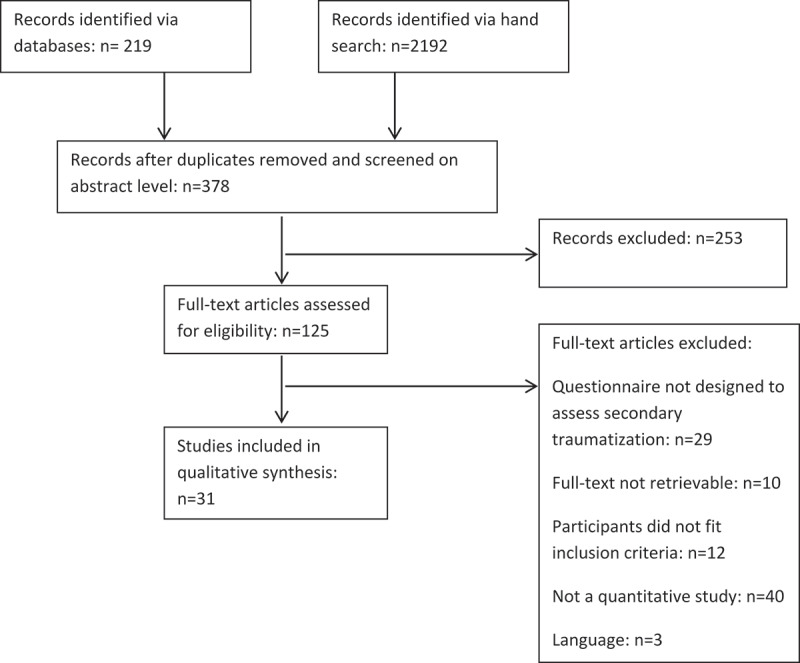
Background: Finding precise definitions of secondary traumatic stress, vicarious traumatization, and compassion fatigue is not easy. While some researchers define these terms differentially, others use them interchangeably. In the present review, we refer to all three phenomena as secondary traumatization.Objectives: This systematic review aims to provide an overview of prevalence rates of secondary traumatization in first responders and to shed light on corresponding resilience and risk factors.Methods: After identifying 219 studies within the searched databases and 2192 references via hand searching, 31 studies were included in this review. We systematically searched the electronic databases PubMed, PsychINFO, and PSYNDEX (German database). The following inclusion criteria were applied: (1) participants had to be first responders working on-site: police officers, firefighters, search and rescue personnel, or emergency and paramedic team members; (2) secondary traumatization (secondary traumatic stress/vicarious traumatization/compassion fatigue) was assessed quantitatively with a validated questionnaire or subscale explicitly measuring secondary traumatization; and (3) English or German language original papers.Results: We found low levels of secondary traumatization in first responders. Several studies describe protective and risk factors for secondary traumatization, including pretraumatic (e.g. age, gender), peritraumatic (e.g. exposure, emotional exhaustion), and post-traumatic factors (e.g. social support, alcohol and tobacco use).Conclusion: Next to an immunizing effect, the low prevalence of secondary traumatization in first responders could be explained by social desirability and job-loss concerns. Therefore, we may be underestimating the prevalence of secondary traumatization in first responders. Some resilience (social support) and risk factors (female gender) are consistent with previous research in other populations. However, owing to the cross-sectional study designs, we must interpret resilience and risk factors with caution. Future research should focus on longitudinal study designs and preventive as well as curative interventions.
Overview
The claims and statistics of this paper haven’t been checked yet.
Free: it reads the open-access text and checks the first 5 claims that cite a source we can check. Create a free account to check every claim.
Integrity signals
Registry
Cites
Statistics
Figures
Verification
Claims the paper makes
The claims and statistics of this paper haven’t been checked yet.
Free: it reads the open-access text and checks the first 5 claims that cite a source we can check. Create a free account to check every claim.
Claims other papers make about this one
Each is checked against this paper’s own text: does it say what the citing paper says it does?
The cited source says what the claim attributes to it.
In the citing paper
“Exposure to other people’s trauma at work can be detrimental to employees (Greinacher et al., 2019; Lee et al., 2018) and to the efficient fulfilment of their work.”
From The psychological impacts of content moderation on content moderators: A qualitative study (2023) · cites this paper as Greinacher et al., 2019
The cited source says what the claim attributes to it.
In the citing paper
“Nevertheless, this study suggests the psychological impacts experienced by commercial CMs are comparable to those experienced by professionals such as first responders and police tasked with analysing child exploitation material (Greinacher et al., 2019; Bourke & Craun, 2014).”
From The psychological impacts of content moderation on content moderators: A qualitative study (2023) · cites this paper as Greinacher et al., 2019
The check wasn’t confident either way, so it gives no verdict — never disputed.
In the citing paper
“Importantly for our purposes, Google Scholar also includes whitepapers, technical reports, and other gray literature published by civil society organizations [78], who have also conducted important research on content reviewer mental health.”
From Measuring the Mental Health of Content Reviewers, a Systematic Review (2025) · cites this paper as [78]
Experimental — accuracy not yet measured
Self-check
Percentages, sums and reported differences re-computed from the paper’s own numbers.
The self-check needs the paper’s full text.
Citations
Cites
Diagnostic and Statistical Manual of Mental Disorders
American Psychiatric Association (2013) · doi:10.1176/appi.books.9780890425596 · Cited by 116,369
Diagnostic and Statistical Manual of Mental Disorders(DSM)
(2008) · Encyclopedia of Counseling · doi:10.4135/9781412963978.n182 · Cited by 10,830
Diagnostic and Statistical Manual of Mental Disorders (DSM-IV)
Hu, R. J. (2003) · Encyclopedia of the Neurological Sciences · doi:10.1016/b0-12-226870-9/01070-4 · Cited by 9,117 · cited 12×
“American Psychiatric Association. (1994). Diagnostic and statistical manual of mental disorders: DSM-IV. Washington, DC: American Psychiatric Association Publishing. American Psychiatric Association. (2013). Diagnostic and statistical manual of mental disorders (DSM-5®). Washington, DC: American Psychiatric Associatio…”
BackgroundMethodInfluentialMeta-analysis of risk factors for posttraumatic stress disorder in trauma-exposed adults
Brewin, C. R., Andrews, B., & Valentine, J. D. (2000) · Journal of Consulting and Clinical Psychology · doi:10.1037/0022-006x.68.5.748 · Cited by 5,243
(1992) · Cited by 5,228
Figley, C. R. (1995) · Cited by 1,466
Deering, D. (1996) · Journal of Psychosocial Nursing and Mental Health Services · doi:10.3928/0279-3695-19961101-26 · Cited by 1,349
Prevalence of Secondary Traumatic Stress among Social Workers
Bride, B. E. (2007) · Social Work · doi:10.1093/sw/52.1.63 · Cited by 937 · cited 2×
“Two studies (Bourke & Craun, 2014; Turgoose et al., 2017) categorized scores into no/little, mild, moderate, high, and severe levels of secondary trauma, as suggested by Bride (2007).”
Background(1995) · Medical Entomology and Zoology · Cited by 927
Development and Validation of the Secondary Traumatic Stress Scale
Bride, B. E., Robinson, M. M., Yegidis, B., & Figley, C. R. (2004) · Research on Social Work Practice · doi:10.1177/1049731503254106 · Cited by 874
Research works printed but not linked: 11
- Crampton D. J. (2014). Comparison of PTSD and compassion fatigue between urban and rural paramedics. (Doctoral dissertation). The University of the Rockies, Denver, CO Retrieved from https://search.proquest.com/docview/1350627026?pq-origsite=gscholar
- Daniels J. (2006). Sekundäre Traumatisierung: Kritische Prüfung eines Konstruktes. (Doctoral dissertation). Retrieved from http://www.sekundaertraumatisierung.de/sfSimpleBlog/show/stripped_title/materialien-und-artikel.html
- Figley C. R. (1999). Compassion fatigue: Toward a new understanding of the cost of caring In Stamm B. H. (Ed.), Secondary traumatic stress (pp. 3– 28). Towson, MD: Sidran Institute.
- Hofmann P. (2009). Addressing compassion fatigue. Healthcare Executive, 24(5), 40– 41. 19764288
- Krieger C. N. III (2017). Understanding the impact of secondary traumatic stress on crimes against children investigators. (Master's thesis). Tarleton State University, Stephenville, Texas Retrieved from https://search.proquest.com/docview/1904391507?pq-origsite=gscholar
- Krutolewitsch A., Horn A. B., & Maercker A. (2015). Trauma-Ausmaß und ausgewählte Prädiktoren in einer Studie mit Feuerwehr- und Rettungskräften. [ Extent of trauma and some selected predictors in a study of rescue workers] Trauma. Zeitschrift für Psychotraumatologie und ihre Anwendungen, 13(3), 78– 91.
- Schmidt J. (2012). Feuerwehr. In C. Neitzel & K. Ladehof (Eds.), Taktische Medizin (pp. 307–311) Springer, Berlin: Heidelberg.
- Scott S. R. (2016). Prevalence of vicarious trauma in parole officers working with client specific caseloads. Ann Arbor, MI: ProQuest Information & Learning.
- Setti I., & Argentero P. (2012). Vicarious trauma: A contribution to the Italian adaptation of the secondary traumatic stress scale. Bollettino Di Psicologia Applicata, 264, 58– 64.
- Stamm B. H. (2005). The ProQol manual: The professional quality of life scale. Lutherville, MD: Sidran Press. Retrieved from http://compassionfatigue.org/pages/ProQOLManualOct05.pdf.
- Stamm B. H. (2010). The concise ProQOL manual. Pocatello, ID: Proqol.org.
Cited by
Items 101–200 of 285
Secondary Traumatic Stress in Medical Students During Clinical Clerkships
Grush, K. A., Christensen, W., Lockspeiser, T. M., & Adams, J. E. (2024) · Academic Medicine · doi:10.1097/acm.0000000000005940 · Cited by 7
Prevalence of Secondary Trauma, Compassion Fatigue and Burnout Among Trauma Therapists in Spain
Velasco, J., Sanmartín, F. J., Cuadrado, F., & Moriana, J. A. (2025) · Counselling and Psychotherapy Research · doi:10.1002/capr.12901 · Cited by 8
Vicarious Traumatization Among Emergency Medical Service Personnel: A Systematic Review
Meeker, S. A., Hahn, R., Wilt, V. L., & Molnar, B. E. (2025) · Trauma Violence & Abuse · doi:10.1177/15248380251320990 · Cited by 9
“…to emergency workers (Vagni et al., 2020), and the final study found that volunteers presented lower levels of secondary traumatization compared with interpreters, trauma therapists, social workers, psychotherapists, and physicians working with refugees (Greinacher, Nikendei, et al., 2019).”
InfluentialCogan, N., Kirk, A. F., & Graf, C. (2026) · JMIR Research Protocols · doi:10.2196/72250 · Cited by 8
“The development of the interview schedule was informed by earlier research [52, 53] and focused on FRs’ experiences of exposure to trauma in the workplace and its impact, exploring the domains of (1) mental health and well-being, (2) feelings of safety, (3) help-seeking and supports, and (4)…”
Karrasch, S., Hitzler, M., Behnke, A., Tumani, V., Kolassa, I., & Rojas, R. (2020) · Zeitschrift für Klinische Psychologie und Psychotherapie · doi:10.1026/1616-3443/a000600 · Cited by 8
Being a top cop in pursuit of a sustainable lifestyle
Valmari, E. G., Nygren, U., Ghazinour, M., & Gilenstam, K. (2023) · International Journal of Qualitative Studies on Health and Well-Being · doi:10.1080/17482631.2023.2235789 · Cited by 8
Traumatic residue, mediated remembering and video evidence of sexual violence: A case study
Regehr, C., Regehr, K., & Birze, A. (2022) · International Journal of Law and Psychiatry · doi:10.1016/j.ijlp.2022.101778 · Cited by 6
From where does my support come? Unpacking the contribution of support for police
Schantz, A. D., Coxe, S. J., & Bruk‐Lee, V. (2020) · Policing An International Journal · doi:10.1108/pijpsm-07-2020-0130 · Cited by 6
The Experience of Working With Individuals Who Sexually Offend
Jeglic, E. L., Zulueta, I., & Katsman, K. (2021) · Sexual Abuse · doi:10.1177/10790632211051691 · Cited by 6
“…have found that similar to first responders, treatment providers who provide clinical services to victims or perpetrators of trauma may experience symptoms of trauma themselves—a phenomenon known as vicarious traumatization (Greinacher et al., 2019; McCann & Pearlman, 1990; Way et al., 2004).”
BackgroundParyente, B., & Frei-Landau, R. (2024) · Methodological Innovations · doi:10.1177/20597991241241845 · Cited by 6
“In other words, intensive care of individuals who have experienced trauma may create a traumatic experience in their caregivers as well (Arpacioglu et al., 2021; Greene et al., 2021: Greinacher et al., 2019) and require a rebalancing of their identity.”
Yan, Y., Jiang, L., Hu, M., Wang, L., Xu, X. Y., Jin, Z., Song, Y., Lu, Z.-X., Chen, Y.-Q., Li, N.-N., et al. (2020) · Frontiers in Psychology · doi:10.3389/fpsyg.2020.00767 · Cited by 6
“A nascent and growing body of research suggests that caregiving professionals (Duffy et al., 2015; Denkinger et al., 2018; Greinacher et al., 2019) as well as witnesses and bystanders in the general public (Diehle et al.”
BackgroundZhou, Z.-Y., Zhang, J.-Z., Zhao, X., Niu, Y., Zhang, J., Feng, B., Ge, P., Liu, X., Zhou, L., & Wu, Y. (2023) · Journal of Public Health · doi:10.1007/s10389-023-01959-5 · Cited by 5
“Studies have shown that social support is a protective factor against stress disorders and secondary injuries among first responders (Greinacher et al. 2019).”
Kornwachs, G., Hautzinger, M., & Kızılhan, J. I. (2024) · Frontiers in Psychiatry · doi:10.3389/fpsyt.2024.1434670 · Cited by 5
“Psychotherapy in general, but especially in this region, is an extremely emotionally draining job, which can lead to secondary traumatization (18, 19).”
BackgroundDefining the concept of psychological trauma
Engelhard, I. M., Krypotos, A., McNally, R. J., Mertens, G., & van Zuiden, M. (2026) · Nature Reviews Psychology · doi:10.1038/s44159-026-00557-y · Cited by 5
PTSD, Relationship Satisfaction, and Social Support for EMS Workers and Their Romantic Partners
Henry, M. C., Burks-Wright, M. A., & Zoernig, E. L. (2023) · The Family Journal · doi:10.1177/10664807231198866 · Cited by 6
“EMS workers are distinct from other fi rst responders in that they are responsible for attending to the public ’ s immediate medical needs, compared to protecting the law, property, or environment (Greinacher et al., 2019).”
BackgroundInfluentialVicarious trauma and the COVID‐19 pandemic: The role of organisations
Meeker, S. A., Lincoln, A. K., & Molnar, B. E. (2024) · Stress and Health · doi:10.1002/smi.3458 · Cited by 5
Seeking balance between contradictory experiences - therapists treating survivors of sexual violence
von Mentzer, C., Rembeck, G. I., Dahlberg, H., & Premberg, Å. (2024) · International Journal of Qualitative Studies on Health and Well-Being · doi:10.1080/17482631.2024.2422141 · Cited by 5
“However, “secondary traumatization” can be used as a generic term for the phenomena described above (Greinacher et al., 2019).”
BackgroundArmaș, I., Dobre, D., Fekete, A., Rufat, S., & Albulescu, A.-C. (2024) · International Journal of Disaster Risk Reduction · doi:10.1016/j.ijdrr.2024.105008 · Cited by 6
Onat, M., Yiğit, M., Kayademir, N., Avcı, H., Dinç, G. Ş., & Çöp, E. (2025) · Turkish Journal of Psychiatry · doi:10.5080/u27571 · Cited by 6
Alsous, M. M., Muhaissen, B. A., Massad, T., Sayaheen, B., Alnasser, T. Z., Al‐Smadi, A. M., Zeghoul, R., Alrob, O. A., Aljabali, A. A. A., & Gammoh, O. (2024) · International Journal of Social Psychiatry · doi:10.1177/00207640241270831 · Cited by 6
“Insomnia was assessed using the Insomnia-Severity Index-Arabic version (ISI-A) using a cut-off value above 14 for severe insomnia. echoes prior literature highlighting heightened PTSD levels in both direct witnesses and those exposed to traumatic events (Greinacher et al., 2019).”
Gewirtz‐Meydan, A., & Lazar, A. (2025) · Journal of Sexual Aggression · doi:10.1080/13552600.2025.2484298 · Cited by 5
“…literature on secondary traumatic stress has primarily focused on professionals working with trauma survivors, family members of trauma victims, first responders, and law enforcement personnel (Craun et al., 2014; Dekel et al., 2016; Figley, 2013; Greinacher et al., 2019; Pryce et al., 2007).”
Shirazi, M. S., Sadeghzadeh, M., Abbasi, M., Yousefi, M., & Hedayati, A. (2022) · Iranian Journal of Psychiatry · doi:10.18502/ijps.v17i4.10685 · Cited by 5
“nurses ranged from 4% to 13% in researches performed before the COVID-19 outbreak (20).”
BackgroundPredictors of Secondary Traumatic Stress Symptoms in Police Officers Exposed to Secondary Trauma
Ogińska-Bulik, N. J., & Bąk, G. (2022) · Internal Security · doi:10.5604/01.3001.0016.0390 · Cited by 4
Çorbacı, E., Tansel, E., & Alkan, D. (2025) · Healthcare · doi:10.3390/healthcare13101101 · Cited by 5
“In particular, embracing feelings, turning to hobbies, alcohol use, and social isolation were prominent coping strategies.”
Pajardi, D., D'Agostino, A., Gagliardini, G., Pepi, R., & Colli, A. (2022) · Mediterranean Journal of Clinical Psychology · doi:10.13129/2282-1619/mjcp-3603 · Cited by 4
Adiningsih, H. B., & Abidin, Z. (2021) · Martabat Jurnal Perempuan dan Anak · doi:10.21274/martabat.2021.5.2.240-263 · Cited by 5
Miao, X., Wang, W., Chen, Y., Huang, X., & Wang, R. (2022) · Health Science Reports · doi:10.1002/hsr2.834 · Cited by 4
“In major health events, it is impossible to ignore the psychological stress experienced by rescue workers, who are prone to secondary trauma as a result of long‐term contact with crisis situations.(19) In accordance with previous studies, the overall prevalence of posttraumatic stress disorder (PTSD) among rescue work…”
BackgroundPTSD symptoms among patients with multiple sclerosis in Jordan during October 7th Gaza war outbreak
Gammoh, O., Qnais, E. Y., Alshaikh, H. A., Mansour, M., Al-Habahbeh, S., Weshah, F., Ennab, W., Alotaibi, B. S., & Alqudah, A. M. (2024) · The International Journal of Psychiatry in Medicine · doi:10.1177/00912174241272680 · Cited by 3
Rethinking Lifetime Abuse in Old Age
Band‐Winterstein, T., Shulyaev, K., & Eisikovits, Z. C. (2024) · Journal of Interpersonal Violence · doi:10.1177/08862605241264533 · Cited by 3
“Several studies have described protective and risk factors for re-traumatization, including pre-traumatic (e.g., age and gender), peri-traumatic (e.g., exposure and emotional exhaustion), and posttraumatic factors (e.g., social support, alcohol, and tobacco use) (Greinacher et al., 2019).”
Rzepka, I., Kindermann, D., Friederich, H., & Nikendei, C. (2024) · Trials · doi:10.1186/s13063-024-08480-4 · Cited by 3
“Secondary traumatic stress is particularly prevalent among trauma therapists and other caregivers of traumatized clients [8, 18], nurses [19], or first responders [20] as highlighted in various studies.”
BackgroundSelf-citationMcFadden, S., Lavelle, M., Graham‐Wisener, L., Gormley, O., & Groarke, J. M. (2025) · Journal of Forensic Psychology Research and Practice · doi:10.1080/24732850.2025.2563235 · Cited by 3
Wachter, K., Shaw, S. A., Baccam, Z., & Rodgers, G. (2026) · Journal of Social Service Research · doi:10.1080/01488376.2026.2633334 · Cited by 3
Gender Differences and Secondary Traumatization in Helping Professions
Glomazić, H., & Vidović, S. (2024) · International Scientific Conference “Life in Prison: Criminological, Penological, Psychological, Sociological, Legal, Security, and Medical Issues” · doi:10.47152/prisonlife2024.09 · Cited by 4
Langvik, E., Rostad, I. S., Loncar, L., Lervåg, I. K., Nordnes, A. M., & Saksvik‐Lehouillier, I. (2025) · SAGE Open · doi:10.1177/21582440251324762 · Cited by 4
“STSD, like PTSD, is characterized by flashbacks of the event indirectly exposed to, heightened arousal, and avoidance, and can be instigated by exposure to victims of sexual violence (Foley et al., 2023; Greinacher et al., 2019; Salston & Figley, 2003).”
Naim, S., & Gigi, A. (2025) · Journal of Psychiatric Research · doi:10.1016/j.jpsychires.2025.05.005 · Cited by 4
Boyd, D. C., Steadman, D. W., Marzani-Nissen, G., & Andersen, V. (2025) · Journal of Forensic Sciences · doi:10.1111/1556-4029.70246 · Cited by 3
“…of trauma exposure have been broadly studied in emergency and medical personnel, first responders, military, law enforcement, social work, victim services, and health professionals who treat trauma patients [ 3–19], they have only recently been recognized and studied in forensic science [20–32].”
Introduction to Burnout and Trauma-Related Employment Stress
Holland, M. L., Brock, S. E., Oren, T., & van Eckhardt, M. (2021) · Springer eBooks · doi:10.1007/978-3-030-83492-0_1 · Cited by 3
Trohl, U., Wagner, K., Kalfa, V., Negash, S., Wienke, A., & Führer, A. (2021) · International Journal of Environmental Research and Public Health · doi:10.3390/ijerph182211850 · Cited by 3
“In the literature on asylum seekers in Germany, a prevalence between 28– 75% for depression, 45% for anxiety disorders and up to 41% for PTSD are described for different cohorts of asylum seekers [4,5].”
BackgroundTraumatisierung im Arztberuf: Auslöser, Rollen und Prozessfaktoren
Renner, A., Kaiser, J., & Kersting, A. (2022) · PPmP - Psychotherapie · Psychosomatik · Medizinische Psychologie · doi:10.1055/a-1749-6325 · Cited by 3
Caricati, L., vito, M. D., & Panari, C. (2022) · Journal of Applied Social Psychology · doi:10.1111/jasp.12946 · Cited by 3
NEGATYWNE I POZYTYWNE KONSEKWENCJE WTÓRNEJ EKSPOZYCJI NA TRAUMĘ U FUNKCJONARIUSZY POLICJI
Bąk, G., & Ogińska-Bulik, N. J. (2022) · PRZEGLĄD POLICYJNY · doi:10.5604/01.3001.0016.1502 · Cited by 3
Gurowiec, P. J., Ogińska-Bulik, N. J., Michalska, P., & Kędra, E. (2023) · Archives of Psychiatry and Psychotherapy · doi:10.12740/app/155143 · Cited by 3
A Pilot Program Evaluation for a Backcountry Search and Rescue Stress Injury Awareness Course
Mundo, W., Ryan, Z., Cook, P. F., & McGladrey, L. (2023) · The Journal of Search and Rescue · doi:10.61618/pwzh1966 · Cited by 3
Rudnick, A., Shaheen, A., Lefurgey, S., & Nolan, D. (2023) · Encyclopedia · doi:10.3390/encyclopedia3040095 · Cited by 3
Fallahi, C. R., Mitchell, M. T., Blau, J. J. C., Daigle, C. D., Rodrigues, H. A., & DeLeo, L. (2022) · Minerva Psychiatry · doi:10.23736/s2724-6612.21.02192-8 · Cited by 3
Gammoh, O. S., Bazi, S., Akash, R. A., Sayaheen, B., Alsous, M. M., & Alomari, A. M. A. (2025) · Discover Mental Health · doi:10.1007/s44192-024-00124-y · Cited by 2
“Mental health distress is known to be triggered or exacerbated by continuous exposure to horrific war scenes such as killing civilians, including women and children and bombarding houses, and hospitals [4].”
Laskowitz, S., & Slack, D. (2025) · Journal of Police and Criminal Psychology · doi:10.1007/s11896-025-09783-1 · Cited by 2
“…the impact of second-hand exposure to others’ traumatic events, is a recognized occupational hazard for healthcare, public safety, social work, and other “help-ing” professionals (Zacharias and Upendra 2024; Xu et al. 2024; Armes et al. 2020; Greinacher et al. 2019; McNeillie and Rose 2021).”
Kaya, Ç. S., & Kara, F. R. (2026) · Afyon Kocatepe Üniversitesi Sosyal Bilimler Dergisi · doi:10.32709/akusosbil.1755766 · Cited by 2
Chen, Y., Chang, Y., Wang, I.-T., & Chang, S. D. (2026) · Journal of Nursing Management · doi:10.1155/jonm/8247254 · Cited by 2
Widarsih, R. E., Widyana, R., & Fatmah, S. N. (2021) · Jurnal Psikologi · doi:10.14710/jp.20.1.75-94 · Cited by 2
Mit Augen, Ohren, Haut und Haaren: Zeugenschaft in der psychosozialen Arbeit mit Geflüchteten
Arnold, S. E. (2022) · psychosozial · doi:10.30820/0171-3434-2022-1-25 · Cited by 2
Vaughn, R. M., Bagatell, N., McGovern, H., Feinberg, R., Hendry, K., Chowdhury, R., & Cassidy, J. M. (2023) · Qualitative Research in Medicine & Healthcare · doi:10.4081/qrmh.2023.10823 · Cited by 3
“…and cynicism” (p. 99) that negatively impacts clinical practice (Maslach et al., 1981) along with documentation of secondary traumatic stress disorder (Orrù et al., 2021) or vicarious traumatization (Greinacher et al., 2019) arising from caring for others enduring physical and psychological trauma.”
BackgroundPermatasari, O. S. D., & Hidajat, L. L. (2023) · Gadjah Mada Journal of Psychology (GamaJoP) · doi:10.22146/gamajop.72978 · Cited by 5
Sekundarna traumatizacija: Razvoj konstrukta, mjerni instrumenti i dostupni tretmani
Knežević, M., & Hinek, M. (2023) · Psihologijske teme · doi:10.31820/pt.32.2.4 · Cited by 2
“U ranim se istraživanjima sekundarna traumatizacija procjenjivala upitnicima namijenjenima ispitivanju izraženosti simptoma nastalih kao posljedica izravne (primarne) izloženosti nekomu traumatskom događaju (Greinacher, Nikendei i sur.”
Trauma-informed impact assessment
Sadiq, S. (2024) · Edward Elgar Publishing eBooks · doi:10.4337/9781802208870.00042 · Cited by 2
Utilizing a Psychological First Aid Team for Trauma-Exposed Outpatient Healthcare Workers
Bulman, P., Hubert, Z. M., Chan, M., Wallace, S., & Sheu, A. (2025) · Clinical Practice in Pediatric Psychology · doi:10.1177/21694826251365568 · Cited by 2
“While not a formal diagnosis, HCWs are also at higher risk for experiencing secondary traumatic stress, in which post-trauma symptoms develop due to indirect trauma exposure (Orr`u et al., 2021), or even vicarious trauma, in which there is a shift in cognitive schemas (Greinacher et al., 2019).”
Perspectives on Working with Immigrants Held in Detention Using Photovoice
MacLean, S. A., Agyeman, P. O., Singer, E. K., Baranowski, K. A., & Katz, C. L. (2020) · Psychiatric Quarterly · doi:10.1007/s11126-020-09853-z · Cited by 2
Measuring the Mental Health of Content Reviewers, a Systematic Review
Gonzalez, A., & Matias, J. N. (2025) · arXiv · doi:10.48550/arxiv.2502.00244 · Cited by 1
“People working in helping professions such as social work or therapy can also experience conditions such as secondary traumatic stress (STS), vicarious trauma (VT), and burnout due to their exposure to others’ trauma [40, 77, 107, 168].”
The effect of child sexual abuse investigations on police investigating officers
Faisal, A. (2023) · Assessment and Development Matters · doi:10.53841/bpsadm.2023.15.1.23 · Cited by 1
Secondary Trauma in First Responders and Those Not Providing Professional Care
Motta, R. W. (2023) · Springer eBooks · doi:10.1007/978-3-031-44308-4_5 · Cited by 1
Coimbra, M. A. R., Ikegami, É. M., Delfino, F. A. D. P., da Rosa, E. L. H. T., & Ferreira, L. A. (2023) · Vigiles · doi:10.56914/revistavigiles-2595-4229-v6n1-12 · Cited by 1
Levy, E., Herzog, D., Ryder, C. H., Grunstein, R., & Gidron, Y. (2024) · Journal of Clinical Medicine · doi:10.3390/jcm13082373 · Cited by 1
“These various stressors, which may include STS, vicarious traumatization, and compassion fatigue [4], might lead to post-traumatic stress disorder (PTSD) and a sense of burnout among HAWs in the long run.”
BackgroundCoates, A., Cline, T. W., & Foreman, S. E. (2024) · Issues in Mental Health Nursing · doi:10.1080/01612840.2024.2397539 · Cited by 1
“For example, several studies have found that gender can play a role in the development of STS among health professionals, with greater female susceptibility reported in published studies (Baum, 2016; Greinacher et al. 2019; Yu et al. 2022).”
InfluentialCross‐Sectional Study on the Prevalence of PTSD Symptoms Among First Responders
Vanjari, S. C., Raikar, S. A., Thanki, M. V., & Utpat‐Golwalkar, R. N. (2024) · Research Journal of Medical Sciences · doi:10.36478/makrjms.2024.12.613.617 · Cited by 1
Understanding and Addressing the Emotional Impact of Disasters on Children and Families
Mitchell, G. V., Kasujja, R., Singh, V., Ahearne, K., Flynn, E. C., Norton, A., & Schonfeld, D. J. (2025) · Springer eBooks · doi:10.1007/978-3-031-85501-6_11 · Cited by 2
Lan, F., Lin, Y.-W., Huang, C.-Y., Yu, H.-J., Fernández‐Montero, A., Lin, C., & Kales, S. N. (2025) · Preventive Medicine Reports · doi:10.1016/j.pmedr.2025.103342 · Cited by 1
“First responders who interact with traumatized individuals also experience stress, known as “ secondary trauma ” (Greinacher et al., 2019).”
Scharping, K. (2025) · Trauma Kultur Gesellschaft · doi:10.30820/2752-2121-2025-4-33 · Cited by 1
Burnout and Psychological Distress During the Iron Swords War: First Responders at Greater Risk
Saar‐Ashkenazy, R., Bergman, Y. S., Sasson-Shoshan, T., & Binoun-Chaki, H. (2025) · Stress and Health · doi:10.1002/smi.70131 · Cited by 1
Orenstein, L., Kaim, A., Adini, B. B., & Merkin, S. S. (2026) · Comprehensive Psychiatry · doi:10.1016/j.comppsych.2026.152665 · Cited by 1
The prevalence of burnout in UK emergency ambulance staff: a mixed-methods survey study
Miller, E. (2026) · British Paramedic Journal · doi:10.29045/14784726.2026.3.10.4.25 · Cited by 1
Taskan, T. K., Karadağ, M., & Sahin, I. (2026) · Discover Public Health · doi:10.1186/s12982-026-01865-7 · Cited by 1
Cullen, N., & Duran, F. (2026) · The Police Journal Theory Practice and Principles · doi:10.1177/0032258x261444913 · Cited by 1
Butt, M. K., Eimontas, J., Grigutytė, N., & Amin, R. (2026) · BMC Psychology · doi:10.1186/s40359-026-04753-6 · Cited by 6
“Others have sampled heterogeneous professional groups (e.g., teachers, nurses, case managers), making it difficult to isolate findings relevant to those providing direct psychological support to trauma-exposed individuals [23, 32, 41, 42].”
Understanding Complex Human Responses
Jones-Bonofiglio, K. (2020) · The International Library of Bioethics · doi:10.1007/978-3-030-56156-7_2 · Cited by 1
When Helping Is Dangerous: Benefits and Risks to Providers Delivering Digital Crisis Intervention
Branson, D. C. (2020) · Advances in human services and public health (AHSPH) book series · doi:10.4018/978-1-7998-6705-0.ch014 · Cited by 2
“Being There for Each Other”: Hospital Nurses’ Struggle during the COVID-19 Pandemic
Admi, H., Inchi, L., Bord, S., & Shahrabani, S. (2024) · COVID · doi:10.3390/covid4070068 · Cited by 2
“Secondary traumatization refers to the stress response of people exposed to others who are suffering or undergoing traumatic events without having experienced that traumatic event themselves [8].”
BackgroundMental Health and Psychosocial Support for Forcibly Displaced People: Insights From Slovenia
Gostič, M. (2024) · Two Homelands · doi:10.3986/2024.2.06 · Cited by 2
“Greinacher et al. (2019) conducted a systematic review of the prevalence rates of secondary traumatization in first responders.”
BackgroundFostering a trauma aware mindset in VET youth work students
Smith, O., van der Klashorst, E., & Cacciattolo, M. (2025) · Qualitative Research Journal · doi:10.1108/qrj-06-2025-0203 · Cited by 1
Denk-Florea, C.-B., Gancz, B., Gomoiu, A., Ingram, M., Moreton, R., & Pollick, F. E. (2021) · PLoS ONE · doi:10.1371/journal.pone.0253682 · Cited by 1
Noble, G. (2022) · The Research Repository @ WVU (West Virginia University) · doi:10.33915/etd.11602 · Cited by 3
First Responders: Occupational Effects of Prolonged Trauma Exposure
Schuman, D. L. (2023) · Springer eBooks · doi:10.1007/978-3-031-17125-3_485-1 · Cited by 1
Bolton, M. J., Ault, L. K., Burton, K. W., Allen, D. R., Stewart, A. E., & Watt, M. C. (2024) · PsyArXiv (OSF Preprints) · doi:10.31234/osf.io/3y7s9 · Cited by 1
Langvik, E., & Rostad, I. S. (2020) · NORA - Norwegian Open Research Archives · Cited by 1
Hidden Occupational Hazards for Social Service Providers
Branson, D. C. (2021) · IGI Global eBooks · doi:10.4018/978-1-7998-7348-8.ch008 · Cited by 1
Borrowed Words in Emergency Medicine
Murray, E. (2021) · Wiley eBooks · doi:10.1002/9781119609568.ch1
Baek, S., & Hwang, S. (2022) · Research in Community and Public Health Nursing · doi:10.12799/jkachn.2022.33.2.217
Oliveira, L. P. D. A. (2022) · Digital Library of Theses and Dissertations (Universidade de São Paulo) · doi:10.11606/t.5.2022.tde-28092022-091246
Kaplan, O., Kaplan, M., Shalev, R., & Maimon, M. S. (2023) · Open Journal of Medical Psychology · doi:10.4236/ojmp.2023.121002
Weight, J. (2021) · ISU Red - Research and eData (Illinois State University) · doi:10.30707/etd2022.20230207065834995923.999979
Addressing Vicarious Trauma in the Legal Profession through a Webinar-Based Format
Buzolits, J. S. (2023) · Mental Health & Human Resilience International Journal · doi:10.23880/mhrij-16000201 · Cited by 1
Mashego, B. B., Boshoff, P. J., & Fourie, E. (2023) · SOUTHERN AFRICAN JOURNAL OF SOCIAL WORK AND SOCIAL DEVELOPMENT · doi:10.25159/2708-9355/13317
Psychosocial work environment during the COVID-19 pandemic
(2023) · Frontiers research topics · doi:10.3389/978-2-8325-3498-4
Secondary Trauma Treatment Considerations
Motta, R. W. (2023) · Springer eBooks · doi:10.1007/978-3-031-44308-4_6
Steindl, E.-L. (2024) · Queensland University of Technology · doi:10.5204/thesis.eprints.247172
First Responders: Occupational Effects of Prolonged Trauma Exposure
Schuman, D. L. (2024) · Springer eBooks · doi:10.1007/978-3-031-48129-1_485
Possible Insights and Future Directions
Dougan, M. B., & Chitpin, S. (2025) · Emerald Group Publishing Limited eBooks · doi:10.1108/978-1-83662-694-720251009
Usta, E. (2024) · Türk Psikoloji Yazıları · doi:10.31828/tpy13019964
Metadata
- Authors
- Greinacher, A., Derezza-Greeven, C., Herzog, W., & Nikendei, C.
- Affiliations
- University Hospital Heidelberg (DE)
- Corresponding author
- Greinacher, Anja
- Venue
- European Journal of Psychotraumatology
- Publisher
- Informa UK Limited
- Published
- 2019-01-22
- Volume
- 10
- Issue
- 1
- Pages
- 1562840-1562840
- ISSN
- 2000-8066 (ISSN-L)
- PMC
- PMC6346705
- OpenAlex
- W2914918627
- Semantic Scholar
- baa0cd28e14a73f61f007357831892f44e3f18a0
- Cited by
- 227
- References
- 73
- Citations by year
- 2026: 37 · 2025: 23 · 2024: 33 · 2023: 33 · 2022: 35 · 2021: 37 · 2020: 26 · 2019: 3
- FWCI
- 4.00
- Type
- journal article
- Language
- en
- Open access
- gold
- doi.org
- Licence
- Locations
- European Journal of Psychotraumatology (publishedVersion, cc-by-nc)
- Europe PMC (PubMed Central) (publishedVersion, cc-by-nc)
- PubMed Central (publishedVersion, cc-by-nc)
- PubMed (publishedVersion)
- DOAJ (DOAJ: Directory of Open Access Journals) (submittedVersion)
- Funders
- No funding was received for this study
- Topics
- Social Sciences › Psychology › Clinical Psychology › Posttraumatic Stress Disorder Research
- Social Sciences › Psychology › Social Psychology › Stress and Burnout Research
- Health Sciences › Medicine › Public Health, Environmental and Occupational Health › Occupational Health and Performance
- Keywords
- secondary traumatic stress, vicarious trauma, compassion fatigue, first responders, police officers, firefighters, paramedics, emergency workers, resilience, risk factors, social support, emotional exhaustion, prevalence, gender differences
About these checks
Registry, retraction, Cites and statistics results are computed, not judged, with one exception: a printed reference that no index lists is read once by a model before it counts as a citation error. Claims are extracted by a model and kept only when their quote appears verbatim in the text; each cited source is then checked, with a model’s help, for whether it says what the claim relies on. Those verdicts can be wrong — read the claim’s quote and the cited source before relying on one.
Statistics and arithmetic are recomputed, not judged.
Confidence bands are shown only for fields calibrated on our annotated test set. None is calibrated yet, so no band is shown.
What counts as a claim ›How we measure confidence ›How we check this ›
Are you an author, or do you see a problem with this page? Request a review
Data sources
Bibliographic data: Semantic Scholar, OpenAlex, Crossref.
Contains information from the Semantic Scholar Academic Graph Datasets, made available under the ODC Attribution License (ODC-BY 1.0).
Semantic Scholar’s data is described in: Kinney, R., et al. (2023). The Semantic Scholar Open Data Platform. arXiv:2301.10140.
