

The DOI matches its Crossref record; 92 of the 93 references it cites were found in a registry or an index.
Intergenerational consequences of the Holocaust on offspring mental health: a systematic review of associated factors and mechanisms
Open accessAbstract
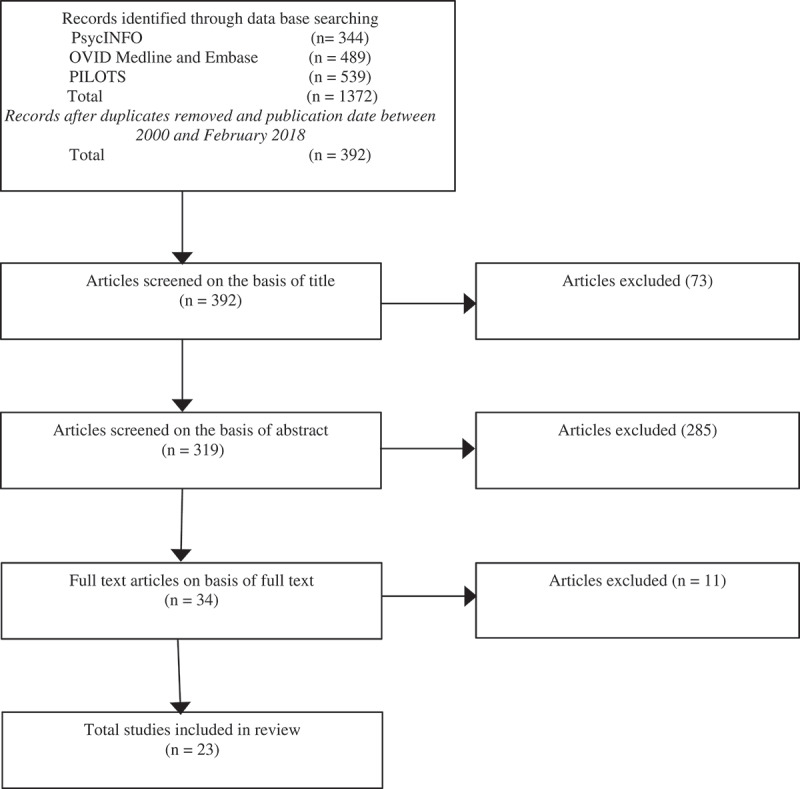
Exposure to war and violence has major consequences for society at large, detrimental impact on people's individual lives, and may also have intergenerational consequences. To gain more insight into these intergenerational consequences, research addressing the impact of the Holocaust on offspring is an important source of information. The aim of the current study was to systematically review the mechanisms of intergenerational consequences by summarizing characteristics in Holocaust survivors and their offspring suggested to impact the offspring's mental health. We focused on: 1) parental mental health problems, 2) (perceived) parenting and attachment quality, 3) family structure, especially parental Holocaust history, 4) additional stress and life events, and 5) psychophysiological processes of transmission. We identified 23 eligible studies published between 2000 and 2018. Only Holocaust survivor studies met the inclusion criteria. Various parent and child characteristics and their interaction were found to contribute to the development of psychological symptoms and biological and epigenetic variations. Parental mental health problems, perceived parenting, attachment quality, and parental gender appeared to be influential for the mental well-being of their offspring. In addition, having two survivor parents resulted in higher mental health problems compared to having one survivor parent. Also, there was evidence suggesting that Holocaust survivor offspring show a heightened vulnerability for stress, although this was only evident in the face of actual danger. Finally, the results also indicate intergenerational effects on offspring cortisol levels. Clinical and treatment implications are discussed.
Overview
The claims and statistics of this paper haven’t been checked yet.
Run the check — free, no account needed. It reads the open-access text and checks the sources it cites.
Integrity signals
Registry
Cites
Statistics
Figures
Verification
Claims the paper makes
The claims and statistics of this paper haven’t been checked yet.
Run the check — free, no account needed. It reads the open-access text and checks the sources it cites.
Claims other papers make about this one
Each is checked against this paper’s own text: does it say what the citing paper says it does?
The source backs part of the claim, not all of it — or backs it for a different population, condition or comparison.
In the citing paper
“Across genocide-affected populations, parental exposure has been associated with altered caregiving patterns characterized by overprotection, controlling behaviors, diminished warmth, and role-reversal dynamics (94–97, 100).”
From Epigenetic changes associated with multi-generational trauma: characterization, mechanisms, and therapeutics (2026) · cites this paper as [94]
Experimental — accuracy not yet measuredThe source backs part of the claim, not all of it — or backs it for a different population, condition or comparison.
In the citing paper
“As reported by Sangalang and Vang (2017) and as echoed in the broader intergenerational trauma field (Dashorst, Mooren, Kleber, de Jong, & Huntjens, 2019), the reviewed studies were consistent in reporting parent- and family-related variables as the most salient mechanisms of transmission.”
From Crossing borders: a systematic review identifying potential mechanisms of intergenerational trauma transmission in asylum-seeking and refugee families (2020) · cites this paper as Dashorst, Mooren, Kleber, de Jong, & Huntjens, 2019
Experimental — accuracy not yet measuredThe cited source says what the claim attributes to it.
In the citing paper
“Maternal survivor status has been more strongly associated with offspring psychological vulnerability compared to paternal exposure, with dual parental exposure corresponding to the highest reported risk (94).”
From Epigenetic changes associated with multi-generational trauma: characterization, mechanisms, and therapeutics (2026) · cites this paper as [94]
Self-check
Percentages, sums and reported differences re-computed from the paper’s own numbers.
The self-check needs the paper’s full text.
Citations
Cites
Diagnostic and Statistical Manual of Mental Disorders
Williams, J. B. W., & First, M. B. (2013) · Oxford University Press eBooks · doi:10.1093/acrefore/9780199975839.013.104 · Cited by 109,845
An inventory for measuring depression
BECK, A. T. (1961) · Archives of General Psychiatry · doi:10.1001/archpsyc.1961.01710120031004 · Cited by 38,032
Liberati, A., Altman, D. G., Tetzlaff, J., Mulrow, C., Gøtzsche, P. C., Ioannidis, J. P. A., Clarke, M., Devereaux, P. J., Kleijnen, J., & Moher, D. (2009) · PLoS Medicine · doi:10.1371/journal.pmed.1000100 · Cited by 28,164
Downs, S. H., & Black, N. (1998) · Journal of Epidemiology and Community Health · doi:10.1136/jech.52.6.377 · Cited by 8,252
Impact of Event Scale: A Measure of Subjective Stress
Horowitz, M., Wilner, N., & Alvarez, W. (1979) · Psychosomatic Medicine · doi:10.1097/00006842-197905000-00004 · Cited by 7,813
Selective Cortical Undercutting As a Means of Modifying and Studying Frontal Lobe Function in Man
Scoville, W. B. (1949) · Journal of neurosurgery · doi:10.3171/jns.1949.6.1.0065 · Cited by 7,374
The brief symptom inventory: an introductory report.
Derogatis, L. R., & Melisaratos, N. (1983) · Psychological Medicine · doi:10.1017/s0033291700048017 · Cited by 6,650
Winnicott, D. W. (2012) · Routledge eBooks · doi:10.4324/9780203441022 · Cited by 6,634
The development of a Clinician-Administered PTSD Scale
Blake, D. D., Weathers, F. W., Nagy, L. M., Kaloupek, D. G., Gusman, F. D., Charney, D. S., & Keane, T. M. (1995) · Journal of Traumatic Stress · doi:10.1002/jts.2490080106 · Cited by 5,024
Development, reliability, and validity of a dissociation scale
BERNSTEIN, E. M., & PUTNAM, F. W. (1986) · The Journal of Nervous and Mental Disease · doi:10.1097/00005053-198612000-00004 · Cited by 3,793
Attachment and loss: Retrospect and prospect.
Bowlby, J. (1982) · American Journal of Orthopsychiatry · doi:10.1111/j.1939-0025.1982.tb01456.x · Cited by 2,930
Evaluating non-randomised intervention studies
Deeks, J., Dinnes, J., D'Amico, R., Sowden, A., Sakarovitch, C., Song, F., Petticrew, M., & Altman, D. (2003) · Health Technology Assessment · doi:10.3310/hta7270 · Cited by 2,907
Foa, E. B., Cashman, L., Jaycox, L., & Perry, K. (1997) · Psychological Assessment · doi:10.1037/1040-3590.9.4.445 · Cited by 2,709
Critical appraisal skills programme
Singh, J. (2013) · Journal of Pharmacology and Pharmacotherapeutics · doi:10.4103/0976-500x.107697 · Cited by 2,601
Models of the self and other: Fundamental dimensions underlying measures of adult attachment.
Griffin, D. W., & Bartholomew, K. (1994) · Journal of Personality and Social Psychology · doi:10.1037/0022-3514.67.3.430 · Cited by 1,881
Chapter 7: Systematic reviews of etiology and risk
Moola, S., Munn, Z., Tufanaru, C., et al. (2020) · JBI eBooks · doi:10.46658/jbimes-20-08 · Cited by 1,578
Validity of the Childhood Trauma Questionnaire in an Adolescent Psychiatric Population
BERNSTEIN, D. P., AHLUVALIA, T., POGGE, D., & HANDELSMAN, L. (1997) · Journal of the American Academy of Child & Adolescent Psychiatry · doi:10.1097/00004583-199703000-00012 · Cited by 1,574
Figley, C. R. (1995) · Cited by 1,466
Keane, T. M., Caddell, J. M., & Taylor, K. L. (1988) · Journal of Consulting and Clinical Psychology · doi:10.1037//0022-006x.56.1.85 · Cited by 1,323
Heim, C., & Binder, E. B. (2012) · Experimental Neurology · doi:10.1016/j.expneurol.2011.10.032 · Cited by 986
Owens, P. C., Smith, R., Brinsmead, M. W., Hall, C., Foureur, M. J., Hurt, D., Lovelock, M., Chan, E.-C., Cubis, J., & Lewin, T. J. (1987) · Life Sciences · doi:10.1016/0024-3205(87)90603-5 · Cited by 958
International Handbook of Multigenerational Legacies of Trauma
(1998) · doi:10.1007/978-1-4757-5567-1 · Cited by 957
Holocaust Exposure Induced Intergenerational Effects on FKBP5 Methylation
Yehuda, R., Daskalakis, N. P., Bierer, L. M., Bader, H. N., Klengel, T., Holsboer, F., & Binder, E. B. (2016) · Biological Psychiatry · doi:10.1016/j.biopsych.2015.08.005 · Cited by 782 · cited 4×
“The study by Yehuda et al. (2016) demonstrated methylation changes (large effect sizes) at the FKBP-5 gene, in the opposite direction, survivors had significantly higher and HSO significantly lower methylation.”
BackgroundInfluentialRasic, D., Hajek, T., Alda, M., & Uher, R. (2014) · Schizophrenia Bulletin · doi:10.1093/schbul/sbt114 · Cited by 758
Yehuda, R., Engel, S. M., Brand, S. R., Seckl, J., Marcus, S. M., & Berkowitz, G. S. (2005) · The Journal of Clinical Endocrinology & Metabolism · doi:10.1210/jc.2005-0550 · Cited by 711
Development of a questionnaire measure of adjustment to cancer: the MAC scale
Watson, M., Greer, S., Young, J., Inayat, Q., Burgess, C., & Robertson, B. (1988) · Psychological Medicine · doi:10.1017/s0033291700002026 · Cited by 666
Kirmayer, L. J., Gone, J. P., & Moses, J. (2014) · Transcultural Psychiatry · doi:10.1177/1363461514536358 · Cited by 652
van Ijzendoorn, M. H., & Schuengel, C. (1996) · Clinical Psychology Review · doi:10.1016/0272-7358(96)00006-2 · Cited by 643 · cited 10×
“This selection was based on both theoretical hypotheses and factors that were proposed in earlier research (e.g. Felsen, 1998; Kellermann, 2001; Solomon, 1998; Van IJzendoorn et al., 2003).”
BackgroundInfluentialThe adult attachment interview: Historical and current perspectives.
Hesse, E. (1999) · Cited by 619
Beyond resilience and PTSD: Mapping the heterogeneity of responses to potential trauma.
Bonanno, G. A., & Mancini, A. D. (2010) · Psychological Trauma Theory Research Practice and Policy · doi:10.1037/a0017829 · Cited by 539
Yehuda, R., Daskalakis, N. P., Lehrner, A., Desarnaud, F., Bader, H. N., Makotkine, I., Flory, J. D., Bierer, L. M., & Meaney, M. J. (2014) · American Journal of Psychiatry · doi:10.1176/appi.ajp.2014.13121571 · Cited by 514
YEHUDA, R., HALLIGAN, S. L., & GROSSMAN, R. (2001) · Development and Psychopathology · doi:10.1017/s0954579401003170 · Cited by 490
The development of a short form of the Manifest Anxiety Scale.
Bendig, A. W. (1956) · Journal of Consulting Psychology · doi:10.1037/h0045580 · Cited by 456
Glover, V. A. S. (2014) · Advances in neurobiology · doi:10.1007/978-1-4939-1372-5_13 · Cited by 422
Beck Depression Inventory ( BDI )
Rosner, R. I. (2015) · The Encyclopedia of Clinical Psychology · doi:10.1002/9781118625392.wbecp261 · Cited by 420
Low Cortisol and Risk for PTSD in Adult Offspring of Holocaust Survivors
Yehuda, R., Bierer, L. M., Schmeidler, J., Aferiat, D. H., Breslau, I., & Dolan, S. (2000) · American Journal of Psychiatry · doi:10.1176/appi.ajp.157.8.1252 · Cited by 353
Intergenerational Trauma in Refugee Families: A Systematic Review
Sangalang, C. C., & Vang, C. (2017) · Journal of Immigrant and Minority Health · doi:10.1007/s10903-016-0499-7 · Cited by 344
Duthie, L., & Reynolds, R. M. (2013) · Neuroendocrinology · doi:10.1159/000354702 · Cited by 329
van IJzendoorn, M. H., Bakermans‐Kranenburg, M. J., & Sagi‐Schwartz, A. (2003) · Journal of Traumatic Stress · doi:10.1023/a:1025706427300 · Cited by 328
Yehuda, R., Bell, A., Bierer, L. M., & Schmeidler, J. (2008) · Journal of Psychiatric Research · doi:10.1016/j.jpsychires.2008.01.002 · Cited by 326
Transgenerational transmission of cortisol and PTSD risk
Yehuda, R., & Bierer, L. M. (2007) · Progress in Brain Research · doi:10.1016/s0079-6123(07)67009-5 · Cited by 306
Transmission of Holocaust Trauma - An Integrative View
Kellermann, N. P. F. (2001) · Psychiatry · doi:10.1521/psyc.64.3.256.18464 · Cited by 305
Rethinking Historical Trauma: Narratives of Resilience
Denham, A. R. (2008) · Transcultural Psychiatry · doi:10.1177/1363461508094673 · Cited by 288
Yehuda, R., Halligan, S. L., & Bierer, L. M. (2001) · Journal of Psychiatric Research · doi:10.1016/s0022-3956(01)00032-2 · Cited by 286
Leen‐Feldner, E. W., Feldner, M. T., Knapp, A. A., Bunaciu, L., Blumenthal, H., & Amstadter, A. B. (2013) · Clinical Psychology Review · doi:10.1016/j.cpr.2013.09.001 · Cited by 225
(1988) · American Journal of Psychiatry · doi:10.1176/ajp.145.7.865 · Cited by 219
Attachment and Traumatic Stress in Female Holocaust Child Survivors and Their Daughters
Sagi‐Schwartz, A., van IJzendoorn, M. H., Grossmann, K. E., Joels, T., Grossmann, K., Scharf, M., Koren‐Karie, N., & Alkalay, S. (2003) · American Journal of Psychiatry · doi:10.1176/appi.ajp.160.6.1086 · Cited by 198
Yehuda, R., Teicher, M. H., Seckl, J. R., Grossman, R. A., Morris, A., & Bierer, L. M. (2007) · Archives of General Psychiatry · doi:10.1001/archpsyc.64.9.1040 · Cited by 195
Chapter 1: JBI Systematic Reviews
(2020) · JBI eBooks · doi:10.46658/jbimes-20-02 · Cited by 182
Yehuda, R., Halligan, S. L., & Bierer, L. M. (2002) · Psychoneuroendocrinology · doi:10.1016/s0306-4530(01)00043-9 · Cited by 175
Maternal PTSD associates with greater glucocorticoid sensitivity in offspring of Holocaust survivors
Lehrner, A., Bierer, L. M., Passarelli, V., Pratchett, L. C., Flory, J. D., Bader, H. N., Harris, I. R., Bedi, A., Daskalakis, N. P., Makotkine, I., et al. (2014) · Psychoneuroendocrinology · doi:10.1016/j.psyneuen.2013.11.019 · Cited by 160
The transgenerational transmission of holocaust trauma
Fonagy, P. (1999) · Attachment & Human Development · doi:10.1080/14616739900134041 · Cited by 149
Lyons‐Ruth, K., Bronfman, E. T., & Atwood, G. (1999) · Cited by 142
Transgenerational Transmission of Effects of the Holocaust
Felsen, I. (1998) · Springer eBooks · doi:10.1007/978-1-4757-5567-1_3 · Cited by 116
Kretchmar, M. D., & Jacobvitz, D. B. (2002) · Family Process · doi:10.1111/j.1545-5300.2002.41306.x · Cited by 113
Transmission of Response to Trauma? Second-Generation Holocaust Survivors’ Reaction to Cancer
Baider, L., Peretz, T., Ever‐Hadani, P., Perry, S., Avramov, R., & De-Nour, A. K. (2000) · American Journal of Psychiatry · doi:10.1176/appi.ajp.157.6.904 · Cited by 113
Children of survivors of the Nazi Holocaust: A critical review of the literature.
Solkoff, N. (1981) · American Journal of Orthopsychiatry · doi:10.1111/j.1939-0025.1981.tb01345.x · Cited by 106
Sangalang, C. C., Jager, J., & Harachi, T. W. (2017) · Social Science & Medicine · doi:10.1016/j.socscimed.2017.04.032 · Cited by 106
Father‐Involvement in a Refugee Sample: Relations between Posttraumatic Stress and Caregiving
van Ee, E., Sleijpen, M., Kleber, R. J., & Jongmans, M. J. (2013) · Family Process · doi:10.1111/famp.12045 · Cited by 104
Self-citationChildren of survivors of the Nazi Holocaust: A critical review of the literature.
Solkoff, N. (1992) · American Journal of Orthopsychiatry · doi:10.1037/h0079348 · Cited by 91
Yehuda, R., Bierer, L. M., Andrew, R., Schmeidler, J., & Seckl, J. R. (2009) · Journal of Psychiatric Research · doi:10.1016/j.jpsychires.2008.12.003 · Cited by 90
Yehuda, R., Blair, W., Labinsky, E., & Bierer, L. M. (2007) · American Journal of Psychiatry · doi:10.1176/ajp.2007.164.1.163 · Cited by 89
Wiseman, H., Barber, J. P., Raz, A., Yam, I., Foltz, C., & Livne-Snir, S. (2002) · International Journal of Behavioral Development · doi:10.1080/01650250143000346 · Cited by 86
Shmotkin, D., & Litwin, H. (2009) · Social Psychiatry and Psychiatric Epidemiology · doi:10.1007/s00127-009-0020-x · Cited by 85
Shrira, A., Palgi, Y., Ben‐Ezra, M., & Shmotkin, D. (2011) · Psychological Trauma Theory Research Practice and Policy · doi:10.1037/a0020608 · Cited by 79
Reynolds, R. M., Pesonen, A., O’Reilly, J. R., Tuovinen, S., Lahti‐Pulkkinen, M., Kajantie, E., Villa, P., Laivuori, H. M., Hämäläinen, E. K., Seckl, J. R., et al. (2015) · Psychological Medicine · doi:10.1017/s003329171400316x · Cited by 76
Disorganizing Experiences in Second- and Third-Generation Holocaust Survivors
Scharf, M., & Mayseless, O. (2010) · Qualitative Health Research · doi:10.1177/1049732310393747 · Cited by 71
Maternal Exposure to the Holocaust and Health Complaints in Offspring
Flory, J. D., Bierer, L. M., & Yehuda, R. (2011) · Disease Markers · doi:10.1155/2011/250470 · Cited by 70
Havinga, P., Boschloo, L., Bloemen, A. J. P., Nauta, M. H., de Vries, S. O., Penninx, B. W. J. H., Schoevers, R. A., & Hartman, C. A. (2016) · The Journal of Clinical Psychiatry · doi:10.4088/jcp.15m09936 · Cited by 69
Letzter-Pouw, S. E., Shrira, A., Ben‐Ezra, M., & Palgi, Y. (2013) · Psychological Trauma Theory Research Practice and Policy · doi:10.1037/a0033741 · Cited by 68
Bloch, A. (2018) · Journal of Refugee Studies · doi:10.1093/jrs/fey007 · Cited by 66
Transgenerational Effects of the Holocaust
Solomon, Z. (1998) · Springer eBooks · doi:10.1007/978-1-4757-5567-1_4 · Cited by 58
Bierer, L. M., Bader, H. N., Daskalakis, N. P., Lehrner, A. L., Makotkine, I., Seckl, J. R., & Yehuda, R. (2014) · Psychoneuroendocrinology · doi:10.1016/j.psyneuen.2014.06.001 · Cited by 57
Psychological well-being among Holocaust survivors and immigrants in Israel
Harel, Z., Kahana, B., & Kahana, E. F. (1988) · Journal of Traumatic Stress · doi:10.1007/bf00980364 · Cited by 56
Baider, L., Goldzweig, G., Ever‐Hadani, P., & Peretz, T. (2005) · Psycho-Oncology · doi:10.1002/pon.1010 · Cited by 56
The Long-Term Effects of Extreme War-Related Trauma on the Second Generation of Holocaust Survivors
Gangi, S., Talamo, A., & Ferracuti, S. (2009) · Violence and Victims · doi:10.1891/0886-6708.24.5.687 · Cited by 54
Shrira, A. (2015) · Psychological Trauma Theory Research Practice and Policy · doi:10.1037/tra0000029 · Cited by 49
The Intergenerational Effect of War
Betancourt, T. S. (2015) · JAMA Psychiatry · doi:10.1001/jamapsychiatry.2014.2669 · Cited by 47
Naumova, O. Y., Hein, S. D., Suderman, M. J., Barbot, B., Lee, M., Raefski, A. S., Dobrynin, P. V., Brown, P. J., Moshe Szyf, A., Luthar, S. S., et al. (2016) · Child Development · doi:10.1111/cdev.12485 · Cited by 47
Issues and Interpersonal Values among Three Generations in Families of Holocaust Survivors
Chaitin, J. (2002) · Journal of Social and Personal Relationships · doi:10.1177/0265407502193005 · Cited by 44
Kellermann, N. P. F. (2008) · PubMed · Cited by 39
Child holocaust survivors as parents: A transgenerational perspective.
Krell, R. W., Suedfeld, P., & Soriano, E. (2004) · American Journal of Orthopsychiatry · doi:10.1037/0002-9432.74.4.502 · Cited by 36
Maternal depression and the intergenerational transmission of relational impairment.
Katz, S. J., Hammen, C. L., & Brennan, P. A. (2013) · Journal of Family Psychology · doi:10.1037/a0031411 · Cited by 36
Bader, H. N., Bierer, L. M., Lehrner, A., Makotkine, I., Daskalakis, N. P., & Yehuda, R. (2014) · Frontiers in Endocrinology · doi:10.3389/fendo.2014.00103 · Cited by 36
Breast cancer and psychological distress: mothers’ and daughters’ traumatic experiences
Baider, L., Goldzweig, G., Ever‐Hadani, P., & Peretz, T. (2007) · Supportive Care in Cancer · doi:10.1007/s00520-007-0320-1 · Cited by 36
Taouk, L. H., & Schulkin, J. A. (2016) · Journal of Developmental Origins of Health and Disease · doi:10.1017/s2040174416000416 · Cited by 35
Secondary trauma in children of parents with mental illness.
Lombardo, K. L., & Motta, R. W. (2008) · Traumatology An International Journal · doi:10.1177/1534765608320331 · Cited by 35
Halligan, S. L., & Yehuda, R. (2002) · The Journal of Nervous and Mental Disease · doi:10.1097/00005053-200207000-00002 · Cited by 16
Letzter-Pouw, S. E., & Werner, P. (2013) · Journal of Loss and Trauma · doi:10.1080/15325024.2012.701126 · Cited by 16
KLYKYLO, W. M. (2001) · American Journal of Psychiatry · doi:10.1176/appi.ajp.158.6.978 · Cited by 13
Aftermath of Genocide: Holocaust Survivors' Dissociation Moderates Offspring Level of Cortisol
van IJzendoorn, M. H., Fridman, A., Bakermans‐Kranenburg, M. J., & Sagi‐Schwartz, A. (2012) · Journal of Loss and Trauma · doi:10.1080/15325024.2012.679132 · Cited by 10
The Sibling Relationship as a Source of Shared Environment
McGuire, S. A., Palaniappan, M., & Larribas, T. (2015) · Springer eBooks · doi:10.1007/978-1-4939-2923-8_4 · Cited by 10
Research works printed but not linked: 10
- Aromataris E., 2017, Joanna Briggs Institute reviewer’s manual
- Griffin D. W., 1994, Journal of Peronality and Social Psychology, 67, 340
- 10.1002/jts.2490010404 · DOI
- 10.1037/0022-006X.56.1.85 · DOI
- Kellermann N. P., 2008, Israel Journal of Psychiatry & Related Sciences, 45, 263
- Klaassens E. R., 2010, Bouncing back
- Moola S., 2017, Joanna Briggs Institute reviewer’s manual
- Moos R. H., 1994, Family environment scale manual
- Spielberger C. D., 1968, State-Trait Anxiety Inventory (STAI): Test Manual for Form X
- Spitzer R. L, 1995, Structured clinical interview for axis I DSM-IV disorders (SCID)
Cited by
Sorted by citations
Flanagan, N., Travers, A., Vallières, F., Hansen, M., Halpin, R., Sheaf, G., Rottmann, N., & Johnsen, A. T. (2020) · European Journal of Psychotraumatology · doi:10.1080/20008198.2020.1790283 · Cited by 97
Matheson, K., Seymour, A. M., Landry, J., Ventura, K., Arsenault, E., & Anisman, H. (2022) · International Journal of Environmental Research and Public Health · doi:10.3390/ijerph19116455 · Cited by 111
Bhushan, D., Kotz, K. J., McCall, J., Wirtz, S., Gilgoff, R., Dube, S. R., Powers, C., Olson-Morgan, J., Galeste, M., Patterson, K., et al. (2020) · doi:10.48019/peam8812 · Cited by 79
Zasiekina, L., Дучимінська, Т. І., Bifulco, A. T., & Bignardi, G. (2023) · Military Psychology · doi:10.1080/08995605.2023.2235256 · Cited by 97
Rizkalla, N., Mallat, N. K., Arafa, R., Adi, S., Soudi, L., & Segal, S. P. (2020) · International Journal of Environmental Research and Public Health · doi:10.3390/ijerph17228378 · Cited by 58
Metadata
- Authors
- Dashorst, P., Mooren, T. M., Kleber, R. J., de Jong, P. J., & Huntjens, R. J. C.
- Affiliations
- Foundation Centrum '45 (NL)
- Stichting Centrum’45/partner in Arq, Diemen, The Netherlands
- Utrecht University (NL)
- University of Groningen (NL)
- Department of Clinical Psychology & Experimental Psychopathology, University of Groningen, Groningen, The Netherlands
- Corresponding author
- Dashorst, Patricia
- Venue
- European Journal of Psychotraumatology
- Publisher
- Informa UK Limited
- Published
- 2019-08-30
- Volume
- 10
- Issue
- 1
- Pages
- 1654065-1654065
- ISSN
- 2000-8066 (ISSN-L)
- PMC
- PMC6720013
- OpenAlex
- W2970356242
- Cited by
- 207
- References
- 93
- Citations by year
- 2026: 35 · 2025: 26 · 2024: 27 · 2023: 29 · 2022: 67 · 2021: 12 · 2020: 11
- FWCI
- 3.56
- Type
- journal article
- Language
- en
- Open access
- gold
- doi.org
- Licence
- Locations
- European Journal of Psychotraumatology (publishedVersion, cc-by-nc)
- PubMed Central (publishedVersion, cc-by-nc)
- PubMed (publishedVersion)
- DOAJ (DOAJ: Directory of Open Access Journals) (submittedVersion, cc-by-sa)
- Utrecht University Repository (Utrecht University) (submittedVersion, other-oa)
- University of Groningen research database (University of Groningen / Centre for Information Technology) (submittedVersion, cc-by-nc)
- University of Groningen research database (University of Groningen / Centre for Information Technology) (submittedVersion)
- Funders
- Family Process Institute
- Topics
- Social Sciences › Psychology › Clinical Psychology › Posttraumatic Stress Disorder Research
- Social Sciences › Cultural Studies › Memory, Trauma, and Commemoration
- Social Sciences › Psychology › Clinical Psychology › Child Abuse and Trauma
- Keywords
- Holocaust survivors, intergenerational transmission, offspring mental health, parental mental health, perceived parenting, attachment quality, family structure, parental gender, epigenetics, cortisol, stress vulnerability, war trauma
About these checks
Registry, retraction, Cites and statistics results are computed, not judged, with one exception: a printed reference that no index lists is read once by a model before it counts as a citation error. Claims are extracted by a model and kept only when their quote appears verbatim in the text; each cited source is then checked, with a model’s help, for whether it says what the claim relies on. Those verdicts can be wrong — read the claim’s quote and the cited source before relying on one.
Statistics and arithmetic are recomputed, not judged.
Confidence bands are shown only for fields calibrated on our annotated test set. None is calibrated yet, so no band is shown.
What counts as a claim ›How we measure confidence ›How we check this ›
Are you an author, or do you see a problem with this page? Request a review
