

Epigenetic changes associated with multi-generational trauma: characterization, mechanisms, and therapeutics
Open accessThe DOI matches its Crossref record; 138 of the 138 references it cites were found in a registry or an index; 188 of the 272 sources its claims cite were checked for support.
Abstract
Trauma can contribute to lasting psychological, behavioral, and physiological effects that extend across generations. Intergenerational trauma refers to trauma-related effects observed in children of exposed parents, while transgenerational trauma describes effects observed in later generations without direct exposure. Proposed mechanisms involve interacting biological and psychosocial processes, including stress-responsive regulatory systems, epigenetic variation, and caregiving environments. This review synthesizes evidence on epigenetic changes associated with acute, chronic, and complex traumatic exposures and their relevance to multi-generational outcomes. Studies published between 1990 and 2025 were identified through PubMed and Google Scholar and evaluated for reported epigenetic findings, caregiving patterns, and offspring health outcomes. Across trauma contexts, reported epigenetic variation most consistently involves pathways related to stress-response regulation, immune-inflammatory signaling, neurodevelopment, metabolic processes, and developmental programming. Patterns across exposure types suggest that acute events are most often associated with stress-related and inflammatory signaling that may influence developmental programming, whereas chronic and complex trauma reflect cumulative physiological adaptation involving broader alterations in stress-regulatory, metabolic, and neurodevelopmental systems. Offspring outcomes most consistently include increased vulnerability to anxiety, depressive symptoms, stress-related disorders, and certain chronic medical conditions, often described alongside shifts in caregiving behaviors and psychosocial environments that may shape developmental vulnerability. Interpretation of the current literature is limited by small sample sizes, varying definitions of trauma, and limited multi-generational cohorts. Overall, current evidence supports a model in which trauma-related outcomes across generations reflect interacting biological and caregiving processes, highlighting the importance of integrated molecular and psychosocial frameworks for prevention and intervention.
Overview
CoChat Summary
## TL;DR
This review synthesizes evidence from 1990–2025 on how acute, chronic, and complex trauma may be associated with epigenetic variation and multi-generational outcomes. Across trauma contexts, the most consistent signals involve stress-response, immune-inflammatory, neurodevelopmental, and metabolic pathways, but the paper emphasizes that the evidence is associative rather than causal.
## Key findings
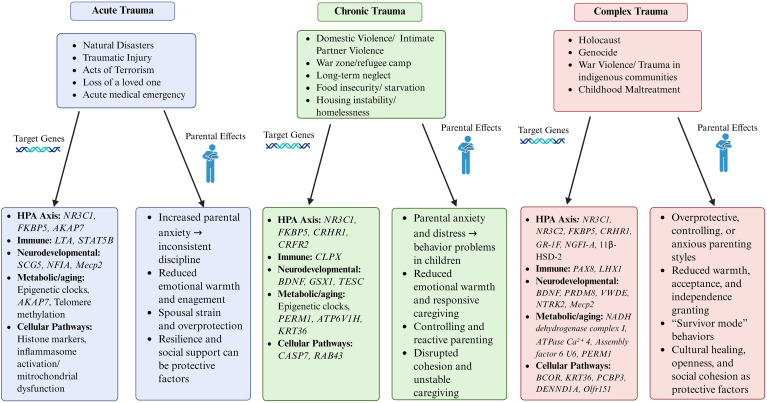
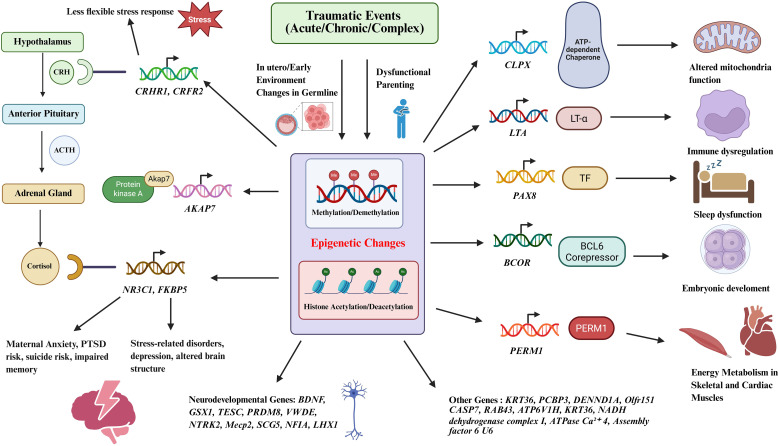
- The authors reviewed studies published between 1990 and 2025 using PubMed and Google Scholar and found that reported epigenetic variation most consistently involved stress-response regulation, immune-inflammatory signaling, neurodevelopment, metabolic processes, and developmental programming.
- Acute trauma was described as most often linked to stress-related and inflammatory signaling, especially when exposure occurred during pregnancy; for example, prenatal disaster or terrorism exposure was associated with lower baseline salivary cortisol, altered FKBP5 expression, and NR3C1 methylation changes.
- Chronic and complex trauma were described as involving broader cumulative adaptation across stress-regulatory, metabolic, circadian, and neurodevelopmental systems; examples include differential DNA methylation in NR3C1 and FKBP5 in genocide studies and altered methylation of BDNF, CLPX, and Mecp2 in chronic maltreatment or neglect models.
- Offspring outcomes most consistently included increased vulnerability to anxiety, depressive symptoms, stress-related disorders, and certain chronic medical conditions.
## Methods
- This is a review of multi-generational trauma literature, organized across acute, chronic, and complex trauma categories and also discussing treatment and limitations.
- The authors state that studies from 1990–2025 were identified through PubMed and Google Scholar, and that they were evaluated for epigenetic findings, caregiving patterns, and offspring health outcomes.
- The review synthesizes evidence from human studies and animal models, focusing mainly on DNA methylation, with additional discussion of histone modifications and noncoding RNAs.
## Limitations
- The paper explicitly notes candidate gene bias, sampling constraints, tissue specificity, temporal variability in epigenetic measurement, and uncertainty about the biological meaning of post-fertilization epigenetic reprogramming.
- It states that many human studies have small sample sizes, often fewer than 100 participants, and that this limits statistical power and generalizability.
- It also says many studies rely on peripheral tissues such as blood, saliva, or urine, which may not reflect brain or germline epigenetic processes.
- Evident from the text: the review is narrative/synthesizing rather than a primary empirical study, so its conclusions depend on the quality and heterogeneity of the underlying literature.
Model-written summary. Check it against the paper before relying on it.
Integrity signals
Registry
Cites
Statistics
Figures
Verification
Claims the paper makes
108 Valid · 5 Not valid · 34 Not checked · 44 Own results and interpretations
Some cited sources support this claim and some don’t — read each source’s verdict below.
In the paper
“Genocide exposure has also been associated with epigenetic variation in pathways involved in neurodevelopment and memory processing.”
§ Epigenetic changes associated with multi-generational trauma: characterization, mechanisms, and therapeutics > Complex trauma > Genocide
What the sources say
- Not checked — no full text of the sourcecites [88] Perroud, 2014, The Tutsi genocide and transgenerational transmission of maternal stress: Epigenetics and biology of the HPA axis, World J Biol Psychiatry source
- Partly supportedcites [89] Rudahindwa, 2018, Transgenerational effects of the genocide against the Tutsi in Rwanda: A post-traumatic stress disorder symptom domain analysis, AAS Open Res sourceExperimental — accuracy not yet measured
The Results (Secondary analyses of NR3C1 DNA methylation; page unavailable) associate methylation of NR3C1 with PTSD symptom domains in genocide-exposed mothers and their offspring. The Methods (DNA methylation measures; page unavailable) identify NR3C1 as the locus studied. The paper describes it as a stress-response gene, but does not establish epigenetic variation in pathways involved in neurodevelopment or memory processing. (LLM, conf=0.87)
- Disputedcites [90] Vukojevic, 2014, Epigenetic modification of the glucocorticoid receptor gene is linked to traumatic memory and post-traumatic stress disorder risk in genocide survivors, J Neurosci sourceExperimental — accuracy not yet measured
The Discussion reports that NR3C1 promoter methylation was not related to traumatic load and did not differ between Rwandan genocide survivors and unexposed healthy individuals. Although the paper links this methylation to memory processes, it does not support the claimed association between genocide exposure and epigenetic variation; it suggests the differences may have predated the trauma. (LLM, conf=0.88)
Checked by a reasoning model — may be wrong.
- Not checked — no full text of the sourcecites [91] Preuss, 2009, Post-learning psychosocial stress enhances consolidation of neutral stimuli, Neurobiol Learn Mem source
- Could not verifycites [92] Sep, 2023, Impaired learning, memory, and extinction in posttraumatic stress disorder: Translational meta-analysis of clinical and preclinical studies, Transl Psychiatry sourceExperimental — accuracy not yet measured
The Introduction (page unavailable) discusses individual differences in learning and memory after traumatic stress, but does not address genocide exposure or epigenetic variation. Searches for genocide exposure and epigenetic or methylation variation found no passage in our copy supporting that association. (LLM, conf=0.76)
plainstates an association- Asserted: passes — The authors put it forward as true.
- Checkable: passes — It can be checked against evidence.
- Load-bearing: passes — The paper’s conclusions depend on it.
- Based: passes — The paper gives a reason why it holds.
The cited sources support only part of this claim — read each source’s verdict below.
In the paper
“Multigenerational cohort data indicate parental bereavement corresponds with immune-related outcomes in offspring, including increased risk of asthma, allergic disease, and autoimmune conditions (45).”
§ Epigenetic changes associated with multi-generational trauma: characterization, mechanisms, and therapeutics > Acute trauma > Sudden loss of a loved one
What the sources say
- Partly supportedcites [45] Brew, 2022, Early-life adversity due to bereavement and inflammatory diseases in the next generation: A population study in transgenerational stress exposure, Am J Epidemiol sourceExperimental — accuracy not yet measured
The Results report increased early-onset asthma risk in offspring of women bereaved in childhood and increased autoimmune-disease risk in offspring of men bereaved in childhood. They do not support a general increase in allergic disease: other outcomes were largely unassociated, and the subgroup finding for atopic disease was not supported by further analyses of eczema and allergic rhinitis. Page numbers were not provided in our copy. (LLM, conf=0.90)
hedgedstates an association- Asserted: passes — The authors put it forward as true.
- Checkable: passes — It can be checked against evidence.
- Load-bearing: passes — The paper’s conclusions depend on it.
- Based: passes — The paper gives a reason why it holds.
- Partly supported
Every source the paper cites for this claim was checked and supports it.
In the paper
“Severe injury has been associated with widespread epigenetic alterations, particularly in inflammatory pathways.”
§ Epigenetic changes associated with multi-generational trauma: characterization, mechanisms, and therapeutics > Acute trauma > Traumatic injury
What the sources say
- Supportedcites [29] Eskesen, 2024, Severe traumatic injury is associated with profound changes in DNA methylation, NPJ Genom Med source
The Abstract reports 10,126 differentially methylated CpGs after severe trauma and says the affected sites were enriched in genes and pathways involved in inflammatory response. The Enrichment analyses section likewise identifies immune-system pathways among the most affected. Page numbers were not supplied in our copy. (LLM, conf=0.94)
plainstates an association- Asserted: passes — The authors put it forward as true.
- Checkable: passes — It can be checked against evidence.
- Load-bearing: unclear — It is unclear whether the paper’s conclusions depend on it.
- Based: passes — The paper gives a reason why it holds.
- Supported
The cited sources support only part of this claim — read each source’s verdict below.
In the paper
“Developmental timing appears to play an important role in shaping outcomes, as exposures occurring in utero or during early childhood, periods characterized by heightened biological plasticity, have been associated with more pronounced neurocognitive and psychological effects (7, 10, 11).”
§ Epigenetic changes associated with multi-generational trauma: characterization, mechanisms, and therapeutics > Introduction
What the sources say
- Partly supportedcites [7] Musanabaganwa, 2022, Leukocyte methylomic imprints of exposure to the genocide against the Tutsi in Rwanda: A pilot epigenome-wide analysis, Epigenomics sourceExperimental — accuracy not yet measured
Our copy supports only the in-utero half of the claim: the Discussion states that the in utero-associated DMRs 'may potentially serve as indicators of exposure to extreme trauma in utero that also influence offspring early development and help to predict the mental health status of the offspring', and the Abstract notes a growing body of research linking trauma exposure during pregnancy to offspring outcomes. However, no passage makes the comparative point the claim rests on — that exposures in utero or in early childhood produce MORE PRONOUNCED neurocognitive and psychological effects than exposures at other ages — and our copy nowhere invokes heightened biological plasticity or examines exposure during early childhood (the pilot design contrasts in utero exposure with no exposure, not different developmental periods). The parts of the attributed claim not supported are the developmental-timing comparison, the plasticity characterization, and the early-childhood exposure window. (LLM, conf=0.68)
- Partly supportedcites [10] Wang, 2022, Prenatal earthquake stress exposure in different gestational trimesters is associated with methylation changes in the glucocorticoid receptor gene (Nr3c1) and long-term working memory in adulthood, Transl Psychiatry sourceExperimental — accuracy not yet measured
The Introduction describes the foetal period as vulnerable to lasting cognitive effects and links early-life stress to emotional and cognitive outcomes. The Results report poorer adult memory after prenatal earthquake exposure, with differences by gestational trimester. The paper does not establish that early-childhood exposure has more pronounced neurocognitive or psychological effects than exposure at other ages. Page numbers were not available in our copy. (LLM, conf=0.84)
- Partly supportedcites [11] Li, 2023, Atypical brain structure and function in young adults exposed to disaster-related prenatal maternal stress: Project Ice Storm, J Neurosci Res sourceExperimental — accuracy not yet measured
Our copy supports only the in-utero half of the claim: the Introduction states that 'the consequences of PNMS on offspring brain structure and function vary with the timing of in-utero exposure' (citing Buss et al., 2010 at 19 vs 25/31 weeks, and Scheinost et al., 2020 for 2nd vs 3rd trimester), and the Discussion (Sec. 4) speaks of 'an important vulnerability window in the 3 months prior to conception' and that 'there may be more than one sensitive exposure period', with Sec. 3.4 reporting a timing-by-distress interaction on left occipital pole thickness (p = .0006). What is not in our copy: any exposure during early childhood (the study covers preconception through birth only), and any comparative statement that such early exposures produce MORE PRONOUNCED neurocognitive and psychological effects than exposures at other ages — the reported outcomes are cortical thickness, gray matter volume and resting-state functional connectivity, and the paper explicitly notes that linking these to behavioral outcomes would add relevance. The 'heightened biological plasticity' framing is also absent; the paper's rationale is gestational-age-specific cortical growth (Rakic, 1988; Zecevic et al., 2005). (LLM, conf=0.72)
hedgedstates an association- Asserted: passes — The authors put it forward as true.
- Checkable: passes — It can be checked against evidence.
- Load-bearing: unclear — It is unclear whether the paper’s conclusions depend on it.
- Based: passes — The paper gives a reason why it holds.
- Rests on an assumption not shown here.
- Partly supported
The cited sources support only part of this claim — read each source’s verdict below.
In the paper
“Reduced expression of FKBP5, a regulator of glucocorticoid signaling, has also been reported following prenatal psychological stress (38).”
§ Epigenetic changes associated with multi-generational trauma: characterization, mechanisms, and therapeutics > Acute trauma > Acts of terrorism
What the sources say
- Partly supportedcites [38] Yehuda, 2009, Gene expression patterns associated with posttraumatic stress disorder following exposure to the World Trade Center attacks, Biol Psychiatry sourceExperimental — accuracy not yet measured
The Results and Discussion report significantly reduced FKBP5 expression in people with PTSD after exposure to the World Trade Center attacks, and the Discussion identifies FKBP5 as an inhibitor of glucocorticoid receptor activity. The paper does not report reduced FKBP5 expression following prenatal psychological stress; that condition is not the one studied. (LLM, conf=0.88)
plainstates an association- Asserted: passes — The authors put it forward as true.
- Checkable: passes — It can be checked against evidence.
- Load-bearing: unclear — It is unclear whether the paper’s conclusions depend on it.
- Based: passes — The paper gives a reason why it holds.
- Partly supported
123 more claims · 70 with their cited sources checked
Create a free account to see all 191 claims and to verify the 19 references still open.
- Probably not a substantial claim. 11
- It may state two separate claims as one. 56
Citations
Cites
Epigenetic regulation of the glucocorticoid receptor in human brain associates with childhood abuse
McGowan, P. O., Sasaki, A., D'Alessio, A. C., Dymov, S., Labonté, B., Szyf, M., Turecki, G., & Meaney, M. J. (2009) · Nature Neuroscience · doi:10.1038/nn.2270 · Cited by 3,531 · cited 1×
“Increased methylation of the NR3C1 promoter and reduced glucocorticoid receptor expression have been observed in hippocampal tissue of suicide completers with histories of maltreatment (119, 120).”
Allele-specific FKBP5 DNA demethylation mediates gene–childhood trauma interactions
Klengel, T., Mehta, D., Anacker, C., Rex-Haffner, M., Pruessner, J. C., Pariante, C. M., Pace, T. W. W., Mercer, K. B., Mayberg, H. S., Bradley, B., et al. (2013) · Nature Neuroscience · doi:10.1038/nn.3275 · Cited by 1,447 · cited 3×
“Lower methylation of FKBP5 has been associated with structural variation in brain regions involved in emotional regulation (120, 121).”
Implication of sperm RNAs in transgenerational inheritance of the effects of early trauma in mice
Gapp, K., Jawaid, A., Sarkies, P., Bohacek, J., Pelczar, P., Prados, J., Farinelli, L., Miska, E., & Mansuy, I. M. (2014) · Nature Neuroscience · doi:10.1038/nn.3695 · Cited by 1,306 · cited 8×
“Similar RNA changes were detected in offspring tissues, including brain and serum (116).”
InfluentialEpigenetic transmission of the impact of early stress across generations
Franklin, T. B., Russig, H., Weiss, I. C., Gräff, J., Linder, N., Michalon, A., Vizi, S., & Mansuy, I. M. (2010) · Biological Psychiatry · doi:10.1016/j.biopsych.2010.05.036 · Cited by 1,125 · cited 2×
“These fi ndings include epigenetic modulation of genes involved in synaptic and stress signaling, including Mecp2 , CB1 , and CRFR2 , with methylation differences observed in both germline and neural tissues (64).”
Whitaker, R. C., Phillips, S. M., & Orzol, S. M. (2006) · Pediatrics · doi:10.1542/peds.2006-0239 · Cited by 817
Holocaust Exposure Induced Intergenerational Effects on FKBP5 Methylation
Yehuda, R., Daskalakis, N. P., Bierer, L. M., Bader, H. N., Klengel, T., Holsboer, F., & Binder, E. B. (2016) · Biological Psychiatry · doi:10.1016/j.biopsych.2015.08.005 · Cited by 782 · cited 5×
“FKBP5 methylation differences have been reported across multiple trauma contexts in both survivors and offspring, raising the possibility that stress-response regulatory genes may help distinguish individuals more likely to bene fi t from speci fi c interventions (38, 66, 83, 84, 136).”
InfluentialIntergenerational transmission of trauma effects: putative role of epigenetic mechanisms
Yehuda, R., & Lehrner, A. (2018) · World Psychiatry · doi:10.1002/wps.20568 · Cited by 730
Yehuda, R., Engel, S. M., Brand, S. R., Seckl, J., Marcus, S. M., & Berkowitz, G. S. (2005) · The Journal of Clinical Endocrinology & Metabolism · doi:10.1210/jc.2005-0550 · Cited by 711 · cited 2×
“Following the September 11 attacks, infants born to mothers with PTSD who were directly exposed to the World Trade Center demonstrated lower baseline salivary cortisol levels, particularly with third-trimester exposure (36).”
Alegría-Torres, J. A., Baccarelli, A., & Bollati, V. (2011) · Epigenomics · doi:10.2217/epi.11.22 · Cited by 587 · cited 1×
“However, lifestyle and behavioral factors known to in fl uence epigenetic regulation, including diet, sleep, stress management, and substance use, may represent modi fi able contributors to biological vulnerability (128).”
Placental 11β‐hydroxysteroid dehydrogenase: a key regulator of fetal glucocorticoid exposure
Benediktsson, R., Calder, A. A., Edwards, C. R. W., & Seckl, J. R. (1997) · Clinical Endocrinology · doi:10.1046/j.1365-2265.1997.1230939.x · Cited by 536
Research works printed but not linked: 2
- Bonelli, 2025, From mother to child: The role of epigenetics in the intergenerational trauma due to intimate partner violence, Ital J Psychiatry, 11, 10.36180/2421-4469-2025-915 · doi:10.36180/2421-4469-2025-915
- Carter, 2022, Expressive therapies capstone theses 589: lesley university
Cited by
Izinseka: African somatic epistemology and the neuroscience of bodily knowing
Khumalo, T. (2026) · Inkanyiso · doi:10.4102/ink.v18i1.377
Metadata
- Authors
- Kac, E., Qi, Q., & Ryznar, R.
- Affiliations
- Rocky Vista University (US)
- Corresponding author
- Ryznar, Rebecca
- ORCID
- Ryznar, Rebecca
- Venue
- Frontiers in Psychiatry
- Publisher
- Frontiers Media SA
- Published
- 2026-04-01
- Volume
- 17
- Pages
- 1769422-1769422
- ISSN
- 1664-0640 (ISSN-L)
- PMC
- PMC13079623
- OpenAlex
- W7147418457
- Semantic Scholar
- 8336286569f9ef40e089e9155ba2b42165ef3f03
- Cited by
- 1
- References
- 136
- Citations by year
- 2026: 1
- FWCI
- 0.67
- Type
- journal article
- Language
- en
- Open access
- gold
- doi.org
- Licence
- Locations
- Frontiers in Psychiatry (publishedVersion, cc-by)
- PubMed (publishedVersion)
- PubMed Central (publishedVersion, cc-by)
- DOAJ (DOAJ: Directory of Open Access Journals) (submittedVersion, cc-by-sa)
- Topics
- Life Sciences › Biochemistry, Genetics and Molecular Biology › Molecular Biology › Epigenetics and DNA Methylation
- Social Sciences › Psychology › Clinical Psychology › Child Abuse and Trauma
- Social Sciences › Psychology › Clinical Psychology › Posttraumatic Stress Disorder Research
- Keywords
- intergenerational trauma, epigenetics, complex trauma, chronic trauma, acute trauma, stress response regulation, inflammatory signaling, developmental programming, care environment, offspring mental health, anxiety, depression, epigenetic therapy
About these checks
Registry, retraction, Cites and statistics results are computed, not judged, with one exception: a printed reference that no index lists is read once by a model before it counts as a citation error. Claims are extracted by a model and kept only when their quote appears verbatim in the text; each cited source is then checked, with a model’s help, for whether it says what the claim relies on. Those verdicts can be wrong — read the claim’s quote and the cited source before relying on one.
The claim verdicts this report counts are experimental: their accuracy is not yet measured.
A language model drew the claims from the paper on 2026-10-09, under version 3 of the claim definition (model deepseek-v4.1-flash, prompt extract-v3).
A second model labelled each claim on 2026-10-09 (model jev-1.13-20260917, definition revision gold-guideline-v0.2).
Cited sources are checked with a language model’s help (gpt-6-sol and qwen3.8-omni-flash).
Statistics and arithmetic are recomputed, not judged.
Confidence bands are shown only for fields calibrated on our annotated test set. None is calibrated yet, so no band is shown.
What counts as a claim ›How we measure confidence ›How we check this ›
Are you an author, or do you see a problem with this page? Request a review
How to cite
Cite CoChat for the checks on this page, and the paper for its own findings.
- This page
- CoChat. (2026). Citation check: Epigenetic changes associated with multi-generational trauma: characterization, mechanisms, and therapeutics. https://app.cochat.ai/papers/10.3389/fpsyt.2026.1769422
- The paper
- Kac, E., Qi, Q., & Ryznar, R. (2026). Epigenetic changes associated with multi-generational trauma: characterization, mechanisms, and therapeutics. Frontiers in Psychiatry. https://doi.org/10.3389/fpsyt.2026.1769422
Data sources
Bibliographic data: Semantic Scholar, OpenAlex, Crossref.
Contains information from the Semantic Scholar Academic Graph Datasets, made available under the ODC Attribution License (ODC-BY 1.0).
Semantic Scholar’s data is described in: Kinney, R., et al. (2023). The Semantic Scholar Open Data Platform. arXiv:2301.10140.
