

Virtual reality exposure therapy for posttraumatic stress disorder (PTSD): a meta-analysis
Open accessThe DOI matches its Crossref record; 67 of the 68 references it cites were found in a registry or an index; none of the 35 sources its claims cite is checked for support yet.
Abstract
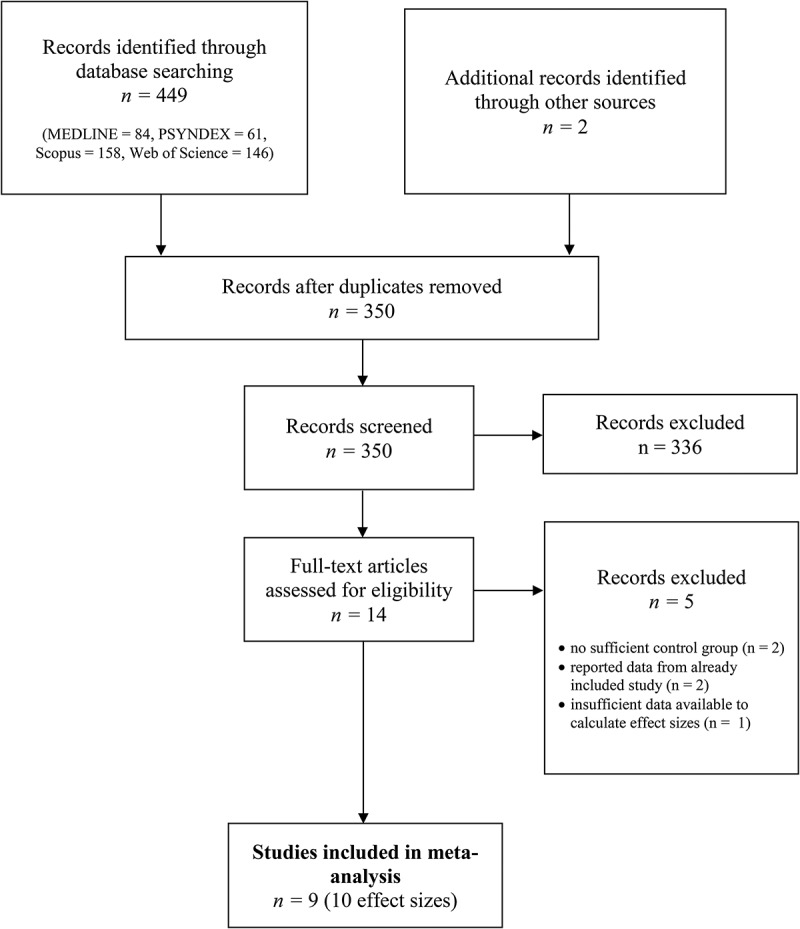
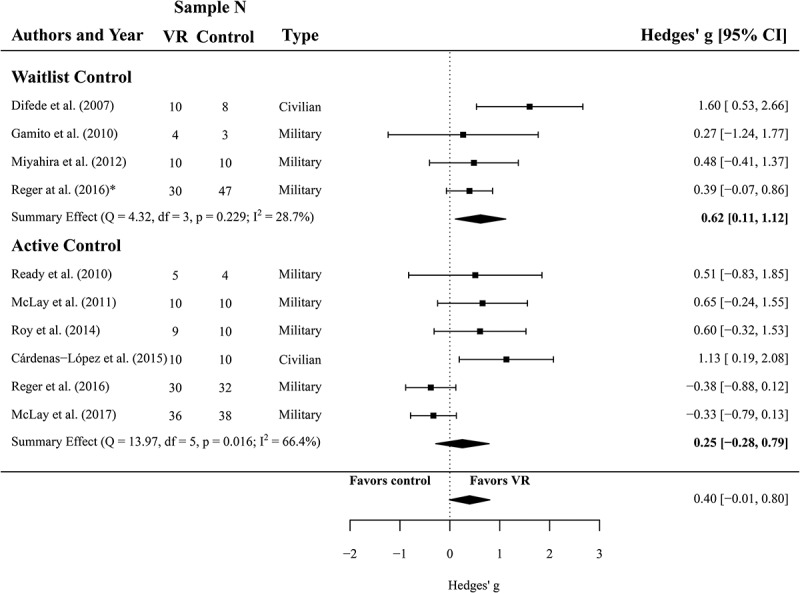
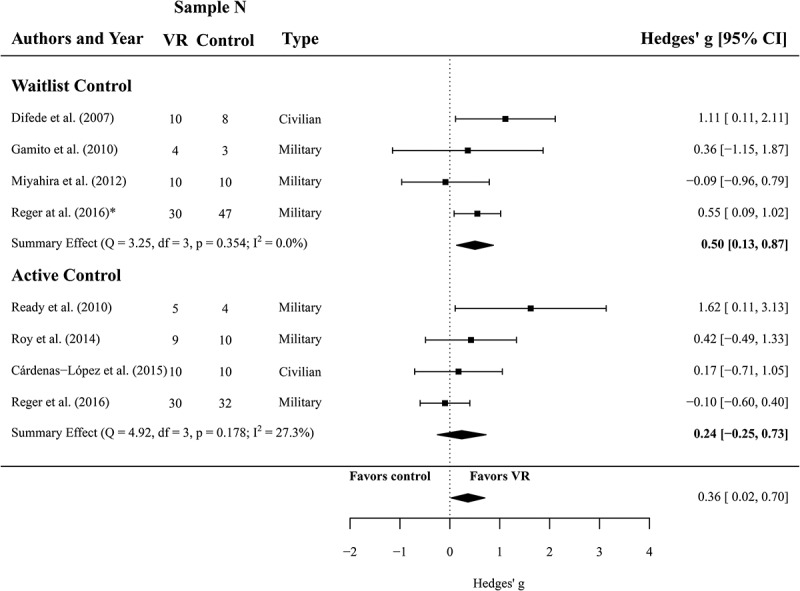
Contrary to specific phobias, for which Virtual Reality Exposure Therapy (VRET) constitutes an effective treatment, uncertainty still exists regarding the usefulness of VRET for posttraumatic stress disorder (PTSD). Therefore, this meta-analysis investigated the efficacy of VRET for PTSD as compared to waitlist and active comparators. A literature search yielded nine controlled studies encompassing 296 participants (124 VRET, 172 controls). The differences between conditions regarding the primary outcome of PTSD symptom severity and the secondary outcome of depressive and anxiety symptoms post-treatment were calculated using Hedges’ g. Compared to waitlist controls, VRET showed a significantly better outcome for PTSD symptoms (g = 0.62, p = .017) and depressive symptoms (g = 0.50, p = .008). There was no significant difference between VRET and active comparators regarding PTSD symptoms (g = 0.25, p = .356) and depressive symptoms (g = 0.24, p = .340) post-treatment. No significant effects emerged for anxiety symptoms. These findings suggest that VRET may be as effective as active comparators for PTSD patients. However, the results must be interpreted with caution due to the limited number of trials and the substantial number of – predominantly male – military service members studied. Additional controlled trials, considering a wider range of trauma types and balanced gender, are required to strengthen the evidence.
Overview
CoChat Summary
## TL;DR
This meta-analysis of 9 controlled trials (296 participants) found that virtual reality exposure therapy (VRET) improved PTSD and depressive symptoms versus waitlist controls, but not versus active comparators. The evidence was judged preliminary because the trials were small, mostly involved male military samples, and had limited reporting of important factors like adverse effects and follow-up.
## Key findings
- Across 9 controlled trials, the sample included 296 participants: 124 in VRET conditions and 172 in control groups.
- Versus waitlist controls, VRET showed a significant benefit for PTSD symptom severity: Hedges’ g = 0.62, 95% CI 0.11 to 1.12, p = .017; heterogeneity was low/non-important (I² = 29).
- Versus waitlist controls, VRET also improved depressive symptoms: g = 0.50, 95% CI 0.13 to 0.87, p = .008; heterogeneity was I² = 0.
- Versus active controls, VRET did not differ significantly for PTSD symptoms (g = 0.25, 95% CI −0.28 to 0.79, p = .356), depressive symptoms (g = 0.24, p = .340), or anxiety symptoms versus either waitlist (g = 0.47, p = .387) or active controls (g = −0.26, p = .241).
## Methods
- Systematic search of MEDLINE, PSYNDEX, Scopus, and Web of Science from database inception to December 2018, plus Google Scholar alerts and author contact to capture preprints/unpublished studies.
- Included controlled trials of VR-based treatment in PTSD samples diagnosed by DSM-IV, DSM-5, or ICD-10; no restrictions on age, trauma type, comorbidity, medication, language, or publication status.
- Effect sizes were calculated as Hedges’ g and pooled with random-effects models; PTSD symptom severity was the primary outcome, with depression and anxiety as secondary outcomes.
## Limitations
- The paper states that small sample sizes and the restricted number of controlled trials limit firm conclusions.
- The paper states that medication was poorly reported: only one study specified concurrent medication, and many studies gave no details; 4 studies reported medication was stable during intervention.
- The paper states that no included study reported long-term follow-up, and none provided information about adverse treatment effects.
- Evident from the text: the evidence is based mostly on predominantly male military samples, with only 2 of 9 studies including civilians, which limits generalizability.
Model-written summary. Check it against the paper before relying on it.
Integrity signals
Registry
Cites
Statistics
Figures
Verification
Claims the paper makes
0 Valid · 0 Not valid · 21 Not checked · 42 Own results and interpretations
A result the paper reports from its own data — it cites no other source for it, so there is none to check. The quote shows it is in the paper.
In the paper
“A literature search yielded nine controlled studies encompassing 296 participants (124 VRET, 172 controls).”
- Also stated in: § Study characteristics · plain
“In total, nine controlled trials were included with a total of 296 participants (124 in VR treatment conditions, 172 in control groups).”
§ Virtual reality exposure therapy for posttraumatic stress disorder (PTSD): a meta-analysis > Abstract
plainn = 296- Asserted: passes — The authors put it forward as true.
- Checkable: passes — It can be checked against evidence.
- Load-bearing: passes — The paper’s conclusions depend on it.
- Based: passes — The paper gives a reason why it holds.
- Also stated in: § Study characteristics · plain
A result the paper reports from its own data — it cites no other source for it, so there is none to check. The quote shows it is in the paper.
In the paper
“none of the studies reported any treatment-related adverse effects (e.g. worsening of symptoms or attempted suicide) over the course of the studies.”
§ Virtual reality exposure therapy for posttraumatic stress disorder (PTSD): a meta-analysis > Results > Study characteristics
plainn = 296- Asserted: passes — The authors put it forward as true.
- Checkable: passes — It can be checked against evidence.
- Load-bearing: unclear — It is unclear whether the paper’s conclusions depend on it.
- Based: passes — The paper gives a reason why it holds.
A result the paper reports from its own data — it cites no other source for it, so there is none to check. The quote shows it is in the paper.
In the paper
“Compared to waitlist controls, VRET showed a significantly better outcome for PTSD symptoms (g = 0.62, p = .017) and depressive symptoms (g = 0.50, p = .008).”
- Also stated in: § Efficacy of VRET regarding depressive symptoms · plain
“For the comparison between VRET and waitlist controls (N = 54 and N = 68, respectively, k = 4), we found a significant summary effect of g = 0.50 (CI 0.13 to 0.87, p = .008) and low, non-significant heterogeneity of I2 = 0 (Q(3) = 3.25, p = .354), all in favour of VRET.”
§ Virtual reality exposure therapy for posttraumatic stress disorder (PTSD): a meta-analysis > Abstract
plainstates a causen = 110 ·- Asserted: passes — The authors put it forward as true.
- Checkable: passes — It can be checked against evidence.
- Load-bearing: passes — The paper’s conclusions depend on it.
- Based: passes — The paper gives a reason why it holds.
- Rests on an assumption not shown here.
- Also stated in: § Efficacy of VRET regarding depressive symptoms · plain
A result the paper reports from its own data — it cites no other source for it, so there is none to check. The quote shows it is in the paper.
In the paper
“Again, no significant effect was found in this comparison: g = −0.26 (CI −0.70 to 0.18, p = .241).”
§ Virtual reality exposure therapy for posttraumatic stress disorder (PTSD): a meta-analysis > Results > Efficacy of VRET regarding anxiety symptoms
plainn = 82- Asserted: passes — The authors put it forward as true.
- Checkable: passes — It can be checked against evidence.
- Load-bearing: passes — The paper’s conclusions depend on it.
- Based: passes — The paper gives a reason why it holds.
- Rests on an assumption not shown here.
A result the paper reports from its own data — it cites no other source for it, so there is none to check. The quote shows it is in the paper.
In the paper
“The meta-analysis revealed a non-significant effect of g = 0.47 (CI −0.60 to 1.54, p = .387).”
§ Virtual reality exposure therapy for posttraumatic stress disorder (PTSD): a meta-analysis > Results > Efficacy of VRET regarding anxiety symptoms
plainn = 84- Asserted: passes — The authors put it forward as true.
- Checkable: passes — It can be checked against evidence.
- Load-bearing: passes — The paper’s conclusions depend on it.
- Based: passes — The paper gives a reason why it holds.
- Rests on an assumption not shown here.
26 more claims
Create a free account to see all 63 claims and to verify the 35 references still open.
- It may state two separate claims as one. 24
- Probably not a substantial claim. 14
- The quote only partly states this claim. 1
Claims other papers make about this one
Each is checked against this paper’s own text: does it say what the citing paper says it does?
The source backs part of the claim, not all of it — or backs it for a different population, condition or comparison.
In the citing paper
“They found that anxiety decreased among patients who used VR, while it increased in those who did not apply it.”
From Novel non-pharmacological strategies for managing dentophobia in adult patients - literature review (2024) · cites this paper as [10]
Experimental — accuracy not yet measuredThe source backs part of the claim, not all of it — or backs it for a different population, condition or comparison.
In the citing paper
“Notably, 92% of participants reported decreased anxiety”
From Novel non-pharmacological strategies for managing dentophobia in adult patients - literature review (2024) · cites this paper as [10]
Experimental — accuracy not yet measuredThe source backs part of the claim, not all of it — or backs it for a different population, condition or comparison.
In the citing paper
“In several non-ICU–related mental health disorders, VR exposure is accepted as an effective treatment and user-friendly modality (14, 15).”
From Virtual Reality to Improve Sequelae of the Postintensive Care Syndrome: A Multicenter, Randomized Controlled Feasibility Study (2021) · cites this paper as [14]
Experimental — accuracy not yet measuredThe source backs part of the claim, not all of it — or backs it for a different population, condition or comparison.
In the citing paper
“Also, in the non-ICU setting, randomized studies to determine the optimal number of VR sessions studies are lacking, and the studies have not reported long-term follow-up results, which further limit the ability to justify the number of VR sessions (14, 39).”
From Virtual Reality to Improve Sequelae of the Postintensive Care Syndrome: A Multicenter, Randomized Controlled Feasibility Study (2021) · cites this paper as [14]
Experimental — accuracy not yet measuredThe check wasn’t confident either way, so it gives no verdict — never disputed.
In the citing paper
“100% wanted to use VR in future surgical treatments”
From Novel non-pharmacological strategies for managing dentophobia in adult patients - literature review (2024) · cites this paper as [10]
Experimental — accuracy not yet measured
2 more claims about this paper
Create a free account to see every claim other papers make about this one.
Statistics recomputed
Every reported test result, recomputed from its test statistic and degrees of freedom. A result shows as not adding up only once an independent check has confirmed it.
- ConsistentQ(3) = 4.32reported p = .229 · recomputed p = .229
“Q(3) = 4.32, p = .229”
- ConsistentQ(5) = 13.97reported p = .016 · recomputed p = .016
“Q(5) = 13.97, p = .016”
- ConsistentQ(3) = 3.25reported p = .354 · recomputed p = .355
“Q(3) = 3.25, p = .354”
- ConsistentQ(3) = 4.92reported p = .178 · recomputed p = .178
“Q(3) = 4.92, p = .178”
Self-check
Percentages, sums and reported differences re-computed from the paper’s own numbers.
Self-check results appear here once an independent check has confirmed them.
Citations
Cites
Diagnostic and Statistical Manual of Mental Disorders
American Psychiatric Association (2013) · doi:10.1176/appi.books.9780890425596 · Cited by 116,369
Statistical Power Analysis for the Behavioral Sciences
Muller, K. (1989) · Technometrics · doi:10.1080/00401706.1989.10488618 · Cited by 99,167
Bias in meta-analysis detected by a simple, graphical test
Egger, M., Smith, G. D., Schneider, M., & Minder, C. (1997) · BMJ · doi:10.1136/bmj.315.7109.629 · Cited by 56,722
An inventory for measuring depression
BECK, A. T. (1961) · Archives of General Psychiatry · doi:10.1001/archpsyc.1961.01710120031004 · Cited by 38,032
Statistical Power Analysis for the Behavioral Sciences (2nd ed.).
Lachenbruch, P. A., & Cohen, J. (1989) · Journal of the American Statistical Association · doi:10.2307/2290095 · Cited by 37,395 · cited 2×
“Following general convention (Cohen, 1988), an effect size an effect size of 0.”
BackgroundInfluential(1970) · Cited by 24,983
Conducting Meta-Analyses in R with the metafor Package
Viechtbauer, W. (2010) · Journal of Statistical Software · doi:10.18637/jss.v036.i03 · Cited by 20,464 · cited 1×
“The calculations of the effect sizes and the subsequent meta-analysis were then conducted using the package metafor for R (Viechtbauer, 2010).”
MethodDiagnostic and Statistical Manual of Mental Disorders, 5th ed.
Carter, M. J. (2014) · Therapeutic Recreation Journal · Cited by 15,169
Journal of Clinical Psychiatry
(2018) · Journal of Clinical Psychiatry · doi:10.5505/kpd · Cited by 13,651
Sterne, J. A. C., Sutton, A. J., Ioannidis, J. P. A., Terrin, N., Jones, D. R., Lau, J., Carpenter, J., Rucker, G., Harbord, R. M., Schmid, C. H., et al. (2011) · BMJ · doi:10.1136/bmj.d4002 · Cited by 7,709 · cited 1×
“Furthermore, guidelines for conducting funnel plot asymmetry tests recommend the inclusion of at least 10 studies to maintain sufficient power for distinguishing chance from real asymmetry (Egger, Smith, Schneider, & Minder, 1997; Sterne et al., 2011).”
Background
Research works printed but not linked: 3
- Derogatis L. R. (1994). SCL-90-R: Administration, scoring and procedures manual. Minneapolis, MN: National Computer Systems.
- International Society for Traumatic Stress Studies (2018). Posttraumatic stress disorder prevention and treatment guidelines: Methodology and recommendations. Retrieved from http://www.istss.org/treating-trauma/new-istss-prevention-and-treatment-guidelines.aspx 31283056
- Weathers F., Litz B., Herman D., Huska J., & Keane T. (1993, 10). The PTSD checklist (PCL): Reliability, validity, and diagnostic utility. Paper presented at the Annual Convention of the International Society for Traumatic Stress Studies, San Antonio, TX.
Cited by
Items 101–200 of 247
Virtual Reality Applications for the Treatment of Anxiety and Mental Disorders
Safikhani, S., Pirker, J., & Wriessnegger, S. C. (2021) · International Conference of the Immersive Learning Research Network (iLRN) · doi:10.23919/ilrn52045.2021.9459356 · Cited by 9
Vlake, J. H., van Bommel, J., Wils, E., Korevaar, T. I. M., Taccone, F. S., Schut, A. F., Elderman, J. H., Labout, J. A. M., Raben, A., Dijkstra, A., et al. (2022) · BMJ Open · doi:10.1136/bmjopen-2022-061876 · Cited by 14
Diemer, J., Kothgassner, O. D., Herrmann, M. J., & Zwanzger, P. (2023) · Der Nervenarzt · doi:10.1007/s00115-023-01570-9 · Cited by 9
Self-citationBarbieri, M., Albanese, G. A., Merello, A., Crepaldi, M., Setti, W., Gori, M., Canessa, A., Sabatini, S. P., Facchini, V., & Sandini, G. (2024) · Frontiers in Bioengineering and Biotechnology · doi:10.3389/fbioe.2024.1285107 · Cited by 12
The impact of virtual reality exposure therapy in the treatment of PTSD and anxiety disorders
Eskandar, K. (2024) · Debates em Psiquiatria · doi:10.25118/2763-9037.2024.v14.1319 · Cited by 8
Emotion and Ethics in Virtual Reality
Fisher, A. (2025) · Australasian Journal of Philosophy · doi:10.1080/00048402.2025.2515848 · Cited by 8
“Virtual reality exposure therapy is often used in treatment of post-traumatic stress disorder, as one can encounter feared situations that would not be safe to do so in reality (Kothgassner et al .”
Vilageliu-Jordà, È., Cantallops, A. E., & García‐Molina, A. (2022) · Revista de Neurología · doi:10.33588/rn.7410.2022034 · Cited by 18
“Uno de los ejemplos más paradigmáticos del uso de la RV en la práctica clínica lo encontramos en las terapias de exposición para fobias específicas [13-17].”
BackgroundMonti, L., Marconi, E., Bocci, M. G., Kotzalidis, G. D., Mazza, M., Galliani, C., Tranquilli, S., Vento, G., Conti, G., Sani, G., et al. (2023) · World Journal of Psychiatry · doi:10.5498/wjp.v13.i4.191 · Cited by 13
Sexual assault as a public health problem and other developments in psychotraumatology
Olff, M. (2022) · European Journal of Psychotraumatology · doi:10.1080/20008198.2022.2045130 · Cited by 9
“Virtual reality exposure therapy for posttraumatic stress disorder (PTSD): a meta-analysis (Kothgassner et al., 2019) 4.”
BackgroundWu, J., Tsai, Y.-Y., Chen, Y.-J., Hsiao, F., Hsu, C., Lin, K., & Liao, L. (2024) · Medical & Biological Engineering & Computing · doi:10.1007/s11517-024-03209-6 · Cited by 12
“ARET and VRET can potentially enhance PTSD treatment [127, 128].”
Mardon, A. K., Wilson, D., Leake, H. B., Harvie, D. S., Andrade, A. Q. D., Chalmers, J., Bowes, A., & Moseley, G. L. (2025) · Frontiers in Pain Research · doi:10.3389/fpain.2025.1535915 · Cited by 8
“These fi ndings are in line with preliminary evidence that VR technology appears bene fi cial for improving PTSD symptoms across different populations (44).”
Use of virtual reality in bipolar disorder: a systematic review
de Pablo, G. S., Hernández, O. R., Gómez‐Vallejo, S., Young, A. H., Cella, M., & Valmaggia, L. (2024) · Psychological Medicine · doi:10.1017/s0033291724001247 · Cited by 7
“Other interventions could be trialled or piloted in the future, including VR-based exposure therapy, which has been used for anxiety disorders (Boeldt, McMahon, McFaul, & Greenleaf, 2019) and for post-traumatic stress disorder (PTSD) (Kothgassner et al., 2019).”
Virtual reality for stress management and burnout reduction in nursing: A systematic review protocol
Shankar, R., Kumar, F. D. S., Bundele, A., & Mukhopadhyay, A. (2025) · PLoS ONE · doi:10.1371/journal.pone.0319247 · Cited by 8
“Accumulating research demonstrates the efficacy of VR in treating anxiety disorders, depression, phobias, and post-traumatic stress [27,28].”
Macdonald, C. (2024) · Frontiers in Virtual Reality · doi:10.3389/frvir.2024.1506938 · Cited by 10
Evaluation of Virtual Reality opportunities during Pandemic
Nalluri, S. P., Reshma, L., & Munavalli, J. R. (2021) · IEEE International Conference for Convergence in Technology (I2CT) · doi:10.1109/i2ct51068.2021.9418003 · Cited by 10
Development and Feasibility Assessment of Virtual Reality-Based Relaxation Self-Training Program
Jeong, H. S., Oh, J., Paik, M., Kim, H., Jang, S., Kim, B. S., & Kim, J. (2022) · Frontiers in Virtual Reality · doi:10.3389/frvir.2021.722558 · Cited by 10
Bruce, T. A., Rebair, A., & Holmquist, L. E. (2022) · Nordic Conference on Human-Computer Interaction · doi:10.1145/3546155.3547725 · Cited by 7
“IIVEs provide a multi-sensory cue representation within a setting that is highly interactive and emotionally engaging [34], with options to simulate environments that challenge the boundaries of everyday living.”
BackgroundVirtual Reality as an Innovative Tool for Youth Mental Health
Blondell, V. J., & Thomson, N. D. (2025) · Encyclopedia · doi:10.3390/encyclopedia5040215 · Cited by 6
“Furthermore, VRET has also been found to reduce PTSD symptomology through individualized simulations and desensitization [46,47].”
Das, P. J., Kyndait, P., Jamir, S. I., Baishya, D., Kalita, J. K., & Komu, L. T. (2024) · International Journal of Scientific Research in Science and Technology · doi:10.32628/ijsrst24116186 · Cited by 6
Spark, J., Rowe, E., Álvarez‐Jiménez, M., Bell, I., Byrne, L. K., Dzafic, I., Ellinghaus, C., Lavoie, S., Lum, J. A. G., McLean, B., et al. (2025) · JMIR Research Protocols · doi:10.2196/63405 · Cited by 7
“…in the treatment of mental disorders such as social anxiety (for review see Chard and van Zalk [22]), phobias (for review see Kothgassner et al [23]), posttraumatic stress disorder (PTSD; for review see Maples-Keller et al [24]), and as a treatment of psychotic symptoms such as paranoia [25]…”
Kim, J., Jhon, M., Kang, H., Kim, S., & Kim, J. (2023) · Clinical Psychopharmacology and Neuroscience · doi:10.9758/cpn.22.1036 · Cited by 6
“The advantages of VRET over image exposure have been repeatedly described [8,9].”
Ghasempeyvandi, M., & Torkan, H. (2023) · Journal of Education and Health Promotion · doi:10.4103/jehp.jehp_1742_22 · Cited by 6
“[19] Virtual reality treatment involves repeated exposure and allows therapists to practice with patients repeatedly, making training more straightforward and accessible.”
BackgroundSchudy, A., Pochwatko, G., Kopeć, W., Karpowicz, B., Skorupska, K., Grzeszczuk, M., & Okruszek, Ł. (2023) · IEEE International Symposium on Mixed and Augmented Reality Adjunct (ISMAR-Adjunct) · doi:10.1109/ismar-adjunct60411.2023.00098 · Cited by 5
Pizzoli, S. F. M., Durosini, I., Strika, M., & Pravettoni, G. (2024) · Elsevier eBooks · doi:10.1016/b978-0-443-13671-9.00008-9 · Cited by 7
Kim, W., Cho, S., Hong, J. P., Kim, H.-Y., Maeng, S., Kang, J. M., Na, K., Oh, S. H., Park, J. W., Bae, J. N., et al. (2022) · Virtual Reality · doi:10.1007/s10055-022-00623-9 · Cited by 5
Technology Applications in Virtual and Augmented Reality for Human Welfare
Shekar, V., & Kachhi, Z. (2024) · Advances in business strategy and competitive advantage book series · doi:10.4018/979-8-3693-1734-1.ch013 · Cited by 5
Liu, F., Wang, N., Wang, Y., Ye, Z., & Jian, C. (2024) · Current Psychology · doi:10.1007/s12144-024-06425-3 · Cited by 4
“Exposure therapy is a well-established, evidence-based treatment for PTSD that has been shown to be highly effective in reducing trauma-related symptoms and improving overall functioning (Kothgassner et al., 2019; Rauch et al., 2012).”
Greenhalgh, M., Fitzpatrick, C., Rodabaugh, T., Madrigal, E., Timmerman, M. A., Chung, J. S., Ahuja, D., Kennedy, Q., Harris, O. A., & Adamson, M. M. (2021) · Frontiers in Virtual Reality · doi:10.3389/frvir.2021.741578 · Cited by 5
Gausemel, Å., & Filkuková, P. (2024) · Frontiers in Psychology · doi:10.3389/fpsyg.2024.1291961 · Cited by 7
Examining threat responses through a developmental lens
Casey, B. J., Lin, Y.-C., & Meyer, H. C. (2024) · Cerebral Cortex · doi:10.1093/cercor/bhae449 · Cited by 5
Dworznik, G. (2025) · Journalism & Mass Communication Educator · doi:10.1177/10776958241312967 · Cited by 6
“As research shows, it is the experiential element that VR provides that makes it that much more conducive to impactful learning (Chaabane et al., 2022; Imperatori et al., 2020; Kothgassner et al., 2019).”
Effectiveness of XR‐Based Exposure Therapy for Phobic Disorders
Lamb, R. L., Perry, J., Sutherland, E. C., Hoston, D., Garris, A., & DeRiggs, A. (2025) · Journal of Counseling & Development · doi:10.1002/jcad.12557 · Cited by 4
Virtual Painting through Hand Gestures: A Machine Learning Approach
Shanthi, R., Azeez, S., & Kumar, N. D. (2024) · Journal of Ubiquitous Computing and Communication Technologies · doi:10.36548/jucct.2024.1.004 · Cited by 4
Grassini, S. (2022) · European Conference on Cognitive Ergonomics · doi:10.1145/3552327.3552336 · Cited by 10
“VR systems have been used already for some years for VR exposure therapy, for example, to treat post-traumatic stress disorder [8], or for treatment of phobias [9].”
MethodBrassel, S., Brunner, M., Campbell, A., Power, E., & Togher, L. (2024) · Journal of Medical Internet Research · doi:10.2196/45168 · Cited by 6
“…technology that has become more affordable and accessible, with several studies investigating its use in various health care disciplines and conditions such as posttraumatic stress disorder [11], health professional training [12], and as a distraction tool for patients undergoing chemotherapy [13].”
Virtual Reality Exposure Therapy
Turman, M. L., Olden, M., Emrich, M., & Difede, J. (2024) · CBT: science into practice · doi:10.1007/978-3-031-72720-7_4 · Cited by 7
Zhang, H., Feng, Y., Walker, A., & Rode, J. A. (2025) · Proceedings of the 27th International ACM SIGACCESS Conference on Computers and Accessibility · doi:10.1145/3663547.3746363 · Cited by 3
“Virtual reality exposure therapy (VRET) has emerged as a promising tool for PTSD treat-ment by providing immersive, controlled environments in which individuals can confront and gradually desensitize themselves to trauma-related stimuli [35, 44].”
The effectiveness of virtual reality to improve depression: A systematic evidence map
Lü, X. Y., You, J., Xia, T., Huang, Y., & Xu, R. S. (2025) · Digital Health · doi:10.1177/20552076251390555 · Cited by 5
“26,38,52 This phenomenon may be attributed to the fact that contemporary VR interventions for mental disorders are largely based on exposure therapy, which is recognized as the fi rst-line treatment for anxiety-related disorders, rather than being speci fi cally designed to address depressive…”
Goharinejad, S., Goharinezhad, S., Moulaei, K., Krüger, B., & Spittler, T. (2026) · INQUIRY The Journal of Health Care Organization Provision and Financing · doi:10.1177/00469580251413101 · Cited by 7
“54 These results align with earlier research showing that immersive environments can improve how people engage with therapy and the results they achieve.”
Artificial intelligence (AI) for virtual reality exposure therapy (VRET): A systematic review
Bergsnev, K., & Laws, A. L. S. (2026) · Translational Psychiatry · doi:10.1038/s41398-026-03936-4 · Cited by 5
IJdema, T., Laceulle, O. M., Dibbets, P., & Korrelboom, K. (2023) · Computers in Human Behavior Reports · doi:10.1016/j.chbr.2023.100311 · Cited by 4
Sadowski, J., Wolaniuk, S., Klaudel, T., Sikorski, M., & Wąsik, M. (2024) · Health and Technology · doi:10.1007/s12553-024-00935-7 · Cited by 4
Amygdala EFP Neurofeedback Effects on PTSD Symptom Clusters and Emotional Regulation Processes
Goldental, N., Gross, R., Amital, D., Harel, E. V., Hendler, T., Tendler, A., Levi, L., Lavro, D., Harmelech, T., Grinapol, S., et al. (2025) · Journal of Clinical Medicine · doi:10.3390/jcm14072421 · Cited by 5
“Similarly, virtual reality exposure therapies, though promising for addressing avoidance symptoms, have shown variable effects across symptom clusters [56].”
VR and EEG Combined Self-monitoring Platform of Cognitive Care
Lee, B., & Lee, T.-H. (2023) · Springer proceedings in business and economics · doi:10.1007/978-3-031-25390-4_22 · Cited by 4
Goel, R., Tse, T., Smith, L. J., Floren, A., Naylor, B. F., Williams, W., Salas, R., Rizzo, A., & Ress, D. B. (2023) · Chronic Stress · doi:10.1177/24705470231203655 · Cited by 5
“Functional magnetic resonance imaging (fMRI) neuro-feedback (eg, Refs 9 – 11 ) and virtual reality (VR) (eg, Refs 12,13 ) have independently shown promise in producing improvements for exposure-based therapies.”
BackgroundHelgert, A., Straßmann, C., & Eimler, S. C. (2024) · Mensch und Computer (MuC) · doi:10.1145/3670653.3670664 · Cited by 3
“For example, in the feld of medicine, VR is employed for the treatment of post-traumatic stress disorder [40] and pain management [36], as well as for lifelike simulations for medical education and surgical procedure training [2].”
Efficacy of Virtual Reality Exposure Therapy for Post-Traumatic Stress Disorder: A Systematic ReviewPreprint
Nugraha, I. D. (2021) · OSF Preprints (OSF Preprints) · doi:10.31219/osf.io/5tnvb · Cited by 4
Celebrating 15 years of Psychotraumatology – a future with generative AI?
Olff, M. (2024) · European Journal of Psychotraumatology · doi:10.1080/20008066.2024.2429921 · Cited by 4
Novel non-pharmacological strategies for managing dentophobia in adult patients - literature review
Los, A., Fiegler-Rudol, J., Tysiąc-Miśta, M., & Tanasiewicz, M. (2024) · Wiadomości Lekarskie · doi:10.36740/wlek202408112 · Cited by 2
Virtual reality painting: A structured review of a decade of innovation
Shi, Y., Lu, Y., Liu, L., & Liu, E. (2024) · Metaverse · doi:10.54517/m.v5i1.2546 · Cited by 5
Virtual reality hypnotherapy for healthcare students: a feasibility trial
O’Brien, A. A., Hutchinson, J., Fauzi, N. B., Abbott, M., Railton, J., Bell, D., White, S., Smith, J. N., & Riches, S. (2024) · Mental Health and Digital Technologies · doi:10.1108/mhdt-01-2024-0005 · Cited by 3
A Meta-Analysis of Virtual Reality Interventions for Reducing the Symptoms of Anxiety
Moyer, M., Lenz, A. S., Gonzales‐Wong, C. D., & Rodriguez, G. (2025) · Counseling Outcome Research and Evaluation · doi:10.1080/21501378.2024.2438952 · Cited by 4
“…the virtual boundary around them is for the headset to map a ‘safe’ and clear area of use free from furniture, and the screen that obstructed their view of the room can transport them to almost anywhere in the world; the client decides where is ‘safe’ and what to do next (Kothgassner et al., 2019).”
Yamauchi, Y., Ino, K., Sakaguchi, M., & Zempo, K. (2026) · ACM Transactions on Computing for Healthcare · doi:10.1145/3723048 · Cited by 3
“This is partly because of the logistical challenge it presents, such as the need for real-life locations or stimuli preparation, along with the requirement for a clinician to be present to intervene if the patient becomes overly anxious.”
The Role of Digital Technology in Youth Suicide Prevention
Kenny, B., Robinson, J., & Núñez, D. (2025) · Depression and personality · doi:10.1007/978-3-031-96037-6_8 · Cited by 3
Cushnan, J., Best, P., Daele, T. V., D’Arcy, J., Cafferty, P. M., Roche, R., & Elliott, A. (2025) · Cognitive and Behavioral Practice · doi:10.1016/j.cbpra.2025.08.003 · Cited by 5
Virtual reality for postoperative pain relief: A narrative review
Attia, M., Wilson, A. J., Hughes-Noehrer, L., Collinson, S., Rogers, S. K., Abdelghani, M., McGrath, B. A., Bowling, F. L., & Kitchen, G. B. (2025) · Trends in Anaesthesia and Critical Care · doi:10.1016/j.tacc.2025.101618 · Cited by 3
de Haart, R., Daniels, J. K., Timmerman, M. E., Cath, D. C., & Lommen, M. J. J. (2026) · European Journal of Psychotraumatology · doi:10.1080/20008066.2025.2605803 · Cited by 2
Strauch, H., Schuil, I., Simm, S., Grubert, J., Kalamkar, S., & Meißner, K. (2026) · Journal of Medical Internet Research · doi:10.2196/78212 · Cited by 2
“Common application areas with proven effectiveness include VR exposure therapy for severe anxiety disorders [17], such as social anxiety disorder [18,19], posttraumatic stress disorder [20,21], and other psychiatric diagnoses [22, 23].”
Rivastigmine for treatment-refractory posttraumatic stress disorder: a systematic review
Maguire, P. A., Bastiampillai, T. J., Allison, S. C., Wilkes, F., & Looi, J. C. (2024) · East Asian Archives of Psychiatry · doi:10.12809/eaap2353 · Cited by 2
Enhancing Virtual Reality Stress Relief with Haptics: The Virtual Rage Room Use Case
Sameri, J., Neufkens, F., Damme, S. V., Turck, F. D., & Vega, M. T. (2024) · International Conference on Quality of Multimedia Experience (QoMEX) · doi:10.1109/qomex61742.2024.10598274 · Cited by 3
“Virtualization of this space not only circum-vents the limitations of physical Rage Rooms, such as high costs, lack of scalability, and environmental concerns, but also leverages VR’s immersive capabilities to offer a personalized and engaging therapeutic experience [7].”
BackgroundTerapide Sanal Gerçeklik Uygulamalarının Etkililiği: Bir Meta-Analiz Çalışması
YILDIRIM, N. H., & Çolak, T. S. (2024) · Ayna Klinik Psikoloji Dergisi · doi:10.31682/ayna.1208024 · Cited by 2
Psychological Effects of Multisensory VR Exposure-Based Autobiographical Memory Retrieval
Cîrneci, D., Popa, R., Ceciu, R. L., Rădeanu, T., Luca, A. I., Podina, I. R., Goga, M., Goga, N., & Bratosin, I.-A. (2024) · IEEE Access · doi:10.1109/access.2024.3471620 · Cited by 2
Virtual Reality, Seeing-In, and Twofoldness
Fisher, A. (2025) · The British Journal of Aesthetics · doi:10.1093/aesthj/ayaf017 · Cited by 2
Xu, Y., & Wang, T. (2023) · International Conference on Computer Vision and Data Mining (ICCVDM) · doi:10.1117/12.2660392 · Cited by 2
“[6] This paper mainly discusses the research and application of VR technology in post-traumatic stress disorder.”
BackgroundAdrien, V., Bui, É., Baubet, T., Peccia-Galletto, C., Duhamel, J., McNamara, A., Trousselard, M., Reggente, N., & Schoeller, F. (2023) · PsyArXiv (OSF Preprints) · doi:10.31234/osf.io/24beh · Cited by 2
Palmer, L., Quirke, M., Huang, J., & Phillips, J. E. (2024) · Routledge eBooks · doi:10.4324/9781003416241-8 · Cited by 3
Asimakopoulou, E., Theodosis‐Nobelos, P., & Triantis, C. (2024) · Emergency and Critical Care Medicine · doi:10.1097/ec9.0000000000000139 · Cited by 2
da Cruz, M. M. A., Ghisi, G. L. D. M., Grigoletto, I., Vanzella, L. M., da Cruz, M. R. A., Gonzaga, L. A., Franco, M. R., & Vanderlei, L. C. M. (2024) · International Journal of Therapy and Rehabilitation · doi:10.12968/ijtr.2024.0043 · Cited by 1
Expanding Perception: The Metaverse as a New Frontier in Neuropsychoncology
Strika, M., Conti, L., Capetti, B., & Pravettoni, G. (2025) · Lecture notes in computer science · doi:10.1007/978-3-031-97766-4_3 · Cited by 1
Jetly, R., Frewen, P., Lieberman, J. M., Kearney, B. E., Al-Shamali, H. F., Bhat, V., Lanius, R. A., & Nicholson, A. A. (2026) · Journal of Military Veteran and Family Health · doi:10.3138/jmvfh-2025-0024 · Cited by 2
Effects of 3D-MOT with ultrasonic haptic feedback on cognitive and motor–cognitive performance
Chen, P.-H., Huang, C.-C., Chen, Y.-R., Shi, Q.-W., Wang, C., & Huang, C.-H. (2026) · Ultrasonics · doi:10.1016/j.ultras.2026.108058 · Cited by 1
Drop, D. L. Q., Vlake, J. H., van Bommel, J., Wils, E., Hilling, D. E., Korevaar, T. I. M., Taccone, F. S., Devroey, M., So, R. K. L., den Uil, C. A., et al. (2026) · Critical Care · doi:10.1186/s13054-026-06186-4 · Cited by 1
Efficacy of a Serious Game for Individuals with Interpersonal Trauma
Yoon, H. Y., Cho, S.-H., & Choi, Y. (2023) · Korean Journal of Stress Research · doi:10.17547/kjsr.2023.31.4.205 · Cited by 1
A Proposed Framework of Virtual Reality System Design for Neuroscience Education in Mental Health
Xin, Y., Wang, R., Liang, Y., Lu, Q., & Zhang, N. (2024) · Lecture notes in computer science · doi:10.1007/978-3-031-60012-8_9 · Cited by 1
„E-mental health“ und psychiatrische Erkrankungen – Alles nur Hype?
Kurth, C., Wegerer, V., & Steinhoff, B. J. (2020) · Clinical Epileptology · doi:10.1007/s10309-020-00336-6 · Cited by 1
Relaxing in virtual reality: one synthetic agent relaxes all
Gamito, P. S., Souto, T., Conde, A. R., Salvador, Á., Ferreira, M. J., de Sousa, J. A., Ferreira, M. A. M., Dias, F., Mansuklal, S. A., Pereira, R., et al. (2022) · Virtual Reality · doi:10.1007/s10055-022-00650-6 · Cited by 3
“…health conditions, namely in pain management (Matsan-gidou et al. 2017), and in clinical conditions such as social anxiety (Premkumar et al. 2021), posttraumatic stress disorder (Kothgassner et al. 2019), autism spectrum disorder (Mesa-Gresa et al. 2018) and depression (Migoya-Borja et al. 2020).”
BackgroundUm, T. S., Ownby, R. L., & Chou, S. (2024) · medRxiv · doi:10.1101/2024.09.28.24314456 · Cited by 2
Andere verwerkingstechnieken bij trauma
Stöfsel, M. (2020) · Bohn Stafleu van Loghum eBooks · doi:10.1007/978-90-368-2501-6_10
Immersive Rehearsal in a Simulated Environment
Clouse, C., Ewer, M. W., French, D., Gallimore, J. J., & Ganapathy, S. (2021) · Military Medicine · doi:10.1093/milmed/usaa419
Shi, Z. (2022) · Frontiers in Psychology · doi:10.3389/fpsyg.2022.936930 · Cited by 1
“A recent qualitative study emphasizes that VR in art therapy can bring positive experiences, such as positive emotions, games, and exploration (Hacmun et al., 2018, 2021; Kothgassner et al., 2019; Kaimal et al., 2020).”
BackgroundSchuster, L., Friedrich, A.-S. E., Kothgassner, O. D., & Zemp, M. (2022) · Zeitschrift für Klinische Psychologie und Psychotherapie · doi:10.1026/1616-3443/a000662
Self-citationCons, B., & da Costa, R. M. E. M. (2022) · doi:10.5753/sbcas_estendido.2022.222553
Cárdenas‐López, G., Durón-Figueroa, R., & Quero, S. (2023) · Frontiers in Virtual Reality · doi:10.3389/frvir.2023.1158427
“This approach has proven to be highly effective (Rothbaum et al., 2010; Kothgassner et al., 2019).”
BackgroundBöttche, M., Knaevelsrud, C., & Niemeyer, H. (2023) · Springer eBooks · doi:10.1007/978-3-662-65816-1_6
Post-Traumatic Stress Disorder (PTSD) Among Police Officers is a Public Health and Safety Crisis
McGrath, G. E., & Burrell, D. N. (2023) · Advances in public policy and administration (APPA) book series · doi:10.4018/978-1-6684-9522-3.ch005
Exposure to Immersive Relaxing Virtual Environments for Hospitalized Patients
Pereira, M., Oliveira, P., Gomes, M. E., & de Sousa, S. (2023) · Advances in medical technologies and clinical practice book series · doi:10.4018/978-1-6684-9251-2.ch006
Unveiling Emotions in Virtual Reality: Exploring Personal Narratives of US Veterans on VR Chat
Tandon, A., Rajavaram, S., & Avula, Y. (2023) · IFIP advances in information and communication technology · doi:10.1007/978-3-031-50192-0_7
Jahangiri, S., Delāvar, A., & Dortāj, F. (2023) · doi:10.61838/kman.aftj.4.1.6
Designing immersive interfaces for clinical applicationsPreprint
Chenais, N. A. L., & Görgen, A. (2024) · doi:10.31219/osf.io/gvs9d
Wechsler, T. F., & Mühlberger, A. (2024) · DNP – Die Neurologie & Psychiatrie · doi:10.1007/s15202-024-6239-2 · Cited by 1
The Metaverse and Mental Health
Yadav, V., & Dhanda, N. (2024) · Wiley eBooks · doi:10.1002/9781394205127.ch17 · Cited by 1
Decoding PTSD and Paving the Way for Healing
Tripathi, R. K. P. (2024) · Advances in medical diagnosis, treatment, and care (AMDTC) book series · doi:10.4018/979-8-3693-2089-1.ch004
Cognitive Behavioral Therapy Using XR Technology
Hiyoshi, F., Yoshida, K., & Kito, S. (2024) · リハビリテーション医学 : 日本リハビリテーション医学会誌 · doi:10.2490/jjrmc.61.828
Virtual Reality in Clinical Mental Health
Stone, J. (2025) · Wiley eBooks · doi:10.1002/9781394278480.ch7 · Cited by 1
Application of Virtual Reality-based Exposure Therapy in the Treatment of Psychiatric Disorders
Ju, Y. (2024) · International Symposium on Artificial Intelligence for Medicine Sciences (ISAIMS) · doi:10.1145/3706890.3706929 · Cited by 1
“Nevertheless, according to the study by McLay et al., although the short-term therapeutic effects for active-duty military personnel were evaluated, the tracking of its long-term efficacy and recurrence rate still requires strengthening [ 25 ] .”
Current Treatments for Anxiety and Trauma-Related Disorders
Szuhany, K. L., Feldman, B. H., Malgaroli, M., & Simon, N. M. (2025) · Oxford University Press eBooks · doi:10.1093/med/9780197640654.003.0042
Clinical and Technological Innovations in the Field of Neuropsychology of Substance Use and Abuse
Pires, E. U., & Woodruff, E. (2025) · Springer eBooks · doi:10.1007/978-3-031-82614-6_31
Virtual Vistas: Exploring the Demographics of the Virtual Reality User BasePreprint
Schaffer, S., Campbell, L., & Kohut, T. (2025) · SSRN Electronic Journal · doi:10.2139/ssrn.5204518
张, 寒. (2025) · Aging Research · doi:10.12677/ar.2025.124050 · Cited by 1
Suraj, A. (2025) · Carleton University's Institutional Repository (MacOdrum Library, Carleton University) · doi:10.22215/etd/2025-16361
Metadata
- Authors
- Kothgassner, O. D., Goreis, A., Kafka, J. X., Van Eickels, R. L., Plener, P. L., & Felnhofer, A.
- Affiliations
- Medical University of Vienna (AT)
- University of Vienna (AT)
- University of Vienna
- Universität Ulm (DE)
- Corresponding author
- Kothgassner, Oswald D.
- ORCID
- Venue
- European Journal of Psychotraumatology
- Publisher
- Informa UK Limited
- Published
- 2019-08-19
- Volume
- 10
- Issue
- 1
- Pages
- 1654782-1654782
- ISSN
- 2000-8066 (ISSN-L)
- PMC
- PMC6713125
- OpenAlex
- W2969556502
- Cited by
- 246
- References
- 68
- Citations by year
- 2026: 39 · 2025: 43 · 2024: 47 · 2023: 34 · 2022: 34 · 2021: 32 · 2020: 16 · 2019: 1
- FWCI
- 3.29
- Type
- journal article
- Language
- en
- Open access
- gold
- doi.org
- Licence
- Locations
- European Journal of Psychotraumatology (publishedVersion, cc-by-nc)
- PubMed Central (publishedVersion, cc-by-nc)
- PubMed (publishedVersion)
- DOAJ (DOAJ: Directory of Open Access Journals) (submittedVersion, cc-by-sa)
- Funders
- public, commercial, or not-for-profit
- Topics
- Social Sciences › Psychology › Clinical Psychology › Posttraumatic Stress Disorder Research
- Physical Sciences › Computer Science › Human-Computer Interaction › Virtual Reality Applications and Impacts
- Social Sciences › Psychology › Experimental and Cognitive Psychology › Anxiety, Depression, Psychometrics, Treatment, Cognitive Processes
- Keywords
- virtual reality exposure therapy, post-traumatic stress disorder, PTSD symptom severity, depressive symptoms, anxiety symptoms, treatment efficacy, military personnel, trauma exposure
About these checks
Registry, retraction, Cites and statistics results are computed, not judged, with one exception: a printed reference that no index lists is read once by a model before it counts as a citation error. Claims are extracted by a model and kept only when their quote appears verbatim in the text; each cited source is then checked, with a model’s help, for whether it says what the claim relies on. Those verdicts can be wrong — read the claim’s quote and the cited source before relying on one.
A language model drew the claims from the paper on 2026-10-11, under version 3 of the claim definition (model deepseek-v4.1-flash, prompt extract-v3).
A second model labelled each claim on 2026-10-11 (model jev-1.13-20260917, definition revision gold-guideline-v0.2).
Statistics and arithmetic are recomputed, not judged.
Confidence bands are shown only for fields calibrated on our annotated test set. None is calibrated yet, so no band is shown.
What counts as a claim ›How we measure confidence ›How we check this ›
Are you an author, or do you see a problem with this page? Request a review
Data sources
Bibliographic data: Semantic Scholar, OpenAlex, Crossref.
Contains information from the Semantic Scholar Academic Graph Datasets, made available under the ODC Attribution License (ODC-BY 1.0).
Semantic Scholar’s data is described in: Kinney, R., et al. (2023). The Semantic Scholar Open Data Platform. arXiv:2301.10140.
