

Mutation of nucleotides around the +1 position of type 3 polymerase III promoters: The effect on transcriptional activity and start site usage
Open accessThe DOI matches its Crossref record; 43 of the 43 references it cites were found in a registry or an index.
Abstract
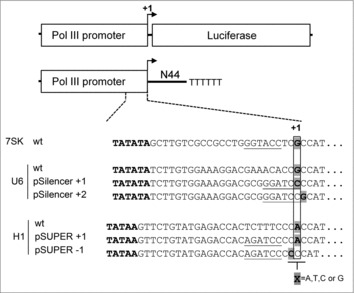
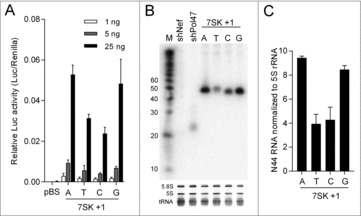
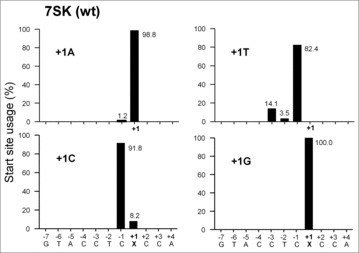
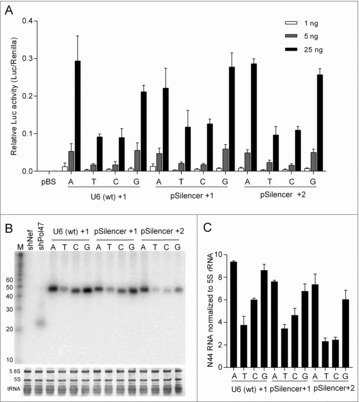
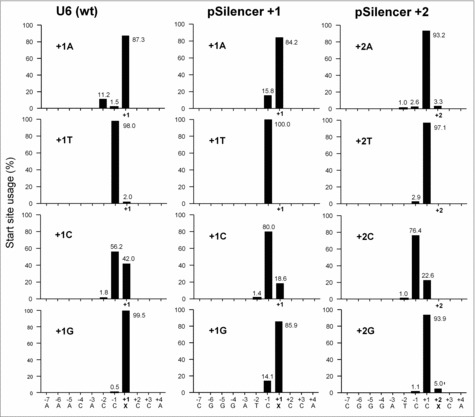
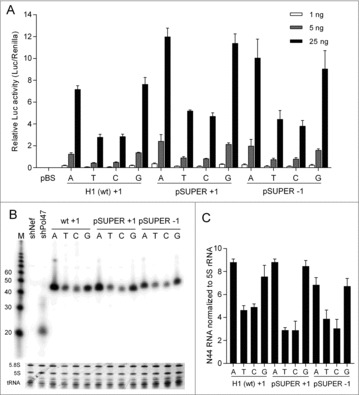
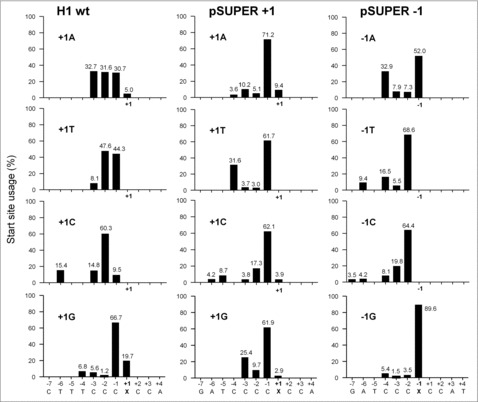
Type 3 RNA polymerase III (Pol III) promoters are widely used for the expression of small RNAs such as short hairpin RNA and guide RNA in the popular RNAi and CRISPR-Cas gene regulation systems. Although it is generally believed that type 3 Pol III promoters use a defined transcription start site (+1 position), most man-made promoter constructs contain local sequence alterations of which the impact on transcription efficiency and initiation accuracy is not known. For three human type 3 Pol III promoters (7SK, U6, and H1), we demonstrated that the nucleotides around the +1 position affect both the transcriptional efficiency and start site selection. Human 7SK and U6 promoters with A or G at the +1 position efficiently produced small RNAs with a precise +1 start site. The human H1 promoter with +1A or G also efficiently produced small RNAs but from multiple start sites in the -3/-1 window. These results provide new insights for the design of vectors for accurate expression of designed small RNAs for research and therapeutic purposes.
Overview
The claims and statistics of this paper haven’t been checked yet.
Free: it reads the open-access text and checks the first 5 claims that cite a source we can check. Create a free account to check every claim.
Integrity signals
Registry
Cites
Statistics
Figures
Verification
Claims the paper makes
The claims and statistics of this paper haven’t been checked yet.
Free: it reads the open-access text and checks the first 5 claims that cite a source we can check. Create a free account to check every claim.
Claims other papers make about this one
Each is checked against this paper’s own text: does it say what the citing paper says it does?
The source backs part of the claim, not all of it — or backs it for a different population, condition or comparison.
In the citing paper
“However, the relatively large size, the requirement that the transcript starts with a G or A, the sometimes too active transcription, and the sensitivity to specific cellular profiles make the human U6 promoter a less versatile promoter [88,131,132].”
From Recombinant Adeno-Associated Viral Vectors (rAAV)-Vector Elements in Ocular Gene Therapy Clinical Trials and Transgene Expression and Bioactivity Assays (2020) · cites this paper as [132]
Experimental — accuracy not yet measured
Self-check
Percentages, sums and reported differences re-computed from the paper’s own numbers.
The self-check needs the paper’s full text.
Citations
Cites
Multiplex Genome Engineering Using CRISPR/Cas Systems
Cong, L., Ran, F. A., Cox, D., Lin, S., Barretto, R., Habib, N., Hsu, P. D., Wu, X., Jiang, W., Marraffini, L. A., et al. (2013) · Science · doi:10.1126/science.1231143 · Cited by 15,339 · cited 2×
“The synthesis of a precise gRNA molecule is extremely important because the 50 end 20-nt of the gRNA plays a role in target site recognition.(13,15) The newly discovered Cpf1 endonuclease uses a single »43-nt CRISPR-derived RNA (crRNA) as guide”
MethodRNA-Guided Human Genome Engineering via Cas9
Mali, P., Yang, L., Esvelt, K. M., Aach, J., Guell, M., DiCarlo, J. E., Norville, J. E., & Church, G. M. (2013) · Science · doi:10.1126/science.1232033 · Cited by 9,210 · cited 1×
“The prokaryotic CRISPR-Cas9 system has been adapted for gene editing in mammalian cells and requires a gRNA to guide the Cas9 endonuclease for site-specific genome editing.(2,13,14) The synthesis of a precise gRNA molecule is extremely important because the 50 end 20-nt of the gRNA plays a role in target site recognit…”
MethodThe new frontier of genome engineering with CRISPR-Cas9
Doudna, J. A., & Charpentier, E. (2014) · Science · doi:10.1126/science.1258096 · Cited by 7,062
Repurposing CRISPR as an RNA-Guided Platform for Sequence-Specific Control of Gene Expression
Qi, L. S., Larson, M. H., Gilbert, L. A., Doudna, J. A., Weissman, J. S., Arkin, A. P., & Lim, W. A. (2013) · Cell · doi:10.1016/j.cell.2013.02.022 · Cited by 5,016
Cpf1 Is a Single RNA-Guided Endonuclease of a Class 2 CRISPR-Cas System
Zetsche, B., Gootenberg, J. S., Abudayyeh, O. O., Slaymaker, I. M., Makarova, K. S., Essletzbichler, P., Volz, S. E., Joung, J., van der Oost, J., Regev, A., et al. (2015) · Cell · doi:10.1016/j.cell.2015.09.038 · Cited by 4,761 · cited 1×
“and the 50 end was shown to be pivotal for function.(16) Other RNA molecules like aptamers and ribozymes may also need precise 50 and 30 ends to adopt the active RNA conformation, which can be critical for target binding and/or catalytic target RNA cleavage.”
BackgroundA System for Stable Expression of Short Interfering RNAs in Mammalian Cells
Brummelkamp, T. R., Bernards, R., & Agami, R. (2002) · Science · doi:10.1126/science.1068999 · Cited by 4,291
Keefe, A. D., Pai, S., & Ellington, A. (2010) · Nature Reviews Drug Discovery · doi:10.1038/nrd3141 · Cited by 2,289
Analysis of off-target effects of CRISPR/Cas-derived RNA-guided endonucleases and nickases
Cho, S. W., Kim, S., Kim, Y., Kweon, J., Kim, H. S., Bae, S., & Kim, J.-S. (2014) · Genome Research · doi:10.1101/gr.162339.113 · Cited by 1,356
RNA therapeutics: beyond RNA interference and antisense oligonucleotides
Kole, R., Krainer, A. R., & Altman, S. (2012) · Nature Reviews Drug Discovery · doi:10.1038/nrd3625 · Cited by 1,152
The RNA Polymerase II Core Promoter
Smale, S. T., & Kadonaga, J. T. (2003) · Annual Review of Biochemistry · doi:10.1146/annurev.biochem.72.121801.161520 · Cited by 1,133 · cited 1×
“Pol II transcription also shows a preferential requirement for C1 purine.(40,41) The transcription initiation mechanism of Pol II and III was shown to be similar.”
Background
Research works printed but not linked: 1
- Liu YP, Schopman NC, Berkhout B Dicer-independent processing of short hairpin RNAs. Nucleic Acids Res 2013; 41: 3723- 3733; PMID:23376931; https://doi.org/ 10.1093/nar/gkt036 23376931 PMC3616727 · DOI · Paper page
Cited by
Optimized CRISPR guide RNA design for two high-fidelity Cas9 variants by deep learning
Wang, D., Zhang, C., Wang, B., Li, B., Wang, Q., Liu, D., Wang, H., Zhou, Y., Shi, L., Lan, F., et al. (2019) · Nature Communications · doi:10.1038/s41467-019-12281-8 · Cited by 331
Precision genome editing using cytosine and adenine base editors in mammalian cells
Huang, T. P., Newby, G. A., & Liu, D. R. (2021) · Nature Protocols · doi:10.1038/s41596-020-00450-9 · Cited by 175
Delineation of the Exact Transcription Termination Signal for Type 3 Polymerase III
Gao, Z., Herrera-Carrillo, E., & Berkhout, B. (2017) · Molecular Therapy — Nucleic Acids · doi:10.1016/j.omtn.2017.11.006 · Cited by 100
Self-citationBuck, T., & Wijnholds, J. (2020) · International Journal of Molecular Sciences · doi:10.3390/ijms21124197 · Cited by 92
“However, the relatively large size, the requirement that the transcript starts with a G or A, the sometimes too active transcription, and the sensitivity to specific cellular profiles make the human U6 promoter a less versatile promoter [88,131,132].”
BackgroundDicer-independent processing of small RNA duplexes: mechanistic insights and applications
Herrera-Carrillo, E., & Berkhout, B. (2017) · Nucleic Acids Research · doi:10.1093/nar/gkx779 · Cited by 95
Self-citationImproving miRNA Delivery by Optimizing miRNA Expression Cassettes in Diverse Virus Vectors
Herrera-Carrillo, E., Liu, Y. P., & Berkhout, B. (2017) · Human Gene Therapy Methods · doi:10.1089/hgtb.2017.036 · Cited by 87
Self-citationA CRISPR-Cas Cure for HIV/AIDS
Hussein, M., Molina, M. A., Berkhout, B., & Herrera-Carrillo, E. (2023) · International Journal of Molecular Sciences · doi:10.3390/ijms24021563 · Cited by 87
Self-citationAlves, C. R. R., Ha, L. L., Yaworski, R., Sutton, E. R., Lazzarotto, C. R., Christie, K. A., Reilly, A., Beauvais, A., Doll, R. M., de la Cruz, D., et al. (2023) · Nature Biomedical Engineering · doi:10.1038/s41551-023-01132-z · Cited by 76
RNA Polymerase II Activity of Type 3 Pol III Promoters
Gao, Z., Herrera-Carrillo, E., & Berkhout, B. (2018) · Molecular Therapy — Nucleic Acids · doi:10.1016/j.omtn.2018.05.001 · Cited by 74
Self-citationDirect evidence of CRISPR-Cas9-mediated mitochondrial genome editing
Bi, R., Li, Y., Xu, M., Zheng, Q., Zhang, D., Li, X., Ma, G., Xiang, B.-L., Zhu, X., Zhao, H., et al. (2022) · The Innovation · doi:10.1016/j.xinn.2022.100329 · Cited by 76
“…716 in the MT-ND4 gene, with a G added to the 5 0 -position of the 20-bp guide sequence to obtain ef fi cient U6 transcription of sgRNA and overall ef fi ciency of the CRISPR-Cas9 system, 37,51,52 and was cloned to create the mito-Cas9 construct sgRNA1 ND4 -MTS COX8A -Cas9-UTR SOD2 (Figure S1).”
Idoko-Akoh, A., Taylor, L., Sang, H., & McGrew, M. J. (2018) · Scientific Reports · doi:10.1038/s41598-018-33244-x · Cited by 66
RNA Interference Therapies for an HIV-1 Functional Cure
Scarborough, R. J., & Gatignol, A. (2017) · Viruses · doi:10.3390/v10010008 · Cited by 64
“Recent results have shown that the transcription start [104,105] and end [106] sites of small RNAs expressed from type 3 RNA Pol III promoters can vary by a few nucleotides.”
BackgroundImprovement of the CRISPR-Cpf1 system with ribozyme-processed crRNA
Gao, Z., Herrera-Carrillo, E., & Berkhout, B. (2018) · RNA Biology · doi:10.1080/15476286.2018.1551703 · Cited by 52
Self-citationZhang, X., Lv, S., Luo, Z., Hu, Y., Peng, X., Lv, J., Zhao, S., Feng, J., Huang, G., Wan, Q.-L., et al. (2021) · Nucleic Acids Research · doi:10.1093/nar/gkab174 · Cited by 50
DNA, RNA, and Protein Tools for Editing the Genetic Information in Human Cells
Chen, X., & Gonçalves, M. A. F. V. (2018) · iScience · doi:10.1016/j.isci.2018.08.001 · Cited by 37
Li, Y., Xu, M., Xiang, B.-L., Li, X., Zhang, D.-F., Zhao, H., Bi, R., & Yao, Y.-G. (2023) · Neuropsychopharmacology · doi:10.1038/s41386-023-01542-2 · Cited by 20
“125–146 in the CTSH gene (with a GG added to the 5’-position of the 20-bp guide sequence to obtain efficient U6 transcription of the sgRNA and an overall efficiency of the CRISPR-Cas9 system) [58, 60].”
BackgroundRojek, J., Basavaraju, Y., Nallapareddy, S., Bulté, D. B., Baumgartner, R., Schoffelen, S., Grav, L. M., Goletz, S., & Pedersen, L. E. (2023) · Biotechnology and Bioengineering · doi:10.1002/bit.28367 · Cited by 17
“When delivered via plasmids, gRNAs expression is driven from Type 3 RNA polymerase III, typically the U6 promoter (Gao et al., 2017; Ma et al., 2014).”
BackgroundBackstrom, J. R., Sheng, J., Wang, M. C., Bernardo‐Colón, A., & Rex, T. S. (2020) · Molecular Therapy — Methods & Clinical Development · doi:10.1016/j.omtm.2020.09.001 · Cited by 19
“Both “A” and “G” are efficient U6 and 7SK transcription start sites.(21) The gStop sequence is 50-GGAGACCAAG-GCAGTTTTTT-30.”
BackgroundGoguen, R. P., Corpo, O. D., Malard, C. M. G., Daher, A., Alpuche‐Lazcano, S. P., Chen, M. J., Scarborough, R. J., & Gatignol, A. (2020) · Molecular Therapy — Nucleic Acids · doi:10.1016/j.omtn.2020.12.022 · Cited by 17
“Further investigations have elaborated on this to identify how the precise nucleotide (nt) sequence around the +1 position affects the transcriptional efficiency of the Pol III promoters, as well as which exact nt position is used as the transcriptional start site.(31) Accurate expression of designed small RNAs is cri…”
Pudgerd, A., Saedan, S., Santimanawong, W., Weerachatyanukul, W., Jariyapong, P., Chaijarasphong, T., Jongsomchai, K., Sritunyalucksana, K., Vanichviriyakit, R., & Chotwiwatthanakun, C. (2024) · Scientific Reports · doi:10.1038/s41598-024-78277-7 · Cited by 14
“Modifying the first codon of gRNA to G to improve the transcription level is recommended since the first codon is important for transcription efficiency 33 .”
MethodGene editing in plants: assessing the variables through a simplified case study
Shockey, J. M. (2020) · Plant Molecular Biology · doi:10.1007/s11103-020-00976-2 · Cited by 15
Nickase fidelity drives EvolvR-mediated diversification in mammalian cells
Hurtado, J. E., Schieferecke, A. J., Halperin, S. O., Guan, J., Aidlen, D., Schaffer, D. V., & Dueber, J. E. (2025) · Nature Communications · doi:10.1038/s41467-025-58414-0 · Cited by 13
Design of AAV Vectors for Delivery of RNAi
Borel, F., & Mueller, C. (2019) · Methods in molecular biology · doi:10.1007/978-1-4939-9139-6_1 · Cited by 12
Myacheva, K., Walsh, A., Riester, M., Pelos, G., Carl, J., & Diederichs, S. (2022) · Cancer Letters · doi:10.1016/j.canlet.2022.215958 · Cited by 12
The discovery and development of RNA-based therapies for treatment of HIV-1 infection
Chen, M. J., Gatignol, A., & Scarborough, R. J. (2022) · Expert Opinion on Drug Discovery · doi:10.1080/17460441.2022.2117296 · Cited by 11
“Studies have indicated that the choice of promoter can impact the potency of shRNAs due to variable transcriptional efficiencies [145,199].”
BackgroundMassengill, M. T., Young, B. M., Lewin, A. S., & Ildefonso, C. J. (2019) · Methods in molecular biology · doi:10.1007/978-1-4939-9065-8_15 · Cited by 9
Multi-locus CRISPRi targeting with a single truncated guide RNA
Moore, M. M., Wekhande, S., Issner, R., Collins, A., Cruz, A. J., Liu, Y. V., Javed, N. M., Casaní-Galdón, S., Buenrostro, J. D., Epstein, C. B., et al. (2025) · Nature Communications · doi:10.1038/s41467-025-56144-x · Cited by 7
Influence of a 3′ Terminal Ribozyme on AgoshRNA Biogenesis and Activity
Herrera-Carrillo, E., Gao, Z., & Berkhout, B. (2019) · Molecular Therapy — Nucleic Acids · doi:10.1016/j.omtn.2019.04.001 · Cited by 7
“DISCUSSION We previously defined several parameters for the design of optimized AgoshRNA molecules: a small 5 nt loop and a duplex length of 18 bp with a bottom A C mismatch.(31,32,34) We successfully designed 21 AgoshRNAs that were active in reporter silencing, but only two of these exhibited profound HIV inhibition…”
Self-citationInhibition of HIV-1 replication using the CRISPR/cas9-no NLS system as a prophylactic strategy
Jeda, A. S., Esghaei, M., Keyvani, H., Bokharaei‐Salim, F., Teimoori, A., & Abdoli, A. (2022) · Heliyon · doi:10.1016/j.heliyon.2022.e10483 · Cited by 5
“The gRNA sequences were initiated with a Gresidue as a U6 promoter transcription start site (TSS) [72].”
MethodMaltseva, D. V., Кириллов, И. Д., Zhiyanov, A., Averinskaya, D. A., Suvorov, R. E., Gubani, D., Kudriaeva, A. A., Belogurov, A. A., & Tonevitsky, A. (2024) · Biochimica et Biophysica Acta (BBA) - Gene Regulatory Mechanisms · doi:10.1016/j.bbagrm.2024.195046 · Cited by 5
Building Blocks of Artificial CRISPR-Based Systems beyond Nucleases
Kuzmin, A. A., & Tomilin, A. N. (2022) · International Journal of Molecular Sciences · doi:10.3390/ijms24010397 · Cited by 6
Enhanced Extracellular Vesicle Cargo Loading via microRNA Biogenesis Pathway Modulation
Pottash, A. E., Levy, D. H., Powsner, E. H., Pirolli, N. H., Kuo, L., Solomon, T. J., Nowak, R., Wang, J., Kronstadt, S. M., & Jay, S. M. (2024) · ACS Biomaterials Science & Engineering · doi:10.1021/acsbiomaterials.4c00821 · Cited by 4
Notes on Functional Modules in the Assembly of CRISPR/Cas9-Mediated Epigenetic Modifiers
Kondrashov, A. V., & Karpova, E. (2020) · Methods in molecular biology · doi:10.1007/978-1-0716-0876-0_30 · Cited by 4
Protocol for Allele-Specific Epigenome Editing Using CRISPR/dCas9
Rajaram, N., Bashtrykov, P., & Jeltsch, A. (2024) · Methods in molecular biology · doi:10.1007/978-1-0716-4051-7_9 · Cited by 4
CRISPR‐Cas9 Genome Editing and Rapid Selection of Cell Pools
Stoyko, D., Timothy, O., Hernandez, A., Κωνσταντινίδου, Π., Meng, Q., & Haase, A. D. (2022) · Current Protocols · doi:10.1002/cpz1.624 · Cited by 4
Boosting AgoshRNA activity by optimized 5’-terminal nucleotide selection
Gao, Z., Berkhout, B., & Herrera-Carrillo, E. (2019) · RNA Biology · doi:10.1080/15476286.2019.1599259 · Cited by 3
Self-citationJaved, M. R., Farooq, R., Hussain, K., Rashid, K., Bashir, A., & Saif, H. (2021) · Elsevier eBooks · doi:10.1016/b978-0-12-821910-2.00003-5 · Cited by 2
Optimal LentiCRISPR-Based System for Sequential CRISPR/Cas9 Screens
Hutcheson, R. L., Hayes, M., & Sugden, B. (2022) · ACS Synthetic Biology · doi:10.1021/acssynbio.2c00152 · Cited by 2
5′-Triphosphate guanosine RNAs recruit GTP-binding proteins to suppress RIG-I/IFN type I signaling
Wołczyk, M., Szymański, J., Trus, I., Naz, Z., Idlin, N., Lechowski, M., Baranowska, E., Bis, A., Nowak, J. S., Tame, T., et al. (2026) · Molecular Cell · doi:10.1016/j.molcel.2026.04.014 · Cited by 2
CRISPR/Cas for PET Reporter Gene Engineering
Chung, T., Merrill, J. R., & Lyons, S. K. (2023) · Methods in molecular biology · doi:10.1007/978-1-0716-3499-8_17 · Cited by 1
Scalable single-cell pooled CRISPR screens with conventional knockout vector librariesPreprint
Islam, M., Yang, Y., Simmons, A. J., Xu, Y., Fisher, E. L., Deng, W., Grieb, B. C., Molina, P., de Caestecker, C. R., Ramirez-Solano, M. A., et al. (2024) · bioRxiv (Cold Spring Harbor Laboratory) · doi:10.1101/2024.02.01.578192 · Cited by 1
“It has been reported that the U6 promoter displays a differential nucleotide preference for the transcription start site (TSS) [13, 14], which we also observed as base bias in sgRNA isoforms.”
BackgroundCRISPR/Cas rendszerek és kis RNS-eik expressziójára alkalmazott promóterek vizsgálata
Weinhardt, N. (2021) · SZTE Repository of Dissertations (University of Szeged) · doi:10.14232/phd.10687
Genetic Manipulation in Cotton Using Embryonic Regulators and CRISPR/Cas9
Lin, Y. T. (2024) · University of North Texas Digital Library (University of North Texas) · doi:10.12794/metadc2415905
Development of new increased fidelity SpCas9 variants
Kulcsár, P. I. (2019) · SZTE Repository of Dissertations (University of Szeged) · doi:10.14232/phd.10317
Using CRISPR-Cas9 Techniques to Model Type I Interferonopathies
Desrochers, A. (2023) · Qucosa (Saxon State and University Library Dresden)
Engineering compact RNA-guided endonucleases for CAG/CTG repeats editing
Mangin, A. (2024) · ORCA Online Research @Cardiff (Cardiff University)
Chen, M. (2023) · eScholarship@McGill (McGill) · doi:10.82308/20819
Αργύρη, Α. Α. (2024) · University of Thessaly Institutional Repository (University of Thessaly) · doi:10.26253/heal.uth.40880
Rational selection of SpCas9 and variant-derived adenine base editors for human genome editing
Wang, J., He, L., Li, L., Zhang, Y., Wang, Y., Yang, Y., Song, Z., Liang, Y., Yang, J., & Gu, F. (2026) · Gene Therapy · doi:10.1038/s41434-026-00639-9
Metadata
- Authors
- Gao, Z., Harwig, A., Berkhout, B., & Herrera-Carrillo, E.
- Affiliations
- Amsterdam UMC Location University of Amsterdam (NL)
- Corresponding author
- Berkhout, Ben
- Herrera-Carrillo, Elena
- Venue
- Transcription
- Publisher
- Informa UK Limited
- Published
- 2017-06-09
- Volume
- 8
- Issue
- 5
- Pages
- 275-287
- ISSN
- 2154-1264 (ISSN-L)
- 2154-1272
- PMC
- PMC5703244
- OpenAlex
- W2623580087
- Cited by
- 47
- References
- 43
- Citations by year
- 2026: 2 · 2025: 2 · 2024: 6 · 2023: 7 · 2022: 7 · 2021: 4 · 2020: 5 · 2019: 6 · 2018: 4 · 2017: 4
- FWCI
- 2.12
- Type
- journal article
- Language
- en
- Open access
- hybrid
- doi.org
- Licence
- Locations
- Transcription (publishedVersion, cc-by)
- PubMed Central (publishedVersion, cc-by)
- PubMed (publishedVersion)
- DIGITAL.CSIC (Spanish National Research Council (CSIC)) (submittedVersion, cc-by)
- Pure Amsterdam UMC (submittedVersion, other-oa)
- Data Archiving and Networked Services (DANS) (submittedVersion)
- Funders
- ZonMw
- Nederlandse Organisatie voor Wetenschappelijk Onderzoek
- China Scholarship Council
- Topics
- Life Sciences › Biochemistry, Genetics and Molecular Biology › Molecular Biology › Genomics and Chromatin Dynamics
- Life Sciences › Biochemistry, Genetics and Molecular Biology › Molecular Biology › RNA Interference and Gene Delivery
- Life Sciences › Biochemistry, Genetics and Molecular Biology › Molecular Biology › CRISPR and Genetic Engineering
- Keywords
- transcription start site selection, transcriptional efficiency, promoter design
- MeSH terms
- Humans, Mutation, Promoter Regions, Genetic, RNA Polymerase III, RNA, Small Nuclear, Codon, Initiator, RNA, Untranslated, Transcription Initiation Site, RNA, Long Noncoding
About these checks
Registry, retraction, Cites and statistics results are computed, not judged, with one exception: a printed reference that no index lists is read once by a model before it counts as a citation error. Claims are extracted by a model and kept only when their quote appears verbatim in the text; each cited source is then checked, with a model’s help, for whether it says what the claim relies on. Those verdicts can be wrong — read the claim’s quote and the cited source before relying on one.
Statistics and arithmetic are recomputed, not judged.
Confidence bands are shown only for fields calibrated on our annotated test set. None is calibrated yet, so no band is shown.
What counts as a claim ›How we measure confidence ›How we check this ›
Are you an author, or do you see a problem with this page? Request a review
Data sources
Bibliographic data: Semantic Scholar, OpenAlex, Crossref.
Contains information from the Semantic Scholar Academic Graph Datasets, made available under the ODC Attribution License (ODC-BY 1.0).
Semantic Scholar’s data is described in: Kinney, R., et al. (2023). The Semantic Scholar Open Data Platform. arXiv:2301.10140.
