

Moderate-to-severe eosinophilia induced by treatment with immune checkpoint inhibitors: 37 cases from a national reference center for hypereosinophilic syndromes and the French pharmacovigilance database
Open accessThe DOI matches its Crossref record; 38 of the 38 references it cites were found in a registry or an index; 16 of the 37 sources its claims cite were checked for support.
Abstract
A better understanding of immune-related adverse events is essential for the early detection and appropriate management of these phenomena. We conducted an observational study of cases recorded at the French reference center for hypereosinophilic syndromes and in the French national pharmacovigilance database. Thirty-seven reports of eosinophilia induced by treatment with immune checkpoint inhibitors (ICIs) were included. The median [range] time to the absolute eosinophil count (AEC) peak was 15 [4─139] weeks. The median AEC was 2.7 [0.8─90.9] G/L. Eosinophil-related manifestations were reported in 21 of the 37 cases (57%). If administered, corticosteroids were always effective (n = 10 out of 10). Partial or complete remission of eosinophilia was obtained in some patients not treated with corticosteroids, after discontinuation (n = 12) or with continuation (n = 4) of the ICI. The AEC should be monitored in ICI-treated patients. If required by oncologic indications, continuation of ICI may be an option in asymptomatic hypereosinophilic patients, and in corticosteroid responders.
Overview
CoChat Summary
TL;DR
In 37 cases of moderate-to-severe eosinophilia after immune checkpoint inhibitor (ICI) therapy, eosinophil-related manifestations occurred in 21/37 (57%), with median time to absolute eosinophil count (AEC) peak of 15 weeks and median AEC of 2.7 G/L. Corticosteroids were effective in all 10 treated patients, and some patients had remission without corticosteroids after ICI discontinuation or continuation.
Key findings
- Among 37 included reports, 25 patients received nivolumab, 6 pembrolizumab, 4 ipilimumab, and 2 nivolumab plus ipilimumab; indications were non-small-cell lung cancer (n = 18), melanoma (n = 18), and Hodgkin’s lymphoma (n = 1).
- Median [range] time to new-onset eosinophilia was 6 [1─52] weeks and to AEC peak was 15 [4─139] weeks; median AEC was 2.7 [0.8─90.9] G/L.
- Eosinophil-related manifestations were reported in 21/37 cases (57%), affecting skin (n = 10), lung (2 eosinophilic pneumonia, 2 eosinophilic bronchiolitis), kidneys (4 nephritis), liver (2 cholangitis), and heart (1 myocarditis); severity included 1 grade IV, 6 grade III, 8 grade II, and 7 grade I cases, with no deaths attributable to Eo-irAEs.
- Corticosteroids were always effective when administered (n = 10/10); partial or complete remission also occurred in some patients not treated with corticosteroids after ICI discontinuation (n = 12) or continuation (n = 4).
Methods
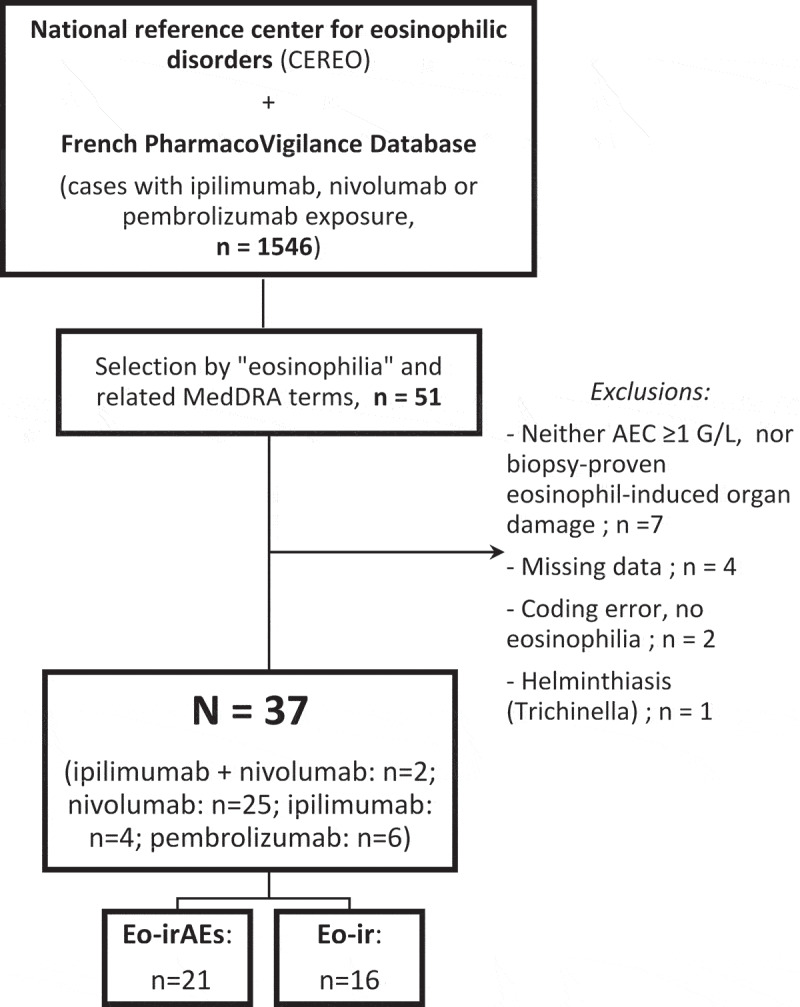
- Observational study of cases recorded at the French national reference center for hypereosinophilic syndromes (CEREO) and the French national pharmacovigilance database (FPVD), searched up to January 15, 2019 and November 1, 2017, respectively.
- Inclusion required at least one AEC >1 G/L after ICI initiation and/or biopsy-confirmed eosinophil-induced organ damage; patients with other likely eosinophilia etiologies or missing data were excluded.
- Cases were classified as Eo-ir (no organ dysfunction attributed to eosinophilia) or Eo-irAEs (organ dysfunction considered induced by proven tissue eosinophilia and/or potentially induced by eosinophils); quantitative variables were reported as median [range], and medians compared using Wilcoxon rank sum test.
Limitations
- The authors state that the retrospective design had inherent limitations: misclassification, missing data, and risk of selection bias due to the FPVD’s self-reporting procedure, which emphasizes the most symptomatic cases.
- The authors note that data on time from corticosteroid onset to remission were not available for the great majority of cases, and corticosteroid dosage was not specified in the pharmacovigilance reports.
- The text makes evident that this is a descriptive case series without a control group, so comparative effectiveness or causality cannot be established from these data.
Model-written summary. Check it against the paper before relying on it.
Integrity signals
Registry
Cites
Statistics
Figures
Verification
Claims the paper makes
9 Valid · 0 Not valid · 10 Not checked · 37 Own results and interpretations
The cited sources support only part of this claim — read each source’s verdict below.
In the paper
“multiple recent reports of Eo-irAEs like eosinophilic fasciitis27-30 or eosinophilic granulomatosis with polyangiitis31 suggest that topical or low-dose oral corticosteroids, with or without CS-sparing treatments, can give excellent results.”
§ Moderate-to-severe eosinophilia induced by treatment with immune checkpoint inhibitors: 37 cases from a national reference center for hypereosinophilic syndromes and the French pharmacovigilance database > Discussion
What the sources say
- Not checked — no full text of the sourcecites [27] Toussaint F, Hammon M, Erdmann M, Moreira A, Kirchberger MC, Schuler G, Schett G, Heinzerling L. Checkpoint inhibitor-induced eosinophilic fasciitis following high eosinophilia associated with complete response. Rheumatology. 2019;58(10):1875–1877. doi: 10.1093/rheumatology/kez164. 31056673 source
- Not checked — no full text of the sourcecites [28] Khoja L, Maurice C, Chappell M, MacMillan L, Al-Habeeb AS, Al-Faraidy N, Butler MO, Rogalla P, Mason W, Joshua AM, et al. Eosinophilic fasciitis and acute encephalopathy toxicity from pembrolizumab treatment of a patient with metastatic melanoma. Cancer Immunol Res. 2016; 4(3): 175– 178. doi: 10.1158/2326-6066.CIR-15-0186. 26822024 source
- Not checked — no full text of the sourcecites [29] Lidar M, Giat E, Garelick D, Horowitz Y, Amital H, Steinberg-Silman Y, Schachter J, Shapira-Frommer R, Markel G. Rheumatic manifestations among cancer patients treated with immune checkpoint inhibitors. Autoimmun Rev. 2018; 17(3): 284– 289. doi: 10.1016/j.autrev.2018.01.003. 29341936 source
- Not checked — no full text of the sourcecites [30] Andrés‐Lencina -J-J, Burillo‐Martínez S, Aragón‐Miguel R, Calleja‐Algarra A, Rodríguez‐Peralto J-L, Ortiz‐Romero P-L, Gargallo‐Moneva V. Eosinophilic fasciitis and lichen sclerosus in a patient treated with nivolumab. Australas J Dermatol. 2018; 59(4): e302– e304. doi: 10.1111/ajd.12836. 29797309 source
- Partly supportedcites [31] Roger A, Groh M, Lorillon G, Pendu CL, Maillet J, Arangalage D, Tazi A, Lebbe C, Baroudjian B, Delyon J. Eosinophilic granulomatosis with polyangiitis (Churg-Strauss) induced by immune checkpoint inhibitors. Ann Rheum Dis. 2019; 78(8): e82– e82. doi: 10.1136/annrheumdis-2018-213857. 29936437 sourceExperimental — accuracy not yet measured
The EGPA case report describes rapid improvement after inhaled corticosteroids and a long-acting beta-agonist, and later treatment with inhaled therapy and an intra-articular corticosteroid injection (case description; page unavailable). It does not report treatment with topical or low-dose oral corticosteroids or a corticosteroid-sparing drug. Symptoms also worsened despite continued inhaled therapy when nivolumab was reintroduced, so the claimed excellent results from the stated regimens are not established by this case. (LLM, conf=0.86)
hedgedstates a possible cause- Asserted: passes — The authors put it forward as true.
- Checkable: passes — It can be checked against evidence.
- Load-bearing: passes — The paper’s conclusions depend on it.
- Based: passes — The paper gives a reason why it holds.
A result the paper reports from its own data — it cites no other source for it, so there is none to check. The quote shows it is in the paper.
In the paper
“Thirty-seven reports of eosinophilia induced by treatment with immune checkpoint inhibitors (ICIs) were included.”
- Also stated in: § Results · plain
“Thirty-seven patients were included in the study (Figure 1): 25 were treated with nivolumab, 6 with pembrolizumab, 4 with ipilimumab, and 2 with a combination of nivolumab and ipilimumab (1 case with the two drugs concomitantly, and 1 case with a switch from ipilimumab to nivolumab).”
§ Moderate-to-severe eosinophilia induced by treatment with immune checkpoint inhibitors: 37 cases from a national reference center for hypereosinophilic syndromes and the French pharmacovigilance database > Abstract
plainstates a causen = 7- Asserted: passes — The authors put it forward as true.
- Checkable: passes — It can be checked against evidence.
- Load-bearing: passes — The paper’s conclusions depend on it.
- Based: passes — The paper gives a reason why it holds.
- Also stated in: § Results · plain
In the paper
“Similarly, the median time to the AEC peak observed in our study (3.4 months [1─32.4]), was shorter than that observed by Berrnard-Teissier et al. (6.4 months [1.4─32]).”
§ Moderate-to-severe eosinophilia induced by treatment with immune checkpoint inhibitors: 37 cases from a national reference center for hypereosinophilic syndromes and the French pharmacovigilance database > Discussion
What the sources say
- Not checked — no full text of the sourcecites [6] Bernard-Tessier A, Jeanville P, Champiat S, Lazarovici J, Voisin A-L, Mateus C, Lambotte O, Annereau M, Michot J-M. Immune-related eosinophilia induced by anti-programmed death 1 or death-ligand 1 antibodies. Eur J Cancer. 2017; 81: 135– 137. doi: 10.1016/j.ejca.2017.05.017. 28624693 source
plain- Asserted: passes — The authors put it forward as true.
- Checkable: passes — It can be checked against evidence.
- Load-bearing: unclear — It is unclear whether the paper’s conclusions depend on it.
- Based: passes — The paper gives a reason why it holds.
A result the paper reports from its own data — it cites no other source for it, so there is none to check. The quote shows it is in the paper.
In the paper
“In the cohort as a whole, the median times to new-onset eosinophilia and to the AEC peak were respectively 6 [1─52] and 15 [4─139] weeks after ICI initiation.”
- Also stated in: § Discussion · plain
“Considering the time to new-onset eosinophilia (median [range]: 6 weeks [1─52] or 1.4 months [0.2─12])”
§ Moderate-to-severe eosinophilia induced by treatment with immune checkpoint inhibitors: 37 cases from a national reference center for hypereosinophilic syndromes and the French pharmacovigilance database > Results
plain- Asserted: passes — The authors put it forward as true.
- Checkable: passes — It can be checked against evidence.
- Load-bearing: passes — The paper’s conclusions depend on it.
- Based: passes — The paper gives a reason why it holds.
- Also stated in: § Discussion · plain
A result the paper reports from its own data — it cites no other source for it, so there is none to check. The quote shows it is in the paper.
In the paper
“The median [range] time to the absolute eosinophil count (AEC) peak was 15 [4─139] weeks.”
- Also stated in: § Results · plain
“In the cohort as a whole, the median times to new-onset eosinophilia and to the AEC peak were respectively 6 [1─52] and 15 [4─139] weeks after ICI initiation.”
§ Moderate-to-severe eosinophilia induced by treatment with immune checkpoint inhibitors: 37 cases from a national reference center for hypereosinophilic syndromes and the French pharmacovigilance database > Abstract
plain- Asserted: passes — The authors put it forward as true.
- Checkable: passes — It can be checked against evidence.
- Load-bearing: unclear — It is unclear whether the paper’s conclusions depend on it.
- Based: passes — The paper gives a reason why it holds.
- Also stated in: § Results · plain
19 more claims
Create a free account to see all 56 claims and every source verdict.
- Probably not a substantial claim. 16
- It may state two separate claims as one. 20
Self-check
Percentages, sums and reported differences re-computed from the paper’s own numbers.
Rated minor: it would not touch a result — a value no result rests on, a p-value that stays on the same side of the significance level, or a conflict that is clerical, resolved elsewhere in the paper, or outside its own findings.
In the paper
“With regard to the severity of the Eo-irAEs, there were 1 grade IV case, 6 grade III cases, 8 grade II cases and 7 grade I cases.”
§ Moderate-to-severe eosinophilia induced by treatment with immune checkpoint inhibitors: 37 cases from a national reference center for hypereosinophilic syndromes and the French pharmacovigilance database > Results
Reported 21 · recomputed 22
Citations
Cites
Pembrolizumab versus Chemotherapy for PD-L1-Positive Non-Small-Cell Lung Cancer
Reck, M., Rodríguez-Abreu, D., Robinson, A. G., Hui, R., Csőszi, T., Fülöp, A., Gottfried, M., Peled, N., Tafreshi, A., Cuffe, S., et al. (2016) · New England Journal of Medicine · doi:10.1056/nejmoa1606774 · Cited by 10,089 · cited 1×
“However, ICIs are also associated with frequent and potentially organ- or life-threatening immune-related adverse events (irAEs), which generally mimic autoimmune or inflammatory conditions; indeed, up to 90% of patients treated with ipilimumab and up to 70% of those treated with PD-1/PD-L1 antibodies experience at le…”
BackgroundImmune-Related Adverse Events Associated with Immune Checkpoint Blockade
Postow, M. A., Sidlow, R., & Hellmann, M. D. (2018) · New England Journal of Medicine · doi:10.1056/nejmra1703481 · Cited by 4,849 · cited 3×
“The time to onset of moderate-to-severe eosinophilia reported in our study is in line with that described for other irAEs that typically arise within a few weeks or months of ICIinitiation.7 Given our stringent inclusion criteria, our objective here was to describe the patients with the most severe ICI-induced AEs; ac…”
ResultCancer immunotherapy comes of age
Mellman, I., Coukos, G., & Dranoff, G. (2011) · Nature · doi:10.1038/nature10673 · Cited by 3,893 · cited 1×
“However, these molecules can be specifically targeted by immune checkpoint inhibitors (ICIs), such as ipilimumab (a monoclonal antibody against the cytotoxic T-lymphocyte antigen 4 (CTLA4)), nivolumab, and pembrolizumab (both of which target programmed cell death protein 1 (PD1) or its ligand (PD-L1)).(1) These drugs…”
BackgroundBrahmer, J. R., Lacchetti, C., Schneider, B. J., Atkins, M. B., Brassil, K. J., Caterino, J. M., Chau, I., Ernstoff, M. S., Gardner, J. M., Ginex, P., et al. (2018) · Journal of Clinical Oncology · doi:10.1200/jco.2017.77.6385 · Cited by 3,713 · cited 1×
“Although an effective ICI may not have to be discontinued after a mild irAE, specific treatments and/or discontinuation of the ICI must be considered in the most severe cases.(5) In a recent retrospective single-center study, the prevalence of immune-related blood eosinophilia (an absolute eosinophil count (AEC) great…”
BackgroundHaanen, J. B. A. G., Carbonnel, F., Robert, C., Kerr, K. M., Peters, S., Larkin, J., & Jordan, K. (2017) · Annals of Oncology · doi:10.1093/annonc/mdx225 · Cited by 2,367
Immune-related adverse events with immune checkpoint blockade: a comprehensive review
Michot, J. M., Bigenwald, C., Champiat, S., Collins, M., Carbonnel, F., Postel-Vinay, S., Berdelou, A., Varga, A., Bahleda, R., Hollebecque, A., et al. (2016) · European Journal of Cancer · doi:10.1016/j.ejca.2015.11.016 · Cited by 2,127 · cited 1×
“However, ICIs are also associated with frequent and potentially organ- or life-threatening immune-related adverse events (irAEs), which generally mimic autoimmune or inflammatory conditions; indeed, up to 90% of patients treated with ipilimumab and up to 70% of those treated with PD-1/PD-L1 antibodies experience at le…”
Backgroundon behalf of the Society for Immunotherapy of Cancer Toxicity Management Working Group, Puzanov, I., Diab, A., Abdallah, K., Bingham, C. O., Brogdon, C., Dadu, R., Hamad, L., Kim, S., Lacouture, M. E., et al. (2017) · Journal for ImmunoTherapy of Cancer · doi:10.1186/s40425-017-0300-z · Cited by 1,992
The Medical Dictionary for Regulatory Activities (MedDRA)
Brown, E. G., Wood, L., & Wood, S. (1999) · Drug Safety · doi:10.2165/00002018-199920020-00002 · Cited by 1,390 · cited 1×
“In the FPVD, cases were selected using logical combinations of the MedDRA preferred terms “eosinophilia”, “eosinophil count abnormal”, “eosinophil count increased”, “eosinophil percentage abnormal”, “eosinophil percentage increased”, “eosinophilic cellulitis”, “eosinophilic fasciitis”, “eosinophilic pustular folliculi…”
MethodManagement of immune checkpoint blockade dysimmune toxicities: a collaborative position paper
Champiat, S., Lambotte, O., Barreau, E., Belkhir, R., Berdelou, A., Carbonnel, F., Cauquil, C., Chanson, P., Collins, M., Durrbach, A., et al. (2016) · Annals of Oncology · doi:10.1093/annonc/mdv623 · Cited by 903 · cited 2×
“These drugs have been approved for the treatment of several cancers, including melanoma, non-small-cell lung cancer, urothelial carcinoma, renal cell carcinoma, squamous cell carcinoma of the head and the neck, and/or Hodgkin’s lymphoma.(2) However, ICIs are also associated with frequent and potentially organ- or life…”
BackgroundBaseline Biomarkers for Outcome of Melanoma Patients Treated with Pembrolizumab
Weide, B., Martens, A., Hassel, J. C., Berking, C., Postow, M. A., Bisschop, K., Simeone, E., Mangana, J., Schilling, B., Di Giacomo, A. M., et al. (2016) · Clinical Cancer Research · doi:10.1158/1078-0432.ccr-16-0127 · Cited by 589
Cited by
Treatment Outcomes of Immune-Related Cutaneous Adverse Events
Phillips, G. S., Wu, J., Hellmann, M. D., Postow, M. A., Rizvi, N. A., Freites-Martinez, A., Chan, D., Dusza, S., Motzer, R. J., Rosenberg, J. E., et al. (2019) · Journal of Clinical Oncology · doi:10.1200/jco.18.02141 · Cited by 241
Opposing roles of eosinophils in cancer
Simon, S. C. S., Utikal, J., & Umansky, V. (2019) · Cancer Immunology, Immunotherapy · doi:10.1007/s00262-018-2255-4 · Cited by 128
Clinical and translational attributes of immune-related adverse events
Suijkerbuijk, K. P. M., van Eijs, M. J. M., van Wijk, F., & Eggermont, A. M. M. (2024) · Nature Cancer · doi:10.1038/s43018-024-00730-3 · Cited by 149
Lee, D. J., Lee, H. J., Farmer, J. R., & Reynolds, K. L. (2021) · Current Cardiology Reports · doi:10.1007/s11886-021-01530-2 · Cited by 108
Melero, I., Tanos, T., Bustamante, M., Sanmamed, M. F., Calvo, E., Moreno, I., Moreno, V., Hernández‐Guerrero, T., Martinez‐García, M., Rodríguez‐Vida, A., et al. (2023) · Science Translational Medicine · doi:10.1126/scitranslmed.abp9229 · Cited by 91
Lambrecht, B. N., Ahmed, E., & Hammad, H. (2025) · Nature Immunology · doi:10.1038/s41590-025-02212-9 · Cited by 77
“This might explain why some adverse effects from checkpoint inhibition in patients with cancer are associated with intense eosinophilia 94 .”
Groh, M., Rohmer, J., Etienne, N., Chahla, W. A., Baudet, A., Wai, A. C. H., Chenivesse, C., Rusek, I. C., Cottin, V., Décamp, M., et al. (2023) · Orphanet Journal of Rare Diseases · doi:10.1186/s13023-023-02696-4 · Cited by 62
“More recently, dupilumab (an anti-IL4/IL13 biologic) and immune checkpoint inhibitors have also been shown to provide HE [45, 46].”
BackgroundSelf-citationEosinophils and Lung Cancer: From Bench to Bedside
Sibille, A., Corhay, J.-L., Louis, R. E., Ninane, V., Jérusalem, G., & Duysinx, B. (2022) · International Journal of Molecular Sciences · doi:10.3390/ijms23095066 · Cited by 54
“Some authors advocate for the existence of a drug-driven, irAE-independent eosinophilic syndrome in the context of ICI [80,86].”
BackgroundGhebeh, H., Elshenawy, M. A., Alsayed, A., & Al‐Tweigeri, T. (2022) · Immunotherapy · doi:10.2217/imt-2021-0149 · Cited by 39
The multidisciplinary approach to eosinophilia
Thomsen, G. N., Christoffersen, M. N., Lindegaard, H., Davidsen, J. R., Hartmeyer, G. N., Assing, K., Mortz, C. G., Martín-Iguacel, R., Møller, M. B., Kjeldsen, A. D., et al. (2023) · Frontiers in Oncology · doi:10.3389/fonc.2023.1193730 · Cited by 41
“In a significant percentage of patients with ICI-induced eosinophilia, treatment must be discontinued due to eosinophilassociated organ damage, such as heart, skin, and colon (124) (Supplementary Table 1).”
BackgroundImmune checkpoint inhibitor-induced diarrhea and colitis: an overview
Zoghbi, M., Burk, K. J., Haroun, E., Saadé, M., & Carreras, M. T. C. (2024) · Supportive Care in Cancer · doi:10.1007/s00520-024-08889-2 · Cited by 48
“Evidence suggests that eosinophilia can persist for up to several months, even after the discontinuation of ICIs [59].”
BackgroundShalit, A., Sarantis, P., Koustas, E., Trifylli, E.-M., Matthaios, D., & Karamouzis, M. V. (2023) · Cancers · doi:10.3390/cancers15020375 · Cited by 31
“Eosinophilia has also been reported as a separate immunotherapy-induced adverse effect [52,53].”
BackgroundTakayasu, S., Mizushiri, S., Watanuki, Y., Yamagata, S., Usutani, M., Nakada, Y., Asari, Y., Murasawa, S., Kageyama, K., & Daimon, M. (2022) · Scientific Reports · doi:10.1038/s41598-022-05400-x · Cited by 32
Sakai, K., Sakurai, T., Velasco, M. A. D., Nagai, T., Chikugo, T., Ueshima, K., Kura, Y., Takahama, T., Hayashi, H., Nakagawa, K., et al. (2021) · Frontiers in Oncology · doi:10.3389/fonc.2021.763468 · Cited by 24
“Moreover, studies have reported associations of irAEs with neutrophil-mediated inflammatory response and formation of neutrophil extracellular traps, as well as high levels of circulating eosinophils (14, 15).”
BackgroundHarada, M., Naoi, H., Yasuda, K., Ito, Y., Kagoo, N., Kubota, T., Ichijo, K., Mochizuki, E., Uehara, M., Matsuura, S., et al. (2021) · BMC Pulmonary Medicine · doi:10.1186/s12890-020-01375-5 · Cited by 20
“Eo-irAEs can occur in systemic organs after ICI therapy and damage various organs, including the skin, lung, kidney, heart, and biliary ducts [4].”
BackgroundImmune checkpoint inhibitors-induced nephropathy: a French national survey
Gérard, A. O., Andreani, M., Fresse, A., Parassol, N., Muzzone, M., Pinel, S., Bourneau‐Martin, D., Borchiellini, D., Rocher, F., Esnault, V. L. M., et al. (2021) · Cancer Immunology Immunotherapy · doi:10.1007/s00262-021-02983-8 · Cited by 20
Renal Complications Related to Checkpoint Inhibitors: Diagnostic and Therapeutic Strategies
Bellière, J., Mazières, J., Meyer, N., Chebane, L., & Despas, F. (2021) · Diagnostics · doi:10.3390/diagnostics11071187 · Cited by 23
“Secondly, the patient experiences or has recently experienced extrarenal irAEs in 40–87% of the cases (hypereosinophilia [48]; immune thrombocytopenic purpura [49]).”
BackgroundLin, A., Zheng, K., Jiang, A., Huang, X., Wang, Q., Hajdú, A., Li, Z., Zhang, J., & Luo, P. (2025) · Med Research · doi:10.1002/mdr2.70019 · Cited by 32
Wendlinger, S., Wohlfarth, J., Kreft, S., Siedel, C., Kilian, T., Dischinger, U., Heppt, M. V., Wistuba‐Hamprecht, K., Meier, F. E., Goebeler, M., et al. (2022) · Cancers · doi:10.3390/cancers14092294 · Cited by 23
“As personalized therapies are on the rise, there is a need for models predicting risk–benefit ratios instead of single clinical endpoints [57].”
BackgroundBerry, E. C., Mullany, S., Quinlivan, A., Craig, A., New‐Tolley, J., Slattery, J. A., Sukumaran, S., Klebe, S., Craig, J. E., Siggs, O. M., et al. (2021) · Journal of Immunotherapy · doi:10.1097/cji.0000000000000394 · Cited by 15
Hematologic malignancies following immune checkpoint inhibition for solid tumors
van Eijs, M. J. M., van der Wagen, L. E., Mous, R., Leguit, R. J., van de Corput, L., van Lindert, A. S. R., Suelmann, B. B. M., Kamphuis, A. M., Nierkens, S., & Suijkerbuijk, K. P. M. (2022) · Cancer Immunology Immunotherapy · doi:10.1007/s00262-022-03230-4 · Cited by 13
“Although HES has been described as an immune-related phenomenon, peak eosinophil counts in previous cases were significantly lower than in patient 5 [8].”
Rubin, L., Talmon, A., Ribak, Y., Lavie, D., Nechushtan, H., Caplan, N., Lotem, M., Shamriz, O., Adini, I., & Tal, Y. (2024) · Journal for ImmunoTherapy of Cancer · doi:10.1136/jitc-2024-009658 · Cited by 12
Sumi, T., Nagahisa, Y., Matsuura, K., Sekikawa, M., Yamada, Y., Nakata, H., & Chiba, H. (2021) · Respirology Case Reports · doi:10.1002/rcr2.868 · Cited by 13
“3%.(2,3) Only a few cases of bronchial asthma development and severity have been reported as allergy-related irAE associated with ICI.”
BackgroundSarcoid-like reactions in patients treated with checkpoint inhibitors for advanced solid tumors
Nykaza, I. R., Murciano‐Goroff, Y. R., Desîlets, A., Harada, G., Postow, M. A., Callahan, M. K., Lee, C., Rudin, C. M., Kelsen, D. P., Stadler, Z. K., et al. (2025) · The Oncologist · doi:10.1093/oncolo/oyaf017 · Cited by 17
Omero, F., Speranza, D., Murdaca, G., Cavaleri, M., Marafioti, M., Cianci, V., Berretta, M., Casciaro, M., Gangemi, S., & Santarpía, M. (2025) · Biomolecules · doi:10.3390/biom15040491 · Cited by 15
“Eosinophilia remission was achieved in certain patients who were not treated with corticosteroids, whether they discontinued or continued on the ICIs [139].”
Elevated Eosinophil Count Following Pembrolizumab Treatment for Non-Small Cell Lung Cancer
Baroz, A. R., Mambetsariev, I., Fricke, J., Pharaon, R. R., Tan, T., Kidambi, T. D., Sandhu, K., Koczywas, M., & Salgia, R. (2021) · Cureus · doi:10.7759/cureus.16266 · Cited by 12
“Only a handful of studies have explored the relationship between regular blood draws and hematological IRAEs such as thrombotic thrombocytopenic purpura [21], but interestingly, a marked increase in eosinophil count has been rarely explored as a correlative marker with immunotherapy [18].”
BackgroundEvolving role for eosinophils in cancer: from bench to bedside
Grisaru‐Tal, S., Jacobsen, E. A., & Munitz, A. (2025) · Trends in cancer · doi:10.1016/j.trecan.2025.05.005 · Cited by 20
Ueki, Y., Ohshima, S., Omata, J., Yokoyama, Y., Takahashi, T., Shodo, R., Yamazaki, K., & Horii, A. (2023) · Cancer Medicine · doi:10.1002/cam4.6648 · Cited by 8
Ozbay, M. F., Yaprak, A. Ç., Balçık, O. Y., İlhan, Y., Genç, T. B., & Göksu, S. S. (2024) · American Journal of Cancer Research · doi:10.62347/krth2276 · Cited by 5
“%) of 1546 patients treated with ICIs had eosinophilia (≥1000) [26].”
Cybulska-Stopa, B., Kamińska‐Winciorek, G., & Dyduch, G. (2020) · Melanoma Research · doi:10.1097/cmr.0000000000000693 · Cited by 5
Eosinophilic reactive airways disease after immune checkpoint inhibitor treatment
Cordial, P., Bentley, I. D., Horowitz, J. C., & Ho, K. (2024) · Respirology Case Reports · doi:10.1002/rcr2.70022 · Cited by 4
“12 As ICIs are increasingly being incorporated into the multimodal approach to cancer treat-ment, close monitoring of absolute eosinophil count and recognition of eosinophilic obstructive lung disease as an irAE following ICI treatment is crucial as prompt treatment may prevent premature ICI…”
BackgroundLyu, L., Bian, S., Guan, K., & Zhao, B. (2025) · International Journal of Cancer · doi:10.1002/ijc.35398 · Cited by 4
“…or ipilimumab noted that monitoring eosinophils was essential during treatment with ICIs in the French national pharmacovigilance database, 14 this study did not focus on the long-term outcomes of Eo-irAEs or the comparison of Eo-irAEs incidence related to treatment with different drugs.”
Reddy, Y. K., Fischer, I. S., Kolodney, J. A., & Willard, M. (2023) · ACG Case Reports Journal · doi:10.14309/crj.0000000000001075 · Cited by 4
“However, given the ICIs’ efficacy in the treatment of various malignancies, it is suggested that asymptomatic blood eosinophilia and mild-to-moderate organ damage do not necessarily constitute sufficient grounds for treatment discontinuation.(5) Further research related to eosinophilia and its causes in the context of…”
BackgroundInfluentialDiamantopoulos, P. T., Gkoufa, A., Anastasopoulou, A. N., Kouzis, P., Lyrarakis, G., Kyriakakis, G., & Gogas, H. J. (2025) · Cancer Medicine · doi:10.1002/cam4.70679 · Cited by 7
Harada, T., Uetani, N., Inui, G., et al. (2024) · Respiratory Medicine Case Reports · doi:10.1016/j.rmcr.2024.102035 · Cited by 4
“Thirty-three cases of hypereosinophilic syndrome induced by immune checkpoint inhibitors have been described [7], of which 21 had eosinophil-related manifestations and four had eosinophilic pneumonia or bronchiolitis.”
BackgroundAcute Eosinophilic Pneumonia Induced by Immune Checkpoint Inhibitor and Anti-TIGIT Therapy
Mohammed, A., Tang, B., Sadikot, S., & BARMAIMON, G. (2024) · American Journal of Case Reports · doi:10.12659/ajcr.943740 · Cited by 4
RetractedMatsumoto, T., Kaneko, A., Kusakabe, Y., Nakayama, E., Tanaka, A., Yamamoto, N., Aihara, K., Yamaoka, S., & Mishima, M. (2022) · Respirology Case Reports · doi:10.1002/rcr2.1037 · Cited by 2
Dao, K., Küntzer, T., Maeder, P. P., Frossard, V., & Livio, F. (2021) · Current Problems in Cancer Case Reports · doi:10.1016/j.cpccr.2021.100133 · Cited by 2
Hattori, T., Ueda, T., Sato, Y., Chikuie, N., Taruya, T., Hamamoto, T., Hattori, M., Ishino, T., & Takeno, S. (2024) · Acta Oto-Laryngologica · doi:10.1080/00016489.2024.2390084 · Cited by 2
Sun, Y., Zhao, J., You, Z., et al. (2025) · Clinical Nuclear Medicine · doi:10.1097/rlu.0000000000006087 · Cited by 2
Khan, Y. H. (2021) · Advances in Cancer Research & Clinical Imaging · doi:10.33552/acrci.2021.03.000555 · Cited by 1
“To our knowledge, there are only two case series published in literature in regard to nivolumab induced eosinophilia, however a majority of those patients also experienced other irAEs of various grades [6,7].”
BackgroundPortu, M., Sanz-Beltran, J., Borges, M. A. D., Navarro, J., Arias, A., Alvarez, P., Fernández-Rebollo, A., Reyes, C., Flores, J., Anguera, G., et al. (2026) · Current Oncology · doi:10.3390/curroncol33060314 · Cited by 1
“…can mimic malignant relapse, infection, heart failure, or other systemic causes of fluid accumulation, diagnosis is often delayed, and management can be challenging [4–6, Eosinophilia is also a recognized class effect of programmed cell death 1/programmed death ligand 1 blockade [15–17].”
Strongyloides—An uncommon cause of eosinophilia whilst on durvalumab
Quah, G. T., Blanchard, G., Miller, N. R., Wilson, P., & Nordman, I. I. C. (2022) · Cancer Reports · doi:10.1002/cnr2.1682
“5 10(9)/L) is very uncommon at 2%.(7) Moderate to severe eosinophilia is associated with the development of hypereosinophilic syndrome where there is end-organ damage due to infiltration of eosinophils.”
BackgroundPD-1 negatively regulates helper T cell differentiation into Th2Preprint
Tajima, M., Ikuta, N., Nakajima, Y., Suzuki, K., Tokumaru, Y., Li, P., Kiyonari, H., Honjo, T., & Ohta, A. (2024) · eLife · doi:10.7554/elife.100879.1 · Cited by 1
Raschi, E., Re, M. D., Conti, V., Roncato, R., Donnini, S., Marzocco, S., Ianaro, A., & Filippelli, A. (2021) · doi:10.36118/pharmadvances.2021.13 · Cited by 2
Ipilimumab/nivolumab/pembrolizumab
(2020) · Reactions Weekly · doi:10.1007/s40278-020-78591-8
Cholle, C., Rousset, J., Sanchez-Peña, P., et al. (2022) · Therapies · doi:10.1016/j.therap.2022.12.011
Self-citationMitsui, R., Kasahara, S., Uchida, S., Shimooka, T., Kawamura, K., Hara, T., Hiraoka, S.-I., Sano, H., Tanaka, S., & Satoh, T. (2024) · Journal of Oral and Maxillofacial Surgery Medicine and Pathology · doi:10.1016/j.ajoms.2024.02.001
Hypereosinophilia with Renal Injury Caused by Immune Checkpoint Inhibitor
Schiappacasse, G. (2023) · Journal on oncology · doi:10.52768/2692-563x/1109
PD-1 negatively regulates helper T cell differentiation into Th2Preprint
Tajima, M., Ikuta, N., Nakajima, Y., Suzuki, K., Tokumaru, Y., Li, P., Kiyonari, H., Honjo, T., & Ohta, A. (2024) · bioRxiv (Cold Spring Harbor Laboratory) · doi:10.1101/2024.07.26.605269
PD-1 negatively regulates helper T cell differentiation into Th2Preprint
Tajima, M., Ikuta, N., Nakajima, Y., Suzuki, K., Tokumaru, Y., Li, P., Kiyonari, H., Honjo, T., & Ohta, A. (2024) · eLife · doi:10.7554/elife.100879 · Cited by 1
Squamous Cell Carcinoma with Prominent Eosinophils
Helm, T. N., Bhele, S., & Fanburg–Smith, J. C. (2024) · Head and Neck Pathology · doi:10.1007/s12105-024-01718-2 · Cited by 1
“Immune checkpoint inhibitors used to treat both solid and hematologic malignancies including ipilim-umab, nivolumab, and pembrolizumab may trigger peripheral eosinophilia [8].”
Pembrolizumab associated hypereosinophilia in locally advanced triple-negative breast cancer
Poto, R., di Salvatore, A., Stigliano, L., Simeone, E., Narducci, M. T., Williams, M., Cuomo, A., Tocchetti, C. G., de Paulis, A., & Varricchi, G. (2025) · Exploration of Medicine · doi:10.37349/emed.2025.1001294 · Cited by 1
Maeno, K., Tajiri, T., Fukuda, S., Onuki, T., Ito, K., Mori, Y., Fukumitsu, K., Kanemitsu, Y., Uemura, T., Ohkubo, H., et al. (2025) · Internal Medicine · doi:10.2169/internalmedicine.5817-25 · Cited by 1
Portu, M., Sanz-Beltran, J., Duarte, M. A., Navarro, J., Arias, A., Alvarez, P., Fernández-Rebollo, A., Reyes, C., Flores, J., Anguera, G., et al. (2026) · Research Square · doi:10.21203/rs.3.rs-8910623/v1
Pulmonary Manifestations of Adverse Events Related to Cancer Treatments
Dudamel, K. V., Khoury, M., Faiz, S. A., & Sheshadri, A. (2026) · Springer eBooks · doi:10.1007/978-3-319-74698-2_214-1
Integrating biology and mathematics to understand checkpoint immunotherapy
Sousa, R. S., Moshensky, A., Murat, C., Geels, S. N., Lowengrub, J. S., & Marangoni, F. (2026) · Trends in cancer · doi:10.1016/j.trecan.2026.09.004
Metadata
- Authors
- Scanvion, Q., Béné, J., Gautier, S., Grandvuillemin, A., Le Beller, C., Chenaf, C., Etienne, N., Brousseau, S., Cortot, A. B., Mortier, L., Staumont-Sallé, D., Morschhauser, F., Forestier, A., Groh, M., Launay, D., Hachulla, E., Labalette, M., Kahn, J.-E., & Lefèvre, G.
- Affiliations
- Université de Lille (FR)
- CHU Dijon Bourgogne (FR)
- Hôpital Européen Georges Pompidou, Centre Régional de PharmacoVigilance, Assistance Publique-Hôpitaux de Paris
- Centre Hospitalier Universitaire de Clermont-Ferrand (FR)
- Assistance Publique – Hôpitaux de Paris (FR)
- Inserm (FR)
- Centre Hospitalier Universitaire de Lille (FR)
- Centre Oscar Lambret (FR)
- Corresponding author
- Lefèvre, Guillaume
- ORCID
- Venue
- OncoImmunology
- Publisher
- Informa UK Limited
- Published
- 2020-01
- Volume
- 9
- Issue
- 1
- Pages
- 1722022-1722022
- ISSN
- 2162-4011 (ISSN-L)
- 2162-402X
- PMC
- PMC7153834
- OpenAlex
- W3016188779
- Semantic Scholar
- d33b9d7e71ec1464652c713e7bf1fa885409aa65
- Cited by
- 59
- References
- 38
- Citations by year
- 2026: 4 · 2025: 10 · 2024: 13 · 2023: 7 · 2022: 8 · 2021: 13 · 2020: 2
- FWCI
- 5.65
- Type
- journal article
- Language
- en
- Open access
- gold
- doi.org
- Licence
- Locations
- OncoImmunology (publishedVersion, cc-by-nc)
- PubMed Central (publishedVersion, cc-by-nc)
- PubMed (publishedVersion)
- HAL (submittedVersion, cc-by-nc)
- HAL (submittedVersion, cc-by)
- DOAJ (DOAJ: Directory of Open Access Journals) (submittedVersion, cc-by-sa)
- LillOA (Université de Lille (University Of Lille)) (submittedVersion)
- Topics
- Health Sciences › Medicine › Rheumatology › Eosinophilic Disorders and Syndromes
- Health Sciences › Medicine › Oncology › Cancer Immunotherapy and Biomarkers
- Life Sciences › Pharmacology, Toxicology and Pharmaceutics › Toxicology › Pharmacovigilance and Adverse Drug Reactions
- Keywords
- immune checkpoint inhibitors, drug-induced eosinophilia, immune-related adverse events, hypereosinophilic syndrome, absolute eosinophil count, corticosteroid therapy, treatment discontinuation, immune-related pneumonitis, pharmacovigilance
- MeSH terms
- Antineoplastic Agents, Immunological, Immune Checkpoint Inhibitors, Humans, Databases, Factual, Hypereosinophilic Syndrome, Pharmacovigilance
About these checks
Registry, retraction, Cites and statistics results are computed, not judged, with one exception: a printed reference that no index lists is read once by a model before it counts as a citation error. Claims are extracted by a model and kept only when their quote appears verbatim in the text; each cited source is then checked, with a model’s help, for whether it says what the claim relies on. Those verdicts can be wrong — read the claim’s quote and the cited source before relying on one.
The claim verdicts this report counts are experimental: their accuracy is not yet measured.
A language model drew the claims from the paper on 2026-09-28, under version 3 of the claim definition (prompt extract-v3).
A second model labelled each claim on 2026-09-28 (model jev-1.13-20260917, definition revision gold-guideline-v0.2).
Cited sources are checked with a language model’s help (gpt-6-sol).
Statistics and arithmetic are recomputed, not judged.
Confidence bands are shown only for fields calibrated on our annotated test set. None is calibrated yet, so no band is shown.
What counts as a claim ›How we measure confidence ›How we check this ›
Are you an author, or do you see a problem with this page? Request a review
Data sources
Bibliographic data: Semantic Scholar, OpenAlex, Crossref.
Contains information from the Semantic Scholar Academic Graph Datasets, made available under the ODC Attribution License (ODC-BY 1.0).
Semantic Scholar’s data is described in: Kinney, R., et al. (2023). The Semantic Scholar Open Data Platform. arXiv:2301.10140.
