

Superconductivity in CuAl2-type Co0.2Ni0.1Cu0.1Rh0.3Ir0.3Zr2 with a high-entropy-alloy transition metal site
Open accessThe DOI matches its Crossref record; 34 of the 34 references it cites were found in a registry or an index.
Abstract
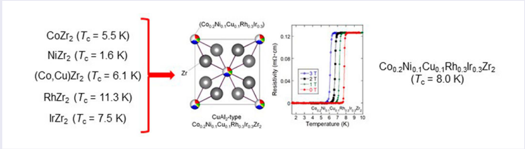
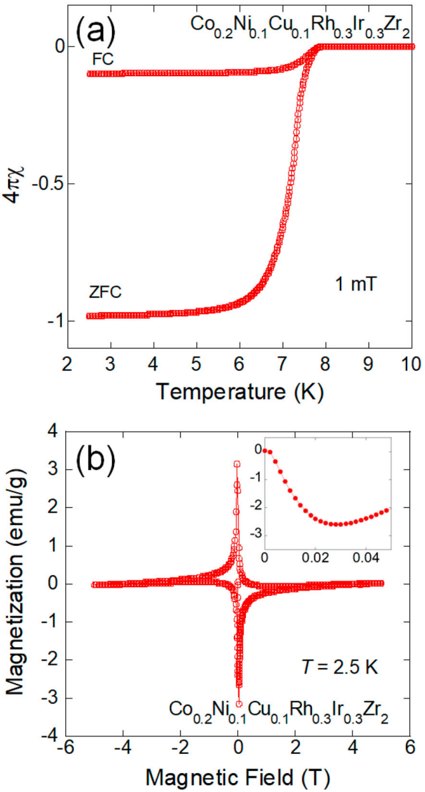
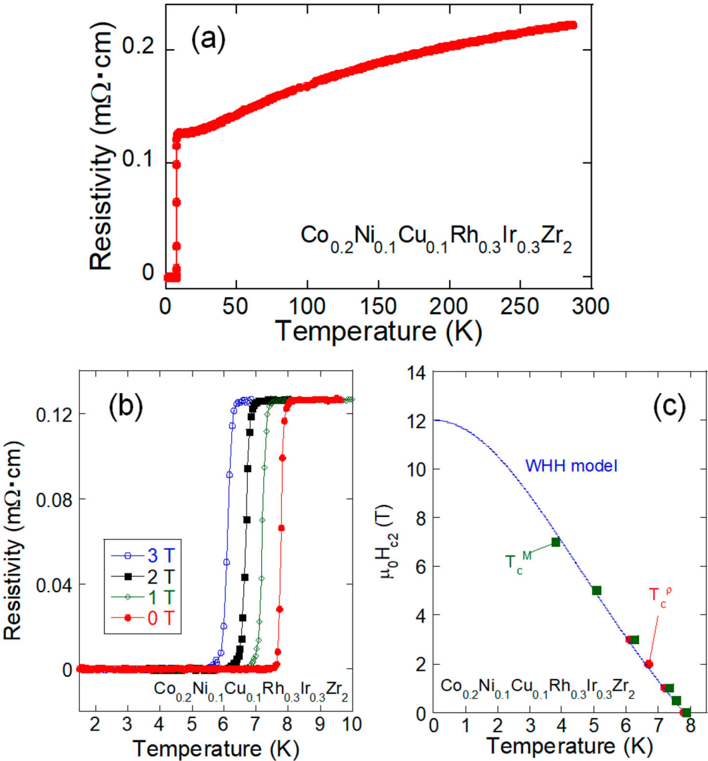
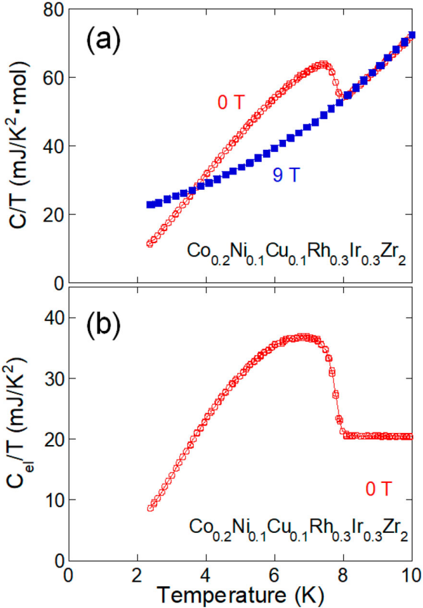
Research on high-entropy-alloy (HEA) superconductors is a growing field in material science. In this study, we explored new HEA-type superconductors and discovered a CuAl2-type superconductor Co0.2Ni0.1Cu0.1Rh0.3Ir0.3Zr2 with a HEA-type transition metal site. A superconducting transition was observed at 8.0 K after electrical resistivity, magnetization, and specific heat measurements. The bulk characteristics of the superconductivity were confirmed through the specific heat measurements. The discovery of superconductivity in HEA-type Co0.2Ni0.1Cu0.1Rh0.3Ir0.3Zr2 will provide a novel pathway to explore new HEA-type superconductors and investigate the relationship between the mixing entropy and superconductivity of HEA-type compounds.
Overview
The claims and statistics of this paper haven’t been checked yet.
Free: it reads the open-access text and checks the first 5 claims that cite a source we can check. Create a free account to check every claim.
Integrity signals
Registry
Cites
Statistics
Figures


Verification
Claims the paper makes
The claims and statistics of this paper haven’t been checked yet.
Free: it reads the open-access text and checks the first 5 claims that cite a source we can check. Create a free account to check every claim.
Claims other papers make about this one
Each is checked against this paper’s own text: does it say what the citing paper says it does?
The cited source says what the claim attributes to it.
In the citing paper
“High-entropy superconductivity is also found in layered structures 61 -64 , σ -type structures 65,66 , and CuAl2-type structures 67 .”
From Recent advances in high-entropy superconductors (2024) · cites this paper as [67]
Self-check
Percentages, sums and reported differences re-computed from the paper’s own numbers.
The self-check needs the paper’s full text.
Citations
Cites
Yeh, J. ‐., Chen, S. ‐., Lin, S. ‐., Gan, J. ‐., Chin, T. ‐., Shun, T. ‐., Tsau, C. ‐., & Chang, S. ‐. (2004) · Advanced Engineering Materials · doi:10.1002/adem.200300567 · Cited by 15,281
Bardeen, J., Cooper, L. N., & Schrieffer, J. R. (1957) · Physical Review · doi:10.1103/physrev.108.1175 · Cited by 13,213
VESTA: a three-dimensional visualization system for electronic and structural analysis
Momma, K., & Izumi, F. (2008) · Journal of Applied Crystallography · doi:10.1107/s0021889808012016 · Cited by 6,834 · cited 1×
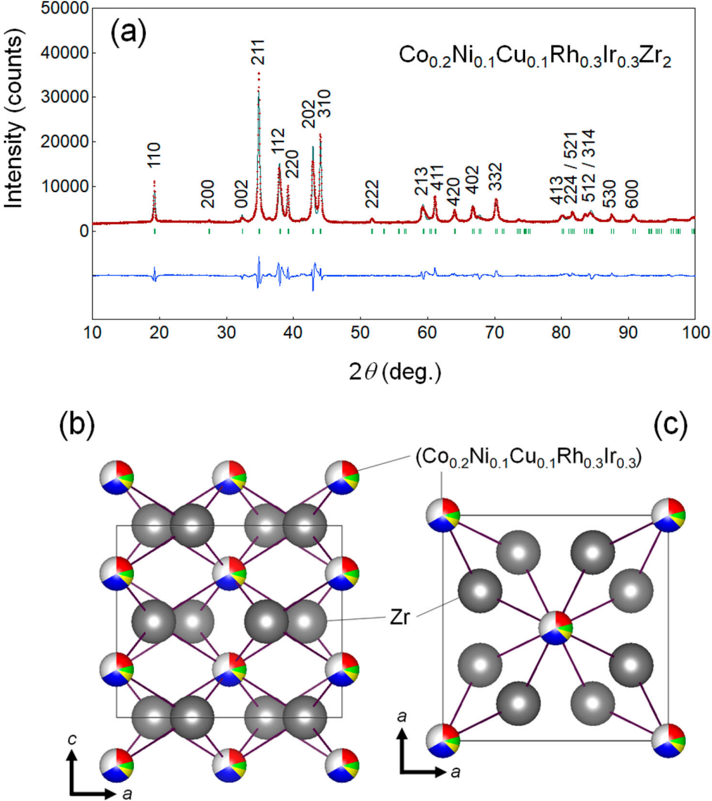
“The obtained XRD pattern was refined by the Rietveld method using RIETAN-FP [31], and schematic images of the refined crystal structure were depicted using VESTA [32].”
MethodHigh-Entropy Alloys: A Critical Review
Tsai, M.-H., & Yeh, J.-W. (2014) · Materials Research Letters · doi:10.1080/21663831.2014.912690 · Cited by 3,477
Werthamer, N. R., Helfand, E., & Hohenberg, P. C. (1966) · Physical Review · doi:10.1103/physrev.147.295 · Cited by 3,201 · cited 1×
“Using the WHH model (Werthamer-Helfand-Hohenberg model) [34], which is applicable for a dirty-limit type-II superconductor, the μ0Hc2(0) was estimated as 12 T.”
MethodThree-Dimensional Visualization in Powder Diffraction
Izumi, F., & Momma, K. (2007) · Solid State Phenomena · doi:10.4028/www.scientific.net/ssp.130.15 · Cited by 2,828 · cited 1×
“The obtained XRD pattern was refined by the Rietveld method using RIETAN-FP [31], and schematic images of the refined crystal structure were depicted using VESTA [32].”
MethodDou, S. X., Soltanian, S., Horvat, J., Wang, X. L., Zhou, S. H., Ionescu, M., Liu, H. K., Munroe, P., & Tomsic, M. (2002) · Applied Physics Letters · doi:10.1063/1.1517398 · Cited by 789 · cited 1×
“improving critical current density in some cases [5–7].”
BackgroundDiscovery of a Superconducting High-Entropy Alloy
Koželj, P., Vrtnik, S., Jelen, A., Jazbec, S., Jagličić, Z., Maiti, S., Feuerbacher, M., Steurer, W., & Dolinšek, J. (2014) · Physical Review Letters · doi:10.1103/physrevlett.113.107001 · Cited by 552 · cited 1×
“3 K [8,9].”
Atomic-Scale Sources and Mechanism of Nanoscale Electronic Disorder in Bi 2 Sr 2 CaCu 2 O 8+δ
McElroy, K., Lee, J., Slezak, J. A., Lee, D.-H., Eisaki, H., Uchida, S., & Davis, J. C. (2005) · Science · doi:10.1126/science.1113095 · Cited by 428 · cited 1×
“improving critical current density in some cases [5–7].”
BackgroundPhase separation in equiatomic AlCoCrFeNi high-entropy alloy
Manzoni, A., Daoud, H., Völkl, R., Glatzel, U., & Wanderka, N. (2013) · Ultramicroscopy · doi:10.1016/j.ultramic.2012.12.015 · Cited by 385 · cited 1×
“In a HEA, five or more mixed elements are sometimes distributed randomly, and mixing elements sometimes results in the formation of nanoscale phase separations [3,4].”
Background
Cited by
High‐Entropy Alloys for Electrocatalysis: Design, Characterization, and Applications
Zhang, Y., Wang, D., & Wang, S. (2022) · Small · doi:10.1002/smll.202104339 · Cited by 296
Multifunctional high-entropy materials
Han, L., Zhu, S., Rao, Z., Scheu, C., Ponge, D., Ludwig, A., Zhang, H., Gutfleisch, O., Hahn, H., Li, Z., et al. (2024) · Nature Reviews Materials · doi:10.1038/s41578-024-00720-y · Cited by 231
High critical current density and high-tolerance superconductivity in high-entropy alloy thin films
Jung, S.-G., Han, Y., Kim, J. H., Hidayati, R., Rhyee, J.-S., Lee, J. M., Kang, W. N., Choi, W. S., Jeon, H.-R., Suk, J., et al. (2022) · Nature Communications · doi:10.1038/s41467-022-30912-5 · Cited by 92
Jarlöv, A., Zhu, Z., Ji, W., Gao, S., Hu, Z., Vivegananthan, P., Tian, Y., Kripalani, D. R., Fan, H., Seet, H. L., et al. (2024) · Materials Science and Engineering R Reports · doi:10.1016/j.mser.2024.100834 · Cited by 90
Synthesis of new high-entropy alloy-type Nb3 (Al, Sn, Ge, Ga, Si) superconductors
Yamashita, A., Matsuda, T. D., & Mizuguchi, Y. (2021) · Journal of Alloys and Compounds · doi:10.1016/j.jallcom.2021.159233 · Cited by 43
Self-citation
Metadata
- Authors
- Mizuguchi, Y., Kasem, M. R., & Matsuda, T. D.
- Affiliations
- Tokyo Metropolitan University (JP)
- Corresponding author
- Mizuguchi, Yoshikazu
- ORCID
- Matsuda, Tatsuma D.
- Venue
- Materials Research Letters
- Publisher
- Informa UK Limited
- Published
- 2020-12-20
- Volume
- 9
- Issue
- 3
- Pages
- 141-147
- ISSN
- 2166-3831 (ISSN-L)
- OpenAlex
- W3086948866
- Cited by
- 62
- References
- 34
- Citations by year
- 2026: 4 · 2025: 9 · 2024: 18 · 2023: 5 · 2022: 16 · 2021: 10
- FWCI
- 3.81
- Type
- journal article
- Language
- en
- Open access
- gold
- doi.org
- Licence
- Locations
- Materials Research Letters (publishedVersion, cc-by)
- arXiv (Cornell University) (submittedVersion)
- DOAJ (DOAJ: Directory of Open Access Journals) (submittedVersion, cc-by-sa)
- arXiv (Cornell University)
- Funders
- Japan Society for the Promotion of Science (18KK0076)
- Advanced Research Program under the Human Resources Funds of Tokyo (H31-1)
- Topics
- Physical Sciences › Engineering › Mechanical Engineering › High Entropy Alloys Studies
- Physical Sciences › Physics and Astronomy › Condensed Matter Physics › Physics of Superconductivity and Magnetism
- Physical Sciences › Materials Science › Electronic, Optical and Magnetic Materials › Heusler alloys: electronic and magnetic properties
- Keywords
- high-entropy alloys, superconductivity, entropy of mixing, superconducting transition, specific heat, electrical resistivity, magnetization, bulk superconductivity
About these checks
Registry, retraction, Cites and statistics results are computed, not judged, with one exception: a printed reference that no index lists is read once by a model before it counts as a citation error. Claims are extracted by a model and kept only when their quote appears verbatim in the text; each cited source is then checked, with a model’s help, for whether it says what the claim relies on. Those verdicts can be wrong — read the claim’s quote and the cited source before relying on one.
Statistics and arithmetic are recomputed, not judged.
Confidence bands are shown only for fields calibrated on our annotated test set. None is calibrated yet, so no band is shown.
What counts as a claim ›How we measure confidence ›How we check this ›
Are you an author, or do you see a problem with this page? Request a review
Data sources
Bibliographic data: Semantic Scholar, OpenAlex, Crossref.
Contains information from the Semantic Scholar Academic Graph Datasets, made available under the ODC Attribution License (ODC-BY 1.0).
Semantic Scholar’s data is described in: Kinney, R., et al. (2023). The Semantic Scholar Open Data Platform. arXiv:2301.10140.
