

Enterovirus D68-associated respiratory and neurological illness in Spain, 2014–2018
Open accessThe DOI matches its Crossref record; 41 of the 41 references it cites were found in a registry or an index.
Abstract
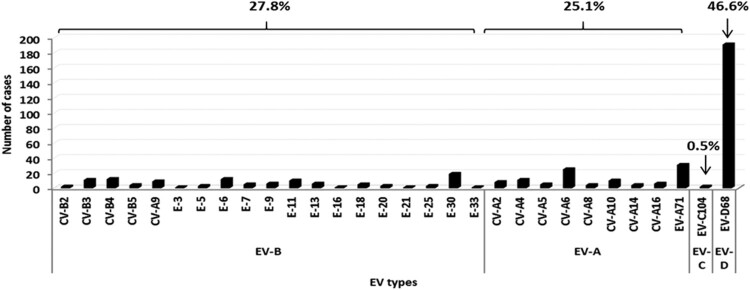
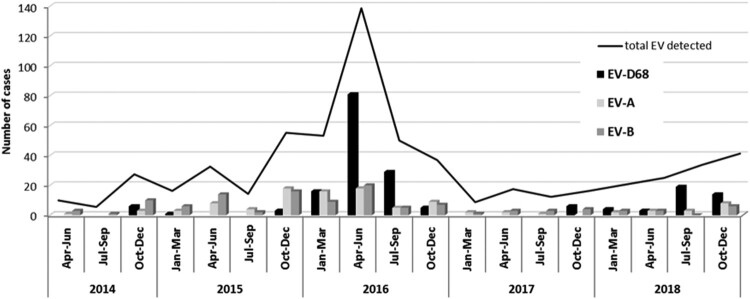
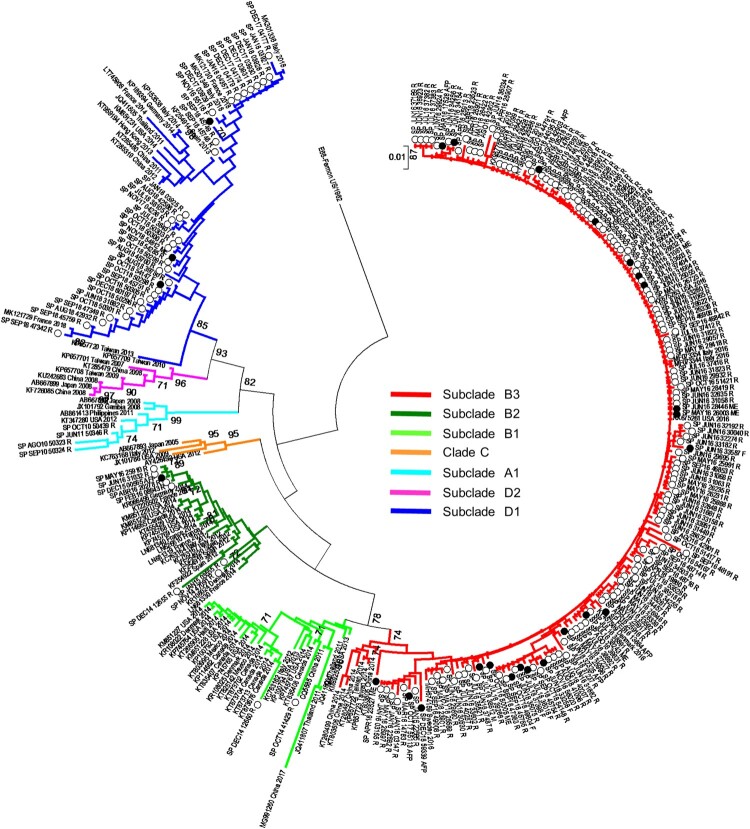
During 2014, enterovirus D68 (EV-D68) outbreaks were described globally, causing severe respiratory diseases in children and, in some cases, subsequent paralysis. In this study, the type characterization of enterovirus (EV) detected in respiratory illnesses and the epidemiology and clinical association of EV-D68 infections in Spain over a five-year period were described. A total of 546 EV-positive samples from hospitalized patients with respiratory infections were included. EV-D68 was the most frequently detected type (46.6%, 191/410 typed EV). Other EV from species A (25.1%), B (27.8%) and C (0.5%) were also identified. EV-D68 infections were more associated with bronchitis while EV-A/B types were more frequent in upper respiratory illness (p < 0.01). EV-D68 was also detected in patients with neurological symptoms (nine meningitis/meningoencephalitis and eight acute flaccid paralysis cases). Phylogenetic analysis of 3′-VP1 region showed most Spanish EV-D68 sequences from 2014 to 2016 belonged to subclades B2/B3, as other American and European strains circulating during the same period. However, those detected in 2017 and 2018 clustered to the emerged subclade D1. In summary, different EV can cause respiratory infections but EV-D68 was the most prevalent, with several strains circulating in Spain at least since 2014. Association between EV-D68 infection and neurological disease was also described.
Overview
The claims and statistics of this paper haven’t been checked yet.
Free: it reads the open-access text and checks the first 5 claims that cite a source we can check. Create a free account to check every claim.
Integrity signals
Registry
Cites
Statistics
Figures
Verification
Claims the paper makes
The claims and statistics of this paper haven’t been checked yet.
Free: it reads the open-access text and checks the first 5 claims that cite a source we can check. Create a free account to check every claim.
Claims other papers make about this one
Each is checked against this paper’s own text: does it say what the citing paper says it does?
The source backs part of the claim, not all of it — or backs it for a different population, condition or comparison.
In the citing paper
“Enterovirus D68 (EV-D68) is the most common member of the species Enterovirus D found to be associated with the development of aseptic meningitis. EV-D68 can cause CNS complications in children, commonly meningitis and flaccid paralysis [72].”
From Viral meningitis: an overview (2021) · cites this paper as [72]
Experimental — accuracy not yet measured
Self-check
Percentages, sums and reported differences re-computed from the paper’s own numbers.
The self-check needs the paper’s full text.
Citations
Cites
ICTV Virus Taxonomy Profile: Picornaviridae
Zell, R., Delwart, E., Gorbalenya, A. E., Hovi, T., King, A. M. Q., Knowles, N. J., Lindberg, A. M., Pallansch, M. A., Palmenberg, A. C., Reuter, G., et al. (2017) · Journal of General Virology · doi:10.1099/jgv.0.000911 · Cited by 631 · cited 1×
“Enterovirus within the Picornaviridae family [4].”
Greninger, A. L., Naccache, S. N., Messacar, K., Clayton, A., Yu, G., Somasekar, S., Federman, S., Stryke, D., Anderson, C., Yagi, S., et al. (2015) · The Lancet Infectious Diseases · doi:10.1016/s1473-3099(15)70093-9 · Cited by 390 · cited 3×
“In addition to respiratory infections, EV-D68 has been associated with neurological complications in recent years [11, [17] [18] [19] [20] [21] .”
BackgroundGlobal emergence of enterovirus D68: a systematic review
Holm-Hansen, C. C., Midgley, S. E., & Fischer, T. K. (2016) · The Lancet Infectious Diseases · doi:10.1016/s1473-3099(15)00543-5 · Cited by 347 · cited 5×
“EV-A and B are occasionally detected in respiratory samples and their involvement in the respiratory pathology is not as clear as in the case of EV-D68 and EV-C104, EV-C105 or EV-C109 [2, [5] [6] [7] [8] [9] [10] [11] [12] [13] [14] [15] [16] 31, 32] .”
BackgroundResultInfluentialA PROBABLE NEW HUMAN PICORNAVIRUS ASSOCIATED WITH RESPIRATORY DISEASE1
SCHIEBLE, J. H., FOX, V. L., & LENNETTE, E. H. (1967) · American Journal of Epidemiology · doi:10.1093/oxfordjournals.aje.a120693 · Cited by 345 · cited 1×
“Since the first isolation in 1962 [3], Enterovirus D68 (EV-D68) has been associated almost exclusively with respiratory diseases.”
BackgroundOberste, M. S., Maher, K., Schnurr, D., Flemister, M. R., Lovchik, J. C., Peters, H., Sessions, W., Kirk, C., Chatterjee, N., Fuller, S., et al. (2004) · Journal of General Virology · doi:10.1099/vir.0.79925-0 · Cited by 303 · cited 1×
“EVD68 has acid sensitivity and grows at lower optimal temperatures in some cell lines than other EV [5].”
BackgroundEnterovirus D68 and acute flaccid myelitis—evaluating the evidence for causality
Messacar, K., Asturias, E. J., Hixon, A. M., Van Leer-Buter, C., Niesters, H. G. M., Tyler, K. L., Abzug, M. J., & Dominguez, S. R. (2018) · The Lancet Infectious Diseases · doi:10.1016/s1473-3099(18)30094-x · Cited by 234 · cited 1×
“Regardless, the recent publication of a mouse model, in which mice inoculated with EV-D68 developed symptoms of myelitis, as well as several reports evaluating the evidence for a causal relationship supported this association [36] [37] [38] [39] .”
BackgroundWorldwide emergence of multiple clades of enterovirus 68
Tokarz, R., Firth, C., Madhi, S. A., Howie, S. R. C., Wu, W., Sall, A. A., Haq, S., Briese, T., & Lipkin, W. I. (2012) · Journal of General Virology · doi:10.1099/vir.0.043935-0 · Cited by 224 · cited 1×
“Spanish sequences from 2014 to 2016 belonged to the clade B, according to the classification previously described [7], and were genetically related to the”
Method(2011) · PubMed · Cited by 200
Rhinoviruses and Respiratory Enteroviruses: Not as Simple as ABC
Royston, L., & Tapparel, C. (2016) · Viruses · doi:10.3390/v8010016 · Cited by 196
A mouse model of paralytic myelitis caused by enterovirus D68
Hixon, A. M., Yu, G., Leser, J. S., Yagi, S., Clarke, P., Chiu, C. Y., & Tyler, K. L. (2017) · PLOS Pathogens · doi:10.1371/journal.ppat.1006199 · Cited by 185 · cited 1×
“genotypes are considered to have more neurotropic potential than A or C strains [30,36,37].”
Background
Research works printed but not linked: 1
- Pallansch MA, Oberste MS, Whitton JL. in DM. Knipe, PM. Howley, editors. Fields virology Vol. 1 Ch. 17. Philadelphia: Lippincott Williams & Wilkins; 2013. p. 490–530.
Cited by
Kohil, A., Jemmieh, S., Smatti, M. K., & Yassine, H. M. (2021) · Archives of Virology · doi:10.1007/s00705-020-04891-1 · Cited by 164
Midgley, S., Benschop, K., Dyrdak, R., Mirand, A., Bailly, J., Bierbaum, S., Buderus, S., Böttcher, S., Eis‐Hübinger, A., Hönemann, M., et al. (2020) · Eurosurveillance · doi:10.2807/1560-7917.es.2020.25.2.1900749 · Cited by 57
Fall, A., Kenmoe, S., Ebogo‐Belobo, J. T., Mbaga, D. S., Bowo‐Ngandji, A., Foe-Essomba, J. R., Tchatchouang, S., Atsama, M. A., Yéngué, J. F., Kenfack‐Momo, R., et al. (2022) · PLoS neglected tropical diseases · doi:10.1371/journal.pntd.0010073 · Cited by 45
“However, although constituted of four clades and five subclades, including clade A, clade B (subclades B1 to B3), clade C and clade D (subclades D1 to D2), recent studies reported that EV-D68 clade D1 is more likely to cause respiratory infections in adults than in children [26,96,115,150].”
de Araújo, J. C., Carvalho, A. P. A., Leal, C. D., Natividade, M. M. P., Borin, M. C., Guerra, A., Carobin, N. V., Sabino, A. D. P., Almada, M., Costa, M. C. M., et al. (2024) · Pathogens · doi:10.3390/pathogens13070589 · Cited by 31
Sridhar, A., Depla, J. A., Mulder, L., Karelehto, E., Brouwer, L., Kruiswijk, L., de Sá, R. V., Meijer, A., Evers, M. M., van Kuppeveld, F. J. M., et al. (2022) · Microbiology Spectrum · doi:10.1128/spectrum.01694-22 · Cited by 31
Martínez-López, N., Muñoz‐Almagro, C., Launes, C., Navascués, A., Imaz-Pérez, M., Reina, J., Romero‐Gómez, M. P., Calvo, C., Ruiz‐García, M., Megías, G., et al. (2021) · Viruses · doi:10.3390/v13050781 · Cited by 26
“EV Genotyping and Phylogenetic Analyses For EV type characterization, amplification of 3′-part of the VP1 gene was performed using conventional RT-nested PCR, specific for EV-A, EV-B, EV-C, and EV-D68, as previously reported [30,31], followed by sequencing and analysis of the sequences obtained (BLAST, http://blast.”
MethodSelf-citationRetrospective Study of the Upsurge of Enterovirus D68 Clade D1 among Adults (2014–2018)
Duval, M., Mirand, A., Lesens, O., Bay, J., Caillaud, D. M., Gallot, D., Lautrette, A., Montcouquiol, S., Schmidt, J., Egron, C., et al. (2021) · Viruses · doi:10.3390/v13081607 · Cited by 26
Al‐Qahtani, S. M., Shati, A. A., Alqahtani, Y. A., & Ali, A. S. (2022) · Frontiers in Pediatrics · doi:10.3389/fped.2022.923125 · Cited by 39
“For example, EV71 and EV68 subtypes were reported to be responsible for the most severe neurological disorder and outcomes among children’s populations (27, 30, 31, 163).”
Backgroundde Ceano-Vivas, M., García, M. L., Velázquez, A., Martín del Valle, F., Menasalvas, A., Cilla, A., Epalza, C., Romero, M. P., Cabrerizo, M., & Calvo, C. (2021) · Frontiers in Pediatrics · doi:10.3389/fped.2021.719119 · Cited by 22
Self-citationToczyłowski, K., Wieczorek, M., Bojkiewicz, E., Wietlicka-Piszcz, M., Gad, B., & Sulik, A. (2020) · Viruses · doi:10.3390/v12080893 · Cited by 41
“Enterovirus D68 has also been detected in children with aseptic meningitis [23].”
BackgroundIkuse, T., Aizawa, Y., Yamanaka, T., Habuka, R., Watanabe, K., Otsuka, T., & Saitoh, A. (2020) · The Pediatric Infectious Disease Journal · doi:10.1097/inf.0000000000002889 · Cited by 19
Leser, J. S., Frost, J., Wilson, C. J., Rudy, M. J., Clarke, P., & Tyler, K. L. (2024) · Journal of Virology · doi:10.1128/jvi.00397-24 · Cited by 18
“Similar large outbreaks of EV-D68 respiratory infection that were associated with AFM or neurologic complications also occurred in 2014 in Canada, Argentina, Norway, Netherlands, France, Germany, and Taiwan (18–25) and 2016 and 2018 in the US (26, 27) and elsewhere (22, 23, 28–32).”
BackgroundEnteroviruses in Respiratory Samples from Paediatric Patients of a Tertiary Care Hospital in Germany
Baertl, S., Pietsch, C., Maier, M., Hönemann, M., Bergs, S., & Liebert, U. G. (2021) · Viruses · doi:10.3390/v13050882 · Cited by 23
“Consistent with previous studies [13,23,28,39], EV-D68 was associated with severe obstructive bronchitis and pneumonia, which are characterised by higher rates of oxygen demand.”
BackgroundResultMapping Attenuation Determinants in Enterovirus-D68
Yeh, M. T., Capponi, S., Catching, A., Bianco, S., & Andino, R. (2020) · Viruses · doi:10.3390/v12080867 · Cited by 16
Penela‐Sánchez, D., González-de-Audicana, J., Armero, G., Henares, D., Esteva, C., de Sevilla, M. F., Ricart, S., Jordán, I., Brotons, P., Cabrerizo, M., et al. (2021) · Viruses · doi:10.3390/v13102059 · Cited by 18
“The fact that no EV-D68 species was detected could be due to the epidemiologic circulation pattern of this EV type, which alternates years of high incidence with years of low circulation [35].”
BackgroundSelf-citationEnterovirus D68 VP3 Targets the Interferon Regulatory Factor 7 To Inhibit Type I Interferon Response
Kang, J. G., Huang, M., Li, J., Zhang, K., Zhu, C., Liu, S., Zhou, Z., Wang, T., & Wang, Z. (2023) · Microbiology Spectrum · doi:10.1128/spectrum.04138-22 · Cited by 16
“United States caused 1,153 infection cases with severe respiratory symptoms (6, 7).”
BackgroundFernández-García, M. D., Garcia‐Ibañez, N., Camacho, J., Gutierrez, A., García, L. S., Calvo, C., Moreno‐Docón, A., Menasalvas, A. I., Medina, A., Pérez-Ruiz, M., et al. (2024) · Eurosurveillance · doi:10.2807/1560-7917.es.2024.29.44.2400221 · Cited by 20
“One possible explanation is that if the viral genome was fragmented, the shorter fragment obtained by mNGS compared with the expected PCR amplification product [15], may have hindered proper primer binding, resulting in a negative PCR result.”
InfluentialSelf-citationSun, Z., Li, W., Xu, J., Ren, K., Gao, F., Jiang, Z., Ji, F., & Pan, D. (2020) · Journal of Proteome Research · doi:10.1021/acs.jproteome.0c00307 · Cited by 11
Square the Circle: Diversity of Viral Pathogens Causing Neuro-Infectious Diseases
Nurmukanova, V., Дмитриевна, М. А., Gordukova, M. A., & Shipulin, G. A. (2024) · Viruses · doi:10.3390/v16050787 · Cited by 10
Rmadi, Y., Elargoubi, A., González-Sanz, R., Mastouri, M., Cabrerizo, M., & Aouni, M. (2022) · Virology Journal · doi:10.1186/s12985-022-01770-w · Cited by 11
Self-citationdel Cuerpo, M., de Audicana, J. G., Fernández-García, M. D., Marín, P., Esteban, M., Español, M., Cabrerizo, M., & Rabella, N. (2022) · Microorganisms · doi:10.3390/microorganisms10030592 · Cited by 11
“We found that CSF is a good sample to detect E30 in aseptic meningitis (90% of the CSF samples studied were positive) compared to other genotypes found in cases of neurological involvement, such as EV-A71 [11,45,46] or EV-D68 [27] where they are barely detected.”
MethodResultInfluentialSelf-citationMengual‐Chuliá, B., Tamayo‐Trujillo, R., Mira‐Iglesias, A., Cano, L., Garcia, S., Ferrús, M. L., Puig‐Barberà, J., Díez‐Domingo, J., López‐Labrador, F. X., & the VAHNSI network (2024) · Journal of Medical Virology · doi:10.1002/jmv.29810 · Cited by 8
“13,14,17 In this study, A2/D1 and A2/D3 subclades were detected only in adult patients, a trend that had previously been observed in Spain, and other countries.”
InfluentialLi, Q., Chen, X., Ai, J., Li, L., Li, C., Zhu, Y., Wang, R., Duan, Y., Zhang, M., & Xie, Z. (2023) · Archives of Virology · doi:10.1007/s00705-023-05823-5 · Cited by 10
“Although EV-D68 has not been detected in cerebrospinal fluid (CSF) from AFP patients [8], it was detected in CSF from two patients with aseptic meningitis and meningoencephalitis in Spain [13].”
BackgroundHedrera-Fernández, A., Candela, R. C., Arceredillo, M. A., Garrido-Barbero, M., Moreno, D. C., Jamardo, A. S., Pérez-Poyato, M., Rodriguez-Fernandez, C., Guerra, P. D. V., Bermejo-Arnedo, I., et al. (2021) · Neuropediatrics · doi:10.1055/s-0041-1725008 · Cited by 7
Enterovirus characterized from cerebrospinal fluid in a cohort from the Eastern United States
Fall, A., Forman, M., Morris, C. P., Gniazdowski, V., Luo, C. H., Hanlon, A., Miller, H., Bergman, Y., & Mostafa, H. H. (2023) · Journal of Clinical Virology · doi:10.1016/j.jcv.2023.105401 · Cited by 28
Detections of rare enterovirus C105 linked to an emerging novel clade, Spain, 2019 to 2024
Fernández-García, M. D., Camacho, J., Díez‐Fuertes, F., de Pedro, E. R., Garcia‐Ibañez, N., Navascués, A., Berengua, C., Antequera, P., Ruiz‐García, M., Pastor-Fajardo, M. T., et al. (2025) · Eurosurveillance · doi:10.2807/1560-7917.es.2025.30.6.2500073 · Cited by 6
“Detection and genotyping methods at the EVL include reverse-transcription nested PCRs targeting the 5 ′ -untranslated region (UTR) and VP1, respectively, ats previously described [8-10], followed by Sanger sequencing and Basic Local Alignment Search Tool (BLAST) analysis.”
Self-citationEnterovirus D68 Sequence Variations and Pathogenicity: A Review
Zhu, Y., Wang, L., & Shen, J. (2026) · Viruses · doi:10.3390/v18010073 · Cited by 5
“Subclade D1 emerged in 2017–2018 and was associated with pediatric cases presenting neurological symptoms, including meningitis and AFM [13].”
Rojo‐Alba, S., González‐Alba, J. M., Martínez, Z. P., Varela, C. O., Álvarez, M. A. A., Fernández, P. R., Pérez, M. R., García, E. G., Boga, J. A., Melón, S., et al. (2024) · European Journal of Clinical Microbiology & Infectious Diseases · doi:10.1007/s10096-024-04970-0 · Cited by 5
Contemporary Enterovirus D68 strains show enhanced replication and translation at 37°CPreprint
Smith, B. D., & Pekosz, A. S. (2020) · bioRxiv (Cold Spring Harbor Laboratory) · doi:10.1101/2020.03.31.019380 · Cited by 6
Andrés, C., Prats‐Méndez, I., Midgley, S., Berginc, N., Gónzalez‐Sánchez, A., Johannesen, C. K., Antón, A., Nadal‐Barón, P., Fischer, T. K., Harvala, H., et al. (2026) · Emerging infectious diseases · doi:10.3201/eid3204.251022 · Cited by 6
“We subjected the partial viral protein (VP) 1 or the complete genome to sequencing for enterovirus typing ( 35 ) and genomic annotation of all enterovirus-positive speci - mens, as previously reported ( 1 – 3 , 33 , 36 – 38 ) ( Table 1).”
Das neue Verständnis pulmonaler Infektionen
Hörster, R., & Rupp, J. (2019) · Der Pneumologe · doi:10.1007/s10405-019-00291-8 · Cited by 3
First Detection of Enterovirus D68 in Korean Children, September 2022
Yun, K. W., Ahn, B., Choi, S. H., Kang, D., Kim, T. S., Lee, M., Park, K. U., & Choi, E. H. (2023) · Infection and Chemotherapy · doi:10.3947/ic.2023.0036 · Cited by 2
“In December 2018, Allplex replaced the Anyplex kit in SNUCH, and several reports indicated that the Allplex kit used in Europe could be used to detect EV-D68 on an EV panel [10-12].”
BackgroundMethodResultPruthvi, K., & Sundarakannan, R. (2024) · Interactions · doi:10.1007/s10751-024-02058-x · Cited by 1
“Furthermore, since pesticides, fertilizers, and the like are already employed in the growing of the primary crop, their usage is not necessary in the production of agro-residual fibers [7].”
Enterovirus D68 infection in children with acute lower respiratory tract infection in ChinaPreprint
Li, Q., Chen, X., Ai, J., Li, L., Li, C., Zhu, Y., Wang, R., Duan, Y., Zhang, M., & Xie, Z. (2022) · Research Square · doi:10.21203/rs.3.rs-1401303/v1
Enterovirus D68 infection in children with acute lower respiratory tract infection in ChinaPreprint
Li, Q., Chen, X., Ai, J., Li, L., Li, C., Zhu, Y., Wang, R., Duan, Y., Zhang, M., & Xie, Z. (2022) · Research Square · doi:10.21203/rs.3.rs-1401303/v2
Trends in Meningitis Prevalence and the Need for Molecular Diagnosis
Baig, M. S., Rizvi, A. H., Varma, S., Ghaus, K., Arzoo, A., Saloni, & Anas, M. (2025) · Medical virology · doi:10.1007/978-981-96-7097-0_8 · Cited by 1
Epidemiological and Clinical Characteristics of the Enterovirus D68 Outbreak in Spain in 2024
Camacho, J., Garcia‐Ibañez, N., Fernández-García, M. D., Biya, Y., de Pedro, E. R., Gutiérrez, A., Nieto, M. C., Ruiz-García, M. M., Pastor-Fajardo, M. T., Lagarejos, E., et al. (2026) · Journal of Medical Virology · doi:10.1002/jmv.70887
Self-citationEntérovirus D68 : analyse épidémiologique & génomique
Duval, M. (2022) · theses.fr (ABES) · doi:10.70675/d9667b88z28f8z4244zadb5z4bd1c24522e4 · Cited by 1
Progress in enterovirus D68-neutralizing antibodies and vaccines
Wang, L., & Shen, J. (2026) · Journal of Virology · doi:10.1128/jvi.00123-26
Metadata
- Authors
- González-Sanz, R., Taravillo, I., Reina, J., Navascués, A., Moreno-Docón, A., Aranzamendi, M., Romero, M. P., del Cuerpo, M., Pérez-González, C., Pérez-Castro, S., Otero, A., & Cabrerizo, M.
- Affiliations
- Instituto de Salud Carlos III (ES)
- Hospital Universitario Son Espases (ES)
- Complejo Hospitalario de Navarra (ES)
- Hospital Virgen de la Arrixaca
- BioCruces Health research Institute (ES)
- Hospital La Paz
- Hospital Santa Creu i Sant Pau
- Hospital Dr. Negrín
- Servicio de Microbiología, Complexo Hospitalario Universitario de Vigo (CHUVI)
- Corresponding author
- Cabrerizo, María
- Venue
- Emerging Microbes & Infections
- Publisher
- Informa UK Limited
- Published
- 2019-01
- Volume
- 8
- Issue
- 1
- Pages
- 1438-1444
- ISSN
- 2222-1751 (ISSN-L)
- PMC
- PMC6781473
- OpenAlex
- W2977608869
- Cited by
- 39
- References
- 41
- Citations by year
- 2026: 4 · 2025: 2 · 2024: 7 · 2023: 4 · 2022: 8 · 2021: 7 · 2020: 6 · 2019: 1
- FWCI
- 4.19
- Type
- journal article
- Language
- en
- Open access
- gold
- doi.org
- Locations
- Emerging Microbes & Infections (publishedVersion, cc-by)
- PubMed Central (publishedVersion, cc-by)
- PubMed (publishedVersion)
- Hispana (submittedVersion, cc-by)
- LA Referencia (Red Federada de Repositorios Institucionales de Publicaciones Científicas) (submittedVersion, cc-by-nc-sa)
- DOAJ (DOAJ: Directory of Open Access Journals) (submittedVersion)
- Docusalut (Conselleria de Salut i Consum del Govern de les Illes Balears) (submittedVersion, cc-by)
- RUNA. Repositorio Institucional del Sergas (Servicio Gallego de Salud (SERGAS)) (submittedVersion, cc-by-nc)
- Funders
- Instituto de Salud Carlos III (PI15CIII/00020)
- Topics
- Health Sciences › Medicine › Epidemiology › Respiratory viral infections research
- Health Sciences › Medicine › Infectious Diseases › Viral Infections and Immunology Research
- Health Sciences › Medicine › Pediatrics, Perinatology and Child Health › Literature Analysis and Criticism
- Keywords
- enterovirus D68, respiratory infections, neurological complications, acute flaccid paralysis, meningitis, meningoencephalitis, bronchitis, enterovirus typing, phylogenetic analysis, VP1 gene, Spain
- MeSH terms
- Adult, Aged, Aged, 80 and over, Bronchitis, Child, Preschool, Enterovirus Infections, Hospitalization, Humans, Infant, Meningitis, Middle Aged, Nervous System Diseases, Paralysis, Phylogeny, Respiratory Tract Infections, Spain, Enterovirus D, Human
About these checks
Registry, retraction, Cites and statistics results are computed, not judged, with one exception: a printed reference that no index lists is read once by a model before it counts as a citation error. Claims are extracted by a model and kept only when their quote appears verbatim in the text; each cited source is then checked, with a model’s help, for whether it says what the claim relies on. Those verdicts can be wrong — read the claim’s quote and the cited source before relying on one.
Statistics and arithmetic are recomputed, not judged.
Confidence bands are shown only for fields calibrated on our annotated test set. None is calibrated yet, so no band is shown.
What counts as a claim ›How we measure confidence ›How we check this ›
Are you an author, or do you see a problem with this page? Request a review
Data sources
Bibliographic data: Semantic Scholar, OpenAlex, Crossref.
Contains information from the Semantic Scholar Academic Graph Datasets, made available under the ODC Attribution License (ODC-BY 1.0).
Semantic Scholar’s data is described in: Kinney, R., et al. (2023). The Semantic Scholar Open Data Platform. arXiv:2301.10140.
