

Enterovirus D68-associated respiratory and neurological illness in Spain, 2014–2018
Open accessThe DOI matches its Crossref record; 41 of the 41 references it cites were found in a registry or an index.
Abstract
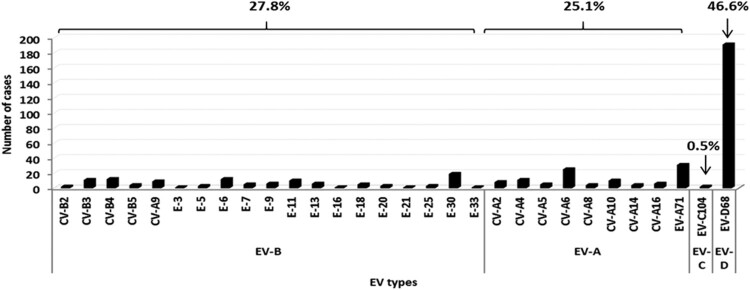
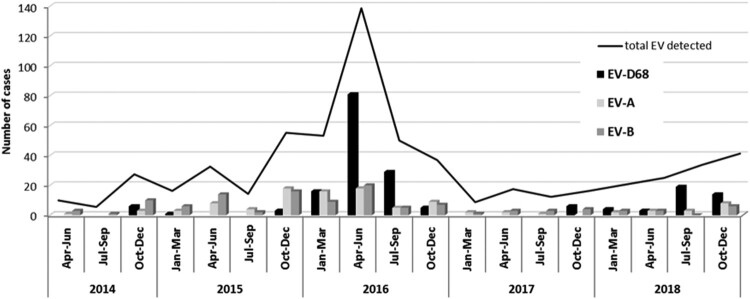
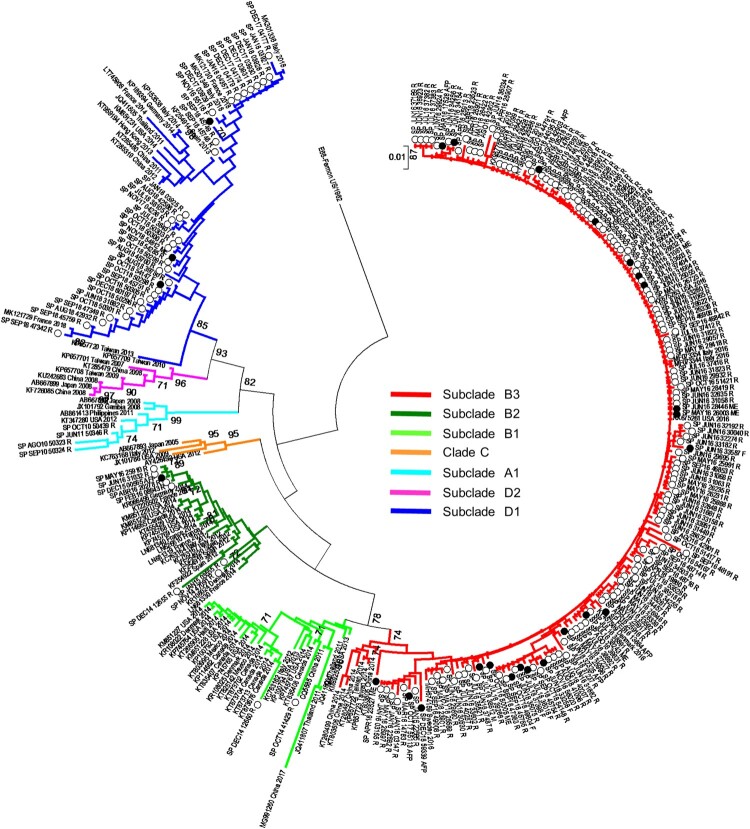
During 2014, enterovirus D68 (EV-D68) outbreaks were described globally, causing severe respiratory diseases in children and, in some cases, subsequent paralysis. In this study, the type characterization of enterovirus (EV) detected in respiratory illnesses and the epidemiology and clinical association of EV-D68 infections in Spain over a five-year period were described. A total of 546 EV-positive samples from hospitalized patients with respiratory infections were included. EV-D68 was the most frequently detected type (46.6%, 191/410 typed EV). Other EV from species A (25.1%), B (27.8%) and C (0.5%) were also identified. EV-D68 infections were more associated with bronchitis while EV-A/B types were more frequent in upper respiratory illness (p < 0.01). EV-D68 was also detected in patients with neurological symptoms (nine meningitis/meningoencephalitis and eight acute flaccid paralysis cases). Phylogenetic analysis of 3′-VP1 region showed most Spanish EV-D68 sequences from 2014 to 2016 belonged to subclades B2/B3, as other American and European strains circulating during the same period. However, those detected in 2017 and 2018 clustered to the emerged subclade D1. In summary, different EV can cause respiratory infections but EV-D68 was the most prevalent, with several strains circulating in Spain at least since 2014. Association between EV-D68 infection and neurological disease was also described.
Overview
The claims and statistics of this paper haven’t been checked yet.
Free: it reads the open-access text and checks the first 5 claims that cite a source we can check. Create a free account to check every claim.
Integrity signals
Registry
Cites
Statistics
Figures
Verification
Claims the paper makes
The claims and statistics of this paper haven’t been checked yet.
Free: it reads the open-access text and checks the first 5 claims that cite a source we can check. Create a free account to check every claim.
Claims other papers make about this one
Each is checked against this paper’s own text: does it say what the citing paper says it does?
The source backs part of the claim, not all of it — or backs it for a different population, condition or comparison.
In the citing paper
“Enterovirus D68 (EV-D68) is the most common member of the species Enterovirus D found to be associated with the development of aseptic meningitis. EV-D68 can cause CNS complications in children, commonly meningitis and flaccid paralysis [72].”
From Viral meningitis: an overview (2021) · cites this paper as [72]
Experimental — accuracy not yet measured
Self-check
Percentages, sums and reported differences re-computed from the paper’s own numbers.
The self-check needs the paper’s full text.
Citations
Cites
ICTV Virus Taxonomy Profile: Picornaviridae
Zell, R., Delwart, E., Gorbalenya, A. E., Hovi, T., King, A. M. Q., Knowles, N. J., Lindberg, A. M., Pallansch, M. A., Palmenberg, A. C., Reuter, G., et al. (2017) · Journal of General Virology · doi:10.1099/jgv.0.000911 · Cited by 631 · cited 1×
“Enterovirus within the Picornaviridae family [4].”
Greninger, A. L., Naccache, S. N., Messacar, K., Clayton, A., Yu, G., Somasekar, S., Federman, S., Stryke, D., Anderson, C., Yagi, S., et al. (2015) · The Lancet Infectious Diseases · doi:10.1016/s1473-3099(15)70093-9 · Cited by 390 · cited 3×
“In addition to respiratory infections, EV-D68 has been associated with neurological complications in recent years [11, [17] [18] [19] [20] [21] .”
BackgroundGlobal emergence of enterovirus D68: a systematic review
Holm-Hansen, C. C., Midgley, S. E., & Fischer, T. K. (2016) · The Lancet Infectious Diseases · doi:10.1016/s1473-3099(15)00543-5 · Cited by 347 · cited 5×
“EV-A and B are occasionally detected in respiratory samples and their involvement in the respiratory pathology is not as clear as in the case of EV-D68 and EV-C104, EV-C105 or EV-C109 [2, [5] [6] [7] [8] [9] [10] [11] [12] [13] [14] [15] [16] 31, 32] .”
BackgroundResultInfluentialA PROBABLE NEW HUMAN PICORNAVIRUS ASSOCIATED WITH RESPIRATORY DISEASE1
SCHIEBLE, J. H., FOX, V. L., & LENNETTE, E. H. (1967) · American Journal of Epidemiology · doi:10.1093/oxfordjournals.aje.a120693 · Cited by 345 · cited 1×
“Since the first isolation in 1962 [3], Enterovirus D68 (EV-D68) has been associated almost exclusively with respiratory diseases.”
BackgroundOberste, M. S., Maher, K., Schnurr, D., Flemister, M. R., Lovchik, J. C., Peters, H., Sessions, W., Kirk, C., Chatterjee, N., Fuller, S., et al. (2004) · Journal of General Virology · doi:10.1099/vir.0.79925-0 · Cited by 303 · cited 1×
“EVD68 has acid sensitivity and grows at lower optimal temperatures in some cell lines than other EV [5].”
BackgroundEnterovirus D68 and acute flaccid myelitis—evaluating the evidence for causality
Messacar, K., Asturias, E. J., Hixon, A. M., Van Leer-Buter, C., Niesters, H. G. M., Tyler, K. L., Abzug, M. J., & Dominguez, S. R. (2018) · The Lancet Infectious Diseases · doi:10.1016/s1473-3099(18)30094-x · Cited by 234 · cited 1×
“Regardless, the recent publication of a mouse model, in which mice inoculated with EV-D68 developed symptoms of myelitis, as well as several reports evaluating the evidence for a causal relationship supported this association [36] [37] [38] [39] .”
BackgroundWorldwide emergence of multiple clades of enterovirus 68
Tokarz, R., Firth, C., Madhi, S. A., Howie, S. R. C., Wu, W., Sall, A. A., Haq, S., Briese, T., & Lipkin, W. I. (2012) · Journal of General Virology · doi:10.1099/vir.0.043935-0 · Cited by 224 · cited 1×
“Spanish sequences from 2014 to 2016 belonged to the clade B, according to the classification previously described [7], and were genetically related to the”
Method(2011) · PubMed · Cited by 200
Rhinoviruses and Respiratory Enteroviruses: Not as Simple as ABC
Royston, L., & Tapparel, C. (2016) · Viruses · doi:10.3390/v8010016 · Cited by 196
A mouse model of paralytic myelitis caused by enterovirus D68
Hixon, A. M., Yu, G., Leser, J. S., Yagi, S., Clarke, P., Chiu, C. Y., & Tyler, K. L. (2017) · PLOS Pathogens · doi:10.1371/journal.ppat.1006199 · Cited by 185 · cited 1×
“genotypes are considered to have more neurotropic potential than A or C strains [30,36,37].”
BackgroundMeijer, A., van der Sanden, S., Snijders, B. E. P., Jaramillo-Gutierrez, G., Bont, L., van der Ent, C. K., Overduin, P., Jenny, S. L., Jusic, E., van der Avoort, H. G. A. M., et al. (2012) · Virology · doi:10.1016/j.virol.2011.11.021 · Cited by 180
Dyda, A., Stelzer‐Braid, S., Adam, D. C., Chughtai, A. A., & MacIntyre, C. R. (2018) · Eurosurveillance · doi:10.2807/1560-7917.es.2018.23.3.17-00310 · Cited by 137 · cited 1×
“Regardless, the recent publication of a mouse model, in which mice inoculated with EV-D68 developed symptoms of myelitis, as well as several reports evaluating the evidence for a causal relationship supported this association [36] [37] [38] [39] .”
BackgroundAcute flaccid paralysis following enterovirus D68 associated pneumonia, France, 2014
Lang, M., Mirand, A., Savy, N., Henquell, C., Maridet, S., Perignon, R., Labbé, A., & Peigue-Lafeuille, H. (2014) · Eurosurveillance · doi:10.2807/1560-7917.es2014.19.44.20952 · Cited by 132
European surveillance for enterovirus D68 during the emerging North-American outbreak in 2014
Poelman, R., Schuffenecker, I., Van Leer-Buter, C., Josset, L., Niesters, H. G. M., & Lina, B. (2015) · Journal of Clinical Virology · doi:10.1016/j.jcv.2015.07.296 · Cited by 130
2014 outbreak of enterovirus D68 in North America
Messacar, K., Abzug, M. J., & Dominguez, S. R. (2016) · Journal of Medical Virology · doi:10.1002/jmv.24410 · Cited by 111 · cited 4×
“Since 2014, an increasing number of EV-D68 outbreaks associated with severe respiratory diseases, mainly in children, have been occurring in different countries, first in the US and Canada, followed by Europe and Asia.”
BackgroundInfluentialBrown, D. M., Hixon, A. M., Oldfield, L. M., Zhang, Y., Novotny, M., Wang, W., Das, S. R., Shabman, R. S., Tyler, K. L., & Scheuermann, R. H. (2018) · mBio · doi:10.1128/mbio.01954-18 · Cited by 105 · cited 1×
“Regardless, the recent publication of a mouse model, in which mice inoculated with EV-D68 developed symptoms of myelitis, as well as several reports evaluating the evidence for a causal relationship supported this association [36] [37] [38] [39] .”
BackgroundPoelman, R., Schölvinck, E. H., Borger, R., Niesters, H. G. M., & van Leer-Buter, C. (2015) · Journal of Clinical Virology · doi:10.1016/j.jcv.2014.11.011 · Cited by 101 · cited 3×
“Since 2014, surveillance of EV-D68 infections is recommended and several studies have been published in Europe and other parts of the world regarding EV-D68 circulation, some reflecting an increase in detection in recent years [12] [13] [14] [15] [16] .”
BackgroundCabrerizo, M., Echevarria, J. E., González, I., de Miguel, T., & Trallero, G. (2008) · Journal of Medical Virology · doi:10.1002/jmv.21197 · Cited by 95
Self-citationPfeiffer, H. C., Bragstad, K., Skram, M. K., Dahl, H., Knudsen, P. K., Chawla, M. S., Holberg-Petersen, M., Vainio, K., Dudman, S. G., Kran, A. M., et al. (2015) · Eurosurveillance · doi:10.2807/1560-7917.es2015.20.10.21062 · Cited by 94
Outbreak of enterovirus D68 of the new B3 lineage in Stockholm, Sweden, August to September 2016
Dyrdak, R., Grabbe, M., Hammas, B., Ekwall, J., Hansson, K. E., Luthander, J., Naucler, P., Reinius, H., Rotzén-Östlund, M., & Albert, J. (2016) · Eurosurveillance · doi:10.2807/1560-7917.es.2016.21.46.30403 · Cited by 90 · cited 2×
“Similar results have been obtained with other studies [34,35], suggesting that all the 2016 outbreaks would be Table 2.”
BackgroundResultUpsurge of Enterovirus D68, the Netherlands, 2016
Knoester, M., Schölvinck, E. H., Poelman, R., Smit, S., Vermont, C. L., Niesters, H. G. M., & Van Leer-Buter, C. C. (2017) · Emerging Infectious Diseases · doi:10.3201/eid2301.161313 · Cited by 86
Casas, I., Pozo, F., Trallero, G., Echevarr�a, J. M., & Tenorio, A. (1999) · Journal of Medical Virology · doi:10.1002/(sici)1096-9071(199902)57:2<145::aid-jmv10>3.0.co;2-n · Cited by 75 · cited 1×
“RV was identified in 41 samples and in the remaining 95 untyped EV, the presence of EV-D68 was excluded by using a RTnested PCR in 5´-non-coding region of the EV genome [27] and subsequent sequencing.”
MethodMolecular evolution and the global reemergence of enterovirus D68 by genome-wide analysis
Gong, Y., Yang, S., Shih, S., Huang, Y., Chang, P.-Y., Huang, C., Kao, K., Hu, H., Liu, Y., & Tsao, K. (2016) · Medicine · doi:10.1097/md.0000000000004416 · Cited by 66 · cited 2×
“However, most of the EV-D68 sequences from 2017 and 2018 (35/51, 68.6%) clustered in the recently described subclade D1 [28] [29] [30] .”
BackgroundResultInfluentialEmergence of enterovirus D68 in Denmark, June 2014 to February 2015
Midgley, S. E., Christiansen, C. B., Poulsen, M. W., Hansen, C. H., & Fischer, T. K. (2015) · Eurosurveillance · doi:10.2807/1560-7917.es2015.20.17.21105 · Cited by 62
Ruggieri, V. L., Paz, M. I., Peretti, M. G., Rugilo, C., Bologna, R., Freire, C., Vergel, S., & Savransky, A. (2017) · European Journal of Paediatric Neurology · doi:10.1016/j.ejpn.2017.07.008 · Cited by 60
Midgley, S., Benschop, K., Dyrdak, R., Mirand, A., Bailly, J., Bierbaum, S., Buderus, S., Böttcher, S., Eis‐Hübinger, A., Hönemann, M., et al. (2020) · Eurosurveillance · doi:10.2807/1560-7917.es.2020.25.2.1900749 · Cited by 57
Emergence of enterovirus D68 clade D1, France, August to November 2018
Bal, A., Sabatier, M., Wirth, T., Coste‐Burel, M., Lazrek, M., Stéfic, K., Brengel‐Pesce, K., Morfin, F., Lina, B., Schuffenecker, I., et al. (2019) · Eurosurveillance · doi:10.2807/1560-7917.es.2019.24.3.1800699 · Cited by 50
Pellegrinelli, L., Giardina, F., Lunghi, G., Renteria, S. U., Greco, L., Fratini, A., Galli, C., Piralla, A., Binda, S., Pariani, E., et al. (2019) · Eurosurveillance · doi:10.2807/1560-7917.es.2018.24.7.1900090 · Cited by 43
van Leer‐Buter, C., Poelman, R., Borger, R., & Niesters, H. G. M. (2016) · Journal of Clinical Microbiology · doi:10.1128/jcm.00207-16 · Cited by 41
Williams, C. J., Thomas, R. H., Pickersgill, T. P., Lyons, M., Lowe, G., Stiff, R. E., Moore, C., Jones, R., Howe, R. A., Brunt, H., et al. (2016) · Eurosurveillance · doi:10.2807/1560-7917.es.2016.21.4.30119 · Cited by 39
Piralla, A., Principi, N., Ruggiero, L., Girello, A., Giardina, F., Sando, E. D., Caimmi, S. M. E., Bianchini, S., Marseglia, G. L., Lunghi, G., et al. (2018) · Journal of Clinical Virology · doi:10.1016/j.jcv.2018.01.005 · Cited by 38 · cited 1×
“Similar results have been obtained with other studies [34,35], suggesting that all the 2016 outbreaks would be Table 2.”
ResultCabrerizo, M., García-Iñiguez, J. P., Munell, F., Amado, A., Madurga-Revilla, P., Rodrigo, C., Pérez, S., Martínez-Sapiña, A., Antón, A., Suárez, G., et al. (2017) · Pediatric Infectious Disease Journal · doi:10.1097/inf.0000000000001668 · Cited by 37
Self-citationEnterovirus Genotype EV-104 in Humans, Italy, 2008–2009
Piralla, A., Rovida, F., Baldanti, F., & Gerna, G. (2010) · Emerging infectious diseases · doi:10.3201/eid1606.091533 · Cited by 37
Molecular Epidemiology of Enterovirus D68 from 2013 to 2014 in Philippines
Furuse, Y., Chaimongkol, N., Okamoto, M., Imamura, T., Saito, M., Tamaki, R., Saito, M., Lupisan, S., & Oshitani, H. (2015) · Journal of Clinical Microbiology · doi:10.1128/jcm.03362-14 · Cited by 33 · cited 3×
“Since 2014, surveillance of EV-D68 infections is recommended and several studies have been published in Europe and other parts of the world regarding EV-D68 circulation, some reflecting an increase in detection in recent years [12] [13] [14] [15] [16] .”
BackgroundGimferrer, L., Campins, M., Codina, M. G., Esperalba, J., Martín, C., Fuentes, F. J., Pumarola, T., & Antón, A. (2015) · Enfermedades Infecciosas y Microbiología Clínica · doi:10.1016/j.eimc.2015.01.008 · Cited by 31
Respiratory Infections by Enterovirus D68 in Outpatients and Inpatients Spanish Children
Calvo, C., Cuevas, M. T., Pozo, F., García‐García, M. L., Molinero, M., Calderón, A., González-Esguevillas, M., Pérez‐Sautu, U., & Casas, I. (2015) · The Pediatric Infectious Disease Journal · doi:10.1097/inf.0000000000000908 · Cited by 23 · cited 1×
“Regarding respiratory diseases, in our country most of detected EV were not usually characterized, and the first reports of EV-D68 detection were published in 2015 [22] [23] [24] .”
BackgroundDetection of Enterovirus D68 in Canadian Laboratories
Hatchette, T. F., Drews, S. J., Grudeski, E., Booth, T. F., Martineau, C., Dust, K., Garceau, R., Gubbay, J. B., Karnauchow, T., Krajden, M., et al. (2015) · Journal of Clinical Microbiology · doi:10.1128/jcm.03686-14 · Cited by 22 · cited 3×
“Moreover, there was a significant increase of cases with neurological complications after the respiratory episode, mainly acute flaccid myelitis [11] .”
BackgroundLaunes, C., Armero, G., Antón, A., Hernández, L., Gimferrer, L., Cisneros, C., Jordán, I., & Muñoz‐Almagro, C. (2015) · Clinical Microbiology and Infection · doi:10.1016/j.cmi.2015.04.021 · Cited by 21
Imamura, T., Suzuki, A. K., Meijer, A., Niesters, H. G. M., Rahamat-Langendoen, J. C., Lojo, J., Hodinka, R. L., Coffin, S. E., Ostroff, S. M., Kraft, C. S., et al. (2011) · University of Groningen research database (University of Groningen / Centre for Information Technology) · Cited by 15
Time to overcome pretreatment HIV drug resistance
Yerly, S., & Calmy, A. (2017) · The Lancet Infectious Diseases · doi:10.1016/s1473-3099(17)30709-0 · Cited by 8
Das neue Verständnis pulmonaler Infektionen
Hörster, R., & Rupp, J. (2019) · Der Pneumologe · doi:10.1007/s10405-019-00291-8 · Cited by 3
Research works printed but not linked: 1
- Pallansch MA, Oberste MS, Whitton JL. in DM. Knipe, PM. Howley, editors. Fields virology Vol. 1 Ch. 17. Philadelphia: Lippincott Williams & Wilkins; 2013. p. 490–530.
Cited by
Kohil, A., Jemmieh, S., Smatti, M. K., & Yassine, H. M. (2021) · Archives of Virology · doi:10.1007/s00705-020-04891-1 · Cited by 164
Midgley, S., Benschop, K., Dyrdak, R., Mirand, A., Bailly, J., Bierbaum, S., Buderus, S., Böttcher, S., Eis‐Hübinger, A., Hönemann, M., et al. (2020) · Eurosurveillance · doi:10.2807/1560-7917.es.2020.25.2.1900749 · Cited by 57
Fall, A., Kenmoe, S., Ebogo‐Belobo, J. T., Mbaga, D. S., Bowo‐Ngandji, A., Foe-Essomba, J. R., Tchatchouang, S., Atsama, M. A., Yéngué, J. F., Kenfack‐Momo, R., et al. (2022) · PLoS neglected tropical diseases · doi:10.1371/journal.pntd.0010073 · Cited by 45
“However, although constituted of four clades and five subclades, including clade A, clade B (subclades B1 to B3), clade C and clade D (subclades D1 to D2), recent studies reported that EV-D68 clade D1 is more likely to cause respiratory infections in adults than in children [26,96,115,150].”
de Araújo, J. C., Carvalho, A. P. A., Leal, C. D., Natividade, M. M. P., Borin, M. C., Guerra, A., Carobin, N. V., Sabino, A. D. P., Almada, M., Costa, M. C. M., et al. (2024) · Pathogens · doi:10.3390/pathogens13070589 · Cited by 31
Sridhar, A., Depla, J. A., Mulder, L., Karelehto, E., Brouwer, L., Kruiswijk, L., de Sá, R. V., Meijer, A., Evers, M. M., van Kuppeveld, F. J. M., et al. (2022) · Microbiology Spectrum · doi:10.1128/spectrum.01694-22 · Cited by 31
Metadata
- Authors
- González-Sanz, R., Taravillo, I., Reina, J., Navascués, A., Moreno-Docón, A., Aranzamendi, M., Romero, M. P., del Cuerpo, M., Pérez-González, C., Pérez-Castro, S., Otero, A., & Cabrerizo, M.
- Affiliations
- Instituto de Salud Carlos III (ES)
- Hospital Universitario Son Espases (ES)
- Complejo Hospitalario de Navarra (ES)
- Hospital Virgen de la Arrixaca
- BioCruces Health research Institute (ES)
- Hospital La Paz
- Hospital Santa Creu i Sant Pau
- Hospital Dr. Negrín
- Servicio de Microbiología, Complexo Hospitalario Universitario de Vigo (CHUVI)
- Corresponding author
- Cabrerizo, María
- Venue
- Emerging Microbes & Infections
- Publisher
- Informa UK Limited
- Published
- 2019-01
- Volume
- 8
- Issue
- 1
- Pages
- 1438-1444
- ISSN
- 2222-1751 (ISSN-L)
- PMC
- PMC6781473
- OpenAlex
- W2977608869
- Cited by
- 39
- References
- 41
- Citations by year
- 2026: 4 · 2025: 2 · 2024: 7 · 2023: 4 · 2022: 8 · 2021: 7 · 2020: 6 · 2019: 1
- FWCI
- 4.19
- Type
- journal article
- Language
- en
- Open access
- gold
- doi.org
- Locations
- Emerging Microbes & Infections (publishedVersion, cc-by)
- PubMed Central (publishedVersion, cc-by)
- PubMed (publishedVersion)
- Hispana (submittedVersion, cc-by)
- LA Referencia (Red Federada de Repositorios Institucionales de Publicaciones Científicas) (submittedVersion, cc-by-nc-sa)
- DOAJ (DOAJ: Directory of Open Access Journals) (submittedVersion)
- Docusalut (Conselleria de Salut i Consum del Govern de les Illes Balears) (submittedVersion, cc-by)
- RUNA. Repositorio Institucional del Sergas (Servicio Gallego de Salud (SERGAS)) (submittedVersion, cc-by-nc)
- Funders
- Instituto de Salud Carlos III (PI15CIII/00020)
- Topics
- Health Sciences › Medicine › Epidemiology › Respiratory viral infections research
- Health Sciences › Medicine › Infectious Diseases › Viral Infections and Immunology Research
- Health Sciences › Medicine › Pediatrics, Perinatology and Child Health › Literature Analysis and Criticism
- Keywords
- enterovirus D68, respiratory infections, neurological complications, acute flaccid paralysis, meningitis, meningoencephalitis, bronchitis, enterovirus typing, phylogenetic analysis, VP1 gene, Spain
- MeSH terms
- Adult, Aged, Aged, 80 and over, Bronchitis, Child, Preschool, Enterovirus Infections, Hospitalization, Humans, Infant, Meningitis, Middle Aged, Nervous System Diseases, Paralysis, Phylogeny, Respiratory Tract Infections, Spain, Enterovirus D, Human
About these checks
Registry, retraction, Cites and statistics results are computed, not judged, with one exception: a printed reference that no index lists is read once by a model before it counts as a citation error. Claims are extracted by a model and kept only when their quote appears verbatim in the text; each cited source is then checked, with a model’s help, for whether it says what the claim relies on. Those verdicts can be wrong — read the claim’s quote and the cited source before relying on one.
Statistics and arithmetic are recomputed, not judged.
Confidence bands are shown only for fields calibrated on our annotated test set. None is calibrated yet, so no band is shown.
What counts as a claim ›How we measure confidence ›How we check this ›
Are you an author, or do you see a problem with this page? Request a review
Data sources
Bibliographic data: Semantic Scholar, OpenAlex, Crossref.
Contains information from the Semantic Scholar Academic Graph Datasets, made available under the ODC Attribution License (ODC-BY 1.0).
Semantic Scholar’s data is described in: Kinney, R., et al. (2023). The Semantic Scholar Open Data Platform. arXiv:2301.10140.
