

The DOI matches its Crossref record; 3 of the 3 references it cites were found in a registry or an index.
SARS-CoV-2 Omicron variant shows less efficient replication and fusion activity when compared with Delta variant in TMPRSS2-expressed cells
Open accessAbstract
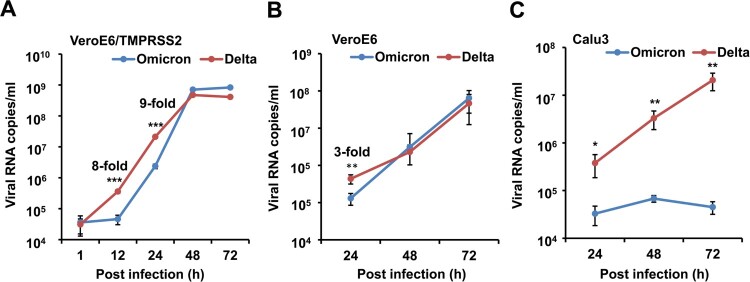
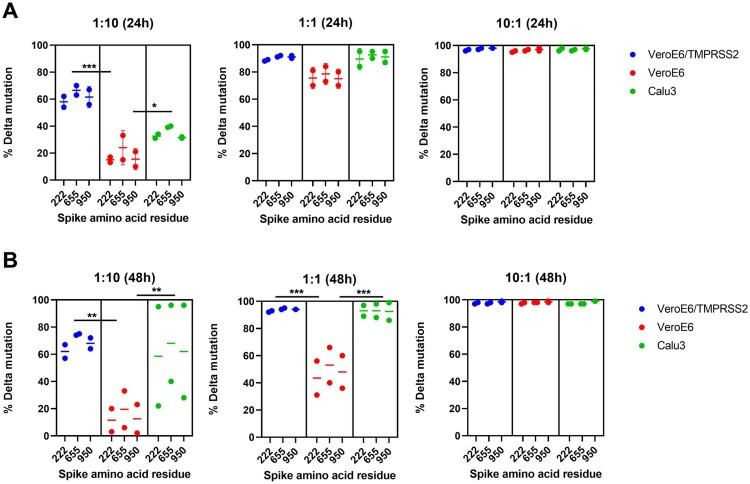
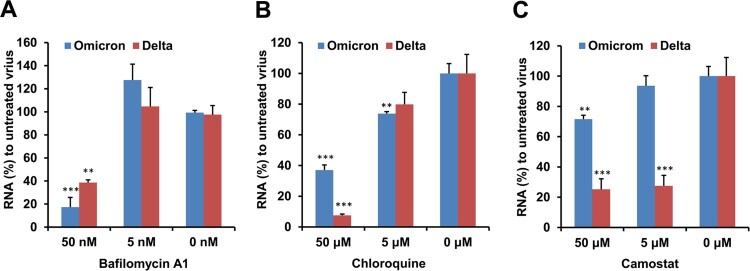
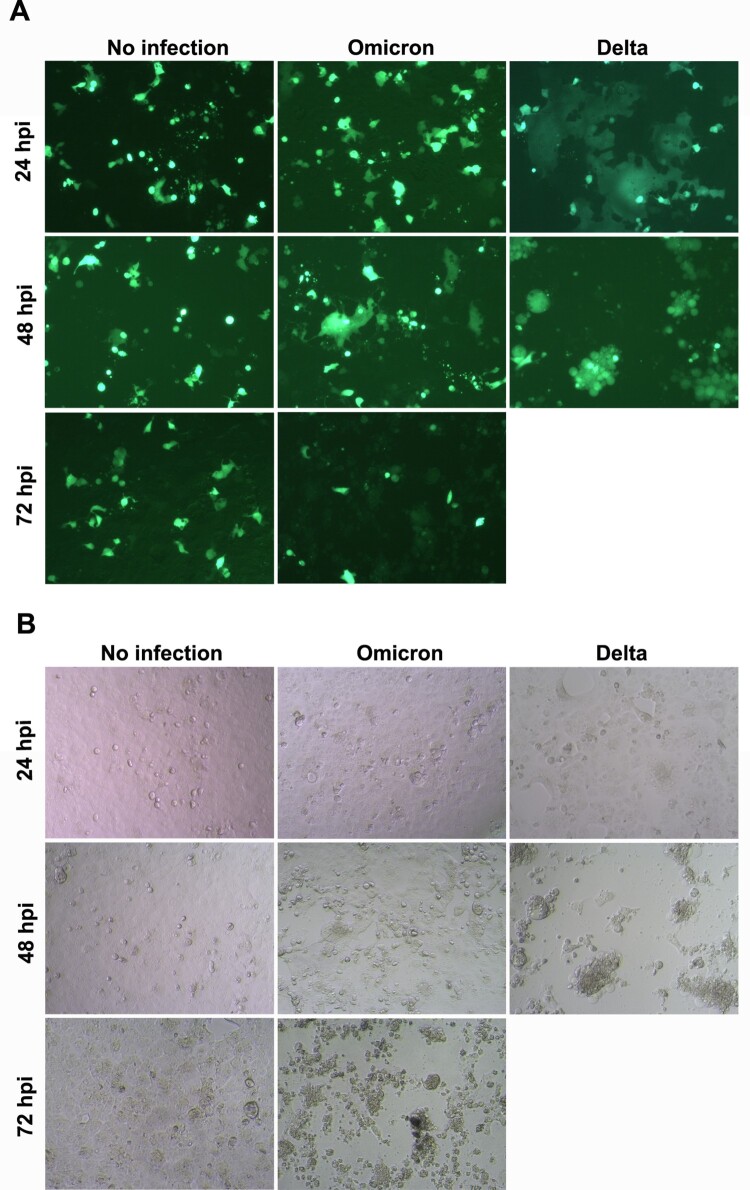
The novel SARS-CoV-2 Omicron variant (B.1.1.529), first found in early November 2021, has sparked considerable global concern and it has >50 mutations, many of which are known to affect transmissibility or cause immune escape. In this study, we sought to investigate the virological characteristics of the Omicron variant and compared it with the Delta variant which has dominated the world since mid-2021. Omicron variant replicated more slowly than the Delta variant in transmembrane serine protease 2 (TMPRSS2)-overexpressing VeroE6 (VeroE6/TMPRSS2) cells. Notably, the Delta variant replicated well in Calu3 cell line which has robust TMPRSS2 expression, while the Omicron variant replicated poorly in this cell line. Competition assay showed that Delta variant outcompeted Omicron variant in VeroE6/TMPRSS2 and Calu3 cells. To confirm the difference in entry pathway between the Omicron and Delta variants, we assessed the antiviral effect of bafilomycin A1, chloroquine (inhibiting endocytic pathway), and camostat (inhibiting TMPRSS2 pathway). Camostat potently inhibited the Delta variant but not the Omicron variant, while bafilomycin A1 and chloroquine could inhibit both Omicron and Delta variants. Moreover, the Omicron variant also showed weaker cell-cell fusion activity when compared with Delta variant in VeroE6/TMPRSS2 cells. Collectively, our results suggest that Omicron variant infection is not enhanced by TMPRSS2 but is largely mediated via the endocytic pathway. The difference in entry pathway between Omicron and Delta variants may have an implication on the clinical manifestations or disease severity.
Overview
The claims and statistics of this paper haven’t been checked yet.
Run the check — free, no account needed. It reads the open-access text and checks the sources it cites.
Integrity signals
Registry
Cites
Statistics
Figures
Verification
Claims the paper makes
The claims and statistics of this paper haven’t been checked yet.
Run the check — free, no account needed. It reads the open-access text and checks the sources it cites.
Claims other papers make about this one
Each is checked against this paper’s own text: does it say what the citing paper says it does?
The cited source says what the claim attributes to it.
In the citing paper
“suggesting entry selectivity of variants is associated with clinical manifestation [67].”
From Insights of Endocytosis Signaling in Health and Disease (2023) · cites this paper as [67]
The cited source says what the claim attributes to it.
In the citing paper
“Current evidence suggests that pharmacological inhibition of endocytic pathways potentially regressed replication of novel SARS-CoV-2 lineage B.1.1.529 (Omicron variant) in VeroE6/TMPRSS2 cell, suggesting entry selectivity of variants is associated with clinical manifestation [67].”
From Insights of Endocytosis Signaling in Health and Disease (2023) · cites this paper as [67]
Self-check
Percentages, sums and reported differences re-computed from the paper’s own numbers.
The self-check needs the paper’s full text.
Citations
Cites
Letko, M., Marzi, A., & Munster, V. (2020) · Nature Microbiology · doi:10.1038/s41564-020-0688-y · Cited by 3,109
HCA Lung Biological Network, Sungnak, W., Huang, N., Bécavin, C., Berg, M., Queen, R., Litvinukova, M., Talavera-López, C., Maatz, H., Reichart, D., et al. (2020) · Nature Medicine · doi:10.1038/s41591-020-0868-6 · Cited by 2,501
Increased risk of SARS-CoV-2 reinfection associated with emergence of Omicron in South Africa
Pulliam, J. R. C., van Schalkwyk, C., Govender, N., Gottberg, A. V., Cohen, C., Groome, M. J., Dushoff, J., Mlisana, K., & Moultrie, H. (2021) · doi:10.1101/2021.11.11.21266068 · Cited by 1,037
Research works printed but not linked: 23
- 10.1016/S1473-3099(20)30196-1 · DOI
- 10.1016/S0140-6736(20)30154-9 · DOI
- 10.1016/j.cell.2021.02.053 · DOI
- 10.1038/s41467-020-20457-w · DOI
- 10.1038/s41586-021-03925-1 · DOI
- 10.1016/j.cell.2020.02.052 · DOI · Paper page
- 10.1038/s41467-021-21825-w · DOI
- 10.1038/s42003-021-02640-x · DOI
- 10.1093/cid/ciaa1275 · DOI · Paper page
- 10.1016/j.ebiom.2021.103544 · DOI
- 10.1093/cid/ciab656 · DOI
- 10.1101/2021.11.11.21266068:2021.11.11.21266068 · DOI
- 10.1016/S0140-6736(21)02758-6 · DOI
- 10.1016/j.lanwpc.2021.100360 · DOI
- 10.1016/j.ebiom.2021.103643 · DOI
- 10.1038/s41580-021-00418-x · DOI · Paper page
- 10.1038/s41586-021-04266-9 · DOI
- 10.1038/s41564-021-00908-w · DOI
- 10.1016/j.celrep.2021.109825 · DOI
- 10.1126/science.abl9463 · DOI
- 10.1038/s41586-021-03491-6 · DOI
- 10.1371/journal.ppat.1009820 · DOI
- 10.1038/s41586-020-2575-3 · DOI
Cited by
Sorted by citations
SARS-CoV-2 Omicron is an immune escape variant with an altered cell entry pathway
Willett, B. J., Grove, J., MacLean, O. A., Wilkie, C., De Lorenzo, G., Furnon, W., Cantoni, D., Scott, S., Logan, N., Ashraf, S., et al. (2022) · Nature Microbiology · doi:10.1038/s41564-022-01143-7 · Cited by 785
Attenuated replication and pathogenicity of SARS-CoV-2 B.1.1.529 Omicron
Shuai, H., Chan, J. F.-W., Hu, B., Chai, Y., Yuen, T. T.-T., Yin, F., Huang, X., Yoon, C., Hu, J., Liu, H., et al. (2022) · Nature · doi:10.1038/s41586-022-04442-5 · Cited by 651
Self-citationSARS-CoV-2 Omicron variant: recent progress and future perspectives
Fan, Y., Li, X., Zhang, L., Wan, S., Zhang, L., & Zhou, F. (2022) · Signal Transduction and Targeted Therapy · doi:10.1038/s41392-022-00997-x · Cited by 599
Pathogenicity, transmissibility, and fitness of SARS-CoV-2 Omicron in Syrian hamsters
Yuan, S., Ye, Z.-W., Liang, R., Tang, K., Zhang, A. J., Lu, G., Ong, C. P., Man Poon, V. K., Chan, C. C.-S., Mok, B. W.-Y., et al. (2022) · Science · doi:10.1126/science.abn8939 · Cited by 191
Self-citationOrigin, virological features, immune evasion and intervention of SARS-CoV-2 Omicron sublineages
Xia, S., Wang, L., Zhu, Y., Lu, L., & Jiang, S. (2022) · Signal Transduction and Targeted Therapy · doi:10.1038/s41392-022-01105-9 · Cited by 167
Self-citation
Metadata
- Authors
- Zhao, H., Lu, L., Peng, Z., Chen, L.-L., Meng, X., Zhang, C., Ip, J. D., Chan, W.-M., Chu, A. W.-H., Chan, K.-H., Jin, D.-Y., Chen, H., Yuen, K.-Y., & To, K. K.-W.
- Affiliations
- University of Hong Kong (HK)
- Queen Mary Hospital (CN)
- Corresponding author
- Zhao, Hanjun
- To, Kelvin Kai-Wang
- ORCID
- Venue
- Emerging Microbes & Infections
- Publisher
- Informa UK Limited
- Published
- 2022-01-19
- Volume
- 11
- Issue
- 1
- Pages
- 277-283
- ISSN
- 2222-1751 (ISSN-L)
- PMC
- PMC8774049
- OpenAlex
- W4200625712
- Cited by
- 413
- References
- 25
- Citations by year
- 2026: 12 · 2025: 29 · 2024: 68 · 2023: 104 · 2022: 197
- FWCI
- 29.38
- Type
- journal article
- Language
- en
- Open access
- gold
- doi.org
- Licence
- Locations
- Emerging Microbes & Infections (publishedVersion, cc-by)
- PubMed Central (publishedVersion, cc-by)
- PubMed (publishedVersion)
- DOAJ (DOAJ: Directory of Open Access Journals) (submittedVersion, cc-by-sa)
- Funders
- Theme-Based Research Scheme (T11-709/21-N)
- Topics
- Health Sciences › Medicine › Infectious Diseases › SARS-CoV-2 and COVID-19 Research
- Health Sciences › Medicine › Infectious Diseases › COVID-19 Clinical Research Studies
- Physical Sciences › Mathematics › Modeling and Simulation › COVID-19 epidemiological studies
- Keywords
- Omicron variant, Delta variant, viral entry pathways, TMPRSS2, endocytic pathway, viral replication, cell-cell fusion, camostat, bafilomycin A1, chloroquine, competition assay
- MeSH terms
- Whole Genome Sequencing, COVID-19, SARS-CoV-2, Animals, Carcinoma, Non-Small-Cell Lung, Chlorocebus aethiops, Chloroquine, Endocytosis, Esters, Guanidines, Humans, Lung Neoplasms, Recombinant Proteins, Serine Endopeptidases, Vero Cells, Virus Cultivation, Virus Replication, Macrolides, Cell Line, Tumor, Virus Internalization, Immune Evasion
About these checks
Registry, retraction, Cites and statistics results are computed, not judged, with one exception: a printed reference that no index lists is read once by a model before it counts as a citation error. Claims are extracted by a model and kept only when their quote appears verbatim in the text; each cited source is then checked, with a model’s help, for whether it says what the claim relies on. Those verdicts can be wrong — read the claim’s quote and the cited source before relying on one.
Statistics and arithmetic are recomputed, not judged.
Confidence bands are shown only for fields calibrated on our annotated test set. None is calibrated yet, so no band is shown.
What counts as a claim ›How we measure confidence ›How we check this ›
Are you an author, or do you see a problem with this page? Request a review
