

“If you do not birget [manage] then you don’t belong here”: a qualitative focus group study on the cultural meanings of suicide among Indigenous Sámi in arctic Norway
Open accessThe DOI matches its Crossref record; 40 of the 40 references it cites were found in a registry or an index.
Abstract
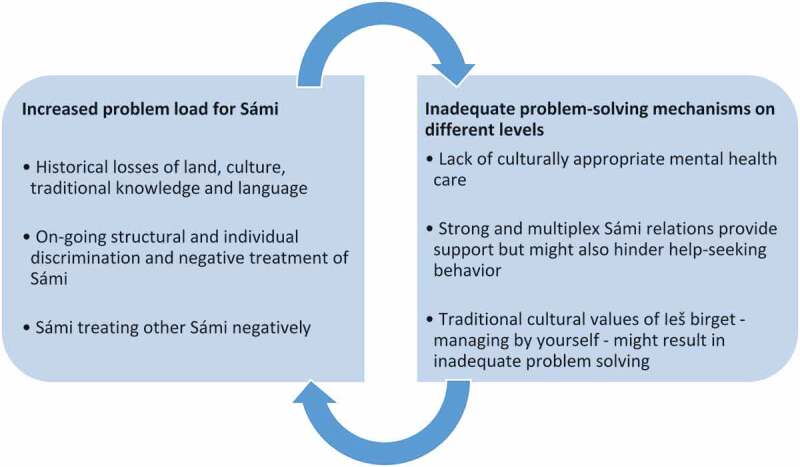
Suicide is a major public health issue across the Arctic, especially among Indigenous Peoples. The aim of this study was to explore and describe cultural meanings of suicide among Sámi in Norway. Five open-ended focus group discussions (FGDs) were conducted with 22 Sámi (20) and non-Sámi (2) participants in South, Lule, Marka, coastal and North Sámi communities in Norway. FGDs were recorded, transcribed verbatim and analysed employing thematic analysis. Six themes were developed from the analysis: "Sámi are treated negatively by the majority society", "Some Sámi face negative treatment from other Sámi", "The historic losses of the Sámi have turned into a void", "Sámi are not provided with equal mental health care", "The strong Sámi networks have both positive and negative impacts" and "'Birgetkultuvvra' might be a problem". The findings indicate that the participants understand suicide among Sámi in relation to increased problem load for Sámi (difficulties in life not encountered by non-Sámi) and inadequate problem-solving mechanisms on different levels, including lack of equal mental health care for Sámi and cultural values of managing by oneself ("ieš birget"). The findings are important when designing suicide prevention initiatives specifically targeting Sámi.
Overview
The claims and statistics of this paper haven’t been checked yet.
Free: it reads the open-access text and checks the first 5 claims that cite a source we can check. Create a free account to check every claim.
Integrity signals
Registry
Cites
Statistics
Figures
Verification
Claims the paper makes
The claims and statistics of this paper haven’t been checked yet.
Free: it reads the open-access text and checks the first 5 claims that cite a source we can check. Create a free account to check every claim.
Claims other papers make about this one
Each is checked against this paper’s own text: does it say what the citing paper says it does?
The source backs part of the claim, not all of it — or backs it for a different population, condition or comparison.
In the citing paper
“These minorities and at-risk groups, such as the Inuit communities, first nations, and aborigines (146), are experiencing rapid change in climatic conditions (132, 147, 148).”
From The Impact of Climate Change on Mental Health: A Systematic Descriptive Review (2020) · cites this paper as [132]
Experimental — accuracy not yet measured
Self-check
Percentages, sums and reported differences re-computed from the paper’s own numbers.
The self-check needs the paper’s full text.
Citations
Cites
Using thematic analysis in psychology
Braun, V., & Clarke, V. (2006) · Qualitative Research in Psychology · doi:10.1191/1478088706qp063oa · Cited by 194,414
Graneheim, U. H., & Lundman, B. (2004) · Nurse Education Today · doi:10.1016/j.nedt.2003.10.001 · Cited by 20,772 · cited 1×
“We argue that the open-ended dialogues and the cultural safety provided through the procedure and context of FGDs fostered honest and reflective conversations that support the credibility and overall trustworthiness of the study [49].”
BackgroundCook, R. J., Dickens, B. M., & Fathalla, M. F. (2003) · Reproductive Health and Human Rights · doi:10.1093/acprof:oso/9780199241323.003.0025 · Cited by 10,769
“Focus Groups Can Be Fun”: The Use of Activity-Oriented Questions in Focus Group Discussions
Colucci, E. (2007) · Qualitative Health Research · doi:10.1177/1049732307308129 · Cited by 376 · cited 1×
“Focus group discussions (FGDs) have previously been used to investigate cultural understandings of suicide in specific populations [20,21], also among Indigenous peoples in the Arctic [22–24].”
Why We Need Qualitative Research in Suicidology
Hjelmeland, H., & Knizek, B. L. (2010) · Suicide and Life-Threatening Behavior · doi:10.1521/suli.2010.40.1.74 · Cited by 376 · cited 1×
“” Qualitative methodology is well suited to consider cultural and contextual issues in relation to suicide [14,15,19].”
MethodSelf-citationInupiat youth suicide and culture loss: Changing community conversations for prevention
Wexler, L. M. (2006) · Social Science & Medicine · doi:10.1016/j.socscimed.2006.07.022 · Cited by 188
Suicide and mental disorders: A discourse of politics, power, and vested interests
Hjelmeland, H., & Knizek, B. L. (2017) · Death Studies · doi:10.1080/07481187.2017.1332905 · Cited by 170 · cited 1×
“Critics argue that that line of research has reached a dead end in terms of coming up with better methods for suicide prevention, and instead emphasise that qualitative research into cultural and contextual aspects of suicide could be a way forward [13 – 15].”
MethodSelf-citationAssimilation of the Sami – Implementation and Consequences1
Minde, H. (2003) · Acta Borealia · doi:10.1080/08003830310002877 · Cited by 163
Chachamovich, E., Kirmayer, L. J., Haggarty, J. M., Cargo, M., McCormick, R., & Turecki, G. (2015) · The Canadian Journal of Psychiatry · doi:10.1177/070674371506000605 · Cited by 137 · cited 2×
“Nunavut, Canada [3], Greenland [4] and northern Russia [1,5] show alarming suicide rates, especially among the Indigenous peoples of the north.”
BackgroundAssimilation of the Sami - Implementation and Consequences
Minde, H. (2005) · Cited by 128
Suicide Mortality Among American Indians and Alaska Natives, 1999–2009
Herne, M. A., Bartholomew, M. L., & Weahkee, R. L. (2014) · American Journal of Public Health · doi:10.2105/ajph.2014.301929 · Cited by 112 · cited 2×
“Suicide is a major public health issue across the Arctic [1], and statistics from Alaska, the United States [2],”
BackgroundSuicide among Indigenous Sami in Arctic Norway, 1970–1998
Silviken, A., Haldorsen, T., & Kvernmo, S. E. (2006) · European Journal of Epidemiology · doi:10.1007/s10654-006-9052-7 · Cited by 103 · cited 1×
“Suicide rates are moderate in arctic Norway and Sweden, but Sámi have died more often from suicide than majority populations [1,6 – 8].”
BackgroundSelf-citationStoor, J. P., Kaiser, N., Jacobsson, L. H., Renberg, E. S., & Silviken, A. (2015) · International Journal of Circumpolar Health · doi:10.3402/ijch.v74.27669 · Cited by 102 · cited 4×
“However, the similarity and overlap in themes between this study and the previous one, among Sámi in Sweden [24], is an argu-ment for at least some dependability and transferability of findings.”
BackgroundResultInfluentialSelf-citationInupiat youth suicide and culture loss : Changing community conversations for prevention.
Wexler (2006) · Social Science & Medicine · Cited by 93
MARSELLA, A. J., DUBANOSKI, J., HAMADA, W. C., & MORSE, H. (2000) · American Behavioral Scientist · doi:10.1177/00027640021956080 · Cited by 83 · cited 1×
“What “ culture ” is is debated, but the following definition has been proposed by Marsella et al. [18].”
BackgroundSuicide in circumpolar regions: an introduction and overview
Young, T. K., Revich, B., & Soininen, L. (2015) · International Journal of Circumpolar Health · doi:10.3402/ijch.v74.27349 · Cited by 83 · cited 8×
“Suicide is a major public health issue across the Arctic [1], and statistics from Alaska, the United States [2], Nunavut, Canada [3], Greenland [4] and northern Russia [1,5] show alarming suicide rates, especially among the Indigenous peoples of the north.”
BackgroundInfluentialEthnic discrimination and psychological distress: A study of Sami and non-Sami populations in Norway
Hansen, K. L., & Sørlie, T. (2012) · Transcultural Psychiatry · doi:10.1177/1363461511433944 · Cited by 83 · cited 1×
“Experiencing oneself as discriminated is ten times more common among Sámi than (majority) Norwegians [32], and those who report this are more likely to also report worse health [33,34].”
BackgroundWexler (2009) · American Indian and Alaska Native Mental Health Research · doi:10.5820/aian.1601.2009.1 · Cited by 83 · cited 1×
“Focus group discussions (FGDs) have previously been used to investigate cultural understandings of suicide in specific populations [20,21], also among Indigenous peoples in the Arctic [22 – 24].”
BackgroundA scoping review of Indigenous suicide prevention in circumpolar regions
Redvers, J., Bjerregaard, P., Eriksen, H. A., Fanian, S., Healey, G., Hiratsuka, V. Y., Jong, M., Larsen, C. V. L., Linton, J., Pollock, N. J., et al. (2015) · International Journal of Circumpolar Health · doi:10.3402/ijch.v74.27509 · Cited by 80
Self-citationCauses of death in the Sami population of Sweden, 1961–2000
Hassler, S., Johansson, R., Sjölander, P., Grönberg, H., & Damber, L. (2005) · International Journal of Epidemiology · doi:10.1093/ije/dyi027 · Cited by 79
Eriksen, A. M. A., Hansen, K. L., Jávo, C., & Schei, B. (2015) · Scandinavian Journal of Public Health · doi:10.1177/1403494815585936 · Cited by 77 · cited 1×
“[35] found that Sámi in Norway reported being subjected to more emotional, physical and sexual violence than majority”
BackgroundEthnic discrimination and bullying in the Sami and non-Sami populations in Norway: the SAMINOR study
Hansen, K. L., Melhus, M., Høgmo, A., & Lund, E. (2008) · International Journal of Circumpolar Health · doi:10.3402/ijch.v67i1.18243 · Cited by 73 · cited 2×
“In addition, Eriksen et al. [35] found that Sámi in Norway reported being subjected to more emotional, physical and sexual violence than majority Norwegians, both growing up and as adults.”
BackgroundCultural context is crucial in suicide research and prevention
Hjelmeland, H. (2011) · Crisis · doi:10.1027/0227-5910/a000097 · Cited by 69 · cited 1×
“” Qualitative methodology is well suited to consider cultural and contextual issues in relation to suicide [14,15,19].”
MethodSelf-citationHansen, K. L. (2015) · International Journal of Circumpolar Health · doi:10.3402/ijch.v74.25125 · Cited by 68 · cited 1×
“Experiencing oneself as discriminated is ten times more common among Sámi than (majority) Norwegians [32], and those who report this are more likely to also report worse health [33,34].”
BackgroundMaking sense of suicide: A discourse analysis of young people's talk about suicidal subjecthood
Roen, K., Scourfield, J., & McDermott, E. (2008) · Social Science & Medicine · doi:10.1016/j.socscimed.2008.09.019 · Cited by 58 · cited 1×
“Focus group discussions (FGDs) have previously been used to investigate cultural understandings of suicide in specific populations [20,21], also among Indigenous peoples in the Arctic [22–24].”
Suicide among men in Ghana: The burden of masculinity
Andoh-Arthur, J., Knizek, B. L., Osafo, J., & Hjelmeland, H. (2018) · Death Studies · doi:10.1080/07481187.2018.1426655 · Cited by 56 · cited 1×
“” Qualitative methodology is well suited to consider cultural and contextual issues in relation to suicide [14,15,19].”
MethodSelf-citationTime trend by region of suicides and suicidal thoughts among Greenland Inuit
Bjerregaard, P., & Larsen, C. V. L. (2015) · International Journal of Circumpolar Health · doi:10.3402/ijch.v74.26053 · Cited by 52 · cited 2×
“Nunavut, Canada [3], Greenland [4] and northern Russia [1,5] show alarming suicide rates, especially among the Indigenous peoples of the north.”
BackgroundSami speakers are less satisfied with general practitioners’ services
Nystad, T., Melhus, M., & Lund, E. (2008) · International Journal of Circumpolar Health · doi:10.3402/ijch.v67i1.18246 · Cited by 50 · cited 1×
“This is well known, and research has confirmed that Sámi patients are more dissatisfied than the majority population with primary health care [37], that use of Sámi language in the Norwegian health system is complicated (even when language competency is available) [38,39] and that ethnic matching in client – therapist…”
BackgroundYoung Men, Masculinities, and Suicide
Rasmussen, M. L., Haavind, H., & Dieserud, G. (2018) · Archives of Suicide Research · doi:10.1080/13811118.2017.1340855 · Cited by 50 · cited 13×
“This study is based on data from focus group discussions with 20 Sámi, and 2 non-Sámi participants, and we cannot know to what extent the participants ’ understanding of suicide among Sámi are representative for all Sámi in Norway.”
BackgroundInfluentialDagsvold, I., Møllersen, S., & Stordahl, V. (2015) · International Journal of Circumpolar Health · doi:10.3402/ijch.v74.26952 · Cited by 44 · cited 1×
“This is well known, and research has confirmed that Sámi patients are more dissatisfied than the majority population with primary health care [37], that use of Sámi language in the Norwegian health system is complicated (even when language competency is available) [38,39] and that ethnic matching in client – therapist…”
BackgroundSuicidal expressions in young Swedish Sami, a cross-sectional study
Omma, L., Sandlund, M., & Jacobsson, L. (2013) · International Journal of Circumpolar Health · doi:10.3402/ijch.v72i0.19862 · Cited by 40 · cited 2×
“[10] found that young adult Sámi on the Swedish side of Sápmi experiencing themselves as discriminated against, also reported significantly more sui-”
BackgroundAboriginal suicidal behaviour research: from risk factors to culturally-sensitive interventions.
Katz, L. Y., Elias, B., O’Neil, J., Enns, M. W., Cox, B. J., Belik, S., & Sareen, J. (2006) · PubMed Central · Cited by 39
Parental Values and Ethnic Identity in Indigenous Sami Families: A Qualitative Study
Jávo, C., Alapack, R. J., Heyerdahl, S., & Røsnning, J. A. (2003) · Family Process · doi:10.1111/j.1545-5300.2003.00151.x · Cited by 38 · cited 1×
“[43] have shown that Sámi parents emphasise that their children, especially their boys, learn to be autonomous and self-reliant.”
BackgroundMortality of the Sami in northern Finland 1979–2005
Soininen, L., & Pukkala, E. (2008) · International Journal of Circumpolar Health · doi:10.3402/ijch.v67i1.18227 · Cited by 38 · cited 1×
“Suicide rates are moderate in arctic Norway and Sweden, but Sámi have died more often from suicide than majority populations [1,6 – 8].”
BackgroundАлександрович, С. Ю., Brenn, T., Kudryavtsev, A. V., & Nilssen, O. (2014) · International Journal of Circumpolar Health · doi:10.3402/ijch.v73.24308 · Cited by 34 · cited 3×
“Sámi have lived in Sápmi (the Sámi homelands; in Arctic and sub-arctic parts of Scandinavia and the Kola penin-sula in Russia) since time immemorial.”
BackgroundMøllersen, S., Sexton, H. C., & Holte, A. (2008) · Nordic Journal of Psychiatry · doi:10.1080/08039480802576043 · Cited by 32 · cited 1×
“This is well known, and research has confirmed that Sámi patients are more dissatisfied than the majority population with primary health care [37], that use of Sámi language in the Norwegian health system is complicated (even when language competency is available) [38,39] and that ethnic matching in client – therapist…”
BackgroundLarsen, A. L., Salamonsen, A., Kristoffersen, A. E., Hamran, T., Evjen, B., & Stub, T. (2018) · International Journal of Circumpolar Health · doi:10.1080/22423982.2018.1438572 · Cited by 26 · cited 1×
“ers have also noted the importance extended family networks has in caring for the sick or vulnerable among Sámi [41].”
BackgroundDagsvold, I., Møllersen, S., & Stordahl, V. (2016) · International Journal of Circumpolar Health · doi:10.3402/ijch.v75.32588 · Cited by 23 · cited 1×
“This is well known, and research has confirmed that Sámi patients are more dissatisfied than the majority population with primary health care [37], that use of Sámi language in the Norwegian health system is complicated (even when language competency is available) [38,39] and that ethnic matching in client – therapist…”
BackgroundClark, Y., Augoustinos, M., & Malin, M. (2016) · Adelaide Research & Scholarship (AR&S) (University of Adelaide) · Cited by 11
Research works printed but not linked: 10
- Kaiser N, Salander Renberg E Suicidal expressions among the Swedish reindeer-herding Sami population. Suicidol Online. 2012; 3: 114– 123.
- Kirmayer L, Brass G, Holton T, et al Suicide among aboriginal people in Canada. Ottawa, ON: Aboriginal Healing Foundation; 2007.
- Sámi Norwegian National Advisory Unit on Mental Health and Substance Abuse, Saami Council Plan for suicide prevention among the Sámi people on Norway, Sweden, and Finland. Karasjok, Norway; Sámi Norwegian National Advisory Unit on Mental Health and Substance Abuse; 2017.
- Inuit Tapiriit Kanatami National Inuit Suicide Prevention Strategy. Ottawa, Canada: Inuit Tapiriit Kanatami; 2016.
- Hansen AM, Virginia RA, Tepecik Dis A, et al Community Wellbeing and Infrastructure in the Arctic. Aalborg University; 2016.
- Strøm KS, Bull K, Broderstad AR, et al Proposal for ethical guidelines for Sámi health research and research on Sámi human biological material. Karasjok, Norway: Sámediggi/Sámi Parliament of Norway; 2018.
- Stoor JPA Kunskapssammanställning om psykosocial ohälsa bland samer [Compilation of knowledge on psychosocial health among Sámi]. Kiruna, Sweden: Sametinget/Sámi Parliament of Sweden; 2016.
- Boine EM Ii gii ge ollesolmmoš ge liiko jus gii nu livče nu čuru das birra jorramin - Selv ingen voksne hadde likt at noen surret rundt der som en flue. Verdioverføring fra far til sønn - i en samisk kontekst [No grown-up would have liked if someone buzzed around them like a fly. Transferring values from father to son – in a Sámi context] In: Hauan MA, editor. Maskuliniteter i Nord. KVINNFORSKs skriftserie Senter for kvinne- og kjønnsforskning. Tromsø: Universitetet i Tromsø, Norwegian; 2007 p. 127– 141.
- River J Suicide and hegemonic masculinity in Australian men. Illions (IL): Charles C. Thomas Springfield; 2014.
- Kalstad Mikkelsen A Taushet, tabuer og tapte ansikter - angår det oss? [Silence, taboos and people loosing face - does it concern us?]. Bårjås. 2016;(1): 46– 58. Norwegian.
Cited by
The Impact of Climate Change on Mental Health: A Systematic Descriptive Review
Cianconi, P., Betrò, S., & Janiri, L. (2020) · Frontiers in Psychiatry · doi:10.3389/fpsyt.2020.00074 · Cited by 1,320
Lateral violence in Indigenous peoples
Whyman, T., Adams, K., Carter, A., & Jobson, L. (2021) · Australian Psychologist · doi:10.1080/00050067.2021.1893595 · Cited by 30
“Of these participants, all identified as Indigenous, with the exception of two participants in Stoor et al. (2019), four participants in Newton (2016) and less than one third of Clark et al. (2017b).”
BackgroundBerg-Nordlie, M. (2021) · Ethnopolitics · doi:10.1080/17449057.2021.1932116 · Cited by 32
“…(‘Gunnar’, Abroad, 2019, F1R0) The Sámi relationship with nature is experienced by many as connected to another core traditional Sámi cultural value: self-sufficiency (iešbirgejupmi), which is also identified by some as a cultural element that contrasts Sámi from non-Sámi (Stoor et al., 2019).”
Background“We belong to nature”: Communicating mental health in an indigenous context
Sørly, R., Mathisen, V., & Kvernmo, S. E. (2020) · Qualitative Social Work · doi:10.1177/1473325020932374 · Cited by 19
“A study by Stoor et al. (2019) showed that Sámi understand suicide among Sámi people as related to historical and ongoing oppression, negative treatment of Sámi by other Sámi, shortage of culturally adapted mental health care, issues within Sámi networks and traditional cultural values.”
BackgroundNess, T. M., & Munkejord, M. C. (2021) · International Journal of Circumpolar Health · doi:10.1080/22423982.2021.1936971 · Cited by 17
Metadata
- Authors
- Stoor, J. P. A., Berntsen, G., Hjelmeland, H., & Silviken, A.
- Affiliations
- Finnmarkssykehuset (NO)
- University Hospital of North Norway (NO)
- Norwegian University of Science and Technology (NO)
- Corresponding author
- Stoor, Jon Petter Anders
- Venue
- International Journal of Circumpolar Health
- Publisher
- Informa UK Limited
- Published
- 2019-01-01
- Volume
- 78
- Issue
- 1
- Pages
- 1565861
- ISSN
- 1239-9736 (ISSN-L)
- 2242-3982
- PMC
- PMC6346707
- OpenAlex
- W2911821026
- Cited by
- 22
- References
- 40
- Citations by year
- 2026: 3 · 2025: 2 · 2024: 1 · 2023: 3 · 2022: 2 · 2021: 8 · 2020: 3
- FWCI
- 3.79
- Type
- journal article
- Language
- en
- Open access
- gold
- doi.org
- Licence
- Locations
- International Journal of Circumpolar Health (publishedVersion, cc-by-nc)
- Europe PMC (PubMed Central) (publishedVersion, cc-by-nc)
- PubMed Central (publishedVersion, cc-by-nc)
- PubMed (publishedVersion)
- DiVA at Umeå University (Umeå University) (submittedVersion, other-oa)
- DOAJ (DOAJ: Directory of Open Access Journals) (submittedVersion, cc-by-sa)
- NORA - Norwegian Open Research Archives (submittedVersion, other-oa)
- NORA - Norwegian Open Research Archives (submittedVersion, cc-by-nc)
- Funders
- Helse Nord RHF (PFP1297-16)
- Sámi Norwegian National Advisory Unit on Mental Health and Substance (05/2014)
- Topics
- Social Sciences › Psychology › Clinical Psychology › Suicide and Self-Harm Studies
- Social Sciences › Health › Indigenous Health, Education, and Rights
- Social Sciences › Anthropology › Indigenous Studies and Ecology
- Keywords
- suicide, Sami, indigenous peoples, Arctic, mental health services, suicide prevention, social exclusion, intergroup relations, historical loss, self-management, community networks, Sami language
- MeSH terms
- Adult, Aged, Arctic Regions, Cultural Characteristics, Ethnicity, Female, Humans, Male, Mental Health, Middle Aged, Norway, Suicide, Focus Groups, Qualitative Research, Young Adult
About these checks
Registry, retraction, Cites and statistics results are computed, not judged, with one exception: a printed reference that no index lists is read once by a model before it counts as a citation error. Claims are extracted by a model and kept only when their quote appears verbatim in the text; each cited source is then checked, with a model’s help, for whether it says what the claim relies on. Those verdicts can be wrong — read the claim’s quote and the cited source before relying on one.
Statistics and arithmetic are recomputed, not judged.
Confidence bands are shown only for fields calibrated on our annotated test set. None is calibrated yet, so no band is shown.
What counts as a claim ›How we measure confidence ›How we check this ›
Are you an author, or do you see a problem with this page? Request a review
Data sources
Bibliographic data: Semantic Scholar, OpenAlex, Crossref.
Contains information from the Semantic Scholar Academic Graph Datasets, made available under the ODC Attribution License (ODC-BY 1.0).
Semantic Scholar’s data is described in: Kinney, R., et al. (2023). The Semantic Scholar Open Data Platform. arXiv:2301.10140.
