

Context-based problem-posing and solving instructional approach and students’ engagement in learning data handling
Open accessThe DOI matches its Crossref record; 57 of the 57 references it cites were found in a registry or an index; 2 of the 69 sources its claims cite were checked for support.
Abstract
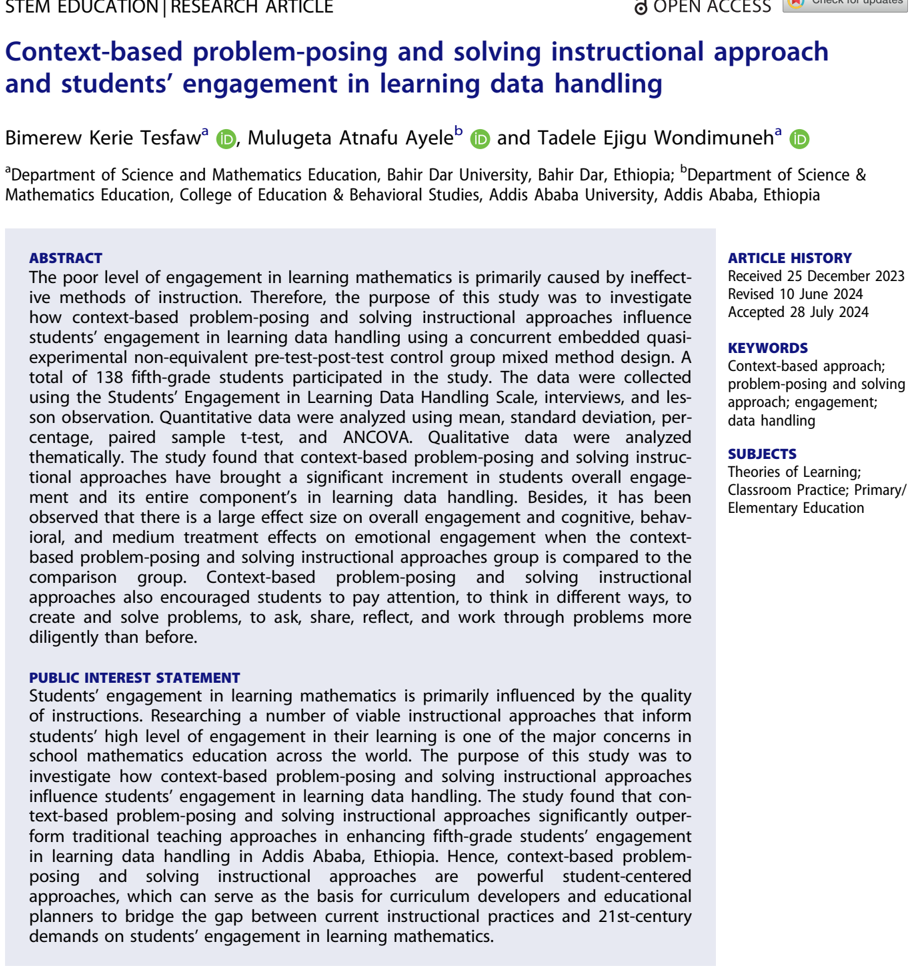
The poor level of engagement in learning mathematics is primarily caused by ineffective methods of instruction. Therefore, the purpose of this study was to investigate how context-based problem-posing and solving instructional approaches influence students’ engagement in learning data handling using a concurrent embedded quasi-experimental non-equivalent pre-test-post-test control group mixed method design. A total of 138 fifth-grade students participated in the study. The data were collected using the Students’ Engagement in Learning Data Handling Scale, interviews, and lesson observation. Quantitative data were analyzed using mean, standard deviation, percentage, paired sample t-test, and ANCOVA. Qualitative data were analyzed thematically. The study found that context-based problem-posing and solving instructional approaches have brought a significant increment in students overall engagement and its entire component’s in learning data handling. Besides, it has been observed that there is a large effect size on overall engagement and cognitive, behavioral, and medium treatment effects on emotional engagement when the context-based problem-posing and solving instructional approaches group is compared to the comparison group. Context-based problem-posing and solving instructional approaches also encouraged students to pay attention, to think in different ways, to create and solve problems, to ask, share, reflect, and work through problems more diligently than before.
Overview
CoChat Summary
TL;DR
This quasi-experimental mixed-methods study examined whether context-based problem-posing and solving instruction improved fifth-grade students’ engagement in learning data handling in Addis Ababa, Ethiopia. It found significant engagement gains in the intervention groups, with the context-based approach showing large effects on overall and cognitive engagement and medium effects on emotional and social engagement compared with traditional teaching.
Key findings
- In the context-based problem-posing and solving group, paired t-tests showed significant gains in overall engagement, T(48)=4.480, p=.000, d=1.08; cognitive engagement, T(48)=5.674, p=.000, d=1.29; emotional engagement, T(48)=2.631, p=.011, d=.55; and social engagement, T(48)=2.831, p=.007, d=.69; behavioral engagement was not significant, T(48)=1.873, p>.05.
- In the problem-posing and solving group, significant gains were reported for overall engagement and cognitive, behavioral, emotional, and social engagement, with effect sizes of 1.20, .92, .97, .80, and .60, respectively; the comparison group showed no statistically significant gains.
- ANCOVA controlling for pre-test found significant group differences for overall engagement, F(2,134)=15.293, p=.000, η²=.186; cognitive engagement, F(2,134)=11.451, p=.000, η²=.146; behavioral engagement, F(2,134)=8.275, p=.000, η²=.110; emotional engagement, F(2,134)=7.565, p=.001, η²=.101; and social engagement, F(2,134)=3.657, p=.028, η²=.052.
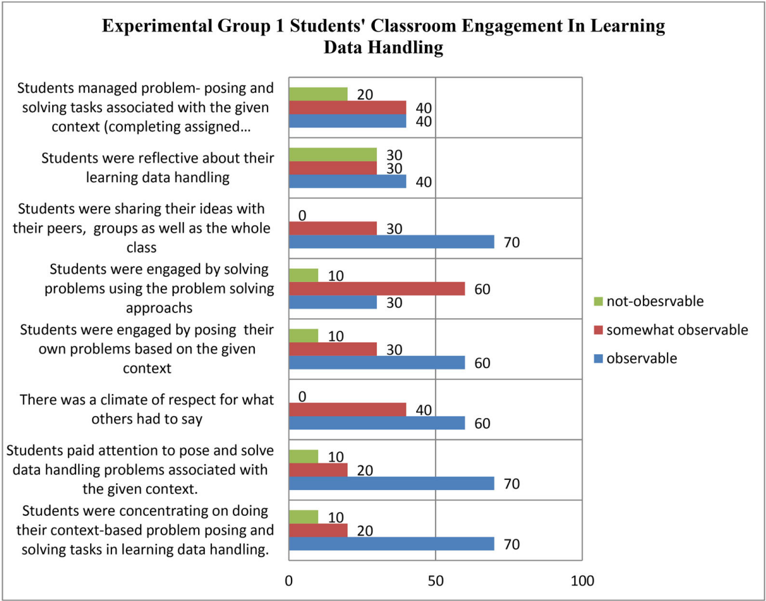
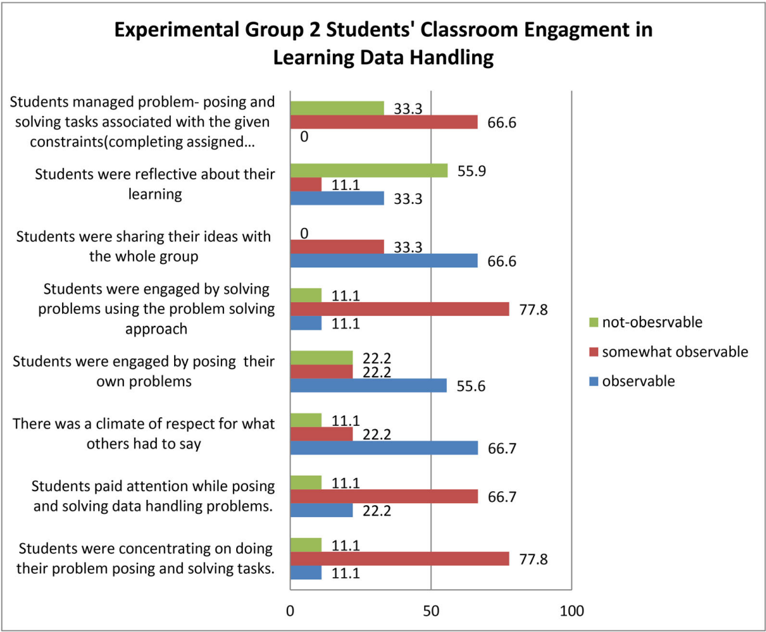
- Tukey HSD showed the two experimental groups significantly differed from the comparison group on most post-test engagement variables, but there were no significant differences between experimental group 1 and experimental group 2; qualitative interviews and lesson observations indicated students paid more attention, created and solved problems, shared, reflected, and worked more diligently.
Methods
- Concurrent embedded quasi-experimental non-equivalent pre-test–post-test control group mixed-method design; 138 fifth-grade students from three government primary schools in Addis Ababa, Ethiopia, assigned to context-based problem-posing and solving (n=49), problem-posing and solving (n=45), or comparison/traditional instruction (n=44).
- Intervention lasted six weeks on data handling; instruments included the 37-item Students’ Engagement in Learning Data Handling Scale, semi-structured interviews with 10 students, and lesson observations (10 lessons in the context-based group, 9 in the problem-posing and solving group).
- Quantitative analysis used paired sample t-tests and ANCOVA with pre-test as covariate, plus Tukey HSD; qualitative data were analyzed thematically.
Limitations
- The paper states that the approach may depend on students’ parents and parental support, and that future studies should examine parent support and other mathematics topics.
- The paper states the intervention was short and focused only on data handling, limiting what can be inferred about longer-term or broader mathematics engagement.
- Evident from the text: groups were intact classes and not randomly assigned, the sample was limited to fifth-grade students in three Addis Ababa schools, and engagement was largely measured through self-report, which may constrain generalizability and introduce response bias.
Model-written summary. Check it against the paper before relying on it.
Integrity signals
Registry
Cites
Statistics
Figures




Verification
Claims the paper makes
1 Valid · 3 Not valid · 52 Not checked · 85 Own results and interpretations
The cited sources support only part of this claim — read each source’s verdict below.
In the paper
“The pilot, pre-test, and post-test results of Cronbach's alpha coefficients for engagement and components of engagement such as Cognitive engagement, Behavioral engagement, Emotional engagement, and Social engagement were almost all greater than 0.70, which is in the acceptable range (Shrestha, 2021).”
§ Context-based problem-posing and solving instructional approach and students' engagement in learning data handling Bimerew > 2.4. Validity and reliability of the instrument
What the sources say
- Partly supportedcites Shrestha, 2021 matched to “Factor Analysis as a Tool for Survey Analysis” (2021) sourceExperimental — accuracy not yet measured
Shrestha (2021) supports only the threshold clause of the sentence: in Section 2.1.1 (Instrument Reliability and Validity) it states that 'Cronbach's alpha value more than 0.7 is considered as acceptable,' repeated in Section 4 as '> 0.7'. The empirical part attributed to this source — pilot, pre-test and post-test alphas for engagement and its cognitive, behavioural, emotional and social components — is not in the paper: our copy's worked example is a tourist/travel satisfaction survey whose components are hospitality, destination attraction and relaxation (Table 5: alphas 0.75, 0.74, 0.71; total scale 0.82), with no engagement constructs and no pilot/pre-test/post-test design (searched: engagement, cognitive/behavioral/emotional/social, pilot pre-test post-test). Those alpha values are the citing study's own results, not Shrestha's. (LLM, conf=0.78)
plain- Asserted: passes — The authors put it forward as true.
- Checkable: passes — It can be checked against evidence.
- Load-bearing: passes — The paper’s conclusions depend on it.
- Based: passes — The paper gives a reason why it holds.
- Partly supported
The cited sources that could be checked couldn’t confirm or dispute this claim.
In the paper
“However, these empirical studies related to problem-posing interventions couldn't see their influence on students' engagement in learning data handling.”
§ Context-based problem-posing and solving instructional approach and students' engagement in learning data handling Bimerew > 1.4 Rationale of the study
What the sources say
- Could not verifycites Kaur & Rosli, 2021 matched to “Problem Posing in Mathematics Education Research: A Systematic Review” (2021) sourceExperimental — accuracy not yet measured
Our copy of the review synthesises 20 empirical problem-posing studies (2015–2020) and reports outcomes on achievement, creative and critical thinking, learning motivation, problem-solving, attitudes and classroom activeness/participation (Abstract; 'Kemal Ozgen (2019)' results sections; 'Primary School Students' table). No passage addresses 'data handling' (or statistics/probability/data representation) as an outcome of problem-posing interventions, and no passage states such a gap; searches for 'data handling', 'statistics, probability, data representation, student engagement' returned only incidental uses of 'data' (e.g. data in linear graphs in Iskenderoglu 2018, preservice teachers). The closest contrary-leaning material is positive engagement effects (problem posing 'enhances students' learning activities to be more active', Introduction, citing Setiawan et al. 2018; 'increased participation in the classroom', Primary School Students table), but these concern general mathematics learning, not data handling, so they neither support nor refute the attributed claim. (LLM, conf=0.72)
hedged- Asserted: passes — The authors put it forward as true.
- Checkable: passes — It can be checked against evidence.
- Load-bearing: passes — The paper’s conclusions depend on it.
- Based: passes — The paper gives a reason why it holds.
- Could not verify
A result the paper reports from its own data — it cites no other source for it, so there is none to check. The quote shows it is in the paper.
In the paper
“Context-based problem-posing and solving instructional approaches also encouraged students to pay attention, to think in different ways, to create and solve problems, to ask, share, reflect, and work through problems more diligently than before.”
§ Context-based problem-posing and solving instructional approach and students' engagement in learning data handling Bimerew > Abstract
plainstates a cause- Asserted: passes — The authors put it forward as true.
- Checkable: passes — It can be checked against evidence.
- Load-bearing: passes — The paper’s conclusions depend on it.
- Based: passes — The paper gives a reason why it holds.
A result the paper reports from its own data — it cites no other source for it, so there is none to check. The quote shows it is in the paper.
In the paper
“The study found that context-based problem-posing and solving instructional approaches have brought a significant increment in students overall engagement and its entire component's in learning data handling.”
§ Context-based problem-posing and solving instructional approach and students' engagement in learning data handling Bimerew > Abstract
plainstates a cause- Asserted: passes — The authors put it forward as true.
- Checkable: passes — It can be checked against evidence.
- Load-bearing: passes — The paper’s conclusions depend on it.
- Based: passes — The paper gives a reason why it holds.
64 more claims
Create a free account to see all 141 claims and to verify the 47 references still open.
- The quote only partly states this claim. 10
- It may state two separate claims as one. 40
- Probably not a substantial claim. 38
Self-check
Percentages, sums and reported differences re-computed from the paper’s own numbers.
Each contradiction between two passages listed here was confirmed by an independent check.
Rated major: it would touch a result — a value a result rests on, reported and recomputed p-values on opposite sides of the significance level, two passages that conflict with no sign which is right, or a cited work retracted before this paper was published.
In the paper
§ Context-based problem-posing and solving instructional approach and students' engagement in learning data handling Bimerew > 3.2. Analysis of covariance using Pre-test as a covariate
“except no significat difference for experimental group 2 with control group for post-social engagement”
§ Context-based problem-posing and solving instructional approach and students' engagement in learning data handling Bimerew > 6. Recommendations
“| | Experimental Group 2 | Comparison Group Comparison Group | .1441 .2047 Ã | .0761 .0777 | .144 .025 |”
Rated minor: it would not touch a result — a value no result rests on, a p-value that stays on the same side of the significance level, or a conflict that is clerical, resolved elsewhere in the paper, or outside its own findings.
In the paper
§ Context-based problem-posing and solving instructional approach and students' engagement in learning data handling Bimerew > 4. Discussion
“However, the present study's findings showed that students' cognitive, behavioral, emotional, social, and overall engagement in learning data handling within the group was significantly increased by both context-based problem-posing and solving instructional approaches and problem-posing and solving instructional approaches.”
§ Context-based problem-posing and solving instructional approach and students' engagement in learning data handling Bimerew > 6. Recommendations
“| Behavioral Engagement: Post-Pre Context-based, problem-posing and solving instructional approaches | .1769 | .6609 1.873 48 .067 | | | |”
Rated minor: it would not touch a result — a value no result rests on, a p-value that stays on the same side of the significance level, or a conflict that is clerical, resolved elsewhere in the paper, or outside its own findings.
In the paper
§ Context-based problem-posing and solving instructional approach and students' engagement in learning data handling Bimerew > 3.1. A Pair sample T-test result on students' mean gain on engagement
“The mean gains of the pre-test and post-test of students' engagement (T(44)¼4.480,p¼.000, d ¼ 1.20)”
§ Context-based problem-posing and solving instructional approach and students' engagement in learning data handling Bimerew > 6. Recommendations
“| | Problem-posing and solving instructional approaches | .3115 | .3995 5.231 44 .000 | | |”
Rated minor: it would not touch a result — a value no result rests on, a p-value that stays on the same side of the significance level, or a conflict that is clerical, resolved elsewhere in the paper, or outside its own findings.
In the paper
§ Context-based problem-posing and solving instructional approach and students' engagement in learning data handling Bimerew > 3.2. Analysis of covariance using Pre-test as a covariate
“experimental group 2 with control group for postemotional engagement since p > 0.05.”
§ Context-based problem-posing and solving instructional approach and students' engagement in learning data handling Bimerew > 6. Recommendations
“| Post-Emotional Engagement | Experimental Group1 Experimental Group 2 | Experimental Group 2 Comparison Group Comparison Group | .0650 .3032 Ã .2383 Ã | .0819 .0824 .0841 | .708 .001 .015 |”
Citations
Cites
Statistical Power Analysis for the Behavioral Sciences
Cohen, J. (2013) · doi:10.4324/9780203771587 · Cited by 25,373
Research Design: Qualitative, Quantitative, and Mixed Method Approaches
อุ่นอารมย์เลิศ, ร. ด. ธ. (2016) · Silpakorn Educational Research Journal · Cited by 4,515
Factor Analysis as a Tool for Survey Analysis
Shrestha, N. (2021) · American Journal of Applied Mathematics and Statistics · doi:10.12691/ajams-9-1-2 · Cited by 2,248
A Self-determination Theory Perspective on Student Engagement
Reeve, J. (2012) · Handbook of Research on Student Engagement · doi:10.1007/978-1-4614-2018-7_7 · Cited by 1,650
Elementary and Middle School Mathematics: Teaching Developmentally
de Walle, J. A. V., Karp, K. S., & Bay-Williams, J. M. (2010) · Cited by 1,581
Student engagement and achievement in American secondary schools
(1993) · Choice Reviews Online · doi:10.5860/choice.30-3945 · Cited by 1,111
Patrick, H., Ryan, A. M., & Kaplan, A. (2007) · Journal of Educational Psychology · doi:10.1037/0022-0663.99.1.83 · Cited by 1,056
Fredricks, J. A., & McColskey, W. (2012) · Handbook of Research on Student Engagement · doi:10.1007/978-1-4614-2018-7_37 · Cited by 1,052
How People Learn: Brain, Mind, Experience, and School: Expanded Edition
(2000) · doi:10.17226/9853 · Cited by 772
The Math and Science Engagement Scales: Scale development, validation, and psychometric properties
Wang, M.-T., Fredricks, J. A., Ye, F., Hofkens, T. L., & Linn, J. S. (2016) · Learning and Instruction · doi:10.1016/j.learninstruc.2016.01.008 · Cited by 592 · cited 5×
“Initially, the scaled was developed based on the theoretical background and existing literatures to insure construct validity (Kong et al., 2003; Rimm-Kaufman et al., 2015; Wang et al., 2016).”
Influential
Research works printed but not linked: 11
- Cambaya, E. J., & Tan, D. A. (2022). Enhancing students' problem-solving skills and engagement in mathematics learning through contextualized instruction. Sci. Int.(Lahore), 34(2), 101-109.
- Crawford, M. L. (2001). Teaching contextually. In Research, rationale, and techniques for improving student motivation and achievement in mathematics and science. Cord.
- Creswell, J. w., & Creswell, J. D. (2018). Research design: Qualitative, quantitative, and mixed methods research designs. Sage Publication.
- Gravetter, F. J., & Wallnau, L. B. (2017). Statistics for the behavioral sciences (10th ed.). Cengage Learning.
- Ministry of Education. (2021). General education curriculum: mathematics (flow chart, mlc & syllabus) grade 1-8.federal democratic Republic of Ethiopia. Ministry of Education. Addis Ababa.
- Mohammed, A. (2021). The effect of cooperative problem-solving approach on secondary school students' mathematics performance and perceptions: The case of Awi-zone [Doctoral dissertation]. Bahir Dar University. https://ir.bdu.edu. et/handle/123456789/12097
- Mutakin, N., Blora, S., Blora, J., Tengah, I., & Id, M. (2021). Improving mathematics learning activities and results through REACT learning strategies in students of class X-Mipa-1 Sma Negeri 2 Blora improving mathematics learn- ing activities and results through react learning strategies in students of class X-MIPA-1 SMA Negeri 2. Blora Mutakin, 1(3), 44-57. https://doi.org/10.21107/literasinusantara.v1n3.2211299 · doi:10.21107/literasinusantara.v1n3.2211299
- National Council of Teachers of Mathematics (NCTM). (2000). Principles and standards for school mathematics. NCTM.
- National Educational Assessment and Examinations Agency (NEAEA). (2020). Ethiopian sixth national learning assessment of grades four and eight students. (NEAEA).
- Shenkut, H., Atnafu, M., & Michael, K. (2022). The Effect of Blended Learning Approach on Students' Engagement in Learning Algebra. Staff and Educational Development International, 25(1), 183-198.
- Wang, M. (2021). Investigating the Effects of Problem-Posing on High School Students' Mathematical Learning [Doctoral dissertation]. Southern Methodist University. https://scholar.smu.edu/cgi/viewcontent.cgi?article=1010&context= simmons_dtl_etds
Cited by
Lestari, D. P., Anwar, L., Sa’dijah, C., Rahim, S. S. A., & Hafiizh, M. (2024) · Journal of Ecohumanism · doi:10.62754/joe.v3i8.5834 · Cited by 5
Habibi, A. A., Lestari, N. D. S., Kurniati, D., Susanto, S., Yudianto, E., & Sanawi, I. (2024) · Kreano Jurnal Matematika Kreatif-Inovatif · doi:10.15294/0gwxkv54 · Cited by 5
The Impact of Sociocultural Factors on English Language Learning in Language Intensive Programs
Aminulloh, M. I., & Pranata, M. S. A. (2025) · Andragogi. · doi:10.31538/adrg.v5i1.1953 · Cited by 5
Agustin, D. P. P., Apriani, M. S., & Sali, M. L. (2024) · Kreano Jurnal Matematika Kreatif-Inovatif · doi:10.15294/rtnq8e58 · Cited by 5
Nguyen, T.-T., Van, T. N., Tong, D. H., & Thi-Nga, H. (2026) · Cogent Education · doi:10.1080/2331186x.2026.2636439 · Cited by 3
Metadata
- Authors
- Tesfaw, B. K., Ayele, M. A., & Wondimuneh, T. E.
- Affiliations
- Bahir Dar University (ET)
- Addis Ababa University (ET)
- Corresponding author
- Tesfaw, Bimerew Kerie
- Venue
- Cogent Education
- Publisher
- Informa UK Limited
- Published
- 2024-08-10
- Volume
- 11
- Issue
- 1
- ISSN
- 2331-186X (ISSN-L)
- OpenAlex
- W4401496327
- Cited by
- 24
- References
- 55
- Citations by year
- 2026: 15 · 2025: 5 · 2024: 4
- FWCI
- 9.47
- Type
- journal article
- Language
- en
- Open access
- gold
- doi.org
- Licence
- Locations
- Cogent Education (publishedVersion, cc-by)
- DOAJ (DOAJ: Directory of Open Access Journals) (submittedVersion, cc-by-sa)
- Topics
- Social Sciences › Education › Mathematics Education and Pedagogy
- Physical Sciences › Mathematics › Statistics and Probability › Statistics Education and Methodologies
- Social Sciences › Education › Mathematics Education and Teaching Techniques
- Keywords
- context-based instruction, problem posing, problem solving, student engagement, data handling, mathematics education, fifth grade students, cognitive engagement, behavioral engagement, emotional engagement, teaching methods
About these checks
Registry, retraction, Cites and statistics results are computed, not judged, with one exception: a printed reference that no index lists is read once by a model before it counts as a citation error. Claims are extracted by a model and kept only when their quote appears verbatim in the text; each cited source is then checked, with a model’s help, for whether it says what the claim relies on. Those verdicts can be wrong — read the claim’s quote and the cited source before relying on one.
The claim verdicts this report counts are experimental: their accuracy is not yet measured.
A language model drew the claims from the paper on 2026-11-15, under version 3 of the claim definition (model deepseek-v4.1-flash, prompt extract-v3).
A second model labelled each claim on 2026-11-15 (model jev-1.13-20260917, definition revision gold-guideline-v0.2).
Cited sources are checked with a language model’s help (qwen3.8-omni-flash).
Statistics and arithmetic are recomputed, not judged.
Confidence bands are shown only for fields calibrated on our annotated test set. None is calibrated yet, so no band is shown.
What counts as a claim ›How we measure confidence ›How we check this ›
Are you an author, or do you see a problem with this page? Request a review
Data sources
Bibliographic data: Semantic Scholar, OpenAlex, Crossref.
Contains information from the Semantic Scholar Academic Graph Datasets, made available under the ODC Attribution License (ODC-BY 1.0).
Semantic Scholar’s data is described in: Kinney, R., et al. (2023). The Semantic Scholar Open Data Platform. arXiv:2301.10140.
