

The DOI matches its Crossref record; 6 of the 6 references it cites were found in a registry or an index.
Effects of physical activity breaks on cognitive function in undergraduate students: a pilot study
Open accessAbstract
Physical activity is known to have several cognitive benefits. As a result, many teachers introduce short bouts of physical activity (active breaks) during their lessons. However, active breaks are less common in the university context, where students tend to remain passive during lessons. Therefore, there is a paucity of literature on active breaks and their benefits for undergraduate students. This study aimed to investigate the effects of a 10-min active break at moderate intensity on vigilance in undergraduate students by using a psychomotor vigilance task. Twenty-six undergraduate students (Mage = 23.36, SD = 1.98; 53.8% females) participated in this study and performed two conditions: control condition (passive condition) and experimental condition (active break). Results revealed that after receiving 10 min of moderate-intensity physical activity, the students improved their attention, as they responded faster to the psychomotor vigilance task than in the control condition. Considering these results, it seems that students can benefit from physical activity breaks by improving their vigilance. However, as this conclusion is based on a pilot study, we should be cautious in interpreting these results. Further research into this finding is needed.
Overview
The claims and statistics of this paper haven’t been checked yet.
Run the check — free, no account needed. It reads the open-access text and checks the sources it cites.
Integrity signals
Registry
Cites
Statistics
Figures
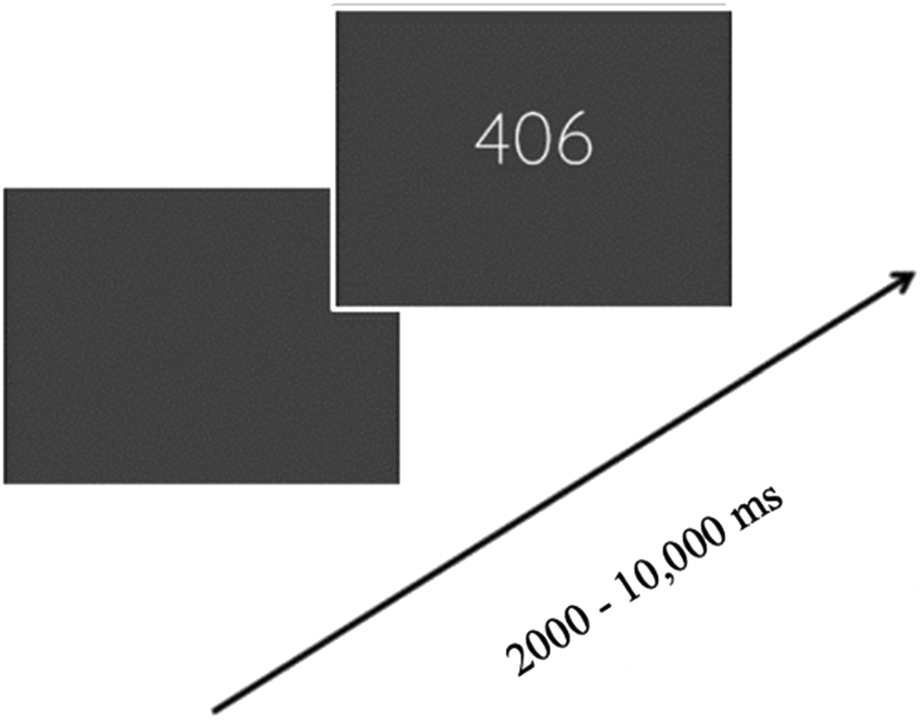

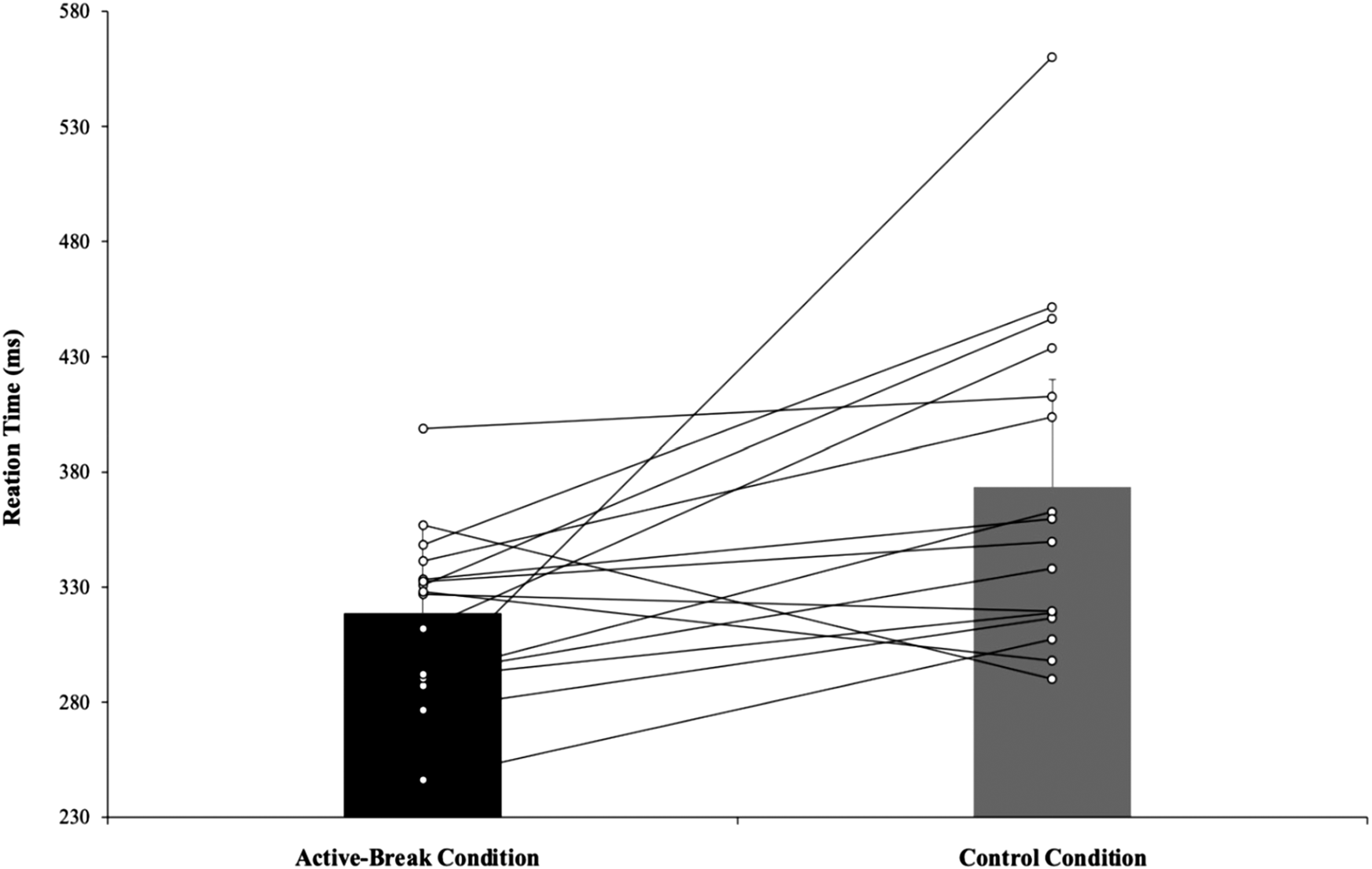
Verification
Claims the paper makes
The claims and statistics of this paper haven’t been checked yet.
Run the check — free, no account needed. It reads the open-access text and checks the sources it cites.
Claims other papers make about this one
Each is checked against this paper’s own text: does it say what the citing paper says it does?
The cited source says what the claim attributes to it.
In the citing paper
“Seven studies addressed sustained attention, five of which found significant improvements [22, 23, 25, 27, 34] and two reported no effect [29, 33], resulting in relatively strong evidence strength (71.4%).”
From Effect of classroom physical activity breaks on learning behaviors and academic achievements in university students: a systematic review (2026) · cites this paper as [27]
Self-check
Percentages, sums and reported differences re-computed from the paper’s own numbers.
The self-check needs the paper’s full text.
Citations
Cites
Age-predicted maximal heart rate revisited
Tanaka, H., Monahan, K. D., & Seals, D. R. (2001) · Journal of the American College of Cardiology · doi:10.1016/s0735-1097(00)01054-8 · Cited by 3,775 · cited 1×
“…simultaneously recorded by the classroom teacher using an ipad™ at the time of the intervention. heart rate data was immediately measured after the active break session. the formula (208 − [0.7 × age]) proposed by tanaka et al. (2001) was used to obtain the estimated threshold of the participants.”
InfluentialChaddock, L., Pontifex, M. B., Hillman, C. H., & Kramer, A. F. (2011) · Journal of the International Neuropsychological Society · doi:10.1017/s1355617711000567 · Cited by 369
Impact of short bouts of physical activity on attention-to-task in elementary school children
Mahar, M. T. (2011) · Preventive Medicine · doi:10.1016/j.ypmed.2011.01.026 · Cited by 202
Janssen, M., Toussaint, H. M., van Mechelen, W., & Verhagen, E. A. (2014) · SpringerPlus · doi:10.1186/2193-1801-3-410 · Cited by 66
Fenesi, B., Lucibello, K., Kim, J. A., & Heisz, J. J. (2018) · Journal of Applied Research in Memory and Cognition · doi:10.1016/j.jarmac.2018.01.012 · Cited by 45
Acute Effects of a Short Bout of Physical Activity on Cognitive Function in Sport Students
Niedermeier, M., Weiss, E. M., Steidl-Müller, L., Burtscher, M., & Kopp, M. (2020) · International Journal of Environmental Research and Public Health · doi:10.3390/ijerph17103678 · Cited by 33 · cited 1×
“…physical activity breaks has also been observed in previous research with children (Ma et al., 2015; Mahar, 2011) and undergraduate students, as niedermeier et al. (2020) demonstrated that 10 min of physical activity increased their visual attention. this finding suggests that even short bouts…”
Research works printed but not linked: 52
- Acevedo, E. O., & Ekkekakis, P. (2006). Psychobiology of physical activity. Human Kinetics.
- American College of Sports Medicine (2010). ACSM’s guidelines for exercise testing and prescription. Lippincott Williams & Wilkins.
- 10.2174/1875399X01407010203 · DOI
- 10.1017/S0033291709005960 · DOI · Paper page
- 10.2165/00007256-200232090-00002 · DOI
- 10.1016/j.neulet.2008.06.024 · DOI
- 10.1123/jsep.31.5.640 · DOI
- 10.1016/j.brainres.2012.02.068 · DOI · Paper page
- Chmura, J., Nazar, K., Kaciuba-Uscilko, H., & Pilis, W. (2002). The changes in psychomotor performance during progressive endurance exercise. Journal of Human Kinetics, 7, 3–10. https://johk.pl/?p=1084
- Dagenbach, D., & Carr, T. H. (1994). Inhibitory processes in attention, memory, and language. Academic Press.
- Davies, R. D., & Parasuraman, R. (1982). The psychology of vigilance. Academic Press.
- 10.1080/02640410410001675289 · DOI
- 10.1249/MSS.0000000000000966 · DOI
- 10.1093/sleep/28.9.1059 · DOI
- 10.1037/0012-1649.43.6.1428 · DOI · Paper page
- 10.1016/B978-0-12-812756-8.00002-5 · DOI
- 10.1111/sms.12310 · DOI
- 10.1249/MSS.0b013e3182305552 · DOI
- 10.1123/jpah.2015-0238 · DOI
- 10.1016/j.actpsy.2008.04.002 · DOI
- 10.1037/a0032634 · DOI
- Horgan, J. (2003). Lecturing for learning. In H. Fry, S. Ketteridge, & S. Marshall (Eds.), A handbook for teaching and learning in higher education (2nd ed., pp. 75–90). Routledge Falmer.
- 10.1016/j.mhpa.2014.05.002 · DOI
- 10.3390/brainsci11060675 · DOI
- 10.1111/j.1469-8986.1976.tb00116.x · DOI
- Kenney, W. L., Willmore, J. H., & Costill, D. L. (2013). Physiology of sport and exercise. Human Kinetics.
- 10.3389/fpsyg.2013.00863 · DOI · Paper page
- 10.1136/bjsports-2016-096224 · DOI · Paper page
- 10.1080/02640418808729800 · DOI
- Léger, L., & Gadoury, C. (1989). Validity of the 20 m shuttle run test with 1 min stages to predict VO2 max in adults. Canadian Journal of Sport Sciences, 14(1), 21–26.
- 10.3758/bf03195580 · DOI
- 10.1139/apnm-2014-0309 · DOI
- 10.5093/psed2020a16 · DOI
- 10.1177/0963721411429458 · DOI · Paper page
- 10.1016/j.clinph.2006.01.017 · DOI · Paper page
- 10.1016/j.jadohealth.2017.09.014 · DOI
- 10.1016/j.jsams.2017.07.002 · DOI
- 10.1177/1087054713507974 · DOI
- 10.1016/j.jsp.2009.11.002 · DOI
- 10.1016/S0165-0173(01)00044-3 · DOI · Paper page
- 10.3389/fpsyg.2016.01474 · DOI
- 10.1016/j.lindif.2009.10.009 · DOI
- 10.1016/S0001-6918(02)00134-8 · DOI · Paper page
- 10.1016/j.ypmed.2011.01.028 · DOI
- 10.1371/journal.pone.0032279 · DOI
- 10.3389/fpsyg.2016.00723 · DOI
- Warm, J. S., Dember, W. N., & Hancock, P. A. (1996). Vigilance and workload in automated systems. In R. Parasuraman & M. Mouloua (Eds.), Automation and human performance: Theory and applications (pp. 183–200). Erlbaum.
- 10.1518/001872008X312152 · DOI
- 10.1177/001872088202400409 · DOI
- 10.1249/00005768-199505000-00024 · DOI
- 10.1111/apa.13323 · DOI
- 10.1080/87567559909596075 · DOI
Cited by
Sorted by citations
Deng, Q., Wu, C., & Yang, L. (2026) · International Journal of Behavioral Nutrition and Physical Activity · doi:10.1186/s12966-026-01936-7
Metadata
- Authors
- Pastor-Vicedo, J. C., León, M. P., González-Fernández, F. T., & Prieto-Ayuso, A.
- Affiliations
- Department of Didactics of Physical Education, Arts Education and Music, University of Castilla-La Mancha
- University of Castilla-La Mancha (ES)
- Department of Physical Education and Sports, University of Granada
- Corresponding author
- Prieto-Ayuso, Alejandro
- ORCID
- Venue
- Cogent Social Sciences
- Publisher
- Informa UK Limited
- Published
- 2024-03-11
- Volume
- 10
- Issue
- 1
- ISSN
- 2331-1886 (ISSN-L)
- OpenAlex
- W4392661758
- Cited by
- 11
- References
- 6
- Citations by year
- 2026: 4 · 2025: 6 · 2024: 1
- FWCI
- 3.79
- Type
- journal article
- Language
- en
- Open access
- gold
- doi.org
- Licence
- Locations
- Cogent Social Sciences (publishedVersion, cc-by)
- Institutional Repository of the University of Granada (University of Granada) (submittedVersion, cc-by-nc-nd)
- DOAJ (DOAJ: Directory of Open Access Journals) (submittedVersion)
- RUIdeRA - Institutional University Repository (University of Castilla-La Mancha) (submittedVersion, other-oa)
- Funders
- Junta de Comunidades de Castilla-La Mancha
- ERDF (SBPLY/19/180501/000147)
- Topics
- Health Sciences › Medicine › Public Health, Environmental and Occupational Health › Physical Activity and Health
- Social Sciences › Psychology › Experimental and Cognitive Psychology › Sleep and Work-Related Fatigue
- Life Sciences › Neuroscience › Cognitive Neuroscience › Mind wandering and attention
- Keywords
- physical activity breaks, active breaks, cognitive function, sustained attention, attention, psychomotor vigilance task, undergraduate students, university students, moderate-intensity exercise
About these checks
Registry, retraction, Cites and statistics results are computed, not judged, with one exception: a printed reference that no index lists is read once by a model before it counts as a citation error. Claims are extracted by a model and kept only when their quote appears verbatim in the text; each cited source is then checked, with a model’s help, for whether it says what the claim relies on. Those verdicts can be wrong — read the claim’s quote and the cited source before relying on one.
Statistics and arithmetic are recomputed, not judged.
Confidence bands are shown only for fields calibrated on our annotated test set. None is calibrated yet, so no band is shown.
What counts as a claim ›How we measure confidence ›How we check this ›
Are you an author, or do you see a problem with this page? Request a review
