

Remittance–economic growth linkage in Africa: the roles of financial development and inflation
Open accessThe DOI matches its Crossref record; 53 of the 53 references it cites were found in a registry or an index; 6 of the 18 sources its claims cite were checked for support.
Abstract
This research explores the relationship between remittance inflows and economic growth across 43 African nations from 2007 to 2021 using two-step System GMM. The results establish that remittances have a statistically significant positive effect on economic growth, and financial development significantly amplifies this growth-promoting effect by channeling remittance funds into productive investment.
Overview
CoChat Summary
TL;DR
This study examines remittance–growth linkage in 43 African countries from 2007 to 2021 using System GMM, finding remittances have a positive significant effect on growth and financial development positively moderates that effect. Inflation’s moderating role is statistically insignificant, while financial development and internet usage show negative direct associations with growth.
Key findings
- Remittances have a positive and highly significant direct effect on economic growth: coefficient 0.2579 (p < 0.01), implying a one percentage point increase in remittances as a share of GDP is associated with approximately 0.26 percentage points higher GDP growth.
- Financial development positively moderates the remittance–growth relationship: the interaction term FD×REM is 0.0620 (p < 0.01), although the direct remittance effect becomes negative in that model (−0.6014, p < 0.01); financial development itself is negative and significant across models (−0.5548, −0.7278, −0.5781, p < 0.01).
- Inflation’s moderating effect is positive but statistically insignificant: INF×REM = 0.0031; inflation has a negative significant direct effect in the base model (−0.0517, p < 0.05).
- Internet usage is negative and significant across models (−0.1073, −0.1084, −0.1108, p < 0.01), while government effectiveness is statistically insignificant (0.3630 in the base model; −0.3442 and 0.9290 in interaction models). Diagnostic tests support the models: AR(2) p-values 0.0852, 0.1023, 0.1169; Hansen J p-values 0.3106, 0.3923, 0.4128.
Methods
- Panel data covering 43 African countries from 2007 to 2021, drawn from the World Development Indicators and Worldwide Governance Indicators.
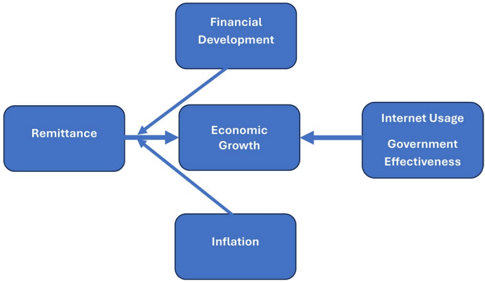
- Dependent variable: GDP growth (annual %). Independent variable: personal remittances received (% of GDP). Moderators: financial development measured by domestic credit to the private sector (% of GDP) and inflation measured by CPI (annual %). Controls: internet usage and government effectiveness.
- System GMM estimation (Arellano–Bover and Blundell–Bond) with a dynamic panel specification including lagged GDP growth and interaction terms; Hansen’s J-test and Arellano–Bond AR(2) test used for instrument validity and autocorrelation diagnostics.
Limitations
- Stated in the paper: reliance on secondary WDI/WGI data may not fully capture country-specific dynamics such as informal remittance flows and unrecorded transactions; the analysis is limited to aggregate economic growth and may overlook sectoral or regional differences. Future research is suggested on sectoral allocation, household-level inequality/poverty/human capital effects, and digital financial inclusion–governance interactions.
- Evident from the text: the abstract states government effectiveness is “consistently linked to lower growth,” but the reported coefficients are statistically insignificant (0.3630, −0.3442, 0.9290), so that claim is not supported by the results presented.
Model-written summary. Check it against the paper before relying on it.
Integrity signals
Registry
Cites
Statistics
Figures



Verification
Claims the paper makes
4 Valid · 0 Not valid · 8 Not checked · 68 Own results and interpretations
The cited sources support only part of this claim — read each source’s verdict below.
In the paper
“this finding in line with most prior studies (see Abdulai, 2023;Adjei et al., 2020;Bucevska, 2022;cazachevici et al., 2020).”
§ Remittance-economic growth linkage in Africa: the roles of financial development and inflation > 4.4. The impact of remittance on economic growth
What the sources say
- Partly supportedcites Abdulai, 2023 matched to “The impact of remittances on economic growth in Ghana: An ARDL bound test approach” (2023) sourceExperimental — accuracy not yet measured
The Conclusions and recommendations report that remittances promote GDP growth in Ghana in both the short and long run, and section 2.1 describes several prior studies with positive findings. But the Introduction calls the literature inconclusive and notes studies finding no significant or negative relationship; it does not establish that most prior studies found a positive effect. The indexed passages provide no page numbers. (LLM, conf=0.86)
- Supportedcites Adjei et al., 2020 matched to “The Effects of Remittances on Economic Growth in West Africa” (2020) source
The Literature Review states that most studies advocate a positive effect of remittances in developing countries and that empirical findings have generally argued for a positive effect on economic growth. It also acknowledges negative and null findings, which does not conflict with the claim about most prior studies. (LLM, conf=0.92)
- Partly supportedcites Bucevska, 2022 matched to “Impact of Remittances on Economic Growth: Empirical Evidence from South-East European Countries” (2022) sourceExperimental — accuracy not yet measured
The Conclusions (page not provided) report a significant positive effect of remittances on growth in the six countries studied. The Literature review (page not provided) describes several earlier positive findings, but calls the wider evidence inconclusive and also reports negative or insignificant findings. It does not establish that most prior studies agree. (LLM, conf=0.83)
plainstates a cause- Asserted: passes — The authors put it forward as true.
- Checkable: passes — It can be checked against evidence.
- Load-bearing: unclear — It is unclear whether the paper’s conclusions depend on it.
- Based: passes — The paper gives a reason why it holds.
- Partly supported
The cited sources support only part of this claim — read each source’s verdict below.
In the paper
“high inflation can erode the real value of remittance inflows, reducing their ability to support household consumption and investment”
§ Remittance-economic growth linkage in Africa: the roles of financial development and inflation > 1. Introduction
What the sources say
- Partly supportedcites dahal et al., 2024 matched to “Exploring the impact of remittance and economic growth on inflation” (2024) sourceExperimental — accuracy not yet measured
The Introduction (page not provided) says remittances can support consumption and investment. The Discussion (page not provided) describes remittances increasing recipients’ purchasing power and contributing to inflation, but neither passage says high inflation erodes the real value of remittances or reduces their ability to support consumption and investment. (LLM, conf=0.78)
plainstates a cause- Asserted: passes — The authors put it forward as true.
- Checkable: passes — It can be checked against evidence.
- Load-bearing: passes — The paper’s conclusions depend on it.
- Based: passes — The paper gives a reason why it holds.
- Partly supported
A result the paper reports from its own data — it cites no other source for it, so there is none to check. The quote shows it is in the paper.
In the paper
“the lagged dependent variable (GdPGt-1) shows a negative and highly significant coefficient of -0.0354 (p < 0.01), suggesting a slight mean reversion in growth patterns across African economies.”
§ Remittance-economic growth linkage in Africa: the roles of financial development and inflation > 4.4. The impact of remittance on economic growth
hedgedstates an association- Asserted: passes — The authors put it forward as true.
- Checkable: passes — It can be checked against evidence.
- Load-bearing: unclear — It is unclear whether the paper’s conclusions depend on it.
- Based: passes — The paper gives a reason why it holds.
A result the paper reports from its own data — it cites no other source for it, so there is none to check. The quote shows it is in the paper.
In the paper
“the findings reveal that remittances have a significant and positive effect on economic growth”
§ Remittance-economic growth linkage in Africa: the roles of financial development and inflation > Abstract
plainstates a cause- Asserted: passes — The authors put it forward as true.
- Checkable: passes — It can be checked against evidence.
- Load-bearing: passes — The paper’s conclusions depend on it.
- Based: passes — The paper gives a reason why it holds.
A result the paper reports from its own data — it cites no other source for it, so there is none to check. The quote shows it is in the paper.
In the paper
“financial development itself shows a stronger negative coefficient (-0.7278, p < 0.01) compared to the base model”
§ Remittance-economic growth linkage in Africa: the roles of financial development and inflation > 4.5.1. Moderating impact of financial development
plainstates an association- Asserted: passes — The authors put it forward as true.
- Checkable: passes — It can be checked against evidence.
- Load-bearing: unclear — It is unclear whether the paper’s conclusions depend on it.
- Based: passes — The paper gives a reason why it holds.
41 more claims
Create a free account to see all 80 claims and to verify the 1 reference still open.
- Probably not a substantial claim. 17
- It may state two separate claims as one. 20
- The quote only partly states this claim. 1
Self-check
Percentages, sums and reported differences re-computed from the paper’s own numbers.
Each contradiction between two passages listed here was confirmed by an independent check.
Rated major: it would touch a result — a value a result rests on, reported and recomputed p-values on opposite sides of the significance level, two passages that conflict with no sign which is right, or a cited work retracted before this paper was published.
In the paper
§ Remittance-economic growth linkage in Africa: the roles of financial development and inflation > Abstract
“notably, government effectiveness is consistently linked to lower growth, suggesting institutional shortcomings”
§ Remittance-economic growth linkage in Africa: the roles of financial development and inflation > 4.5.2. Moderating impact of inflation
“Government effectiveness, while positive (0.9290), remains statistically insignificant.”
Citations
Cites
On the mechanics of economic development
Lucas, R. E. (1988) · Journal of Monetary Economics · doi:10.1016/0304-3932(88)90168-7 · Cited by 24,085 · cited 1×
“…which together explain how remittances, financial development, and inflation interact to influence economic growth. the endogenous Growth theory (lucas, 1988; romer, 1986) emphasizes that internal factors—such as human capital, innovation, and investment—are key drivers of long-term growth.…”
Initial conditions and moment restrictions in dynamic panel data models
Blundell, R., & Bond, S. (1998) · Journal of Econometrics · doi:10.1016/s0304-4076(98)00009-8 · Cited by 22,571
Increasing returns and long-run growth
Romer, P. M. (1986) · Journal of Political Economy · doi:10.1086/261420 · Cited by 20,149 · cited 1×
“…explain how remittances, financial development, and inflation interact to influence economic growth. the endogenous Growth theory (lucas, 1988; romer, 1986) emphasizes that internal factors—such as human capital, innovation, and investment—are key drivers of long-term growth. remittances can…”
Another look at the instrumental variable estimation of error-components models
Arellano, M., & Bover, O. (1995) · Journal of Econometrics · doi:10.1016/0304-4076(94)01642-d · Cited by 19,880 · cited 1×
“…inflows and economic growth, while examining the moderating roles of financial development and inflation. the System GMM approach, as developed by Arellano and Bover (1995) and Blundell and Bond (1998), is particularly suitable for this study because it addresses key econometric challenges such…”
How to do Xtabond2: An Introduction to Difference and System GMM in Stata
Roodman, D. (2009) · The Stata Journal: Promoting communications on statistics and Stata · doi:10.1177/1536867x0900900106 · Cited by 9,848 · cited 1×
“…this structure ensures sufficient cross-sectional and temporal variation for reliable instrument construction and valid inference, in line with roodman (2009). the System GMM also accommodates heteroskedasticity and autocorrelation, thereby enhancing the efficiency and robustness of the…”
Financial development and economic growth in underdeveloped countries
Patrick, H. T. (1966) · Economic Development and Cultural Change · doi:10.1086/450153 · Cited by 1,807 · cited 2×
“…however, high inflation may erode the real value of remittances, diminishing their growth-enhancing potential. the Supply-leading hypothesis (Patrick, 1966) posits that financial development stimulates economic growth by mobilizing savings, reducing transaction costs, and efficiently…”
The impact of remittances on economic growth: An econometric model
Meyer, D., & Shera, A. (2017) · EconomiA · doi:10.1016/j.econ.2016.06.001 · Cited by 408 · cited 1×
“Several studies demonstrate a positive impact. for example, Meyer and Shera (2017) found that remittances significantly promote economic growth, especially when they form a substantial share of GdP. Similarly, Adjei et al. (2020) reported that remittances support growth in West Africa, particularly…”
Remittances and economic growth: A meta-analysis
Cazachevici, A., Havranek, T., & Horvath, R. (2020) · World Development · doi:10.1016/j.worlddev.2020.105021 · Cited by 262 · cited 3×
“…investment, and human capital development. this finding in line with most prior studies (see Abdulai, 2023; Adjei et al., 2020; Bucevska, 2022; cazachevici et al., 2020). financial development (fd) shows a negative and highly significant coefficient of −0.5548 ( p < 0.01), suggesting that…”
InfluentialThe impact of remittances on economic growth in Bangladesh, India, Pakistan and Sri Lanka
Sutradhar, S. R. (2020) · International Journal of Economic Policy Studies · doi:10.1007/s42495-020-00034-1 · Cited by 174 · cited 1×
“Sutradhar (2020) found remittances negatively impacted growth in several South Asian countries, likely due to labor market distortions and over-reliance on external transfers.”
Role of financial development for sustainable economic development in low middle income countries
Hunjra, A. I., Azam, M., Bruna, M. G., & Taskin, D. (2022) · Finance Research Letters · doi:10.1016/j.frl.2022.102793 · Cited by 163 · cited 2×
“…have on the effectiveness of remittances in promoting economic growth (see Afifah et al., 2024; Alemu, 2025; An et al., 2021; ustarz & fanta, 2021; hunjra et al., 2022; Maulana & Suprapti, 2025; Saidi, 2023; Shahbaz et al., 2022). thus, this study seeks to contribute to filling this gap by…”
The impact of financial development on economic growth in middle-income countries
Yang, F. (2019) · Journal of International Financial Markets, Institutions and Money · doi:10.1016/j.intfin.2018.11.008 · Cited by 142 · cited 1×
“Yang (2019) identifies financial development as a key driver of economic growth in middle-income economies, primarily through enhanced capital accumulation and total factor productivity.”
Impact of Remittance on Economic Progress: Evidence from Low-Income Asian Frontier Countries
Chowdhury, E. K., Dhar, B. K., & Gazi, M. A. I. (2022) · Journal of the Knowledge Economy · doi:10.1007/s13132-022-00898-y · Cited by 112 · cited 2×
“Similarly, chowdhury et al. (2023) and nyasha and Odhiambo (2022) identified negative growth effects in low-income Asian countries and South Africa, respectively, attributing this to unproductive consumption and institutional weaknesses.”
Shahbaz, M., Nasir, M. A., & Lahiani, A. (2022) · International Journal of Finance & Economics · doi:10.1002/ijfe.2157 · Cited by 96 · cited 2×
“…growth (see Afifah et al., 2024; Alemu, 2025; An et al., 2021; ustarz & fanta, 2021; hunjra et al., 2022; Maulana & Suprapti, 2025; Saidi, 2023; Shahbaz et al., 2022). thus, this study seeks to contribute to filling this gap by systematically analyzing the moderating roles of financial…”
The effect of financial development and remittances on economic growth
Ur Rehman, N., & Hysa, E. (2021) · Cogent Economics & Finance · doi:10.1080/23322039.2021.1932060 · Cited by 84 · cited 8×
“Similarly, inflationary trends differ across the continent, with some countries experiencing chronic inflation while others maintain relatively stable price levels (Bolhuis & Peter, 2022). these differences suggest that the impact of remittances on economic growth is likely to vary based on country-specific conditions…”
InfluentialFinancial development and economic growth in sub-Saharan Africa: A sectoral perspective
Ustarz, Y., & Fanta, A. B. (2021) · Cogent Economics & Finance · doi:10.1080/23322039.2021.1934976 · Cited by 71 · cited 2×
“…(2020) confirm a positive long-term relationship between financial development and growth across Africa, using panel VAr and quantile regressions. ustarz and fanta (2021) further show sectoral differences, with financial development benefiting the service and agricultural sectors but requiring a…”
Analyzing the impact of positive and negative remittance inflow shocks on economic growth of India
Khan, I. (2023) · Journal of Economic Studies · doi:10.1108/jes-02-2023-0089 · Cited by 61 · cited 3×
“…importance of financial inclusion and investment in amplifying remittance benefits. in South-east europe, Bucevska (2022) found remittances to be a key growth driver, while Khan (2023) noted their stabilizing effect in india during economic shocks. however, not all studies report positive outcomes.”
Remittances and financial development in Africa
Adekunle, I. A., Tella, S. A., Subair, K., & Adegboyega, S. B. (2020) · Journal of Public Affairs · doi:10.1002/pa.2545 · Cited by 47
Impact of Remittances on Economic Growth: Empirical Evidence from South-East European Countries
Bucevska, V. (2022) · South East European Journal of Economics and Business · doi:10.2478/jeb-2022-0006 · Cited by 46 · cited 3×
“…Bangladesh, respectively, highlighting the importance of financial inclusion and investment in amplifying remittance benefits. in South-east europe, Bucevska (2022) found remittances to be a key growth driver, while Khan (2023) noted their stabilizing effect in india during economic shocks.…”
InfluentialMigrants’ remittances and economic growth in Egypt: an empirical analysis from 1980 to 2017
Qutb, R. (2021) · Seikei ronsō/Review of economics and political science · doi:10.1108/reps-10-2018-0011 · Cited by 46 · cited 1×
“Qutb (2022) also reported a long-term negative impact in egypt, linking remittances to increased inflation and imports rather than investment.”
Pappas, A. P., & Boukas, N. (2025) · Economies · doi:10.3390/economies13020031 · Cited by 45 · cited 1×
“Pappas and Boukas (2025), studying eu economies, find that inflation volatility is more detrimental than inflation itself, as it discourages consumption and investment, resulting in slower economic growth.”
Impact of financial development on economic growth: Evidence from Sub‐Saharan Africa
An, H., Zou, Q., & Kargbo, M. (2021) · Australian Economic Papers · doi:10.1111/1467-8454.12201 · Cited by 37 · cited 2×
“…financial development and inflation may have on the effectiveness of remittances in promoting economic growth (see Afifah et al., 2024; Alemu, 2025; An et al., 2021; ustarz & fanta, 2021; hunjra et al., 2022; Maulana & Suprapti, 2025; Saidi, 2023; Shahbaz et al., 2022). thus, this study seeks to…”
The impact of remittances on economic growth in Ghana: An ARDL bound test approach
Abdulai, A.-M. (2023) · Cogent Economics & Finance · doi:10.1080/23322039.2023.2243189 · Cited by 35 · cited 3×
“…channels such as increased household consumption, investment, and human capital development. this finding in line with most prior studies (see Abdulai, 2023; Adjei et al., 2020; Bucevska, 2022; cazachevici et al., 2020). financial development (fd) shows a negative and highly significant…”
Causality between Foreign Remittance and Economic Growth: Empirical Evidence from Croatia
Depken, C. A., Radıć, M. N., & Paleka, H. (2021) · Sustainability · doi:10.3390/su132112201 · Cited by 33 · cited 1×
“Studies using advanced econometric models, such as VAr and Ardl (e.g., depken et al., 2021; Khan, 2023), confirm a causal link from remittances to growth, particularly when they are used to mitigate shocks or finance investments.”
The role of inflation in financial development–economic growth link in sub-Saharan Africa
Ibrahim, M., Aluko, O. A., & Vo, X. V. (2022) · Cogent Economics & Finance · doi:10.1080/23322039.2022.2093430 · Cited by 32 · cited 1×
“…no direct effect on growth, though macroeconomic instability, especially unemployment and exchange rate volatility, negatively impacts the economy. ibrahim et al. (2022), in analyzing the impact of inflation on the financial development–growth nexus, observe that irrespective of the indicator of…”
Re-examining the impact of financial intermediation on economic growth: evidence from Turkey
Yakubu, I. N., Abokor, A. H., & Gedik Balay, I. (2021) · Journal of Economics and Development · doi:10.1108/jed-09-2020-0139 · Cited by 28 · cited 2×
“…inflation (inf) exhibits a negative and significant impact (−0.0517, p < 0.05), confirming that price instability can hamper economic growth (Yakubu et al., 2021). internet usage (int) shows an unexpected negative and significant relationship with growth (−0.1073, p < 0.01). this may be due…”
InfluentialSelf-citationFinancial development and economic growth nexus in Africa
Manu, E. K., Wen, X., Paintsil, I. O., Gyedu, S., & Ntarmah, A. H. (2020) · Business Strategy & Development · doi:10.1002/bsd2.113 · Cited by 28 · cited 1×
“Manu et al. (2020) confirm a positive long-term relationship between financial development and growth across Africa, using panel VAr and quantile regressions. ustarz and fanta (2021) further show sectoral differences, with financial development benefiting the service and agricultural sectors but…”
Impact of Remittances on Financial Development: Revisiting the Evidence for ECOWAS Countries
Keho, Y. (2020) · Theoretical Economics Letters · doi:10.4236/tel.2020.101011 · Cited by 23 · cited 1×
“…such as savings, insurance, and investment (Garr & Awadzie, 2021). conversely, in countries with under-developed financial systems, remittances may be predominantly used for consumption rather than productive investment, thereby limiting their contribution to long-term economic growth (Keho, 2020).”
Remittances and economic growth in East Africa
Adow, A. A. (2025) · Cogent Economics & Finance · doi:10.1080/23322039.2025.2461604 · Cited by 23 · cited 2×
“…the money transfers sent by migrants to their home countries (Zerihun, 2020). these inflows have often surpassed foreign direct investment (fdi) and official development assistance (OdA) in several African nations, underscoring their significance in economic development (Adow, 2025; taiwo, 2021).”
The Effects of Remittances on Economic Growth in West Africa
Adjei, M., Bo, Y., Nketiah, E., Adu-Gyamfi, G., & Obuobi, B. (2020) · Journal of Human Resource and Sustainability Studies · doi:10.4236/jhrss.2020.83018 · Cited by 22 · cited 4×
“…such as increased household consumption, investment, and human capital development. this finding in line with most prior studies (see Abdulai, 2023; Adjei et al., 2020; Bucevska, 2022; cazachevici et al., 2020). financial development (fd) shows a negative and highly significant coefficient of…”
InfluentialHà, N. M., & Ngọc, B. H. (2023) · International Journal of Emerging Markets · doi:10.1108/ijoem-10-2020-1207 · Cited by 19 · cited 1×
“Meanwhile, Minh ha and ngoc (2025) demonstrate that financial development not only boosts national growth but also has positive spillover effects on neighboring Asian countries. in nepal, Pandey et al. (2024) find that financial development, supported by foreign direct investment, significantly…”
Qabaja, M., & Tenekeci, G. (2024) · Ain Shams Engineering Journal · doi:10.1016/j.asej.2024.103013 · Cited by 18 · cited 1×
“Qabaja and tenekeci (2024), covering nine countries across three continents, find bidirectional long-run relationships between inflation and growth in most cases, reinforcing the complexity of the inflation-growth nexus.”
Saidi, K. (2023) · Journal of the Knowledge Economy · doi:10.1007/s13132-023-01443-1 · Cited by 17 · cited 2×
“…economic growth (see Afifah et al., 2024; Alemu, 2025; An et al., 2021; ustarz & fanta, 2021; hunjra et al., 2022; Maulana & Suprapti, 2025; Saidi, 2023; Shahbaz et al., 2022). thus, this study seeks to contribute to filling this gap by systematically analyzing the moderating roles of…”
Oyadeyi, O. O., Oyadeyi, O. O., Osinubi, T. T., et al. (2025) · Cogent Economics & Finance · doi:10.1080/23322039.2025.2460066 · Cited by 16 · cited 1×
“Oyadeyi et al. (2025) also propose optimal inflation benchmarks for nigeria—9% for headline, 8.7% for core, and 12.7% for food inflation—suggesting that inflation targeting within these ranges supports economic performance.”
InfluentialFinancial Development and Foreign Direct Investment Impact on Economic Growth: Evidence from Nepal
Pandey, A., Shrestha, Z., & Acharya, K. R. (2024) · Interdisciplinary Journal of Innovation in Nepalese Academia · doi:10.3126/idjina.v3i1.70294 · Cited by 16 · cited 1×
“…that financial development not only boosts national growth but also has positive spillover effects on neighboring Asian countries. in nepal, Pandey et al. (2024) find that financial development, supported by foreign direct investment, significantly enhances both short-and long-term…”
The impact of remittances on economic growth: empirical evidence from South Africa
Nyasha, S., & Odhiambo, N. M. (2022) · International Journal of Trade and Global Markets · doi:10.1504/ijtgm.2022.121457 · Cited by 15
Inflation and Economic Growth in Sub-Saharan Africa: The Role of Institutions
Mignamissi, D., Bikoula, S. B. M., & Thioune, T. (2023) · Journal of Quantitative Economics · doi:10.1007/s40953-023-00366-7 · Cited by 15 · cited 1×
“Mignamissi et al. (2023) emphasize the non-linear relationship in Sub-Saharan Africa, identifying a 12.23% inflation threshold beyond which inflation becomes harmful to growth.”
InfluentialRemittances and the future of African economies
Adekunle, I. A., Tella, S. A., & Ogunjobi, F. O. (2021) · International Migration · doi:10.1111/imig.12951 · Cited by 14
Nguyen, T.-P., & Pham, T. T. T. (2021) · Journal of Asian Finance Economics and Business · doi:10.13106/jafeb.2021.vol8.no11.0191 · Cited by 14
The political economy of the G20 agenda on financial regulation
Schuknecht, L., & Siegerink, V. (2020) · European Journal of Political Economy · doi:10.1016/j.ejpoleco.2020.101941 · Cited by 11
Do Remittances Enhance Financial Inclusion in LMICs and in Fragile States?
Ben Naceur, S., Chami, R., & Trabelsi, M. (2020) · IMF Working Papers · doi:10.5089/9781513545394.001 · Cited by 11
Policy Pushes, Prices, and People: Unveiling Drivers of Global Remittance Inflows
Khan, I. M. (2024) · Journal of the Knowledge Economy · doi:10.1007/s13132-024-02456-0 · Cited by 10 · cited 1×
“…and fostering economic resilience. the potential benefits of remittances in stimulating economic growth are well-documented. they provide households with additional disposable income, improving access to basic necessities such as food, healthcare, and education (Bucevska, 2022; Khan, 2024).”
Yakubu, I. N., Kapusuzoğlu, A., & Ceylan, N. B. (2022) · Contributions to economics · doi:10.1007/978-3-031-13146-2_5 · Cited by 9
Self-citationRemittances and Economic Growth: Evidence from Ethiopia, Kenya, and Uganda
Zerihun, M. F. (2020) · AFRICAN HUMAN MOBILITY REVIEW · doi:10.14426/ahmr.v6i3.912 · Cited by 7 · cited 1×
“…external finance for many developing economies, particularly in Africa. remittance is the money transfers sent by migrants to their home countries (Zerihun, 2020). these inflows have often surpassed foreign direct investment (fdi) and official development assistance (OdA) in several African…”
Afridi, M. A., Khan, I., Rahman, H. U., & Khan, M. R. (2026) · Journal of Economic and Administrative Sciences · doi:10.1108/jeas-05-2024-0143 · Cited by 6 · cited 1×
“…in influencing the remittance-growth nexus, limited studies have examined their moderating roles within the developing country context (e.g. Afridi et al., 2024). existing research tends to focus on direct relationships, overlooking the interactive effects that financial development and…”
Jusaj, Y., Zogaj, V., & Abazi‐Alili, H. (2024) · Journal of Enterprising Communities People and Places in the Global Economy · doi:10.1108/jec-04-2024-0059 · Cited by 6 · cited 2×
“While some studies argue that remittances serve as an important driver of growth (Abdulai, 2023; Jusaj et al., 2024; Khan, 2023), others suggest that their impact is limited or even negative in some contexts (chowdhury et al., 2023; nyasha & Odhiambo, 2022).”
Exploring the impact of remittance and economic growth on inflation
Kumar Dahal, A., Bahadur Budhathoki, P., & Bhattarai, G. (2024) · SocioEconomic Challenges · doi:10.61093/sec.8(2).126-139.2024 · Cited by 5 · cited 1×
“…of money. high inflation can erode the real value of remittance inflows, reducing their ability to support household consumption and investment (dahal et al., 2024). inflationary pressures may also create economic uncertainty, discouraging investment and capital accumulation. in contrast, low…”
Alemu, F. M. (2025) · Insight on Africa · doi:10.1177/09750878241234254 · Cited by 5 · cited 2×
“Alemu (2025), examining ethiopia, finds that inflation has no direct effect on growth, though macroeconomic instability, especially unemployment and exchange rate volatility, negatively impacts the economy. ibrahim et al. (2022), in analyzing the impact of inflation on the financial…”
The Impact of Remittance on Economic Growth in Bangladesh
Saha, S. K. (2021) · Scholars Journal of Arts Humanities and Social Sciences · doi:10.36347/sjahss.2021.v09i09.013 · Cited by 4
Inflation-GDP growth nexus in South Africa: does lowering inflation target band matter?
Ndou, E., & Gumata, N. (2025) · Macroeconomics and Finance in Emerging Market Economies · doi:10.1080/17520843.2024.2448060 · Cited by 3 · cited 3×
“Similarly, chowdhury et al. (2023) and nyasha and Odhiambo (2022) identified negative growth effects in low-income Asian countries and South Africa, respectively, attributing this to unproductive consumption and institutional weaknesses.”
InfluentialThe Impact of Financial Intermediation on the Economy of Ghana
Garr, D. K. (2021) · Journal of Economics Finance and Management Studies · doi:10.47191/jefms/v4-i6-21 · Cited by 3
Analysis of the relationship between financial development and economic growth in the EU countries
Čižo, E., Lavrinenko, O., & Ignatjeva, S. (2020) · HAL · doi:10.9770/ird.2020.2.3(3 · Cited by 1 · cited 1×
“Similarly, Čižo et al. (2020) observe a bidirectional relationship in eu countries, noting that financial development both drives and responds to economic growth trends, though the strength and direction vary over time. in transitional economies, nguyen and Pham (2021) find an inverted u-shaped…”
The financial system and socio-economic development among emerging economies of Sub-Saharan Africa
Agyapong, E. K., Ohemeng, W., Astu, F., & Boateng, S. S. (2025) · African Journal of Economic and Management Studies · doi:10.1108/ajems-05-2024-0279 · Cited by 1 · cited 1×
“While some African economies have relatively sophisticated banking systems and capital markets, others continue to struggle with financial underdevelopment, limited banking penetration, and high levels of financial exclusion (Agyapong et al., 2025).”
Maulana, A. Z., & Suprapti, I. A. P. (2025) · Journal of Enterprise and Development · doi:10.20414/jed.v7i1.12710 · Cited by 1 · cited 2×
“…of remittances in promoting economic growth (see Afifah et al., 2024; Alemu, 2025; An et al., 2021; ustarz & fanta, 2021; hunjra et al., 2022; Maulana & Suprapti, 2025; Saidi, 2023; Shahbaz et al., 2022). thus, this study seeks to contribute to filling this gap by systematically analyzing…”
Research works printed but not linked: 7
- 6. Afifah, S. n., Machmud, A., istikomah, n., & Purnamasari, i. (2024). Analysis of the impact of inflation on economic Growth in indonesia using Simple regression Method. International Journal of Economics & Business Administration (IJEBA), 12(4), 99-107.
- 23. Gujarati, d. n. (2003). Basic Econometrics. New. Basic Econometrics. New. McGraw-hill.
- 32. Markaj, A. K., & Krasniqi, A. (2024). the relationship between inflation, interest rate, and economic growth: the case of Western Balkans countries. KNOWLEDGE-International Journal, 64(1), 55-60.
- 37. Muhammad, A. A. (2023). examining the relationship among unemployment, inflation, and economic growth. Journal of Business and Economic Options, 6(2), 23-31.
- 39. nainggolan, e., Widyawati, r. f., & fenny, f. (2025). Analysis of the impact of foreign debt, inflation rate and poverty rate on indonesia's economic growth. Journal of Management Science, 8(1), 120-127.
- 56. taiwo, K. (2021). Do remittances spur economic growth in Africa? university library of Munich.
- 57. titoe, M. d. (2019). remittances, financial development and economic growth in the economic community of West African states. West African Journal of Monetary and Economic Integration, 19(2), 71-83.
Cited by
Rahman, Z. U., Khan, W. A., & Nghiem, X. (2026) · Management of Environmental Quality An International Journal · doi:10.1108/meq-11-2024-0484 · Cited by 2
Impact of remittances on economic growth in Sub-Saharan African Countries
Jama, A., & Eshetu, F. (2026) · Cogent Social Sciences · doi:10.1080/23311886.2026.2729587
Majeed, A. (2026) · journal of social sciences review · doi:10.62843/jssr.v6i3.738
Aladejare, S. A. (2026) · SSRN Electronic Journal · doi:10.2139/ssrn.7507010
Metadata
- Authors
- Yakubu, I. N., Issaku, K. M., & Oumarou, S.
- Affiliations
- University for Development Studies (GH)
- Université Abdou Moumouni (NE)
- Corresponding author
- Oumarou, Seydou
- Venue
- Cogent Social Sciences
- Publisher
- Informa UK Limited
- Published
- 2025-12
- Volume
- 11
- Issue
- 1
- ISSN
- 2331-1886 (ISSN-L)
- OpenAlex
- W4416844664
- Semantic Scholar
- d9a2b186bcc1e10e18cd980bef2a51304fb0ea0b
- Cited by
- 4
- References
- 50
- Citations by year
- 2026: 4
- FWCI
- 6.97
- Type
- journal article
- Language
- en
- Open access
- gold
- doi.org
- Licence
- Locations
- Cogent Social Sciences (publishedVersion, cc-by)
- DOAJ (DOAJ: Directory of Open Access Journals) (submittedVersion)
- Topics
- Social Sciences › Sociology and Political Science › Migration and Labor Dynamics
- Social Sciences › Economics, Econometrics and Finance › Economics and Econometrics › Economic Growth and Development
- Social Sciences › Economics, Econometrics and Finance › General Economics, Econometrics and Finance › Monetary Policy and Economic Impact
- Keywords
- remittances, economic growth, financial development, inflation, government effectiveness, internet use, financial intermediation, remittance costs, digital technology adoption, institutional quality, Africa
About these checks
Registry, retraction, Cites and statistics results are computed, not judged, with one exception: a printed reference that no index lists is read once by a model before it counts as a citation error. Claims are extracted by a model and kept only when their quote appears verbatim in the text; each cited source is then checked, with a model’s help, for whether it says what the claim relies on. Those verdicts can be wrong — read the claim’s quote and the cited source before relying on one.
The claim verdicts this report counts are experimental: their accuracy is not yet measured.
A language model drew the claims from the paper on 2026-09-28, under version 3 of the claim definition (prompt extract-v3).
A second model labelled each claim on 2026-09-28 (model jev-1.13-20260917, definition revision gold-guideline-v0.2).
Cited sources are checked with a language model’s help (gpt-6-sol).
Statistics and arithmetic are recomputed, not judged.
Confidence bands are shown only for fields calibrated on our annotated test set. None is calibrated yet, so no band is shown.
What counts as a claim ›How we measure confidence ›How we check this ›
Are you an author, or do you see a problem with this page? Request a review
Data sources
Bibliographic data: Semantic Scholar, OpenAlex, Crossref.
Contains information from the Semantic Scholar Academic Graph Datasets, made available under the ODC Attribution License (ODC-BY 1.0).
Semantic Scholar’s data is described in: Kinney, R., et al. (2023). The Semantic Scholar Open Data Platform. arXiv:2301.10140.
