

Exploring the integration of cultural roots in contemporary Thai actor training using the Delphi method
Open accessThe DOI matches its Crossref record; 43 of the 45 references it cites were found in a registry or an index, and 1 are not checked yet; 8 of the 89 sources its claims cite were checked for support.
Abstract
Despite the country’s rich heritage of classical and folk performance, theatre education remains dominated by Western models, with traditional forms often marginalised or viewed as incompatible with modern performance contexts.
Verified 2026-11-22 · 1 reference not checked yet
Overview
CoChat Summary
TL;DR
This Delphi study examined how selected Thai traditional performing arts techniques could be integrated into contemporary actor training in Thailand. Ten experts participated in two rounds, and only breathwork achieved full consensus as a foundational technique, while other techniques received conditional support depending on context and pedagogy.
Key findings
- Among six traditional techniques evaluated in round 2, only breathwork for developing mindfulness and presence achieved full consensus: median 5.0, IQR 0.0, and 100% of panellists rating it 4 or above.
- Dance improvisation with music (folk dance) was the only other technique to meet two of three criteria: median 4.0 and 75% agreement, but its IQR of 1.25 slightly exceeded the acceptable limit.
- The remaining four techniques failed to meet at least two consensus criteria, though expert commentary indicated conditional support depending on learning objectives, context, and pedagogical approach.
- Panellists emphasised the teacher’s role as facilitator, the learner’s attitude, engaging with cultural essence rather than surface aesthetics, and integrating body, voice, singing, and storytelling.
Methods
- A two-round Delphi method was used, following Chuenjitwongsa (2017), with ethical approval from Thammasat University’s human research ethics committee.
- Ten purposively sampled experts in Thai theatre and performer training participated in round 1 online video in-depth interviews between May and June 2025; each met at least two inclusion criteria and had a minimum of ten years’ professional experience, with collective experience spanning 10 to 40 years.
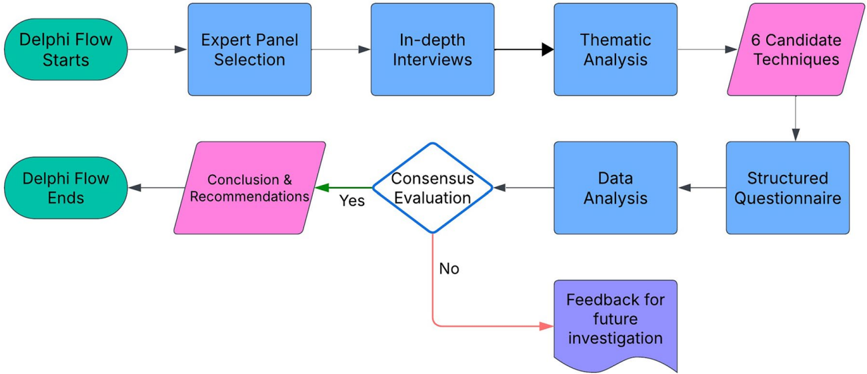
- Round 1 interviews were thematically analysed to identify six techniques; round 2 used a Google Forms questionnaire with 8 of the 10 experts, rating each technique on a 0–5 scale. Consensus required all three: median ≥4, IQR ≤1, and at least 70% of panellists rating 4 or 5.
Limitations
- The paper states the panel was limited to ten experts, reflecting the relatively small professional performing arts community in Thailand, though selection followed robust inclusion criteria.
- The paper states that only two Delphi rounds were used, that the other five techniques did not achieve full consensus, and that further rounds could be conducted in future research; it also suggests future rounds could include video demonstrations and broader panels.
- Evident from the text: round 2 had attrition, with only 8 of 10 experts participating, and the study assessed expert ratings and recommendations rather than implementing or testing a training programme.
Model-written summary. Check it against the paper before relying on it.
Integrity signals
Registry
Cites
Statistics
Figures


Verification
Claims the paper makes
6 Valid · 0 Not valid · 53 Not checked · 78 Own results and interpretations
The cited sources support only part of this claim — read each source’s verdict below.
In the paper
“Prevailing attitudes among students and teachers continue to deepen the divide between traditional forms and modern theatre in thailand.”
§ Exploring the integration of cultural roots in contemporary Thai actor training using the Delphi method > 1. Introduction
What the sources say
- Partly supportedcites Damrhung, 2005 matched to “Working Between two Worlds: New Roles for Traditional Thai Dance and Dancers” (2005) sourceExperimental — accuracy not yet measured
The section 'The cultural evolution of modern Thailand's traditional performing arts' does support much of the sentence: it describes 'institutional divisions into classical, folk, and modern theatre' matched by 'a hierarchy of respect for the arts,' with most young people 'unmoved by the power and the value of disciplined training in the classical and folk arts' while there is 'slightly more respect... for those interested in modern drama school,' and states these sharp divisions 'are not helpful for young people who want to interact and learn from each other.' However, the paper attributes the divisions to the government and to academic research, treating student attitudes as mirroring rather than deepening them, and it does not describe teachers' attitudes as widening a traditional/modern divide (the closest passage concerns the FAD ranking degrees and bureaucratic rank above innovation by artists and teachers). The progressive framing 'continue to deepen' also sits uneasily with the same section's statement that since the 2002 educational reforms 'these trends seem to be reversing.' (LLM, conf=0.72)
- Partly supportedcites sompiboon, 2021 matched to “I am Don Quixote the Trio Likay: A Soul-searching Content within Thai Popular Performance” (2021) sourceExperimental — accuracy not yet measured
The Introduction states that 'Likay has been stigmatized as an unsophisticated, and to some degree vulgar, popular performance which is considered inferior to elite or intellectual performances' owing to Thailand's 'highly hierarchically structured society' and class-based 'aesthetic judgment and discrimination' (Ferguson, 2007), and the Abstract/Introduction frame Anatta's work as hybridising tradition-popular and contemporary theatre in Thailand — so the general point about prevailing attitudes sustaining a divide between traditional popular forms and elite/modern theatre is in our copy. However, no passage attributes these attitudes to students or teachers specifically; the only educational reference is that likay is 'light entertainment for the low-class circle and poor education', i.e. a description of its audience, and the paper's own thrust is that likay practice 'bridges the gap' and 'goes beyond the limitations and boundaries of social hierarchy' (Why a Likay Performance is Comparable to Don Quixote of La Mancha; Conclusion) rather than that the divide continues to deepen. The 'students and teachers' population and the deepening-process framing are therefore unsupported by this source. (LLM, conf=0.70)
plainstates a cause- Asserted: passes — The authors put it forward as true.
- Checkable: passes — It can be checked against evidence.
- Load-bearing: passes — The paper’s conclusions depend on it.
- Based: passes — The paper gives a reason why it holds.
- Partly supported
The cited sources support only part of this claim — read each source’s verdict below.
In the paper
“classical 'royal' dance-dramas are often seen as highly technical yet rigid, constrained by strict conventions that feel disconnected from contemporary storytelling, while popular folk forms such as Likay are sometimes stigmatised as unsophisticated or vulgar entertainment, viewed as inferior to the 'high art' associated with elite or intellectual theatre (Damrhung, 2005;sompiboon, 2021).”
§ Exploring the integration of cultural roots in contemporary Thai actor training using the Delphi method > 1. Introduction
What the sources say
- Partly supportedcites Damrhung, 2005 matched to “Working Between two Worlds: New Roles for Traditional Thai Dance and Dancers” (2005) sourceExperimental — accuracy not yet measured
Our copy supports the general devaluation framework but not the claim's specific wording. In 'The cultural evolution of modern Thailand's traditional performing arts' Damrhung writes that the institutional divisions into classical, folk and modern theatre are 'matched by a hierarchy of respect for the arts', and that the FAD's standards 'led to an official discounting and a discrediting of much of the rich diversity of our performance traditions', causing communities 'to undercut their local folk arts and artists'. However, no passage calls Likay (or folk forms generally) 'unsophisticated' or 'vulgar', or frames it as inferior to 'elite or intellectual theatre'; Likay is described neutrally/positively as 'the popular form of Likay (which is popular and freer than the classical arts)' and as 'clever, beautiful, and sharply sarcastic', and as having adapted to 'commercial entertainment' and 'less-disciplined forms'. The companion half of the citing sentence (classical dance as technical yet rigid and disconnected) is well supported ('classical dance has frozen its repertoire'; standardisation 'has shrunk the scope for creativity'; audiences classify classical arts as 'frozen museum pieces'), so the citation fits that part better than the folk-stigma part attributed here. (LLM, conf=0.72)
- Supportedcites sompiboon, 2021 matched to “I am Don Quixote the Trio Likay: A Soul-searching Content within Thai Popular Performance” (2021) source
The Introduction (p. of 'I am Don Quixote the Trio Likay') opens with 'Likay has been stigmatized as an unsophisticated, and to some degree vulgar, popular performance which is considered inferior to elite or intellectual performances,' tying this to hierarchical aesthetic discrimination (Bechstedt/Reynolds; Ferguson, 2007). Supporting passages in 'Why a Likay Performance is Comparable to Don Quixote of La Mancha' describe likay as 'light entertainment for the low-classes and poorly educated' and a 'chaobaan (villager or commoner) performance ... substandard' to national high-art standards, and the figure discussion refers to the 'deep-seated culture that likay is solely light entertainment full of vulgarity and farce.' The cited part of the sentence (the likay clause, for which Sompiboon 2021 is offered) is thus fully stated in our copy; the classical dance-drama half is credited to Damrhung 2005 and not judged here. (LLM, conf=0.92)
hedged- Asserted: passes — The authors put it forward as true.
- Checkable: passes — It can be checked against evidence.
- Load-bearing: passes — The paper’s conclusions depend on it.
- Based: passes — The paper gives a reason why it holds.
- Partly supported
Every source the paper cites for this claim was checked and supports it.
In the paper
“a study by Phetruchee et al. (2024) explored the application of the stanislavski system to Lakhon Nai, a genre traditionally known for its aesthetic refinement and stylised gestures rather than psychological realism.the study found that techniques such as emotional memory, role analysis, and visualisation enhanced the expressive depth and authenticity of performers in thai court drama.”
§ Exploring the integration of cultural roots in contemporary Thai actor training using the Delphi method > 1. Introduction
What the sources say
- Supportedcites Phetruchee et al. (2024) matched to “The Application of the Stanislavski System in Thai Court Drama Learning” (2024) source
The Introduction identifies Thai court drama as Lakhon Nai and describes its emphasis on aesthetic refinement. The Discussion and Conclusion reports enhanced authenticity and emotional depth from applying Stanislavski’s techniques; the sections on preparation, role analysis, and visualization discuss the techniques named in the citing sentence. Page numbers were not available in our copy. (LLM, conf=0.93)
plainstates a cause- Asserted: passes — The authors put it forward as true.
- Checkable: passes — It can be checked against evidence.
- Load-bearing: unclear — It is unclear whether the paper’s conclusions depend on it.
- Based: passes — The paper gives a reason why it holds.
- Supported
The cited sources support only part of this claim — read each source’s verdict below.
In the paper
“this research underscores the potential for reciprocal influence between thai performance traditions and Western acting methodologies, suggesting avenues for innovative cross-cultural artistic development.”
§ Exploring the integration of cultural roots in contemporary Thai actor training using the Delphi method > 1. Introduction
What the sources say
- Partly supportedcites Phetruchee et al. (2024) matched to “The Application of the Stanislavski System in Thai Court Drama Learning” (2024) sourceExperimental — accuracy not yet measured
The Discussion and Conclusion describes the potential for cross-cultural adaptation by using Stanislavski’s methods to enhance Thai court drama. The Introduction likewise discusses adapting Western techniques to Thai performance. Neither passage describes reciprocal influence in which Thai traditions also shape Western acting methodologies; page numbers are not available in our copy. (LLM, conf=0.86)
hedgedstates an association- Asserted: passes — The authors put it forward as true.
- Checkable: passes — It can be checked against evidence.
- Load-bearing: passes — The paper’s conclusions depend on it.
- Based: passes — The paper gives a reason why it holds.
- Partly supported
A result the paper reports from its own data — it cites no other source for it, so there is none to check. The quote shows it is in the paper.
In the paper
“While the other techniques did not meet the statistical criteria for consensus, expert commentary indicated conditional support depending on context and pedagogical approach.”
§ Exploring the integration of cultural roots in contemporary Thai actor training using the Delphi method > Abstract
hedged- Asserted: passes — The authors put it forward as true.
- Checkable: passes — It can be checked against evidence.
- Load-bearing: passes — The paper’s conclusions depend on it.
- Based: passes — The paper gives a reason why it holds.
37 more claims
Create a free account to see all 137 claims and to verify the 7 references still open.
- It may state two separate claims as one. 50
- Probably not a substantial claim. 72
Citations
Cites
Reflecting on reflexive thematic analysis
Braun, V., & Clarke, V. (2019) · Qualitative Research in Sport, Exercise and Health · doi:10.1080/2159676x.2019.1628806 · Cited by 19,677 · cited 1×
“…the expert interviews were subjected to thematic analysis to inform the development of the round 2 questionnaire. thematic analysis, as outlined by Braun and clarke (2019, 2021) and Braun et al. (2019), involves a six-phase process: (1) familiarisation with the data through repeated reading and…”
One size fits all? What counts as quality practice in (reflexive) thematic analysis?
Braun, V., & Clarke, V. (2021) · Qualitative Research in Psychology · doi:10.1080/14780887.2020.1769238 · Cited by 9,727
Research guidelines for the Delphi survey technique
Hasson, F. (2000) · Journal of Advanced Nursing · doi:10.1046/j.1365-2648.2000.01567.x · Cited by 5,951 · cited 7×
“…individual perspectives into shared agreement while reducing the impact of dominant individuals that can shape discussions in direct group settings (hasson et al., 2000; sablatzky, 2022). the Delphi method is characterised by four key features: anonymity, iteration, controlled feedback, and the…”
InfluentialBraun, V., Clarke, V., Hayfield, N., & Terry, G. (2019) · Handbook of Research Methods in Health Social Sciences · doi:10.1007/978-981-10-5251-4_103 · Cited by 2,910
Consensus measurement in Delphi studies
von der Gracht, H. A. (2012) · Technological Forecasting and Social Change · doi:10.1016/j.techfore.2012.04.013 · Cited by 1,831 · cited 2×
“…measure of consensus due to its resistance to outliers and its effectiveness in capturing the consistency of expert responses (Beiderbeck et al., 2021; Von der gracht, 2012); and (3) at least 70% of panellists assigning a rating of 4 or 5. this combination of statistical indicators ensures that…”
Stability of response characteristics of a Delphi panel: application of bootstrap data expansion
Akins, R. B., Tolson, H., & Cole, B. R. (2005) · BMC Medical Research Methodology · doi:10.1186/1471-2288-5-37 · Cited by 994
Beiderbeck, D., Frevel, N., von der Gracht, H. A., Schmidt, S. L., & Schweitzer, V. M. (2021) · MethodsX · doi:10.1016/j.mex.2021.101401 · Cited by 642 · cited 1×
“…and widely accepted measure of consensus due to its resistance to outliers and its effectiveness in capturing the consistency of expert responses (Beiderbeck et al., 2021; Von der gracht, 2012); and (3) at least 70% of panellists assigning a rating of 4 or 5. this combination of statistical…”
Braun, V., Clarke, V., Hayfield, N., & Terry, G. (2018) · Handbook of Research Methods in Health Social Sciences · doi:10.1007/978-981-10-2779-6_103-1 · Cited by 423
International Journal of Applied Linguistics & English Literature
(2014) · International Journal of Applied Linguistics & English Literature · doi:10.7575/aiac · Cited by 241
(2008) · Cited by 153
Research works printed but not linked: 26
- 2. akkararatsakul, P. (2019). The creation of the northern folk dance performance for exercise in the elderly with the risk of osteo- arthritis: Tombol Namrid Elderly School, Muang District, Uttaradit [master's Degree thesis]. srinakharinwirot university.
- 7. Boonserm, P. (2016). Tradition and transformation of Thai classical dance: Nation, (Re)invention, and pedagogy [PhD thesis]. university of exeter.
- 11. Bridhyakorn, D. K. B., & Yupho, D. (2015). The Khōn. the fine arts Department.
- 14. chuenjitwongsa, s. (2017). How to conduct a Delphi study (michal tombs, ed.). school of Postgraduate medical and Dental education, Wales Deanery, cardiff university.
- 19. Damrhung, P., and lowell s. (eds.). (2024). Lives in motion: Celebrating dance in Thailand. routledge.
- 20. Diteeyont, s. (2013). Adaptation of Thai traditional plays on the thai contemporary stage: Finding an identity for the modern Thai theatre [Paper presentation]. asian conference on arts and humanities (pp. 4-7).
- 21. Dunlee, s., teppharak, K., & Krityakiarana, W. (2021). application of thai dance posture in muscle exercises to increase muscle strength and weakness among office workers. Journal of Fine and Applied Arts, Khon Kaen University, 14, 41-65.
- 22. hanphitakphong, P., & tapang, r. (2016). effect of fawn Jerng exercise on body flexibility in female adolescents. Naresuan Phayao Journal, 9, 35-39.
- 24. intharatsamee, K. (2022). The innovative performance of folk song drama [PhD thesis]. chulalongkorn university.
- 25. intharatsamee, K., & rojanasuksomboon, a. (2022). folk musical drama: Developmental process of improvisational acting skills. Pathumthani University Academic Journal, 14, 307-321.
- 26. iqbal, s., & Pipon-Young, l. (2009). the Delphi method. Methods, 22, 598-601.
- 29. Kiriwat, a. (2001). Khōn: Masked dance drama of the Thai epic Ramakien [ma theatre thesis]. university of maine.
- 31. Kongjinda, c. (2023). Development of 4 Regions Thai-folk dance learning outcomes through smartphone learning appli- cations for Matthayom 2 Students of Kasem Phithaya School Bangkok [master's Degree thesis]. srinakharinwirot university.
- 32. Kosanpipat, P. (2009). Development of a Fon Jeng exercise model to promote health status and health-related physical fitness of elderly women [PhD thesis]. chulalongkorn university.
- 37. na nakhon, W., onsiri, s., amitpai, c., & sukhomol, n. (2022). effects of applied fon-Jerng exercise dance program on physical fitness of elderly in the sriwiang Village, Wiang chai District, chiang rai Province. Journal of Health, Physical Education and Recreation, 48, 295-304.
- 38. nawai, a., ampansirirat, a., Kosanpipat, P., fujai, s., & Phongphanngam, s. (2020). Development of a fon Jeng exer- cise model to promote physical fitness and psychological well-being among community-dwelling older adults with knee pain. Journal of Social Science and Buddhistic Anthropology, 5, 266-285.
- 42. onsuntia, s. (2024). the creation of thai folk dance: rum tone nonthai. Journal of Human and Society, Sisaket Rajabhat University, 8, 119-136.
- 43. Pengjan, J. (2020). Development of an assessment scale for basic skills training for Khon drama for students in the college of dramatic arts under bunditpatanasilpa institute [master's Degree thesis]. sukhothai thammathirat open university.
- 47. Punpeng, g. (2021). Phillip Zarrilli's psychophysical acting approach. Academic Journal for the Humanities and Social Sciences Dhonburi Rajabhat University, 4, 138-151.
- 48. Punpeng, g. (2024a). Actor training for the 21st century: A psychophysical approach. chulalongkorn university Press.
- 55. suwanampha, t., gajaseni, r., anuwat, J., nakorn, n. n., mahamart, P., & Bowornitthikorn, P. (2021). the preliminary dance practice of Khon Phra. Wipitpatanasilpa Journal of Arts, 1. https://doi.org/10.14456/wipit.2021. · doi:10.14456/wipit.2021
- 56. suwannathat, n., tanphanich, t., & Vongsrangsap, s. (2025). Physical fitness development for Khon practitioner. Wipitpatanasilpa Journal of Arts, 5, 96-111.
- 58. suzuki, t. (1995). Culture is the body (P. Zarrilli ed., pp. 163-167). routledge.
- 59. suzuki, t., sant, t., & Jansen, s. (2003). Discipline in actor training. The Drama Review, 47, 147-158.
- 64. Waiyawek, P., & tongkam, W. (2021). Development of nora dance curriculum for the youth. Walailak Journal of Social Science, 14, 1-16.
- 68. Zarrilli, P. (2007). senses and silence in actor training and performance. in s. Banes and a. lepecki (eds.), The senses in performance (pp. 47-70). routledge.
Metadata
- Authors
- Punpeng, G.
- Affiliations
- Thammasat University (TH)
- Corresponding author
- Punpeng, Grisana
- ORCID
- Punpeng, Grisana
- Venue
- Cogent Arts & Humanities
- Publisher
- Informa UK Limited
- Published
- 2025-10-08
- Volume
- 12
- Issue
- 1
- ISSN
- 2331-1983 (ISSN-L)
- OpenAlex
- W4414987896
- Semantic Scholar
- 9ddbc9e8c58cccd0e9f936ed77e8c205bab36cea
- Cited by
- 1
- References
- 42
- Citations by year
- 2025: 1
- FWCI
- 4.62
- Type
- journal article
- Language
- en
- Open access
- gold
- doi.org
- Licence
- Locations
- Cogent Arts and Humanities (publishedVersion, cc-by)
- DOAJ (DOAJ: Directory of Open Access Journals) (submittedVersion, cc-by-sa)
- Funders
- THAMMASAT UNIVERSITY
- CHULALONGKORN UNIVERSITY
- Topics
- Social Sciences › Arts and Humanities › Visual Arts and Performing Arts › Theatre and Performance Studies
- Social Sciences › Arts and Humanities › Visual Arts and Performing Arts › Arts and Performance Studies
- Social Sciences › Arts and Humanities › Visual Arts and Performing Arts › Artistic and Creative Research
- Keywords
- traditional performing arts, theatre education, breathwork, movement sequences, expert consensus, teacher as facilitator
About these checks
Registry, retraction, Cites and statistics results are computed, not judged, with one exception: a printed reference that no index lists is read once by a model before it counts as a citation error. Claims are extracted by a model and kept only when their quote appears verbatim in the text; each cited source is then checked, with a model’s help, for whether it says what the claim relies on. Those verdicts can be wrong — read the claim’s quote and the cited source before relying on one.
The claim verdicts this report counts are experimental: their accuracy is not yet measured.
A language model drew the claims from the paper on 2026-10-10, under version 3 of the claim definition (model deepseek-v4.1-flash, prompt extract-v3).
A second model labelled each claim on 2026-10-10 (model jev-1.13-20260917, definition revision gold-guideline-v0.2).
Cited sources are checked with a language model’s help (qwen3.8-omni-flash and gpt-6-sol).
Statistics and arithmetic are recomputed, not judged.
Confidence bands are shown only for fields calibrated on our annotated test set. None is calibrated yet, so no band is shown.
What counts as a claim ›How we measure confidence ›How we check this ›
Are you an author, or do you see a problem with this page? Request a review
How to cite
Cite CoChat for the checks on this page, and the paper for its own findings.
- This page
- CoChat. (2026). Citation check: Exploring the integration of cultural roots in contemporary Thai actor training using the Delphi method. https://app.cochat.ai/papers/10.1080/23311983.2025.2570062
- The paper
- Punpeng, G. (2025). Exploring the integration of cultural roots in contemporary Thai actor training using the Delphi method. Cogent Arts & Humanities. https://doi.org/10.1080/23311983.2025.2570062
Data sources
Bibliographic data: Semantic Scholar, OpenAlex, Crossref.
Contains information from the Semantic Scholar Academic Graph Datasets, made available under the ODC Attribution License (ODC-BY 1.0).
Semantic Scholar’s data is described in: Kinney, R., et al. (2023). The Semantic Scholar Open Data Platform. arXiv:2301.10140.
