

Time-motion analysis as a novel approach for evaluating the impact of environmental heat exposure on labor loss in agriculture workers
Open accessThe DOI matches its Crossref record; 33 of the 34 references it cites were found in a registry or an index.
Abstract
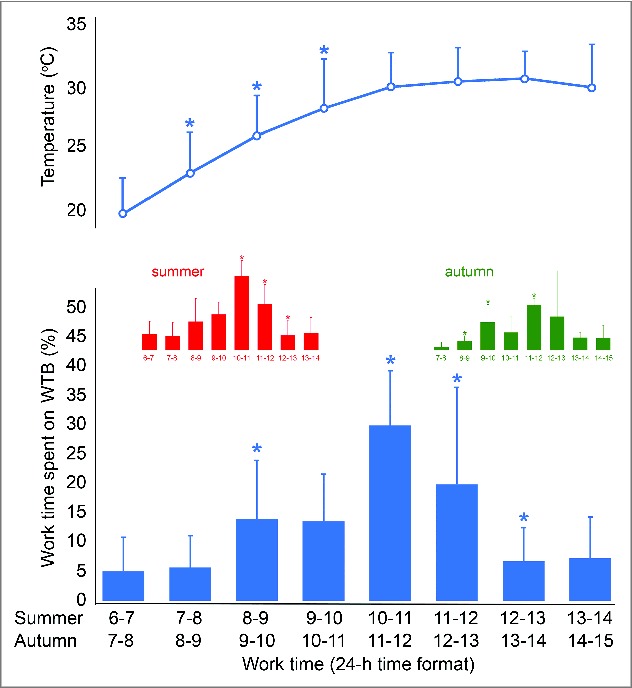
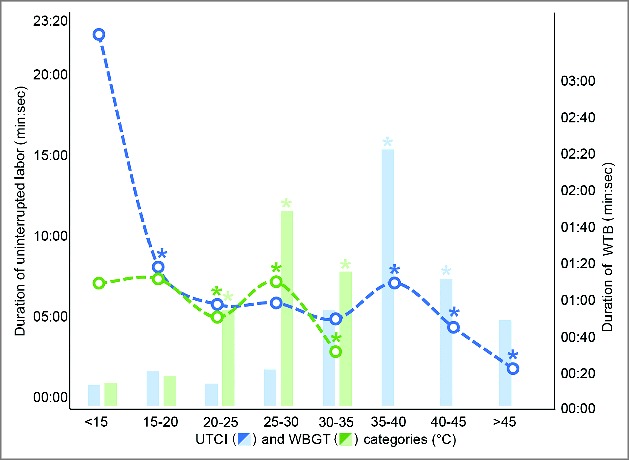
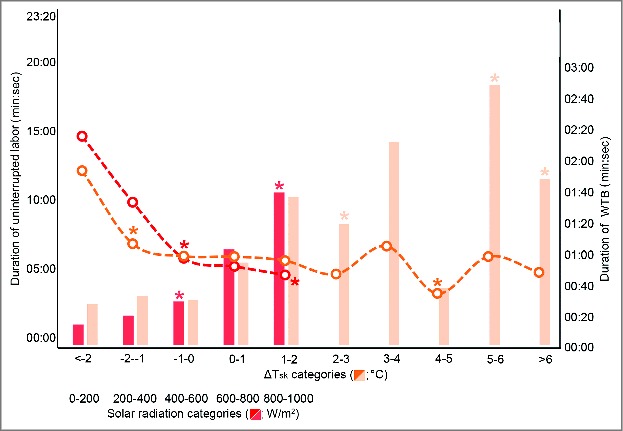
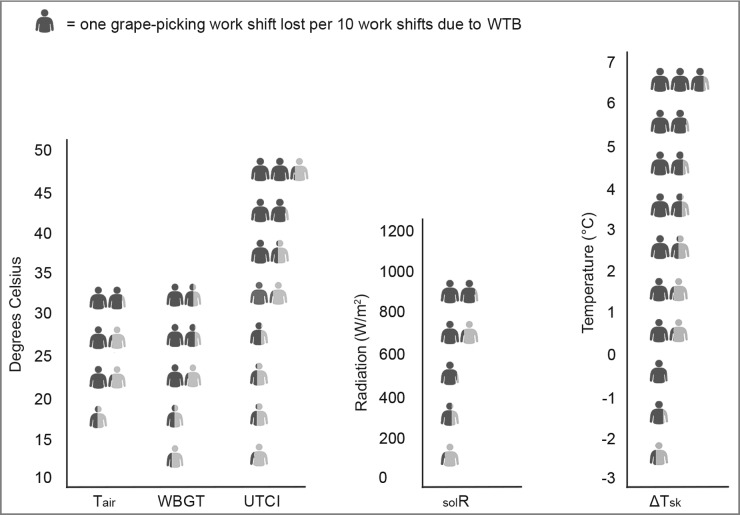
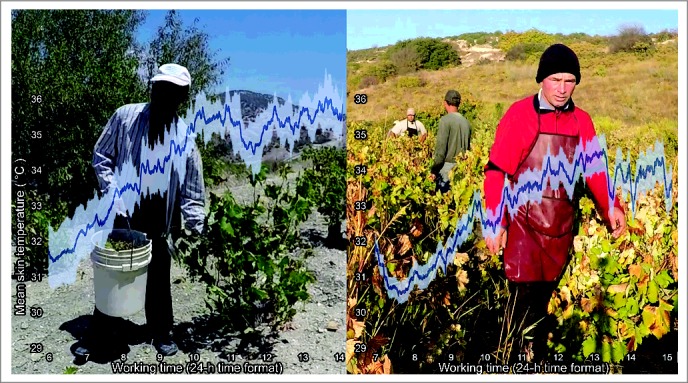
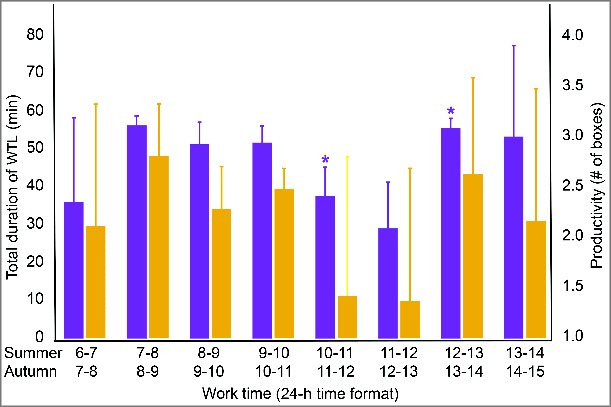
Introduction: In this study we (i) introduced time-motion analysis for assessing the impact of workplace heat on the work shift time spent doing labor (WTL) of grape-picking workers, (ii) examined whether seasonal environmental differences can influence their WTL, and (iii) investigated whether their WTL can be assessed by monitoring productivity or the vineyard manager's estimate of WTL. Methods: Seven grape-picking workers were assessed during the summer and/or autumn via video throughout four work shifts. Results: Air temperature (26.8 ± 4.8°C), wet bulb globe temperature (WBGT; 25.2 ± 4.1°C), universal thermal climate index (UTCI; 35.2 ± 6.7°C), and solar radiation (719.1 ± 187.5 W/m2) were associated with changes in mean skin temperature (1.7 ± 1.8°C) (p < 0.05). Time-motion analysis showed that 12.4% (summer 15.3% vs. autumn 10.0%; p < 0.001) of total work shift time was spent on irregular breaks (WTB). There was a 0.8%, 0.8%, 0.6%, and 2.1% increase in hourly WTB for every degree Celsius increase in temperature, WBGT, UTCI, and mean skin temperature, respectively (p < 0.01). Seasonal changes in UTCI explained 64.0% of the seasonal changes in WTL (p = 0.017). Productivity explained 36.6% of the variance in WTL (p < 0.001), while the vineyard manager's WTL estimate was too optimistic (p < 0.001) and explained only 2.8% of the variance in the true WTL (p = 0.456). Conclusion: Time-motion analysis accurately assesses WTL, evaluating every second spent by each worker during every work shift. The studied grape-picking workers experienced increased workplace heat, leading to significant labor loss. Monitoring productivity or the vineyard manager's estimate of each worker's WTL did not completely reflect the true WTL in these grape-picking workers.
Overview
The claims and statistics of this paper haven’t been checked yet.
Free: it reads the open-access text and checks the first 5 claims that cite a source we can check. Create a free account to check every claim.
Integrity signals
Registry
Cites
Statistics
Figures
Verification
Claims the paper makes
The claims and statistics of this paper haven’t been checked yet.
Free: it reads the open-access text and checks the first 5 claims that cite a source we can check. Create a free account to check every claim.
Claims other papers make about this one
Each is checked against this paper’s own text: does it say what the citing paper says it does?
The source backs part of the claim, not all of it — or backs it for a different population, condition or comparison.
In the citing paper
“This is probably related to the well-described effect of self-pacing that is known to act proactively to avoid an increase in workers’ core body temperature [13,25].”
From The Impacts of Sun Exposure on Worker Physiology and Cognition: Multi-Country Evidence and Interventions (2021) · cites this paper as [13]
Experimental — accuracy not yet measuredThe source backs part of the claim, not all of it — or backs it for a different population, condition or comparison.
In the citing paper
“However, recent data confirmed that these employees perform the vast majority of their work outdoors and are directly affected by sun exposure, leading to increased heat strain and impaired capacity for manual labor [10,11,12,13].”
From The Impacts of Sun Exposure on Worker Physiology and Cognition: Multi-Country Evidence and Interventions (2021) · cites this paper as [13]
Experimental — accuracy not yet measuredThe cited source says what the claim attributes to it.
In the citing paper
“Recent data from the European Commission project HEAT-SHIELD [23] show that higher skin temperature is linked with reduced capacity to perform manual labor, leading to significant economic losses [13,24].”
From The Impacts of Sun Exposure on Worker Physiology and Cognition: Multi-Country Evidence and Interventions (2021) · cites this paper as [13]
Self-check
Percentages, sums and reported differences re-computed from the paper’s own numbers.
The self-check needs the paper’s full text.
Citations
Cites
Faul, F., Erdfelder, E., Lang, A.-G., & Buchner, A. (2007) · Behavior Research Methods · doi:10.3758/bf03193146 · Cited by 65,971
A formula to estimate the approximate surface area if height and weight be known. 1916.
Bois, D. D., & Bois, E. F. D. (1989) · PubMed · Cited by 5,706
Du BOIS, D. (1916) · Archives of Internal Medicine · doi:10.1001/archinte.1916.00080130010002 · Cited by 4,342
A new weighting system for mean surface temperature of the human body
Ramanathan, N. L. (1964) · Journal of Applied Physiology · doi:10.1152/jappl.1964.19.3.531 · Cited by 1,883 · cited 1×
“2 (thigh C leg)].(22) The difference (DTsk) between the baseline Tsk (i.”
BackgroundDeriving the operational procedure for the Universal Thermal Climate Index (UTCI)
Bröde, P., Fiala, D., Błażejczyk, K., Holmér, I., Jendritzky, G., Kampmann, B., Tinz, B., & Havenith, G. (2012) · International Journal of Biometeorology · doi:10.1007/s00484-011-0454-1 · Cited by 1,243
Practical Assessment of Body Composition
Jackson, A. S., & Pollock, M. L. (1985) · The Physician and Sportsmedicine · doi:10.1080/00913847.1985.11708790 · Cited by 1,149 · cited 1×
“The latter was used to calculate body fat percentage according to the Jackson and Pollock equation.(19) Body surface area was calculated using the Du Bois formula.”
MethodKjellstrom, T., Holmer, I., & Lemke, B. (2009) · Global Health Action · doi:10.3402/gha.v2i0.2047 · Cited by 802
Self-citationPrediction of functional aerobic capacity without exercise testing
JACKSON, A. S., BLAIR, S. N., MAHAR, M. T., WIER, L. T., ROSS, R. M., & STUTEVILLE, J. E. (1990) · Medicine & Science in Sports & Exercise · doi:10.1249/00005768-199012000-00021 · Cited by 644 · cited 1×
“Maximal oxygen uptake was estimated using a non-exercise prediction model.(21)”
MethodEnergy cost and metabolic power in elite soccer: a new match analysis approach
OSGNACH, C., POSER, S., BERNARDINI, R., RINALDO, R., & DI PRAMPERO, P. E. (2010) · Medicine & Science in Sports & Exercise · doi:10.1249/mss.0b013e3181ae5cfd · Cited by 597 · cited 1×
“Time-motion analysis is a qualitative method that has been used for some time for the assessment of physical performance and work intensity in elite team sports.(29,30) In occupational settings, it is one of the recommended methods by the American Conference of Governmental Industrial Hygienists to assess hand activit…”
MethodHeat stress causes substantial labour productivity loss in Australia
Zander, K. K., Botzen, W. J. W., Oppermann, E., Kjellstrom, T., & Garnett, S. T. (2015) · Nature Climate Change · doi:10.1038/nclimate2623 · Cited by 459 · cited 1×
“2 billion USD).(15) Therefore, it is vital to identify means that will allow employees to be more productive despite using traditional work practices in their natural habitat and – at the same time – will protect their health and safety as well as improve job satisfaction.”
BackgroundSelf-citationModeling the Wet Bulb Globe Temperature Using Standard Meteorological Measurements
Liljegren, J. C., Carhart, R. A., Lawday, P., Tschopp, S., & Sharp, R. (2008) · Journal of Occupational and Environmental Hygiene · doi:10.1080/15459620802310770 · Cited by 404
Calculating Workplace WBGT from Meteorological Data: A Tool for Climate Change Assessment
LEMKE, B., & KJELLSTROM, T. (2012) · Industrial Health · doi:10.2486/indhealth.ms1352 · Cited by 394
Self-citationClimate in the eastern Mediterranean, and adjacent regions, during the past 6000 years – A review
Finné, M., Holmgren, K., Sundqvist, H. S., Weiberg, E., & Lindblom, M. (2011) · Journal of Archaeological Science · doi:10.1016/j.jas.2011.05.007 · Cited by 350
Effects of Heat Stress on Working Populations when Facing Climate Change
LUNDGREN, K., KUKLANE, K., GAO, C., & HOLM^|^Eacute;R, I. (2013) · Industrial Health · doi:10.2486/indhealth.2012-0089 · Cited by 310
Human behavioral thermoregulation during exercise in the heat
Flouris, A. D., & Schlader, Z. J. (2015) · Scandinavian Journal of Medicine & Science in Sports · doi:10.1111/sms.12349 · Cited by 249 · cited 2×
“In turn, this leads to increased perceived exertion that, eventually, causes reductions in work rate.(6)”
BackgroundSelf-citationSAHU, S., SETT, M., & KJELLSTROM, T. (2013) · Industrial Health · doi:10.2486/indhealth.2013-0006 · Cited by 249 · cited 3×
“, the number of boxes full of grapes picked by the entire group in each hour divided by the number of workers (six workers during the summer and five workers during the autumn)].(10)”
BackgroundSelf-citationPerformance in the Heat—Physiological Factors of Importance for Hyperthermia‐Induced Fatigue
Nybo, L., Rasmussen, P., & Sawka, M. N. (2014) · Comprehensive Physiology · doi:10.1002/cphy.c130012 · Cited by 231
Self-citationHübler, M., Klepper, G., & Peterson, S. (2008) · Ecological Economics · doi:10.1016/j.ecolecon.2008.04.010 · Cited by 151
Global wine markets, 1860 to 2016: a statistical compendium
Anderson, K., Nelgen, S., & Pinilla, V. (2017) · University of Adelaide Press eBooks · doi:10.20851/global-wine-markets · Cited by 138
Long term changes in diurnal temperature range in Cyprus
Price, C. G., Michaelides, S. C., Pashiardis, S., & Alpert, P. (1999) · Atmospheric Research · doi:10.1016/s0169-8095(99)00022-8 · Cited by 113 · cited 1×
“maximum temperature in August (the main part of the harvest season) is around 36 C.(4) These working conditions would be considered a heat-wave in Central European countries such as Germany.”
BackgroundGlobal wine markets, 1961 to 2009: a statistical compendium
Anderson, K., & Nelgen, S. (2009) · University of Adelaide Press eBooks · doi:10.1017/upo9780987073013 · Cited by 108
Falcone, G., De Luca, A., Stillitano, T., Strano, A., Romeo, G., & Gulisano, G. (2016) · Sustainability · doi:10.3390/su8080793 · Cited by 105
Ramos, M. C., & Martínez-Casasnovas, J. A. (2005) · Journal of Hydrology · doi:10.1016/j.jhydrol.2005.07.055 · Cited by 82 · cited 2×
“For instance, factors such as land leveling and soil moisture can locally affect grape production by up to 50% within the same vineyard.(16)”
BackgroundMethodEnergy expenditure and intensity of physical activity in soccer referees during match-play.
da Silva, A. I., Fernandes, L. C., & Fernández, R. (2008) · Europe PMC (PubMed Central) · Cited by 80
Prolonged self-paced exercise in the heat – environmental factors affecting performance
Junge, N., Jørgensen, R., Flouris, A. D., & Nybo, L. (2016) · Temperature · doi:10.1080/23328940.2016.1216257 · Cited by 80
Self-citationAssigning Metabolic Equivalent Values to the 2002 Census Occupational Classification System
Tudor-Locke, C., Ainsworth, B. E., Washington, T. L., & Troiano, R. (2011) · Journal of Physical Activity and Health · doi:10.1123/jpah.8.4.581 · Cited by 75 · cited 1×
“Based on our calculations, our workers performed moderate-intensity work with an average work rate of »330 W for men and »260 W for women (calculation based on known energy expenditure for “farming, fishing, and forestry”).(36) As such, work-rest ratios should be 3:1, 1:1, and 1:3 at WBGT 29 C, 30.”
Links between thermoregulation and aging in endotherms and ectotherms
Flouris, A. D., & Piantoni, C. (2014) · Temperature · doi:10.4161/23328940.2014.989793 · Cited by 74 · cited 1×
“This was anticipated, given the significant changes seen in Tsk, which is the main driver of behavioral thermoregulation.(6,35) Indeed, environmental and metabolic heat gain lead to increased Tsk, which augments thermal perception and/or cardiovascular strain.”
BackgroundSelf-citationOccupational heat stress in Australian workplaces
Jay, O., & Brotherhood, J. R. (2016) · Temperature · doi:10.1080/23328940.2016.1216256 · Cited by 66
Heat exposure and productivity in orchards: Implications for climate change research
Quiller, G., Krenz, J. E., Ebi, K. L., Hess, J. J., Fenske, R. A., Sampson, P. D., Pan, M., & Spector, J. T. (2017) · Archives of Environmental & Occupational Health · doi:10.1080/19338244.2017.1288077 · Cited by 50 · cited 1×
“occupational studies in the literature reporting similar effects on the productivity of workers in the agriculture industry.(9,10) Agricultural workers, and especially grape-picking workers, cannot avoid workplace heat exposure.”
BackgroundThe physical demands of electrical utilities work in North America
Meade, R. D., Lauzon, M., Poirier, M. P., Flouris, A. D., & Kenny, G. P. (2016) · Journal of Occupational and Environmental Hygiene · doi:10.1080/15459624.2015.1077966 · Cited by 45 · cited 3×
“of workers during periods of increased occupational heat stress.(17) Time-motion analysis includes analyzing movement and the time spent on each movement through video analysis.”
BackgroundMethodInfluentialSelf-citationHeudorf, U., & Schade, M. (2014) · Zeitschrift für Gerontologie und Geriatrie · doi:10.1007/s00391-014-0673-2 · Cited by 37
Wurzelbacher, S. J., Burt, S. E., Crombie, K., Ramsey, J. G., Luo, L., Allee, S., & Jin, Y. (2010) · Journal of Occupational and Environmental Hygiene · doi:10.1080/15459624.2010.481171 · Cited by 27 · cited 1×
“threshold limit values,(31) and has been adopted to determine the degree of correlation between hand activity/force ratings in various jobs.(32) Moreover, we recently used this technique to assess the physiologic strain of electrical utilities workers in hot regions of North America.”
MethodHow should we measure occupational heat stress?
Budd, G. M. (2016) · Temperature · doi:10.1080/23328940.2016.1218992 · Cited by 4
Research works printed but not linked: 2
- ACGIH Hand activity level In: 2001 TLVs and BEIs. Cincinnati (OH): ACGIH; 2001.
- International Organization for Standardization ISO standard 7243: hot environments – estimation of heat stress on working man based on the WBGT index (wet bulb globe temperature). Geneva: International Organization for Standardization; 1989.
Cited by
Hot weather and heat extremes: health risks
Ebi, K. L., Capon, A., Berry, P., Broderick, C., de Dear, R., Havenith, G., Honda, Y., Kovats, R. S., Ma, W., Malik, A., et al. (2021) · The Lancet · doi:10.1016/s0140-6736(21)01208-3 · Cited by 2,172
Self-citationFlouris, A. D., Dinas, P. C., Ioannou, L. G., Nybo, L., Havenith, G., Kenny, G. P., & Kjellstrom, T. (2018) · The Lancet Planetary Health · doi:10.1016/s2542-5196(18)30237-7 · Cited by 579
“4,6,26,33–35, 39–”
Self-citationCurrent and projected regional economic impacts of heatwaves in Europe
García-León, D., Casanueva, A., Standardi, G., Burgstall, A., Flouris, A. D., & Nybo, L. (2021) · Nature Communications · doi:10.1038/s41467-021-26050-z · Cited by 279
Self-citationOverview of Existing Heat-Health Warning Systems in Europe
Casanueva, A., Burgstall, A., Kotlarski, S., Messeri, A., Morabito, M., Flouris, A. D., Nybo, L., Spirig, C., & Schwierz, C. (2019) · International Journal of Environmental Research and Public Health · doi:10.3390/ijerph16152657 · Cited by 243
Self-citationOccupational heat strain in outdoor workers: A comprehensive review and meta-analysis
Ioannou, L. G., Foster, J., Morris, N. B., Piil, J. F., Havenith, G., Mekjavic, I. B., Kenny, G. P., Nybo, L., & Flouris, A. D. (2022) · Temperature · doi:10.1080/23328940.2022.2030634 · Cited by 208
“Our search resulted in 38 eligible ecological studies that involved monitoring experienced and acclimatized outdoor workers carrying out 41 jobs across 21 countries: Australia [64,66,80–82], Brazil [83], China [84,85], Cyprus [11,58,86], El Salvador [87], Greece [2,58], Cambodia [88], Guatemala [67], Hong Kong [89], I…”
BackgroundMethodInfluentialSelf-citation
Metadata
- Authors
- Ioannou, L. G., Tsoutsoubi, L., Samoutis, G., Bogataj, L. K., Kenny, G. P., Nybo, L., Kjellstrom, T., & Flouris, A. D.
- Affiliations
- University of Thessaly (GR)
- University of Nicosia (CY)
- Biotehnical Faculty, University of Ljubljana, Ljubljana, Slovenia
- University of Ottawa (CA)
- University of Copenhagen (DK)
- Centre for Technology Research & Innovation (Cyprus) (CY)
- Corresponding author
- Flouris, Andreas D.
- ORCID
- Venue
- Temperature
- Publisher
- Informa UK Limited
- Published
- 2017-07-03
- Volume
- 4
- Issue
- 3
- Pages
- 330-340
- ISSN
- 2332-8940 (ISSN-L)
- 2332-8959
- PMC
- PMC5605156
- OpenAlex
- W2736059161
- Cited by
- 103
- References
- 34
- Citations by year
- 2026: 7 · 2025: 9 · 2024: 10 · 2023: 9 · 2022: 14 · 2021: 15 · 2020: 11 · 2019: 12 · 2018: 11 · 2017: 4
- FWCI
- 7.69
- Type
- journal article
- Language
- en
- Open access
- hybrid
- doi.org
- Licence
- Locations
- Temperature (publishedVersion, cc-by-nc-nd)
- PubMed Central (publishedVersion, cc-by-nc-nd)
- PubMed (publishedVersion)
- Research at the University of Copenhagen (University of Copenhagen) (publishedVersion, cc-by-nc-nd)
- University of Thessaly Institutional Repository (University of Thessaly) (submittedVersion)
- Funders
- European Commission (668786, HORIZON2020)
- Topics
- Health Sciences › Medicine › Physiology (medical) › Thermoregulation and physiological responses
- Health Sciences › Medicine › Public Health, Environmental and Occupational Health › Occupational Health and Safety in Workplaces
- Health Sciences › Medicine › Public Health, Environmental and Occupational Health › Agriculture and Farm Safety
- Keywords
- time and motion study, labor loss, agricultural labor, skin temperature, Universal Thermal Climate Index, wet bulb globe temperature, solar radiation, seasonal variation, labor productivity, rest breaks, vineyard management
About these checks
Registry, retraction, Cites and statistics results are computed, not judged, with one exception: a printed reference that no index lists is read once by a model before it counts as a citation error. Claims are extracted by a model and kept only when their quote appears verbatim in the text; each cited source is then checked, with a model’s help, for whether it says what the claim relies on. Those verdicts can be wrong — read the claim’s quote and the cited source before relying on one.
Statistics and arithmetic are recomputed, not judged.
Confidence bands are shown only for fields calibrated on our annotated test set. None is calibrated yet, so no band is shown.
What counts as a claim ›How we measure confidence ›How we check this ›
Are you an author, or do you see a problem with this page? Request a review
Data sources
Bibliographic data: Semantic Scholar, OpenAlex, Crossref.
Contains information from the Semantic Scholar Academic Graph Datasets, made available under the ODC Attribution License (ODC-BY 1.0).
Semantic Scholar’s data is described in: Kinney, R., et al. (2023). The Semantic Scholar Open Data Platform. arXiv:2301.10140.
