

Integrin-linked kinase stabilizes myotendinous junctions and protects muscle from stress-induced damage
Open accessThe DOI matches its Crossref record; 58 of the 58 references it cites were found in a registry or an index.
Abstract
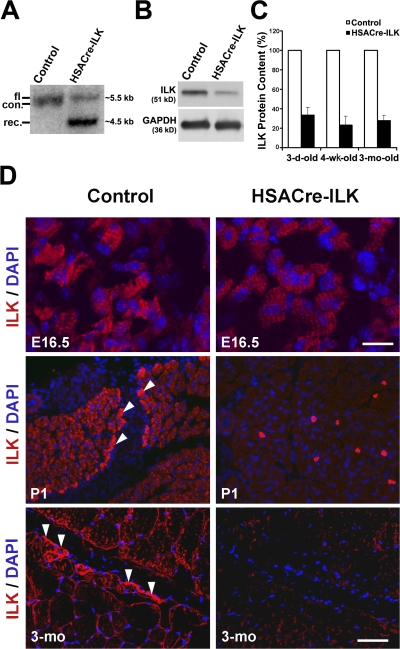
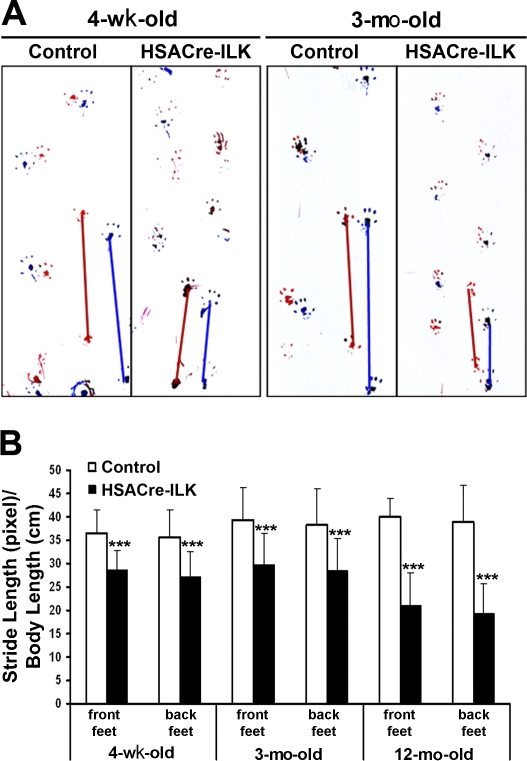
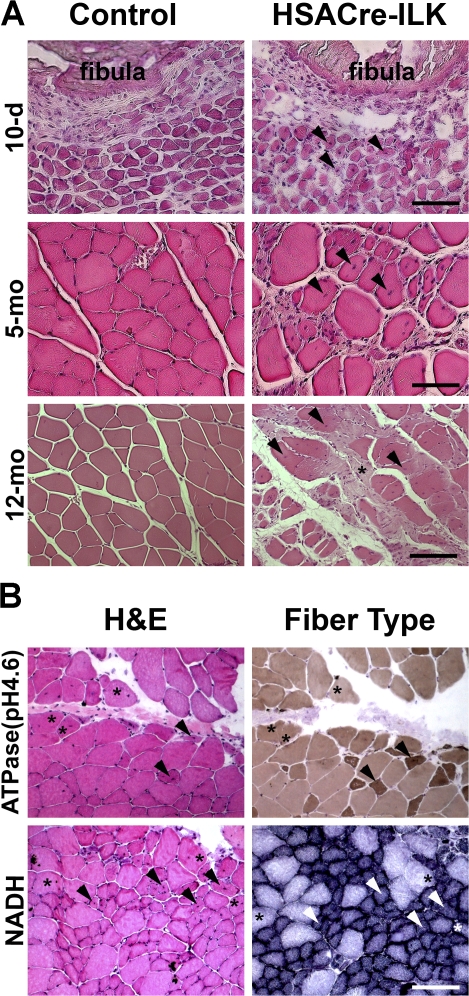
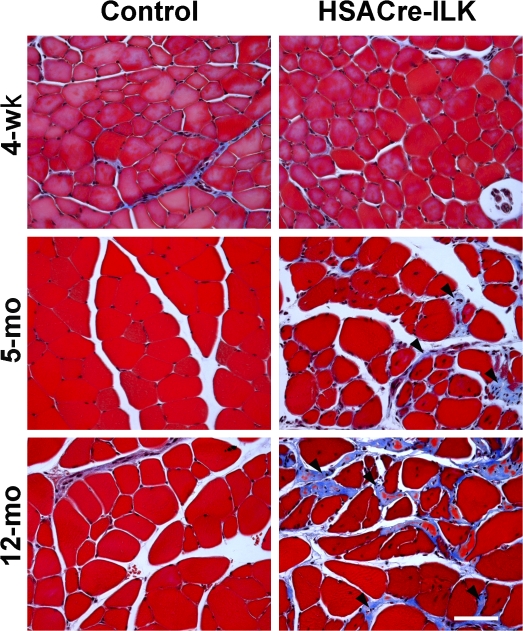
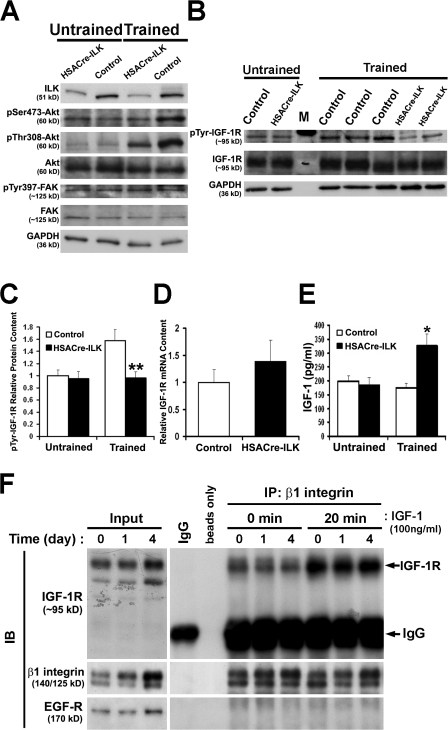
Skeletal muscle expresses high levels of integrin-linked kinase (ILK), predominantly at myotendinous junctions (MTJs) and costameres. ILK binds the cytoplasmic domain of β1 integrin and mediates phosphorylation of protein kinase B (PKB)/Akt, which in turn plays a central role during skeletal muscle regeneration. We show that mice with a skeletal muscle–restricted deletion of ILK develop a mild progressive muscular dystrophy mainly restricted to the MTJs with detachment of basement membranes and accumulation of extracellular matrix. Endurance exercise training enhances the defects at MTJs, leads to disturbed subsarcolemmal myofiber architecture, and abrogates phosphorylation of Ser473 as well as phosphorylation of Thr308 of PKB/Akt. The reduction in PKB/Akt activation is accompanied by an impaired insulin-like growth factor 1 receptor (IGF-1R) activation. Coimmunoprecipitation experiments reveal that the β1 integrin subunit is associated with the IGF-1R in muscle cells. Our data identify the β1 integrin–ILK complex as an important component of IGF-1R/insulin receptor substrate signaling to PKB/Akt during mechanical stress in skeletal muscle.
Overview
The claims and statistics of this paper haven’t been checked yet.
Free: it reads the open-access text and checks the first 5 claims that cite a source we can check. Create a free account to check every claim.
Integrity signals
Registry
Cites
Statistics
Figures
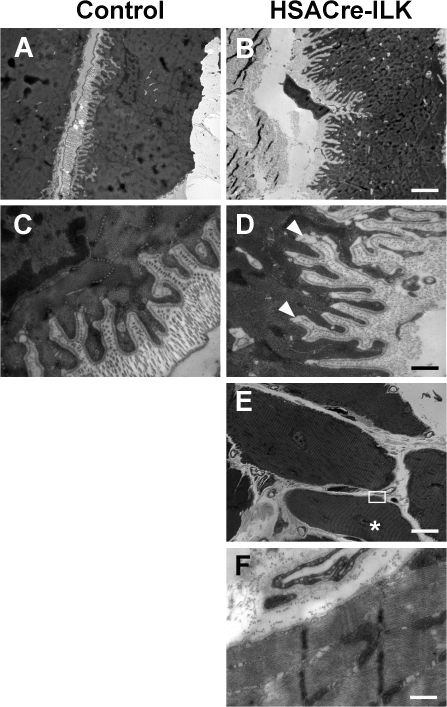
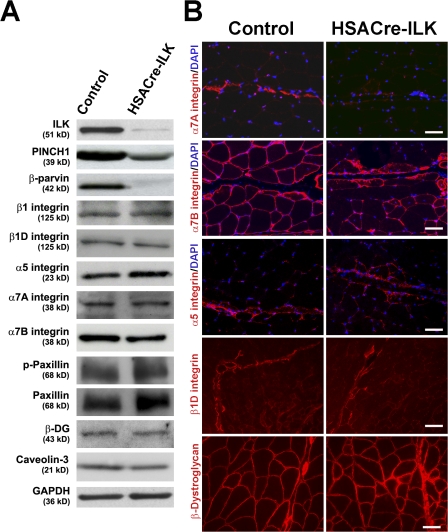
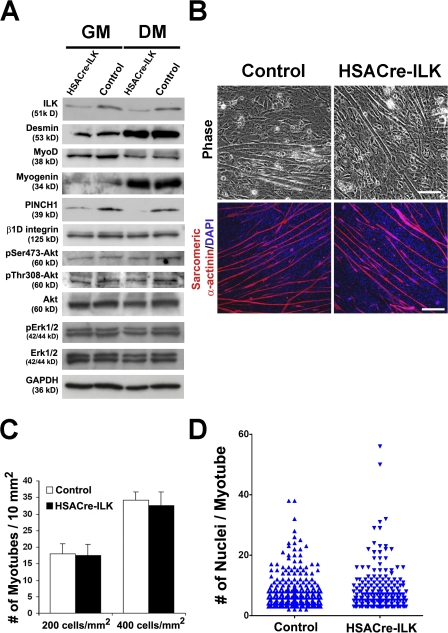
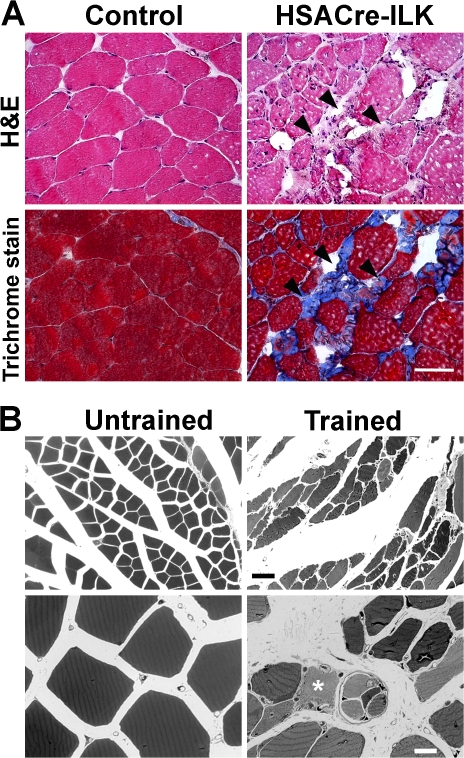
Verification
Claims the paper makes
The claims and statistics of this paper haven’t been checked yet.
Free: it reads the open-access text and checks the first 5 claims that cite a source we can check. Create a free account to check every claim.
Claims other papers make about this one
Each is checked against this paper’s own text: does it say what the citing paper says it does?
The source backs part of the claim, not all of it — or backs it for a different population, condition or comparison.
In the citing paper
“Binding of ECM molecules to specific integrin receptors affects intracellular signaling by, for example, by triggering activation of PI3K and Rac1–MAPK pathways that induce MuSC activation and differentiation96,97.”
From The central role of muscle stem cells in regenerative failure with aging (2015) · cites this paper as [97]
Experimental — accuracy not yet measured
Self-check
Percentages, sums and reported differences re-computed from the paper’s own numbers.
The self-check needs the paper’s full text.
Citations
Cites
Hynes (2002) · doi:10.1016/s0092-8674(02)00971-6 · Cited by 8,606 · cited 2×
“Integrins are a large family of / heterodimeric adhesion receptors ( Bouvard et al., 2001 ; Hynes, 2002 ).”
Bodine, S. C., Stitt, T. N., Gonzalez, M., Kline, W. O., Stover, G. L., Bauerlein, R., Zlotchenko, E., Scrimgeour, A., Lawrence, J. C., Glass, D. J., et al. (2001) · Nature Cell Biology · doi:10.1038/ncb1101-1014 · Cited by 2,752 · cited 2×
“This observation differs from the loss-of-function studies of ILK in fl ies ( Zervas et al., 2001 ), where ILK is primarily required to attach the actin cytoskeleton at the plasma membrane JCB • VOLUME 180 • NUMBER 5 • 2008 1046 as S6K and 4E-BP ( Bodine et al., 2001 ; Rommel et al., 2001 ).”
Rommel, C., Bodine, S. C., Clarke, B. A., Rossman, R., Nunez, L., Stitt, T. N., Yancopoulos, G. D., & Glass, D. J. (2001) · Nature Cell Biology · doi:10.1038/ncb1101-1009 · Cited by 1,583 · cited 2×
“This observation differs from the loss-of-function studies of ILK in fl ies ( Zervas et al., 2001 ), where ILK is primarily required to attach the actin cytoskeleton at the plasma membrane JCB • VOLUME 180 • NUMBER 5 • 2008 1046 as S6K and 4E-BP ( Bodine et al., 2001 ; Rommel et al., 2001 ).”
Guertin, D. A., Stevens, D. M., Thoreen, C. C., Burds, A. A., Kalaany, N. Y., Moffat, J., Brown, M., Fitzgerald, K. J., & Sabatini, D. M. (2006) · Developmental Cell · doi:10.1016/j.devcel.2006.10.007 · Cited by 1,415 · cited 1×
“…is suffi cient for activation of PKB/Akt, and that the phosphorylation of Ser473 determines the specifi city of PKB/Akt toward FOXO1 and FOXO3 and, to a lesser extent, the absolute activity of PKB/ Akt ( Frias et al., 2006 ; Guertin et al., 2006 ; Jacinto et al., 2006 ; Shiota et al., 2006 ).”
Jacinto, E., Facchinetti, V., Liu, D., Soto, N., Wei, S., Jung, S. Y., Huang, Q., Qin, J., & Su, B. (2006) · Cell · doi:10.1016/j.cell.2006.08.033 · Cited by 1,410 · cited 1×
“…is suffi cient for activation of PKB/Akt, and that the phosphorylation of Ser473 determines the specifi city of PKB/Akt toward FOXO1 and FOXO3 and, to a lesser extent, the absolute activity of PKB/ Akt ( Frias et al., 2006 ; Guertin et al., 2006 ; Jacinto et al., 2006 ; Shiota et al., 2006 ).”
Musarò, A., McCullagh, K., Paul, A., Houghton, L., Dobrowolny, G., Molinaro, M., Barton, E. R., L Sweeney, H., & Rosenthal, N. (2001) · Nature Genetics · doi:10.1038/84839 · Cited by 1,137 · cited 1×
“A potential candidate for such an upstream activator is IGF-1R, which plays a central role during muscle repair ( Musaro et al., 2001 ), acts through PI-3K/PKB/Akt/mTor signaling ( Bodine et al., 2001 ; Rommel et al., 2001 ), cross talks with the 1 integrin signaling pathway ( Goel et al., 2004 ,…”
Delcommenne, M., Tan, C., Gray, V., Rue, L., Woodgett, J., & Dedhar, S. (1998) · Proceedings of the National Academy of Sciences · doi:10.1073/pnas.95.19.11211 · Cited by 1,092 · cited 2×
“…proteins, such as PINCH, parvin, paxillin, and kindlin ( Legate et al., 2006 ), and to phosphorylate several proteins, including GSK-3 and PKB/Akt ( Delcommenne et al., 1998 ; Novak et al., 1998 ; Persad et al., 2000 ), both of which are important for homeostasis and regeneration of muscle (…”
BackgroundRando, T. A., & Blau, H. M. (1994) · The Journal of cell biology · doi:10.1083/jcb.125.6.1275 · Cited by 936 · cited 1×
“Isolation and differentiation of primary myoblasts Primary myoblasts were isolated as described by Rando and Blau (1994) .”
mSin1 Is Necessary for Akt/PKB Phosphorylation, and Its Isoforms Define Three Distinct mTORC2s
Frias, M. A., Thoreen, C. C., Jaffe, J. D., Schroder, W., Sculley, T., Carr, S. A., & Sabatini, D. M. (2006) · Current Biology · doi:10.1016/j.cub.2006.08.001 · Cited by 695 · cited 1×
“…is suffi cient for activation of PKB/Akt, and that the phosphorylation of Ser473 determines the specifi city of PKB/Akt toward FOXO1 and FOXO3 and, to a lesser extent, the absolute activity of PKB/ Akt ( Frias et al., 2006 ; Guertin et al., 2006 ; Jacinto et al., 2006 ; Shiota et al., 2006 ).”
Signalling pathways that mediate skeletal muscle hypertrophy and atrophy
Glass, D. J. (2003) · Nature Cell Biology · doi:10.1038/ncb0203-87 · Cited by 694 · cited 2×
“Growth of skeletal muscle critically depends on the activation of mTOR kinase by PKB/Akt ( Glass, 2003 ; Hoffman and Nader, 2004 ).”
Background
Cited by
Regulation of skeletal muscle growth by the IGF1-Akt/PKB pathway: insights from genetic models
Schiaffino, S., & Mammucari, C. (2011) · Skeletal Muscle · doi:10.1186/2044-5040-1-4 · Cited by 816
“Mechanical signals via integrin b 1a nd integrin-linked kinase (ILK) lead to phosphorylation of the IGF1 receptor and activation of the PI3K-Akt pathway in muscle cells [ 13 ].”
BackgroundGenetic and cell biological analysis of integrin outside-in signaling
Legate, K. R., Wickström, S. A., & Fässler, R. (2009) · Genes & Development · doi:10.1101/gad.1758709 · Cited by 802
“An interaction between b1 and IGF1R is enhanced following IGF-1 treatment in mouse C2C12 myoblast cells (Wang et al. 2008), implying that a functional interaction may also occur within untransformed skeletal muscle cells.”
BackgroundThe central role of muscle stem cells in regenerative failure with aging
Blau, H. M., Cosgrove, B. D., & Ho, A. T. V. (2015) · Nature Medicine · doi:10.1038/nm.3918 · Cited by 437
From mechanotransduction to extracellular matrix gene expression in fibroblasts
Chiquet, M., Gelman, L., Lutz, R., & Maier, S. (2009) · Biochimica et Biophysica Acta (BBA) - Molecular Cell Research · doi:10.1016/j.bbamcr.2009.01.012 · Cited by 402
Mechanisms that regulate adaptor binding to β-integrin cytoplasmic tails
Legate, K. R., & Fässler, R. (2009) · Journal of Cell Science · doi:10.1242/jcs.041624 · Cited by 370
Metadata
- Authors
- Wang, H.-V., Chang, L.-W., Brixius, K., Wickström, S. A., Montanez, E., Thievessen, I., Schwander, M., Müller, U., Bloch, W., Mayer, U., & Fässler, R.
- Affiliations
- Max Planck Institute of Biochemistry (DE)
- 3Department of Molecular and Cellular Sport Medicine, 50933 Cologne, Germany
- 1Department of Molecular Medicine, Max Planck Institute of Biochemistry, 82152 Martinsried, Germany
- Scripps Research Institute (US)
- 4Department of Cell Biology, The Scripps Research Institute, La Jolla, CA 92037
- 5Biomedical Research Centre, School of Biological Sciences, University of East Anglia, Norwich NR4 7TJ, England, UK
- Venue
- The Journal of Cell Biology
- Publisher
- Rockefeller University Press
- Published
- 2008-03-10
- Volume
- 180
- Issue
- 5
- Pages
- 1037-1049
- ISSN
- 0021-9525 (ISSN-L)
- 1540-8140
- PMC
- PMC2265410
- OpenAlex
- W2171773546
- Cited by
- 112
- References
- 57
- Citations by year
- 2026: 4 · 2025: 5 · 2024: 3 · 2023: 5 · 2022: 5 · 2021: 5 · 2020: 4 · 2019: 5 · 2018: 5 · 2017: 7 · 2016: 4 · 2015: 8 · 2014: 5 · 2013: 8 · 2012: 11
- FWCI
- 3.84
- Type
- journal article
- Language
- en
- Open access
- bronze
- doi.org
- Locations
- The Journal of Cell Biology (publishedVersion)
- PubMed Central (publishedVersion, cc-by-nc-sa)
- PubMed (publishedVersion)
- Dipòsit Digital de la Universitat de Barcelona (Universitat de Barcelona) (submittedVersion, cc-by)
- Max Planck Institute for Plasma Physics (submittedVersion)
- Max Planck Digital Library (submittedVersion)
- MPG.PuRe (Max Planck Society) (submittedVersion)
- UEA Digital Repository (University of East Anglia) (submittedVersion)
- Funders
- Wellcome Trust (060549)
- Topics
- Life Sciences › Biochemistry, Genetics and Molecular Biology › Molecular Biology › Muscle Physiology and Disorders
- Health Sciences › Medicine › Immunology and Allergy › Cell Adhesion Molecules Research
- Life Sciences › Biochemistry, Genetics and Molecular Biology › Molecular Biology › Metabolism, Diabetes, and Cancer
- Keywords
- integrin-linked kinase, myotendinous junction, costameres, beta1 integrin, Akt signaling, IGF-1 receptor, muscle regeneration, muscular dystrophy, endurance exercise, mechanical stress, extracellular matrix, basement membrane, skeletal muscle
- MeSH terms
- Scaffold Protein ILK, Animals, Basement Membrane, Binding Sites, Enzyme Activation, Extracellular Matrix, Muscular Dystrophy, Animal, Phosphorylation, Physical Conditioning, Animal, Sarcolemma, Stress, Mechanical, Tendons, Signal Transduction, Down-Regulation, Protein Serine-Threonine Kinases, Receptor, IGF Type 1, Mice, Knockout, Muscle, Skeletal, Muscle Fibers, Skeletal, Integrin beta1, Macromolecular Substances, Proto-Oncogene Proteins c-akt, Mice
About these checks
Registry, retraction, Cites and statistics results are computed, not judged, with one exception: a printed reference that no index lists is read once by a model before it counts as a citation error. Claims are extracted by a model and kept only when their quote appears verbatim in the text; each cited source is then checked, with a model’s help, for whether it says what the claim relies on. Those verdicts can be wrong — read the claim’s quote and the cited source before relying on one.
Statistics and arithmetic are recomputed, not judged.
Confidence bands are shown only for fields calibrated on our annotated test set. None is calibrated yet, so no band is shown.
What counts as a claim ›How we measure confidence ›How we check this ›
Are you an author, or do you see a problem with this page? Request a review
Data sources
Bibliographic data: Semantic Scholar, OpenAlex, Crossref.
Contains information from the Semantic Scholar Academic Graph Datasets, made available under the ODC Attribution License (ODC-BY 1.0).
Semantic Scholar’s data is described in: Kinney, R., et al. (2023). The Semantic Scholar Open Data Platform. arXiv:2301.10140.
