

The DOI matches its Crossref record; 58 of the 58 references it cites were found in a registry or an index.
Local palmitoylation cycles define activity-regulated postsynaptic subdomains
Open accessAbstract
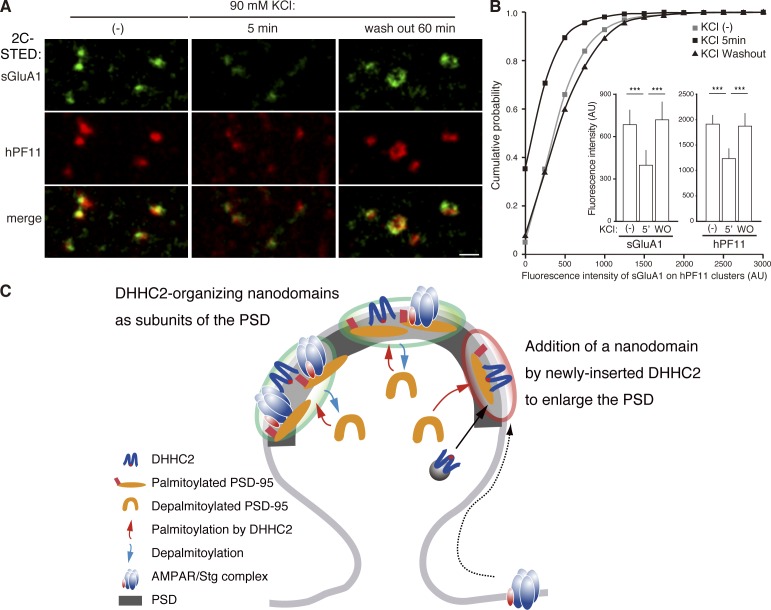
Distinct PSD-95 clusters are primary landmarks of postsynaptic densities (PSDs), which are specialized membrane regions for synapses. However, the mechanism that defines the locations of PSD-95 clusters and whether or how they are reorganized inside individual dendritic spines remains controversial. Because palmitoylation regulates PSD-95 membrane targeting, we combined a conformation-specific recombinant antibody against palmitoylated PSD-95 with live-cell super-resolution imaging and discovered subsynaptic nanodomains composed of palmitoylated PSD-95 that serve as elementary units of the PSD. PSD-95 in nanodomains underwent continuous de/repalmitoylation cycles driven by local palmitoylating activity, ensuring the maintenance of compartmentalized PSD-95 clusters within individual spines. Plasma membrane targeting of DHHC2 palmitoyltransferase rapidly recruited PSD-95 to the plasma membrane and proved essential for postsynaptic nanodomain formation. Furthermore, changes in synaptic activity rapidly reorganized PSD-95 nano-architecture through plasma membrane-inserted DHHC2. Thus, the first genetically encoded antibody sensitive to palmitoylation reveals an instructive role of local palmitoylation machinery in creating activity-responsive PSD-95 nanodomains, contributing to the PSD (re)organization.
Overview
The claims and statistics of this paper haven’t been checked yet.
Run the check — free, no account needed. It reads the open-access text and checks the sources it cites.
Integrity signals
Registry
Cites
Statistics
Figures
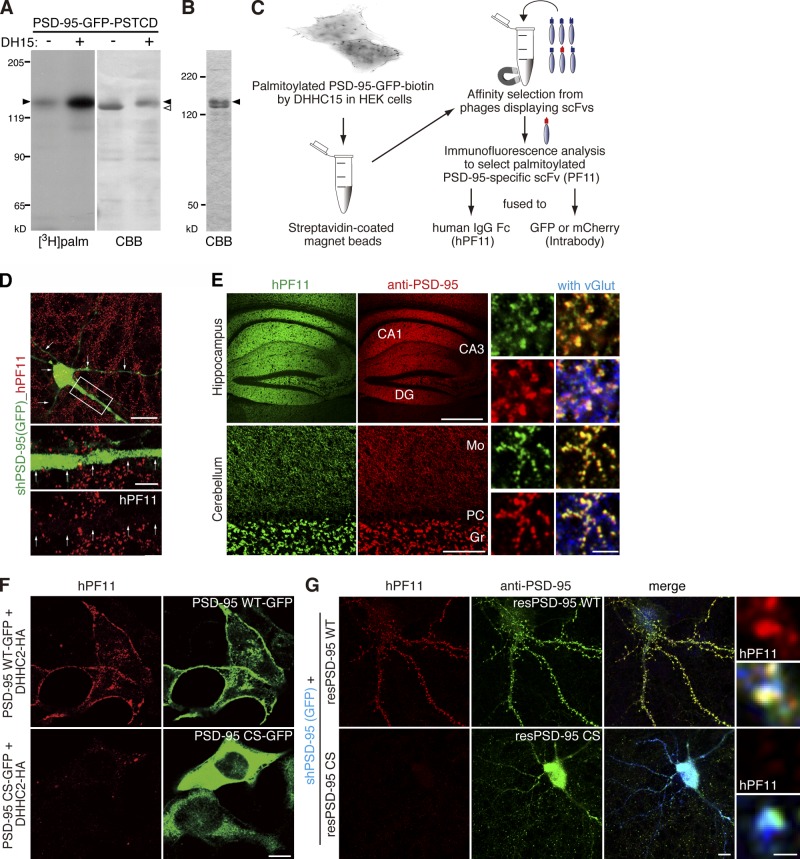
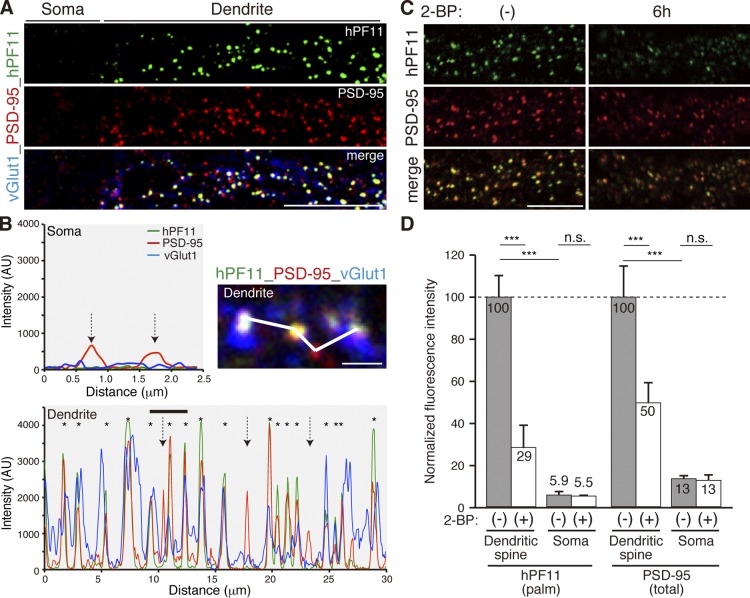
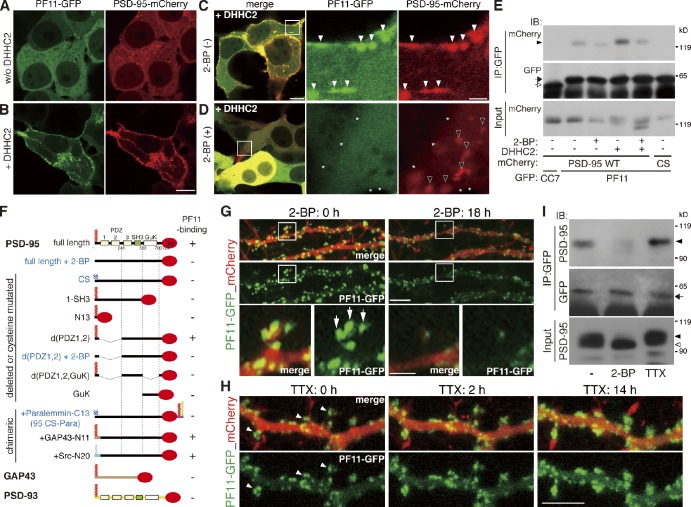
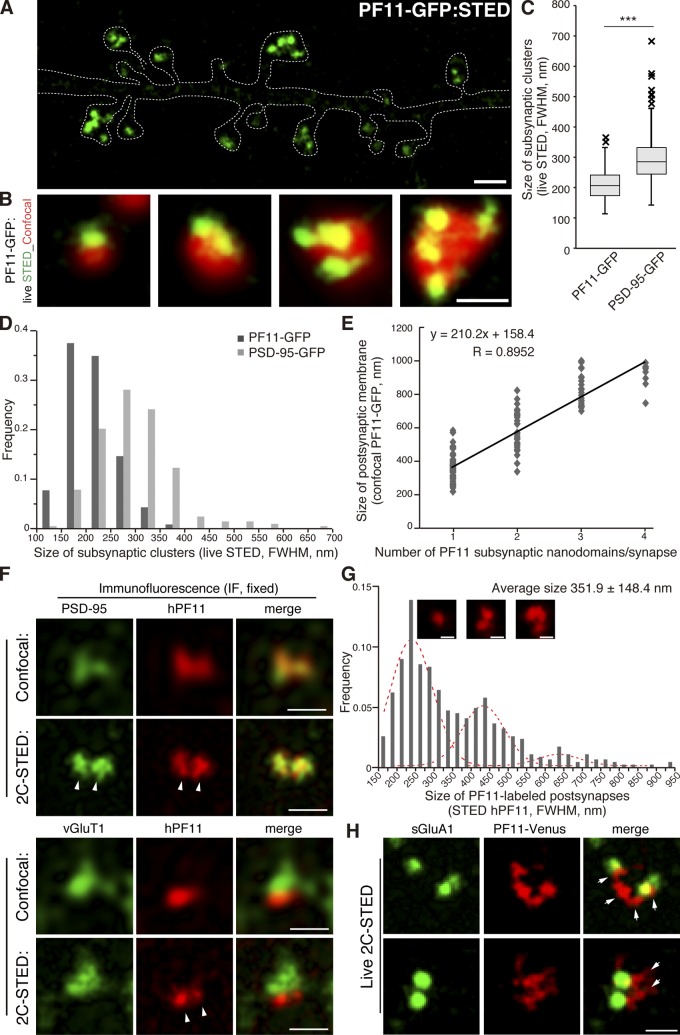
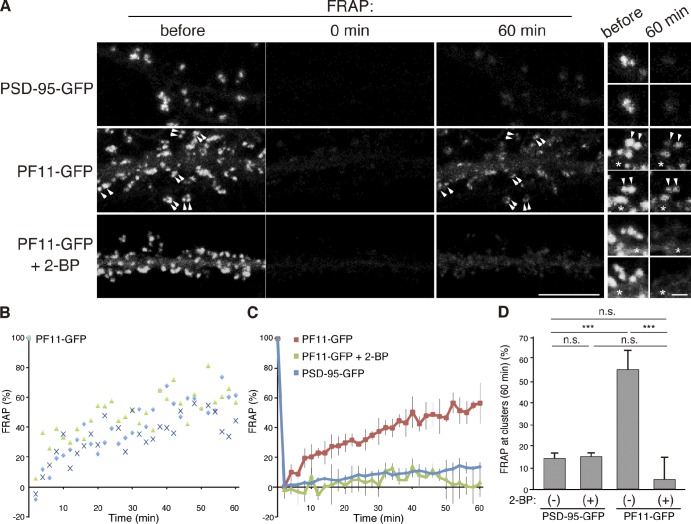
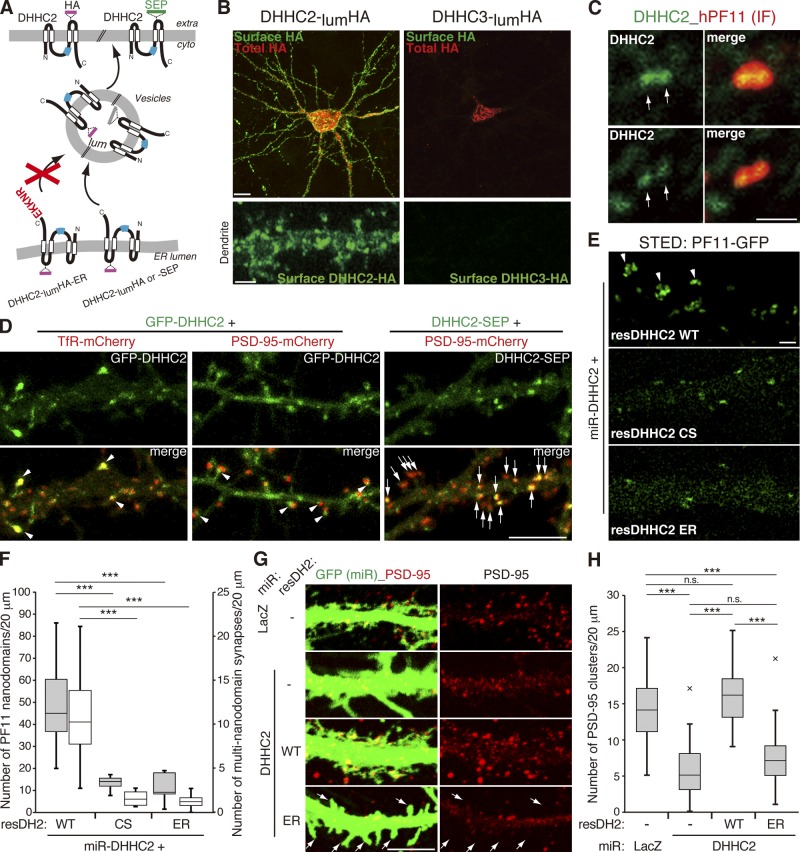
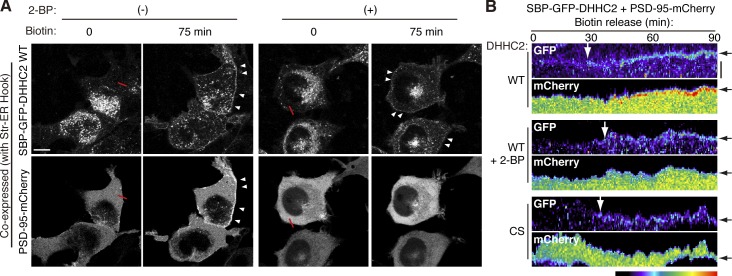
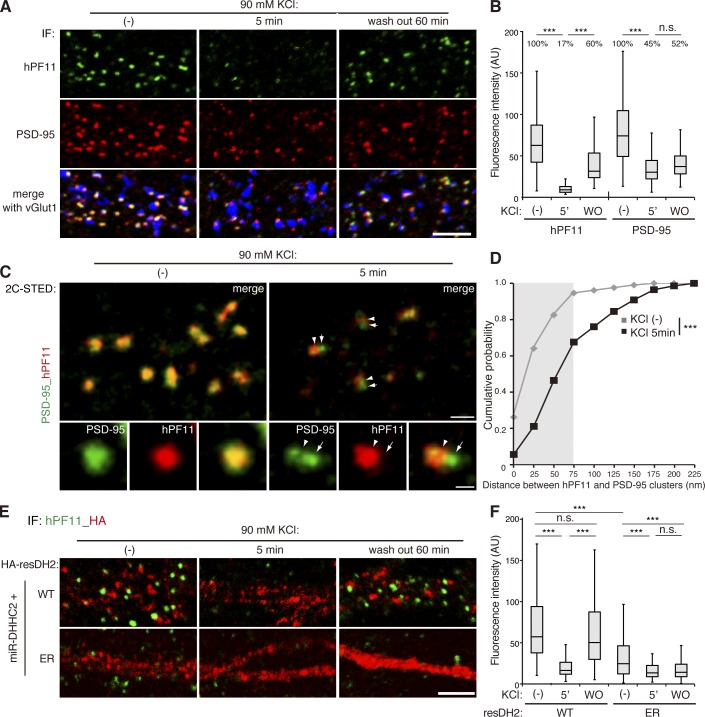
Verification
Claims the paper makes
The claims and statistics of this paper haven’t been checked yet.
Run the check — free, no account needed. It reads the open-access text and checks the sources it cites.
Claims other papers make about this one
Each is checked against this paper’s own text: does it say what the citing paper says it does?
The cited source doesn’t support the claim as written.
In the citing paper
“The average estimated diameter of ~80 nm for RIM1/2 NCs was very close to the reported size of PSD-95 and AMPA receptor (AMPAR) NCs4–6.”
From A trans-synaptic nanocolumn aligns neurotransmitter release to receptors (2016) · cites this paper as [6]
Checked by a reasoning model — may be wrong.
Experimental — accuracy not yet measuredThe source backs part of the claim, not all of it — or backs it for a different population, condition or comparison.
In the citing paper
“These presynaptic RIM nanoclusters closely aligned with concentrated postsynaptic receptors and scaffolding proteins4–6, suggesting a transsynaptic molecular “nanocolumn.””
From A trans-synaptic nanocolumn aligns neurotransmitter release to receptors (2016) · cites this paper as [6]
Experimental — accuracy not yet measuredThe cited source says what the claim attributes to it.
In the citing paper
“The alignment of pre and postsynaptic nanoscale subdomains4–6 suggests that even small synapses may be composed of dynamic functional modules28,29.”
From A trans-synaptic nanocolumn aligns neurotransmitter release to receptors (2016) · cites this paper as [6]
Self-check
Percentages, sums and reported differences re-computed from the paper’s own numbers.
The self-check needs the paper’s full text.
Citations
Cites
A guide to choosing fluorescent proteins
Shaner, N. C., Steinbach, P. A., & Tsien, R. Y. (2005) · Nature Methods · doi:10.1038/nmeth819 · Cited by 2,823
Visualizing secretion and synaptic transmission with pH-sensitive green fluorescent proteins
Miesenböck, G., Angelis, D. A. D., & Rothman, J. E. (1998) · Nature · doi:10.1038/28190 · Cited by 2,569
PDZ domain proteins of synapses
Kim, E., & Sheng, M. (2004) · Nature reviews. Neuroscience · doi:10.1038/nrn1517 · Cited by 1,630
PSD-95 Involvement in Maturation of Excitatory Synapses
El-Husseini, A. E.-D., Schnell, E., Chetkovich, D. M., Nicoll, R. A., & Bredt, D. S. (2000) · Science · doi:10.1126/science.290.5495.1364 · Cited by 1,303
Palmitoylation: policing protein stability and traffic
Linder, M. E., & Deschenes, R. J. (2006) · Nature Reviews Molecular Cell Biology · doi:10.1038/nrm2084 · Cited by 1,192
Neurexins Induce Differentiation of GABA and Glutamate Postsynaptic Specializations via Neuroligins
Graf, E. R., Zhang, X., Jin, S., Linhoff, M. W., & Craig, A. M. (2004) · Cell · doi:10.1016/j.cell.2004.11.035 · Cited by 1,029
An Acylation Cycle Regulates Localization and Activity of Palmitoylated Ras Isoforms
Rocks, O., Peyker, A., Kahms, M., Verveer, P., Koerner, C., Lumbierres, M., Kuhlmann, J., Waldmann, H., Wittinghofer, A., & Bastiaens, P. (2005) · Science · doi:10.1126/science.1105654 · Cited by 866
Neuroligins Determine Synapse Maturation and Function
Varoqueaux, F., Aramuni, G., Rawson, R. L., Mohrmann, R., Missler, M., Gottmann, K., Zhang, W., Südhof, T. C., & Brose, N. (2006) · Neuron · doi:10.1016/j.neuron.2006.09.003 · Cited by 837
Superresolution Imaging of Chemical Synapses in the Brain
Dani, A., Huang, B., Bergan, J. F., Dulac, C. G., & Zhuang, X. (2010) · Neuron · doi:10.1016/j.neuron.2010.11.021 · Cited by 748
Control of Excitatory and Inhibitory Synapse Formation by Neuroligins
Chih, B., Engelman, H. S., & Scheiffele, P. (2005) · Science · doi:10.1126/science.1107470 · Cited by 730
Cited by
Sorted by citations
Fluorescence nanoscopy in cell biology
Sahl, S. J., Hell, S. W., & Jakobs, S. (2017) · Nature Reviews Molecular Cell Biology · doi:10.1038/nrm.2017.71 · Cited by 996
Structure, Function, and Pharmacology of Glutamate Receptor Ion Channels
Hansen, K. B., Wollmuth, L. P., Bowie, D., Furukawa, H., Menniti, F. S., Sobolevsky, A. I., Swanson, G. T., Swanger, S. A., Greger, I. H., Nakagawa, T., et al. (2021) · Pharmacological Reviews · doi:10.1124/pharmrev.120.000131 · Cited by 686
A trans-synaptic nanocolumn aligns neurotransmitter release to receptors
Tang, A.-H., Chen, H., Li, T. P., Metzbower, S. R., MacGillavry, H. D., & Blanpied, T. A. (2016) · Nature · doi:10.1038/nature19058 · Cited by 677
MINFLUX nanoscopy delivers 3D multicolor nanometer resolution in cells
Gwosch, K. C., Pape, J. K., Balzarotti, F., Hoess, P., Ellenberg, J., Ries, J., & Hell, S. W. (2020) · Nature Methods · doi:10.1038/s41592-019-0688-0 · Cited by 570
Choquet, D., & Triller, A. (2013) · Neuron · doi:10.1016/j.neuron.2013.10.013 · Cited by 560
Metadata
- Authors
- Fukata, Y., Dimitrov, A., Boncompain, G., Vielemeyer, O., Perez, F., & Fukata, M.
- Affiliations
- National Institute for Physiological Sciences (JP)
- Centre National de la Recherche Scientifique (FR)
- Centre National de la Recherche Scientifique, Unité Mixte de Recherche 144 2 and 3
- Corresponding author
- Perez, Franck
- Fukata, Masaki
- Venue
- Journal of Cell Biology
- Publisher
- Rockefeller University Press
- Published
- 2013-07-08
- Volume
- 202
- Issue
- 1
- Pages
- 145-161
- ISSN
- 0021-9525 (ISSN-L)
- 1540-8140
- PMC
- PMC3704990
- OpenAlex
- W2168234829
- Cited by
- 262
- References
- 58
- Citations by year
- 2026: 8 · 2025: 13 · 2024: 23 · 2023: 12 · 2022: 20 · 2021: 28 · 2020: 24 · 2019: 21 · 2018: 23 · 2017: 27 · 2016: 20 · 2015: 20 · 2014: 17 · 2013: 6
- FWCI
- 10.31
- Type
- journal article
- Language
- en
- Open access
- hybrid
- doi.org
- Licence
- cc-by-nc-sa
- Locations
- The Journal of Cell Biology (publishedVersion, cc-by-nc-sa)
- Europe PMC (PubMed Central) (publishedVersion, cc-by-nc-sa)
- PubMed Central (publishedVersion, cc-by-nc-sa)
- PubMed (publishedVersion)
- Funders
- Agence Nationale de la Recherche (ANR-09-BLAN-0290)
- Japan Society for the Promotion of Science
- Topics
- Life Sciences › Neuroscience › Cellular and Molecular Neuroscience › Neuroscience and Neuropharmacology Research
- Life Sciences › Biochemistry, Genetics and Molecular Biology › Molecular Biology › Protein Kinase Regulation and GTPase Signaling
- Life Sciences › Biochemistry, Genetics and Molecular Biology › Cell Biology › Cellular transport and secretion
- Keywords
- palmitoylation, PSD-95, postsynaptic density, dendritic spines, plasma membrane targeting, synaptic organization
- MeSH terms
- Disks Large Homolog 4 Protein, Animals, Chlorocebus aethiops, Fluorescent Dyes, Hippocampus, Humans, Membrane Proteins, Synaptic Transmission, Neuronal Plasticity, Neurons, Palmitates, Sensitivity and Specificity, Structure-Activity Relationship, Transfection, COS Cells, Dendritic Spines, Green Fluorescent Proteins, Mice, Rats, Guanylate Kinases, Lipoylation, HEK293 Cells, Post-Synaptic Density
About these checks
Registry, retraction, Cites and statistics results are computed, not judged, with one exception: a printed reference that no index lists is read once by a model before it counts as a citation error. Claims are extracted by a model and kept only when their quote appears verbatim in the text; each cited source is then checked, with a model’s help, for whether it says what the claim relies on. Those verdicts can be wrong — read the claim’s quote and the cited source before relying on one.
Statistics and arithmetic are recomputed, not judged.
Confidence bands are shown only for fields calibrated on our annotated test set. None is calibrated yet, so no band is shown.
What counts as a claim ›How we measure confidence ›How we check this ›
Are you an author, or do you see a problem with this page? Request a review
