

The DOI matches its Crossref record; 33 of the 33 references it cites were found in a registry or an index.
Intrinsic and Extrinsic Control of Hemopoietic Stem Cell Numbers: Mapping of a Stem Cell Gene
Open accessAbstract
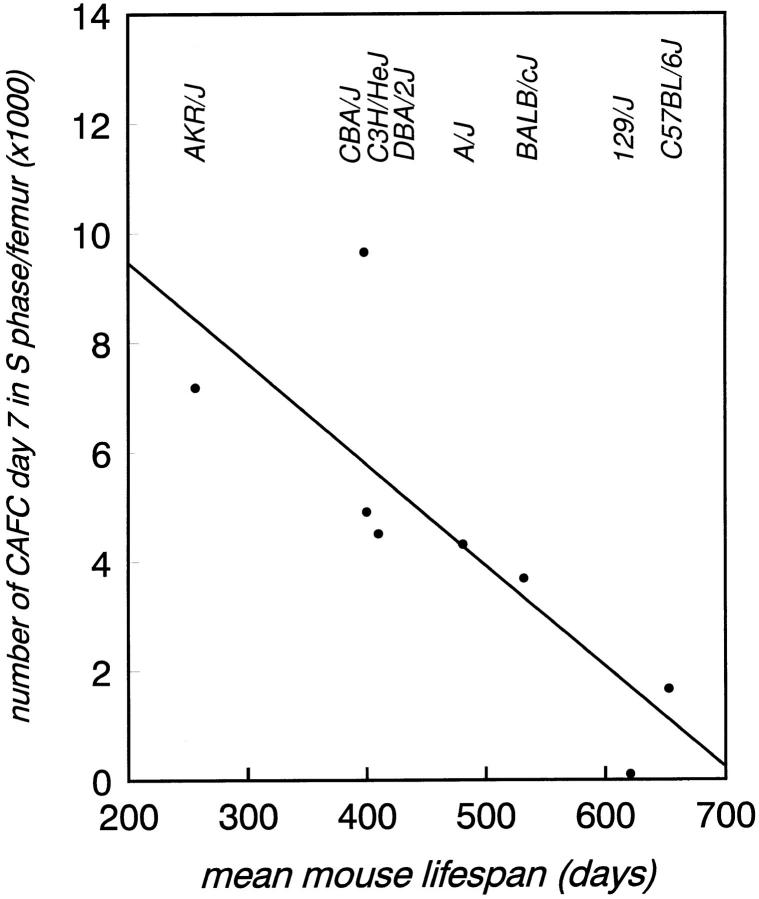
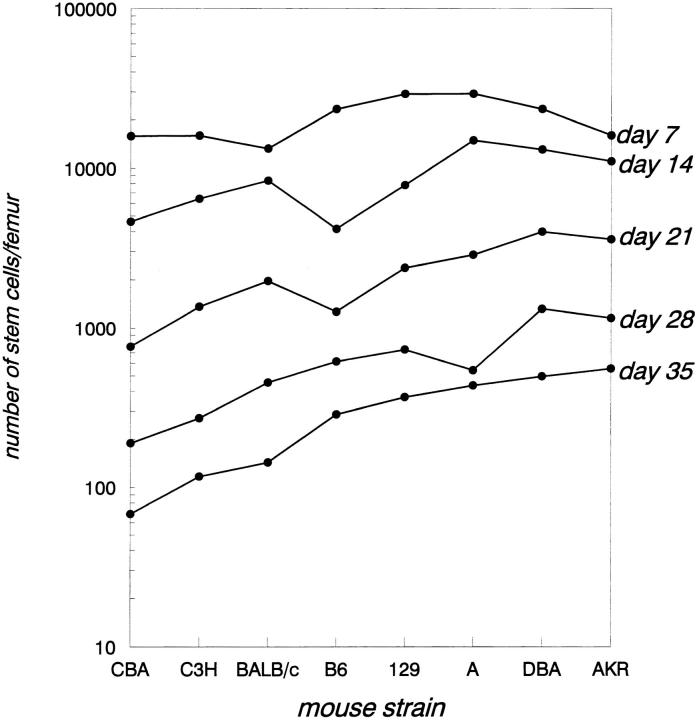
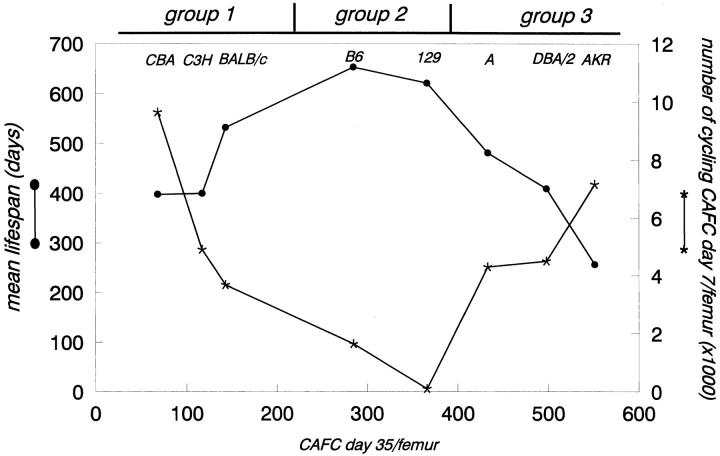
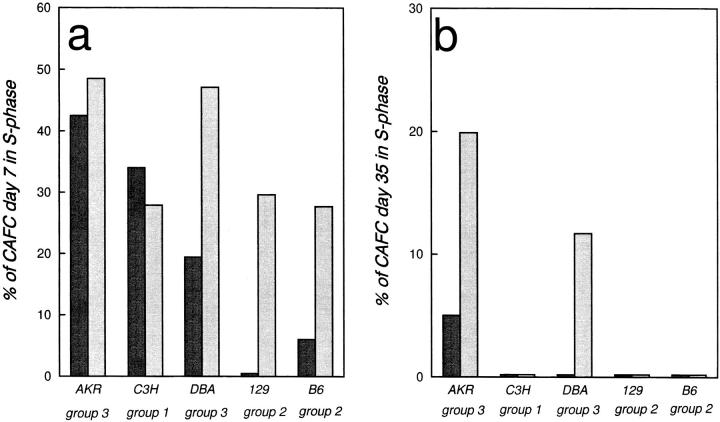
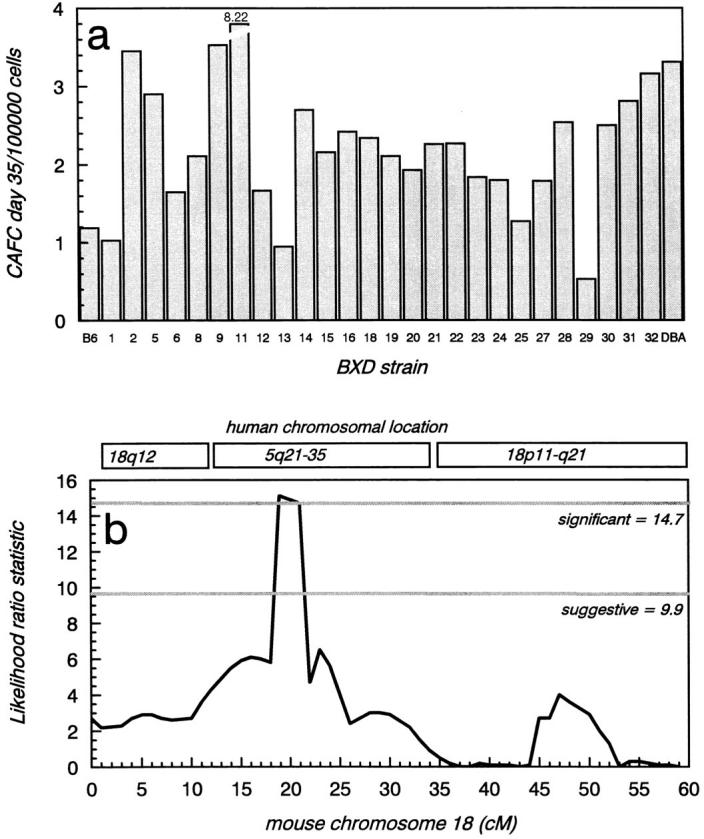
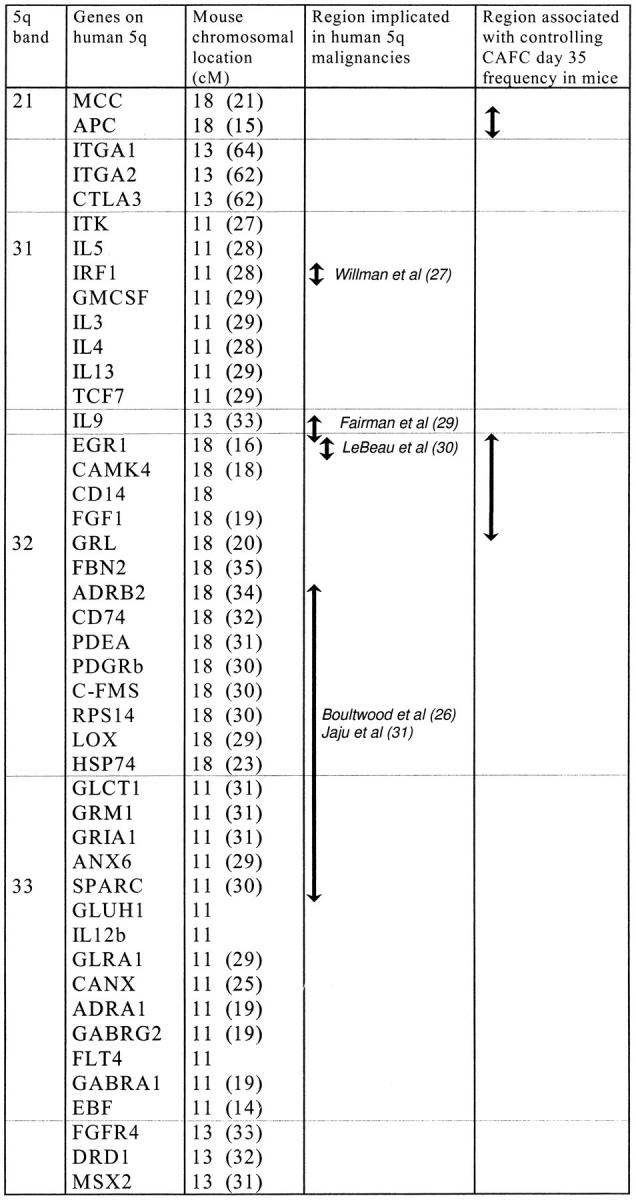
We evaluated in vivo interactions between extrinsic (growth factor induced) and intrinsic (genetically determined) effectors of mouse primitive hemopoietic stem cell proliferation and numbers. Accordingly, stem cell frequency and cell cycle kinetics were assessed in eight strains of inbred mice using the cobblestone area-forming cell (CAFC) assay. A strong inverse correlation was observed between mouse lifespan and the number of autonomously cycling progenitors (CAFC day 7) in the femur. The population size of primitive stem cells (CAFC day 35) varied widely (up to sevenfold) among strains, unlike total CAFC day 7 numbers (cycling and quiescent), which were similar. Administration of the early acting cytokine flt-3 ligand to these strains resulted in activation of quiescent primitive stem cells exclusively in strains with high endogenous stem cell numbers (DBA and AKR), but was unrelated to strain-specific progenitor cell cycling. To map loci affecting stem cell frequency, we quantified stem cells in BXD recombinant inbred mice (offspring of C57BL/6 and DBA/2). The resulting strain distribution pattern showed high concordance with a marker that mapped to chromosome 18 (19 cM). Linkage with this genomic interval was associated with a likelihood of odds score of 3.3, surpassing the level required for significance. Interestingly, this segment, containing the EGR-1 gene, shows synteny with human chromosome 5q, a region strongly associated with various hematological malignancies. Our findings indicate that a gene mapping to this region is mutated in either C57BL/6 or DBA/2 (and possibly AKR) mice. These studies in apparently healthy mice may facilitate the identification of a gene implicated in human 5q-syndromes.
Overview
The claims and statistics of this paper haven’t been checked yet.
Run the check — free, no account needed. It reads the open-access text and checks the sources it cites.
Integrity signals
Registry
Cites
Statistics
Figures
Verification
Claims the paper makes
The claims and statistics of this paper haven’t been checked yet.
Run the check — free, no account needed. It reads the open-access text and checks the sources it cites.
Claims other papers make about this one
Each is checked against this paper’s own text: does it say what the citing paper says it does?
In the citing paper
“aging (also of the hematopoietic system) is at least qualitatively different in distinct strains of mice.”
From Aging of hematopoietic stem cells (2018) · cites this paper as [31]
Self-check
Percentages, sums and reported differences re-computed from the paper’s own numbers.
The self-check needs the paper’s full text.
Citations
Cites
Genetic dissection of complex traits: guidelines for interpreting and reporting linkage results
Lander, E. S., & Kruglyak, L. (1995) · Nature Genetics · doi:10.1038/ng1195-241 · Cited by 5,236 · cited 2×
“Statistical criteria for linkage (16) were established by performing a permutation test (1,000 permutations at 1-cM intervals) (17).”
Empirical threshold values for quantitative trait mapping.
Churchill, G. A., & Doerge, R. W. (1994) · Genetics · doi:10.1093/genetics/138.3.963 · Cited by 4,935
The aging of hematopoietic stem cells
Morrison, S. J., Wandycz, A. M., Akashi, K., Globerson, A., & Weissman, I. L. (1996) · Nature Medicine · doi:10.1038/nm0996-1011 · Cited by 853 · cited 1×
“Conversely, the stem cell pool in unmanipulated mice continuously expands during its lifetime, such that old mice have substantially more stem cells than young mice, although aging has no effect on circulating blood cell counts (2, 3).”
BackgroundBiology of the Laboratory Mouse
(1941) · JAMA · doi:10.1001/jama.1941.02820440081034 · Cited by 805
Mackarehtschian, K., Hardin, J. D., Moore, K., Boast, S., Goff, S. P., & Lemischka, I. R. (1995) · Immunity · doi:10.1016/1074-7613(95)90167-1 · Cited by 575 · cited 1×
“A wealth of in vitro data has shown that FL has potent effects on primitive stem cell proliferation (8–11), and in vivo flk-2/flt-3 knockout mice show stem cell defects, especially affecting lymphopoiesis (12).”
A Macintosh program for storage and analysis of experimental genetic mapping data
Manly, K. F. (1993) · Mammalian Genome · doi:10.1007/bf00357089 · Cited by 496
Deletion of IRF-1 , Mapping to Chromosome 5q31.1, in Human Leukemia and Preleukemic Myelodysplasia
Willman, C. L., Sever, C. E., Pallavicini, M. G., Harada, H., Tanaka, N., Slovak, M. L., Yamamoto, H., Harada, K., Meeker, T. C., List, A. F., et al. (1993) · Science · doi:10.1126/science.8438156 · Cited by 380 · cited 1×
“(27) to be deleted in some 5q-samples, maps to mouse chromosome 11.”
Human/Mouse Homology Relationships
DeBry, R. W., & Seldin, M. F. (1996) · Genomics · doi:10.1006/geno.1996.0209 · Cited by 367
de Haan, G., NIJHOF, W., & Zant, G. E. V. (1997) · Blood · doi:10.1182/blood.v89.5.1543 · Cited by 300
Ploemacher, R., der Sluijs, J. V., van Beurden, C., Baert, M., & Chan, P. (1991) · Blood · doi:10.1182/blood.v78.10.2527.2527 · Cited by 261 · cited 2×
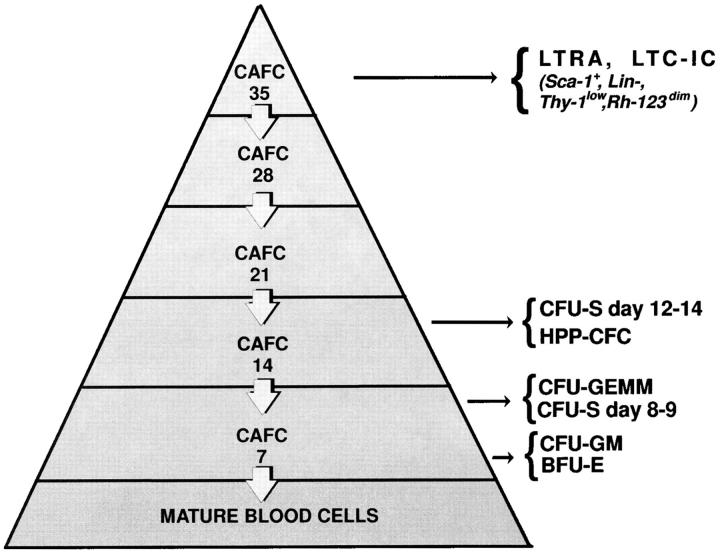
“CAFC day 7, a population of cells which has been shown to consist primarily of multipotent progenitors (18–20), showed a substantial HU kill, whereas primitive CAFC day 35, which contain cells with long-term repopulating ability (18, 20), were not killed by a 1-h incubation with HU, demonstrating their proliferative q…”
Cited by
Sorted by citations
Items 101–134 of 134
Ranjan, A. K., Joglekar, M. V., Atre, A. N., Patole, M. S., Bhonde, R. R., & Hardikar, A. A. (2012) · Journal of Immunological Methods · doi:10.1016/j.jim.2012.02.018 · Cited by 7
“Moreover, this technique would be useful for stem cell biology research in the field of hematology and vascular biology where low cell number is the main constrain (de Haan and Van Zant, 1997; Sieburg et al., 2006).”
MethodSchraml, E., Fehrer, C., Brunauer, R., Lepperdinger, G., Chesnokova, V., & Schauenstein, K. (2008) · Gerontology · doi:10.1159/000161736 · Cited by 7
Identification of quantitative trait loci regulating haematopoietic parameters in B6AKRF2 mice
van Os, R. P., Ausema, A., Noach, E. J. K., van Pelt, K., Dontje, B., Vellenga, E., & de Haan, G. (2005) · British Journal of Haematology · doi:10.1111/j.1365-2141.2005.05835.x · Cited by 7
Analysis of expansion of myeloid progenitors in mice to identify leukemic susceptibility genes
Sollars, V. E., Pequignot, E., Rothstein, J. L., & Buchberg, A. M. (2006) · Mammalian Genome · doi:10.1007/s00335-006-0017-7 · Cited by 5
QTL analyses of lineage-negative mouse bone marrow cells labeled with Sca-1 and c-Kit
Jawad, M., Cole, C., Zanker, A., Giotopoulos, G., Fitch, S. R., Talbot, C. J., & Plumb, M. (2008) · Mammalian Genome · doi:10.1007/s00335-008-9097-x · Cited by 4
Bradford, G. B., & Bertoncello, I. (2003) · Humana Press eBooks · doi:10.1385/1-59259-140-x:079 · Cited by 4
Analysis of Hematopoietic Phenotypes in Knockout Mouse Models
Bertoncello, I., & Williams, B. (2003) · Humana Press eBooks · doi:10.1385/1-59259-220-1:181 · Cited by 4
Stem cells from birth to death: The history and the future
de Haan, G., & Zant, G. E. V. (2002) · AGE · doi:10.1007/s11357-002-0006-z · Cited by 3
“We and others have employed genetic mapping to identify loci that determine stem cell numbers, proliferative activity, response to cytokines, and response to aging (93-95,67,96-98,73,99).”
Andreeva, E. R., Andrianova, I. V., Bobyleva, P. I., Gornostaeva, A. N., Ездакова, М. И., Golikova, E., & Buravkova, L. B. (2020) · European Journal of Cell Biology · doi:10.1016/j.ejcb.2020.151069 · Cited by 3
Cardiac Regeneration and Aging
Leri, A., Kajstura, J., & Anversa, P. (2010) · Elsevier eBooks · doi:10.1016/b978-0-12-381332-9.00045-1 · Cited by 3
Scaradavou, A., Sung, D., & Rubinstein, P. (2007) · American Journal of Hematology · doi:10.1002/ajh.20972 · Cited by 3
“The findings of the low dose BM transplants could be explained by the Van Zant data [29]: A/J is a ‘‘faster engrafting’’ strain.”
ResultLebensdauer: Genetische Determinierung und lebensverlängernde Strategien
Niedermüller, H., & Hofecker, G. (2004) · Springer eBooks · doi:10.1007/978-3-642-18741-4_2 · Cited by 3
A Quantitative Trait Locus on chr.4 Regulates Thymic Involution
Kumar, R., Avagyan, S., & Snoeck, H. (2010) · The Journals of Gerontology Series A · doi:10.1093/gerona/glq041 · Cited by 3
Hematopoietic stem cells and aging
Zant, G. E. V., Manning, E., & Geiger, H. (2002) · Advances in cell aging and gerontology · doi:10.1016/s1566-3124(02)09042-9 · Cited by 2
Intracellular factors regulating activity of hemopoietic stem cells
Va, K. (2005) · Bulletin of Experimental Biology and Medicine · doi:10.1007/s10517-005-0226-1 · Cited by 1
Strategies for Thymic Regeneration: Recent Advances Towards Clinical Therapy
Barsanti, M., Hun, M. L., Boyd, R. L., & Chidgey, A. P. (2016) · Springer eBooks · doi:10.1007/978-4-431-56027-2_3 · Cited by 2
Aging of the Niche and the Microenvironment and Its Role in Stem Cell Aging
Geiger, H. (2012) · Else Kröner-Fresenius Symposia · doi:10.1159/000338021 · Cited by 1
Formation and Differentiation of Leukocytes
Wright, D. E., & Weissman, I. L. (2001) · Springer eBooks · doi:10.1007/978-1-4614-7512-5_2 · Cited by 1
The role of the embryonic microenvironment in hematopoietic cell development
Haak, E. (2007) · RePub (Erasmus University Rotterdam) · Cited by 1
T Lymphocytes of Allophenic Mice Do Not Reject Spleen Colony-Forming Units of the Parental Genotypes
Fedorov, L. M., & Panteleev, E. I. (2000) · Stem Cells and Development · doi:10.1089/152581600419198 · Cited by 1
Hematopoietic Stem Cells, Aging, and Cancer
Bell, D. R., & Zant, G. E. V. (2005) · Elsevier eBooks · doi:10.1016/b978-012088387-5/50007-8 · Cited by 1
Lewis, J. D., & GORDON, M. (2003) · Elsevier eBooks · doi:10.1016/b978-012689663-3/50059-4 · Cited by 1
DNA methylation, cell differentiation and genetic factors involved in radiosensitivity
Giotopoulos, G. (2008) · Leicester Research Archive (University of Leicester)
GENETIC REGULATION OF HEMATOPOIETIC STEM CELL NUMBERS IN MICE
Liang, Y. (2005) · UKnowledge (University of Kentucky)
Regulatory role of fibroblast growth factors on hematopoietic stem cells
Yeoh, J. S. G. (2007) · University of Groningen research database (University of Groningen / Centre for Information Technology)
Hematopoietic Stem Cell Aging and Fate Decision
Illing, A., & Ju, Z. (2010) · Else Kröner-Fresenius Symposia · doi:10.1159/000312645
Molecular and Endocrine Mechanisms Underlying the Stem Cell Theory of Aging
Coutu, D. L., & Galipeau, J. (2013) · Stem cell biology and regenerative medicine · doi:10.1007/978-1-4614-9569-7_17
“A series of seminal studies by Van Zant, de Haan, and colleagues suggest a strong link between HSCs’ cycling state and aging [ 32 , 89 , 96 – 102 ].”
BackgroundRoberts, A. W., Foote, S. J., & Metcalf, D. (1999) · Springer eBooks · doi:10.1007/978-1-4615-4797-6_4
Afterword: Prospects and Challenges in Lung Regenerative Medicine
Bertoncello, I. (2015) · Stem cell biology and regenerative medicine · doi:10.1007/978-3-319-21082-7_19
The Purification of Mouse Hematopoietic Stem Cells at Sequential Stages of Maturation
Morrison, S. J. (2003) · Humana Press eBooks · doi:10.1385/1-59259-140-x:015
Bystrykh, L. V., Weersing, E., Dontje, B., Geiger, H., Ivanova, N. B., Lemischka, [. V., Vellenga, E., Zant, G. E. V., & de Haan, G. (n.d.) · University of Groningen research database (University of Groningen / Centre for Information Technology)
Control of Adult Bone Marrow Erythroid Progenitor Cell Fate by Combinatorial Niche Factor Signals
Wang, W. (2012) · TSpace (University of Toronto)
A Limited Role for p21 in Maintaining Normal Hematopoietic Stem Cell Functioning
Kamminga, L. M., Ausema, A., Bystrykh, L. V., & Draijer, D. P. (2007)
Maiuthed, A., Chanvorachote, P., Schneider-Stock, R., & Eichler, J. (2018) · doi:10.58837/chula.the.2018.436
Metadata
- Authors
- Haan, G. D., & Zant, G. V.
- Affiliations
- University of Kentucky HealthCare (US)
- From the Blood and Marrow Transplant Program, Division of Hematology/Oncology, University of Kentucky Medical Center, Lexington, Kentucky 40536-0093
- ORCID
- Haan, Gerald de
- Venue
- The Journal of Experimental Medicine
- Publisher
- Rockefeller University Press
- Published
- 1997-08-18
- Volume
- 186
- Issue
- 4
- Pages
- 529-536
- ISSN
- 0022-1007 (ISSN-L)
- 1540-9538
- PMC
- PMC2199035
- OpenAlex
- W2115154817
- Cited by
- 134
- References
- 33
- Citations by year
- 2020: 2 · 2018: 4 · 2017: 1 · 2016: 2 · 2015: 6 · 2013: 3 · 2012: 3
- FWCI
- 5.39
- Type
- journal article
- Language
- en
- Open access
- bronze
- doi.org
- Locations
- The Journal of Experimental Medicine (publishedVersion)
- PubMed Central (publishedVersion, cc-by-nc-sa)
- PubMed (publishedVersion)
- UKnowledge (University of Kentucky) (submittedVersion, cc-by-nc-sa)
- Funders
- Nederlandse Organisatie voor Wetenschappelijk Onderzoek
- Topics
- Health Sciences › Medicine › Hematology › Hematopoietic Stem Cell Transplantation
- Health Sciences › Medicine › Hematology › Blood disorders and treatments
- Life Sciences › Biochemistry, Genetics and Molecular Biology › Cell Biology › Mesenchymal stem cell research
- Keywords
- hematopoietic stem cells, stem cell frequency, Flt3 ligand, stem cell quiescence, cell cycle kinetics, cobblestone area-forming cells, BXD recombinant inbred mice, linkage mapping, chromosome 18, EGR1, 5q- syndrome, mouse strain differences, mouse lifespan
- MeSH terms
- Animals, Cell Count, Cell Division, Chromosome Mapping, Female, Hematopoietic Stem Cells, Humans, Mice, Inbred Strains, Species Specificity, Mice
About these checks
Registry, retraction, Cites and statistics results are computed, not judged, with one exception: a printed reference that no index lists is read once by a model before it counts as a citation error. Claims are extracted by a model and kept only when their quote appears verbatim in the text; each cited source is then checked, with a model’s help, for whether it says what the claim relies on. Those verdicts can be wrong — read the claim’s quote and the cited source before relying on one.
Statistics and arithmetic are recomputed, not judged.
Confidence bands are shown only for fields calibrated on our annotated test set. None is calibrated yet, so no band is shown.
What counts as a claim ›How we measure confidence ›How we check this ›
Are you an author, or do you see a problem with this page? Request a review
