

The DOI matches its Crossref record; 33 of the 33 references it cites were found in a registry or an index.
Intrinsic and Extrinsic Control of Hemopoietic Stem Cell Numbers: Mapping of a Stem Cell Gene
Open accessAbstract
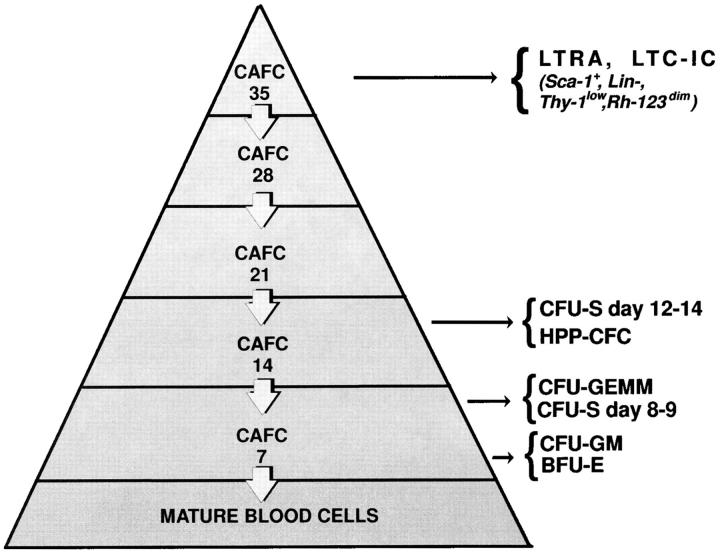
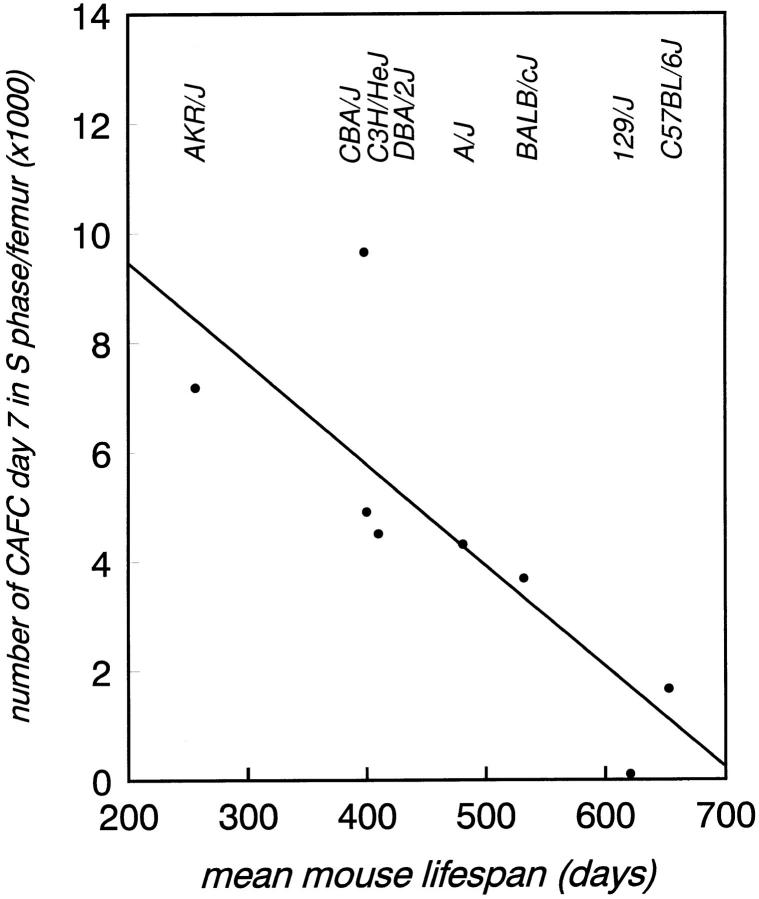
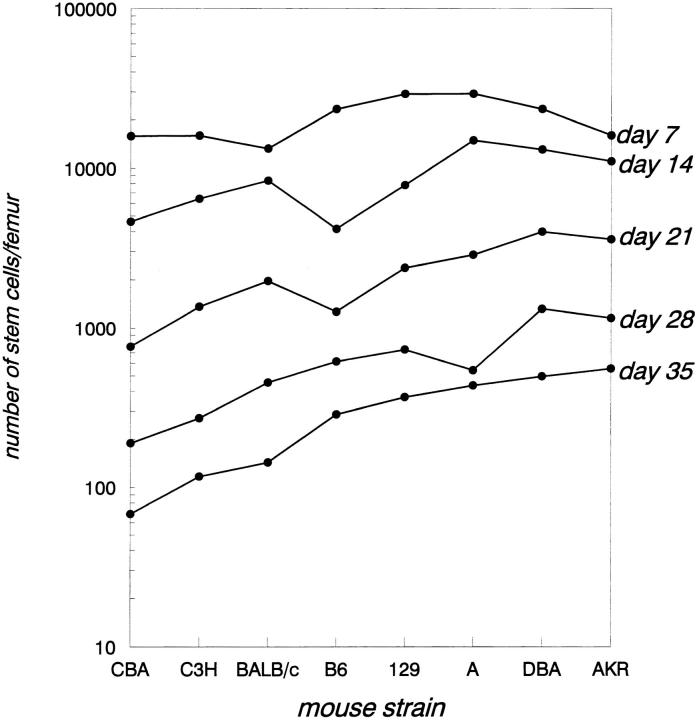
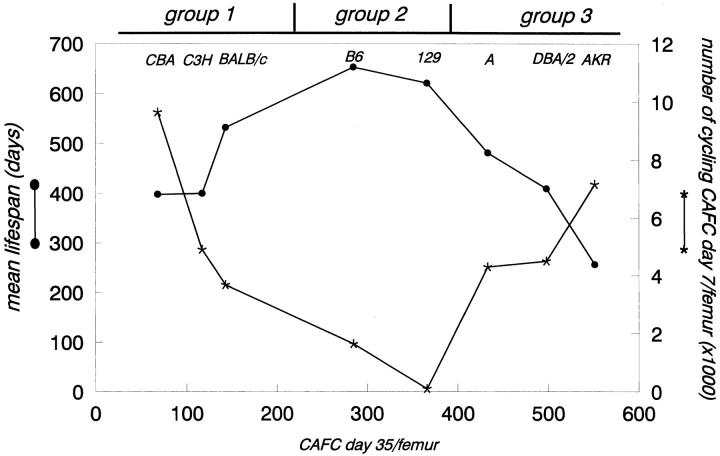
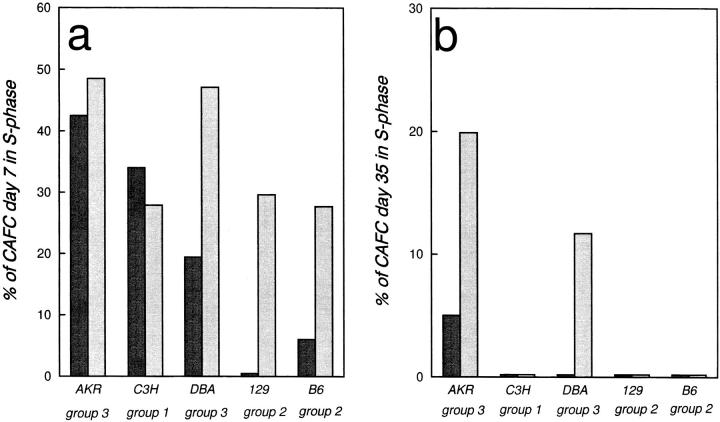
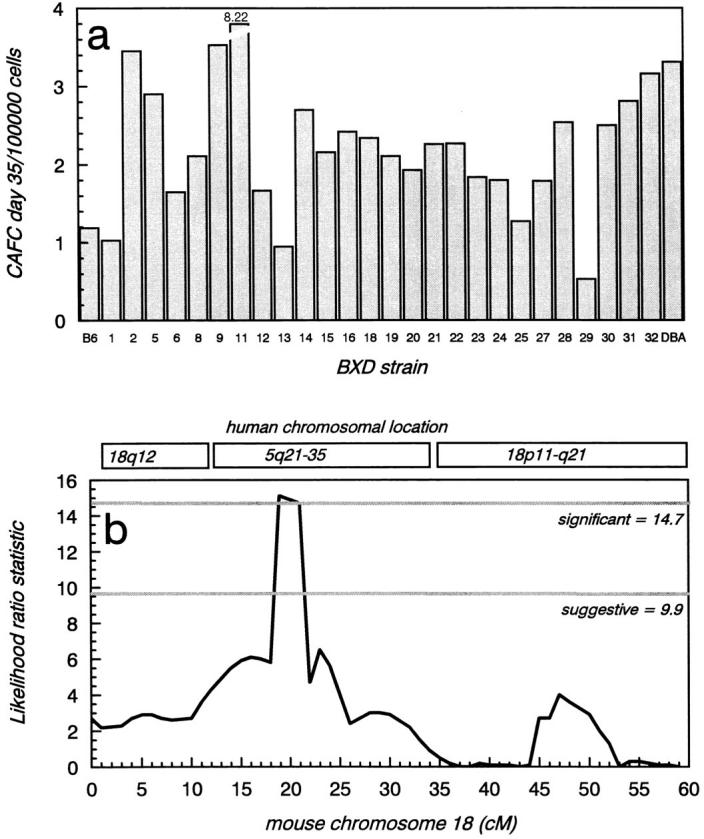
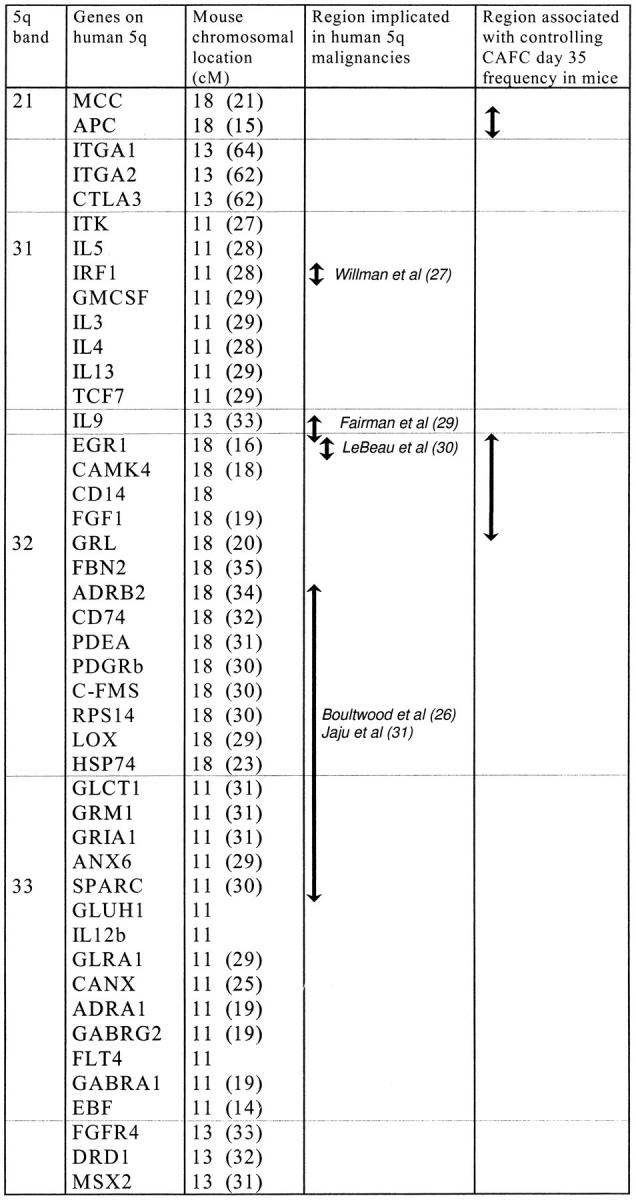
We evaluated in vivo interactions between extrinsic (growth factor induced) and intrinsic (genetically determined) effectors of mouse primitive hemopoietic stem cell proliferation and numbers. Accordingly, stem cell frequency and cell cycle kinetics were assessed in eight strains of inbred mice using the cobblestone area-forming cell (CAFC) assay. A strong inverse correlation was observed between mouse lifespan and the number of autonomously cycling progenitors (CAFC day 7) in the femur. The population size of primitive stem cells (CAFC day 35) varied widely (up to sevenfold) among strains, unlike total CAFC day 7 numbers (cycling and quiescent), which were similar. Administration of the early acting cytokine flt-3 ligand to these strains resulted in activation of quiescent primitive stem cells exclusively in strains with high endogenous stem cell numbers (DBA and AKR), but was unrelated to strain-specific progenitor cell cycling. To map loci affecting stem cell frequency, we quantified stem cells in BXD recombinant inbred mice (offspring of C57BL/6 and DBA/2). The resulting strain distribution pattern showed high concordance with a marker that mapped to chromosome 18 (19 cM). Linkage with this genomic interval was associated with a likelihood of odds score of 3.3, surpassing the level required for significance. Interestingly, this segment, containing the EGR-1 gene, shows synteny with human chromosome 5q, a region strongly associated with various hematological malignancies. Our findings indicate that a gene mapping to this region is mutated in either C57BL/6 or DBA/2 (and possibly AKR) mice. These studies in apparently healthy mice may facilitate the identification of a gene implicated in human 5q-syndromes.
Overview
The claims and statistics of this paper haven’t been checked yet.
Run the check — free, no account needed. It reads the open-access text and checks the sources it cites.
Integrity signals
Registry
Cites
Statistics
Figures
Verification
Claims the paper makes
The claims and statistics of this paper haven’t been checked yet.
Run the check — free, no account needed. It reads the open-access text and checks the sources it cites.
Claims other papers make about this one
Each is checked against this paper’s own text: does it say what the citing paper says it does?
In the citing paper
“aging (also of the hematopoietic system) is at least qualitatively different in distinct strains of mice.”
From Aging of hematopoietic stem cells (2018) · cites this paper as [31]
Self-check
Percentages, sums and reported differences re-computed from the paper’s own numbers.
The self-check needs the paper’s full text.
Citations
Cites
Genetic dissection of complex traits: guidelines for interpreting and reporting linkage results
Lander, E. S., & Kruglyak, L. (1995) · Nature Genetics · doi:10.1038/ng1195-241 · Cited by 5,236 · cited 2×
“Statistical criteria for linkage (16) were established by performing a permutation test (1,000 permutations at 1-cM intervals) (17).”
Empirical threshold values for quantitative trait mapping.
Churchill, G. A., & Doerge, R. W. (1994) · Genetics · doi:10.1093/genetics/138.3.963 · Cited by 4,935
The aging of hematopoietic stem cells
Morrison, S. J., Wandycz, A. M., Akashi, K., Globerson, A., & Weissman, I. L. (1996) · Nature Medicine · doi:10.1038/nm0996-1011 · Cited by 853 · cited 1×
“Conversely, the stem cell pool in unmanipulated mice continuously expands during its lifetime, such that old mice have substantially more stem cells than young mice, although aging has no effect on circulating blood cell counts (2, 3).”
BackgroundBiology of the Laboratory Mouse
(1941) · JAMA · doi:10.1001/jama.1941.02820440081034 · Cited by 805
Mackarehtschian, K., Hardin, J. D., Moore, K., Boast, S., Goff, S. P., & Lemischka, I. R. (1995) · Immunity · doi:10.1016/1074-7613(95)90167-1 · Cited by 575 · cited 1×
“A wealth of in vitro data has shown that FL has potent effects on primitive stem cell proliferation (8–11), and in vivo flk-2/flt-3 knockout mice show stem cell defects, especially affecting lymphopoiesis (12).”
A Macintosh program for storage and analysis of experimental genetic mapping data
Manly, K. F. (1993) · Mammalian Genome · doi:10.1007/bf00357089 · Cited by 496
Deletion of IRF-1 , Mapping to Chromosome 5q31.1, in Human Leukemia and Preleukemic Myelodysplasia
Willman, C. L., Sever, C. E., Pallavicini, M. G., Harada, H., Tanaka, N., Slovak, M. L., Yamamoto, H., Harada, K., Meeker, T. C., List, A. F., et al. (1993) · Science · doi:10.1126/science.8438156 · Cited by 380 · cited 1×
“(27) to be deleted in some 5q-samples, maps to mouse chromosome 11.”
Human/Mouse Homology Relationships
DeBry, R. W., & Seldin, M. F. (1996) · Genomics · doi:10.1006/geno.1996.0209 · Cited by 367
de Haan, G., NIJHOF, W., & Zant, G. E. V. (1997) · Blood · doi:10.1182/blood.v89.5.1543 · Cited by 300
Ploemacher, R., der Sluijs, J. V., van Beurden, C., Baert, M., & Chan, P. (1991) · Blood · doi:10.1182/blood.v78.10.2527.2527 · Cited by 261 · cited 2×
“CAFC day 7, a population of cells which has been shown to consist primarily of multipotent progenitors (18–20), showed a substantial HU kill, whereas primitive CAFC day 35, which contain cells with long-term repopulating ability (18, 20), were not killed by a 1-h incubation with HU, demonstrating their proliferative q…”
Boultwood, J., Lewis, S. M., & Wainscoat, J. S. (1994) · Blood · doi:10.1182/blood.v84.10.3253.3253 · Cited by 244
Beau, M. M. L., Espinosa, R., Neuman, W. L., Stock, W., Roulston, D., Larson, R. A., Keinänen, M., & Westbrook, C. A. (1993) · Proceedings of the National Academy of Sciences · doi:10.1073/pnas.90.12.5484 · Cited by 238 · cited 2×
“(30) to be of critical importance in the ontogeny of 5q-malignancies in humans.”
BackgroundGabbianelli, M., Pelosi, E., Montesoro, E., Valtieri, M., Luchetti, L., Samoggia, P., Vitelli, L., Barberi, T., Testa, U., & Lyman, S. D. (1995) · Blood · doi:10.1182/blood.v86.5.1661.bloodjournal8651661 · Cited by 218
Shah, A. J., Smogorzewska, E. M., Hannum, C. H., & Crooks, G. (1996) · Blood · doi:10.1182/blood.v87.9.3563.bloodjournal8793563 · Cited by 212
Jacobsen, S. E. W., Okkenhaug, C., Myklebust, J. H., Veiby, O. P., & Lyman, S. D. (1995) · The Journal of Experimental Medicine · doi:10.1084/jem.181.4.1357 · Cited by 161
An Animal Model of Chronic Aplastic Marrow Failure. I. Late Marrow Failure After Busulfan
Morley, A., & Blake, J. (1974) · Blood · doi:10.1182/blood.v44.1.49.49 · Cited by 146 · cited 1×
“For example, after chemotherapy or irradiation, blood cell counts may recover to normal values, but stem cell numbers remain severely reduced for the entire lifespan of the animal (1).”
BackgroundHirayama, F., Lyman, S., Clark, S., & Ogawa, M. (1995) · Blood · doi:10.1182/blood.v85.7.1762.bloodjournal8571762 · Cited by 144
Roberts, A. W., Foote, S. J., Alexander, W. S., Scott, C. L., Robb, L. G., & Metcalf, D. (1997) · Blood · doi:10.1182/blood.v89.8.2736 · Cited by 140
Wodnar-Filipowicz, A., Lyman, S. D., Gratwohl, A. A., Tichelli, A., SPECK, B., & Nissen, C. (1996) · Blood · doi:10.1182/blood.v88.12.4493.bloodjournal88124493 · Cited by 118 · cited 1×
“Importantly, several clinical studies now have demonstrated that FL serum concentrations inversely correlate with hematopoietic stem/progenitor cell frequency, whereas no such associations are apparent between FL levels and peripheral blood cell numbers (13, 14).”
Lyman, S. D., Seaberg, M. A., Hanna, R., Zappone, J., Brasel, K., Abkowitz, J., Prchal, J., Schultz, J., & Shahidi, N. (1995) · Blood · doi:10.1182/blood.v86.11.4091.bloodjournal86114091 · Cited by 113 · cited 1×
“Importantly, several clinical studies now have demonstrated that FL serum concentrations inversely correlate with hematopoietic stem/progenitor cell frequency, whereas no such associations are apparent between FL levels and peripheral blood cell numbers (13, 14).”
Müller‐Sieburg, C. E., & Riblet, R. J. (1996) · The Journal of Experimental Medicine · doi:10.1084/jem.183.3.1141 · Cited by 109
Jd, D., & Ploemacher, R. (1993) · PubMed · Cited by 108
Van Zant, G., Holland, B. P., Eldridge, P. W., & Chen, J. J. (1990) · The Journal of Experimental Medicine · doi:10.1084/jem.171.5.1547 · Cited by 99
Boultwood, J., Fidler, C., Lewis, S. M., Kelly, S., Sheridan, H., Littlewood, T. J., Buckle, V. J., & Wainscoat, J. S. (1994) · Genomics · doi:10.1006/geno.1994.1090 · Cited by 87 · cited 1×
“, (26, 28) is partly syntenic with a segment on mouse chromosome 18, but appears to be too telomeric to be considered as a candidate region for the present QTL.”
Zant, G. E. V., Eldridge, P. W., Behringer, R. R., & Dewey, M. J. (1983) · Cell · doi:10.1016/0092-8674(83)90096-x · Cited by 75
Genetic control of murine hematopoietic stem cell pool sizes and cycling kinetics.
Phillips, R. L., Reinhart, A. J., & Zant, G. E. V. (1992) · Proceedings of the National Academy of Sciences · doi:10.1073/pnas.89.23.11607 · Cited by 68
Ploemacher, R., van der Loo, J. C. M., Beurden, C. A. J. V. D. L.-V., & Baert, M. R. M. (1993) · PubMed · Cited by 68
Russell, E. S. (1966) · The Mouseion at the JAXlibrary (Jackson Laboratory) · Cited by 67
Physical mapping of the minimal region of loss in 5q- chromosome.
Fairman, J., Chumakov, I. M., Chinault, A. C., Nowell̀, P. C., & Nagarajan, L. (1995) · Proceedings of the National Academy of Sciences · doi:10.1073/pnas.92.16.7406 · Cited by 66 · cited 1×
“(29) have identified a region between EGR-1 and IL-9 .”
BackgroundWolf, N. S., Penn, P., Jiang, D., Fei, R. G., & Pendergrass, W. R. (1995) · Experimental Cell Research · doi:10.1006/excr.1995.1092 · Cited by 61 · cited 1×
“It is noteworthy that caloric restriction, which has long been known to increase lifespan, is accompanied by a reduced mitotic index of multiple cell systems (22).”
BackgroundIchihara, M., Hara, T., Takagi, M., Cho, L., Gorman, D. M., & Miyajima, A. (1995) · The EMBO Journal · doi:10.1002/j.1460-2075.1995.tb07075.x · Cited by 52 · cited 1×
“In the field of hematology this type of approach has been, for example, successfully employed to characterize the gene involved in IL-3 nonresponsiveness of A/J mice (24).”
In vitro assays for primitive hematopoietic cells [letter; comment]
Ploemacher, R., van der Loo, J., & der Sluijs, J. V. (1992) · Blood · doi:10.1182/blood.v79.3.834.834 · Cited by 9 · cited 1×
“(25), the CAFC assay will only result in reproducible and accurate stem cell measurements if (phase contrast–negative) colonies growing beneath stromal cells are counted.”
BackgroundNarrowing the critical deleted region in the 5q-syndrome.
Jaju, R. J., Boultwood, J., Fidler, C., Sheridan, H., Oliver, F., Walker, H., Parker, N., Kostrzewa, M., Mueller, U., Wainscoat, J. S., et al. (1996) · Blood · Cited by 1
Cited by
Sorted by citations
Weissman, I. L. (2000) · Cell · doi:10.1016/s0092-8674(00)81692-x · Cited by 1,827
In vivo proliferation and cell cycle kinetics of long-term self-renewing hematopoietic stem cells
Cheshier, S. H., Morrison, S. J., Liao, X., & Weissman, I. L. (1999) · Proceedings of the National Academy of Sciences · doi:10.1073/pnas.96.6.3120 · Cited by 858
Rufer, N., Brümmendorf, T. H., Kolvraa, S., Bischoff, C., Christensen, K., Wadsworth, L., Schulzer, M., & Lansdorp, P. M. (1999) · The Journal of Experimental Medicine · doi:10.1084/jem.190.2.157 · Cited by 709
“Interestingly, in mice the genetically controlled fraction of actively cycling hematopoietic progenitor cells correlates significantly with the life span of the animal (38), whereas the overall telomere length clearly does not (32).”
BackgroundPassegue, E. A., Jamieson, C. H. M., Ailles, L., & Weissman, I. L. (2003) · Proceedings of the National Academy of Sciences · doi:10.1073/pnas.2034201100 · Cited by 712
Aging of hematopoietic stem cells
de Haan, G., & Lazare, S. S. (2018) · Blood · doi:10.1182/blood-2017-06-746412 · Cited by 432
Metadata
- Authors
- Haan, G. D., & Zant, G. V.
- Affiliations
- University of Kentucky HealthCare (US)
- From the Blood and Marrow Transplant Program, Division of Hematology/Oncology, University of Kentucky Medical Center, Lexington, Kentucky 40536-0093
- ORCID
- Haan, Gerald de
- Venue
- The Journal of Experimental Medicine
- Publisher
- Rockefeller University Press
- Published
- 1997-08-18
- Volume
- 186
- Issue
- 4
- Pages
- 529-536
- ISSN
- 0022-1007 (ISSN-L)
- 1540-9538
- PMC
- PMC2199035
- OpenAlex
- W2115154817
- Cited by
- 134
- References
- 33
- Citations by year
- 2020: 2 · 2018: 4 · 2017: 1 · 2016: 2 · 2015: 6 · 2013: 3 · 2012: 3
- FWCI
- 5.39
- Type
- journal article
- Language
- en
- Open access
- bronze
- doi.org
- Locations
- The Journal of Experimental Medicine (publishedVersion)
- PubMed Central (publishedVersion, cc-by-nc-sa)
- PubMed (publishedVersion)
- UKnowledge (University of Kentucky) (submittedVersion, cc-by-nc-sa)
- Funders
- Nederlandse Organisatie voor Wetenschappelijk Onderzoek
- Topics
- Health Sciences › Medicine › Hematology › Hematopoietic Stem Cell Transplantation
- Health Sciences › Medicine › Hematology › Blood disorders and treatments
- Life Sciences › Biochemistry, Genetics and Molecular Biology › Cell Biology › Mesenchymal stem cell research
- Keywords
- hematopoietic stem cells, stem cell frequency, Flt3 ligand, stem cell quiescence, cell cycle kinetics, cobblestone area-forming cells, BXD recombinant inbred mice, linkage mapping, chromosome 18, EGR1, 5q- syndrome, mouse strain differences, mouse lifespan
- MeSH terms
- Animals, Cell Count, Cell Division, Chromosome Mapping, Female, Hematopoietic Stem Cells, Humans, Mice, Inbred Strains, Species Specificity, Mice
About these checks
Registry, retraction, Cites and statistics results are computed, not judged, with one exception: a printed reference that no index lists is read once by a model before it counts as a citation error. Claims are extracted by a model and kept only when their quote appears verbatim in the text; each cited source is then checked, with a model’s help, for whether it says what the claim relies on. Those verdicts can be wrong — read the claim’s quote and the cited source before relying on one.
Statistics and arithmetic are recomputed, not judged.
Confidence bands are shown only for fields calibrated on our annotated test set. None is calibrated yet, so no band is shown.
What counts as a claim ›How we measure confidence ›How we check this ›
Are you an author, or do you see a problem with this page? Request a review
