

The DOI matches its Crossref record; 29 of the 29 references it cites were found in a registry or an index.
A critical role for the autophagy gene Atg5 in T cell survival and proliferation
Open accessAbstract
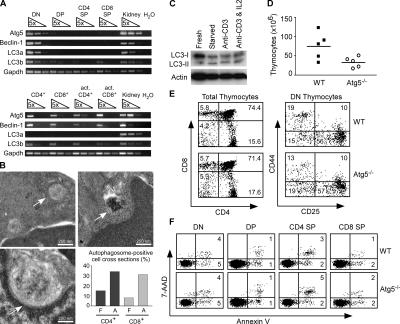
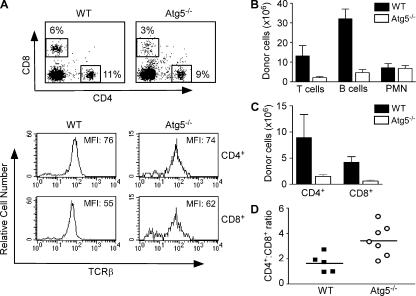
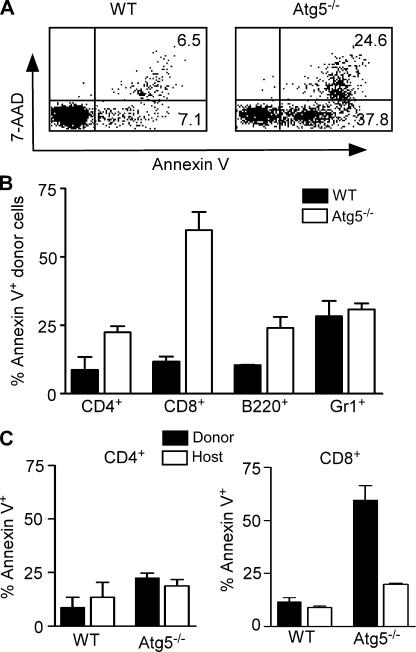
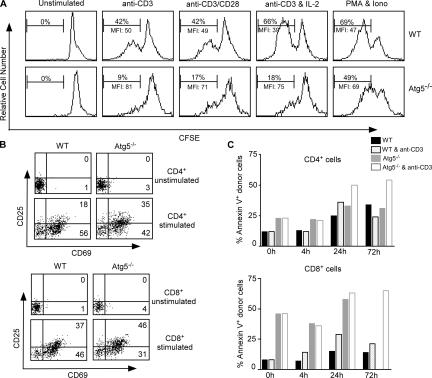
Macroautophagy (hereafter referred to as autophagy) is a well-conserved intracellular degradation process. Recent studies examining cells lacking the autophagy genes Atg5 and Atg7 have demonstrated that autophagy plays essential roles in cell survival during starvation, in innate cell clearance of microbial pathogens, and in neural cell maintenance. However, the role of autophagy in T lymphocyte development and survival is not known. Here, we demonstrate that autophagosomes form in primary mouse T lymphocytes. By generating Atg5−/− chimeric mice, we found that Atg5-deficient T lymphocytes underwent full maturation. However, the numbers of total thymocytes and peripheral T and B lymphocytes were reduced in Atg5 chimeras. In the periphery, Atg5−/− CD8+ T lymphocytes displayed dramatically increased cell death. Furthermore, Atg5−/− CD4+ and CD8+ T cells failed to undergo efficient proliferation after TCR stimulation. These results demonstrate a critical role for Atg5 in multiple aspects of lymphocyte development and function and suggest that autophagy may be essential for both T lymphocyte survival and proliferation.
Overview
The claims and statistics of this paper haven’t been checked yet.
Run the check — free, no account needed. It reads the open-access text and checks the sources it cites.
Integrity signals
Registry
Cites
Statistics
Figures
Verification
Claims the paper makes
The claims and statistics of this paper haven’t been checked yet.
Run the check — free, no account needed. It reads the open-access text and checks the sources it cites.
Claims other papers make about this one
Each is checked against this paper’s own text: does it say what the citing paper says it does?
The source backs part of the claim, not all of it — or backs it for a different population, condition or comparison.
In the citing paper
“In this respect it is noteworthy that some cell-types of the immune system such as dendritic cells 260 seem to tolerate loss of autophagy fairly well, whereas others such as T and B cells are compromised in their development and function after autophagy inhibition.757,758”
From Guidelines for the use and interpretation of assays for monitoring autophagy (2012) · cites this paper as [757]
Experimental — accuracy not yet measuredIn the citing paper
“Proper induction of autophagy has been shown to be important for the maintenance of cellular bioenergetics and sustained T cell viability after activation (25, 26).”
From Fueling Immunity: Insights into Metabolism and Lymphocyte Function (2013) · cites this paper as [26]
Self-check
Percentages, sums and reported differences re-computed from the paper’s own numbers.
The self-check needs the paper’s full text.
Citations
Cites
Repertoires of Autophagy in the Pathogenesis of Ocular Diseases
Li, Y., Jiang, Q. L., Cao, G.-F., Yao, J., & Yan, B. (2015) · Cellular Physiology and Biochemistry · doi:10.1159/000373980 · Cited by 16,351
LC3, a mammalian homologue of yeast Apg8p, is localized in autophagosome membranes after processing.
Kabeya, Y., Mizushima, N., Ueno, T., Yamamoto, A., Kirisako, T., Noda, T., Kominami, E., Ohsumi, Y., & Yoshimori, T. (2000) · The EMBO Journal · doi:10.1093/emboj/19.21.5720 · Cited by 6,605 · cited 2×
“The second pathway results in the conjugation of microtubule-associated protein 1 light chain 3 (LC3; yeast Atg8) to phospholipids for incorporation into the autophagosome membrane (14).”
Self-citationCui, C., Cui, J., Jin, F., Cui, Y., Li, R., Jiang, X., Tian, Y., Wang, R. C., Jiang, P., & Gao, J. (2017) · Cellular Physiology and Biochemistry · doi:10.1159/000479571 · Cited by 5,214
Suppression of basal autophagy in neural cells causes neurodegenerative disease in mice
Hara, T., Nakamura, K., Matsui, M., Yamamoto, A., Nakahara, Y., Suzuki-Migishima, R., Yokoyama, M., Mishima, K., Saito, I., Okano, H., et al. (2006) · Nature · doi:10.1038/nature04724 · Cited by 3,882
Self-citationBcl-2 Antiapoptotic Proteins Inhibit Beclin 1-Dependent Autophagy
Pattingre, S., Tassa, A., Qu, X., Garuti, R., Liang, X. H., Mizushima, N., Packer, M., Schneider, M. D., & Levine, B. (2005) · Cell · doi:10.1016/j.cell.2005.07.002 · Cited by 3,536 · cited 1×
“Bcl-2 has been shown to inhibit autophagosome formation in nutrient-starved yeast and human cancer cell lines (25), yet Bcl-2 expression in Bax−/− Bak−/− mouse embryonic fi broblasts enhances autophagy after etoposide treatment (19).”
Self-citationLoss of autophagy in the central nervous system causes neurodegeneration in mice
Komatsu, M., Waguri, S., Chiba, T., Murata, S., Iwata, J.-I., Tanida, I., Ueno, T., Koike, M., Uchiyama, Y., Kominami, E., et al. (2006) · Nature · doi:10.1038/nature04723 · Cited by 3,500
The role of autophagy during the early neonatal starvation period
Kuma, A., Hatano, M., Matsui, M., Yamamoto, A., Nakaya, H., Yoshimori, T., Ohsumi, Y., Tokuhisa, T., & Mizushima, N. (2004) · Nature · doi:10.1038/nature03029 · Cited by 2,865 · cited 2×
“Although autophagy is important for survival during periods of nutrient deprivation (5), its role in regulating cellular life and death decisions remains largely unknown (for review see reference 15).”
Self-citationGutierrez, M. G., Master, S. S., Singh, S. B., Taylor, G. A., Colombo, M. I., & Deretic, V. (2004) · Cell · doi:10.1016/j.cell.2004.11.038 · Cited by 2,252 · cited 1×
“Furthermore, autophagy contributes to the clearance of intracellular pathogens including group A Streptococcus and Mycobacterium tuberculosis (9, 10).”
Isolation and characterization of autophagy‐defective mutants of Saccharomyces cerevisiae
Tsukada, M., & Ohsumi, Y. (1993) · FEBS Letters · doi:10.1016/0014-5793(93)80398-e · Cited by 1,837 · cited 2×
“Atg5 was fi rst identifi ed in a screen for yeast incapable of surviving nitrogen starvation (2).”
Inhibition of Macroautophagy Triggers Apoptosis
Boya, P., González‐Polo, R. A., Casares, N., Perfettini, J., Dessen, P., Larochette, N., Métivier, D., Meley, D., Souquère, S., Yoshimori, T., et al. (2005) · Molecular and Cellular Biology · doi:10.1128/mcb.25.3.1025-1040.2005 · Cited by 1,669 · cited 1×
“Both the inhibition of apoptosis can induce autophagy (19, 20, 23), and the inhibition of autophagy can induce apoptosis (24).”
Growth factor regulation of autophagy and cell survival in the absence of apoptosis
Lum, J. J., Bauer, D. E., Kong, M., Harris, M. H., Li, C., Lindsten, T., & Thompson, C. B. (2005) · Cell · doi:10.1016/j.cell.2004.11.046 · Cited by 1,487 · cited 2×
“Autophagy is also essential for maintaining cell survival after growth factor withdrawal (8).”
Dissection of Autophagosome Formation Using Apg5-Deficient Mouse Embryonic Stem Cells
Mizushima, N., Yamamoto, A., Hatano, M., Kobayashi, Y., Kabeya, Y., Suzuki, K., Tokuhisa, T., Ohsumi, Y., & Yoshimori, T. (2001) · The Journal of Cell Biology · doi:10.1083/jcb.152.4.657 · Cited by 1,361 · cited 1×
“The terminal products of one of these two pathways, an Atg5–Atg12 covalent complex, is required for the elongation of the isolation membrane (13).”
Self-citationRole of Bcl-2 family proteins in a non-apoptotic programmed cell death dependent on autophagy genes
Shimizu, S., Kanaseki, T., Mizushima, N., Mizuta, T., Arakawa-Kobayashi, S., Thompson, C. B., & Tsujimoto, Y. (2004) · Nature Cell Biology · doi:10.1038/ncb1192 · Cited by 1,358
Self-citationRegulation of an ATG7 - beclin 1 Program of Autophagic Cell Death by Caspase-8
Yu, L., Alva, A. S., Su, H. C., Dutt, P., Freundt, E. C., Welsh, S. J., Baehrecke, E. H., & Lenardo, M. J. (2004) · Science · doi:10.1126/science.1096645 · Cited by 1,249 · cited 2×
“Both the inhibition of apoptosis can induce autophagy (19, 20, 23), and the inhibition of autophagy can induce apoptosis (24).”
Petiot, A., Ogier‐Denis, É., Blommaart, E. F. C., Meijer, A. J., & Codogno, P. (2000) · Journal of Biological Chemistry · doi:10.1074/jbc.275.2.992 · Cited by 1,168 · cited 1×
“Class III phosphatidylinoside 3-kinase in complex with Beclin-1 (yeast Atg6) induces autophagosome formation (11, 12).”
Protection against Fatal Sindbis Virus Encephalitis by Beclin, a Novel Bcl-2-Interacting Protein
Liang, X. H., Kleeman, L. K., Jiang, H., Gordon, G. W., Goldman, J. E., Berry, G., Herman, B. A., & Levine, B. (1998) · Journal of Virology · doi:10.1128/jvi.72.11.8586-8596.1998 · Cited by 1,128 · cited 3×
“Bcl-2 has been shown to inhibit autophagosome formation in nutrient-starved yeast and human cancer cell lines (25), yet Bcl-2 expression in Bax−/− Bak−/− mouse embryonic fi broblasts enhances autophagy after etoposide treatment (19).”
Autophagy Defends Cells Against Invading Group A Streptococcus
Nakagawa, I., Amano, A., Mizushima, N., Yamamoto, A., Yamaguchi, H., Kamimoto, T., Nara, A., Funao, J., Nakata, M., Tsuda, K., et al. (2004) · Science · doi:10.1126/science.1103966 · Cited by 1,091 · cited 1×
“Furthermore, autophagy contributes to the clearance of intracellular pathogens including group A Streptococcus and Mycobacterium tuberculosis (9, 10).”
Self-citationAutophagy: dual roles in life and death?
Baehrecke, E. H. (2005) · Nature Reviews Molecular Cell Biology · doi:10.1038/nrm1666 · Cited by 986
Autophagosome Formation in Mammalian Cells.
Mizushima, N., Ohsumi, Y., & Yoshimori, T. (2002) · Cell Structure and Function · doi:10.1247/csf.27.421 · Cited by 897
Self-citationZhang, J., Cado, D., Chen, A., Kabra, N., & Winoto, A. (1998) · Nature · doi:10.1038/32681 · Cited by 792 · cited 1×
“FADD-defi cient T cells display a defect in proliferation, with normal up-regulation of activation markers (26, 27).”
Autophagy in metazoans: cell survival in the land of plenty
Lum, J. J., DeBerardinis, R. J., & Thompson, C. B. (2005) · Nature Reviews Molecular Cell Biology · doi:10.1038/nrm1660 · Cited by 774 · cited 2×
“Although autophagy has been long recognized, only recently have its essential roles in various cellular functions been established (3, 4).”
Autophagic programmed cell death by selective catalase degradation
Yu, L., Wan, F., Dutta, S., Welsh, S., Liu, Z., Freundt, E. C., Baehrecke, E. H., & Lenardo, M. J. (2006) · Proceedings of the National Academy of Sciences · doi:10.1073/pnas.0511288103 · Cited by 680 · cited 1×
“Both the inhibition of apoptosis can induce autophagy (19, 20, 23), and the inhibition of autophagy can induce apoptosis (24).”
Essential Roles of Atg5 and FADD in Autophagic Cell Death
Pyo, J.-O., Jang, M.-H., Kwon, Y., Lee, H.-J., Jun, J.-I., Woo, H., Cho, D.-H., Choi, B., Lee, H., Kim, J.-H., et al. (2005) · Journal of Biological Chemistry · doi:10.1074/jbc.m413934200 · Cited by 553 · cited 4×
“FADD-defi cient T cells display a defect in proliferation, with normal up-regulation of activation markers (26, 27).”
InfluentialSelf-citationThe pleiotropic role of autophagy: from protein metabolism to bactericide
Mizushima, N. (2005) · Cell Death and Differentiation · doi:10.1038/sj.cdd.4401728 · Cited by 494 · cited 2×
“Although autophagy has been long recognized, only recently have its essential roles in various cellular functions been established (3, 4).”
Self-citationAutophagy is involved in T cell death after binding of HIV-1 envelope proteins to CXCR4
Espert, L. (2006) · Journal of Clinical Investigation · doi:10.1172/jci26185 · Cited by 472 · cited 2×
“CD4+ human umbilical cord T cells also can be induced to form autophagosomes by the HIV-1 envelope glycoprotein (22).”
Tassa, A., Roux, M.-P., Attaix, D., & Béchet, D. (2003) · Biochemical Journal · doi:10.1042/bj20030826 · Cited by 210 · cited 1×
“Class III phosphatidylinoside 3-kinase in complex with Beclin-1 (yeast Atg6) induces autophagosome formation (11, 12).”
Autophagy and Caspases: A New Cell Death Program
Li, Y., Lenardo, M. J., & Baehrecke, E. H. (2004) · Cell Cycle · doi:10.4161/cc.3.9.1097 · Cited by 124 · cited 1×
“The induction of autophagy may either program or prevent cell death (3, 4, 16).”
Zhang, Y., Rosenberg, S., Wang, H., Imtiyaz, H. Z., Hou, Y.-J., & Zhang, J. (2005) · The Journal of Immunology · doi:10.4049/jimmunol.175.5.3033 · Cited by 68 · cited 1×
“FADD-defi cient T cells display a defect in proliferation, with normal up-regulation of activation markers (26, 27).”
Gerland, L., Genestier, L., Peyrol, S., Michallet, M., Hayette, S., Urbanowicz, I., Ffrench, P., Magaud, J., & Ffrench, M. (2004) · Experimental Gerontology · doi:10.1016/j.exger.2004.01.013 · Cited by 60 · cited 2×
“Human T lymphocytes stimulated and cultured in vitro form autophagosomes as identifi ed by transmission electron microscopy (21).”
Research works printed but not linked: 2
- 2005, Nat. Rev. Mol. Cell Biol., 6, 505
- 2004, Cell Cycle., 3, 1124
Cited by
Sorted by citations
Repertoires of Autophagy in the Pathogenesis of Ocular Diseases
Li, Y., Jiang, Q. L., Cao, G.-F., Yao, J., & Yan, B. (2015) · Cellular Physiology and Biochemistry · doi:10.1159/000373980 · Cited by 16,351
Autophagy in the Pathogenesis of Disease
Levine, B., & Kroemer, G. (2008) · Cell · doi:10.1016/j.cell.2007.12.018 · Cited by 7,069
Autophagy fights disease through cellular self-digestion
Mizushima, N., Levine, B., Cuervo, A. M., & Klionsky, D. J. (2008) · Nature · doi:10.1038/nature06639 · Cited by 6,452
Self-citationGuidelines for the use and interpretation of assays for monitoring autophagy (3rd edition).
Klionsky, D. J., Abdelmohsen, K., Abe, A., Abedin, M. J., Abeliovich, H., Acevedo Arozena, A., Adachi, H., Adams, C. M., Adams, P. D., Adeli, K., et al. (2016) · Autophagy · doi:10.1080/15548627.2015.1100356 · Cited by 5,894
“are compromised in their development and function after autophagy inhibition.(1213,1214) In addition to pharmacological inhibition, RNA silencing, gene knockout and dominant negative RAB and ATG protein expression, pathogen-derived autophagy inhibitors can also be considered to manipulate autophagy.”
Guidelines for the use and interpretation of assays for monitoring autophagy
Klionsky, D. J., Abdalla, F. C., Abeliovich, H., Abraham, R. T., Acevedo-Arozena, A., Adeli, K., Agholme, L., Agnello, M., Agostinis, P., Aguirre-Ghiso, J. A., et al. (2012) · Autophagy · doi:10.4161/auto.19496 · Cited by 3,996
“In this respect it is noteworthy that some cell-types of the immune system such as dendritic cells(260) seem to tolerate loss of autophagy fairly well, whereas others such as T and B cells are compromised in their development and function after autophagy inhibition.(757,758) In addition to pharmacological inhibition,…”
Background
Metadata
- Authors
- Pua, H. H., Dzhagalov, I., Chuck, M., Mizushima, N., & He, Y.-W.
- Affiliations
- Duke Medical Center (US)
- Japan Science and Technology Agency (JP)
- Venue
- The Journal of Experimental Medicine
- Publisher
- Rockefeller University Press
- Published
- 2006-12-26
- Volume
- 204
- Issue
- 1
- Pages
- 25-31
- ISSN
- 0022-1007 (ISSN-L)
- 1540-9538
- PMC
- PMC2118420
- OpenAlex
- W2154663531
- Cited by
- 622
- References
- 29
- Citations by year
- 2026: 10 · 2025: 23 · 2024: 17 · 2023: 23 · 2022: 25 · 2021: 31 · 2020: 34 · 2019: 35 · 2018: 34 · 2017: 39 · 2016: 45 · 2015: 35 · 2014: 34 · 2013: 42 · 2012: 55
- FWCI
- 19.36
- Type
- journal article
- Language
- en
- Open access
- bronze
- doi.org
- Locations
- The Journal of Experimental Medicine (publishedVersion)
- Europe PMC (PubMed Central) (publishedVersion, cc-by-nc-sa)
- PubMed Central (publishedVersion, cc-by-nc-sa)
- PubMed (publishedVersion)
- Funders
- National Institutes of Health
- National Cancer Institute (R01CA092123, CA92123)
- National Institute of Diabetes and Digestive and Kidney Diseases (P30DK040561)
- Topics
- Life Sciences › Biochemistry, Genetics and Molecular Biology › Cell Biology › Autophagy in Disease and Therapy
- Life Sciences › Immunology and Microbiology › Immunology › T-cell and B-cell Immunology
- Life Sciences › Immunology and Microbiology › Immunology › Phagocytosis and Immune Regulation
- Keywords
- autophagy, ATG5, ATG7, T cell proliferation, T cell development, autophagosomes, CD8+ T cells, CD4+ T cells, T cell receptor stimulation, lymphocyte apoptosis, chimeric mice
- MeSH terms
- Autophagy-Related Protein 5, Animals, Autophagy, Base Sequence, Cell Differentiation, Cell Survival, Female, Mice, Inbred C57BL, Microtubule-Associated Proteins, Pregnancy, Receptors, Antigen, T-Cell, T-Lymphocytes, Fetal Tissue Transplantation, DNA Primers, Transplantation Chimera, Mice, Knockout, Hematopoietic Stem Cell Transplantation, CD8-Positive T-Lymphocytes, Cell Proliferation, Mice
About these checks
Registry, retraction, Cites and statistics results are computed, not judged, with one exception: a printed reference that no index lists is read once by a model before it counts as a citation error. Claims are extracted by a model and kept only when their quote appears verbatim in the text; each cited source is then checked, with a model’s help, for whether it says what the claim relies on. Those verdicts can be wrong — read the claim’s quote and the cited source before relying on one.
Statistics and arithmetic are recomputed, not judged.
Confidence bands are shown only for fields calibrated on our annotated test set. None is calibrated yet, so no band is shown.
What counts as a claim ›How we measure confidence ›How we check this ›
Are you an author, or do you see a problem with this page? Request a review
