

The DOI matches its Crossref record; 37 of the 37 references it cites were found in a registry or an index.
Regulation of intestinal inflammation by microbiota following allogeneic bone marrow transplantation
Open accessAbstract
Despite a growing understanding of the link between intestinal inflammation and resident gut microbes, longitudinal studies of human flora before initial onset of intestinal inflammation have not been reported. Here, we demonstrate in murine and human recipients of allogeneic bone marrow transplantation (BMT) that intestinal inflammation secondary to graft-versus-host disease (GVHD) is associated with major shifts in the composition of the intestinal microbiota. The microbiota, in turn, can modulate the severity of intestinal inflammation. In mouse models of GVHD, we observed loss of overall diversity and expansion of Lactobacillales and loss of Clostridiales. Eliminating Lactobacillales from the flora of mice before BMT aggravated GVHD, whereas reintroducing the predominant species of Lactobacillus mediated significant protection against GVHD. We then characterized gut flora of patients during onset of intestinal inflammation caused by GVHD and found patterns mirroring those in mice. We also identified increased microbial chaos early after allogeneic BMT as a potential risk factor for subsequent GVHD. Together, these data demonstrate regulation of flora by intestinal inflammation and suggest that flora manipulation may reduce intestinal inflammation and improve outcomes for allogeneic BMT recipients.
Overview
The claims and statistics of this paper haven’t been checked yet.
Run the check — free, no account needed. It reads the open-access text and checks the sources it cites.
Integrity signals
Registry
Cites
Statistics
Figures
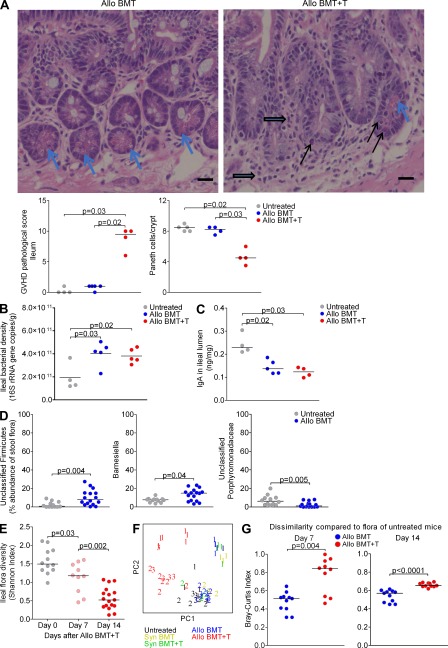
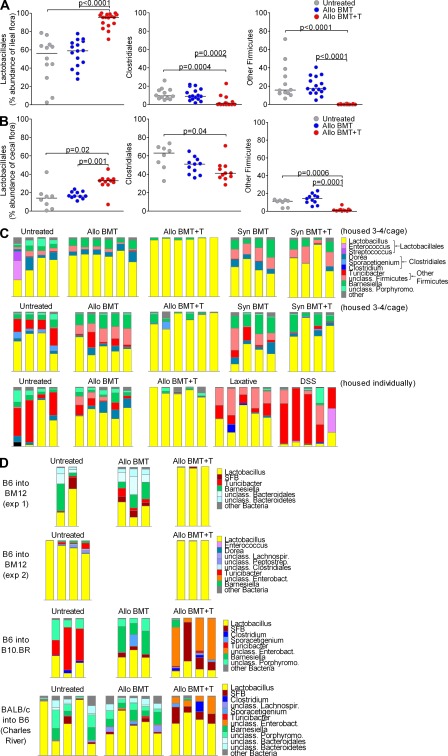
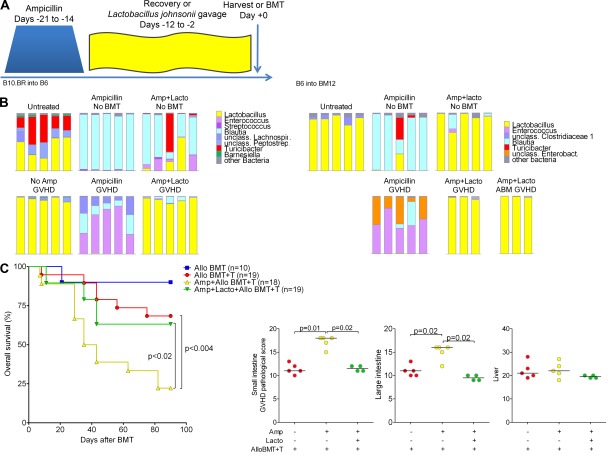
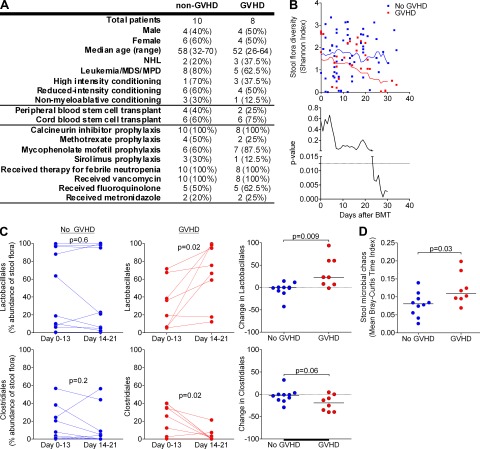
Verification
Claims the paper makes
The claims and statistics of this paper haven’t been checked yet.
Run the check — free, no account needed. It reads the open-access text and checks the sources it cites.
Claims other papers make about this one
Each is checked against this paper’s own text: does it say what the citing paper says it does?
In the citing paper
“Preclinical models have shown that commensal bacteria influence the pathophysiology of GVHD.10,17–20”
From Microbiota as Predictor of Mortality in Allogeneic Hematopoietic-Cell Transplantation (2020) · cites this paper as [19]
In the citing paper
“The onset of acute-GVHD is associated with significant shifts in the composition of the microbiota with a loss of overall diversity and reduction of health-promoting obligate anaerobes such as Faecalibacterium, Ruminococcus, Lactobacillus, and Blautia, and an enrichment of Enterococcus and Clostridiales”
From The Influence of the Gut Microbiome on Cancer, Immunity, and Cancer Immunotherapy (2018) · cites this paper as Jenq et al., 2012
Self-check
Percentages, sums and reported differences re-computed from the paper’s own numbers.
The self-check needs the paper’s full text.
Citations
Cites
Naive Bayesian Classifier for Rapid Assignment of rRNA Sequences into the New Bacterial Taxonomy
Wang, Q., Garrity, G. M., Tiedje, J. M., & Cole, J. R. (2007) · Applied and Environmental Microbiology · doi:10.1128/aem.00062-07 · Cited by 20,145
Schloss, P. D., Westcott, S. L., Ryabin, T., Hall, J. R., Hartmann, M., Hollister, E. B., Lesniewski, R. A., Oakley, B. B., Parks, D. H., Robinson, C. J., et al. (2009) · Applied and Environmental Microbiology · doi:10.1128/aem.01541-09 · Cited by 19,549
Measuring biological diversity
Magurran, A. E. (2004) · Choice Reviews Online · doi:10.5860/choice.42-1547 · Cited by 6,617
Gut microbiota in health and disease
Sekirov, I., Russell, S. L., Antunes, L. C. M., & Finlay, B. B. (2010) · Physiological Reviews · doi:10.1152/physrev.00045.2009 · Cited by 4,182
Human nutrition, the gut microbiome and the immune system
Kau, A. L., Ahern, P. P., Griffin, N. W., Goodman, A. L., & Gordon, J. I. (2011) · Nature · doi:10.1038/nature10213 · Cited by 2,588
Ferrara, J. L. M., Levine, J. E., Reddy, P. R., & Holler, E. (2009) · The Lancet · doi:10.1016/s0140-6736(09)60237-3 · Cited by 2,508
Dethlefsen, L., Huse, S., Sogin, M. L., & Relman, D. A. (2008) · PLoS Biology · doi:10.1371/journal.pbio.0060280 · Cited by 2,361
Intestinal homeostasis and its breakdown in inflammatory bowel disease
Maloy, K. J., & Powrie, F. M. (2011) · Nature · doi:10.1038/nature10208 · Cited by 1,911
UniFrac – An online tool for comparing microbial community diversity in a phylogenetic context
Lozupone, C., Hamady, M., & Knight, R. D. (2006) · BMC Bioinformatics · doi:10.1186/1471-2105-7-371 · Cited by 1,454
Cooke, K., Kobzik, L., Martin, T., Brewer, J., Delmonte, J., Crawford, J., & Ferrara, J. (1996) · Blood · doi:10.1182/blood.v88.8.3230.bloodjournal8883230 · Cited by 967
Cited by
Sorted by citations
Zelante, T., Iannitti, R. G., Cunha, C., De Luca, A., Giovannini, G., Pieraccini, G., Zecchi, R., D’Angelo, C., Massi-Benedetti, C., Fallarino, F., et al. (2013) · Immunity · doi:10.1016/j.immuni.2013.08.003 · Cited by 2,614
Commensal Bacteria Control Cancer Response to Therapy by Modulating the Tumor Microenvironment
Iida, N., Dzutsev, A., Stewart, C. A., Smith, L., Bouladoux, N., Weingarten, R. A., Molina, D. A., Salcedo, R., Back, T., Cramer, S., et al. (2013) · Science · doi:10.1126/science.1240527 · Cited by 2,251
Lloyd-Price, J., Abu-Ali, G., & Huttenhower, C. (2016) · Genome Medicine · doi:10.1186/s13073-016-0307-y · Cited by 1,891
Garrett, W. S. (2015) · Science · doi:10.1126/science.aaa4972 · Cited by 1,404
The Influence of the Gut Microbiome on Cancer, Immunity, and Cancer Immunotherapy
Gopalakrishnan, V., Helmink, B. A., Spencer, C. N., Reuben, A., & Wargo, J. A. (2018) · Cancer Cell · doi:10.1016/j.ccell.2018.03.015 · Cited by 1,392
Metadata
- Authors
- Jenq, R. R., Ubeda, C., Taur, Y., Menezes, C. C., Khanin, R., Dudakov, J. A., Liu, C., West, M. L., Singer, N. V., Equinda, M. J., Gobourne, A., Lipuma, L., Young, L. F., Smith, O. M., Ghosh, A., Hanash, A. M., Goldberg, J. D., Aoyama, K., Blazar, B. R., Pamer, E. G., & R.M. van den Brink, M.
- Affiliations
- Memorial Sloan Kettering Cancer Center (US)
- Adult Bone Marrow Transplantation Service 1 and 2 ; and 3
- Cornell University (US)
- University of Florida (US)
- University of Minnesota (US)
- Corresponding author
- Jenq, Robert R.
- ORCID
- Venue
- Journal of Experimental Medicine
- Publisher
- Rockefeller University Press
- Published
- 2012-04-30
- Volume
- 209
- Issue
- 5
- Pages
- 903-911
- ISSN
- 0022-1007 (ISSN-L)
- 1540-9538
- PMC
- PMC3348096
- OpenAlex
- W2131766513
- Cited by
- 626
- References
- 37
- Citations by year
- 2026: 15 · 2025: 35 · 2024: 23 · 2023: 45 · 2022: 55 · 2021: 53 · 2020: 58 · 2019: 48 · 2018: 51 · 2017: 67 · 2016: 61 · 2015: 40 · 2014: 43 · 2013: 22 · 2012: 10
- FWCI
- 14.69
- Type
- journal article
- Language
- en
- Open access
- green
- www.ncbi.nlm.nih.gov
- Licence
- cc-by-nc-sa
- Locations
- The Journal of Experimental Medicine (publishedVersion)
- Europe PMC (PubMed Central) (publishedVersion, cc-by-nc-sa)
- PubMed Central (publishedVersion, cc-by-nc-sa)
- PubMed (publishedVersion)
- Funders
- National Institutes of Health (UL1TR000064, 4r37ai039031-21, 5k23ai095398-05)
- National Heart, Lung, and Blood Institute (R01HL056067, R01HL069929)
- National Cancer Institute (P01CA023766, P01CA142106, R01CA107096, P30CA008748)
- National Institute of Allergy and Infectious Diseases (R01AI034495, R37-AI039031, R01AI100288, R01AI080455, K23-AI095398, P01AI056299, R01AI042135)
- National Center for Advancing Translational Sciences
- Topics
- Life Sciences › Biochemistry, Genetics and Molecular Biology › Molecular Biology › Gut microbiota and health
- Health Sciences › Medicine › Hematology › Hematopoietic Stem Cell Transplantation
- Life Sciences › Agricultural and Biological Sciences › Food Science › Probiotics and Fermented Foods
- Keywords
- intestinal inflammation, gut microbiota, allogeneic bone marrow transplantation, graft-versus-host disease, Lactobacillus, Lactobacillales, Clostridiales, microbial diversity, microbiome manipulation, gut microbiota composition
- MeSH terms
- Ampicillin, Animals, Base Sequence, Enterocolitis, Feces, Graft vs Host Disease, Gram-Positive Bacteria, Humans, Molecular Sequence Data, Phylogeny, RNA, Ribosomal, 16S, Species Specificity, Transplantation, Homologous, Bone Marrow Transplantation, Dextran Sulfate, Sequence Analysis, DNA, Biodiversity, Mice, Metagenome
About these checks
Registry, retraction, Cites and statistics results are computed, not judged, with one exception: a printed reference that no index lists is read once by a model before it counts as a citation error. Claims are extracted by a model and kept only when their quote appears verbatim in the text; each cited source is then checked, with a model’s help, for whether it says what the claim relies on. Those verdicts can be wrong — read the claim’s quote and the cited source before relying on one.
Statistics and arithmetic are recomputed, not judged.
Confidence bands are shown only for fields calibrated on our annotated test set. None is calibrated yet, so no band is shown.
What counts as a claim ›How we measure confidence ›How we check this ›
Are you an author, or do you see a problem with this page? Request a review
