

Constant velocity physical warp drive solution
Open accessThe DOI matches its Crossref record; 28 of the 30 references it cites were found in a registry or an index; 17 of the 20 sources its claims cite were checked for support.
Abstract
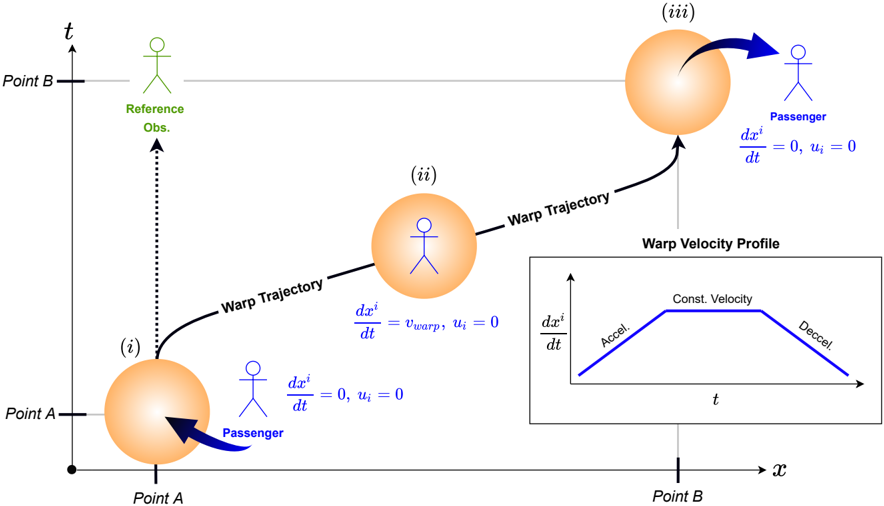
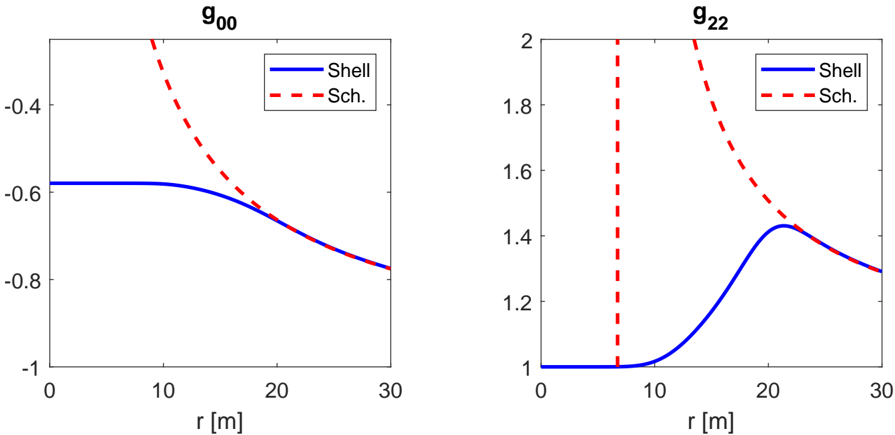
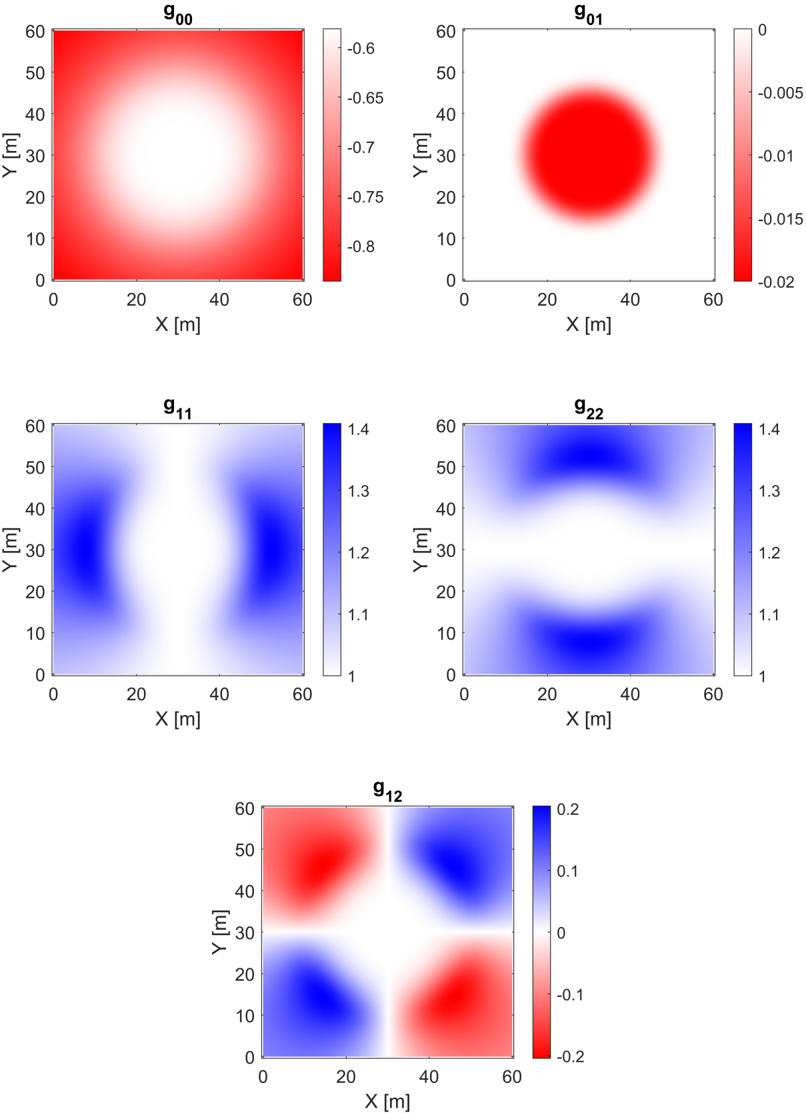
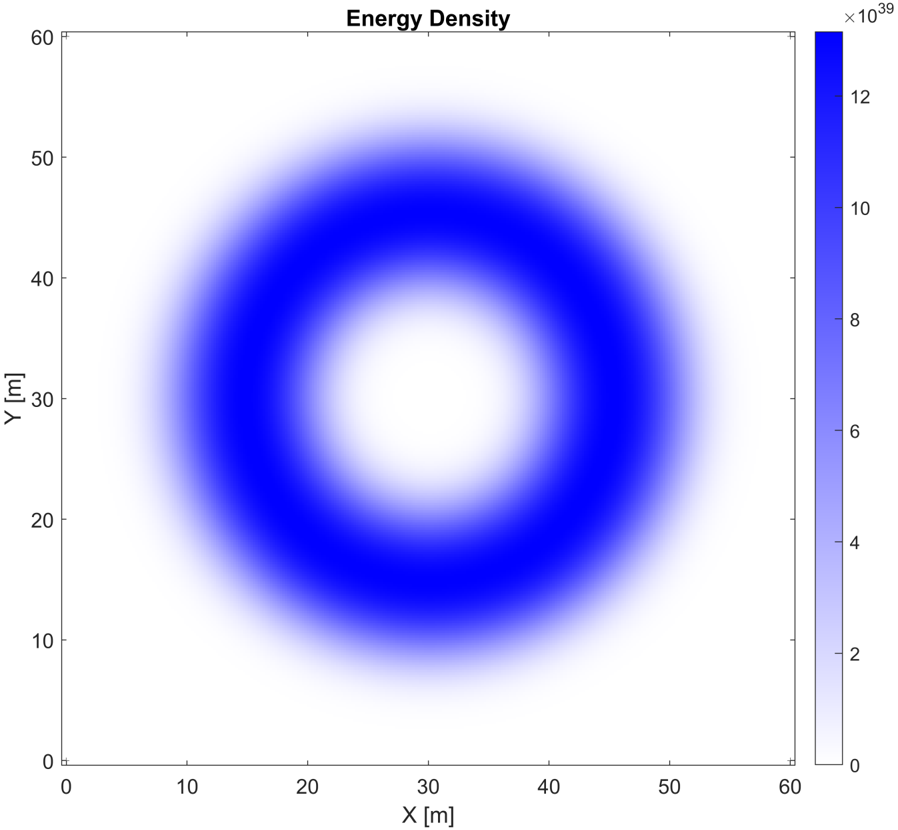
Abstract Warp drives are exotic solutions of general relativity that offer novel means of transportation. In this study, we present a solution for a constant-velocity subluminal warp drive that satisfies all of the energy conditions. The solution involves combining a stable matter shell with a shift vector distribution that closely matches well-known warp drive solutions such as the Alcubierre metric. We generate the spacetime metric numerically, evaluate the energy conditions, and confirm that the shift vector distribution cannot be reduced to a coordinate transformation. This study demonstrates that classic warp drive spacetimes can be made to satisfy the energy conditions by adding a regular matter shell with a positive ADM mass.
Overview
CoChat Summary
## TL;DR
The paper presents a numerical construction of a constant-velocity, subluminal warp drive built from a stable matter shell plus an interior shift vector. The resulting spacetime is reported to satisfy the NEC, WEC, DEC, and SEC, while producing geodesic transport and a measurable time-delay asymmetry.
## Key findings
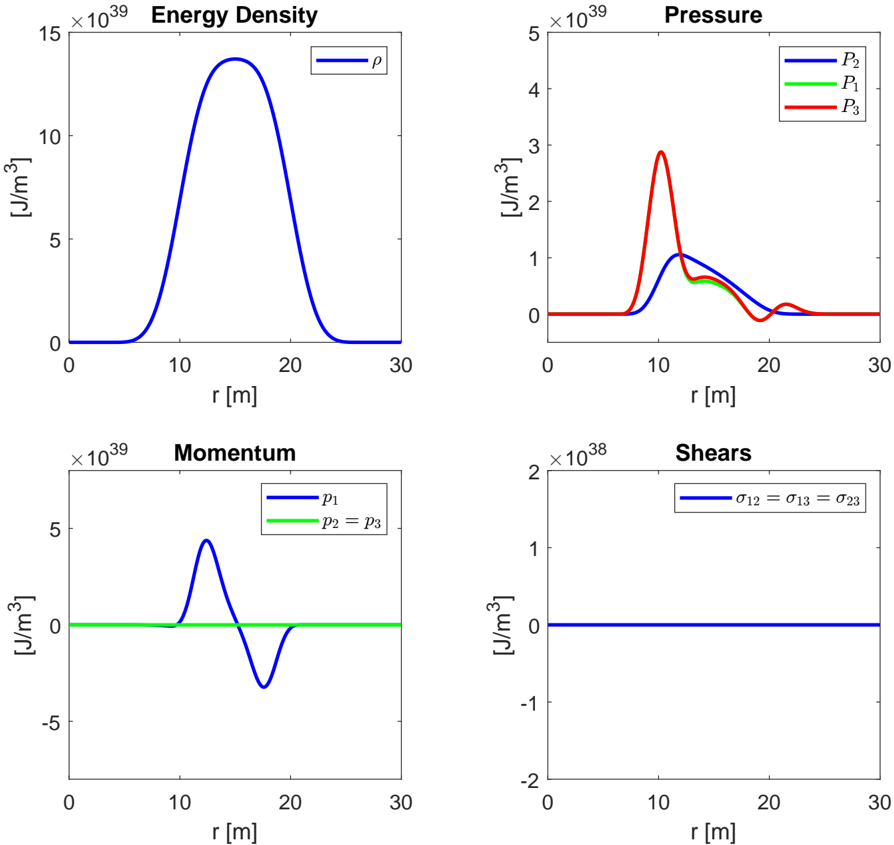
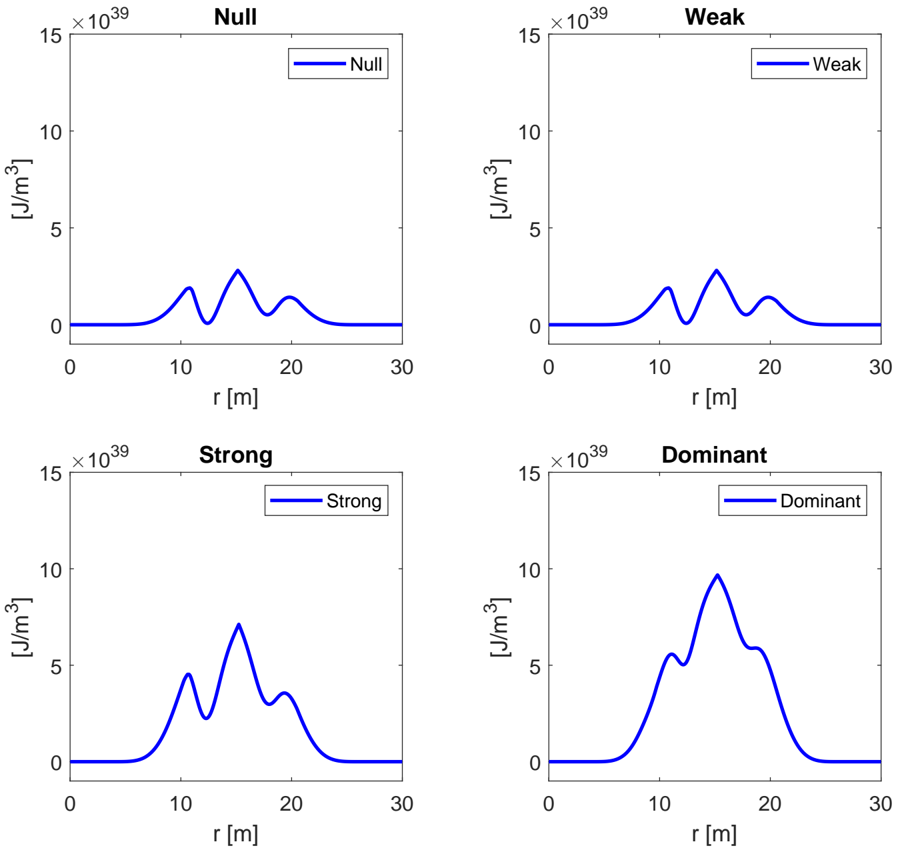
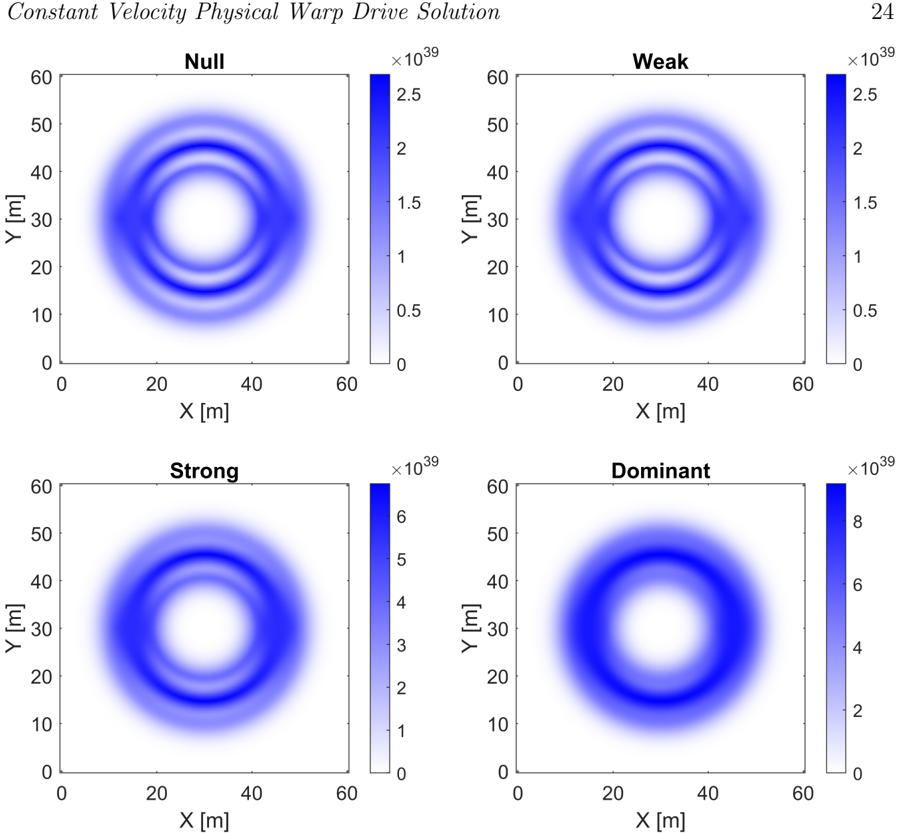
- The authors report a constant-velocity subluminal physical warp drive that satisfies all four energy conditions: NEC, WEC, DEC, and SEC.
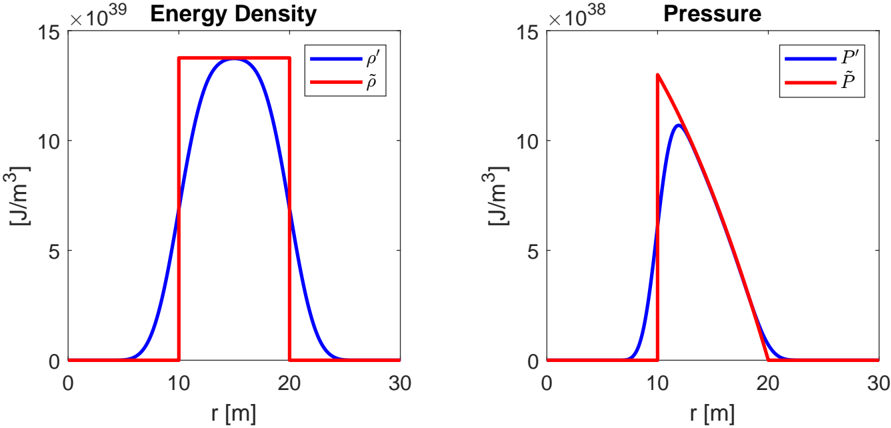
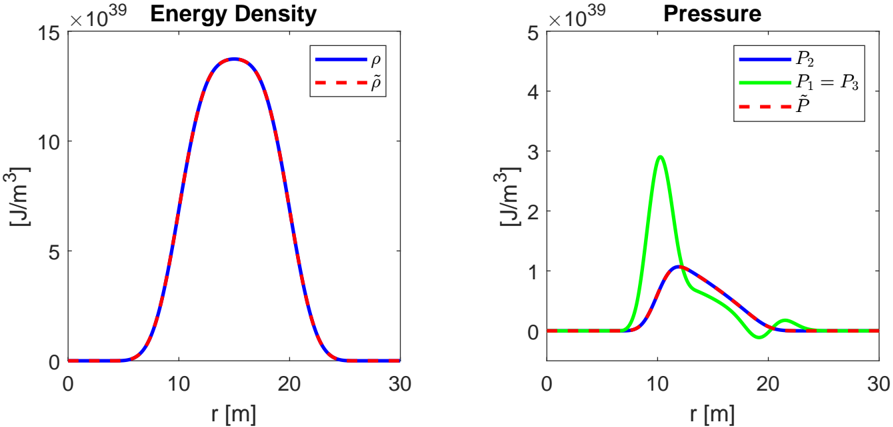
- The solution is built from a stable matter shell with a positive ADM mass; the paper gives an example shell with R1 = 10 m, R2 = 20 m, and M = 4.49 × 10^27 kg (2.365 Jupiter masses).
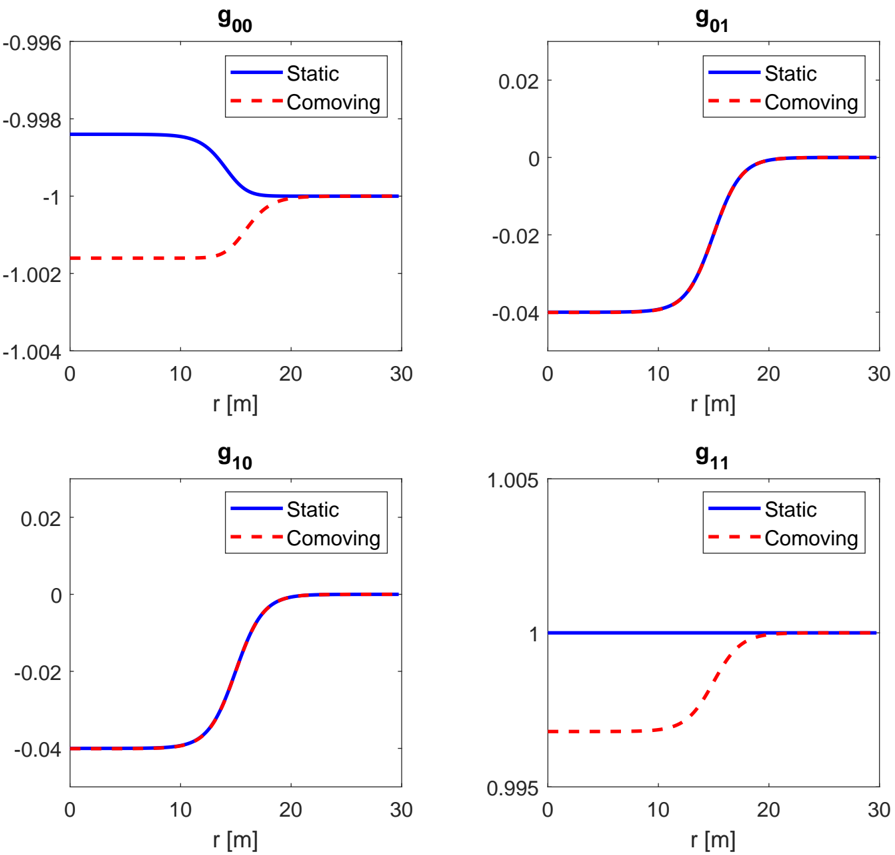
- Adding an interior shift vector with βwarp = 0.02 was found possible without any energy condition violation.
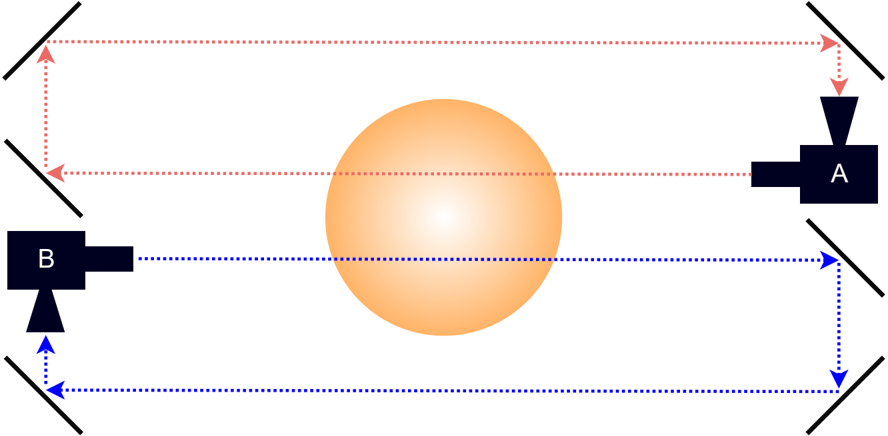
- A light-ray test found a transit-time difference of δt ≈ 7.6 ns for the Warp Shell, compared with δt = 0 ns for the Matter Shell; Table 1 also reports 8.0 ns for Alcubierre, 9.1 ns for Van Den Broeck, and 6.7 ns for Modified Time at vwarp = 0.04c.
- The authors conclude the shift-vector modification cannot be reduced to a coordinate transformation because the photon travel time is measurable and differs by direction.
## Methods
- The paper uses a numerical 3+1 formalism and the Warp Factory toolkit to construct and evaluate the metric, stress-energy tensor, and energy conditions.
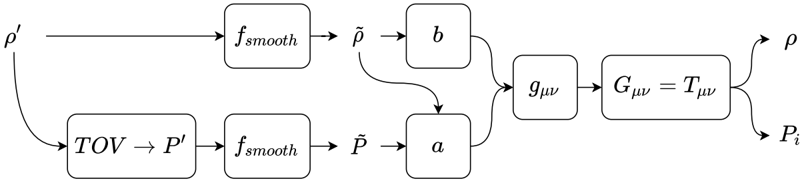
- The warp solution is built in two stages: first a stable spherical matter shell is constructed via the TOV equation with smoothing of density and pressure; then an interior shift vector is added to create the constant-velocity warp shell.
- Energy conditions are evaluated from the Eulerian stress-energy tensor using sampled null and timelike observers; the observer vector field is sampled with 100 spatial orientation samples and, for timelike observers, 10 velocity magnitude samples.
- The authors also perform a null-geodesic light-ray transit-time test through the shell to detect the shift-vector effect.
## Limitations
- The paper states that the result is numerical and subject to interpolation, finite-difference, and floating-point round-off errors; it notes that meaningful results are limited to stress-energy/energy-condition values above about 10^34 in magnitude.
- The authors say the shift magnitude βwarp = 0.02 is “likely not an upper limit” and that optimizations could improve the solution, so the reported configuration is conservative.
- Evident from the text: the work covers only the constant-velocity phase and does not model the acceleration phase in detail; the paper explicitly says acceleration remains an open problem.
Model-written summary. Check it against the paper before relying on it.
Integrity signals
Registry
Cites
Statistics
Figures



Verification
Claims the paper makes
13 Valid · 5 Not valid · 5 Not checked · 58 Own results and interpretations
Every source the paper cites for this claim was checked and supports it.
In the paper
“Alcubierre's solution is a shift vector addition to an otherwise Minkowski spacetime.”
What the sources say
- Supportedcites [1] Alcubierre, 1994, The warp drive: hyper-fast travel within general relativity, Class. Quantum Grav. source
The metric in L77, equation (8), has the Minkowski form apart from the shift term in the x component. The discussion in U 5 confirms that the spatial hypersurfaces are flat and that spacetime curvature arises from the non-uniform shift; it does not claim the resulting spacetime is itself Minkowski. (LLM, conf=0.91)
plain- Asserted: passes — The authors put it forward as true.
- Checkable: passes — It can be checked against evidence.
- Load-bearing: passes — The paper’s conclusions depend on it.
- Based: passes — The paper gives a reason why it holds.
- Supported
Every source the paper cites for this claim was checked and supports it.
In the paper
“Thus, it is clear that all the characteristic warp drive features of this spacetime are sourced purely by the shift vector.”
What the sources say
- Supportedcites [1] Alcubierre, 1994, The warp drive: hyper-fast travel within general relativity, Class. Quantum Grav. source
In section U 5, Alcubierre states that the spatial geometry is flat, the lapse is one, and spacetime curvature arises from the non-uniform shift. The same passage derives the expansion of volume elements from the shift-dependent extrinsic curvature; section (11) describes expansion behind the spaceship and contraction in front. This supports the claim for the warp-drive features of the spacetime constructed in the paper. (LLM, conf=0.89)
boostedstates a cause- Asserted: passes — The authors put it forward as true.
- Checkable: passes — It can be checked against evidence.
- Load-bearing: passes — The paper’s conclusions depend on it.
- Based: passes — The paper gives a reason why it holds.
- Supported
Every source the paper cites for this claim was checked and supports it.
In the paper
“The Natarioclass of solutions (defined by shift vectors with unit lapse α = 1 and flat spatial metric γ ij = δ ij ) has been shown to always violate the energy conditions [15].”
What the sources say
- Supportedcites [15] Santiago, 2022, Generic warp drives violate the null energy condition, Phys. Rev. D source
Section 2 defines the generic Natário class using a shift (flow) vector, unit lapse, and a flat spatial metric. Section 8 concludes that all members of this warp-drive class violate the NEC and, consequently, the WEC, SEC, and DEC. (LLM, conf=0.94)
boostedstates a cause- Asserted: passes — The authors put it forward as true.
- Checkable: passes — It can be checked against evidence.
- Load-bearing: unclear — It is unclear whether the paper’s conclusions depend on it.
- Based: passes — The paper gives a reason why it holds.
- Supported
Every source the paper cites for this claim was checked and supports it.
In the paper
“As a rule of thumb, the Eulerian momentum flux and pressures should be less than the energy density to satisfy the energy conditions [11].”
What the sources say
- Supportedcites [11] Helmerich, 2024, Analyzing warp drive spacetimes with warp factory, Classical Quant. Grav. source
Section 5.1 (p. 30) says energy-condition violations can occur where pressure and momentum-density terms surpass energy density. That supports the citing sentence’s rule of thumb, though the paper also identifies negative energy density as another cause of violations. (LLM, conf=0.93)
hedgedstates a possible cause- Asserted: passes — The authors put it forward as true.
- Checkable: passes — It can be checked against evidence.
- Load-bearing: passes — The paper’s conclusions depend on it.
- Based: passes — The paper gives a reason why it holds.
- Supported
Every source the paper cites for this claim was checked and supports it.
In the paper
“Alcubierre's solution allows for acceleration using a time-varying v s ( t ).”
What the sources say
- Supportedcites [1] Alcubierre, 1994, The warp drive: hyper-fast travel within general relativity, Class. Quantum Grav. source
In L76, Alcubierre describes changing the spaceship’s coordinate acceleration during a trip and says it can be an arbitrary function of time. This supports a time-varying velocity in the solution. The paper distinguishes coordinate acceleration from proper acceleration, which remains zero along the spaceship’s path. (LLM, conf=0.92)
plainstates a cause- Asserted: passes — The authors put it forward as true.
- Checkable: passes — It can be checked against evidence.
- Load-bearing: unclear — It is unclear whether the paper’s conclusions depend on it.
- Based: passes — The paper gives a reason why it holds.
- Supported
42 more claims · 4 with their cited sources checked
Create a free account to see all 81 claims and every source verdict.
- It may state two separate claims as one. 18
- Probably not a substantial claim. 19
- The quote only partly states this claim. 2
Citations
Cites
Republication of: The dynamics of general relativity
Arnowitt, R., Deser, S., & Misner, C. W. (2008) · General Relativity and Gravitation · doi:10.1007/s10714-008-0661-1 · Cited by 2,284 · cited 1×
“Insight might be gathered by considering the ADM momentum [2] where conservation of the four-momentum might be a key element to understanding the constraint to warp solutions when creating physically accelerating solutions with ADM mass.”
The Dynamics of General RelativityPreprint
(2004) · Cited by 1,515
Fourth test of general relativity
Shapiro, I. I. (1964) · Physical Review Letters · doi:10.1103/physrevlett.13.789 · Cited by 1,137
The warp drive: hyper-fast travel within general relativity
Alcubierre, M. (1994) · Classical and Quantum Gravity · doi:10.1088/0264-9381/11/5/001 · Cited by 569 · cited 3×
“To illustrate this let us consider the Alcubierre metric [1] given by: where x s ( t ) and v s ( t ) are the center position and speed of the warp drive, respectively, and f ( r s ) is a shape function that defines the warp bubble extent from the center.”
BackgroundAveraged energy conditions and quantum inequalities
Ford, L. H., & Roman, T. A. (1995) · Physical Review D · doi:10.1103/physrevd.51.4277 · Cited by 284 · cited 1×
“All of these classic warp drive spacetimes violate some if not all of the energy conditions [10, 15], and therefore, their construction has been largely considered to be unfeasible.”
BackgroundAveraged Energy Conditions and Quantum Inequalities
Ford, L. H., & Roman, T. A. (1994) · arXiv · doi:10.48550/arxiv.gr-qc/9410043 · Cited by 276
Superluminal subway: The Krasnikov tube
Everett, A. E., & Roman, T. A. (1997) · Physical Review D · doi:10.1103/physrevd.56.2100 · Cited by 117 · cited 1×
“The requirement of moving with passengers distinguishes warp drive solutions from Krasnikov tubes [8], for example.”
BackgroundA `warp drive' with more reasonable total energy requirements
Broeck, C. V. D. (1999) · Classical and Quantum Gravity · doi:10.1088/0264-9381/16/12/314 · Cited by 99 · cited 2×
“Warp drive spacetimes, first introduced by Alcubierre [1] and later by others [14, 19], offer several unique transportation properties for timelike observers.”
BackgroundEvidence of Large Recoil Velocity from a Black Hole Merger Signal
Varma, V., Biscoveanu, S., Islam, T., et al. (2022) · Physical Review Letters · doi:10.1103/physrevlett.128.191102 · Cited by 79 · cited 1×
“14 Reference warp metrics are converted to a comoving frame using a Galilean transformation to their coordinates.”
Warp drive with zero expansion
Natário, J. (2002) · Classical and Quantum Gravity · doi:10.1088/0264-9381/19/6/308 · Cited by 70 · cited 2×
“Spatial gradients in the lapse and metric spatial terms can affect d u i / d t and then d x i / d t but require careful management of their spatial derivatives to avoid energy or tidal forces existing inside the passenger volume.”
Background
Cited by
Analyzing warp drive spacetimes with warp factory
Helmerich, C., Fuchs, J., Bobrick, A., Sellers, L., Melcher, B., & Martire, G. (2024) · Classical and Quantum Gravity · doi:10.1088/1361-6382/ad2e42 · Cited by 4
Self-citationA Closer Look at Natário’s Zero-Expansion Warp Drive
Rodal, J. J. A. (2024) · International Journal of Theoretical Physics · doi:10.1007/s10773-024-05700-0 · Cited by 4
Al-Shammari, R. M. (2024) · SSRN Electronic Journal · doi:10.2139/ssrn.5016164
The extraterrestrial hypothesis: an epistemological case for removing the taboo
Lane, W. C. (2025) · European Journal for Philosophy of Science · doi:10.1007/s13194-025-00634-8 · Cited by 17
“Warp drives may achieve near-light speeds without time or mass dilation (Fuchs et al., 2024), and effectively faster-than-light travel (e.g., through wormholes) could render all calculations moot.”
TraceGR: Modular Spacetime Imaging using Null Geodesics in Raycasting Applications
Beeai, Z., Makkar, A., & Ellithy, A. (2024) · IEEE MIT Undergraduate Research Technology Conference (URTC) · doi:10.1109/urtc65039.2024.10937597
“This development will allow visualization of recent studies such as a theorized constant-velocity warp drive that does not violate the energy constraints [9].”
Metadata
- Authors
- Fuchs, J., Helmerich, C., Bobrick, A., Sellers, L., Melcher, B., & Martire, G.
- Affiliations
- University of Alabama in Huntsville (US)
- Technion – Israel Institute of Technology (IL)
- University of California, Los Angeles (US)
- Venue
- Classical and Quantum Gravity
- Publisher
- IOP Publishing
- Published
- 2024-04-29
- Volume
- 41
- Issue
- 9
- Pages
- 095013
- ISSN
- 0264-9381 (ISSN-L)
- 1361-6382
- OpenAlex
- W4396223651
- Semantic Scholar
- a698e3b54b1fd25c85f23e6e1190129cba3cf403
- Cited by
- 11
- References
- 30
- Citations by year
- 2026: 4 · 2025: 3 · 2024: 4
- FWCI
- 2.64
- Type
- journal article
- Language
- en
- Open access
- green
- arxiv.org
- Licence
- cc-by
- iopscience.iop.org/page/copyright (vor)
- iopscience.iop.org/info/page/text-and-data-mining (tdm)
- Locations
- Classical and Quantum Gravity (publishedVersion)
- arXiv (Cornell University) (submittedVersion, cc-by)
- arXiv (Cornell University) (cc-by)
- Funders
- Applied Physics (Warp Grant)
- Topics
- Physical Sciences › Physics and Astronomy › Astronomy and Astrophysics › Relativity and Gravitational Theory
- Physical Sciences › Physics and Astronomy › Astronomy and Astrophysics › Cosmology and Gravitation Theories
- Physical Sciences › Mathematics › Geometry and Topology › Advanced Differential Geometry Research
- Keywords
- warp drive, Alcubierre metric, energy conditions, spacetime metric, ADM mass
About these checks
Registry, retraction, Cites and statistics results are computed, not judged, with one exception: a printed reference that no index lists is read once by a model before it counts as a citation error. Claims are extracted by a model and kept only when their quote appears verbatim in the text; each cited source is then checked, with a model’s help, for whether it says what the claim relies on. Those verdicts can be wrong — read the claim’s quote and the cited source before relying on one.
The claim verdicts this report counts are experimental: their accuracy is not yet measured.
A language model drew the claims from the paper on 2026-10-10, under version 3 of the claim definition (model deepseek-v4.1-flash, prompt extract-v3).
A second model labelled each claim on 2026-10-10 (model jev-1.13-20260917, definition revision gold-guideline-v0.2).
Cited sources are checked with a language model’s help (gpt-6-sol).
Statistics and arithmetic are recomputed, not judged.
Confidence bands are shown only for fields calibrated on our annotated test set. None is calibrated yet, so no band is shown.
What counts as a claim ›How we measure confidence ›How we check this ›
Are you an author, or do you see a problem with this page? Request a review
How to cite
Cite CoChat for the checks on this page, and the paper for its own findings.
- This page
- CoChat. (2026). Citation check: Constant velocity physical warp drive solution. https://app.cochat.ai/papers/10.1088/1361-6382/ad26aa
- The paper
- Fuchs, J., Helmerich, C., Bobrick, A., Sellers, L., Melcher, B., & Martire, G. (2024). Constant velocity physical warp drive solution. Classical and Quantum Gravity. https://doi.org/10.1088/1361-6382/ad26aa
Data sources
Bibliographic data: Semantic Scholar, OpenAlex, Crossref.
Contains information from the Semantic Scholar Academic Graph Datasets, made available under the ODC Attribution License (ODC-BY 1.0).
Semantic Scholar’s data is described in: Kinney, R., et al. (2023). The Semantic Scholar Open Data Platform. arXiv:2301.10140.
