

Atmospheric propellant fed Hall thruster discharges: 0D-hybrid model and experimental results
Open accessThe DOI matches its Crossref record; 36 of the 38 references it cites were found in a registry or an index; 2 of the 13 sources its claims cite were checked for support.
Abstract
0D-hybrid model and experiment for atmospheric-propellant-fed Hall thruster discharges.
Overview
CoChat Summary
TL;DR
The paper presents a 0D-hybrid model for atmospheric-propellant Hall thruster discharges and compares it with HT5k experimental data using a 0.56N₂ + 0.44O₂ anode mixture and N₂ cathode. The calibrated model reproduced thrust and discharge power with mean absolute errors of 3.7% and 7.6%, respectively.
Key findings
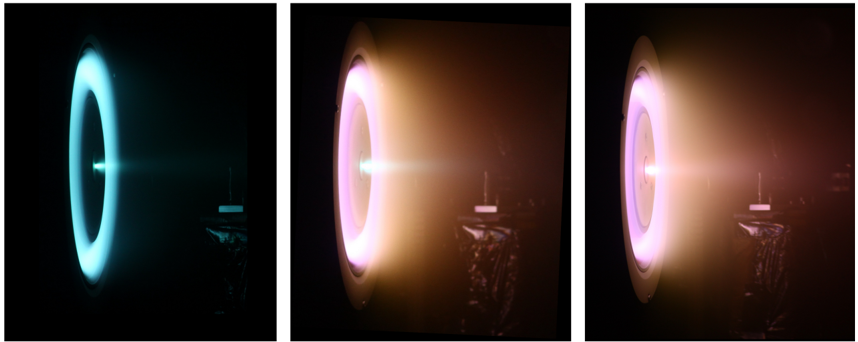
- The HT5k was characterized in six operating conditions from 5 mg/s to 7 mg/s of 0.56N₂ + 0.44O₂ and 225 V to 300 V discharge voltage, with cathode N₂ flow between 0.5 mg/s and 0.7 mg/s.
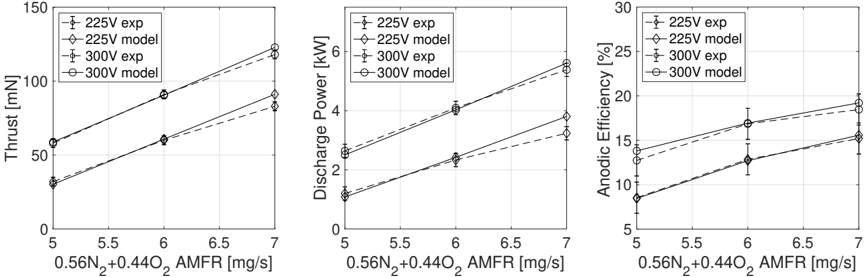
- Verified performance ranged from 30 mN to 120 mN thrust, 1.2 kW to 5.2 kW discharge power, and 8% to 18% anodic efficiency.
- The calibrated 0D-hybrid model achieved a mean absolute error of 3.7% in thrust and 7.6% in discharge power against the six experimental conditions.
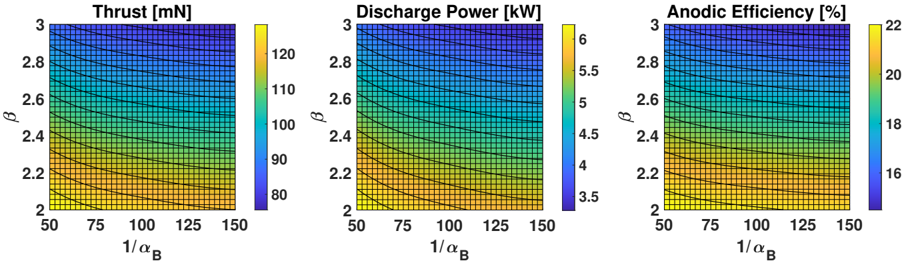
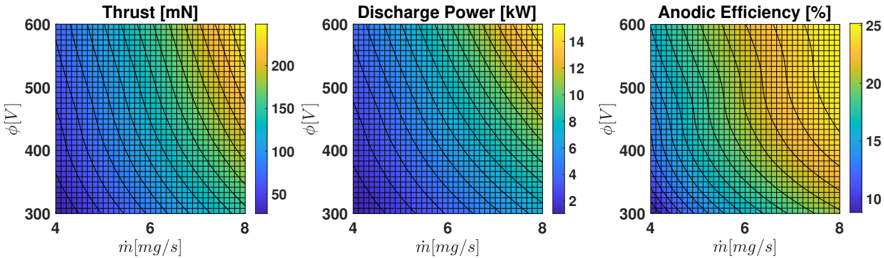
- Model calibration gave α_B,0 = 1/126 and β_0 = 2.77; sensitivity tests showed performance increased with larger neutral/ion residence times and with higher mass flow rate and discharge voltage.
Methods
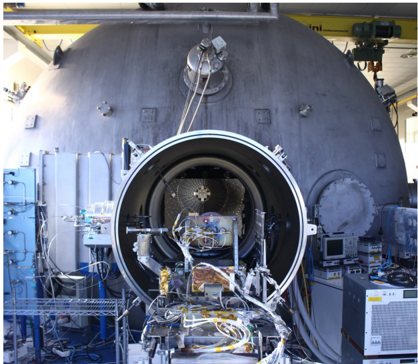
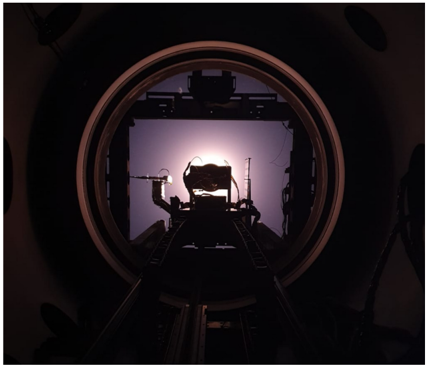
- Experimental campaign: SITAEL’s IV10 vacuum facility, HT5k 5 kW-class magnetically shielded Hall thruster with HC20h hollow cathode, six operating points using 0.56N₂ + 0.44O₂ anode propellant and N₂ cathode propellant.
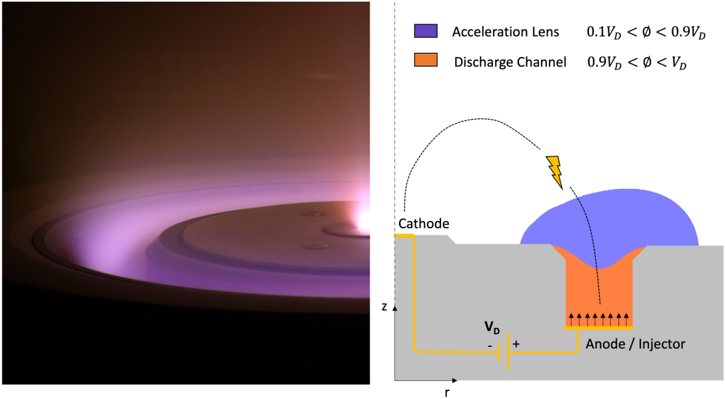
- Model: 0D particle continuity and electron energy balance ODEs in MATLAB, coupled to a 2D magnetic/potential solver in FreeFem++ and 3D Monte Carlo simulations for neutral and ion transport.
- Calibration: model tuned against experimental thrust and discharge current by optimizing anomalous diffusion coefficient α_B and effective ionization cost β using MATLAB pattern search.
Limitations
- The paper states several model approximations: heavy-species dynamics are collisionless; electron-neutral collisions are neglected relative to anomalous diffusion; electron pressure is neglected in the 2D potential solve; ion birth location is approximated as uniform in each control volume; and only ground-state neutral and ion species are included, with excitation losses absorbed into β.
- The paper states that model sensitivity results for mass flow rate and discharge voltage are not supported by experimental evidence, so actual performance may deviate due to excitation state, anomalous diffusion, and increased channel/anode temperature.
- The paper notes that the PFG plume is not fully representative of VLEO flow because it contains slow neutrals and very high-speed ions, unlike the collimated neutral VLEO flow; post-test inspection also found altered coloration likely from anode oxidation, though it did not compromise functionality for the short test campaign.
Model-written summary. Check it against the paper before relying on it.
Integrity signals
Registry
Cites
Statistics
Figures
Verification
Claims the paper makes
1 Valid · 0 Not valid · 8 Not checked · 69 Own results and interpretations
The sources with a verdict support this claim; the rest weren’t checked yet, have no full text we could read, or their verdicts aren’t rated yet.
In the paper
“Together with a relatively low amount of experimental data, very few numerical models are available for air-fed and air-breathing plasma thrusters.”
What the sources say
- Not checked — no full text of the sourcecites [16] [17] Taploo, A., Lin, L., Keidar, M. (2021). Analysis of ionization in air-breathing plasma thruster. Physics of Plasmas, 28(9). https://doi.org/10.1063/5.0059896 - source
- Supportedcites [17] [18] Mrozek, K., Dytrych, T., Moliˇ s, P., Daniel, V., Obrusnik, A. (2021), 'Global plasma modeling of a magnetized high-frequency plasma source in low-pressure nitrogen and oxygen for airbreathing electric propulsion applications'. Plasma Sources Science and Technology, 30(12). https://doi.org/10.1088/1361-6595/ac36ac - source
The Introduction (page unavailable) surveys numerical models of plasma sources and thrusters, then notes that the models discussed use rare atomic gases rather than nitrogen and oxygen relevant to air-breathing electric propulsion. That supports the broad claim that few models are available for air-fed or air-breathing thrusters. (LLM, conf=0.82)
- Could not verifycites [18] [19] Ferrato, E., Giannetti, V., Tisaev, M., Lucca Fabris, A., Califano, F., and Andreussi, T., 'Rarefied Flow Simulation of Conical Intake and Plasma Thruster for Very Low Earth Orbit Spaceflight', Frontiers in Physics, 2022. doi: 10.3389/fphy.2022.833159. - sourceExperimental — accuracy not yet measured
The Introduction describes the authors’ 0D hybrid model, and Section 2.1 says modeling air-breathing electric propulsion is complex. Neither passage says that very few numerical models of air-fed or air-breathing plasma thrusters are available; searches for model availability and scarcity found no such statement. The indexed passages provide no page numbers. (LLM, conf=0.72)
plain- Asserted: passes — The authors put it forward as true.
- Checkable: passes — It can be checked against evidence.
- Load-bearing: passes — The paper’s conclusions depend on it.
- Based: passes — The paper gives a reason why it holds.
A result the paper reports from its own data — it cites no other source for it, so there is none to check. The quote shows it is in the paper.
In the paper
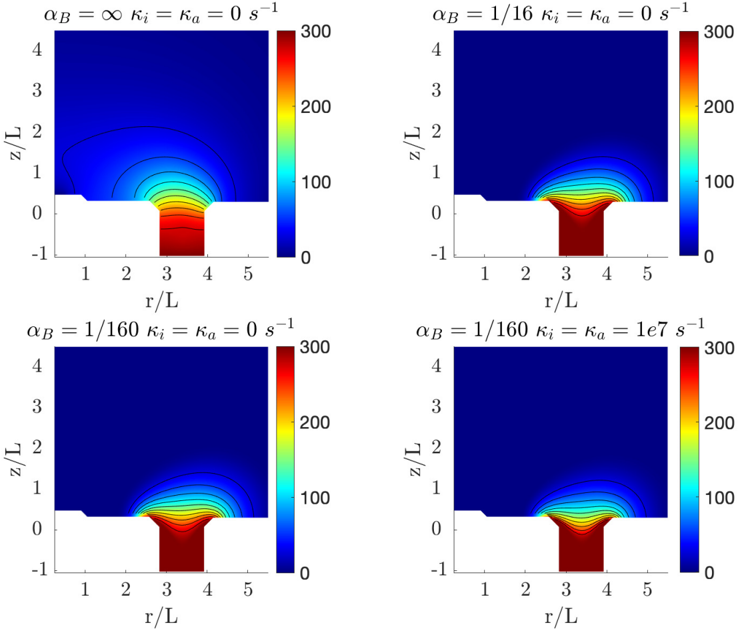
“On the other hand, as α B Ñ8 the anisotropy induced by the applied magnetic field vanishes, see Figure 4.”
plainstates a cause- Asserted: passes — The authors put it forward as true.
- Checkable: passes — It can be checked against evidence.
- Load-bearing: unclear — It is unclear whether the paper’s conclusions depend on it.
- Based: passes — The paper gives a reason why it holds.
- Rests on 2 assumptions not shown here.
A result the paper reports from its own data — it cites no other source for it, so there is none to check. The quote shows it is in the paper.
In the paper
“As Figure 4 shows for a reference 300 V discharge, the 2D electric potential solution is not impacted for values of κ less than 1e6 1/s and a single iteration is usually sufficient to ensure consistency with variations of less than 1% everywhere in the domain.”
plainSingle case- Asserted: passes — The authors put it forward as true.
- Checkable: passes — It can be checked against evidence.
- Load-bearing: unclear — It is unclear whether the paper’s conclusions depend on it.
- Based: passes — The paper gives a reason why it holds.
- Rests on 3 assumptions not shown here.
A result the paper reports from its own data — it cites no other source for it, so there is none to check. The quote shows it is in the paper.
In the paper
“Calibrated model comparison against experimental data resulted in a mean absolute error of 3.7% in thrust and 7.6% in discharge power.”
plain- Asserted: passes — The authors put it forward as true.
- Checkable: passes — It can be checked against evidence.
- Load-bearing: passes — The paper’s conclusions depend on it.
- Based: passes — The paper gives a reason why it holds.
A result the paper reports from its own data — it cites no other source for it, so there is none to check. The quote shows it is in the paper.
In the paper
“the HT5k Hall thruster was characterized in six operating conditions, ranging from 5 mg/s to 7 mg/s of 0.56N 2 + 0.44O 2 mass flow rate and 225 V to 300 V of discharge voltage.”
- Also stated in: § 2. Particle Flow Generator Characterization Test Campaign · plain
“From this reference operating condition, discharge voltage and mass flow rate were varied at a constant cathode to anode mass flow rate ratio of 1/10, and the thruster was successfully characterized in six different operating conditions.”
plain- Asserted: passes — The authors put it forward as true.
- Checkable: passes — It can be checked against evidence.
- Load-bearing: passes — The paper’s conclusions depend on it.
- Based: passes — The paper gives a reason why it holds.
- Also stated in: § 2. Particle Flow Generator Characterization Test Campaign · plain
40 more claims
Create a free account to see all 78 claims and to verify the 3 references still open.
- Probably not a substantial claim. 14
- It may state two separate claims as one. 20
Claims other papers make about this one
Each is checked against this paper’s own text: does it say what the citing paper says it does?
The source backs part of the claim, not all of it — or backs it for a different population, condition or comparison.
In the citing paper
“Nonetheless, based on the collected measurements and on a dedicated discharge model [95], it was possible to identify a range of conditions representative of average flow density and velocity.”
From A review of air-breathing electric propulsion: from mission studies to technology verification (2022) · cites this paper as [95]
Experimental — accuracy not yet measuredIn the citing paper
“Electrostatic thrust- ers, including gridded ion and Hall effect devices, have been shown to generate lower T/P, ranging from ∼ 10-40 mN/kW, but with higher I sp (up to 2000 s for HETs [14,15]).”
From Requirements for air-breathing electric propulsion in low-altitude orbits (2024) · doi:10.1007/s44205-024-00095-w · cites this paper as [15]
In the citing paper
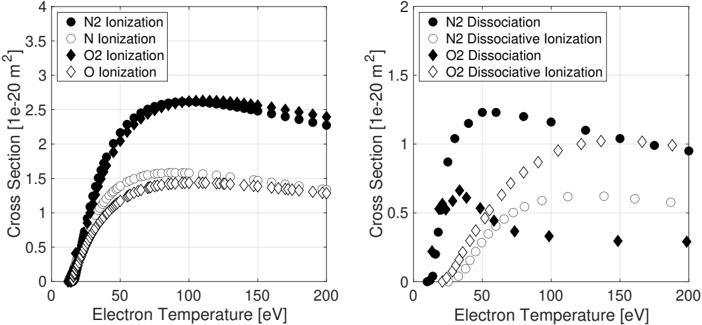
“With respect to xenon, the typical propellant of plasma thrusters, nitrogen and oxygen have higher first ionization energy (13.62 eV for O and 14.53 eV for N, versus 12.13 eV of Xe), lower electron ionization cross section [95] and lower mass.”
From A review of air-breathing electric propulsion: from mission studies to technology verification (2022) · cites this paper as [95]
In the citing paper
“Over this operating envelope, the produced thrust was measured to be between 30 and 120 mN for discharge powers between 1.2 and 5.2 kW for an anodic efficiency between 8% and 18%.”
From A review of air-breathing electric propulsion: from mission studies to technology verification (2022) · cites this paper as [95]
In the citing paper
“The first so-called particle flow generator (PFG) was developed and characterized in the framework of an ESA funded study.The PFG was based on the first development model of the HT5k, SITAEL's 5 kWclass Hall thruster.”
From A review of air-breathing electric propulsion: from mission studies to technology verification (2022) · cites this paper as [95]
1 more claim about this paper
Create a free account to see every claim other papers make about this one.
Self-check
Percentages, sums and reported differences re-computed from the paper’s own numbers.
Each contradiction between two passages listed here was confirmed by an independent check.
Rated major: it would touch a result — a value a result rests on, reported and recomputed p-values on opposite sides of the significance level, two passages that conflict with no sign which is right, or a cited work retracted before this paper was published.
In the paper
§ 4.4. Sensitivity to Neutrals and Ions Mean Residence Time
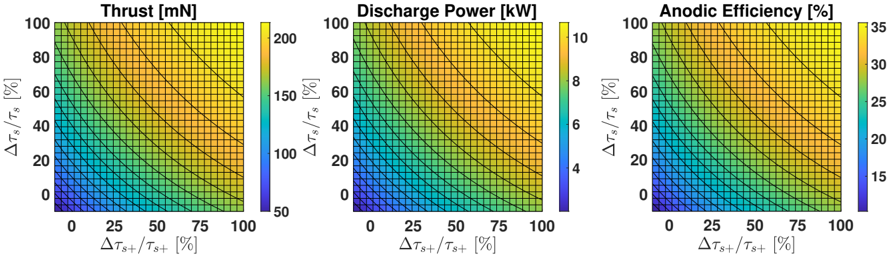
“When both ion and neutral residence times are increased of +100%, 213 mN of thrust, 8.88 kW of discharge power, and 35.6% of anodic efficiency are achieved.”
§ 4.2. Calibrated Model vs Experimental Performance
“Figure 11: Comparison among verified PFG operating conditions and model results for β 0 ' 2 . 77 and α B, 0 ' 1 { 126. Discharge power and anodic efficiency are defined as P D ' V D I D and η ' T 2 {p 2 9 mP D q .”
Citations
Cites
Plasma Physics via Computer Simulation
Birdsall, C. K., & Langdon, A. B. (2018) · CRC Press eBooks · doi:10.1201/9781315275048 · Cited by 3,745
Hecht, F. (2012) · Journal of Numerical Mathematics · doi:10.1515/jnum-2012-0013 · Cited by 3,500
New model for electron-impact ionization cross sections of molecules
Hwang, W., Kim, Y.-K., & Rudd, M. E. (1996) · The Journal of Chemical Physics · doi:10.1063/1.471116 · Cited by 586
Tutorial: Physics and modeling of Hall thrusters
Boeuf, J.-P. (2017) · Journal of Applied Physics · doi:10.1063/1.4972269 · Cited by 504
Cross Sections for Dissociative Ionization of Molecules by Electron Impact
Rapp, D., Englander-Golden, P., & Briglia, D. D. (1965) · The Journal of Chemical Physics · doi:10.1063/1.1695897 · Cited by 333
Electron-impact dissociation of nitrogen
Cosby, P. C. (1993) · The Journal of Chemical Physics · doi:10.1063/1.464385 · Cited by 275
The benefits of very low earth orbit for earth observation missions
Crisp, N. H., Roberts, P. C. E., Livadiotti, S., Oiko, V. T. A., Edmondson, S., Haigh, S. J., Huyton, C., Sinpetru, L. A., Smith, K. L., Worrall, S. D., et al. (2020) · Progress in Aerospace Sciences · doi:10.1016/j.paerosci.2020.100619 · Cited by 255
Magnetic shielding of a laboratory Hall thruster. I. Theory and validation
Mikellides, I. G., Katz, I., Hofer, R. R., & Goebel, D. M. (2014) · Journal of Applied Physics · doi:10.1063/1.4862313 · Cited by 210
Ionization of carbon, nitrogen, and oxygen by electron impact
Kim, Y.-K., & Desclaux, J.-P. (2002) · Physical Review A · doi:10.1103/physreva.66.012708 · Cited by 207
Plasma flow and plasma–wall transition in Hall thruster channel
Keidar, M., Boyd, I. D., & Beilis, I. I. (2001) · Physics of Plasmas · doi:10.1063/1.1421370 · Cited by 198
Secondary electron emission from dielectric materials of a Hall thruster with segmented electrodes
Dunaevsky, A., Raitses, Y., & Fisch, N. J. (2003) · Physics of Plasmas · doi:10.1063/1.1568344 · Cited by 157
Recommended Practice for Thrust Measurement in Electric Propulsion Testing
Polk, J. E., Pancotti, A., Haag, T., King, S., Walker, M., Blakely, J., & Ziemer, J. (2017) · Journal of Propulsion and Power · doi:10.2514/1.b35564 · Cited by 132
An overview of discharge plasma modeling for Hall effect thrusters
Hara, K. (2019) · Plasma Sources Science and Technology · doi:10.1088/1361-6595/ab0f70 · Cited by 120
Assessment of gas–surface interaction models for computation of rarefied hypersonic flow
Padilla, J. F., & Boyd, I. D. (2009) · Journal of Thermophysics and Heat Transfer · doi:10.2514/1.36375 · Cited by 102
A review of gas-surface interaction models for orbital aerodynamics applications
Livadiotti, S., Crisp, N. H., Roberts, P. C. E., Worrall, S. D., Oiko, V. T. A., Edmondson, S., Haigh, S. J., Huyton, C., Smith, K. L., Sinpetru, L. A., et al. (2020) · Progress in Aerospace Sciences · doi:10.1016/j.paerosci.2020.100675 · Cited by 95
Romano, F., Chan, Y.-A., Herdrich, G., Traub, C., Fasoulas, S., Roberts, P. C. E., Smith, K., Edmondson, S., Haigh, S., Crisp, N. H., et al. (2020) · Acta Astronautica · doi:10.1016/j.actaastro.2020.07.008 · Cited by 87
Analysis of atmosphere-breathing electric propulsion
Schonherr, T., Komurasaki, K., Romano, F., Massuti-Ballester, B., & Herdrich, G. (2015) · IEEE Transactions on Plasma Science · doi:10.1109/tps.2014.2364053 · Cited by 84
System modelling of very low Earth orbit satellites for Earth observation
Crisp, N. H., Roberts, P. C. E., Romano, F., Smith, K. L., Oiko, V. T. A., Sulliotti-Linner, V., Hanessian, V., Herdrich, G. H., García-Almiñana, D., Kataria, D., et al. (2021) · Acta Astronautica · doi:10.1016/j.actaastro.2021.07.004 · Cited by 78
Presheath/sheath model with secondary electron emission from two parallel walls
Ahedo, E. (2002) · Physics of Plasmas · doi:10.1063/1.1503798 · Cited by 78
Experimental Study of Air Breathing Ion Engine Using Laser Detonation Beam Source
Tagawa, M., Yokota, K., Nishiyama, K., Kuninaka, H., Yoshizawa, Y., Yamamoto, D., & Tsuboi, T. (2013) · Journal of Propulsion and Power · doi:10.2514/1.b34530 · Cited by 66
A Review of Gas-Surface Interaction Models for Orbital Aerodynamics Applications
Livadiotti, S., Crisp, N., Roberts, P., Worrall, S. D., Oiko, V., Edmondson, S., Haigh, S. J., Huyton, C., Smith, K., Sinpetru, L., et al. (2020) · Research Explorer (The University of Manchester) · Cited by 65
Tisaev, M., Ferrato, E., Giannetti, V., Paissoni, C., Baresi, N., Lucca Fabris, A., & Andreussi, T. (2022) · Acta Astronautica · doi:10.1016/j.actaastro.2021.11.011 · Cited by 64
Self-citationA comprehensive review of atmosphere-breathing electric propulsion systems
Zheng, P., Wu, J., Zhang, Y., & Wu, B. (2020) · International Journal of Aerospace Engineering · doi:10.1155/2020/8811847 · Cited by 61
An experimental investigation of alternative propellants for the helicon double layer thruster
Charles, C., Boswell, R. W., Laine, R., & MacLellan, P. (2008) · Journal of Physics D: Applied Physics · doi:10.1088/0022-3727/41/17/175213 · Cited by 52
Exact Solution for the Generalized Bohm Criterion in a Two-Ion-Species Plasma
Lee, D., Oksuz, L., & Hershkowitz, N. (2007) · Physical Review Letters · doi:10.1103/physrevlett.99.155004 · Cited by 46
The AETHER project: development of air-breathing electric propulsion for VLEO missions
Andreussi, T., Ferrato, E., Paissoni, C. A., Kitaeva, A., Giannetti, V., Piragino, A., Schäff, S., Katsonis, K., Berenguer, C., Kovacova, Z., et al. (2022) · CEAS Space Journal · doi:10.1007/s12567-022-00442-3 · Cited by 46
Self-citationAre Very Low Earth Orbit (VLEO) satellites a solution for tomorrow’s telecommunication needs?
Berthoud, L., Hills, R., Bacon, A., Havouzaris-Waller, M., Hayward, K., Gayrard, J.-D., Arnal, F., & Combelles, L. (2022) · CEAS Space Journal · doi:10.1007/s12567-022-00437-0 · Cited by 39
Mrózek, K., Dytrych, T., Moliš, P., Dániel, V., & Obrusník, A. (2021) · Plasma Sources Science and Technology · doi:10.1088/1361-6595/ac36ac · Cited by 35
Computational Study of Hall-Effect Thruster with Ambient Atmospheric Gas as Propellant
Garrigues, L. (2012) · Journal of Propulsion and Power · doi:10.2514/1.b34307 · Cited by 33
Development of Hollow Cathodes for Space Electric Propulsion at Sitael
Pedrini, D., Misuri, T., Paganucci, F., & Andrenucci, M. (2017) · Aerospace · doi:10.3390/aerospace4020026 · Cited by 33
Erofeev, A. I., Nikiforov, A. P., Popov, G. A., Suvorov, M. O., Syrin, S. A., & Khartov, S. A. (2017) · Solar System Research · doi:10.1134/s0038094617070048 · Cited by 32
Development Status and Way Forward of SITAEL’s Air-breathing Electric Propulsion Engine
Andreussi, T., Ferrato, E., Giannetti, V., Piragino, A., Paissoni, C. A., Cifali, G., & Andrenucci, M. (2019) · AIAA Propulsion and Energy 2019 Forum · doi:10.2514/6.2019-3995 · Cited by 29 · cited 4×
“In this regard, air-breathing electric propulsion (EP) is emerging as a viable concept for long-life missions in VLEO [4–7].”
InfluentialSelf-citationRarefied Flow Simulation of Conical Intake and Plasma Thruster for Very Low Earth Orbit Spaceflight
Ferrato, E., Giannetti, V., Tisaev, M., Lucca Fabris, A., Califano, F., & Andreussi, T. (2022) · Frontiers in Physics · doi:10.3389/fphy.2022.823098 · Cited by 27
Self-citationAnalysis of ionization in air-breathing plasma thruster
Taploo, A., Lin, L., & Keidar, M. (2021) · Physics of Plasmas · doi:10.1063/5.0059896 · Cited by 26
Ion plume investigation of a Hall effect thruster operating with Xe/N 2 and Xe/air mixtures
Gurciullo, A., Fabris, A. L., & Cappelli, M. A. (2019) · Journal of Physics D: Applied Physics · doi:10.1088/1361-6463/ab36c5 · Cited by 26
Geng, J., Brieda, L., Rose, L., & Keidar, M. (2013) · Journal of Applied Physics · doi:10.1063/1.4821018 · Cited by 9
PIC Simulations of the MS4 Thruster
Lewerentz, L., Kahnfeld, D., Schulz, N. L., Heidemann, R. J., & Schneider, R. (2022) · Frontiers in Physics · doi:10.3389/fphy.2022.833159 · Cited by 3
Research works printed but not linked: 4
- [13] A. I. Erofeeva, A. P. Nikiforova, G. A. Popovb, M. O. Suvorovb,S. A. Syrinb, and S. A. Khartovb, 'Air-Breathing Ramjet Electric Propulsion for Controlling Low-Orbit Spacecraft Motion to Compensate for Aerodynamic Drag', December 2017, Solar System Research 51(7):639-645, doi:10.1134/S0038094617070048 - · DOI · Paper page
- [14] F. Romano, Y. Chan, G. Herdrich, C. Traub, and P. Roberts, 'Design, Set-Up, and First Ignition of the RF Helicon-based Plasma Thruster', Space Propulsion Conference 2020+1Volume: 00247, March 2021. -
- [21] V. Giannetti, E. Ferrato, A. Piragino, M. Reza, F. Faraji, M. Andrenucci and T. Andreussi, 'HT5k Thruster Unit Development History, Status and Way Forward', IEPC-2019-878, 36th International Electric Propulsion Conference University of Vienna, Austria 2019 -
- [29] I. Katz, I.G. Mikellides, B.A. Jorns and A.L. Ortega, 'Hall2De Simulations with an Anomalous Transport model Based on the Electron Cyclotron Drift Instability', IEPC-2015-402 / ISTS-2015b-402, Presented at Joint Conference of 30th International Symposium on Space Technology and Science 34th International Electric Propulsion Conference and 6th Nano-satellite Symposium, Hyogo-Kobe, Japan July 4 - 10, 2015. -
Cited by
A review of air-breathing electric propulsion: from mission studies to technology verification
Andreussi, T., Ferrato, E., & Giannetti, V. (2022) · Journal of Electric Propulsion · doi:10.1007/s44205-022-00024-9 · Cited by 94
Self-citationMoon, G., Yi, M., Park, K., Kim, Y., Yoon, H., & Jun, E. (2023) · Vacuum · doi:10.1016/j.vacuum.2023.112066 · Cited by 28
Requirements for air-breathing electric propulsion in low-altitude orbits
(2024) · doi:10.1007/s44205-024-00095-w · Cited by 15
Plasma plume simulation of an atomic oxygen-fed ion thruster in very-low-earth-orbit
Moon, G., Choe, W., & Jun, E. (2023) · Plasma Sources Science and Technology · doi:10.1088/1361-6595/ad15b0 · Cited by 13
Shirasu, K., Koizumi, H., Sekine, H., & Komurasaki, K. (2024) · Journal of Applied Physics · doi:10.1063/5.0230606 · Cited by 12
Metadata
- Authors
- Ferrato, E., Giannetti, V., Califano, F., & Andreussi, T.
- Affiliations
- University of Pisa (IT)
- Corresponding author
- Ferrato, Eugenio
- Giannetti, Vittorio
- Califano, Francesco
- Andreussi, Tommaso
- Venue
- Plasma Sources Science and Technology
- Publisher
- IOP Publishing
- Published
- 2022-07-01
- Volume
- 31
- Issue
- 7
- Pages
- 075003
- ISSN
- 0963-0252 (ISSN-L)
- 1361-6595
- OpenAlex
- W4282969774
- Cited by
- 23
- References
- 38
- Citations by year
- 2026: 10 · 2025: 6 · 2024: 4 · 2023: 2 · 2022: 1
- FWCI
- 0.89
- Type
- journal article
- Language
- en
- Open access
- green
- iopscience.iop.org
- Licence
- other-oa
- publishingsupport.iopscience.iop.org/iop-standard/v1 (vor, 13 d)
- iopscience.iop.org/info/page/text-and-data-mining (tdm, 13 d)
- Locations
- Plasma Sources Science and Technology (publishedVersion)
- CINECA IRIS Institutial research information system (University of Pisa) (submittedVersion, other-oa)
- CINECA IRIS Institutional Research Information System (Sant'Anna School of Advanced Studies) (submittedVersion)
- Funders
- Horizon 2020 Framework Programme (870436)
- Topics
- Physical Sciences › Engineering › Electrical and Electronic Engineering › Low-Pressure Plasma Processing and Diagnostics
- Physical Sciences › Physics and Astronomy › Atomic and Molecular Physics, and Optics › Vacuum and Plasma Arcs
- Physical Sciences › Physics and Astronomy › Atomic and Molecular Physics, and Optics › Atmospheric-Pressure Plasma Applications
- Keywords
- Hall thruster, air-breathing electric propulsion, nitrogen-oxygen plasma, cathode, discharge power, thrust, anodic efficiency, model calibration
About these checks
Registry, retraction, Cites and statistics results are computed, not judged, with one exception: a printed reference that no index lists is read once by a model before it counts as a citation error. Claims are extracted by a model and kept only when their quote appears verbatim in the text; each cited source is then checked, with a model’s help, for whether it says what the claim relies on. Those verdicts can be wrong — read the claim’s quote and the cited source before relying on one.
The claim verdicts this report counts are experimental: their accuracy is not yet measured.
A language model drew the claims from the paper on 2026-10-10, under version 3 of the claim definition (model deepseek-v4.1-flash, prompt extract-v3).
A second model labelled each claim on 2026-10-10 (model jev-1.13-20260917, definition revision gold-guideline-v0.2).
Cited sources are checked with a language model’s help (gpt-6-sol).
Statistics and arithmetic are recomputed, not judged.
Confidence bands are shown only for fields calibrated on our annotated test set. None is calibrated yet, so no band is shown.
What counts as a claim ›How we measure confidence ›How we check this ›
Are you an author, or do you see a problem with this page? Request a review
Data sources
Bibliographic data: Semantic Scholar, OpenAlex, Crossref.
Contains information from the Semantic Scholar Academic Graph Datasets, made available under the ODC Attribution License (ODC-BY 1.0).
Semantic Scholar’s data is described in: Kinney, R., et al. (2023). The Semantic Scholar Open Data Platform. arXiv:2301.10140.
